Print ISSN: 2288-4637 / Online ISSN 2288-4645 doi:10.13106/jafeb.2021.vol8.no10.0353
The Relationship Between Internal Control and Accounting Information Quality: Empirical Evidence from Manufacturing Sector in Vietnam*
Hoang Thanh NGO
1, Duc Huu LUU
2, Thuy Thi TRUONG
3Received: June 30, 2021 Revised: September 09, 2021 Accepted: September 17, 2021
Abstract
The article analyzes the impact of internal control on the quality of accounting information in Vietnamese paper manufacturing enterprises, providing empirical evidence on factors affecting the quality of accounting information. To analyze the impact of internal control on the quality of accounting information, the researchers used questionnaires to conduct a survey of paper manufacturing companies. Research data is collected through emails and face-to-face interviews with managers, employees working in different positions, managers at all levels, chief accountants, and accountants, of 56 paper manufacturing enterprises in Vietnam. 321 questionnaires were distributed of which only 296 were valid and could be used in this study. Quantitative research was carried out with SPSS 25 software. Research results show that 3 factors have a positive influence on the quality of accounting information including control environment, accounting information system, and internal control procedures in Vietnamese paper manufacturing enterprises. Based on the findings, the author has made recommendations on the control environment, accounting information system, and internal control procedures in order to improve the effectiveness of internal control and the quality of accounting information of paper production enterprises, thereby contributing to improved competitiveness and operational efficiency.
Keywords: Internal Control, Accounting Information Quality, Manufacturing Enterprises, Vietnam JEL Classification Code: M40, M41
stealing assets or committing fraud, internal controls can help improve operational efficiency by improving the accuracy and timeliness of financial reporting. Internal control of a publicly traded firm is required to help improve stock market operations in today’s dynamic business environment, as well as to ensure that stakeholders receive adequate information for decision-making and have trust in the transparency of financial statements. Internal control is associated with the requirements of corporate governance, an essential requirement of companies listed on the Vietnamese stock market in particular and the international stock market in general.
According to Agrawal and Chadha (2005) and Brown (2010), the recent wave of accounting scandals appearing in the international financial community has raised questions about the quality of financial reporting. Some famous companies such as Enron, WorldCom, Marconi, Parmalat, etc., were involved in serious accounting frauds, which reduced investors’
confidence in the financial statements of listed companies.
According to Karamanou and Vafeas (2005), Beekes and Brown (2006), Brown and Caylor (2006), Firth et al. (2007), and Petra (2007), the disclosure of financial information and dishonest accounting information has necessitated the establishment of a corporate governance structure to improve
*Acknowledgements:
The authors are thankful to the Academy of Finance for funding this research. We would like to thank the anonymous referees for their helpful comments and suggestions.
1
First Author. Head of Management Science, Academy of Finance, Hanoi, Vietnam. Email: [email protected]
2
Head of Political Affairs and Students, Academy of Finance, Hanoi, Vietnam. Email: [email protected]
3
Corresponding Author. Deputy Director, Academy of Finance, Hanoi, Vietnam [Postal Address: 58 Le Van Hien Road, Bac Tu Liem District, Hanoi, 130500, Vietnam]
Email: [email protected]
© Copyright: The Author(s)
This is an Open Access article distributed under the terms of the Creative Commons Attribution Non-Commercial License (https://creativecommons.org/licenses/by-nc/4.0/) which permits unrestricted non-commercial use, distribution, and reproduction in any medium, provided the original work is properly cited.
1. Introduction
Internal controls are the mechanisms, rules, and
procedures implemented by a company to ensure the
integrity of financial and accounting information, promote
accountability, and prevent fraud. Besides complying
with laws and regulations and preventing employees from
the quality of financial accounting information and control information.
In recent years, the paper industry in Vietnam has experienced strong growth through enterprises applying advanced technology, strictly complying with requirements for environmentally friendly products. The industry has created jobs for tens of thousands of workers and helps to develop other economic sectors. Despite the fact that it is not one of the important industries in the economy, the paper industry’s main products, such as pulp, printing paper, writing paper, tissue, and so on, are essential to society.
The rapid growth of digital communication has resulted in a decrease in demand for newsprint but has resulted in considerable growth in the packaging paper and paper box segments (as ancillary products of the company, serving online sales and direct delivery). Besides, in recent years, our country’s high export growth has also led to a sharp increase in the demand for packaging paper, especially for industries with a high proportion of exports such as textiles, footwear, seafood, components, electronic equipment, etc. According to statistics, Vietnam’s paper industry has grown at a rate of about 10% to 12% per year in recent years. The growth of packaging paper alone is approximately 15–17% annually.
There are already large-scale investment projects (400–500 thousand tons/year) in operation in this industry, and some businesses plan to invest in projects with a capacity of over 1 million tonnes of packaging paper per year. With a strong increase in demand and diverse roles in the economy, the paper industry’s production contributes about 1.5% of GDP, export turnover reaches over 1 billion USD.
This study aims to examine the influence of internal control on the quality of accounting information of Vietnamese paper- making enterprises, thereby making some recommendations for enterprises to improve the quality of their accounting information and effectiveness of internal control.
2. Literature Review
Internal controls are processes designed to help safeguard an organization and minimize risk to its objectives. Internal controls minimize risks and protect assets, ensure accuracy of records, promote operational efficiency, and encourage adherence to policies, rules, regulations, and laws.
DeFond and Jiambalvo (1991) argued that companies whose financial statements must be disclosed rarely have an audit department in the company. The internal audit department in the company has an influence on the quality of financial accounting information. This shows the relationship between the quality of financial accounting information and the internal audit department - an important factor in the organization’s internal control.
Ashbaugh-Skaife et al. (2008) investigated the effect of internal control deficiencies and their remediation on accrual quality. First, they documented that firms reporting
internal control deficiencies have lower quality accruals as measured by accrual noise and absolute abnormal accruals relative to firms not reporting internal control problems.
Second, they found that firms that report internal control deficiencies have significantly larger positive and larger negative abnormal accruals relative to control firms. This finding suggested internal control weaknesses are more likely to lead to unintentional errors that add noise to accruals than intentional misstatements that bias earnings upward. Third, they documented that firms whose auditors confirm remediation of previously reported internal control deficiencies exhibit an increase in accrual quality relative to firms that do not remediate their control problems. Finally, the found firms that receive different internal control audit opinions in successive years exhibit changes in accrual quality consistent with changes in internal control quality.
Collectively, their cross‐sectional and intertemporal change tests provided strong evidence that the quality of internal control affects the quality of accruals.
Angella and Eno (2009) developed a conceptual model used in evaluating the internal control systems in public sector projects in Uganda financed by the African Development Bank. The outcome of the evaluation process is that some control components of effective internal control systems are lacking in these projects. This renders the current control structures ineffective. The study ends with recommendations to improve the existing internal control systems in the projects and suggests areas for further researchs.
Altamuro and Beatty (2010) examined the financial reporting effects of the Federal Depository Insurance Corporation Improvement Act (FDICIA) internal control provisions. Exemptions from these provisions for banks with assets under $500 million and non-US banks provide two unaffected control samples. Their difference-in-differences method suggested that FDICIA- mandated internal control requirements increased loan-loss provision validity, earnings persistence, and cash-flow predictability and reduced benchmark-beating and accounting conservatism for affected versus unaffected banks. More pronounced effects in interim versus fourth quarters suggested that greater auditor presence substitutes for internal control regulation.
Klai and Omri (2011) examined the influence of
governance mechanisms on financial reporting quality for
a sample of Tunisian companies. Specifically, the authors
focused on the characteristics of the board of directors and
the ownership structure of companies listed on the Tunis
Stock Exchange in the period 1997–2007. The results
showed that governance mechanisms affect the quality of
financial information of Tunisian companies. In particular,
the power of foreigners, families, and block holders reduces
the quality of reporting, while the control of the state and
financial institutions is associated with good quality of
financial disclosure.
In addition, Abdallah (2013) determined the influence of accounting information system factors on the quality of financial statements submitted to tax authorities. Komala (2012) determined the effect of the accounting information system on the quality of accounting information. Similar to Komala (2012), Rapina (2014) showed that the commitment of management, organizational culture, and organizational structure have a significant effect on the quality of accounting information systems. Furthermore, it was found that the quality of the accounting information system has implications for the quality of accounting information.
In addition, there are studies on internal control such as Alawaqleh (2021), Pham (2021), and Tran et al. (2021)
To evaluate the impact of the internal control on the quality of accounting information in Vietnamese paper manufacturing enterprises, the study uses three detailed hypotheses as follows:
H1: Control environment has a positive relationship with quality of accounting information in Vietnamese paper manufacturing enterprises.
H2: Accounting information system has a positive relationship with quality of accounting information in Vietnamese paper manufacturing enterprises.
H3: Internal control procedures have a positive relationship with the quality of accounting information in Vietnamese paper manufacturing enterprises.
3. Research Method and Model
The research method used includes a questionnaire survey of paper manufacturing enterprises to assess the impact of internal control on the quality of accounting information.
Quality of accounting information, Control environment, Accounting information system, Internal control procedures are measured on a five-level Likert scale (Very good, good, average, not good, weak). The 5-level Likert scale is used in many studies, so the author also quantifies each factor according to five levels. Quantitative research was carried out with the software SPSS 25.
The population of the study is all paper manufacturing enterprises in Vietnam. Research data is collected through
email and in the form of face-to-face interviews with managers, employees working in different positions, managers at all levels, chief accountants, and accountants of 56 paper manufacturing enterprises in Vietnam. The survey results collected 321 questionnaires. After eliminating the invalid questionnaires due to many empty cells, the author chose to use 296 questionnaires.
The proposed research model is as follows:
QAI = β
1+ β
2× CE + β
3× AIS + β
4× ICP + E
4. Results
4.1. Testing the Scale
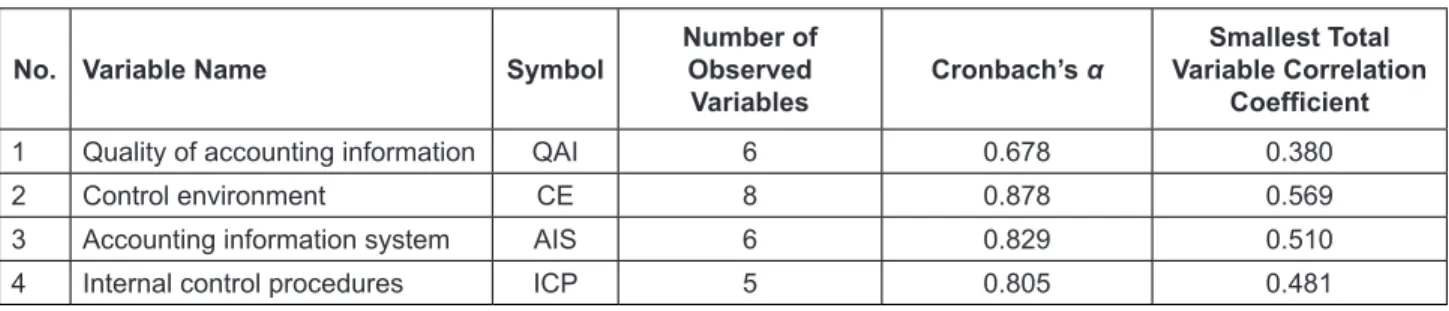
The results of evaluating the reliability of the scale by Cronbach’s alpha show that all scales have reliability greater than 0.6 and the correlation coefficient of the total variable is greater than 0.3. All scales satisfy the conditions for EFA exploratory factor analysis. The reliability of the scale is summed up in Table 1.
4.2. Exploratory Factor Analysis
Factor analysis was performed with Principle Component extraction, Varimax rotation for the dependent variable.
The results in Table 2 show that the coefficient KMO = 0.878 (condition > 0.5), and significance level and Bartlett test = 0.000 (meets the condition < 0.05), which show that EFA analysis is appropriate. The total variance extracted is 55.893% > 50%, and loading factors are all greater than 0.5, so they are satisfactory. The official scale after EFA processing includes 19 observed variables as proposed.
4.3. Regression Analysis
Adjusted R
2reflects the influence of the independent variables on the variance of the dependent variable, in this case, 3 factors (Control environment, Accounting information system, Internal control procedures) ministry) influence 55.1% of the variation in the quality of accounting information
Table 1: Scale Test Results
No. Variable Name Symbol Number of
Observed
Variables Cronbach’s α Smallest Total Variable Correlation
Coefficient
1 Quality of accounting information QAI 6 0.678 0.380
2 Control environment CE 8 0.878 0.569
3 Accounting information system AIS 6 0.829 0.510
4 Internal control procedures ICP 5 0.805 0.481
of paper manufacturing enterprises. The Durbin-Watson coefficient is 1.866, which falls between 1.5 and 2.5, hence, there is no first-order sequence autocorrelation (Table 3).
The authors proceed to test the suitability of the regression model using accredited ANOVA (Table 4) to ensure that it is compatible with the data collected and has a meaningful application.
The model’s F-statistic has a Sig value. = 0.000 < 0.05, which shows that the model fits the data set and can be
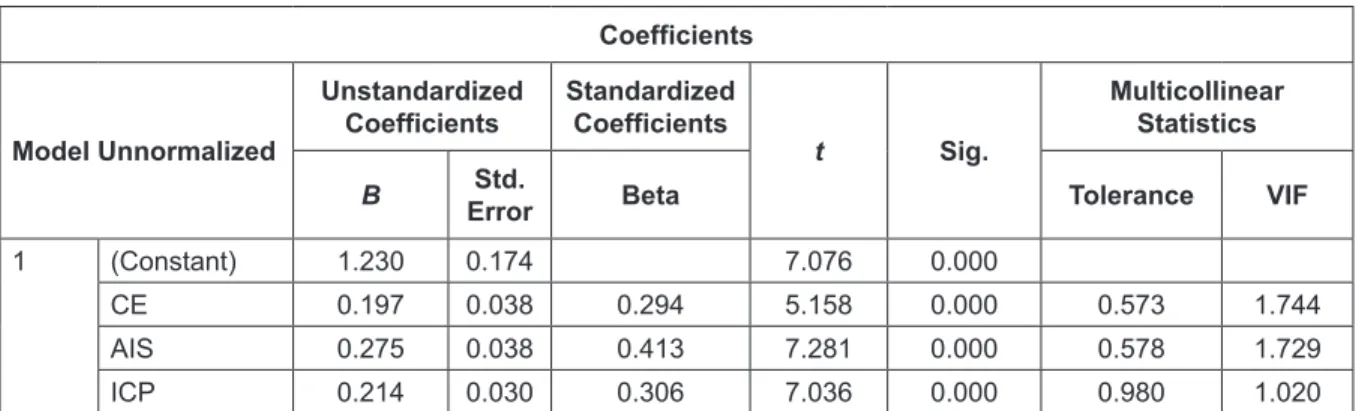
generalized. The VIF coefficients are all less than 2, so there is no multicollinearity between the components that do not appear in the research model.
Table 5 shows the impact of internal control on the quality of accounting information of companies manufac- turing paper in Vietnam.
The regression model is written as follows:
QAI = 1.230 + 0.294CE + 0.413AIS + 0.306ICP + E Table 2: Results of EFA Analysis
Factor
1 2 3
CE7 0.862
CE5 0.752
CE6 0.715
CE3 0.681
CE2 0.672
CE8 0.657
CE1 0.558
CE4 0.520
AIS1 0.782
AIS2 0.764
AIS4 0.694
AIS6 0.683
AIS5 0.577
AIS3 0.559
ICP2 0.843
ICP1 0.813
ICP3 0.775
ICP5 0.650
ICP4 0.644
Table 3: Statistical Results of Factors
Summary Model
Model R R
squared R-squared
Corrected Estimated Error of Standard
Deviation
Durbin-Watson Coefficient
1 0.776
a0.602 0.551 0.36184 1,866
a
Predictors: (Constant), ICP, AIS, CE.
b