ORIGINAL ARTICLE
잠재적 미생물 농약으로서 다양한 식물성장 촉진 활성을 가진 siderophore 생산 세균의 분리와 특성
최승훈․유지연․박성진․박민주․이오미1)․손홍주*
부산대학교 생명환경화학과 및 생명산업융합연구원, 1)농림축산검역본부 식물검역기술개발센터
Isolation and Characterization of Siderophore-Producing Bacteria with Various Plant Growth-Promoting Abilities as a Potential Biocontrol Agent
Seunghoon Choi, Ji-Yeon Yoo, SungJin Park, MinJoo Park, O-Mi Lee1), Hong-Joo Son* Department of Life Science and Environmental Biochemistry, Life and Industry Convergence Institute, Pusan National University, Miryang 50463, Korea
1)Plant Quarantine Technology Center, Animal and Plant Quarantine Agency, Gimcheon 39660, Korea
Abstract
To develop eco-friendly microbial inoculants, siderophore-producing bacteria were isolated and identified, and their production characteristics and plant growth-promoting abilities were investigated. A strain S21 was isolated from rhizosphere of Korean perilla (Perilla frutescens) and identified as Enterobacter amnigenus by phenotypic properties and 16S rRNA gene sequencing. The highest siderophore production was obtained in a medium containing 0.5% fructose, 0.1% urea, 0.5% K2HPO4
and 0.1% succinic acid. By using this improved medium, siderophore production increased by 2.5 times compared to that of basal medium. The strain S21 showed insoluble phosphate solubilizing, ammonification and antifungal activities, and also produced hydrolytic enzymes (protease and lipase), indoleacetic acid and 1-aminocyclopropane-1-carboxylate deaminase. Our data suggest that E. amnigenus S21 is a potential candidate that can be used as eco-friendly biocontrol agent and biofertilizer.
Key words : Enterobacter amnigenus, Improved medium, PGPR, Siderophore
1)1. 서 론
수많은 병원체에 기인한 식물 질병으로 인해 전세계 적으로 연간 농작물 생산량이 30% 정도 감소하며, 이에 따라 46,600만 달러에 해당하는 경제적 손실이 발생하
고 있는 것으로 알려져 있다(Sulochana et al., 2014). 현 재, 농작물의 질병을 제어하기 위하여 거의 전적으로 화 학농약을 사용하고 있으나 화학농약은 토양의 질과 생태 계에 부정적인 영향을 미칠 뿐만 아니라 농약저항성 병 해충의 출현과 같은 새로운 문제를 초래하고 있어 농작물
Received 1 July, 2020; Revised 21 July, 2020;
Accepted 19 August, 2020
*Corresponding author: Hong-Joo Son, Department of Life Science and Environmental Biochemistry, Pusan National University, Miryang 50463, Korea
Phone: +82-55-350-5544 E-mail: [email protected]
ⓒ The Korean Environmental Sciences Society. All rights reserved.
This is an Open-Access article distributed under the terms of the Creative Commons Attribution Non-Commercial License (http://
creativecommons.org/licenses/by-nc/3.0) which permits unrestricted non-commercial use, distribution, and reproduction in any medium, provided the original work is properly cited.
질병의 통제는 인류에게 여전히 큰 도전으로 남아있다 (Paul and Lade, 2014). 최근 이러한 문제점을 해결하기 위하여 미생물을 이용한 환경친화적 농작물 질병 제어법 이 강구되고 있다.
식물의 근권(Rhizosphere)은 다양한 미생물이 서식 하고 있는 역동적인 환경이다. 근권에서 직간접적으 로 식물성장을 촉진시키는 미생물을 Plant Growth- Promoting Rhizobacteria (PGPR)라고 한다. PGPR은 질소고정(Cocking, 2003), 철 흡수(Miethke and Marahiel, 2007), 불용성 인산의 가용화(Sharma et al., 2013), 식물호르몬 합성(Spaepen et al., 2007) 및 항균 물질 합성(Compant et al., 2005) 등을 통하여 농작물의 성장을 촉진하고, 또한 병원균의 생육을 억제한다.
철은 미생물의 생육과 대사에 없어서는 안되는 중요 한 필수원소이다. 철은 전자 수송, 산화환원 반응, 활성산 소의 해독, DNA 전구체의 합성 등에 매우 중요한 역할 을 한다(Hider and Kong, 2010). Siderophore는 저분 자의 비리보조옴성 펩티드(Non-ribosomal peptide)로 서, 미생물 생육에 필수적인 철과 특이적으로 결합할 수 있는 물질이다(Reid et al., 1993). 세균에 의하여 합성된 siderophore는 세포 밖으로 방출되어 환경에 있는 철과 결합하여 복합체를 형성한다(Miethke and Marahiel, 2007). Siderophore 생산균주는 세포막에 위치하는 수 용체를 통하여 이 복합체를 흡수하여 이용할 수 있으나 다른 미생물은 흡수할 수 없다(Arora et al., 2001). 따라 서 siderophore를 합성하는 미생물은 농작물에 질병을 유발하는 미생물의 철 흡수능을 감소시킴으로써 질병을 억제할 수 있으며, 통합적 식물질병 관리(integrated plant disease management)를 위한 지속가능한 방법으 로 제안되었다(Pandey et al., 2005). 철이 제한요인으로 작용하는 해양 생태계에 서식하는 미생물은 siderophore 를 생성하여 철 요구성을 충족시키는 방향으로 진화해 온 것으로 추정되고 있으며(Butler, 2005), 이에 따라 해 양 미생물의 siderophore 생산에 대한 연구는 많이 이루 어졌지만 토양 미생물에 대한 연구는 드물다(Reid et al., 1993; Hopkinson and Morel, 2009).
미생물 또는 미생물 대사산물의 상업적 생산을 위하 여 생산수율을 높이는 것이 필수적이지만 해결해야 할 문제는 많다. 가장 먼저 연구되어야 할 내용은 대사산물 생산을 위한 배지 조성의 최적화이다. 비록 철이
siderophore 합성을 조절하는 중요한 요인이기는 하지만 탄소원, 질소원, 유기산도 중요한 역할을 수행하는 것으 로 보고되었다(Saha et al., 2012).
따라서 본 연구에서는 농작물의 근권 토양에서 siderophore 생산 균주를 분리 및 동정한 후, 분리된 공 시균주의 siderophore 생산에 미치는 배지조성의 영향을 조사하였다. 또한 공시균주에 의한 다양한 식물성장 촉 진 활성을 조사하여, 환경친화적인 생물학적 제어법 확 립에 필요한 기초자료를 확보하고자 하였다.
2. 재료 및 방법
2.1. Siderophore 생산균주의 분리 및 동정
Siderophore 생산 미생물은 Fe3+에 대한 siderophore 의 높은 친화성에 기초하여 개발된 chrome azurol S (CAS) 평판배지 분석법에 의하여 분리하였다(Schwyn and Neilands, 1987). CAS는 Fe3+과 결합하여 복합체를 형성함으로써 녹청색을 나타낸다. 그러나 siderophore가 존재할 경우, 복합체의 Fe3+은 siderophore와 결합하게 되고, 노랑색~주황색의 CAS는 유리된다. 결과적으로 siderophore를 생산하는 미생물 집락의 주변부는 노랑 색~주황색으로 변하게 된다. 다양한 농작물 근권 토양 을 채집하여 토양 현탁액을 조제 및 계단희석한 후, CAS 평판배지에 접종하여 30℃에서 배양하면서 집락 주위에 생성된 주황색 환의 직경이 큰 균주를 siderophore 생산 미생물로 선정하였다.
공시균주의 형태와 배양적 특성은 Manual for the identification of medical bacteria (Barrow and Felthanm, 1993)에 준하여 조사한 후, Bergey's manual of determinative bacteriology (Holt et al., 1994)를 참 조하여 예비 동정하였다. 또한 공시균주의 16S rRNA 유전자의 염기서열을 분석한 후, GenBank database를 이용하여 비슷한 균주들과의 상동성을 비교하고, MEGA software를 이용하여 계통학적 위치를 조사하였 다. 이때, 16S rRNA 유전자를 증폭하는데 사용된 primer는 27F (AGAGTTTGATCMTGGCTCAG)와 1492R (TACGGYTACCTTGTTAC GACTT)이었다.
2.2. Siderophore 생산에 영향을 미치는 배지성분 조사 Siderophore 생산에 사용된 기본배지는 glucose medium이었으며, 그 조성은 glucose 1%, urea 0.085%,
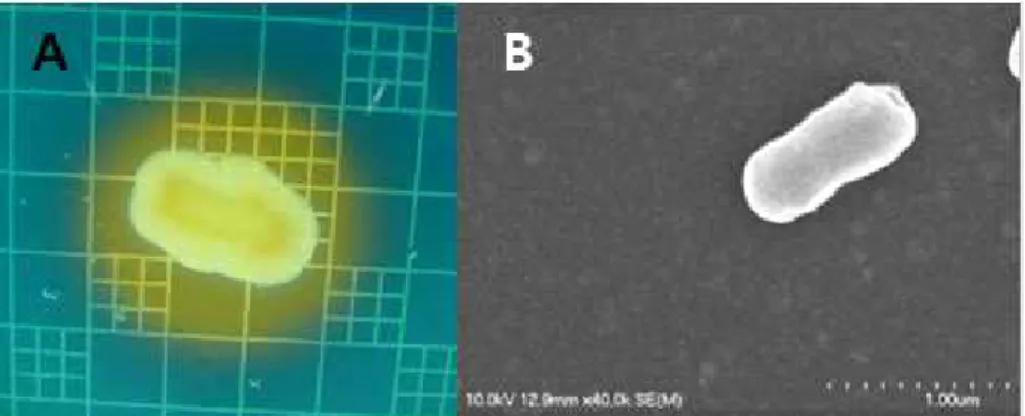
Fig. 1. Phenotypic characters of isolate S21. (A) siderophore production; (B) cell morphology.
K2HPO4 0.056% (pH 7)이었다(Sasirekha and Srividya, 2016). 공시균주의 siderophore 생산에 영향을 미치는 요인을 알아보기 위하여 각종 탄소원, 질소원, 무기염 및 유기산에 따른 siderophore 생산량을 측정하였다. 특별 히 언급하지 않는 한, nutrient broth에서 배양한 전배양 액 2% (v/v)를 기본배지에 접종하여 30℃, 200 rpm에서 24시간동안 배양하였다. 균체 생육도는 660 nm에서 흡 광도를 측정하여 조사하였다.
2.3. Siderophore의 정량분석
배양액 내 siderophore의 정량분석은 Alexander and Zuberer(1991)의 방법에 준하여 조사하였다. 배양액으 로부터 일정량의 시료를 회수하여 10,000 g에서 10분 간 원심분리하였다. 배양 상등액 0.5 mL와 CAS 용액 0.5 mL를 혼합하여 30℃에서 30분간 반응시킨 후, 630 nm에서의 흡광도를 측정하였다. Siderophore 생산량은 다음 식에 의하여 산출하였다.
Siderophore (%) = [(Ar-As)/Ar] × 100
여기서 Ar은 균주를 접종하지 않은 배지의 흡광도를, As는 시료의 흡광도를 나타낸다.
2.4. 식물성장 촉진 활성 조사
공시균주의 불용성 인산 가용능은 Nautiyal(1999)의 방법, 암모니아 생성능은 Dey et al.(2004)의 방법, 곰팡 이 세포성분 분해효소(chitinase, cellulase, protease, lipase)의 활성은 표준방법(Gerhardt et al., 1981)에 의
하여 정성적으로 평가하였다. 또한 식물성장 호르몬인 indoleacetic acid (IAA)와 1-aminocyclopropane-1- carboxylate (ACC) deaminase의 생성능은 Tang and Bonner(1947)의 방법 및 Penrose and Glick(2003)의 방 법에 의하여 정량적으로 분석하였다. 항진균능은 potato dextrose agar 평판배지를 이용한 대치배양법으로 확인 하였다. 각종 식물병원성 곰팡이인 Botrytis cinerea,
Colletotrichum gloeosporioides, Fusarium oxysporum, Rhizoctonia solani, Phythium ultimum, Phytophthora cactorum를 피검균주로 사용하였다.
3. 결과 및 고찰
3.1. 공시균주의 분리 및 동정
농작물 근권 토양 시료로부터 녹청색의 CAS 평판배 지에서 집락 주변에 주황색 환을 형성하는 27 균주를 분 리하였다. 그 중 주황색 환의 직경이 가장 큰 S21 균주를 공시균주로 선정하였다(Fig. 1A). 공시균주는 운동성이 있는 간균(1.1 ㎛ wide × 0.43 ㎛ long) 형태를 나타내는 그람음성세균으로(Fig. 1B), 내생포자를 형성하지 않았 으며, catalase와 urease 생성능은 있었으나 oxidase 생 성능은 없었다. Nutrient agar 평판배지에서 생성된 단일 집락은 점성이 있었고, 중앙부가 편평(Flat)한 둥근 (Circular) 모양이었으며, 집락의 가장자리는 물결모양 (Entire)을 나타내었다. Bergey's manual of determinative bacteriology를 참조하여 공시균주를 동정한 결과,
Enterobacter 속에 포함될 가능성이 가장 높았다. 따라서
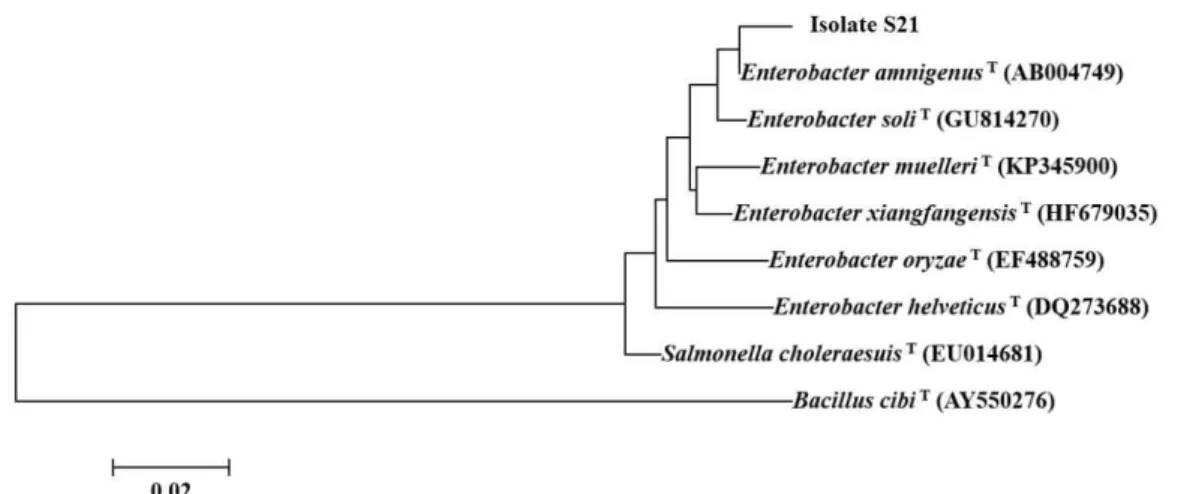
Fig. 2. Phylogenetic tree based on 16S rRNA gene sequences showing the positions of isolate S21 and type strains.
공시균주를 정확하게 동정하기 위하여 16S rRNA 유전 자의 염기서열을 분석한 후, GenBank database에 등록 된 표준균주와 비교한 결과, Enterobacter amnigenus와 99%의 상동성을 나타내었다. 이미 알려진 Enterobacter 속 균주들과의 계통학적 연관성을 알아보기 위하여 계통 수를 작성한 결과, 공시균주는 계통학적으로 E.
amnigenus와 동일한 그룹에 포함되었다(Fig. 2). 따라
서 이들 결과에 기초하여 공시균주를 E. amnigenus S21 로 명명하였다.3.2. Siderophore 생산을 위한 배지조성 개선
Siderophore를 생산하는 미생물에 따라 생산 배지의 조성은 다르며, 배지의 성분은 siderophore 생산성에 큰 영향을 미친다고 보고되었다(Saha et al., 2012;
Sasirekha and Srividya, 2016). 지금까지 보고된 관련 연구는 siderophore 생산과 철과의 관계 즉, siderophore 는 철이 결핍된 환경에서 생산된다는 것을 보고한 것이 대 부분이며(Cornelis, 2010; Saha et al., 2012), siderophore 생산을 위한 배지성분의 개선에 대한 구체적인 연구는 소수에 불과하다(Reid et al., 1993; Hopkinson and Morel, 2009).
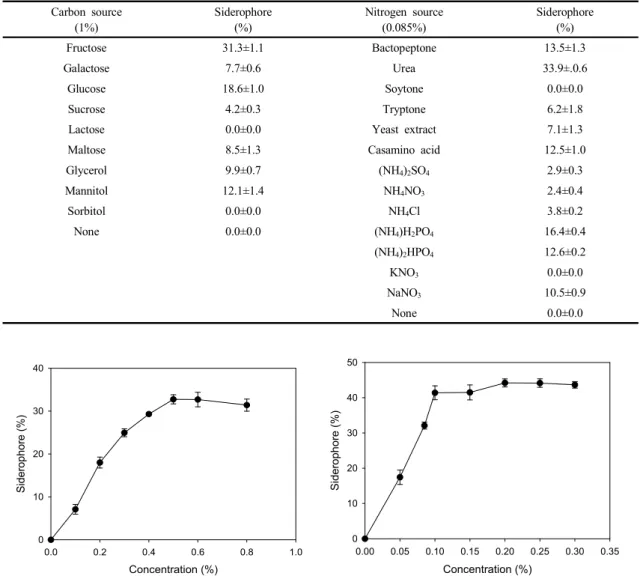
먼저 각종 탄소원을 1%씩 기본배지에 첨가하여 공시 균주에 의한 siderophore 생산량을 측정한 결과는 Table 1에서 보는 바와 같다. 탄소원은 siderophore의 생산에 필수적인 인자임을 알 수 있었으며, lactose와 sorbitol을 제외한 모든 탄소원에서 siderophore가 생산되었다. 그
중 기본배지의 탄소원인 glucose보다 높은 생산량을 나 타낸 것은 fructose이었다. Fructose의 농도에 따른 siderophore의 생산량을 조사한 결과, 0-0.5% 범위에서 농도 증가에 비례하여 생산량도 증가하였으며, 그 이상 의 농도에서는 일정하였다(Fig. 3). Brevibacillus brevis GZDF3 (Sheng et al., 2020), Bacillus sp. PZ-1 (Yu etal., 2017), Pseudomonas aeruginosa FP6 (Sasirekha and Srividya, 2016)의 경우, siderophore 생산에 최적 인 탄소원은 각각 sucrose, glucose, mannitol이며, fructose에서는 생산량이 매우 적었다고 하였다. 따라서 siderophore 생산에 최적인 탄소원은 균주 특이적임을 알 수 있었다.
각종 질소원을 0.085%씩 기본배지에 첨가하여 공시 균주에 의한 siderophore 생산량을 측정한 결과, 탄소원 과 마찬가지로 질소원 역시 siderophore 생산에 필수적 인 인자였으며, 기본배지의 질소원인 urea에서 가장 높 은 생산량을 나타내었다(Table 1). 또한 siderophore 생 산량은 urea 0.1%까지 증가하다가 그 이상의 농도에서 는 차이를 나타내지 않았다(Fig. 4). P. aeruginosa FP6 는 urea에서 가장 높은 siderophore 생산을 나타내어 (Sasirekha and Srividya, 2016) 본 공시균주와 동일한 결과를 보인 반면, B. brevis GZDF3 (Sheng et al., 2020)는 asparagine에서 높은 생산량을 나타내었다. 한 편, 공시균주의 배양액 내에 urea가 잔존할 경우, 이 배양 액은 siderophore에 의한 생물농약으로서의 기능과 함께
Carbon source (1%)
Siderophore (%)
Nitrogen source (0.085%)
Siderophore (%)
Fructose 31.3±1.1 Bactopeptone 13.5±1.3
Galactose 7.7±0.6 Urea 33.9±.0.6
Glucose 18.6±1.0 Soytone 0.0±0.0
Sucrose 4.2±0.3 Tryptone 6.2±1.8
Lactose 0.0±0.0 Yeast extract 7.1±1.3
Maltose 8.5±1.3 Casamino acid 12.5±1.0
Glycerol 9.9±0.7 (NH4)2SO4 2.9±0.3
Mannitol 12.1±1.4 NH4NO3 2.4±0.4
Sorbitol 0.0±0.0 NH4Cl 3.8±0.2
None 0.0±0.0 (NH4)H2PO4 16.4±0.4
(NH4)2HPO4 12.6±0.2
KNO3 0.0±0.0
NaNO3 10.5±0.9
None 0.0±0.0
Table 1. Influence of carbon and nitrogen sources on siderophore production by E. amnigenus S21
Concentration (%)
0.0 0.2 0.4 0.6 0.8 1.0
Siderophore (%)
0 10 20 30 40
Concentration (%)
0.00 0.05 0.10 0.15 0.20 0.25 0.30 0.35
Siderophore (%)
0 10 20 30 40 50
Fig. 3. Influence of fructose concentration on siderophore production by E. amnigenus S21.
Fig. 4. Influence of urea concentration on siderophore production by E. amnigenus S21.
질소비료로서의 기능도 할 수 있음을 시사한다. 동시에 본 공시균주가 urea를 질소원으로 이용할 수 있는 능력 은 토양에 존재하는 과잉의 urea 비료를 감소시킴으로써 알칼리성 토양의 생물정화를 위한 가능성까지 시사한다 (Sayyed and Chincholkar, 2010). 본 실험의 결과는 토 양환경의 조건에 따라 공시균주를 적절하게 사용할 경우, 잠재적으로 농작물의 질병 예방과 함께 생산성 향상까지 유도할 수 있음을 나타내며, 이에 관한 후속연구가 필요
함을 알 수 있었다.
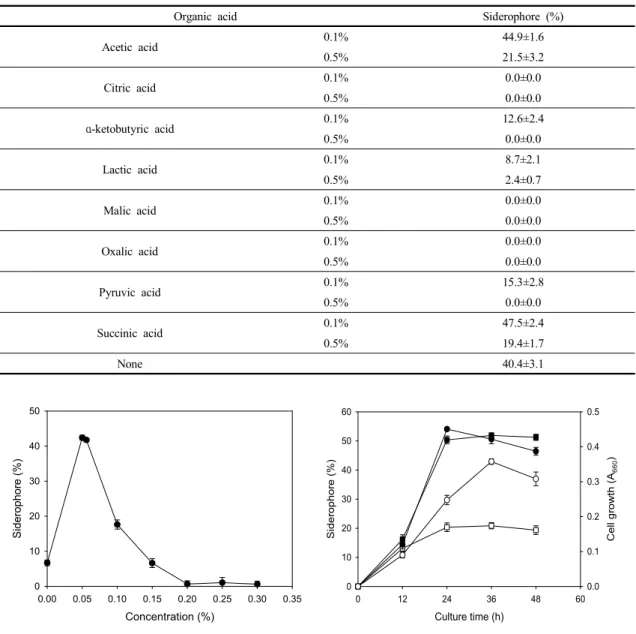
기본배지 성분인 K2HPO4의 농도가 siderophore 생 산량에 미치는 영향을 조사한 결과, 0.5%까지 농도 증 가에 비례하여 생산량이 증가하다가 그 이상의 농도에 서는 감소하여 전형적인 inhibition type을 나타내었다 (Fig. 5).
유기산은 siderophore의 생산량에 영향을 미친다는 보고가 있다(Sayyed and Chincholkar, 2010). 따라서
Organic acid Siderophore (%)
Acetic acid 0.1% 44.9±1.6
0.5% 21.5±3.2
Citric acid 0.1% 0.0±0.0
0.5% 0.0±0.0
α-ketobutyric acid 0.1% 12.6±2.4
0.5% 0.0±0.0
Lactic acid 0.1% 8.7±2.1
0.5% 2.4±0.7
Malic acid 0.1% 0.0±0.0
0.5% 0.0±0.0
Oxalic acid 0.1% 0.0±0.0
0.5% 0.0±0.0
Pyruvic acid 0.1% 15.3±2.8
0.5% 0.0±0.0
Succinic acid 0.1% 47.5±2.4
0.5% 19.4±1.7
None 40.4±3.1
Table 2. Influence of organic acid on siderophore production by E. amnigenus S21
Concentration (%)
0.00 0.05 0.10 0.15 0.20 0.25 0.30 0.35
Siderophore (%)
0 10 20 30 40 50
Culture time (h)
0 12 24 36 48 60
Siderophore (%)
0 10 20 30 40 50 60
Cell growth (A660)
0.0 0.1 0.2 0.3 0.4 0.5
Fig. 5. Influence of K2HPO4 concentration on siderophore production by E. amnigenus S21.
Fig. 6. Time curves of cell growth and siderophore production in basal and improved media. ●, cell growth in improved medium; ○, cell growth in basal medium;
■, siderophore production in improved medium; □, siderophore production in basal medium.
각종 유기산을 저농도(0.1%) 및 고농도(0.5%)로 배지에 추가적으로 첨가하여 배양한 결과, 저농도의 acetic acid 와 succinic acid가 각각 첨가된 실험구에서 siderophore 생산량이 약간 증가되었으며, citric acid, malic acid 및
oxalic acid는 조사한 모든 농도에서 siderophore 생산 을 완전히 저해하였다(Table 2). 결과적으로 유기산의 첨가는 siderophore 생산에 큰 영향을 미치지 않음을 알 수 있었다. 한편, Sayyed et al.(2005)에 의하면 succinic
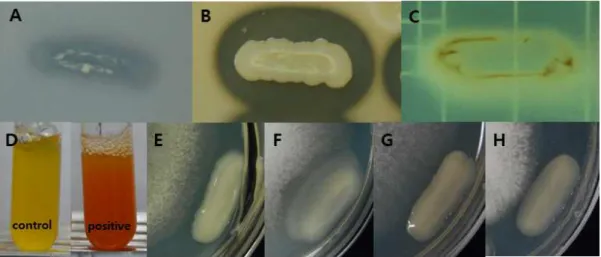
Fig. 7. Plant growth-promoting activities of E. amnigenus S21. (A) insoluble phopsphate solubilization; (B) protease production; (C) lipase production, (D) ammonification; antifungal activities against (E) C. gloeosporioides, (F) F. oxysporum, (G) P. cactorum and (H) P. ultimum.
acid는 Pseudomonas putida의 siderophore 생산량을 증가시키지만 citric acid는 영향을 미치지 못한다고 하 였다. 그러나 Sharma et al.(2016)은 citric acid에 의하 여 Pseudomonas spp.의 siderophore 생산량은 증가한 다고 하였다.
상기에서 확립된 개선배지와 기본배지에 공시균주를 각각 접종하여 배양하면서 시간 경과에 따른 siderophore 생산량과 균체 생육도를 비교한 결과는 Fig. 6에서 보는 바와 같다. 기본배지 및 개선배지에서 각각 36시간 및 24 시간까지 대수증식을 하다가 정지기에 돌입하였으며, siderophore 생산량은 균체 생육에 비례하여 증가하다가 36시간에 각각 21% 및 52%를 나타내었다. 따라서 본 실험을 통하여 확립된 개선배지에서는 기본배지 대비 siderophore 생산량이 약 2.5배 정도 증가되었음을 알 수 있었다. 미생물에 의한 siderophore의 생산은 균체 생 육과 비례하는 경우(Yu et al., 2017)와 비례하지 않는 경우(Sheng et al., 2020)가 보고되어 있는데, 본 균주는 후자에 해당되었다.
3.3. 공시균주의 식물성장 촉진 활성
서론에서 언급했다시피 PGPR은 불용성 인산 가용능 을 포함한 다양한 식물성장 촉진 활성을 보유하고 있는 것이 농업용 미생물 제제로서 야외에 적용 시 유리하다.
따라서 siderophore를 생성할 수 있는 본 공시균주의 식
물성장 촉진 활성을 조사하였다. 공시균주는 불용성 인 산을 가용화(Fig. 7A)할 수 있었으며, 식물병원성 곰팡 이의 세포성분 분해효소로 protease (Fig. 7B)와 lipase (Fig. 7C)를 생성할 수 있었다. 또한 항진균 휘발성 물질 인 암모니아를 생성할 수 있었고(Fig. 7D), 탄저병균인
C. gloeosporioides, 시들음병균인 F. oxysporum, 뿌리
썩음병균인 P. ultimum, 역병균인 P. cactorum에 대한 길항능을 가지고 있었다(Fig. 7E-H). 그러나 본 균주는 cellulase, chitinase를 생성할 수 없었으며, 잿빛곰팡이 병균인 B. cinerea, 모잘록병균인 R. solani의 생육은 저 해하지 못했다. 한편, 공시균주는 액체배양에서 8.3 μ g/mL의 식물성장 호르몬인 IAA를 생성하였으며, ACC 의 효소 분해산물로서 77 μg/mL의 α-ketobutyrate를 생성함에 따라 식물 스트레스 물질인 ethylene을 감소시 키는 ACC deaminase 활성을 보유하고 있는 것으로 확 인되었다.4. 결 론
본 연구에서는 친환경 미생물제제 개발을 목적으로 식물병원성 미생물이 필요로 하는 철의 흡수능을 감소시 킬 수 있는 siderophore 생산 미생물을 분리 및 동정한 후, 그 생산 특성과 식물성장 촉진 활성을 조사하였다.
들깨의 근권 토양으로부터 CAS 평판배지에서 집락
주변에 주황색 환을 형성하는 S21 균주를 분리하였으 며, 공시균주의 표현형적 특성과 16S rRNA 유전자의 염기서열에 기초하여 동정한 결과, E. amnigenus로 확인되었다. Siderophore 생산을 위해 확립된 배지 조 성은 fructose 0.5%, urea 0.1%, K2HPO4 0.5%, succinic acid 0.1%이었으며, 이 조건에서 siderophore 생산량은 기본배지 대비 약 2.5배 증가되었다. 또한 공시균주는 불용성인산 가용능과 세포성분 분해효소 (protease, lipase), 암모니아, IAA 및 ACC deaminase 와 같은 식물성장 촉진 활성을 나타내었으며, C.
gloeosporioides 등 몇몇 식물병원성 곰팡이의 생육도
억제하였다. 이러한 결과는 E. amnigenus S21가 환 경친화적 생물농약 및 생물비료로서 사용될 수 있는 잠재적 후보군이 된다는 것을 시사한다.REFERENCES
Alexander, D. B., Zuberer, D. A., 1991, Use of chrome azurol-S reagents to evaluate siderophore production by rhizosphere bacteria, Biol. Fert. Soils, 12, 39-45.
Arora, N. K., Kang, S. C., Maheshwari, D. K., 2001, Isolation of siderophore-producing strains of Rhizobium meliloti and their biocontrol potential against Macrophomina phaseolina that causes charcoal rot of groundnut, Curr. Sci., 81, 673-677.
Barrow, G. I., Felthanm, R. K. A., 1993, Cowan and Steel's manual for the identification of medical bacteria, 3rd ed., Cambridge University Press, New York, 94-150.
Butler, A., 2005, Marine siderophores and microbial iron mobilization, Biometals, 18, 369-374.
Cocking, E. C., 2003, Endophytic colonization of plant roots by nitrogen-fixing bacteria, Plant Soil, 252, 169-175.
Compant, S., Duffy, B., Nowak, J., Clement, C., Barka, E.
I., 2005, Use of plant growth-promoting bacteria for biocontrol of plant diseases: principles, mechanisms of action, and future prospects, Appl. Environ. Microbiol., 71, 4951-4959.
Cornelis, P., 2010, Iron uptake and metabolism in pseudomonads, Appl. Microbiol. Biotechnol., 86, 1637-1645.
Dye, R., Pal, K. K., Bhatt, D. M., Chauhan, S. M., 2004, Growth promotion and yield enhancement of peanut
(Arachis hypogaea L.) by application of plant growth-promoting bacteria, Microbiol. Res., 159, 371-394.
Gerhardt, P., Murray, R. G. E., Costilow, R. N., Nester, E.
W., Wood, W. A., Krieg, N. R., Phillips, G. B., 1981, Manual of methods for general bacteriology, American Society for Microbiology, Washington, D.C.
Hider, R., Kong, X., 2010, Chemistry and biology of siderophores, Nat, Prod, Rep., 27, 637-657.
Holt, J. G., Krieg, N. R., Sneath, P. H. A., Staley, J. T., Williams, S. T., 1994, Bergey's Manual of Determinative Bacteriology, The Williams and Wilkins Co., Baltimore.
Hopkinson, B. M., Morel, F. M., 2009, The role of siderophores in iron acquisition by photosynthetic marine microorganisms, Biometals, 4, 659-669.
Miethke, M., Marahiel, M. A., 2007, Siderophore-based iron acquisition and pathogen control, Microbiol. Mol.
Biol. Rev., 71, 413-451.
Nautiyal, C. S., 1999, An Efficient microbiological growth medium for screening phosphate solubilizing microorganisms, FEMS Microbiol. Lett., 170, 265-270.
Pandey, P., Kang, S. C., Gupta, C. P., Maheshwari, D. K., 2005, Rhizosphere competent Pseudomonas aeruginosa GRC1 produces characteristic siderophore and enhances growth of Indian mustard (Brassica campestris), Curr.
Microbiol., 51, 303-309.
Paul, D., Lade, H., 2014, Plant-growth-promoting rhizobacteria to improve crop growth in saline soils: a review, Agron. Sustain. Dev., 34, 737-752.
Penrose, D. M., Glick, B. R., 2003, Methods for isolating and characterizing ACC deaminase-containing plant growth-promoting rhizobacteria, Physiol. Plant., 118, 10-15.
Reid, R. T., Live, D. H., Faulkner, D. J., Butler. A. A., 1993, Siderophore from a marine bacterium with an exceptional ferric ion affinity constant, Nature, 366, 455-458.
Saha, R., Saha, N., Donofrio, R. S., Bestervelt, L. L., 2013, Microbial siderophores: a mini review, J. Basic.
Microbiol., 52, 1-15.
Sasirekha, B., Srividya, S., 2016, Siderophore production by Pseudomonas aeruginosa FP6, a biocontrol strain for Rhizoctonia solani and Colletotrichum gloeosporioides causing diseases in chilli, Agric. Nat.
Resour., 50, 250-256.
Sayyed, R. Z., Badgujar, M. D., Sonawane, H. M., Mhaske, M. M., Chincholkar, S B., 2005, Production of microbial iron chelators (siderophores) by fluorescent pseudomonads, Indian J. Biotechnol., 4, 484-490.
Sayyed, R. Z., Chincholkar, S. B., 2010, Growth and siderophore production Alcaligenes faecalis is influenced by heavy metals. Indian J. Microbiol., 50, 179-182.
Schwyn, B., Neilands, J. B., 1987, Universal chemical assay for the detection an determination of siderophores, Anal. Biochem., 160, 46-56.
Sharma, S. B., Sayyed, R. Z., Trivedi, M. H., Gobi, T. A., 2013, Phosphate solubilizing microbes: sustainable approach for managing phosphorus deficiency in agricultural soils, SpringerPlus, 2, 587-602.
Sharma, T., Kumar, N., Rai, N., 2016, Production and optimization of siderophore producing Pseudomonas species isolated from Tarai region of Uttarakhand, Int. J.
Pharma. Bio. Sci., 7, 306-314.
Sheng, M., Jia, H., Zhang, G., Zeng, L., Zhang, T., Long, Y., Lan, J., Hu, Z., Zeng, Z., Wang, B., Liu, H., 2020, Siderophore production by rhizosphere biological control bacteria Brevibacillus brevis GZDF3 of Pinellia ternata and its antifungal effects on Candida albicans, J. Microbiol. Biotechnol., 30, 689-699.
Spaepen, S., Vanderleyden, J., Remans, R., 2007, Indole-3-acetic acid in microbial and microorganism -plant signaling, FEMS Microbiol. Rev., 31, 425-448.
Sulochana, M. B., Jayachandra, S. Y., Kumar, S. A., Parameshwar, A. B., Reddy, K. M., Dayanand, A., 2014, Siderophore as a potential plant growth-promoting
agent produced by Pseudomonas aeruginosa JAS-25, Appl. Biochem. Biotechnol., 174, 297-308.
Tang, Y. W., Bonner, J., 1947, The enzymatic inactivation of indoleacetic acid I. some characteristics of the enzyme contained in pea seedlings, Arch. Biochem., 13, 17-25.
Yu, S., Teng, C., Bai, X., Liang, J., Song, T., Dong, L., Jin, Y., Qu, J., 2017, Optimization of siderophore production by Bacillus sp. PZ-1 and its potential enhancement of phytoextraction of Pb from soil, J.
Microbiol. Biotechnol., 27, 1500-1512.
∙Graduate student. Seung-Hoon Choi
Department of Life Science and Environmental Biochemistry, Pusan National University [email protected]
∙Researcher. Ji-Yeon Yoo
Department of Life Science and Environmental Biochemistry, Pusan National University [email protected]
∙Graduate student. Sung-Jin Park
Department of Life Science and Environmental Biochemistry, Pusan National University [email protected]
∙Graduate student. Min-Joo Park
Department of Life Science and Environmental Biochemistry, Pusan National University [email protected]
∙Researcher. O-Mi Lee
Plant Quarantine Technology Center Animal and Plant Quarantine Agency [email protected]
∙Professor. Hong-Joo Son
Department of Life Science and Environmental Biochemistry, Pusan National University [email protected]