인도 Mysore 대학교 연구성과의 계량정보학적 분석:
1996-2006
Growth and Impact of Research Output of University of Mysore, 1996-2006: A Case Study
1)Mallinath Kumbar
*⋅B.M.Gupta
**⋅S.K.Dhawan
***Contents
1. Introduction
2. Objectives
3. Methodology and Literature Review
4. Data Analysis
5. Conclusion and Suggestion
∙ References
초 록
이 연구는 University of Mysore의 과학기술 분야 연구자들이 수행한 연구성과의 성장과 기여, 영 향에 대해 분석하였다. 또한 이 대학 소속 과학자들의 커뮤니케이션 패턴을 분석하고 서로 다른 저널 에 발표된 연구성과의 집중 및 분산 정도를 조사한다. 평균인용도의 측면에서 이 대학이 강점과 약점 을 가지고 있는 연구영역, 성장률과 영향, 학과별 연구동향에 대해 분석하였으며, 전반적인 수준과 주 제분야별, 국가별로 연구성과의 국제적 협력에 대해 조사한다. 인용빈도가 높은 논문과 생산성이 높은 저자의 특성에 대해서도 분석하였다.
키 워 드
계량정보학 – University of Mysore, 인용분석, 연구생산성, 커뮤니케이션 패턴, 국제협력, 연구 – 사례연구
* Reader, Dept. of Library & Information Science, Univ. of Mysore, [email protected]
** Scientist, National Institute of Science Technology & Development Studies, [email protected]
*** Scientist, National Institute of Science Technology & Development Studies, [email protected] ∙ 논문접수일자 : 2008년 8월 20일
∙ 게재확정일자 : 2008년 9월 19일
ABSTRACT
This study describes the growth, contribution and impact of research carried out by University of Mysore scientists in science and technology. It indicates the patterns of communications of university scientists and studies the extent of concentration and scattering of their research output in different journals. It also analyses the strong and weak areas of university research, their growth rate and impact in terms of average citations received. It also studies the output and impact of research under different existing subject departments of the university and analyses the international collaborative share of research output at the overall level as well as across various subjects, indicating also the major countries involved in international collaboration. It describes the share and characteristics of select high cited papers and the top productive authors.
KEYWORDS
Informetrics – University of Mysore, Informetrics, Citation Analysis, Research Productivity, Communication Pattern, International Collaboration in Research, Case study
1. Introduction
Research productivity in higher edu- cation is gaining importance for the past one decade in India. Faculty members of the universities in India have two func- tions to perform teaching and research.
Teaching is one of the canonically per- formed functions. However, research in universities has gained momentum dur- ing the past one and half decade, mainly due to support received through Ph.D.
projects, in-house projects, and extra-
mural funding projects from major gov- ernment scientific agencies. The research output of the university scientists in the form of research papers in peer-reviewed scholarly journals is being considered as one of the main criteria for assessing the performance of the university scientists and faculty. The University of Mysore has been accredited “A+”by National Assess- ment and Accreditation Council in 2006.
The University of Mysore is among the foremost institutions of its kind, and is an enduring symbol in the sphere of
higher education in India. It was founded by the then Maharaja of Mysore, His Highness Sri Krishnaraja Wodeyar IV and his Dewan, the renowned engineer statesman, Sir M.Visvesvaraya, on July 27, 1916. The Maharaja of Mysore became its first chancellor. A Bill to establish and incorporate the University was in- troduced in Mysore Legislative Council in 1916. It was passed unanimously on 17th July 1916. The first meeting of the University Council was held on 12th August 1916 and the first meeting of the senate on 12th October 1916.
The first Act of the University came in the year 1933 (University of Mysore Act 1933). The University offered a two-year intermediate course, three year B.A.(Hons), B.Sc.,(Hons) Degree courses and M.A., M.Sc. courses. There were also the fac- ulties of Medicine and Engineering. The University also offered diplomas in vo- cational subjects. The University Extension Lectures and Publication Bureau were notable features of the university. The main campus of the university created in 1960, lies in a picturesque area of 739 acres at the western end of the Kukka- rahalli Lake. The university headquarters, the Crawford Hall, is located right across
the lake on the eastern end. This in- spiring locale of the campus was aptly named Manasagangotri (fountainhead of the Ganges of the Mind) by the poet- laureate, Dr. K.V.Puttappa (Kuvempu).
In due course, two satellite campuses were set up in response to the demands of postgraduate education from semi-urban /rural areas: Sir M.Visvesvaraya Postgra- duate Centre at Tubinakere in Mandya, and the Mysore University Postgraduate Centre at Hemagangotri in Hassan.
There are 37 postgraduate departments in University of Mysore, of which 14 are science departments. In all 132 faculty members are working in these science departments. An attempt has been made in this communication to analyze the contribution, growth and impact of the research output of the university scien- tists working in different S&T depart- ments and faculties of the University of Mysore for the past one decade.
2. Objectives
The main objectives are :
1) To study the publication pattern of faculty of science and technology of Uni-
versity of Mysore between 1996 to 2006;
2) To study the impact of research output of the faculty of science and technology of University of Mysore.
3) To analyze the contribution of the authors of University of Mysore in na- tional and international journals
4) To identify strong and weak dis- ciplines of University of Mysore with reference to the research output;
5) To study the international collabo- rative efforts by the academics of Uni- versity of Mysore and
6) To rank the academics of Univer- sity of Mysore based on their research output.
3. Methodology and Literature Review
The data for the study was down- loaded from the Scopus database in June 2007. SCOPUS is an international mul- tidisciplinary database indexing over 15,000 international peer reviewed journals in science and technology, besides more than 500 international conference/seminar pro- ceedings. We have used 11 years publications data from 1996 to 2006 for analyzing
the growth and impact of university research. A larger time coverage data has been used to ensure accurate results.
In addition, we have used citations data for qualitative analysis of Indian research output. Three years citations window has been used for computing average cita- tions per paper for all papers published by India from 1996 to 2003. Two years citations window was used for all papers published in 2004, and one-year citations window used for all papers published in 2005.
Some studies have been conducted in the past analyzing the contribution and impact of individual organizations. Jeevan and Gupta1-2 have analyzed the con- tribution and impact of Indian Institute of Technology, Kharagpur by suggesting a methodology for studying the quanti- tative profile of a research cum teaching institute, with a view to get idea about the its performance and impact. Similarly Singh, Gupta and Kumar3 studied the research contribution and impact of Indian Institute of Technology, Roorkee from 1993 to 2001. The present study looks at the methodology of evaluation and covers wider aspects than the earlier studies.
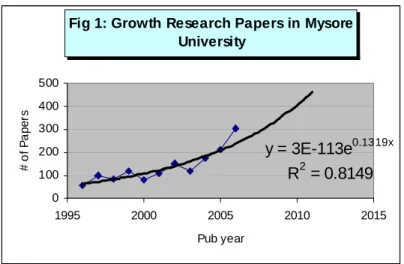
Fig 1: Growth Research Papers in Mysore University
y = 3E-113e
0.1319xR
2= 0.8149
0 100 200 300 400 500
1995 2000 2005 2010 2015
Pub year
# of Papers
Year # of papers Annual Ave.
growth rate % # of citations Ave. citations per paper
1996 55 84 1.53
1997 99 80.00 146 1.47
1998 86 -13.13 158 1.84
1999 119 38.37 183 1.54
2000 79 -33.61 200 2.53
2001 110 39.24 171 1.55
2002 153 39.09 395 2.58
2003 121 -20.92 317 2.62
2004 175 44.63 - -
2005 214 22.29 - -
2006 307 43.46 - -
Total 1518 Ave 23.94 - -
<Table 1> Growth and Impact of Research
4. Data Analysis
4.1 Growth and Impact of Research
The University of Mysore published a total of 1,518 research papers in different disciplines of science and technology during 1996-2006, as seen from the Scopus database. During these 11 years, its publi-
cations output rose significantly, grow- ing nearly by six times from 55 papers in 1996 to 307 in 2006. Its annual growth rate, computed on 11 years data averaged at 23.9%. Given its current pace of pub- lication activity, it is estimated that the university publication output may rise to 400 papers per annum by 2010(<Table 1>,
<Fig 1>).
No. of papers No. of Source Journals
No. of papers
No. of Source Journals
No. of papers
No. of Source Journals
1 214 11 2 23 2
2 51 12 2 26 1
3 47 13 4 32 1
4 16 14 2 34 1
5 11 15 2 43 1
6 9 17 1 106 1
7 9 18 1 - -
8 14 19 2 - -
9 5 21 3 - -
10 2 22 1 - -
<Table 2> Frequency Distribution of Papers in Various Source Journals Fig 2: Ave ra ge Impa ct pe r Pa pe r
1.4 1.9 2.4 2.9
1994 1996 1998 2000 2002 2004
Pub Y ear
Av Impact per Paper
The impact of research was ascer- tained in terms of citations university papers received duringthe first three years of their publication. This citations data for its papers published during 1996- 2003 was normalized into an indicator
‘average citations per paper’ mainly for studying and understanding comparative growth in citations impact over previous years. The university has come to demon- strate significant rise in terms of aver- age citations per paper from 1.53 in 1996 to 2.62 in 2003. Hence, it could be stated
that the university has indeed progressed and has shown good quality research during 2000-03, except for the year 2000(<Table 1>, <Fig 2>).
The university published its total re- search output in 405 peer reviewed na- tional and international source journals in different disciplines of science and technology. The frequency distribution of university output in these 405 journals revealed a typical publication scattering pattern(<Table 2>). For example, the university faculty members published
Top Cumulative Journals
Cumulative No of Papers
Cumulative Share of Papers
10 351 0.23
20 516 0.34
30 631 0.42
40 719 0.47
50 799 0.53
60 868 0.57
70 926 0.61
80 975 0.64
90 1015 0.67
<Table 3> Cumulative Productivity in Journals
S.No. Source Journal Title No of Papers
1 Acta Crystallographica Section E Structure Report Online 106 2 Indian Journal of Chemistry Section B organic & Medicinal Chemistry 43 3 Molecular Crystals & Liquid Crystals Science and Technology Section A 34
4 Asoan Journal of Chemistry 32
5 Oxidation Communications 26
6 Current Science 23
7 Synthetic Communications 23
8 Journal of Applied Polymer Science 22
9 Indian Journal of Chemical Technology 21
10 Synthesis and Reactivity in Inorganic & Metal Organic Chemistry 21
11 Analytical Sciences 21
12 Asian Journal of Microbiology, Biotechnology & Environmental Sciences 19
13 Indian Journal of Experimental Biology 19
14 Journal of Geological Society of India 18
15 Journal of Indian Chemical Society 17
16 Farmaco 15
16 Journal of Reinforced Plastics & Composites 15
17 Journal of Food Science & Technology 14
18 Journal of Pharmaceutical and Biomedical Analysis 14
19 Pattern Recognition Letters 13
<Table 4> List of Most Productive Journals, 1996-06
more than 100 papers in just one single journal, in 3 different journals it pub- lished between 26 to 43 papers each, and in the remaining 401 journals, its pub- lication frequency had been extremely, ranging between 1 and 26 each in 11 years. This data seek to demonstrate that visibility of the university in most source journals has been very low. This is also evident from the low cumulative productivity of university papers in dif- ferent journal sets(<Table 3>). It is only in relatively select few journals that its
publication frequency has been somewhat better. The list of top 19 source journals is shown in <Table 4>.
# of papers # of citations Average citations per paper 96-99 00-03 96-03 96-99 00-03 96-03 96-99 00-03 96-03
Chemistry 131 205 336 252 533 785 1.92 2.6 2.34
Physics& Astronomy 66 69 135 57 101 158 0.86 1.46 1.17
Bioch, Genet. & Mol. Biol. 41 85 126 87 311 398 2.12 3.66 3.16 Agr. & Biol. Sci. 57 68 125 50 164 214 0.88 2.41 1.71
Materials Science 33 31 64 49 75 124 1.48 2.42 1.94
Pharm, Toxic. & Pharmcauetics 17 46 63 24 226 250 1.41 4.91 3.97
Chemical Engineering 1 22 41 24 17 41 24 0.77 1
Earth & Planet. Sci. 22 17 39 58 29 87 2.64 1.71 2.23
Environment. Science 18 20 38 25 12 37 1.39 0.6 0.97
Engineering 17 12 29 33 22 55 1.94 1.83 1.9
Medicine 14 13 27 12 14 26 0.86 1.08 0.96
Mathematics 13 10 23 12 9 21 0.92 0.9 0.91
Computer Science 13 9 22 25 18 43 1.92 2 1.95
Multidisciplinary 11 4 15 17 9 26 1.55 2.25 1.73
Immunology & Microbiology 4 11 15 2 13 15 0.5 1.18 1
Energy 1 6 7 2 24 26 2 4 3.71
Health Professions 1 0 1 2 0 2 2 0 2
Total 359 463 696 471 1083 1554 1.31 2.34 2.23
<Table 5> Subject-Wise Break-up of Papers and Impact
4.2 Subject-wise Study of Research Papers
The University of Mysore has published in nearly 16 major disciplines in science and technology during 1996-2006. How- ever, itis in four major disciplines that research activity of the university has been dominating. Chemistry, physics &
astronomy, biochemistry, genetics &
molecular biology, and agriculture & bi- ological sciences are the most dominat- ing areas of its research. Based on pub- lications data for 1996-06, its publications share in these four disciplines varied
between 18% and 48%. In addition, the university has been making strides in new and emerging areas of research. For example, chemical engineering, energy, immunology & microbiology, and bioche- mistry, genetics & molecular biology are its emerging areas of research.
Although the size of publications ac- tivity in these subject areas is still small (ranging between 1 to 46 papers in four years), but its growth rate in these dis- ciplines has been relatively faster, rising from 100% to 2100%. Besides, the average citation per paper in these disciplines has been remarkably high, ranging be-
# of Papers # of Citations Average Citations per paper 96-99 00-03 96-03 96-99 00-03 96-03 96-99 00-03 96-03
App. Botany 14 21 35 15 59 64 1.07 2.81 1.83
Botany 13 10 23 8 10 18 0.62 1.00 0.78
Statistics 3 1 4 0 1 1 0.00 1.00 0.25
Physics 86 93 179 112 138 250 1.30 1.48 1.40
Zoology 31 32 63 56 46 102 1.81 1.44 1.62
Chemistry 140 239 379 260 635 895 1.86 2.66 2.36
Geology 26 17 43 64 57 121 2.46 3.35 2.81
Food Science 8 4 12 10 2 12 1.25 0.50 1.00
Biochemistry. 14 13 27 34 51 85 2.43 3.92 3.15
Comput. Sci. 6 6 12 6 6 12 1.00 1.00 1.00
Mathematics 7 6 13 1 1 2 0.14 0.17 0.15
Environment Science 4 5 9 8 4 12 2.00 080 1.33
Total - - - - - - - - -
<Table 6> Department Wise Breakup of Papers by University of Mysore
tween 3.16 and 3.97. In comparison, the average citations per paper in the tradi- tional subject disciplines have been varying between 1.17 and 2.34. It seeks to demonstrate that the university re- search has been doing comparatively better in terms of research impact in its emerging areas of research(<Table 5>).
4.3 Departments-Wise Profile of the University
As seen from publications data for University of Mysore indexed in Scopus database for 1996-2003, research output in science and technology is confined to
12 science departments of the university (<Table 6>). Chemistry department leads in publications productivity with 379 pa- pers during 1996-2006, followed by phys- ics department (179 papers), and zoology department (63 papers). The research output by the remaining nine departments has been verysmall ranging between 9 and 43 papers during 1996-06. However, despite showing publications output of smaller size, publishing 27 papers only, biochemistry department has emerged stronger in its average impact per paper.
It showed the highest average impact per paper of 3.15. The geology department with average impact per paper of 2.81
<Fig 3> Publications Output by Subject through Collaborative Research
and chemistry department with average impact per paper of 2.36, followed the biochemistry department. The remaining departments showed average impact per paper in the lower ranges, varying be- tween 0.25 and 1.83. Hence, depart- ments of biochemistry and geology have indeed shown good performance in terms of quality research(<Table 6>).
4.4 International Collaborative Research
The university published nearly 14% of its papers through international col- laboration with institutions from USA,
Germany, Japan, Canada, South Korea, and Denmark etc. Its collaborative re- search output during 1996-06 was the largest with USA (51%), followed by Germany (23%), Japan (10%), Canada (6%), South Korea (5%), and Denmark (4%).
The publications activity through inter- national collaborative research was the largest in physics (38.4%), followed by biochemistry (35.6%), and chemistry (28%).
In other disciplines, its publication share of the international collaborative output has been small, varying between 0.5%
and 13%(<Table 7>).
Number of Collaborative Papers during 1996-06
USA Germany Japan Canada S. Korea Denmark
Chemistry 53 1 6 - - 1
Physics & Astronomy 22 40 9 4 9 -
Bioch , Genet. & Mol. Biol. 33 42 2 - - 1
Agr. & Biol. Sci. 12 4 1 2 - 9
Materials Science 9 - 11 - 9 -
Pharm., Toxic. & Pharmceutics 9 - 1 - - -
Chemical Engineering 10 - 1 - - -
Earth & Planet. Sci. 3 4 2 1 - -
Environment. Science 5 - - - - 1
Engineering 11 - 1 6 6 -
Medicine 2 - - 2 - -
Mathematics 2 - - - - -
Computer Science 8 - 2 6 1 -
Multidisciplinary - 2 - 1 - -
Immunology & Microbiology 1 - - - - 1
Energy 1 - 2 - - -
Health Professions - - - 1 - -
Total 112 52 22 13 11 9
<Table 7> Subject-Wise Break-up of Collaborative Papers
Top Cumulative Authors
Cumulative No of Papers
Cumulative Share of Papers
10 498 0.33
20 656 0.43
30 764 0.50
40 884 0.58
50 948 0.62
60 991 0.65
70 1065 0.70
80 1093 0.72
<Table 8> Cumulative Productivity of Authors
4.5 Author Productive Profile of University Members
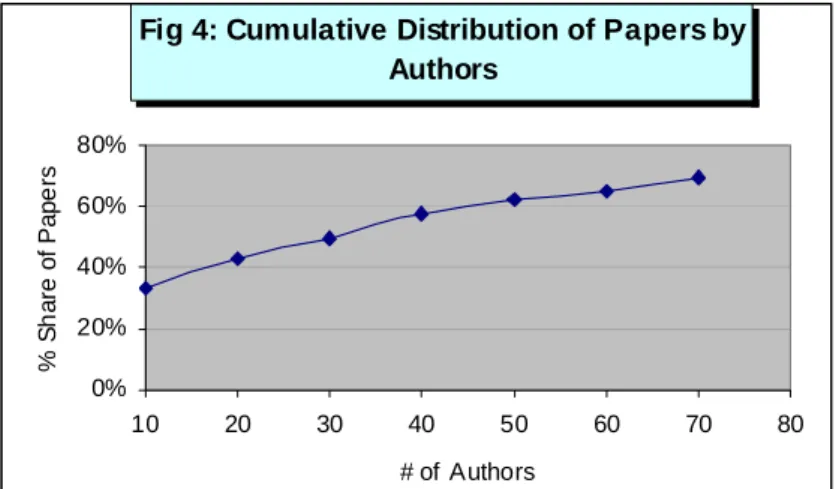
<Table 8> gives the details of top cu- mulative authors, the corresponding num- ber of cumulative papers and their cu- mulative share. It can be observed from
<Table 8> that research activity in the University of Mysore seems to be highly skewed. This is because top 80 authors account for 72% of total publications output by the university. This analysis is based on publication data in respect of the university in science and tech- nologyfor its research papers published
during 1996-06. The cumulative dis- tribution of their publications also seeks to convey the point that the excellence in University of Mysore is confined to a body of select few authors. In other words, a large body of authors from the university contribute very small share,
S.No. Name of Authors
1996-06 1996-03
# of papers
# of papers
# of citations
Average citations per paper
1 H.S. Yathirajan
Dept. of Studies in Chemistry 139 41 104 2.54
2 K.S. Rangappa
Dept. of Studies in Chemistry 125 30 74 2.47
3 J. Shashidhar Prasad
Dept. of Studies in Physics 105 57 173 3.03
4 M.A. Sridhar
Dept. of Studies in Physics 91 39 105 2.69
5 P.Nagaraja
Dept. of Studies in Chemistry 58 25 20 0.80
6 H.S. Shetty
Dept. of Studies in Applied Botany & Biotechnology 56 39 30 0.77 7 K.Basavaiah
Dept. of Studies in Chemistry 55 24 44 1.83
8 D.C.Gowda
Dept. of Studies in Chemistry 55 15 71 4.73
9 N.K. Lokanath
Dept. of Studies in Physics 42 27 38 1.41
10 C. Ranganathaiah
Dept. of Studies in Physics 39 5 29 5.80
11 K. Abiraj
Dept. of Studies in Chemistry 34 24 57 2.38
<Table 9> List of High Productivity Authors
Fig 4: Cumulative Distribution of Papers by Authors
0%
20%
40%
60%
80%
10 20 30 40 50 60 70 80
# of Authors
% Share of Papers
12 H. Somastekarappa
Dept. of Studies in Physics 29 8 6 0.75
13 S. Ananda
Dept. of Studies in Chemistry 29 11 7 0.64
14 G.R. Sriinivasa
Dept. of Studies in Chemistry 29 20 19 0.95
15 H.D. Ravanasiddappa
Dept. of Studies in Chemistry 29 7 23 3.29
16 P. Nagabhushan
Dept. of Studies in Computer Science 28 0 0 0
17 P Prakash
Dept. of Studies in food Science & Nutrition 27 41 104 2.54 18 K.M.Lokanatha Rai
Dept. of Studies in Chemistry 26 30 74 2.47
19 M. Singha
Dept. of Studies in Zoology 25 39 105 2.69
20 R.S. Narasegowda
Dept. of Studies in Zoology 25 29 141 4.86
nearly 29% of the total university output.
It also means that majority of the au- thors from University of Mysore show low publication frequency (<Table 8>, <Fig 4>).
The select list of high productivity au- thors is given in <Table 9>.
4.6 Highly Cited Papers
The University of Mysore published a total of 1,518 papers in 11 years, of which 17 papers have been considered as com- paratively higher cited papers, each re- ceiving 30 citations or more since their publication during 1996-2006. Of these, seven papers were published during
2000-2004, and the remaining 10 during 1996-1999. Out of these 17 papers, 11 papers involve international collaboration and 4 involve national collaboration. The paper coauthored by F D'Souza and pub- lished in 2004 received 91 citations, the highest number of citations. It means that international collaboration has increased the citation profile of university output.
The full list of higher cited papers is shown in Table 10. It is to be noted that the share of highly cited papers in the total output by University of Mysore in science and technology is still not very significant.
Authors Affiliations Title Source title Year Times Cited
1 El-Khouly M.E., Ito O., Smith P.M., D'Souza F.
Tohoku University, Katahira, Inst.
Multidisc. Res. for Adv. Mat., Sendai, Japan; University of Mysore, Mysore et al
Intermolecular and supramolecular photoinduced electron transfer processes of fullerene-porphyrin/phthalocyani ne systems
Journal of Photochemistry and
Photobiology C:
Photochemistry Reviews
2004 91
2 Poojary D.M., Clearfield A.
Texas A and M Univ, Dept of Chem, TX , USA; University of Mysore, ; Indian Institute of Science, Bangalore, India; et al
Application of X-ray Powder Diffraction Techniques to the Solution of Unknown Crystal Structures
Accounts of Chemical Research
1997, 30(10), 414-22
56
3
Rangappa K.S., Raghavendra M.P., Mahadevappa D.S., Channegowda D.
University of Mysore, Department of Studies in Chemistry, Mysore;
Georgetown University Medical Center, Department of Biochemistry, Washington, DC, USA
Sodium
N-Chlorobenzenesulfonamide as a Selective Oxidant for Hexosamines in Alkaline Medium:
A Kinetic and Mechanistic Study
Journal of Organic Chemistry
1998, 63(3), 531-36
47
4
Nutman A.P., Chadwick B., Krishna Rao B., Vasudev V.N.
Australian Nat Univ, Res Sch of Earth Sciences,Canberra, ACT, Australia; Univ of Mysore, Dept of Geology, Mysore et al
SHRIMP U/Pb zircon ages of acid volcanic rocks in the Chitradurga and Sandur Groups, and granites adjacent to the Sandur schist belt, Karnataka
Journal of the Geological Society of India
1996, 47(2), 153-64
47
5
Rao C.N.R., Gundiah G., Deepak F.L., Govindaraj A., Cheetham A.K.
Chem. and Physics of Materials Unit, CSIR Ctr. of Excellence in Chemistry, Jawaharlal Nehru Ctr. Adv. Sci.
Res., Jakkur P.O., Bangalore 560 064, India; Materials Research Laboratory, University of California, Santa Barbara, CA 93106, United States; Purdue University; University of Mysore; Royal Society of Chemistry;
Royal Society;
Jawaharlal Nehru Ctr.
Adv. Sci. Res.;
University of Mysore;
Indian Institute of Science; Oxford University
Carbon-assisted synthesis of inorganic nanowires
Journal of Materials Chemistry
2004., 14(4), 440-50
43
<Table 10> High Cited Papers by University of Mysore
6
Nagaraja P., Murthy K.C.S., Rangappa K.S., Gowda N.M.M.
University of Mysore, Manasagangotri, Department of Studies in Chemistry, Mysore;
Cipla Limited, Bangalore; Western Illinois University, Department of Chemistry, Macomb, IL, USA
Spectrophotometric methods for the determination of certain catecholamine derivatives in pharmaceutical preparations
Talanta 1998 43
7 Meissner B., Deters P., Srikantappa C., Kohler H.
Institut Für Mineralogie, Petrographie und Geochemie, München, Germany; D University of Mysore, epartment of Geology, Mysore
Geochronological evolution of the Moyar, Bhavani and Palghat shear zones of southern India:
Implications for east Gondwana correlations
Precambrian Research
2002, 114, 149-75
41
8 Shivaleela E.S., Sivarajan K.N., Selvarajan A.
Indian Institute of Science, Elec. Comm.
Engn Dept, Bangalore;
Govt. BDT Coll. of Eng., Davanagere, University of Mysore;
et al
Design of a new family of two-dimensional codes for fiber-optic CDMA networks
Journal of Lightwave Technology
1998, 16(4), 501-08
40
9
Bhaskar Rao Y.J., Chetty T.R.K., Janardhan A.S., Gopalan K.
Natl. Geophysical Research Institute, Hyderabad; University of Mysore, Mysore
Sm-Nd and Rb-Sr ages and P-T history of the Archean Sittampundi and Bhavani layered meta-anorthosite complexes in Cauvery shear zone, South India:
Evidence for Neoproterozoic reworking of Archean crust
Contributions to Mineralogy and Petrology
1996, 125, 237-50
39
10 Salimath B., Marme D., Finkenzeller G.
Institute of Molecular Medicine, Tumor Biology Center, Freiburg, Germany;
Univ of Mysore, Dept of Biochem, Mysore
Expression of the vascular endothelial growth factor gene is inhibited by p73
Oncogene
2000, 19(31), 3470-76
39
11 Somashekar R., Somashekarappa H.
Univ of Mysore, Dept Phys, Mysore;
Yuvaraja Coll, Dept of Phy, Mysore
X-ray Diffraction-Line Broadening Analysis:
Paracrystalline Method
Journal of Applied Crystallography
1997, 30(2), 147-52
35
12
Nagaraja P., Srinivasa Murthy K.C., Yathirajan H.S.
Mysore Univ, Dept. of Stud in Chem, Mysore
Spectrophotometric determination of isoniazid with sodium 1,2- naphthoquinone-4-sulphonate and cetyltrimethyl ammonium bromide
Talanta
1996, 43(7), 1075-80
35
13 Arvind, Mallesh K.S., Mukunda N.
IISc, Dept of Phys, Bangalore; University of Mysore, Department of Studies in Physics, Mysore et al
A generalized Pancharatnam geometric phase formula for three-level quantum systems
Journal of Physics A:
Mathematical and General
1997, 30(7), 2417-31
35
14
Raith M.M., Srikantappa C., Buhl D., Koehler H.
Mineralogisch-Petrolog isches Inst., Univ.
Bonn, Bonn, Germany;
Univ. Mysore, Dept of Geology, Mysore, et al
The Nilgiri enderbites, South India: Nature and age constraints on protolith formation, high-grade metamorphism and cooling history
Precambrian Research
1999, 98, 129-50
35
15
Riman R.E., Suchanek W.L., Byrappa K., Chen C.-W., Shuk P., Oakes C.S.
The State University of New Jersey, Dep. of Ceramic/Mat. Eng., NJ, USA; University of Mysore, Department of Geology, Mysore
Solution synthesis of hydroxyapatite designer particulates
Solid State Ionics
2002, 151, 393-402
31
16
Gururaj A.E., Belakavadi M., Venkatesh D.A., Marme D., Salimath B.P.
Univ of Mysore, Dept.of Appl Bot &
Biotech, Mysore;
Tumor Biology Center, Freiburg, Germany
Molecular mechanisms of anti-angiogenic effect of curcumin
Biochemical and Biophysical Research Communications
2002, 297(4), 934-42.
31
17 Gowda S., Abiraj K., Gowda D.C.
Univ of Mysore, Dept.of Studies in Chem, Mysore
Reductive cleavage of azo compounds catalyzed by commercial zinc dust using ammonium formate or formic acid
Tetrahedron Letters
2002, 43(7), 1329-31
30
5. Conclusion and Suggestion
The research activity in University of Mysore in science and technology is on a growing path, growing with an average growth rate of 23% per annum. This analysis is based on publications data consisting of 1,518 research papers, pub- lished by the university staff during 1996-2006. The university has indeed progressed in terms of quality of research.
Its average citations per paper have ris- en from 1.53 in 1996 to 2.62 in 2003.
Chemistry, physics & astronomy, bio- chemistry, genetics & molecular biology,
and agriculture & biological sciences are its most dominating research areas.
Chemical engineering, energy, immunol- ogy & microbiology, and biochemistry, genetics & molecular biology are its emerging areas of research. Its quality of research and its growth rate in emerging areas of research is better than in traditional research areas.
The international collaborative research activity in the university is still very small, accounting for just 14% share.
This is because the international collab- orative research activity in the uni- versity is confined to select few subjects,
such as physics (38.4%), biochemistry (35.6%), and chemistry (28%). In other disciplines, it is still a low-key affair, varying between 0.5% and 13%. The collaborative research activity in the university is also confined to select few countries. It is the largest with USA (51%), followed by Germany (23%), and Japan (10%), Canada (6%). It is least with South Korea (5%), and Denmark (4%).
Research activity in the university seems to be highly skewed. The ex- cellence in research is confined to select few authors. In other words, publication frequency of large majority of authors from the university is small. Besides, the share of highly cited papers in the university output is still not very significant.
With the globalization of academic community, nowadays, it is important to explore new opportunities for collabo- rative research with all countries from developed and developing world espe- cially in the emerging areas of research such as chemical engineering, energy, immunology & microbiology, and bio- technology. Within the country the uni- versity departments may explore new models of collaborative research, such as
going in for university-private partner- ship in research, as well as university -national laboratories partnership in research. Such measures have the po- tential to catalyze publications activity, improve publication frequency of authors as well as help improve their quality of research.
References
Jeevan, V. K. J. and Gupta, B. M. A. 2002.
“Scientometric profile of research output from Indian Institute of Technology.” Scientometrics, 53(1):
165-168.
Jeevan, V. K. J. and Gupta, B. M. 2001.
“R&D Performance of different departments of IIT.” Kharagpur: A scientometric study based on publications. Journal of Library &
Information Science, 26(2): 129- 143.
Singh, Yogendra, Gupta, B. M. and Kumar, Suresh. 2005. “Research contribu- tions and impact of research of Indian Institute of Technology, Roorkee, 1993-2001.” Annals of Library &
Information Studies, 52(1): 8-14.