. Introduction
Ⅰ
As modern society continues to change, consumer buying behavior is shifting from traditional purchasing behavior to purchasing behavior for pleasure. Moreover, a stronger propensity to consume due to increased
†Corresponding author: Goeun Lee, Tel. +82-2-3290-2643, Fax. +82-2-927-7934 E-mail: [email protected]
household income has changed the concept of fashion goods from essential goods for simply wearing to a medium of self-expression, as consumers’ appetites have individualized and diversified. Thus, more fashion goods are bought by consumers based on impulse, with vague, emotional, and irrational buying motives,
Consumer Regulatory Focus and Impulse Buying of Apparel
Goeun Lee*† · Yoon-jung Lee
Dept. of Home Economics, The Graduate School, Korea University* Dept. of Education, Korea University
Abstract
This study aimed to determine the relationship between consumer regulatory focus and impulse buying of apparel products and the mediating effect of consumer fashion innovativeness . A large portion of consumer buying behavior is based on impulse.
However, impulse buying is difficult to predict; moreover, factors that explain consumers’
impulse buying tendencies are not yet fully identified. In this study, consumer regulatory focus was considered as a factor that explains consumers’ impulse buying tendencies. The purpose of this study was to examine how fashion innovativeness and impulse buying tendencies differ, based on the consumer regulatory focus. A structural equation modeling was conducted to validate the research model. A questionnaire agency conducted online survey for 1 week and of the 400 copies distributed, total of 400 were collected.
Promotion-focus and fashion innovativeness were positively correlated, which in turn had an effect on rational, emotional, and situational impulse buying. The promotion-focus had a negative effect on fashion innovation, but a positive effect on emotional impulse buying.
On the other hand, prevention-focus had negative effect on emotional impulse buying, and situational impulse buying. Consumer regulatory focus and fashion innovativeness were useful predictors different consumer tendencies of impulse buying of apparel.
Keywords : apparel purchase, consumer regulatory focus, fashion innovativeness, impulse buying tendencies
rather than making rational decisions with prearranged plans and obvious buying motives.
Consumers satisfy their appetite for pleasure with impulse buying. This aspect of impulse buying has not been included in practical calculations. Thus, former studies made negative conclusions on impulsive buying. However, due to the nature of fashion goods that emphasize emotional preference over cognitive appraisal, considering elements of pleasure related to purchasing, impulse buying of fashion goods might be interpreted with relation to consumer satisfaction, which has a greater value than mere purchasing.
Regulatory focus explains the consumer motive aspect of risk behavior. According to Higgins (1997), individual tendency of motives consists of two different regulatory systems: promotion focus and prevention focus. Promotion focus refers to a tendency to acquire and look forward to positive results, while prevention focus relates to a tendency to minimize losses and prevent negative results. Higgins explained that every person has a different tendency focus, and consumers regulate their manner to pursuit of pleasure and avoid unpleasantness with two types of regulatory focus.
Fashion goods are fashion conscious and of rapid changes. Thus, it is often observed that consumers often face risk-taking situations and impulse buying may easily occur. It has a close relationship with the consumer’s feelings, body, and social wants, and is easily affected by external stimulus, such as discounts or store atmosphere. There have been many active studies on impulse buying of fashion goods. The study of clothing has provided many implications to understand consumer impulse buying;
however, most of them focused on goods or circumstances of shopping, and relatively lacked
efforts to discriminate differences in impulse buying motivations depending on the character of each consumer. Thus, this study analyzes the effect of consumer character on impulse buying of fashion goods with application of regulatory focus theory, which is widely discussed in the field of consumer behavior.
II. Theoretical Background
1. The Regulatory Focus Theory
According to Higgins (1997), there may be different types of human motivational orientations or individuals’ styles of self-regulation, one being the approach mentality to achieve something positive and seek pleasure and the other being the avoidance mentality which prevents pain or something negative in advance.
Higgins called the former promotion focus and the latter prevention focus. He argued that regulatory focus is affected by individual factors, situational factors, and human motivation and individuals go through different emotional experiences by their regulatory focus.
Consumer researchers have studied the effects of regulatory focus on various consumer behaviors, such as consumers’ attitudes to different products or information processes of advertising messages. For example, according to Werth & Forster (2007), customers with different levels of regulatory focuses showed differences in product preference and evaluation. Those who have stronger promotion focus were motivated to purchase based on gains or achievements from the product since they are sensitive to presence of positive aspects. On the other hand, those who have strong prevention focus are motivated to avoid loss by selecting safety
since they are sensitive and aware of the presence of negative aspects.
Regulatory focus was also found to affect consumers’ cognitive information processing.
Those who have strong promotion focus show tendency to purchase products by taking more risks when positive aspects are highlighted than those who have stronger prevention focus.
Therefore, they show high levels of purchase intention toward new products with higher fashion innovativeness than those who have prevention focus (Lee, 2009). Consumers who have high promotion focus weighed necessity differently from those who have high prevention focus in evaluating new products. New products bear various risks and uncertain performance compared to existing products, but may bring potential gains to necessity (Herzenstein, 2007).
According to Lee & Jo (2007), consumers who have strong promotion focus have purchased and owned more innovative high-tech products than those who have stronger prevention focus, whereas these two types of customers showed no difference in regulatory focus in existing products such as daily necessities. Werth &
Forster (2007) found that those who have strong promotion focus showed interest in innovative features, whereas those who have prevention focus prefer products with warranties. Based on previous research findings, consumers with stronger promotion focus are expected to show higher levels of innovativeness toward fashion products as well.
Therefore, this study attempts to verify whether customers’ individual differences that may be inferred by regulatory focus theory really do exist in apparel purchasing context through fashion innovativeness since this type of study has not been conducted.
2. Fashion Innovativeness
Innovation refers to the degree which an individual adopts new products and ideas in relation to other members in the group to which he or she belongs (Roger, 1995). In this view, fashion innovativeness is the speed to which the individual adopts new fashion relative to other members in the group to which he or she belongs. Goldsmith and Hofacker (1991) suggest that the object and area of innovation should be studied multilaterally and they also suggest the concept of innovation of a specific area. Jun (2007) considers innovation of fashion as an inner characteristic of consumers and understands fashion innovativeness as an object which is embodied in innovation of a specific area. Thus, fashion innovativeness takes form as fashion products and related services in the fashion field from inner innovation which is related to fashion and this is one of the characteristics of consumers who adopt new fashions apart from innovative behaviors. This study adopts the definition of Lee (1997) who defined fashion innovativeness as the degree in which an individual adopts a new fashion style and follows trends. According to his study, fashion innovativeness is an innovative attitude pursuing challenges to uncertainty and acceptance of a new fashion which is different from existing ones. Thus, consumers who have a high tendency of adventurousness will be more affected by fashion innovativeness.
However, it was reported that even though a consumer has high innovativeness for products, it does not necessarily mean that the consumer also has purchase intention (Park, 2004).
Therefore customers can be affected by goals or motivations such as regulatory focus.
Thus, this study examines how fashion
innovativeness differs depending on the regulatory focus of the customer. Those who are promotion-focused would expect gains and improvements from fashionable clothing products and would positively accept clothes of high fashion innovativeness in order to achieve those gains, thus would show a high tendency to purchase them. On the other hand, those who are prevention-focused would desire safety and adopt an avoidance strategy, which means they would show less acceptance or purchase intention toward clothes with high fashion innovativeness. Therefore, this study is carried out based on the following hypotheses:
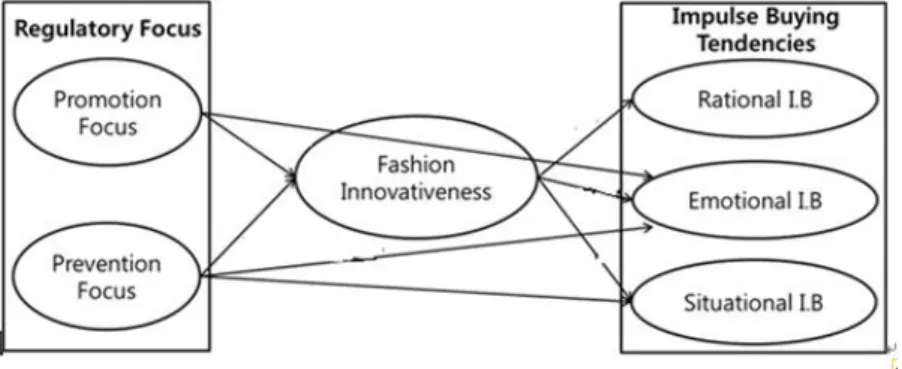
H1. Promotion focus tendency has an effect on fashion innovativeness.
H2. Prevention focus tendency has an effect on fashion innovativeness.
3. Impulse Buying Tendencies
Many scholars continue to study various aspects of impulse buying. Impulse buying behavior is the purchasing behavior of consumers who did not plan to purchase or do any prior information search due to spontaneous exposure to the situation in stores (Park, 2005) or a buying behavior that lacks careful consideration of all information and alternatives prior to the purchase (Rook, 1987). In view of the consumer value dimension, consumption which is related to impulse buying seems to be the value of pleasure. Many present studies reveal that certainly there are pleasure factors as well as practical values in motivations of consumption, pointing to a theoretical reason for impulse buying. If impulse buying which is related to consumption for pleasure gives the consumers themselves satisfaction to meet their consumer desires, it can be thought to be
meaningful consumption which consumers themselves seek for the value of consumption (Rhee, 1997).
Impulse buying behavior which focuses on the inner psychological and emotional aspects of consumers is distinguished from non-planning buying. That is, in buying fashion products, buying based on rational judgment and emotional favor is classified as non-planning buying and the buying by lack of either rational judgment or emotional favor is defined as impulse buying (Ko, 1933). Since the behavior of impulse buying of fashion products happens spontaneously in the situation in which the consumers have no prior plans to buy and are motivated by the stimulus of inner desire and emotion without enough information, it is seen as buying due to unreasonable decision-making.
Impulse buying of fashion products can happen in various ways. Ko Sun Young (1933) argues that impulse buying of clothes is a kind of non-planning buying divided into rational impulse buying, emotional impulse buying, and rational non-planning buying. And Cha Ji Min (2001) argues that the impulse buying of clothes is classified into rational non-planning buying, emotional non-planning buying, general impulse buying, and careful impulse buying.
Variables that affect impulse buying may include consumer features, general features of purchasing behavior, product features and marketing stimulus (Oh, 2007). Kollat and Willett (1967) examined several consumer characteristics that affect impulse buying. In the in fashion marketing field, studies on impulse buying have been conducted with various approaches, and consistently focused on consumer characteristics in order to understand the phenomenon of impulsive buying. In particular, among other consumer variables,
innovativeness, or the tendency of adopting innovative products relatively earlier than other members of society, is helpful to understand the inner features of the consumer related with impulse buying (Yang, 2002). It is found that some parts of consumers’ impulse buying occur when consumers try novel or new things, and also are closely related with risk-taking tendencies. Therefore it is suggested that innovativeness is considered as a consumer factor that is related to impulse buying.
Thus, based on previous studies, this study classifies impulse buying into three types:
rational impulse buying or the case in which consumers purchase a garment on impulse when they realize the need for the garment at the moment of purchase, emotional impulse buying or the case in which consumers purchase a garment on impulse in response to emotion at the time of purchase, and situational impulse buying or the case in which consumers respond not to an inner factor but an external circumstance such as a sales promotion.
According to previous research, those with high fashion innovativeness are more likely to purchase apparel products on impulse than those with low fashion innovativeness (Jun, 2010). In particular, fashion innovativeness is
Figure 1. Research Model
likely to influence emotional impulse buying.
Therefore, the following hypothesis can be formulated.
H3. Fashion innovativeness has an effect on impulse buying tendencies.
This study also assumes the differences between the types of impulse buying according to regulatory focus characteristics.
For example, impulse buying is associated with pleasure and consumers with promotion focus are more expected to impulsively purchase apparel products for emotional pleasure and satisfaction (Suh, 2013), regardless of their fashion innovativeness. Therefore, consumers with a promotion focus are more likely to engage in emotional impulse buying. On the other hand, consumers with a prevention focus are expected to consider the risk of losing the opportunity to make a planned purchase and thus are less likely to engage in rational impulse buying (Lee, 2009). However, they are not likely to take any risk and thus are less likely to engage in situational impulse buying. Therefore, the following hypotheses are posited.
H4. Promotion focus tendency has an effect on impulse buying tendencies.
H5. Prevention focus tendency has an effect on impulse buying tendencies.
III. Research Method
1. Survey Methods
A survey was conducted to collect the data.
For this research, preliminary research was conducted with 50 people and then questions were modified and supplemented prior to conducting a real questionnaire with females aged 20-49. Research subjects were females aged from 20s to 40s who are generally interested in fashion and considered high-volume clothes consumers. The questionnaire was carried out online for one week through a questionnaire agency, and 400 copies were distributed and collected. Collected questionnaires already completed its filtering copies containing invalid or no response, therefore all 400 copies were used to verify the model of this study. Women in their 20s (40%), 30s (40%) and 40s (20%) participated in the study. They lived in Seoul. Monthly household income of participants ranged with 59.6% below
$2,000, 22.3% between $2,000 - $5,000, 12.5%
between $5,000 - $10,000, and 5.6% over
$10,000.
2. Research Instruments
The regulatory focus was measured by an FRQ measure developed by Higgins. The FRG measure was comprised of a total of 11 items, that is, 6 items related to promotion focus and 5 items related to prevention focus. For measurement of fashion innovativeness, a measure developed by Goldsmith and Hofacker was used. The impulse buying scale was composed of 13 items which are related to Piron and Stern’s definition of impulse buying tendencies. Each item was measured on a Likert
scale (1 point = highly unlikely, 2 points = not likely, 3 = average, 4 = likely, 5= highly likely) 3. Data Analysis
For data analysis, a confirmatory factor analysis and structural equation modeling were conducted in order to test the research model.
AMOS 18.0 was used for the analysis.
IV. Result
1. Reliability and Validity of Measures
The validity of this study was examined by means of factor analysis in order to identify the co-relationship between variables that were included in study mode, and to find the similarity between variables and to make meaning of each variable.
Also, reliability was measured by using Cronbach’s alpha coefficient to find the consistency of responses given by respondents.
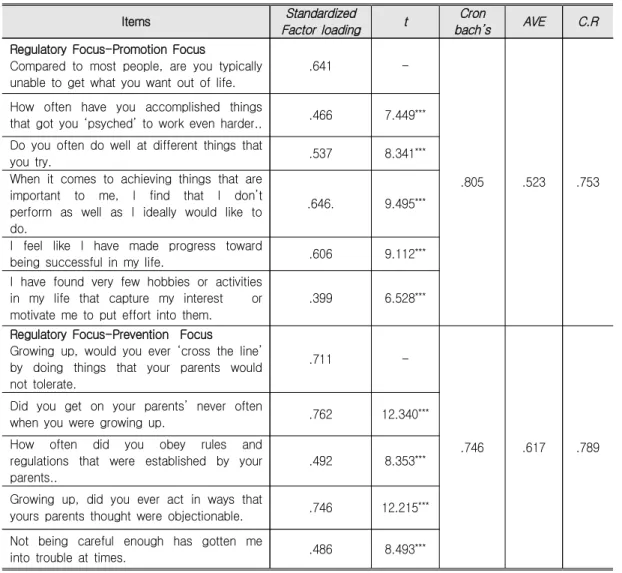
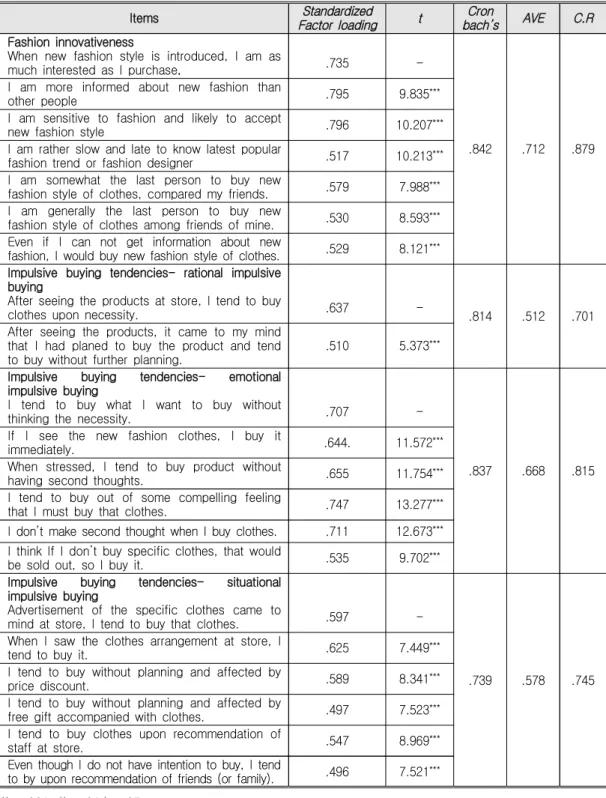
The validity of each variable is analyzed by confirmatory factor analysis and then measured by construct reliability (CR) and average variance extracted (AVE). The summary of the reliability and validity of measured questions is depicted in <Table 1>. The evaluation showed that the reliability of questions for each factor was over .6, which means they are relatively sufficient for hypothesis validation. In general, CR over 0.7 and AVE over 0.5 are considered of being stable, and the ones in this study showed 0.7 and 0.5 respectively, therefore their validity was confirmed. Therefore, it is assessed as appropriate to analyze the interrelationship between factors by using the measured questions. Table 2 shows that squared
correlation estimates of variables confirm the discriminant validity.
In order to find the conceptual structure of factors related to regulatory focus and impulsive buying behavior, a confirmatory factor analysis was conducted. It was found that two items in rational impulse buying and two items in emotional impulsive buying hindered unidimensionality and were removed. After removing those two items, a second confirmatory
Table 1. Reliability and Validity of Items
Items Standardized
Factor loading t Cron
bach’s AVE C.R
Regulatory Focus-Promotion Focus
Compared to most people, are you typically unable to get what you want out of life.
.641 -
.805 .523 .753
How often have you accomplished things
that got you ‘psyched’ to work even harder.. .466 7.449***
Do you often do well at different things that
you try. .537 8.341***
When it comes to achieving things that are important to me, I find that I don’t perform as well as I ideally would like to do.
.646. 9.495***
I feel like I have made progress toward
being successful in my life. .606 9.112***
I have found very few hobbies or activities in my life that capture my interest or motivate me to put effort into them.
.399 6.528***
Regulatory Focus-Prevention Focus Growing up, would you ever ‘cross the line’
by doing things that your parents would not tolerate.
.711 -
.746 .617 .789
Did you get on your parents’ never often
when you were growing up. .762 12.340***
How often did you obey rules and regulations that were established by your parents..
.492 8.353***
Growing up, did you ever act in ways that
yours parents thought were objectionable. .746 12.215***
Not being careful enough has gotten me
into trouble at times. .486 8.493***
factor analysis was performed with the remaining construct concept, resulting in satisfactory goodness of fit. The result of this analysis indicated that regulatory focus can be divided into prevention focus and promotion focus, and again impulsive buying tendencies are divided into rational, emotional impulsive buying as well as impulsive buying affected by marketing stimulus.
Table 1. Continued
Items Standardized
Factor loading t Cron
bach’s AVE C.R
Fashion innovativeness
When new fashion style is introduced, I am as
much interested as I purchase. .735 -
.842 .712 .879
I am more informed about new fashion than
other people .795 9.835***
I am sensitive to fashion and likely to accept
new fashion style .796 10.207***
I am rather slow and late to know latest popular
fashion trend or fashion designer .517 10.213***
I am somewhat the last person to buy new
fashion style of clothes, compared my friends. .579 7.988***
I am generally the last person to buy new
fashion style of clothes among friends of mine. .530 8.593***
Even if I can not get information about new
fashion, I would buy new fashion style of clothes. .529 8.121***
Impulsive buying tendencies- rational impulsive buying
After seeing the products at store, I tend to buy
clothes upon necessity. .637 -
.814 .512 .701
After seeing the products, it came to my mind that I had planed to buy the product and tend to buy without further planning.
.510 5.373***
Impulsive buying tendencies- emotional impulsive buying
I tend to buy what I want to buy without
thinking the necessity. .707 -
.837 .668 .815
If I see the new fashion clothes, I buy it
immediately. .644. 11.572***
When stressed, I tend to buy product without
having second thoughts. .655 11.754***
I tend to buy out of some compelling feeling
that I must buy that clothes. .747 13.277***
I don’t make second thought when I buy clothes. .711 12.673***
I think If I don’t buy specific clothes, that would
be sold out, so I buy it. .535 9.702***
Impulsive buying tendencies- situational impulsive buying
Advertisement of the specific clothes came to
mind at store, I tend to buy that clothes. .597 -
.739 .578 .745
When I saw the clothes arrangement at store, I
tend to buy it. .625 7.449***
I tend to buy without planning and affected by
price discount. .589 8.341***
I tend to buy without planning and affected by
free gift accompanied with clothes. .497 7.523***
I tend to buy clothes upon recommendation of
staff at store. .547 8.969***
Even though I do not have intention to buy, I tend
to by upon recommendation of friends (or family). .496 7.521***
***p<.001, **p<.01,*p<.05
Table 2. The Result of Confirmatory Factor Analysis Promotion
Focus
Prevention Focus
Fashion Innovativeness
Rational I,B.
Emotional I.B.
Situational I.B.
Promotion
Focus .523a
Prevention
Focus .432b .617
Fashion Innovative
ness
.257 .192 .712
Rational
I,B. .051 .010 .052 .512
Emotional
I.B. .254 .223 .267 .031 .668
Situational
I.B .112 .197 .114 .283 .081 .578
a : Average Variance Extracted(AVE)for constructs are displayed on the diagonal.
b : Number below the diagonal are squared correlation estimates of two variables.
2. Validation of Structural Model
A structural modeling analysis was conducted to test the structural model. Table 3 summarizes the goodness of fit of the measurement model and structural model for each factor. The result of the goodness of fit of the measurement model on each factor showed that x2 values are significant at 0.001% significance level, which means the model is not appropriate. However, the validation of x2 needs checking by using another goodness of fit index since as the size of the sample increases, the goodness of fit of the model decreases (Kim, 2001). For the goodness of fit index of this study, values from the Goodness of Fit Index (GFI), Adjusted Goodness of Fit Index (AGFI), Comparative Fit Index (CFI), and Root Mean Square Error of Approximation (RMSEA) fulfill the general evaluation criteria of covariance structural analysis. Therefore, it is evaluated as suitable to analyze the co-relationship between factors by
using measured questions.
The goodness of fit indices of the structural model were x2(df=747)=2169.243, p-value=.000, GFI=.791, AGFI=.759, and RMSEA=.069, which were generally satisfying, and the model was considered to be appropriate to explain the co-relationship between factors that are suggested by this study.
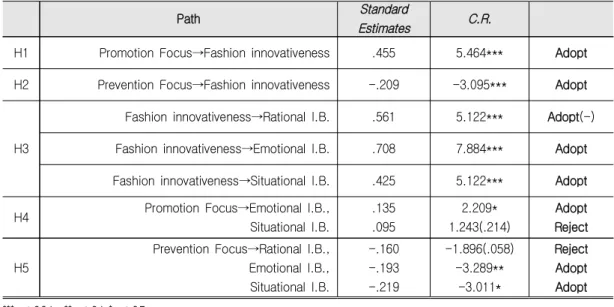
It was assumed that H1 could positively affect fashion innovativeness of customers who have promotion focus in the following Table 4, and empirical analysis result of H1 was selected as a significant level (standardized coefficient
=.455, t= 5.464, p=.000). Therefore it can be interpreted that the more customers have a promotion focus, the higher the fashion innovativeness. On the other hand, H2 assumed that customers who have a prevention focus would show a low level of fashion innovativeness in contrast with customers who have a promotion focus; however, the results of empirical analysis of H2 were selected as a
Table 3. Goodness of Fit Indices for Measurement Models Fit
Index
Regulatory focus
Fashion Innovativeness
Impulse buying tendencies
Total Model
X2 207.611 31.318 460.061 2169.243
df 43 13 98 747
P .000 .003 .000 .000
GFI .904 .961 .872 .791
AGFI .853 .915 .823 .759
CFI .834 .923 .818 .801
RMSEA .098 .091 .096 .069
Initial numbers
of questions 11 7 20
Final numbers of
questions 11 7 16
significant level (standardized coefficient
=.-.209, t=-3.095, p=.000). H3 was about whether fashion innovativeness affects impulse buying tendencies. It is assumed that if fashion innovativeness is high, rational impulse buying would be negatively affected and emotional and situational impulsive buying would be positively affected, and empirical analysis of H3 showed that the higher the fashion innovativeness in customers, the more impulsive buying is affected by rational, emotional and marketing stimulus.
H4 and H5 examine which types of impulse buying tendencies are affected by each regulatory focus. The result of empirical analysis showed that the more customers are promotion-focused, the more customers are affected by emotional impulse buying, whereas they are not affected by situational impulse buying. In contrast, customers who have prevention focus are not affected by rational impulsive buying, but negatively affected by emotional and situational impulsive buying.
These results were contrary to the existing
hypothesis that expected that promotion focus would have a positive influence on emotional and situational impulse buying, whereas prevention focus would have a positive influence on rational impulse buying.
Therefore, the results of this study indicated that the more promotion-focused the customers are, the higher fashion innovative they tend to be, and the latter actually make purchases affected by emotional impulse buying out of other impulse buying tendencies. In contrast, those who have prevention focus ranked low in fashion innovativeness and make purchases less based on emotional and situational impulse buying.
V. Conclusions
This study has attempted to verify empirically that impulsive clothes buying behavior and fashion innovativeness of consumers are affected by regulatory focus which is a psychological
Table 4. Results of Structural Model Testing
Path Standard
Estimates C.R.
H1 Promotion Focus Fashion innovativeness→ .455 5.464*** Adopt
H2 Prevention Focus Fashion innovativeness→ -.209 -3.095*** Adopt
H3
Fashion innovativeness Rational I.B.→ .561 5.122*** Adopt(-) Fashion innovativeness Emotional I.B.→ .708 7.884*** Adopt Fashion innovativeness Situational I.B.→ .425 5.122*** Adopt
H4 Promotion Focus Emotional I.B., → Situational I.B.
.135 .095
2.209*
1.243(.214)
Adopt Reject H5
Prevention Focus Rational I.B., → Emotional I.B., Situational I.B.
-.160 -.193 -.219
-1.896(.058) -3.289**
-3.011*
Reject Adopt Adopt
***p<.001, **p<.01,*p<.05
Figure 2. Results of Structural Model
feature of consumers. The results showed that the conceptual model for impulsive clothes buying behavior is related with the regulatory focus of a customer. According to the derived result, the regulatory focus of a customer is divided into promotion focus and prevention focus; the consumers who have a promotion focus tendency have higher fashion innovativeness,
whereas the consumers who are more prevention-focused show lower fashion innovativeness. Furthermore, those who have higher fashion innovativeness are more likely affected by rational, emotional and situational impulse buying. However, it showed differences from the existing hypothesis in terms of direct effect on consumers who have a promotion
focus or prevention focus in impulsive buying. It is found that promotion focus positively affects emotional impulse buying, which is not affected by situational impulse buying; on the other hand, those who have a prevention focus are negatively affected by emotional and situational impulse buying.
This study verified customers’ individual differences that may be inferred by regulatory focus theory do really exist in an apparel purchasing context since these types of studies have not been previously conducted. Thus, this study is to expand the present knowledge of impulse buying of apparel in consumers and help marketers to understand consumers better.
In conclusion, this study seems to verify that regulatory focus and fashion innovativeness are significant as antecedents of and potential variables to predict consumers’ impulse buying behavior. Secondly, this study suggests a detailed concept of impulse buying behavior by means of analysis from multiple aspects with a regulatory focus in the fashion sector, given that impulse buying behavior has been explained only by a single aspect. Thirdly, it is expected that the findings of this study will contribute to formulating a new mechanism for processing of impulse buying behavior in the fashion industry.
The limitation of this study is that the degree of impulse buying behavior varies depending on age, economic status, and types of fashion products but these factors are not controlled in this mechanism.
Another limitation is that since the subjects of this study are women in their 20s to 40s only, the findings could be difficult to generalize.
Thus, future study is needed to include other variables to predict impulsive buying behavior on clothes products, or to establish a more solid mechanism by comparing other models. Another
possible research area could extend subjects to broader regions or more diverse classes, even differences among countries and cultures.
References
Brakus, J. J., Herzenstein, M., & Posavac, S. S.
(2007). Adoption of New and Really New Product. Journal of Marketing Research, 44(May). 251-260.
Choo, H. J., & Jun, D. G. (2010). A study on the clothing involvement, fashion innovativeness, impulse buying, and brand loyalty of male university students. Journal of the Korean Society of Clothing and Textiles, 34(3), 424-436.
Chung, E. J. (2001). The Effect of Regulatory Focus on Risk Taking. The Korean Journal of Social and Personality Psychology, 25(2), 209-220.
Crowe, E. & Higgins, E. T. (1997). Regulatory Focus and Strategic Inclinations: Promotion and Prevention in Decision-making. USA:
Colombia University.
Forste. J., & Werth, L. (2007). Regulatory Focus Influences Consumer Behavior. European Journal of Social Psychology, 37, 33-51.
Goldsmith, R. E. (2001) Using the Domain Specific Innovativeness Scale to Identify Innovative Internet Consumer. Internet Research, 11(2), 149-158.
Higgins, E. T. (1998). Promotion and Prevention:
Regulatory Focus as a Motivational Principle.
Advances in Experimental Social Psychology, 30, 1-46.
Hoch, S. J., & Rook. D. W. (1985). Consumer Impulses. Advances in Consumer Research, 12. 15-27.
Jeon, D. K.(2007). Effects of Clothing
Consumers' Innate Innovativeness on Fashion Innovativeness and Fashion Adoption (Unpublished doctoral dissertation). Seoul National University, Seoul, Korea.
Jo, E. H., & Lee, B. K. (2009). The Effects of Consumer Innovativeness and Self-regulatory Focus on the Adoption of New Products.
Journal of Advertising, 20(1), 127-143.
Kang, E. M., & Park, E. J.(2001). The Effects of Consumer's Psychological Characteristics on the Impulse buying Behavior of Apparels.
Journal of the Korean Society of Clothing and Textiles, 25(3), 586-597.
Kim, K. S. (2001). AMOS Analysis Structural Equation Modeling. Seoul: Data Solution.
Kollat, D. T., & Willett, R. P. (1967). Consumer Impulse Purchasing Behavior. Journal of Marketing Research, 4(February), 21-31.
Ko, E. J., & Yoon, S. Y. (2004). Impact of Fashion Brand Personality on Brand Preference and Purchase Intention. Journal of Global Academy of Marketing Science, 14, 59-80.
Ko, S. Y. (1993). The Study on the Impulse Buying of Clothing Products. (Unpublished master’s thesis). Seoul National University, Seoul, Korea.
Ko, S. H., & Hwang, S. J. (2011). The Influence of the Suitability of the Chronic Regulatory Focus and the Advertising Message Type on the Evaluation of Beauty Product. Journal of Fashion Business, 15(2), 1-11.
Ko. S., & Yeo. J. (2010). A Study for the Effect of Regulatory Fit on Beauty Service and Product. Journal of Fashion Business, 14(4), 1-9.
Kwon, S. U., Park, J. C., & Ryu, K. S. (2006).
The Effect of Regulatory Focus on the Choice of a Compromise Option. Korea Marketing Association, 21(4), 49-65.
Lee, S. H. (2005). Influencing Factor on Internet Shopping Addiction. Journal of Fashion Business, 9(5), 114-121.
Nam, S. K. (2005). Consumer Self-regulation Model and Impulsive Purchasing Behavior.
Journal of Korean Psychology, 6(3), 61-77.
Park, J. J. (2004). The Impact of the Consumer's Innovativeness on Online Shopping Behavior. Journal of Advertising, 63, 79-101.
Park, J. M. (2004). Consumers' Behavioral Patterns Related to the Compulsive Purchase Disposition. The Korean Journal of Advertising and Public Relations, 6(1), 39-74.
Rhee, E. Y. (1997). Fashion Marketing. Seoul:
Kyomoonsa.
Rhee, Y. J. (2007). A Study on the Relationship Between Risk Dimensions of Apparel Involvement and Online Impulse Buying Behavior. Journal of the Korean Society of Clothing and Textiles, 28(2), 348-359.
Stern, H. (1962). The Significance of Impulsive Buying Today. Journal of Marketing, 26(2), 59-62.
Suh, Y. H. (2013). The Moderating Effects of Clothing Consumer’s Regulatory Focus on the Relationship Between Shopping Experience and Impulse Buying. Management Information Systems Review, 32(2), 237-257.
Yang, Y. (2002). The Differences in Consumer Innovation and Information Acquisition Behavior based on Impulse Buying Tendency.
Journal of Advertising, 57, 53-74.
Received (July 1, 2015)
Revised (August 31, 2015; October 8, 2015) Accepted(October 14, 2015)