Migration Policies of a Main Memory Index Structure for Moving Objects Databases
Kyounghwan An and Kwangsoo Kim Telematics Research Division,
Electronics and Telecommunications Research Institute, 161 Gajeong-dong, Yuseong-gu, Daejeon, 305-350, Republic of Korea
{khan, enoch}@etri.re.kr
Abstract: To manage and query moving objects efficiently in MMDBMS, a memory index structure should be used. The most popular index structure for storing trajectories of moving objects is 3DR-tree. The 3DR-tree also can be used for MMDBMS. However, the volume of data can exceed the ca- pacity of physical memory since moving objects report their locations continuously. To accommodate new location reports, old trajectories should be migrated to disk or purged from memory. This paper focuses on migration policies of a main memory index structure. Migration policies consist of two steps: (i) node selection, (ii) node placement. The first step (node selection) selects nodes that should be migrated to disk.
The criteria of selection are the performance of insertion or query. The second step (node placement) determines the order of nodes written to disk. This step can be thought as dynamic declustering policies.
Keywords: LBS, Moving Object, Main Memory Database.
1. Introduction
Recently, the need for LBS (Location Based Services) is increasing due to the widespread of mobile computing devices (e.g. PDA, cellular phone, and notebook com- puter) and positioning technologies (e.g. GPS and RFID).
There are many applications that need to manage and query a large number of “moving objects” in LBS. Since the moving objects should report their locations fre- quently, a database system should be able to handle a huge number of updates and queries efficiently. In such an environment, traditional disk-resident DBMSs cannot be used since the number of updates and queries exceeds the capacity of the disk. To overcome the limitation, main memory resident DBMSs (henceforth MMDBMS) should be used to manage moving objects.
In MMDBMS, to manage and query moving objects efficiently, a memory index structure should be used.
There were several index structures for moving objects databases [4, 5]. The most popular index structure for storing trajectories of moving objects is 3DR-tree. How- ever, if the index structure is used in MMDBMSs, the volume of data can exceed the capacity of physical memory since moving objects report their locations con- tinuously. To accommodate new location reports, old trajectories should be migrated to disk or purged from memory.
This paper focuses on migration policies of a main
memory index structure. Migration policies consist of two steps: (i) node selection, (ii) node placement. The first step (node selection) selects nodes that should be migrated to disk. The criteria of selection are the per- formance of insertion or query. The second step (node placement) determines the order of nodes written to disk.
This step can be thought as dynamic declustering poli- cies. By using suggested migration policies, we can ob- tain following advantages. First, a main memory index structure can store location reports continuously without stopping the system. Second, the performance of inser- tions and queries can be improved.
The remainder of this paper is organized as follows. In section 2, we examine related works. In section 3, we define the problems when migrating nodes to disk and section 4 presents migration policies that consist of two steps. A summary of the paper is presented in section 5.
2. Related Works
There were studies on storing data separately in differ- ent media [1] and migrating data [2, 3] according to the volume of data, the frequencies of use, and the restric- tions on processing data.
The study [1], which stores data in different media, stores hot data in main memory based DBMS while cold data in disk based DBMS. For example, bank applica- tions may store account information in main memory while customer information in disk. However, it can not handle the situation if data accumulate over time and exceeds physical memory capacity.
The study [2], which migrates nodes, stores current data (nodes) in disk while migrates past data (nodes) into optical media. Time-Split B-tree in [2] migrates a node into optical media when a node splits in time axis. Since it migrates a node at a time it cannot be applied to our environment which requires minimum disk I/O. Also, it is inefficient in main memory environment since there exist repeated data in the nodes.
The study [3], which migrates data, migrate data into different media according to the semantic of data by ad- ministrator or DBMS. However, it does not suggest the method migrating index nodes.
3. Problem Definition
Migration policy migrates part of main memory index from memory to disk when the volume of index structure exceeds given limitation. After the migration, nodes ex- ist both in main memory and in disk. In this section, we define the problems when migrating nodes into disk.
1) Pointers in nodes
Since nodes can exist both in main memory and in disk after migration, a node can have two physical pointer types: (i) main memory pointer, (ii) disk pointer.
Logical types of pointers can be classified into four cate- gories according to the direction they point.
Table 1. Logical Types of Pointers
Direction Name of Pointer Memory à Memory m2m pointer Memory à Disk m2d pointer Disk à Memory d2m pointer Disk à Disk d2d pointer
When a memory resident node (henceforth memory node) points to other memory node, it is called m2m pointer. Usually main memory based indices have m2m pointers. When a disk resident node (henceforth disk node) points to other disk node, it is called d2d pointer.
Usually disk based indices have d2d pointers. When a node points a node of other type, it is called m2d or d2m pointers. Two pointers are new types that do not exist in the previous indices. In those pointers, d2m pointers have the following problems.
a
b m2d
d2d
d2d d2m
m2m
Memory node Disk node
Fig. 1. Problem of d2m pointer
First, after parts of the nodes migrate to disk by migra- tion policies (in Fig 1, nodes of dotted line), several types of pointers can exist. In Fig 1, there is a d2m pointer. The d2m pointer has the following problems.
First, if node b should be migrated to disk, node a should be loaded into memory to update a pointer. Second, if node b should be referenced by a query, node a should be loaded before accessing node b.
It is inefficient to load a disk node to access a memory node. To prevent the situation, migration policy should consider avoiding d2m pointers.
2) Migration
A migration policy should minimize disk I/O when migrating nodes into disk or referencing disk nodes by queries. Also it should operate non-blocking mode since location reports should be processed in a limited time constraint. To achieve the goals the followings are should be considered.
§ Migration Time
Main purpose of migration policies is to ensure mem- ory space when location reports are inserted into an in- dex structure. If free memory space is below the given threshold, migration of nodes from memory to disk should occur. Migration time depends on both the threshold and granularity of migration.
§ Node Selection
Selecting a candidate node for migration is important since it affects the query performance. If queries access disk nodes frequently, the performance will deteriorate.
It would be better to choose nodes that will not be refer- enced by queries. In general, more recent trajectories will be referenced frequently than old trajectories. Node selection algorithm should consider the properties of moving objects databases.
§ Granularity of Migration
If migration policy writes a node at a time, the system will suffer from disk I/O. Thus, it is necessary to write several nodes at a time. If granularity is large, more memory space will be needed since the memory space that is occupied by migration nodes can not be used for insertion algorithm of index structure. However, large granularity will be more efficient when loading nodes into memory since some dynamic clustering will be ap- plied while migrating nodes.
4. Migration Policies
1) Steps of Migration Policies
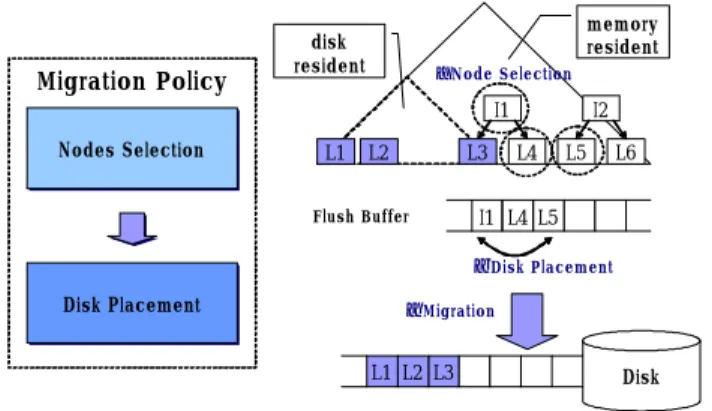
The following figure shows the steps of the migration policies.
Migration Policy
Nodes Selection Nodes Selection
Disk Placement Disk Placement
L1 L2 L3
I1 I2
L5 L6 L4
L1 L2 L3 Disk
memory resident disk
resident
I1 L4 L5
•Node Selection
‚Disk Placement ƒMigration
Flush Buffer
Fig. 2. Migration Policy
When free memory space is below given threshold,
migration occurs. The first step of migration policy is to select candidate nodes to migrate. If nodes are selected, the second step is to rearrange nodes in flush buffer to improve query performance. Finally, rearranged nodes are written to disk. Before the final step, pointers are translated from memory pointers to disk pointers. All steps operate in a non-blocking mode by flush daemon.
Node selection policy and disk placement policy can be tightly coupled or loosely coupled. It means nodes can be selected considering disk placement or not.
2) Node Selection Policy
There can be several methods to select candidate nodes. To avoid d2m pointer, node selection policies should not select a node until all child nodes become disk resident. Figure 3 shows the example.
candidate node
Fig. 3. Principle of Node Selection
In fig 3, although a non-leaf node is selected as a can- didate node, it cannot be migrated to disk since it has child nodes that reside in memory. If the candidate node migrates to disk, d2m pointers will be generated. Node selection policy should proceed until it finds a node that does not make d2m pointers.
In this paper, we suggest three node selection policies that follow above principle.
§ NSP1: Selection by Creation Time
The first node selection policy is to choose a node ac- cording to the creation time of a node. Since it is sim- plest approach, there is no overhead when selecting nodes.
§ NSP2: Selection by Node Time
The second node selection policy is to choose a node according to the time value of node’s MBB. Since the probability of referencing a node is not by the creation time of a node but by the time value of MBB, it is more appropriate to take this approach. To select a candidate node, it traverses index structure until it finds a node which has oldest time value of MBB.
§ NSP3: Selection by LRU
The final approach is to choose a node according to LRU policy. In this approach, a least recently used node is selected. This approach can be good if insertions and queries are made on main memory. However, it can be inefficient if insertions and queries are made on disk since it may not be good for the disk placement policy.
3) Node Placement Policy
There can be several methods to place candidate nodes into disk. The purpose of node placement policy is to reduce disk I/O when queries are made on disk resident nodes.
In this paper, we suggest two node placement policies.
§ NPP1: Ordering by Node Selection
The first approach is to order nodes by the order of node selection. This approach can be used if there is low probability of selecting disk resident nodes. This ap- proach can be very inefficient if there are many chances to reference disk resident nodes (old trajectories).
§ NPP2: Ordering by Index Structure
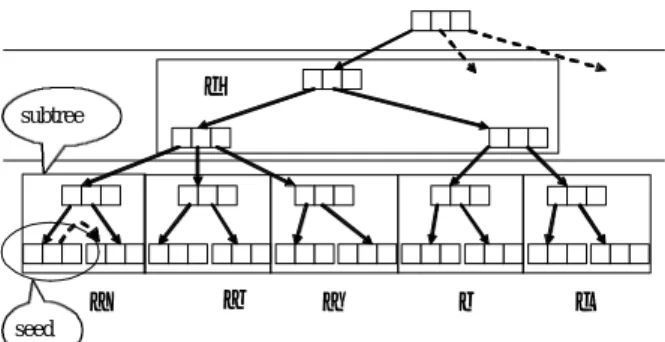
This approach is to order nodes according to index structure. This approach is good when there are many chances to reference disk resident nodes. Since it is pos- sible to load several nodes at a time (bulk loading), disk I/O time is reduced than other approach. In this approach, the granularity becomes subtree. The following figure shows the example.
• ‚ ƒ „ …
†
seed subtree
Fig. 4. Ordering by index structure
In fig 4, granularity of migration is decided as two level of the tree (deciding granularity is explained later).
If a seed node is selected, a subtree is decided containing the seed node. After the subtree is decided, nodes are ordered from parent node to child nodes according to the order of breadth first search.
4) Migration Time
Migration occurs when free memory space becomes under given threshold. Following formula explains mi- gration time.
) 1 ( )
(
1
0
≥
×
−
≥
∑− ×
=
α α S N
U M F
p h
n
n (1)
In formula (1), let h be the tree height, F be fanout, and U be node utilization. M means free memory space, Sp means a size of one page, N is the number of page that is needed to migrate (granularity). α (stability fac- tor) means the number of free space for migration. The more α becomes greater, the more the system will oper-
ate stable.
5) Granularity of Migration
Granularity of Migration (N) is determined to prevent the system from blocking. To guarantee stable operation of the server, the number of moving objects and the fre- quency of reporting locations should be considered. The following equations give us the granularity of migration.
Let m be the number of moving objects to be managed and Ti be the interval of reporting locations. Then λ is reporting rate and shown in eq. (2).
∑=
= m
i 1Ti
λ 1 (2)
Let F be the fanout of the tree and U be the utilization of the tree. N is the number of page needed to migrate and we want to obtain its value. The rate of accessing disk (W) is expressed in eq. (3).
N U W F × 1
= ×λ
(3)
Let Tseek be the time for seeking right position in disk and Ttransfer be the time for transferring one page. Then N (granularity) should be determined by the following formula.
1 )
( + × ≤
×
=W Tseek N Ttransfer
C (4)
6) Structure of Nodes
After the migration, an index structure can have sev- eral types of pointers. To distinguish pointers, we use bitmap indicating the type of a pointer in the head of a node. When search algorithm traverses the tree, it uses bitmap information.
pointer type
bitmap MBB ptr
Header Entry
(a) Non-leaf node
id MBB
Entry
orientation
(b) Leaf node trajectory # node
type
node type Header
Fig. 5. Structure of a Node
In case of the leaf node, the structure is similar to that of STR-tree[4]. It has ID of line segment in a trajectory, three dimensional MBB (Minimum Bounding Box), and orientation of the line segment.
In case of the non-leaf node, pointer type bitmap is in-
cluded. Pointer type bitmap indicates the types of point- ers in the entries.
In case of both non-leaf node and leaf node, node type field is included in the header. It indicates whether the node exist in memory or both memory and disk. A node exists both in memory and disk when it is loaded from disk by a query. Migration occurs when a node exist only in memory.
5. Conclusions
Moving objects reports their locations continuously over time. Since the volume of trajectories can be large to be stored in main memory, part of index structure should be migrated to disk. In this paper, we suggested migration policies that consist of two steps: (i) node se- lection, (ii) disk placement.
By using our algorithm, we can achieve the following things. First, main memory based moving objects data- base can operate continuously without blocking the sys- tem. Second, when insertions and queries are made on main memory and disk, it can process it efficiently since node selection and disk placement considers the per- formance. Our further work is to implement the system and compare the performance of suggested algorithms.
References
[1] D.Gawlick and D.Kinkade, “Varieties of concurrency control in IMS/VS Fast Path,” Data Eng. Bull., vol.8.no.2,pp.3-10, June 1985
[2] D. Lomet and B. Salzberg, "Access Methods for Mul- tiversion Data", Proc. of SIGMOD, 1989
[3] M.Stonebraker, “Managing persistent objects in a multi- level store,” in Proc. ACM SIGMOD Conf., Denver, CO, May 1991, pp2-11
[4] D.Pfoser, C.S.Jensen, and Y.Theodoridis, “Novel Ap- proaches in Query Processing for Moving Objects,”In Proc.of the VLDB Conference, pp.395-406, 2000 [5] N.Beckmann, H.-P.Kriegel, R.Schneider and B. Seeger,
“The R*-tree: An efficient and robust access method for points and rectangles,” Proceedings of ACM SIGMOD Int'l. Conf. on Management of Data, pp. 322- 331, 1990
[6] Güting, R., Böhlen, M., Erwig, M., Jensen, C.
S.,Lorentzos,N.,Schneider, M., and Vazirgiannis, M.: A Foundation for Representing and Querying Moving Ob- jects. ACM Transactions on Database Systems, to appear, 2000
[7] Hector Garcia-Molina and Kenneth Salem. Main memory database systems: An overview. IEEE Trans. Knowledge Data Eng., 4:509-516, 1992
[8] Li Chen,Rupesh Choubey and Elke A.Rundensteiner,
“Merging R-Trees: Efficient Strategies for Local Bulk In- sertion”, Geoinformatica Volume6 Issue1, 2002
[9] T.J.Lehman and M.J.Carey,”A Study of index structures for main memory database management systems,” in Proc.12th Conf. on VLDB,Aug.1986