소형 해양조사 부이 Hull에 대한 설계
손나나*․박수홍**
Hull Structure Design of a small scale Oceanographic Buoy
NaNa Sun
*․Soo-hong Park
**요 약
소형스케일용 해양부이를 위한 hull설계부분을 소개한다. hull구조설계와 부이의 모든 부분을 연결하는 설계 부분에 대하여 연구하였으며, 주로 부이의 hull설계내용을 순차적으로 소개한다.
전체적인 강도와 충돌저항력을 향상시키는 방법으로 부이를 지지하는 2층 및 반지름방향의 주요구조와 함 께 내벽을 이용하여 설계를 수행하였다.
ABSTRACT
Hull design for a small scale Oceanographic buoy will be introduced in this paper. The hull structure design, the connection methods between all parts will be discussed. We mainly introduce a design process of this buoy hull. We use walls with two layers and a radial bone structure to support the body to increase overall intensity and capacity to resist impact.
Key Words
Oceanographic buoy, radial bone structure, center pipe, side bones
* 동서대학교([email protected])
** 교신저자: 동서대학교 메카트로닉스공학과([email protected] )
Ⅰ. INTRODUCTION
SOUTH Korea is a country surrounded by sea in three sides. This country has a large sea area.
A marine environmental survey system is needed to get information including wind speed, wind direction, air temperature, air pressure, relative humidity, rainfall, visibility, wave height, ocean currents, water temperature, etc.
The current research methods for coastal studies include research cruises, manual data collection, and autonomous vehicles. However, research cruises are very costly, time consuming, low efficient, and
environmentally disastrous. A research vessel cannot enter the shallow waters of the coastal regions and in order to launch a research cruise requires an immense amount of money, time, and resources [1].
With the development of maritime communication techniques and data transceiver equipment, this kind of system can be well designed nowadays. As a requisite, a carrier which can supply a platform to carry these equipments will be designed in this research. This carrier is called a marine buoy system.
Marine buoy system has some common functions
and characteristics with ocean shipping system but also has a lot of different sides. They all work in the ocean or other offshore environment but buoy is commonly much smaller than a vessel in the outer dimensions. Buoy system has advantage of low-cost and easy to use. The manufactory of small scaled buoy is around 50 years [2]. It needs new technology and experience. Especially in South Korea, this is still a new area with a large potential to be developed.
Ⅱ. Objective
Hull design for a small scale Oceanographic buoy will be introduced in this paper. The hull structure design, the connection methods between all parts will be discussed. The final objective is to design this buoy hull system to fit the environment well in any weather situation and to optimal the design process. Depending on different requirements, buoy system will have different outlook structure. Among all kinds of buoy, hull is the most important part. It will be used as the storage of various equipments, including the batteries, control boxes (main board box, data logger box, and combine box), and sensor cables, etc. Besides, buoy hull is the connection of upper buoy mast and buoy pillar in the bottom. Buoy hull is the main source of buoyancy. The stability of buoy which directly influences whether a buoy can work normally in the offshore environment is definitively decided by the design of buoy hull.
Therefore in this research, we will focus on the structure design of marine investigation buoy hull and make some analysis about the design process.
Ⅲ. Design Process
1. Design platform Introduction
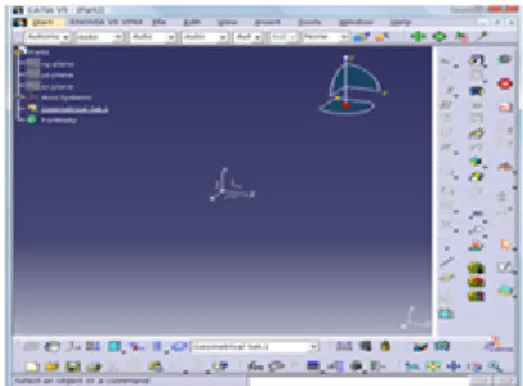
CATIA (Computer Aided Three-dimensional Interactive Application) is a multi-platform CAD/CAM/CAE commercial software suite developed by the French company Dassault Systems and marketed worldwide by IBM. Written in the C++ programming language, CATIA is the corner stone of the Dassault Systems product lifecycle management software suite [3].
Fig. 1 Catia V5R19 part design module user’s interface
2. Buoy Hull section
Divided by the outer shape of buoy hull, buoy is divided to cylindrical, boat-shaped, spherical and disc-shaped. Among all types of outer shape structure, we choose structure with solid of revolution shape as the hull shape because it has the characteristics of:
1) A large area of the water panel, a large Moment of Inertia (MI) of section plane at waterline and a relatively high meta-centre;
2) This kind of structure makes buoy have a relatively larger displacement;
3) This structure makes the buoy structure much stronger and enhances the ability of anti-collision;
4) A larger deck and cabin area. Researchers
can easily work on it and it is also more
convenient for the towing and transportation [4].
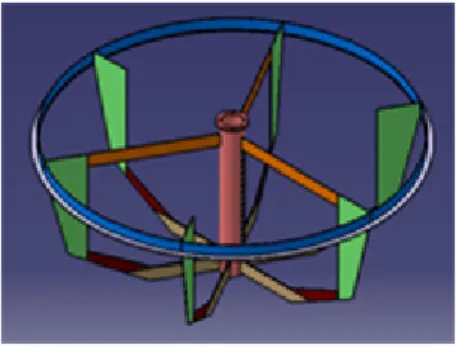
3. Three Dimensional Modeling Building Here the bellowing is a cylinder-shaped hull without top deck. It has two walls-the outer wall and the inner wall. The outer wall as the primary shell of buoy will decide the geometry of buoy. It will withstand the longitudinal bending strength, water pressure, wave impact and other external forces. The structure system of two separated walls can increase capacity of withstanding all these forces. There suppose to be three batteries depending to act as the power supply on the requirement of equipment system. The batteries, boxes and sensors will be setting in the room of inner hull. The height of buoy hull is decided considering workers need to work inside. All design works are based on the design principle to make the convenience of workers be maximum. This kind of buoy hull has a structure of radial bones. The centre pipe is the pipe bracket of water temperature sensor. It is here acting as the supporting base pillar throughout the whole buoy hull in the height direction in order to catch the water temperature data directly. The other support bone structure will be divided from the centre to the inner cylinder surface, becoming a radial shape. The top bone will be connected to the centre pipe and the inner wall.
Fig. 2 The buoy hull without a top deck
structure is made up with brackets of three layers. The centre pipe is the structure centre at the same time acts as the water temperature
sensor bracket. The top bones which are made of three bars connect centre pipe, inner wall and the side bones. The side bones as well are made up with three layers. The top layer is six plates with a vertical edge in the inside direction, which is convenient to support the inner wall. In order to connect with the outer wall, they have a sloping outer edge with the same inclination of outside wall. All of the three side bones have the same have the same inclination respectively with the shape of the outer wall. In short, the side bones will connect the outer wall and inner wall, therefore, the angles of both sides will be the same with their connections.
Fig. 3 Data flow of structure design and establishment of database catalog
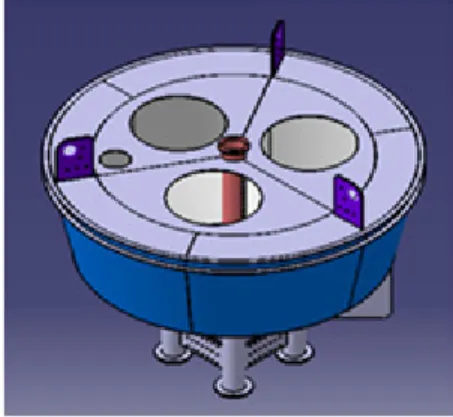
The top deck has three big holes made as the
hatch holes. A smaller hole here is made as the
cable way hole. Cable from the mast system will
be throughout the cable way to the batteries and
control boxes to supply power and make controlling
work.
Fig. 4 Buoy hull with three holes
The hatch wall must be 150 mini-meters higher than the deck plane in order to be watertight. The diameters of hatch inner hole must be larger than 850 mini-meters for assembly of equipments and the ease of human operation.
Fig. 5 Buoy hull over all view
The whole buoy hull structure is a revolution-shaped structure.
Bottom pillars are mainly made of several pipes to support the hull and mast on ground. In the bottom of pillars, a connection structure will be usually used to connect the buoy body with mooring lines.
In case that the buoy hull crash in the ocean or river with the other ship or floating object, we assemble a round rubber guard at the top side of the hull.
There are four legs in the bottom of buoy hull to support the whole body when the buoy is placed on land. In the middle of the legs, there are two cross plates, to enhance ability of the pillars to support the buoy. The function of key structure at the bottom of hull is to keep the balance of the entire system.
Ⅳ. Establishment of Database based on CATIA
The oceanographic buoy has a large amount of parts and features which will take a lot of time of designers to do the duplicated work. It is very time consuming and low efficient. Many of the parts and features have similar properties and shape.
Sometimes, a change of one or two dimensions will change one part to another. In the process of buoy hull design, we can invoke this method and build a part library for these parts.
Buoy structure usually contains numerous of similar parts and features. In order to reduce duplication of manual labor, it is necessary to do a structure analysis to the entire buoy structure, sort the parts and features with the similar property and put them into the same database. CATIA V5 provides a well enough function to build the database catalog library.
Here is a data flow chart about buoy structure design and the establishment steps of part database catalog library with a typical feature.
The steps are:
1) Build the standard three dimensional model in the relative function module and save as a file with the file extension .CATPart.
2) In order to realize parametric design
processing. We use formula command to set the
parameters, variables and relationship between the
geometric dimensions and parameters based on
requirement of relative geometric parameters.
3) Using the parameters we created in step 2, we create a design table relative with the model file and generate a series of multi-dimension standard parts with the same type.
4) Create a new catalog file, input the model file with design table and add description information to these parts to generate a catalog file. In order to realize preview and invocation, using the library browser to browse new catalog file.
Because CATIA V5 already provides a default database catalogs, we did a research to these catalogs and found we can make modification to these default database catalogs easily and in very small scale in actual operation. Hence, we concluded a method to modify the interactive default database by modifying the object editor of software. In this method, we can directly supply the required buoy structure plates and profiles to complete the hull plates and profiles database development. The detail steps are:
1) Modify the physic properties of marine material or add new material by doing modification of Structure Materials. CATMaterial file.
2) Increase and reduce the thickness by modifying the thickness table files.
3) Modify thickness of sheet plate and cross section of profiles in database file Structure Material Specifications.catalog. Open external link file and save it.
4) If a profile that is not in the default catalog is needed, we must create a new part file in CATIA, hence then link it to the database.
CATIA supplies a powerful management platform to create new databases for offshore structure design. If necessary, according to the needs of enterprises, it is possible to build their own structure database and share it with the other designers.
Such as the design for a deck plate in the oceanographic buoy design above, diffident buoy have different plates and with different dimensions
but the same shape and features. We take the design process of a deck for an example and apply this method to all the design process.
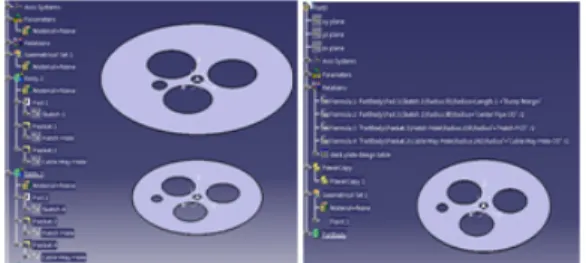
The work below is about a deck design (figure 9). This deck has three hatch holes for hatches one center hole in the center for water temperature sensor bracket, and one cable way hole for cable way bracket. We use formula command to define parameters about deck diameter, hatch hole diameter, center pipe home diameter and other features, use relations to make the whole model parametric designed, use design table to set the variables of different kinds of deck and power-copy to make the design model instantiated. The structure tree in figure 3 made a clear record about the building of database catalog.
Fig. 6 Deck of an Oceanographic buoy and Instantiate from document and browse model from catalog
One of the most important points in this process is that we should create inputs for the model. It needs a referring feature when browsing from documents. This referring features maybe a point, a plane, or a coordinate system. It depends on the actual situation.
In this deck design, we build a new coordinate
in the new product, choose it as the new input and
choose another set of data in design table. As a
result, the new deck comes out as the below figure
3. In order to make result comparable, we invoke
two set of data in different parameters in design
table and put them in the same product.
about the Oceanographic deck. This is only an example of various parts in buoy design. If we apply this kind of design method to the entire design process, it will improve the design efficiency greatly.
Ⅴ. Conclusion and Future Work
CATIA V5 is intelligent design software.
Through the building of a structure product library in this research, the new way to catalog development is found and make a reference to the practical application. Designers need not to build another part from the very first step to the end if this part has a similar outside structure properties with the existing parts. If they have not exactly but only several similar properties, it's also possible to invoke these standard parts. Besides, based on it, it is possible to change the relations between parts or other parameters and make it become a new part.
Research in this area is the necessary for offshore buoy design. In this research, we accumulated a very important design experience.
There are still various of further studies needing us to do. Such as the simulation of this buoy system, the stability of buoy in the fluid environment, and the economic benefits. In the future study, we will do a deeper study in this area.
감사의 글
본 논문은 지식경제부 동남경제권 기술개발사업인 2010년도 차세대 소형선박용 디지털 레이더 시스템 개발사업으로 (주)신동디지텍 및 마린크래프트의 지 원으로 이루어졌습니다.
Reference
[1] Adam Stuart Outlaw, "Computerization of an Autonomous Mobile Buoy", Florida Institute of Technology, May, 2006.
[2] Google image,"OCG site map", 2010.
[3] Wikipedia, "catia, wiki" , 2010.
[4] Baidu Wenku, "Small oceanographic
environmental observing buoy", Beijing press, 2009.
[5] GuBing, Liu Yong, " CATIA Knowledge ware-based Intelligent Design of Standard Parts", Beijing press, 2009.
[6] Zhou XinGen,"Application of CATIA V5 in ship structure design", KwangDong press, 2008.
저자 소개
손나나(Nana Sun)
2008년 중국심천대학교 기계설계 공학과 졸업 (공학사)
2011년 동서대학교 대학원 메카트 로닉스공학과 졸업(공학석사)
※ 관심분야 : 기계산품설계, 구조해석
박수홍(Soo-hong park)