• 검색 결과가 없습니다.

Development of Metal Recovery Process for Municipal Incineration Bottom Ash (MIBA)

N/A
N/A
Protected

Academic year: 2021

Share "Development of Metal Recovery Process for Municipal Incineration Bottom Ash (MIBA)"

Copied!
5
0
0

로드 중.... (전체 텍스트 보기)

전체 글

(1)

≫ 연구논문 ≪

Development of Metal Recovery Process for Municipal Incineration Bottom Ash (MIBA)

§

Ryota Kuroki*, Hitoshi Ohya*, Kazumasa Ishida** and Kenichi Yamazaki**

*The University of Kitakyushu, 1-1, Hibikino, Wakamatsu-ku, Kitakyushu City, Fukuoka, Japan

**Maruya Co. Ltd., 2-15, Torigoshimachi, Kanda-cho, Kyoto-gun, Fukuoka 800-0311, Japan

Abstract

The utilization of incineration ash from municipal waste must be promoted to solve the social problem on the shortage of final disposal site. In this research, metals should be recovered to avoid the damage of the crushing machine during the utilization of incineration ash in cement industry. In fact, incineration bottom ash from municipal waste contains iron in 3-5%. Nonferrous metal and stainless steel in 1% is also included. The research and development on the physical recovery process was performed not only to remove the metals but also to recover high grade products. Metals were separated from incineration ash in Maruya Co. Ltd.. In fact, iron scrap recovered by magnetic separation can be selled. After that, mixed metal was separated from incin- eration ash using screen. In this research, mixed metal tried to divided copper, aluminum, brass and stainless steel using drum type magnetic separation, eddy current separation and high magnetic separation. As a result, recovered iron had an 80% for the grade. Aluminum was recovered by eddy current separation without copper and brass.

Key words : municipal waste, incineration bottom ash, metal recovery, physical separation, mixed metal

1. Introduction

Municipal waste of 44.32 million tons a year is generated in Japan. The 76% was incinerated

1)

. Incine- ration ash is divided into bottom ash and fly ash. Fly ash contains heavy metals, which must be strictly treated for neutralization of the landfills. Most of bottom ash is sent to final disposal site because it does not contain high fraction of heavy metals. As a result, life of final disposal site is about 20 years

1)

, so it is necessary to extend their life. For that reason, bottom ash is used as raw materials in cement industry.

Incineration bottom ash from municipal waste contains iron in 3 ~ 5%. Nonferrous metal and stainless steel in 1% is also included

2)

. The metals in bottom and fly

ash were tried to be detected or collected in the previous research

3,4)

. In this work, the research and development on the physical recovery process was performed not only to remove the metals but also to recover high grade products.

2. Experimental

Metals were collected from incineration ash in Maruya Co. Ltd.. In fact, iron scrap recovered by magnetic separation can be sold. After that, mixed metal was separated from incineration ash using screen. In this research, mixed metal tried to be divided to copper, aluminum, brass and stainless steel using a drum type magnetic separation, an eddy current separation and a

· Received : March 18, 2019 · Revised : April 10, 2019 · Accepted : May 22, 2019

§
Corresponding Author : Hitoshi Ohya (E-mail : [email protected])

Department of Environmental Engineering, The University of Kitakyushu, 16-1 Hibikino, Wakamatsu, Kitakyushu city, Fukuoka 808- 0135, Japan

ⓒThe Korean Institute of Resources Recycling. All rights reserved. This is an open-access article distributed under the terms of the

Creative Commons Attribution Non-Commercial License (http://creativecommons.org/licenses/by-nc/3.0/), which permits unrestricted

non-commercial use, distribution and reproduction in any medium, provided the original work is properly cited.

(2)

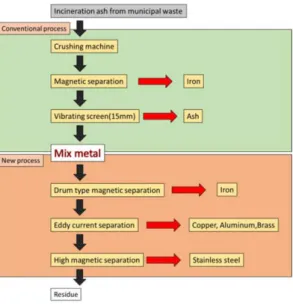
high magnetic separation (Fig. 1).

Four different samples from different areas and incineration methodology were selected and are donated in Table 1. In this work, incineration bottom ash was used in the Iizuka City, this incinerator was a fluidized bad furnace. The incinerator in Okawa City was a stoker furnace. Optical sorting was added in the separation experiment flow to separate the remaining metal. A vibrating screen was also added to recover stainless steel of high grade. The improvement process is shown in Fig. 2.

The recovered material was analyzed to calculate the

grade using X-ray fluorescence spectroscopy.

3. Results and Discussion

The recovered materials are shown in Table 2. The recovered materials were analyzed on the grade using X-ray fluorescence spectroscopy to obtain the composition Fig. 1. Separation experiment flow.

Fig. 2. Separation experiment flow (Improvement process).

Table 2. Recovered materials and mass fraction

Separation method Recovered materials Recovered component Mass fraction [%]

1 2 3 4

Magnetic separation Magnetic material Iron 2.67 3.00 2.15 4.58

Vibrating screen 15 mm under Ash 87.0 91.6 95.6 76.3

Drum type magnetic

separation Magnetic material Iron 2.00 0.550 0.266 2.08

Eddy current separation Flying material Aluminum, Copper,

Brass 3.67 0.850 0.0594 7.50

High magnetic separation Magnetic material Stainless steel 3.00 1.05 0.387 4.58

Optical sorting Flying material Mix metal 0.210 2.08

 Residue Grass, ceramics waste 1.67 2.95 1.33 2.92

(3)

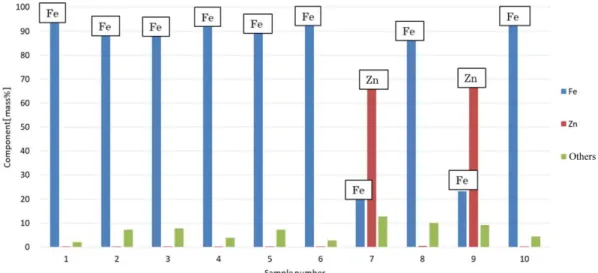
of the materials. Most of the samples were iron except for sample 7 and 9. Zink was detected in sample 7 and 9 but it is the zinc from the zine steel plate used to put the sample. Magnetic separation was effective to recover iron in high grade from MIBA.

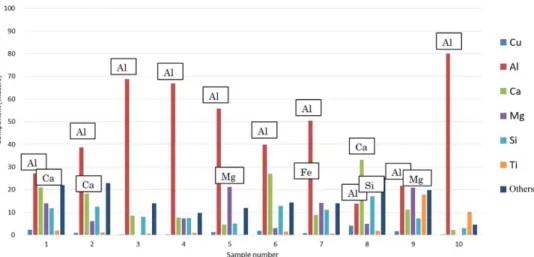
The analysis result of magnetic fraction component recovered by drum type magnetic separation is shown in Fig. 4. It is worth to note all metals were recovered by drum type magnetic separation. Aluminum was detected in sample 3. Copper was detected in sample 7. Sample 1, 8 and 9 must be stainless steel because

chromium was detected with iron. This separation method was not effective to recover iron.

The analysis result of flying component recovered by eddy current separation is shown in Fig. 5. In all the samples, high aluminum content was detected. On the other hand, these flying fractions did not contain copper and brass. Aluminum was able to be collected for frying substance without copper and brass.

The analysis result of the magnetic fraction recovered at 30 mm above by high magnetic separation is shown in Fig. 6. Moreover, the material recovered at 30 mm Fig. 3. XRF analysis result of magnetic material recovered by magnetic separation.

Fig. 4. XRF analysis result of magnetic material recovered by drum type magnetic separation.

(4)

Fig. 6. XRF analysis result of magnetic material recovered by high magnetic separation (30 mm above).

Fig. 7. XRF analysis result of magnetic material recovered by high magnetic separation (30 mm above).

(5)

under is shown in Fig. 7. Iron and chromium were detected in all samples above 30 mm. High grade stainless steel can be collected in the 30 mm screen process.

However stainless steel was contained in the samples in samples under 30 mm. The recovery rate of stainless steel is a future subject would be controlled by the size of samples.

4. Conclusions

Magnetic separation was effective for recovering iron from municipal incineration bottom ash (MIBA). Magnetic material recovered by drum type magnetic separation contained dry batteries and other substances. This separation method was not effective to recover iron.

Copper, aluminum and brass are typically collected by eddy current separation. Copper and brass were not detected in the analysis of these flying materials.

Aluminum was able to be collected for frying substance without copper and brass.

Ceramic waste was included in the magnetic material recovered by high magnetic separation because of the trajectory. This ceramics waste was smaller than stainless steel. High grade stainless steel could be recovered by using a 30 mm screen. In addition, this metal recovery process can separate stainless steel in a mix of metals and obtain it in high grade.

References

1. Waste disposal technology processing information, Min- istry of the Environment, http://www.env.go.jp/recycle/

waste_tech/ippan/index.html

2. FY2013 Kitakyushu City Environmental future technol- ogy development grants FS finalized report, Maruya Co.

Ltd. 2014.

3. H. Yamamoto, T. Yokoyama, K. Oshita, M. Takaoka, and N. Takeda, 2007 : Journal of Material Cycles and Waste Management, 18, pp.314-324.

4. K. Nakahara, M. Tada, H. Yamamoto, T. Shinagawa, and T. Akashi, 2000 : NKK Technical Report, 170, pp.8-14.

Ryota Kuroki

• The present, Engineer, Makino Corporation

• 2019 Maste’s degree in Environmental Engineering, The University of Kitakyushu

• 2017 Bachelar’s degree in Chemical and Environmental Engineering, The University of Kitakyushu

Hitoshi Ohya

• 2008 – the present, Professor, The University of Kitakyushu

• 1986 Researcher, Research Institute of Advanced International Science and Technology (AIST)

• 1997 Ph.D. Engineering, Kyusyu University

• 1985 Maste’s degree in Chemical Engineering, Kyoto University

• 1983 Bachelar’s degree in Chemical Engineering, Kyoto University

Kazumas Ishida

• The Present, Managing Director, Maruya Co., Ltd.

• 2001 Engineer, Maruya Co., Ltd.

• 1999 Engineer, Nippon Magnetic Dressing Co., Ltd.

• 1995 Graduated from Southwestern Academy

Kenichi Yamazaki

• The present, Manager, Maruya Co., Ltd.

• 2007 Engineer, Maruya Co., Ltd.

• 2005 Bachelar’s degree in Social

Science, Kwansei Gakuin University

수치

Fig. 2. Separation experiment flow (Improvement process).
Fig. 4. XRF analysis result of magnetic material recovered by drum type magnetic separation.
Fig. 6. XRF analysis result of magnetic material recovered by high magnetic separation (30 mm above).

참조

관련 문서