Municipal Solid Waste Management: Challenges and Opportunities in Nepal
Anup Gurung and Sang-Eun Oh*
Department of Biological Environment, Kangwon National University, Gangwon-do, Chuncheon-si, 192-1 Hyoja-2-dong, South Korea
Nepal is one of the least urbanized countries in the world where more than 80% of the total population live in rural areas. In recent years, the rate of urbanization became rampant which ultimately accelerated immense pressure on municipal services, especially on managing the ever increasing amount of wastes. Due to lack of technology, infrastructure and financial capacity management of increasing amount of solid waste has become a major challenge in municipalities of Nepal. The indiscriminate dumping of solid wastes already affected the urban environment by creating a serious occupational health and environmental hazard to the vicinity of the dumping sites. However, there is great possibility of recovering methane from the landfill sites since the typical Nepalese municipal solid waste contains more than 65% of organic wastes. Despite having enormous potential of generating electricity from hydropower, Nepal is facing acute shortage of energy. Therefore, comprehensive scientific research and development is necessary for making solid waste to environmentally friendly by converting waste to the energy.
Key words: Biogas, Methane, Municipal solid waste, Renewable energy
Received : 2012. 3. 8 Accepted : 2012. 5. 22
*Corresponding author : Phone: +82332506449
E-mail: [email protected]
Introduction
It is generally acknowledged that in the world today there are potentially calamitous problems relating to environmental destruction, resource depletion and over population (Baranzini et al., 2003; Hoel and Kverndokk, 1996; IPCC, 2007; Johari et al., 2012). One of the major issues in the 21st century is the global warming, which has caused a change in the climate of the earth, causing temperatures to rise (IPCC, 2007; Khasnis and Nettleman, 2005; Lonngren and Bai, 2008; Rahman and Khondaker, 2012; Singh et al., 2011). This in turn already affected the various species on the world including humans as well (IPCC, 2007; Johari et al., 2012; Khasnis and Nettleman, 2005; Lonngren and Bai, 2008). Anthropogenic activities including burning of fossil fuels (coal, oil and natural gas), the emission of carbon dioxide (CO2) and agricultural activities are responsible for increasing the green house gases (GHGs) in the atmosphere (Bauen, 2006; Khasnis and Nettleman, 2005; Rahman and Khondaker, 2012;
Singh et al., 2011; Turton and Barreto, 2006).
Today we face an unprecedented set of problems
especially due to combustion of fossil fuels (Bauen, 2006; Johari et al., 2012; Rahman and Khondaker, 2012;
Umbach, 2010). Globally different approaches have been taken to reduce the emission of GHGs in the atmosphere (Rahman and Khondaker, 2012). Moreover, emphasis is laid on discovering renewable and green energy sources in combination to reduce the GHGs as well as reduce the energy gap globally by using more energy efficient technologies (Arent et al., 2011; Rahman and Khondaker, 2012; Weiland, 2010). In this regard, recovery of renewable energy i.e. biogas from biomass will become vital for replacing conventional fossil fuels thereby reducing the GHGs simultaneously (Bond and Templeton, 2011;
Hilkiah Igoni et al., 2008; Katuwal and Bohara, 2009;
Weiland, 2010). Biogas, which produces through anae- robic digestion, is a versatile renewable energy source that plays pivotal role in the global carbon cycle (Bond and Templeton, 2011; Weiland, 2010).
Based on the type of feedstocks, biogas contains 50-70% methane and 30-50% CO2 and can be used to replace fossil fuels in power and heat production (Bajgain et al., 2005; Bond and Templeton, 2011; Katuwal and Bohara, 2009; Weiland, 2010). Biogas can be produced from wide ranges of biomass such as livestock farm-waste (manures, slurries and waste waters), crop residues, food
Table 1. Summary of geographical and demographical figures of Nepal (CBS, 2003; FAO, 2002).
Parameters Mountains Hills Terai
Altitude (m above sea level) 4877-8850 610-4877 100-610
Area (km2) 51,817 61,345 34,019
% of Total area 35 42 23
Width (North-south) 25-60 60-80 25-40
Climate type Tundra Temperate Subtropical
Population (% of total) 7 44 49
Cultivated area (% of total) 0.3 48.1 51.6
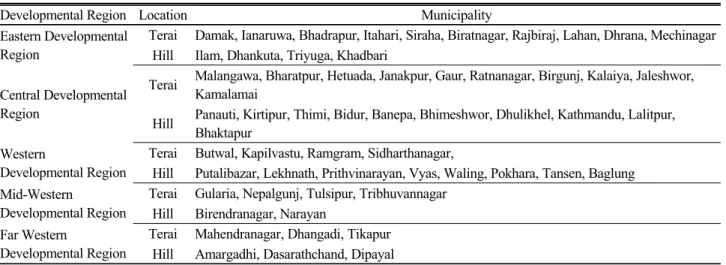
Table 2. Developmental regions and municipalities with their geographical location in Nepal (PRA, 2008).
Developmental Region Location Municipality
Eastern Developmental Region
Terai Damak, Ianaruwa, Bhadrapur, Itahari, Siraha, Biratnagar, Rajbiraj, Lahan, Dhrana, Mechinagar Hill Ilam, Dhankuta, Triyuga, Khadbari
Central Developmental Region
Terai Malangawa, Bharatpur, Hetuada, Janakpur, Gaur, Ratnanagar, Birgunj, Kalaiya, Jaleshwor, Kamalamai
Hill Panauti, Kirtipur, Thimi, Bidur, Banepa, Bhimeshwor, Dhulikhel, Kathmandu, Lalitpur, Bhaktapur
Western
Developmental Region
Terai Butwal, Kapilvastu, Ramgram, Sidharthanagar,
Hill Putalibazar, Lekhnath, Prithvinarayan, Vyas, Waling, Pokhara, Tansen, Baglung Mid-Western
Developmental Region
Terai Gularia, Nepalgunj, Tulsipur, Tribhuvannagar Hill Birendranagar, Narayan
Far Western
Developmental Region
Terai Mahendranagar, Dhangadi, Tikapur Hill Amargadhi, Dasarathchand, Dipayal waste, and vegetable processing plants (Behera et al., 2010; Chandra et al., 2012; Hill and Bolte, 2000; Liu et al., 2009; Weiland, 2010). In this regard, municipal solid waste (MSW), which is considered as the unwanted waste products, has a high potential for the generation of biogas through the anaerobic digestion (Hilkiah Igoni et al., 2008; Johari et al., 2012; Singh et al., 2011). The management of MSW is one of the challenging and expensive tasks in cities throughout the world, especially in the developing countries like India, Bangladesh, Nepal, Pakistan and Malaysia (Johari et al., 2012;
Pokhrel and Viraraghavan, 2005; Singh et al., 2011). The main objective of this review is to investigate the current trend of MSW management in Nepal. In addition, this review tries to identify the possible ways of converting MSW into useful energy source through the anaerobic digestion.
Generation of MSW in Nepalese cities
Nepal is one of the least developed countries in the world with low annual per capita income. Approxi- mately 26 million people (based on 2007 population census) live in this small country (CBS, 2012). The
annual per capita gross domestic product (GDP) is about US$562 and still more than 25% of the population live below poverty line (CBS, 2012; NPC, 2010). Nepal is one of the least urbanized countries where approximately 15% population live in cities (NPC, 2010). In recent years, the rate of urbanization is becoming rampant even though the population size living in the urban areas is small as compared to other developing nations (Pokhrel and Viraraghavan, 2005; PRA, 2008; WaterAid, 2008).
Nepal is divided into 14 zones, 75 districts and 5 developmental regions (CBS, 2003). Table 1 shows the geographical and demographical figures of Nepal.
It is estimated that the urban growth rate in Nepal is about 6.5% annually and concentrated in 58 mu- nicipalities (Pokhrel and Viraraghavan, 2005; UNEP, 2001; WaterAid, 2008). The rapidly and haphazardly increasing rate of urbanization has already put immense pressure for the government in terms of environmental health, sanitation, access to resources and environmental management (Dangi et al., 2011; Pokhrel and Viraraghavan, 2005; WaterAid, 2008). Although Terai (Southern part of Nepal with flat topography) occupies only 23% of the total land areas of Nepal, it is densely populated (50% of the population of Nepal) (CBS, 2003; FAO, 2002). Table 2
Table 3. Summary of total solid waste generation by some municipalities in 2004 (SWMRMC, 2004).
Municipality Per capita waste generation +
Estimated population Total municipal waste generation
Household *Municipal
--- kg cap-1 d-1 --- number ton d-1
Amargadhi 0.29 0.39 18,804 7.27
Bhadrapur 0.35 0.47 18,797 8.77
Bhaktapur 0.39 0.52 75,002 39
Bharatpur 0.28 0.37 98,539 36.79
Biratnagar 0.17 0.23 175,333 39.74
Birgunj 0.7 0.93 124,032 115.76
Dhulikhel 0.14 0.19 11,897 2.22
Dharam 0.36 0.48 102,466 49.18
Kathmandu 0.39 0.52 737,588 383.55
Lalitpur 0.54 0.72 174,504 125.64
Pokhara 0.14 0.19 172,578 32.21
Tikapur 0.09 0.12 42,050 5.05
Tulsipur 0.25 0.33 36,715 12.24
Lekhnath 0.37 0.49 44,084 21.75
Janakpur 0.15 0.2 78,852 15.77
Gorkha 0.26 0.35 26,958 9.35
Butwal 0.21 0.28 83,851 23.48
Itahari 0.41 0.55 44,905 24.55
Kamalamai 0.15 0.2 34,857 6.97
Tansen 0.43 0.57 22,164 12.71
*Household waste assumed to cover 75% of total municipal waste generation in average.
+Population projection based on census 2001 and growth rate of period (1999-2001).
shows the five developmental regions and 58 municipalities in Nepal. Due to rapid urbanization and changing patterns of resources, local authorities at municipal level are facing difficulties to manage the ever increasing amounts of waste particularly MSW (Pokhrel and Viraraghavan, 2005; UNEP, 2001; WaterAid, 2008). It is acknowledged that increasing economic prosperity in cities will lure more populations which ultimately increases the amount of solid waste (Hoornweg and Laura, 1999; Singh et al., 2011).
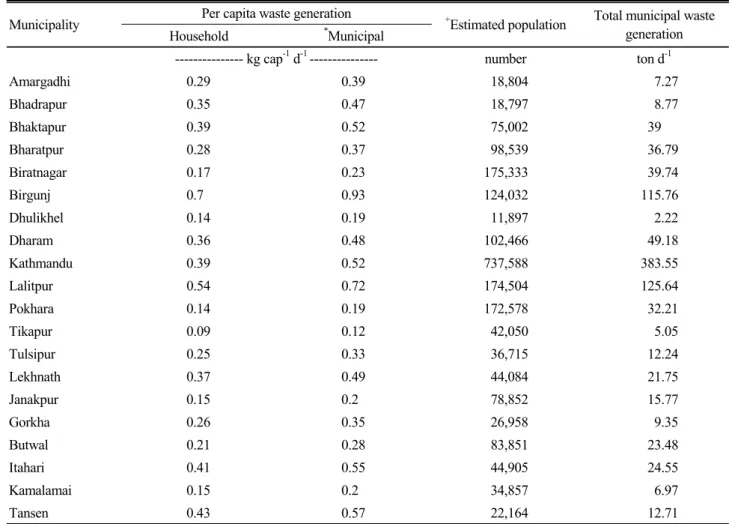
According to the estimation made in 2004, generation of solid waste by each municipalities differed between 2.22 and 383.55 ton d-1 with the average rate of 0.34 ton d-1 (SWMRMC, 2004). The total amount of solid waste generated by all of the municipalities during the year 2004 was 1,369 ton d-1 (SWMRMC, 2004). The problem of solid waste management is more severe in major cities like Kathmandu, Lalitpur, Pokhara, Bhaktapur and Biratnagar (Dangi et al., 2011; Pokhrel and Viraraghavan,
2005; PRA, 2008; SWMRMC, 2004). For example, a single municipality, Kathmandu generated the total solid waste of 383.55 ton d-1 (SWMRMC, 2004). It has been estimated that the total waste generation will be increased by 25% by the year 2015 (SWMRMC, 2004).
Table 3 shows the total solid waste generation of some municipalities in Nepal.
Characteristics of MSW
The management of solid waste is greatly affected by the composition of the generated waste (Johari et al., 2012). According to the estimation based on 2003, the average physical composition of MSW was 61.95%
organic biomass followed by inert (9.32%), paper (8.21%), plastic (7.34%), glass (2.38%), textile (1.91%), metal (1.18%), rubber (0.59%), medical (0.39%), leather (0.32%) and others (6.42%), respectively (SWMRMC, 2004). Very recently Dangi et al. (2011) analyzed the
Table 4. Chronology of waste composition in major municipalities (2003) (SWMRMC, 2004).
Waste types Percentage of waste by weight
Kathmandu Pokhara Bhaktapur Lalitpur Dharan Biratnagar
Organic 65.98 62 70.16 53.96 44.71 82.6
Inert 1.01 - 21.05 0.27 2.62 -
Metal 0.84 2.4 0.07 2.03 4.21 0.23
Paper 10.38 6.51 2.37 9.9 22.63 6.4
Glass 1.38 5.14 1.33 12.8 3.15 -
Plastic 16.31 12 3.23 9.49 20.52 8.81
Textile 3.58 5.83 1.69 2.71 0.52 1.92
Rubber 0.24 3.77 0.05 - - -
Leather 0.24 - - - - -
Medical - - - 1.3 0.52 -
Others 0.04 2.35 0.05 7.54 1.12 0.04
composition of waste sampled from households, restaurants, hotels, institutions and streets and they found that the largest proportion was organic wastes (71%).
Table 4 shows the chronology of waste composition in major municipalities of Nepal.
Solid waste management practice in Nepal
Increasing urbanization has intensified environmental pressures especially unorganized waste disposal and thus, municipal solid waste management (MSWM) is a major challenge for developing countries (Dangi et al., 2011; Singh et al., 2011). The rapid and uncontrolled urbanization population growth rate has resulted in acute problem for MSWM in Nepal (Dangi et al., 2011;
Pokhrel and Viraraghavan, 2005; PRA, 2008; WaterAid, 2008). Due to lack of financial capability as well as lack of government awareness the MSW is not being adequately managed throughout the country (Pokhrel and Viraraghavan, 2005; PRA, 2008). Despite exerting a serious health and environmental hazard, particularly in the slums areas, the MSW management is yet to be prioritized in the national development agenda (Pokhrel and Viraraghavan, 2005; PRA, 2008; WaterAid, 2008).
Due to low budget allocation for environmental manage- ment and public health, municipal authorities were able to collect only 42% (58 municipalities) of total solid waste generated in the cities (SWMRMC, 2004; WaterAid, 2008). In most of the cases, the collected urban solid wastes are either randomly dumped in open space or disposed at a poorly engineered landfill site (Pokhrel and
Viraraghavan, 2005; SWMRMC, 2004; WaterAid, 2008). Although few municipalities applied the process of burning or composting for controlling solid waste, this is insignificant as compared to the total amount of waste generated everyday (Pokhrel and Viraraghavan, 2005;
PRA, 2008). In the existing landfill sites incineration of waste that has no obvious value occur sporadically and frequently, without energy recovery purposes (WaterAid, 2008). Furthermore, the existing landfill sites in major cities are either closed or not allowed to dump the waste by the local residents due to lack of open space and the possible critical occupational and environmental health problems posed by the wastes (WaterAid, 2008).
In general, slow burning together with uncontrolled dumping on the rivers, hillsides and forest are the most common methods practiced for MSW disposal in municipalities of Nepal (Pokhrel and Viraraghavan, 2005; WaterAid, 2008). The uncontrolled generation and management of MSW pose threat to river systems as well as contribute to the global warming process due to anaerobic decomposition (Pokhrel and Viraraghavan, 2005; PRA, 2008; WaterAid, 2008). The indiscriminate dumping and unsorted MSW mainly affected the slum and squatter areas, where the residents have less capacity to pay for better services and are often ignored by the municipalities authorities (PRA, 2008; WaterAid, 2008).
In order to stop such critical environmental issues, some municipalities have initiated the coordination with local communities and the private sector to introduce innova- tive approaches for waste management which are cost- effective and efficient (WaterAid, 2008). Door-to-door
waste collection is one of the example of such innovative approaches to manage unsorted waste in the major municipalities such as Kathmandu, Pokhara, Biratnagar, Bhaktapur etc., (PRA, 2008; WaterAid, 2008).
Very recently, non-governmental organization such as Practical Action has initiated a project known as
“Strengthening Local Capacities in Integrated Sustainable Waste Management (ISWM) in small and medium municipalities of Nepal” to control the indiscriminate dumping and manage the waste efficiently in the municipalities (PRA, 2008). The ISWM project was funded by the European Union under its EC Asia Pro Eco II programme (PRA, 2008). ISWM has the following activities (WaterAid, 2008):
∙ Reduction of the total amount of waste generated in the households
∙ Proper segregation and storage of waste at source
∙ Efficient collection and transportation of waste
∙ Street sweeping
∙ Waste transfer from preliminary collection vehicles to haulage vehicles
∙ Waste compressing, recycling and landfilling
∙ Hazardous waste management
∙ Public education and participation for awareness and waste management
Despite getting financial and technical assistance from donor agencies, the optimization of MSWM remained one of the major challenges in all the municipalities. Due to lack of infrastructural, technical and financial resources, the waste collection and sorting remained unsatisfactory in Nepal (WaterAid, 2008).
Generation of biogas from MSW:
potential for managing and generating renewable energy from MSW
Anaerobic digestion can provide an alternate route to recycle organic MSW thereby recovering a potentially energy source-“biogas” (Bond and Templeton, 2011;
Hilkiah Igoni et al., 2008). The organic waste in the MSW can be converted into useful energy source through the microbially-controlled production of biogas (Bond and Templeton, 2011). All types of organic wastes can be used as feedstock in anaerobic digestion as long as they contain carbohydrates, proteins, fats, cellulose and
hemicelluose (Weiland, 2010). Anaerobic biodegradation of organic wastes present in MSW is one of the important reaction occurs in a landfill (Johari et al., 2012).
In order to generate biogas, three types of reaction have to be happened during the anaerobic digestion (Johari et al., 2012). The first stage is called as hydrolysis where microorganisms convert complex molecules into soluble products such as glucose (Johari et al., 2012;
Themelis and Ulloa, 2007). The second stage is called as acetogenesis where acid forming bacteria convert soluble products into simple organic acids, CO2 and hydrogen (Themelis and Ulloa, 2007). Different acid such as acetic acid, propanoic acid, butanoic acid and ethanol are also produced during the second stage (Themelis and Ulloa, 2007). The third stage is called as methenogenesis where methanogens finally converted acids or reducing CO2
with H2 to methane (Themelis and Ulloa, 2007).
The concept of biogas was first introduced to Nepal in 1955 (Katuwal and Bohara, 2009). However, the promotion and dissemination of the technology came into effect after the establishment of Gober Gas Company (GGC) by the government of Nepal in 1977 (Bajgain et al., 2005;
Katuwal and Bohara, 2009). After its recognition as a feasible technology and realizing the importance, the Biogas Support Program was launched in the fiscal year 1992-1993 in a joint venture of the Agricultural Develop- ment Bank of Nepal, GGC and the Netherlands Develop- ment Organization (SNV/N) (Bajgain et al., 2005; de Castro, 1995; Katuwal and Bohara, 2009). Furthermore, the establishment of the biogas technology was popularized by the Alternative Energy Promotion Center (AEPC) (AEPC, 2012; WECS, 2010).
By the end of July 2011, a total of 256,662 biogas plants were installed covering 75 districts of Nepal over 2800 Village Development Committees (VDCs) (AEPC, 2012). The installation of biogas plants not only provide renewable energy but also provide direct as well as indirect benefits to individual and the society such as job opportunities in the rural areas (AEPC, 2012; Katuwal and Bohara, 2009). The biogas programme is the first project in Nepal to operate under Clean Development Mechanism principles (AEPC, 2012). In overall, improved health, increased crop productivity, reduced workload on women and reduced the consumption of firewood are some of the major benefits to the biogas users in Nepal (AEPC, 2012; Katuwal and Bohara, 2009; WECS, 2010).
At present, cattle dung and toilet waste are used as
feedstock in all the existing biogas plants in Nepal (for example 63% of the biogas plants are connected toilets) (AEPC, 2012; WaterAid, 2008). Very recently, some organizations and institutions have also initiated recovering biogas using vegetable market waste and kitchen waste as substrates (WaterAid, 2008). Nevertheless, the production of biogas from landfills remained undocumented process in Nepal. The opportunity to generate methane from landfills is still not realized in Nepal (WaterAid, 2008).
At present only collection and sorting of MSW is prioritized in all the municipalities (PRA, 2008;
WaterAid, 2008).
However, the recovery of methane from landfills will not only solve the management of MSW but also reduces the energy gap in the country. Nepal is one of the least developed countries with low per capita energy consumption (Katuwal and Bohara, 2009). During the fiscal year 2008/09, the total energy of 402 GJ (equivalent to 9.3 million liters of oil) was consumed in Nepal (WECS, 2010). Nepal does not have fossil fuel reserve and also primarily depend on traditional biomass for cooking, heating and lighting (WECS, 2010). During the year 2010, approximately 87% of the total national energy demand was met by traditional biomass especially firewood (MOF, 2011). Despite having enormous potential of generating hydro-electricity (technically and economically feasible: 42 GW), country is suffering from acute supply of energy throughout the country (MOF, 2011; WECS, 2010). So far only 697 MW (by the end of 2010) of elec- tricity has been generated from hydro-electric plants (MOF, 2011).
Therefore, generation of methane from landfills could contribute in annual reduction of GHGs to the extent of 987,084 tons CO2 equivalent @ 7 tons plant-1 (WECS, 2010). It will reduce the consumption of firewood dramatically since rural population entirely rely on firewood for household activities including cooking heating and lighting (Katuwal and Bohara, 2009). In addition, the smokeless biogas can improve the general health condition by replacing conventional open cooking stove in rural areas (Katuwal and Bohara, 2009). Thus, the utilization of landfills as feedstock for generation of biogas will solve the waste disposal problems as well as provide renewable energy at low cost as compared to national gridline system (Bajgain et al., 2005; Bond and Templeton, 2011; Katuwal and Bohara, 2009; WECS, 2010).
Conclusions
Nepal is one of the least developed countries where majority of the population live in rural areas. However, in recent years the urbanization rate became rampant in the country which compete for available of land space as well as generate more wastes. Although proper manage- ment of solid waste is essential for urban sanitation and environment, many municipalities are not able to manage the generated wastes. Due to lack of infra- structures, technical and financial back up, almost all municipalities are struggling with disposal of MSW. The generation of methane from landfills can provide another option for recycling of organic waste as well as recover biogas simultaneously. However, the process of generation of biogas from landfills remained undocumented and unpractical in the Nepalese municipalities. Therefore, proper research and developments are necessary to make the biogas technology using landfills as feedstock in municipalities of Nepal.
Acknowledgment
This study was supported by the Institute of En- vironmental Research at Kangwon National University.
References
AEPC. 2012. Making Renewable Energy Mainstream Supply to Rural Areas of Nepal Alternative Energy Promostion Center, Kathmandu Nepal, http://www.aepc.gov.np/index. php?
option=com_content&view=article&id=86&Itemid=105 (accessed on 2012-04-09).
Arent, D.J., A. Wise, and R. Gelman. 2011. The status and prospects of renewable energy for combating global warming.
Energy Econ. 33:584-593.
Bajgain, S., I. Shakya, and M.S. Mendis. 2005. The Nepal Biogas Support Program: a successful model for public private partnership for rural household energy supply Report prepared by Biogas Support Program Nepal, Vision Press P.Ltd., Kathmandu, Nepal.
Baranzini, A., M. Chesney, and J. Morisset. 2003. The impact of possible climate catastrophes on global warming policy. Energy Policy 31:691-701.
Bauen, A. 2006. Future energy sources and systems-Acting on climate change and energy security. J. Power Sources 157:893-901.
Behera, S.K., J.M. Park, K.H. Kim, and H.-S. Park. 2010.
Methane production from food waste leachate in laboratory- scale simulated landfill. Waste Manage. 30:1502-1508.
Bond, T. and M.R. Templeton. 2011. History and future of domestic biogas plants in the developing world. Energy Sustain. Develop. 15:347-354.
CBS. 2003. Statistical yearbook: Central bureau statistics government of Nepal, national planning commission, Kath- mandu, Nepal.
CBS. 2012. Central Bureau of Statistics Government of Nepal, National Planning Commission Secretariat, Kathmandu, Nepal.
Chandra, R., H. Takeuchi, and T. Hasegawa. 2012. Methane production from lignocellulosic agricultural crop wastes: A review in context to second generation of biofuel production.
Renew. Sustain. Energy Rev. 16:1462-1476.
Dangi, M.B., C.R. Pretz, M.A. Urynowicz, K.G. Gerow, and J.M. Reddy. 2011. Municipal solid waste generation in Kathmandu, Nepal. J. Environ. Manage. 92:240-249.
de Castro, J.F.M. 1995. Biogas for household use: the case of Nepal. Energy Sustain. Develop. 1:37-40.
FAO. 2002. Policy and strategy for poverty alleviation and sustainable household foor security in Nepal Food and Agriculture Organization (FAO), Regional Office for Aisa and the Pacific, Bangkok.
Hilkiah Igoni, A., M.J. Ayotamuno, C.L. Eze, S.O.T. Ogaji, and S.D. Probert. 2008. Designs of anaerobic digesters for producing biogas from municipal solid-waste. Appl. Energy 85:430-438.
Hill, D.T. and J.P. Bolte. 2000. Methane production from low solid concentration liquid swine waste using conventional anaerobic fermentation. Bioresour. Technol. 74:241-247.
Hoel, M. and S. Kverndokk. 1996. Depletion of fossil fuels and the impacts of global warming. Resour. Energy Econ. 18:115-136.
Hoornweg, D. and T. Laura. 1999. What a waste: solid waste management in Asia Working Paper Series No. 1, Urban Development Sector, East Asia and Pacific Region, The World Bank, Washington DC.
IPCC. 2007. Contribution of working groups I, II and III to the fourth assessment report of the intergovernmental panel on climate change climate Geneva, Switzerland.
Johari, A., S.I. Ahmed, H. Hashim, H. Alkali, and M. Ramli.
2012. Economic and environmental benefits of landfill gas from municipal solid waste in Malaysia. Renewa. Sustain. Energy Rev. 16:2907-2912.
Katuwal, H. and A.K. Bohara. 2009. Biogas: A promising renewable technology and its impact on rural households in Nepal. Renew. Sustain. Energy Rev. 13:2668-2674.
Khasnis, A.A. and M.D. Nettleman. 2005. Global Warming and
Infectious Disease. Arch. Med. Res. 36:689-696.
Liu, G., R. Zhang, H.M. El-Mashad, and R. Dong. 2009. Effect of feed to inoculum ratios on biogas yields of food and green wastes. Bioresour. Technol. 100:5103-5108.
Lonngren, K.E. and E.-W. Bai. 2008. On the global warming problem due to carbon dioxide. Energy Policy 36:1567- 1568.
MOF. 2011. Economic Survey: Fiscal Year 2010/11 Government of Nepal, MInistry of Finance (MOF), Kathmandu, Nepal.
NPC. 2010. Three year plan approach paper 2010/11-2012/ 13 government of Nepal, national planning commission, Kathmandu, Nepal.
Pokhrel, D. and T. Viraraghavan. 2005. Municipal solid waste management in Nepal: practices and challenges. Waste Manage.
25:555-562.
PRA. 2008. Best practices on solid waste management of Nepalese cities Practical Ation, Kathmandu, Nepal.
Rahman, S.M. and A.N. Khondaker. 2012. Mitigation measures to reduce greenhouse gas emissions and enhance carbon capture and storage in Saudi Arabia. Renew. Sustain. Energy Rev.
16:2446-2460.
Singh, R.P., V.V. Tyagi, T. Allen, M.H. Ibrahim, and R. Kothari.
2011. An overview for exploring the possibilities of energy generation from municipal solid waste (MSW) in Indian scenario. Renew. Sustain. Energy Rev. 15:4797 -4808.
SWMRMC. 2004. Diagnostic report on state of solid waste management in Municipalities of Nepal Government of Nepal, Solid Waste Management and Resoruce Mobilization Center, Kathmandu, Nepal.
Themelis, N.J. and P.A. Ulloa. 2007. Methane generation in landfills. Renew. Energy 32:1243-1257.
Turton, H. and L. Barreto. 2006. Long-term security of energy supply and climate change. Energy Policy 34:2232-2250.
Umbach, F. 2010. Global energy security and the implications for the EU. Energy Policy 38:1229-1240.
UNEP. 2001. Nepal: state of the envrionment 2001 Published by United Nations Environment Programme in collaboration with MoPE, HMGN, SACEP, ICIMOD, and NORAD, Kathmandu, Nepal.
WaterAid. 2008. Solid management in Nepal WaterAid, Kath- mandu, Nepal.
WECS. 2010. Energy Sector Synopsis Report 2010 Government of Nepal, Water and Energy Commission Secretariat, Kathmandu, Nepal.
Weiland, P. 2010. Biogas production: current state and perspectives.
Appl. Microbiol. Biotechnol. 85:849-860.