• 검색 결과가 없습니다.

Expression of caveolin-3 as positive intracellular signaling regulator on the development of hypertrophy in cardiac tissues

N/A
N/A
Protected

Academic year: 2021

Share "Expression of caveolin-3 as positive intracellular signaling regulator on the development of hypertrophy in cardiac tissues"

Copied!
8
0
0

로드 중.... (전체 텍스트 보기)

전체 글

(1)

537

Expression of caveolin-3 as positive intracellular signaling regulator on the development of hypertrophy in cardiac tissues

Joo-Heon Kim

1

, Jin Han

2

, Yong-Kwon Kim

3

, Young-Ae Yang

3

, Yonggeun Hong*

2,3

1

Institute of Animal Medicine, College of Veterinary Medicine, Gyeongsang National University, Jinju 660-701, Korea

2

Cardiovascular & Metabolic Disease Center, College of Medicine, Inje University, Busan 614-735, Korea

3

College of Biomedical Science and Engineering, Inje University, Gimhae 621-749, Korea (Accepted : November 28, 2005)

Abstract : We have examined distribution and expression of caveolin-3 (cav-3), one of three caveolin isoforms from 16-wks-old spontaneously hypertensive rats (SHR) compared with age-matched control wistar-kyoto (WKY) rats. The expression of cav-3 was increased, whereas expression of PKB/Akt and calcineurin (Cn) was not changed in cardiac tissues of SHR compared to WKY rats. Interestingly, expression of cav-3, PKB/Akt and Cn were decreased in plasma membrane fraction in SHR compared to WKY rats. In H9c2 cardiomyoblast cells treated with phenylephrine (50 µM, 48hr) or isoproterenol (10 µM, 48hr), the expression of cav-3 was markedly enhanced compared to nontreated cells. Upon immunofluorescence analysis, cav-3 was localized in plasma membrane of control H9c2 cells. However phenylephrine or isoproterenol treatment caused translocation of cav-3 to perinuclear region. These results suggest that cav-3 plays as positive regulators in the development of hypertrophy in cardiac tissues of SHR rats.

Key words : calcineurin, caveolin, hypertrophy, SHR, spontaneously hypertensive rat, PKB/Akt,

Introduction

Caveolae were first observed by electron microscopists in the 1950s [25, 39]. They were named as plasmale- mmal vesicles by Palade and, 2 years later, Yamada proposed the name ‘caveolae’ to define these small flask-shaped, 50-100 nm invagination of the plasma membrane [25, 39]. Morphologically, they are abundant in endothelial cells; adipocyte; cardiac, smooth and striated myocytes; and epithelial cells [2, 12, 29].

Caveolin was identified as a principal protein component of caveolae. PKB/Akt least four caveolin gene products are present in mammalians; caveolin-1

α

, -2, and -3 [1, 10, 27, 29] and possibly two in Caenorhabditis elegans [34]. Caveolin-1 (cav-1) and - 2 (cav-2) are coexpressed and form a hetero-oligomeric complex [28] in many cell types, with particularly high levels in adipocytes, endothelial cells and muscle cells [12, 29] whereas expression of caveolin-3 (cav-3) is muscle-specific and found in both cardiac and skeletal

muscle, as well as smooth muscle cells. Cav-3 is 65%

identical with and 85% similar to cav-1. The caveolin- 1 gene appears to be the progenitor of the cav-2 and -3 genes [34].

Purification methods using the caveolae marker protein caveolin established new criteria for identifying this membrane. These included (a) resistance to solubilization by Triton X-100 at 4

o

C (at low tempe- rature), (b) a light buoyant density [30], and (c) richness in glycosphingolipid (GSLs), cholesterol, and lipid-anchored membrane proteins [8, 11, 37].

Recent study also examined the functional role of caveolins in regulating signaling along the MAPK cascade [6]. Interestingly, the activation of this pathway is usually accompanied with a downregulation of cav-1 gene expression while increase in the level of cav-1 protein strongly inhibits the pathway.

Coexpression with cav-1 dramatically inhibited signaling from EGF-R, Raf, MEK-1, and Erk-2 to the nucleus

in vivo

[7].

*Corresponding author: Yonggeun Hong

College of Biomedical Science and Engineering, Inje University, Gimhae 621-749, Korea

[Tel: +82-55-320-3681, Fax: +82-55-329-1678, E-mail: [email protected]]

(2)

After various pathologic stresses and in response to increased demands for cardiac work, heart adapts through compensatory hypertrophy of myocytes.

Hypertrophic stimuli induce an increase in cell size in the absence of cell division [19, 38] and are accompanied by a number of qualitative and quantitative changes in gene expression [3]. Cardiac hypertrophy is induced by a variety of factors, such as vasoactive peptides, growth factors, cytokines, and hormones [22].

Specially, catecholamines (phenylephrine, isoproterenol) also play pivotal roles in cellular growth [4]. There are main hypertrophic signaling pathway has been described which involves activation of the Ca

2+

/calmodulin- dependent phosphatase calcineurin [21]. Persistent stimulation of cardiac cells by catecholamines, for example, has been known as a prime example of calcineurin-induced cardiac hypertrophy [15].

We used phenylephrine and isoproterenol to study catecholamines-induced hypertrophy in H9c2 cells with specific inhibitors, verapamil and cyclosporin A (CsA).

They are well known as an inhibitor of calcium influx and calcineurin, respectively. We examined the molecules involved in the catecholamines signal, such as adrenergic receptor, G-proteins, adenylate cyclase, PLC, Akt/PKB, Erk, calcineurin, and protein kinase A, which are accumulated in caveolae with caveolin in cardiac hypertrophy. Previously, the direct regulation of G- proteins, adenylate cyclase and protein kinase A by caveolin has also been demonstrated [36]. Thus, we examined the role of caveolins on the progression of cardiac hypertrophy induced by hypertension and on the catecholamines-induced hypertrophy in H9c2 cells.

Materials and Methods

Animals

Animal care of spontaneously hypertensive rat (SHR), Wistar Kyoto rat (WKY) strain, were followed as described previously [14]. They were starved overnight and anesthetized by intraperitoneal adminis- tration of 100 µg of sodium pentobarbital per g of body weight at 10 to 15 min before the experiments. At 8- wk-old-age, systolic blood pressure of SHR and their control WKY rats were measured using tail cuff plethysmography as described previously [26].

Immunoblotting, immunofluorescence microscopy H9c2 cells were cultured in DMEM medium

containing 10% fetal bovine serum. Cultivated cells and tissue from rat heart were lysed in RIPA buffer [40], and proteins were subjected to SDS-PAGE on 12% gels [14]. All of the antibodies (all 1 : 2500 dilution) used were cav-3, calcineurin, PKB/Akt from Transduction Lab (USA). For immunofluorescence staining, cells were fixed 4% paraformaldehyde and permeabilized with 0.1% Triton X-100, washed three times (PBS containing 0.01% Triton X-100 and 10%

FBS), followed by incubation with anti-mouse cav-3.

A 1 : 100 dilution of TRITC (Molecular Probes, USA) secondary antibody was used. Images were captured using a immunofluorescence microscope (Olympus, Japan).

Immunohistochemistry

Immunohistochemical detection of cav-3 was performed as described previously [11, 13]. Briefly, prepared left ventricular myocardium from 16-wks-old WKY and SHR rats were fixed using 4% paraformal- dehyde and incubated with monoclonal anti-caveolin- 3 primary antibody (1 : 500) diluted in phosphate- buffered saline containing 1 mg/ml bovine serum albumin for 2 hr, rinsed with the same solution for 30 min, and incubated with biotinylated goat anti-mouse IgG (1 : 200) for 60 min. The samples were then exposed to avidin-biotin-peroxidase complex method (Vectastain ABC kit; Vector, USA) and reacted with DAB according to the manufacturers recommendations and counterstained with hematoxylin.

Caveolin-enriched membrane fractionation Hearts from SHR and WKY rats were harvested, minced with a razor blade, and homogenized for 30 sec using a Polytron tissue grinder in 2 ml of MES- buffered saline with 1% (v/v) Triton X-100, at 4

o

C.

Samples were centrifuged (1,000×g, 5 min, 4

o

C), and

the supernatant was adjusted to 40% sucrose by the

addition of 2 ml of 80% sucrose in MES-buffered

saline. A 5-35% continuous sucrose gradient was

formed above the homogenate and centrifuged at

39,000 rpm for 16 hr in a SW41 rotor (Beckman

Instruments, USA). A light-scattering band in the 15-

20% sucrose region was observed. Twelve 1-ml

fractions were collected, starting from the top of the

gradient. For SDS-PAGE/Immunoblotting, an equal

amount of total protein from each fraction (25 µg) was

analyzed.

(3)

Results

Expression of caveolin-3 in left ventricular myocardium from 16-wks-old WKY and SHR rats From our results, the fundamental orientation of hypertension in genetically hypertensive SHR rats showed a cardiac hypertrophy concomitant with enlargement of heart size (data not shown), thicken cardiac wall (data not shown), and cav-3 overexpression (Fig. 1B) in whole cell level. In order to investigate that the differential expression of cav-3 in the left ventricular (LV) myocardium of hearts from 16-wks- old WKY and SHR rats, immmunohistochemistry analysis was directly performed with the isolated LV myocardium. As shown in Fig. 1, cav-3 expression was significantly increased in the myocardium of SHR (Fig.

1B) compare to in that of WKY rats (Fig. 1A).

However, prominent staining of cav-3 in the sarcolemma (muscle plasma membrane) and intercalated disc (arrows in Fig. 1A) observed in WKY rats, become throughout the cytosol of cells with strong signals visible in the cytosol of SHR rats (Fig. 1B).

Thus we suggest that the overexpression in whole cell level but the retardation in translocation of cav-3 to PM from cytosol (as shown in Fig. 1B) is related to the hypertrophy which was observed in the hypertensive SHR rats.

Expression and localization of caveolin 3 at caveolin-enriched fraction in cardiac tissues of WKY and SHR rats

In cardiac tissues of 16-wks-old WKY and SHR rats, the expression of cav-3 was investigated. In a whole tissue lysate, the amount of cav-3 expression in

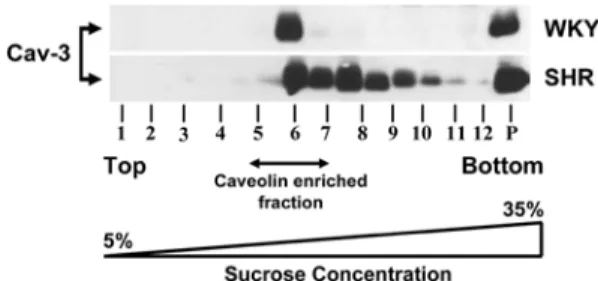
hypertensive SHR was higher than in normotensive WKY (by 5-fold at 16 weeks, n = 3) (Fig. 2). In contrast, cav-1 expression was similar between 16-wks- old in WKY and SHR rats (data not shown). Thus, cav- 3 expression, but not cav-1, was altered in hypertensive SHR with cardiac hypertrophy (Fig. 2). Finally, our data render was to speculate that the increased expression of cav-3 may play a role in the accelerated development of cardiac hypertrophy in the hypertensive SHR rats.

Localization of caveolin-3 upon agonist induced hypertrophy in H9c2 cardiomyoblast cells

We demonstrated that the expression of cav-3 was decreased in plasma membrane (PM) fraction, more specifically in caveolae of hypertensive SHR compared Fig. 1. Immunohistochemical analysis of caveolin-3 expre-

ssion in left ventricular myocardium from 16-wks-old WKY and SHR rats. Prominent staining of caveolin-3 in the sarcolemma and intercalated disc was observed in WKY rats (A) compared to SHR rats (B).

×

400.

Fig. 2. Localization of caveolin-3 from caveolin-enriched membrane fraction of cardiac tissues from 16-wks-old WKY and SHR rats.

Fig. 3. Localization of caveolin-3 in caveolin-enriched membrane fraction from control (A) and phenylephrine (PE, 50

µ

M, 48 hr) induced hypertrophy in H9c2 cardiomyoblast cells (B). Cell lysates prepared from H9c2 cardiomyoblast cells were fractionated as shown in Fig.

2 and subjected to immunoblot analysis with caveolin-3

antibody.

(4)

to WKY rats (Fig. 2). Upon agonist-induced hypertrophy in H9c2 cell, the expression cav-3 was markedly enhanced (Fig. 3). After the induction of hypertrophy by phenylphrine (50 µM, 48 hr) treatment, a marked decrease of the cav-3 translocation to plasma membrane was observed with a increased expression of cav-3 in cytosolic fraction (data not shown). At experiment to determine trafficking of cav-3 from cytoplasm to plasma membrane, the results strongly indicate that the agonists (phenylephrine or isoproterenol) induced hypertrophy cause the impairment in translocation of cav-3 to plasma membrane from cytosolic cellular compartment.

Expression of caveolin-3 and hypertrophy-related signaling molecules in agonist-induced hypertrophic H9c2 cardiomyoblast cells

It is well established that GPCR ligands such as phenylephrine (PE) [35] or isoproterenol (ISO) [41] are capable of inducing cardiomyocyte hypertrophy through the activation of wide array of intracellular signaling pathway. Thus, we studied the role of cav- 3 in the development of hypertrophy induced by the hypertrophic agonists, PE (50 µM, 48 hr) or ISO (10 µM, 48 hr) [9, 41] in cultured H9c2 cells. In the H9c2 cells treated with PE (50 µM) or ISO (10 µM) alone, the expression of cav-3 and calcineurin were markedly enhanced (Fig. 4. lane 2 and 5 compared to no treatment (control) of Lane 1). Also, expression of PKB/Akt was markedly increased by the treatment of PE (50 µM) (lane 2) but the expression was decreased in the ISO alone treated cells (lane 5).

Recent studies reported that treatment of verapamil (L-type Ca

2+

channel antagonist), or cyclosporin A (CsA) (calcineurin inhibitor), could prevent cardiomyocyte hypertrophy induced by PE or ISO treatment (Fig. 4) [21] and could prevent cardiac hypertrophy in various rodent models of heart disease [31]. Thus, we examined the effects of verapamil or CsA on the expression of cav-3 and calcineurin in the agonist induced hypertrophic H9c2 cells. In the presence of verapamil, the expression of both cav-3 and calcineurin in hypertrophic H9c2 cells was markedly reduced (lane 3 and 6). However, in the presence of CsA both PE and ISO treated cells, only calcineurin expression was greatly reduced (become basal (control) level) (lane 4 and 7) compared to hypertrophic H9c2 cells induced

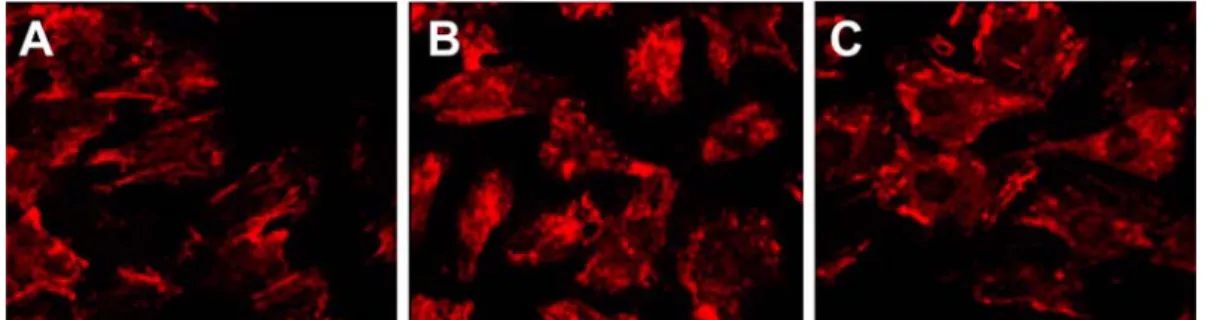
Fig. 5. Fluorescent microscopic analysis of caveolin-3 translocation upon agonist induced hypertrophy in H9c2 cardiomyoblast cells. Cells were plated onto chamber slides and treated with phenylephrine (PE, 50

µ

M) or isoproterenol (ISO, 10

µ

M) for 48 hr. The cells were then stained with TRITC labeled caveolin-3 and viewed by immunofluorescence microscopy. (A) Control. (B) PE induced hypertrophic cells. (C) ISO induced hypertrophic cells.

×

200.

Fig. 4. Expression of caveolin-3 and hypertrophy-related signaling molecules in agonist induced hypertrophic H9c2 cardiomyoblast cells. Cells were treated with phenylephrine (PE, 50

µ

M), isoproterenol (ISO, 10

µ

M), Verapamil (1

µ

M), cyclosporine A (CsA, 500 ng/ml) for 48 hr. The cells

were then lysed with a buffer containing Triton X-100/

n

-

octhyglucoside, and proteins were separated by SDS-PAGE

and subjected to immunoblotting analysis with anti-

caveolin-3, PKB/Akt, and calcineurin antibodies

(5)

by PE or ISO alone (lane 2 and 5). Also, H9c2 cells treated with CsA alone for 48 hr, the expression of cav- 3 was increased but PKB/Akt was decreased (lane 8) compared to no treatment of control lane 1. Interestingly, we did not see significant changes in expression of Erk upon above various conditions. Interestingly, the expression of cav-3 was also increased in hypertensive animal model of SHR rats as we demonstrated in Figs.

1, 2 along with agonist induced hypertrophic H9c2 cells the same results as shown in Fig. 4. Thus, these results indicate that upregulation of cav-3 as well as calcineurin may be involved in the progression of cardiac hypertrophy.

Immunofluorescent localization of caveolin-3 and its translocation upon agonist induced hypertrophy in H9c2 cardiomyoblast cells

In agonist induced hypertrophic H9c2 cells (Fig. 4) and hypertensive SHR rats (Figs. 1, 2), we observed the retardation of cav-3 translocation to caveolae in the plasma membrane by subcellular fractionation (data not shown), caveolin-rich membrane fractionation (Figs. 2, 3), and immunohistochemistry (Fig. 1). Accordingly, we investigated the localization of cav-3 and its subcellular translocation upon PE (50 µM, 8 hr) or ISO (10 µM, 48 hr) treatment in H9c2 cells by immunofluo- rescence microscopic analysis as described in “Materials and Methods”. Immunostaining with the anti-cav-3 antibody showed that cav-3 was localized in the plasma membrane of control H9c2 cells (Fig. 5. control).

When H9c2 cells were incubated with PE(50 µM, 48 hr) or ISO (10 µM, 8 hr) after incubation of the cells in of 1% serum media for 18 hr, cav-3 was translocated to dispersed throughout the cytosol of the cells (Fig.

5. PE, ISO).

These results indicated that retardation of cav-3 translocation to caveolae of the plasma membrane may cause hypertrophy. Interestingly, cav-3 distribution, translocation, and interaction with hypertrophy-related signaling molecules in H9c2 cells after treatment of agonists inducing hypertrophy showed similar patterns of cav-3 in cardiac hypertrophic cardiac tissues of SHR rats.

Discussion

There are two main types of hypertension [1, 3].

Primary or essential hypertension accounts for over

90% of all patients and the secondary makes up the rest. As the name implies, the essential hypertension has no obvious known cause. The heart is one of the main target organs in hypertension. Changes in myocyte expression of both contractile and non contractile proteins and increased interstitial fibrosis are typically found during the natural course of hypertensive heart disease and results in progressive pathological hypert- rophy, which may lead to heart failure (HF) [1, 3, 4].

Caveolae are small vesicular invagination of the cell membrane [16]. The chief structural proteins of caveolae are caveolins. Caveolins are an evolutionarily conserved family of 18 to 25 kDa cholesterol binding integral membrane proteins implicated in caveolae biogenesis, endocytic event, cholesterol transport, and various signal transduction processes [23].

Although the effect of cav-3 and calcineurin to promote cardiomyocyte hypertrophy

in vivo

and

in vitro

is established, its overall necessity as a hypertrophic mediator is currently an area of on going debate. The introduction of a concept of the calcineurin and/or PKB/Akt regulatory function of cav-3 have suggested a necessary role for calcineurin and PKB/Akt in many, but not all, animal models of hypertrophy or cardiomyopathy. Studies presented here showed overexp- ression of cav-3 in the left ventricle of genetically hypertensive rats, SHR. Cav-3 is muscle-specific and found in both cardiac and skeletal muscle, as well as smooth muscle cell [31, 33]. Expression of cav-3 is induced during the differentiation of skeletal myoblasts and caveolin-3 is localized to the muscle cell plasma membrane (sarcolemma) where it forms a complex with dystrophin and its associated glycoproteins [31].

Cav-3 has been shown to interact with different signaling molecules. For example, c-Src, Src-like kinases (Lyn) all co-fractionated with cav-3 in C2C12 cells, suggesting a role of muscle cell caveolae in the transduction events mediated by these molecules [10].

Also, cav-3 has been reported to directly interact with

nNOS, the nitric oxide synthase isoform expressed in

skeletal muscle. In this studies, analysis of cardiac

tissue from SHR rats revealed 1) dramatic increase in

sarcolemmal cav-3 in ventricle tissue, 2) hypertrophy

of cardiac muscle, 3) upregulation of cav-3, PKB/Akt

and calcineurin expression in catecholamines (PE, ISO)

treated H9c2 cells. One possibility is that upregulation

of cav-3 induces the hypertrophic processing or

stoichiometry of caveolin isoforms complex to form

(6)

stable caveolae structure, leading to hypertrophy of cardiac tissues.

In the previous studies, after various pathologic stresses and in response to increased demands for cardiac work, the heart adapts through compensatory hypertrophy of myocytes, which is characterized by an increase in the size of myocytes (cardiac hypertrophy), and the expression of contractile and other proteins normally expressed only during fetal development [17, 18]. While the hypertrophic response is initially a compensatory mechanism that augments cardiac output, sustained hypertrophy can lead to dilated cardiomyopathy, heart failure and sudden death.

Despite the diverse stimuli that lead to cardiac hypertrophy, there is a prototypical final molecular response of cardiomyocytes to hypertrophic signals that involves an increase in cell size, cell number and protein synthesis, enhanced sarcomeric organization, up-regulation of fetal cardiac genes, and induction of immediate-early genes, such as c-Jun, c-fos and c-myc [20]. Also, our data defined a new regulatory mechanism in the signaling pathway that couples hypertrophic signals at the cell membrane to changes in cardiac gene expression suggesting opportunities for pharmacological intervention into cardiac hypertrophy and heart failure.

Ca

2+

binds with calmodulin, which activated calcineurin. Thus, It is elevation concentrations of calcium in intracellular, is increased binding with calmodulin, resulting in calcineurin (serine-threonine phosphatase) activation [5]. Once activated, induction to transcription factor such as c-Jun, c-fos and c-myc at nucleus, is induction of protein synthesis and increased to cell size and cell number. subsequently, induced hypertension (hypertrophy). As a result, cardiac hypertrophy because cellular number becomes much or size enlarges. Interestingly, enhanced G- protein-coupled receptors in caveolae [24]. These findings suggest that the amount of caveolin/caveolae may be an important factor in cardiac hypertrophy. We have investigated the expression level of caveolin-isoform, and cardiac hypertrophy related molecule such as PKB/

Akt and calcineurin in cardiac and skeletal muscles of SHR and WKY rats following four different develop- mental stage. Subsequently, the critical role of cav-3 in developmental stage of hypertension by cardiac vascular hypertrophy was investigated in the PKB/Akt and calcineurin signaling pathway.

Taken together, most striking were that 1) expression

of cav-3 was increased dramatically and 2) interaction of cav-3 with hypertrophy-related signaling molecules was increased in hearts of SHR rats and agonist induced hypertrophic H9c2 cardiomyoblast cells. Thus these data suggest that cav-3 may play as a positive regulator in the pathogenesis of hypertension by induction of cardiac hypertrophy.

Acknowledgement

This work was supported in part by Funds from Ministry of Agriculture and Forestry made in program FY 2005 to Research Project on the Production of Bio- organs and 2004 Inje University Research Grant.

References

1. Anderson RGW. The caveolae membrane system.

Annu Rev Biochem 1998, 67 , 199-225.

2. Baumann CA, Ribon V, Kanzaki M, Thurmound DC, Mora S, Shigematsu S, Bickel PE, Pessin JE, Saltiel AR. CAP defines a second signaling pathway required for insulin-stimulated glucosetransport. Nature 2000, 407 , 202-207.

3. Boheler KR, Schwartzk M. Gene expression in cardiac hypertrophy. Trends Cardiovasc Med 1992, 5 , 176-182.

4. Colombo F, Noel J, Mayers P, Mericier I, Calderone A. Beta-adrenergic stimulation of rat cardiac fibroblasts promotes protein synthesis via the activation of phosphatidylinositol 3-kinase. J Mol Cell Cardiol 2001, 33 , 1091-1106.

5. De Windt LJ, Lim HW, Bueno OF, Liang Q, Delling U, Braz JC, Glascock, Limball TF, del Monte F, Hajjar RJ, Molkentin JD. Targeted inhibition of calcineurin attenuates cardiac hypertrophy in vivo. Proc Natl Acad Sci USA 2001, 98 , 3322-3327.

6. Engelman JA, Chu C, Lin A, Jo H, Ikezu T, Okamoto T, Kohtz DS, Lisanti MP. Caveolin- mediated regulation of signaling along the p42/44 MAP kinase cascade in vivo; a role for the caveolin- scaffolding domain, FEBS Lett 1998, 428 , 205-211.

7. Engelman JA, Zhang XL, Razani B, Pestell RG,

Lisanti MP. p42/44 MAP kinase-dependent and -

independent signaling pathways regulate caveolin-1

gene expression. Activation of ras-MAP kinase and

protein kinase a signaling cascade transcriptionally

(7)

down-regulates caveolin-1 promoter activity. J Biol Chem 1999, 274 , 32333-32341.

8. Fujimoto TKH, Nomura RUT. Isoforms of caveolin- 1 and caveolar structure. J Cell Sci 2000, 113 , 3509- 3517.

9. Fujta T, Yoya Y, Iwatsubo K, Ouda T, Kimura K, Umemura S, Ishikawa Y. Accumulation of molecules involved in a

1

-adrenergic signal within caveolae:

caveolin expression and the development of cardiac hypertrophy. Cardiovascular Res 2001, 51 , 709-716.

10. Galbiati F, Volonte D, Engelman JA, Scherer PE, Lisanti MP. Targeted down-regulation of caveolin-3 is sufficient to inhibit myotube formation in differentiating C2C12 myoblasts. Transient activationof p38 mitogen- activated protein kinase is required for induction of caveolin-3 expression and subsequent myotube formation. J Biol Chem 1999, 274 , 30315-30321.

11. Gerdes J Li L, Schlueter C, Duchrow M, Wohlenberg C, Gerlach C, Stahmer I. Immunobiological and molecular biological characterization of the cell proliferation-associated nuclear antigen that is defined by monoclonal antibody Ki-67. Am J Pathol 1991, 138 , 867-873.

12. Gustavsson J, Parpal S, Kalrlsson M, Ramising C, Thorn H, Borg M, Lindroth M, Peterson HK, Magnusson KE, Stralfors P. Localization of the insulin receptor in caveolae of adipocyte plasma membrane. FASEB J 1999, 13 , 1961-1971.

13. Hong SH, Ondrey FG, Avis IM, Chen Z, Loukinova E, Cavanaugh PF Jr, Waes C, Mulshine JL.

Cyclooxygenase regulates human oropharyngeal carcinomas via the proinflammatory cytokine IL-6: a general role for inflammation? FASEB J 2000, 14 , 1499-1507.

14. Hong Y, Cho JH, Kim JH. Involvement of calcineurin and Akt/PKB in development of hereditary hypertension.

Korean J Vet Res 2004, 44 , 7-13.

15. Karpen JW, Rich TC. The fourth dimension in cellular signaling. Science 2001, 293 , 2204-2205.

16. Kurzchalia TV, Parton RG. Membrane microdomains and caveolae. Curr Opin Cell Biol 1999, 11 , 424-431.

17. MacLellan WR, Schneider MD. Genetic dissection of cardiac growth control pathways. Annu Rev Physiol 2000, 62 , 289-319.

18. Marian AJ, Roberts R. Recent advances in the molecular genetics of hypertrophic cardiomyopathy.

Circulation 1995, 92 , 1336-1347

19. Marian AJ, Roberts R. Familial hypertrophic cardiomyopathy: a paradigm of the cardiac hypertrophic response to injury. Ann Med 1998, Suppl 1 , 24-32.

20. Molkentin JD, Dorn II GW. Cytoplasmic signaling pathways that regulate cardiac hypertrophy. Annu Rev Physiol 2001, 63 , 391-426.

21. Molkentin JD, Lu JR, Antos CL, Markham B, Richardson J, Robbins J, Grant SR, Olson EN. A calcineurin-dependent transcriptional pathway for cardiac hypertrophy. Cell 1998, 93 , 215-228.

22. Nicol RL, Frey N, Pearson G, Cobb M, Richardson J, Olson EN. Activated MEK5 induces serial assembly of sarcomeres and eccentric cardiac hypertrophy.

EMBO J 2001, 20 , 2757-2767.

23. Okamoto T, Schlegel A, Scherer PE, Lisanti MP.

Caveolins a family of scaffolding proteins for organizing preassembled signaling complexes at the plasma membrane. J Biol Chem 1998, 273 , 5419-5422.

24. Ostrom RS, Gregorian C, Drenan RM, Xiang Y, Regan JW, Insel PA. Receptor number and caveolar co-localization determine receptor coupling efficiency to adenylyl cyclase. J Biol Chem 2001, 276 , 42063- 42069.

25. Palade GE. An electron microscope study of the mitochondrial structure. J Histochem Cytochem 1953, 1 , 188-211.

26. Pfeffer MA, Frohlich ED, Pfeffer JM, Yunice A, Nordquist JA. Pathophysiological implications of the increased cardiac output of young spontaneously hypertensive rats. Circ Res 1974, 34/35 , I235-I242.

27. Razani B, Schlegel A, Lisanti MP. Caveolin proteins in signaling, oncogenic transformation and muscular dystrophy. J Cell Sci 2000, 113 , 2103-2109.

28. Schlegel A, Lisanti MP. Caveolae and their coat proteins, the caveolins: from electron microscopic novelty to biological launching pad. J Cell Physiol 2001, 186 , 329-337.

29. Smart EJ, Graft GA, McNiven MA, Sessa WC, Engelman JA, Scherer PE, Okamoto T, Lisanti MP.

Caveolins, liquid-ordered domains, and signal transduction. Mol Cell Biol 1999, 19 , 7289-7304.

30. Smart EJ, Ying YS, Mineo C, Anderson RGW. A detergent-free method for purifying caveolae membrane from tissue culture cells. Proc Natl Acad Sci USA 1995, 92 , 10104-10108.

31. Song KS, Scherer PE, Tang Z, Okamoto T, Li S,

(8)

Chafel M, Chu C, Kohtz DS, Lisanti MP. Expression of caveolin-3 in skeletal, cardiac, and smooth muscle cells. Caveolin-3 is a component of the arcolemma and co-fractionates with dystrophin and dystrophin associated glycoproteins. J Biol Chem 1996, 271 , 15160-15165.

32. Sussman MM, Lim HW, Gude N, Taigen T, Olson EN, Robbins J, Colbert MC, Gualberto A, Wieezorek DF, Molkentin JD. Prevention of cardiac hypertrophy in mice by calcineurin inhibition. Science 1998, 281 , 1690-1693.

33. Tang Z, Scherer PE, Okamoto T, Song K, Chu C, Kohtz DS, Nishimoto I, Lodish HF, Lisanti MP.

Molecular cloning of caveolin-3, a novel member of the caveolin gene family expressed predominantly in muscle. J Biol Chem 1996, 271 , 2255- 2261.

34. Tang Z, Okamoto T, Boontrakulpoontawee P, Katada T, Otsuka AJ, Lisanti MP. Identification, sequence, and expression of an invertebrate caveolin gene family from the nematode Caenorhabditis elegans.

Implication for the molecular evolution of mammalian caveolin genes. J Biol Chem 1997, 272 , 2437-2445.

35. Taylor JM, Rovin JD, Parsons T. A role for focal adhesion kinase in phenylephrine-induced hypertrophy

of rat ventricular cardiomyocytes. J Biol Chem 2000, 275 , 19250-19257.

36. Toya Y, Schwencke C, Couet J, Lisanti MP, Ishikawa Y. Inhibition of adenyl cyclase by caveolin peptides. Endocrinology 1998, 139 , 15693-15701.

37. Uehara K, Miyoshi M. Tubular invaginations with caveolae and coated pits in the sinus endothelial cells of the rat spleen. Histochem Cell Biol 1999, 112 , 351- 38. 358. Watanabe T, Pakala R, Katagiri T, Benedict CR.

Angiotensin II and serotonin potentiate endothelin-1- induced vascular smooth muscle cell proliferation. J Hypertension 2001, 19 , 731-739.

39. Yamada E. The fine structure of the gall bladder of the mouse. J Biophys Biochem Cytol 1955, 1 , 445-458.

40. Zong WX, Ditsworth D, Bauer DE, Wang ZQ, Thompson CB. Alkylating DNA damage stimulates a regulated form of necrotic cell death. Genes Dev 2004, 18 , 1272-1282.

41. Zou Y, Komuro I, Yamazaki T, Kudoh S, Uozumi

H, Kadowaki T, Yazaki Y. Both Gs and Gi proteins

are critically involved cardiomyocyte. J Biol Chem

1999, 274 , 9760-9770.

수치

Fig. 2.  Localization of caveolin-3 from caveolin-enriched membrane fraction of cardiac tissues from 16-wks-old WKY and SHR rats
Fig. 4.  Expression of caveolin-3 and hypertrophy-related signaling molecules in agonist induced hypertrophic H9c2 cardiomyoblast cells

참조

관련 문서

1) Effects of methanol extracts of Capsella bursa-pastoris on cyclooxygenase-2 (COX-2) and Inducible Nitric oxide synthase (iNOS) expression in human prostate cancer cell

In the past year, it is obvious that this cooperation development has also promoted in Vietnam the formation and development of a Korean studies training

The Study on the Changes of Bacterial Inorganic Phosphate Metabolism in Interactions between Nitric Oxide and Salmonlla enterica serovar Typhimurium..

This study suggested diversity in the configuration of expression through expression of abstract images, the style of modern painting, which are expressed

Methanol extracts from watermelon peels dramatically reduced inducible Nitric Oxide Synthase(iNOS) expression at various concentration and

Result: During the study period, 482 patients had elevated cardiac troponin-T levels. The positive predictive value for the.. The diagnostic importance of

The index is calculated with the latest 5-year auction data of 400 selected Classic, Modern, and Contemporary Chinese painting artists from major auction houses..

1 John Owen, Justification by Faith Alone, in The Works of John Owen, ed. John Bolt, trans. Scott Clark, "Do This and Live: Christ's Active Obedience as the