서 론
잉어과(Cyprinidae) 납자루아과(Acheilognathinae) 어류는 유럽과 동북아시아 국가에 주로 분포하는 몸이 측편되고 체 고가 높은 소형담수어로 담수조개(Bivalves: Unionidae)와 독 특한 상호관계를 형성한다(Smith et al., 2004; Damme et al., 2007). 납자루아과 어류는 산란기 동안 암컷은 길어진 산란관 으로 조개의 출수공을 통해 조개 내 아가미에 산란하게 된다. 수컷은 화려한 혼인색을 띠고 조개 주위에 세력권을 형성하며 암컷이 산란한 후 정액을 방출하여 조개의 아가미 안에서 알 의 수정이 이루어진다(Smith et al., 2004). 수정된 알은 수온에 따라 차이가 있지만 3~4주 정도 조개 안에서 발생단계가 진
행되고 난황을 다 흡수한 후 유영능력이 강해지면 조개 밖으 로 나가게 되며, 자유유영이 가능한 시기까지 조개를 숙주로 서 이용하게 된다(Aldridge, 1999).
담수 조개는 글로키디아(glochidia)라고 불리는 유생생활 사를 가지며 유생은 어류에 체외기생 시기를 거쳐야 한다 (Dillon, 2000). 글로키디아는 보통 담수조개의 바깥쪽 아가미 (외새엽)를 보육낭으로 이용하지만 일부종은 안쪽과 바깥쪽 아가미 모두를 보육낭으로 사용하기도 한다. 글로키디아는 발 생이 진행되고 약 2~6주부터 8달까지 부모조개에 의해 보육 되다가 수중으로 방출되지만 99% 이상은 적절한 숙주에 부착 하지 못해 생존율이 매우 낮다(Haag, 2013). 글로키디아가 어 류를 숙주로 가짐으로써 얻는 이점은 이동성이 낮은 조개의 분산과 관련된 것으로 알려져 있다(Schwalb et al., 2015).
이로 인해 납자루아과 어류는 담수조개를 산란장소로 이용 하고 담수조개는 글로키디아 유생을 납자루아과 어류에 체외
—63 — http://www.fishkorea.or.kr ISSN: 1225-8598(Print), 2288-3371(Online). DOI: https://doi.org/10.35399/ISK.32.2.4
Accepted: April 20, 2020
한강납줄개의 조개유생 보육에 따른 작은말조개 내 산란 특성
김형수
*·
박종영1국립수산과학원 내수면양식연구센터, 1전북대학교 생명과학과
Spawning Characteristics of Hangang Bitterling, Rhodeus pseudosericeus (Pisces: Acheilognathinae) in the Host Mussel with Glochidia
by Hyeong Su Kim* and Jong Young Park1 (Inland Aquaculture Research, National Institute of Fisheries Science, Changwon 51688, Republic of Korea; 1Department of Biological Science, College of Natural Science, Chonbuk National University, Jeonju 54896, Republic of Korea)ABSTRACT This study investigated spawning characteristics of Hangang bitterling, Rhodeus
pseudosericeus inside the host mussel, Unio douglasiae sinuolatus at the Heukcheon Stream inKorea from April to June 2017. 327 mussels were collected, among them, 34 (14.1%) were spawned mussels of R. pseudosericeus with glochidia. The mean number of R. pseudosericeus embryos with or without glochidia by the mussel gill position was 5.0±3.58 (range, 1~8) vs. 2.8±2.13 (1~9) in the left outer demibranch, 1.5±0.96 (1~3) vs. 1.7±0.82 (1~3) in the left inner demibranch, 1.4±0.51 (1~2) vs.
2.1±1.85 (1~6) in the right inner demibranch, and 6.4±4.82 (1~20) vs. 3.0±1.86 (1~6) in the right outer demibranch. The frequency of R. pseudosericeus embryos with or without glochidia by the mussel gill position was 82.6% vs. 73.4% in the left outer demibranch, 17.4% vs. 9.4% in the left inner demibranch, 26.1% vs. 15.6% in the right inner demibranch, and 58.7% vs. 67.2% in the right outer demibranch. The mean number of R. pseudosericeus embryos with or without glochidia was 8.5±6.43 (1~23) vs. 4.5±3.38 (1~14). The number and frequency of R. pseudosericeus embryos were higher in the mussel with glochidia and the outer demibranchs than those without glochidia and with inner demibranchs.
Key words: Rhodeus pseudosericeus, bitterling, host-parasites, coevolution, host mussel
저자 직위: 김형수(해양수산연구사), 박종영(교수)
* Corresponding author: Hyeong Su Kim Tel: 82-55-540-2720, Fax: 82-55-546-6292, E-mail: [email protected]
기생하여 멀리 분산하기 위한 수단으로 이용하기 때문에 서 로 이득을 얻는 상호공생으로 알려져 왔다. 그러나 납자루아 과 어류가 조개의 아가미로의 물 순환, 먹이섭식, 호흡 방해 등 피해를 줄 수 있다는 연구가 발표되면서 최근 연구들은 납 자루아과 어류가 생존율이 낮은 알과 자어기를 안전하게 보 낼 수 있도록 산란장소로 조개를 이용하는 숙주-기생관계 를 가지는 것으로 보고하고 있다(Reichard et al., 2001; Mills and Reynolds, 2003; Spence and Smith, 2013). 또한 납자루 아과 어류는 알과 자어의 생존율을 높이기 위해 짧은 부화시 간, 적은 알수, 저산소에 견딜 수 있는 에탄올 경로, 조개선택 성 등 다양한 적응방식에 대한 연구가 알려져 있다(Aldridge, 1997; Smith et al., 2000, 2004; Kitamura, 2005, 2006a, 2006b;
Reichard et al., 2010).
한강납줄개 R. pseudosericeus는 Arai et al.(2001)에 의해 강원도 횡성군 공근면 금계천에서 채집한 체장 45.5mm의 표 본을 기준으로 신종 기재된 한국고유종으로, 최근 ‘야생생물 보호 및 관리에 관한 법률’에 근거하여 환경부지정 멸종위기 II급 어류로 지정되었다(2018.10.). 본 종에 대한 연구는 난발 생과 초기생활사(Kim et al., 2006; Suzuki, 2006), 분자생물학 적 분석을 통한 계통지리학적 연구(Jeon and Suk, 2014), 산란 특성(Kim et al., 2017), 서식양상(Ko et al., 2019)에 대한 연 구만이 수행되어 종 보존을 위한 연구는 부족한 실정이다. 또 한 본 종은 신종으로 발표되기 이전까지 유럽에 넓게 분포하 는 납줄개 R. sericeus와 동일종으로 여겨졌는데 이전의 연구 에서는 숙주선호도, 조개선택 요인, 조개와 담수조개 사이의 계통적 관계 등 숙주-기생 관계를 밝히기 위한 다양한 연구가 수행된 바 있었으나 한강납줄개에 대한 자세한 연구는 진행된 바 없다(Smith et al., 2001, 2004; Mills and Reynolds, 2002a, 2002b, 2003; Liu et al., 2006; Reichard et al., 2010).
따라서 본 연구는 숙주-기생 관계를 형성하며 독특한 생물 학적 특성을 가지고 진화한 납자루아과 어류와 담수조개와의 상호관계 중 한강납줄개의 글로키디아 유생 보육에 따른 작은 말조개 내 산란특성을 연구하여 종 보존을 위한 기초자료를 확보하고자 한다. 또한 본 종과 형태적으로 매우 유사한 납줄 개의 산란특성과 비교하여 한강납줄개와 작은말조개 사이의 진화적 적응양상에 대해 논의하고자 한다.
재료 및 방법
1. 연구 장소
본 연구는 한강납줄개의 산란기인 2017년 4~6월까지 경 기도 양평군 흑천 중상류 일대에서 매달 1~5일 사이, 15~20 일 사이 2회 실시하였다. 본 종은 멸종위기 II급 어류로 지정 되어 있어 구체적인 조사장소는 표기하지 않았으나 본 연구장
소는 흑천으로 연결되는 작은 웅덩이로, 크기는 가로 30m, 세 로 10m, 수심은 평균 0.8m이며, 8종의 어류가 서식하였지만 납자루아과 어류는 한강납줄개 1종, 조개는 작은말조개 Unio douglasiae sinuolatus 1종만이 서식하였다(Kwon et al., 1993;
Kim and Park, 2002). 조개는 족대(망목, 3×3mm)를 사용하여 채집하였고, 한강납줄개는 환경부 지정 멸종위기 II급 어류이 므로 본 연구를 위해 한강유역환경청에 포획허가를 취득한 후 수행하였다(허가번호, 2017-22).
2. 작은말조개 내 산란양상
숙주조개 내 산란양상을 분석하기 위해서 채집된 모든 조개 는 0.1mm 수준까지 각장을 측정하였고 생존에 영향을 주지 않도록 조개의 패각을 살짝 열어 한강납줄개의 산란여부를 확 인하였으며 산란 되지 않은 조개는 현장에 재방사하였다. 산 란이 확인된 조개는 알과 자어를 토출하지 못하도록 입수공 과 출수공 부위를 끈으로 조인 후 10% formalin solution에 즉 시 고정하였다. 고정된 조개는 실험실로 이동 후 패각근을 절 단하여 한강납줄개의 알과 자어가 놓여진 아가미의 위치와 그 개수를 기록하였다. 동시에 조개의 유생인 글로키디아의 보육 여부와 위치를 기록하였다.
3. 통계분석
모든 유의성 검증은 SYSTAT 소프트웨어(Systat version 18.0, SPSS INC., Chicago, IL, USA)를 이용하였다. 한강납줄 개의 산란유무와 글로키디아 유생 보육유무에 따른 조개 각장 의 차이는 ANOVA를 이용하여 검증하였다. 조개의 아가미 위 치, 글로키디아 유생 보육유무에 따른 한강납줄개 알과 자어 수 그리고 산란빈도의 차이는 Kruskal-Wallis H test를 수행하 였다. 글로키디아 유생 보육유무에 따른 한강납줄개 알과 자 어수의 차이는 t-test로 분석하였으며, 통계학적 유의수준은 P<0.05로 설정하였다.
결 과
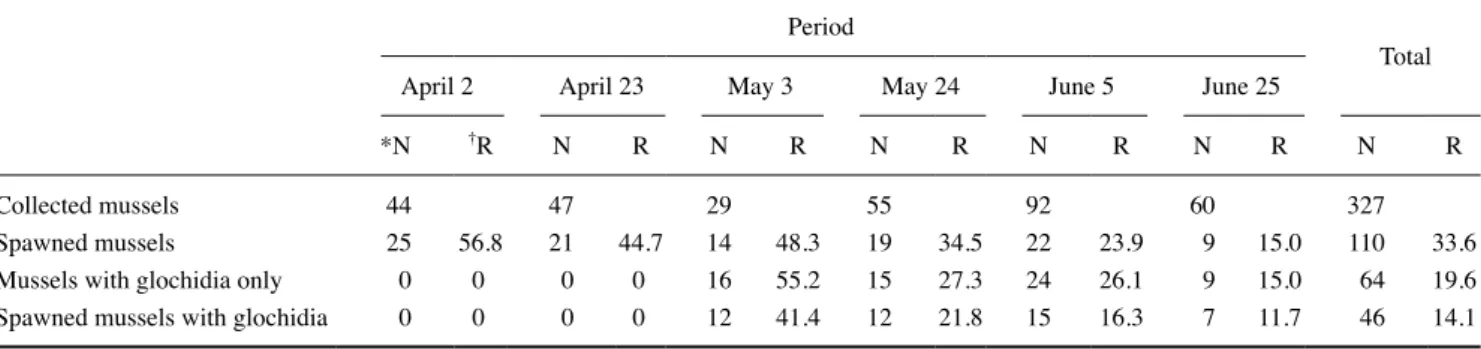
1. 한강납줄개 산란 및 글로키디아 유생 출현양상
한강납줄개 산란 및 글로키디아 유생의 작은말조개 내 출 현양상은 Table 1과 같다. 조사기간 동안 확인된 조개는 모두 327개체이었고, 이 중 한강납줄개의 산란이 확인된 조개의 비 율은 33.6%(n=110)이었다. 글로키디아 유생을 보육한 조개 의 비율은 19.6%(n=64)이었고 한강납줄개 산란과 글로키디 아 유생이 동시에 확인된 조개의 비율은 14.1%(n=46)로 나 타났으며, 특히 글로키디아 유생을 보육한 조개 가운데 한강 납줄개의 산란이 동시에 확인된 조개의 비율은 71.9%로 매우
높게 나타났다.
2. 조시기간에 따른 한강납줄개 산란양상
조사기간에 따른 한강납줄개의 산란이 확인된 조개의 출 현비율은 4월 2일 조사에서 56.8%(n =25), 23일 조사에서 44.7%(n=21), 5월 3일 조사에서 48.3%(n=14), 24일 조사에 서 34.5%(n=19), 6월 5일 조사에서 23.9%(n=22), 25일 조 사에서 15.0%(n=9)로 나타나 기간이 지남에 따라 산란된 조 개의 비율이 낮아지는 것으로 나타났다. 글로키디아 유생을 보육한 조개의 출현비율은 4월 2일, 23일 조사에서는 확인되 지 않았고 5월 3일 조사에서 55.2%(n=16), 24일 조사에서 27.3%(n=15), 6월 5일 조사에서 26.1%(n=24), 25일 조사에 서 15.0%(n=9)로 유생을 보육한 조개가 확인되었고 5~6월 조사기간 동안은 시간이 지남에 따라 글로키디아 유생을 보육 한 조개의 출현비율은 낮아지는 것으로 나타났다.
3. 조개의 아가미 위치와 글로키디아 유생 보육유무에 따른 산란양상
작은말조개는 4장의 아가미(반새)가 있었고, 이 중 바깥 쪽 아가미(외반새) 2장만을 보육낭으로 사용하였다. 한강 납줄개 알과 자어 그리고 글로키디아 유생을 보육한 조개 와 보육하지 않은 조개의 크기는 차이가 없었고(two-way ANOVA, Duncan’s multiple range test, mussel size with or without bitterlings, F1,323=40.9, P=0.473; mussel size with or without glochidia, F1,323=15.6, P=0.657), 한강납줄개 알과 자어는 글로키디아 유생과 상호작용은 없는 것으로 나타났다
(F1,323=76.3, P=0.327; Fig. 1).
아가미 위치에 따른 글로키디아 유생을 보육한 조개에서 확인된 한강납줄개 알과 자어수는 왼쪽 외반새 5.0±3.58개 (range, 1~8; n=38), 왼쪽 내반새 1.5±0.96개(1~3; n=8), 오 른쪽 내반새 1.4±0.51개(1~2; n=12), 오른쪽 외반새 6.4±
4.82개(1~20; n=27)로 나타났으며, 외반새가 내반새보다 많 았다(Kruskal-Wallis H test, P<0.001; Fig. 2). 아가미 위치에 Table 1. Number and proportion of spawned mussels, mussels with glochidia only, and spawned mussels with glochidia from collected mussels from April to June 2017
Period
Total April 2 April 23 May 3 May 24 June 5 June 25
*N †R N R N R N R N R N R N R
Collected mussels 44 47 29 55 92 60 327
Spawned mussels 25 56.8 21 44.7 14 48.3 19 34.5 22 23.9 9 15.0 110 33.6
Mussels with glochidia only 0 0 0 0 16 55.2 15 27.3 24 26.1 9 15.0 64 19.6
Spawned mussels with glochidia 0 0 0 0 12 41.4 12 21.8 15 16.3 7 11.7 46 14.1
*N: Number of mussels, †R: Relative rate(%)
Fig. 1. Shell size-frequency distributions of collected and spawned mussels with or without glochidia from April to June 2017.
Fig. 2. Mean number of Rhodeus pseudosericeus embryos with or without glochidia in the four parts of gill position inside mussels from April to June 2017. Vertical lines show SD.
따른 글로키디아 유생을 보육하지 않은 조개에서 확인된 한강 납줄개 알과 자어수는 왼쪽 외반새 2.8±2.13개(1~9; n=47), 왼쪽 내반새 1.7±0.82개(1~3; n=6), 오른쪽 내반새 2.1±
1.85개(1~6; n=10), 오른쪽 외반새 3.0±1.86개(1~6; n=43) 로 나타났고, 외반새가 내반새보다 많았다(Kruskal-Wallis H test, P<0.001; Fig. 2).
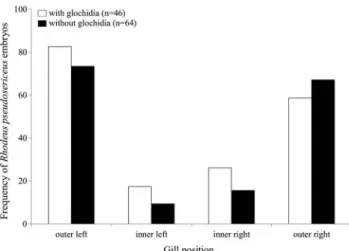
아가미 위치에 따른 글로키디아 유생을 보육한 조개에서 확 인된 한강납줄개 알과 자어의 출현빈도는 왼쪽 외반새 82.6%, 왼쪽 내반새 17.4%, 오른쪽 내반새 26.1%, 오른쪽 외반새 58.7%로 나타났으며, 외반새가 내반새보다 높은 것으로 나타 났다(Kruskal-Wallis H test, P<0.001; Fig. 3). 아가미 위치에 따른 글로키디아 유생을 보육하지 않은 조개에서 확인된 한강
납줄개 알과 자어의 출현빈도는 왼쪽 외반새 73.4%, 왼쪽 내 반새 9.4%, 오른쪽 내반새 15.6%, 오른쪽 외반새 67.2%로 나 타났고, 외반새가 내반새보다 높은 것으로 나타났다(Kruskal- Wallis H test, P<0.001; Fig. 4). 한강납줄개 알과 자어의 출현 빈도는 글로키디아 유생을 보육한 조개에서 보육하지 않은 조 개보다 더 높았다(Kruskal-Wallis H test, P<0.001; Fig. 3).
글로키디아 유생을 보육한 조개에서 확인된 알과 자어수 는 8.5±6.43개(1~23, n=46)였고, 출현빈도는 3개(15.2%), 4 개(13.0%), 6개(10.9%) 순으로 나타났다. 글로키디아 유생을 보육하지 않은 조개에서 확인된 알과 자어수는 4.5±3.38개 (1~14, n=64)였으며, 출현빈도는 1개(21.9%), 2개(15.6%), 3 개(10.9%) 순으로 나타났다. 한강납줄개 알과 자어수는 글로 키디아 유생을 보육한 조개에서 보육하지 않은 조개보다 더 많았다(un-paired t-test, P<0.001; Fig. 4).
고 찰
한강납줄개의 산란기는 3~6월까지로 알려져 있는데 본 연 구결과 한강납줄개의 산란이 확인된 조개의 출현비율은 4월 1차부터 가장 높게 확인되었고 이후 6월 2차 조사까지는 감 소하는 경향을 보였지만 지속적으로 확인되어 이전 연구결과 와 일치하였다(Kim et al., 2017; Table 1). 또한, 글로키디아 유 생을 보육한 작은말조개는 4월 조사에서는 확인되지 않았고 5~6월 조사기간 동안 확인되었으나 7월부터는 확인되지 않 았는데, 작은말조개의 산란기는 유생을 보육한 5~6월로 추정 되어 기존 4월부터 8월 중순까지의 보고와는 차이가 있었다.
이는 조사지역, 수환경 조건, 기후변화 등 환경 요인의 차이로 인한 결과라고 판단된다(Park and Kwon, 1993).
Fig. 4. Frequency of Rhodeus pseudosericeus embryos with or without glochidia inside mussels from April to June 2017.
Fig. 3. Frequency of Rhodeus pseudosericeus embryos with or with- out glochidia in the four parts of gill position inside mussels from April to June 2017.
Back and Song(2005)은 묵납자루 Acheilognathus signifer의 작은말조개 내 산란은 각장이 30mm 이상일 경우 조개선택성 은 차이가 없다고 하였고, Song and Kwon(1994)은 줄납자루 A. yamatsute는 말조개 U. douglasiae의 크기가 클수록 산란 빈도가 높게 나타난다고 하였다. 그러나 본 연구에서 한강납 줄개는 글로키디아 유생 유무와 관계없이 각장 50~55mm에 서 가장 높은 알과 자어의 출현빈도를 보이고 있었다(Fig. 1).
묵납자루는 작은말조개보다 각장이 큰 곳체두드럭조개에서는 66~70mm에서, 작은말조개는 51~55mm에서 가장 높은 산 란빈도가 나타났는데(Kim et al., 2014), 이는 산란관 길이가 조개 내 산란위치와 연관성이 높으며 깊이 산란된 알은 조개 로부터의 토출 위험성을 낮출 수 있기 때문에 이는 납자루 자 치어의 생존율을 높이기 위한 조개선택성의 결과라고 판단된 다(Kitamura, 2006a).
담수산 이매패의 글로키디아 유생은 아가미 안에서 배발생 이 일어나기 때문에 아가미를 보육낭(marsupium)으로도 사용 하게 된다(Kwon et al., 1993). 작은말조개는 2장의 외반새만 을 보육낭으로 사용하였는데 납자루아과 어류 가운데 내반새 보다 외반새에서 출현빈도가 높은 종은 묵납자루, 일본산 A.
longipinnis가 보고되었고, 내반새에서 출현빈도가 높은 종은 줄납자루, 납지리 A. rhombeus, 일본산 R. ocellatus kurumeus, 유럽산 R. sericeus, R. amarus가 보고되었다(Song and Kwon, 1994; Reichard et al., 2001; Smith et al., 2004; Back and Song, 2005; Kitamura, 2006b; Kitamura et al., 2009; Kim et al., 2018). 납자루아과 어류는 4가지 이유(적극적 선택, 공간 이용 성, 산란관 접근성, 토출율)로 인해 내반새에 주로 산란하는데, 이 중 내반새에 산란하는 것은 글로키디아 유생과의 산소와 공간의 경쟁을 피하기 위함이라고 보고된 바 있다(Aldridge, 1997; Mill and Reynolds, 2003; Kitamura, 2006a, 2006b). 또한, Kanoh(2000)는 그룹 산란의 경우 조개 내 산란장소를 선택할 시간이 부족하므로 내반새에만 산란하지 못하고 외반새에도 산란하게 된다고 하였다.
특히, 납지리와 일본산 A. longipinnis는 추계산란종으로 글 로키디아 유생의 영향을 받지 않지만 묵납자루와 본 연구결 과의 한강납줄개는 글로키디아 유생을 보육함에도 불구하 고 외반새에서 더 많은 알과 자어수 및 출현빈도를 보였는데 이는 매우 독특한 결과라고 생각된다(Back and Song, 2005;
Kitamura et al., 2009; Kim et al., 2014, 2018; Figs. 2, 3). 이러 한 결과는 첫째, 조개의 해부학적 구조와도 연관이 있는 것으 로 판단되는데 조개의 외반새는 새강과 접하는 부위가 막혀있 어 알과 자어가 조개 밖으로 토출이 불가능한 구조이지만 내 반새는 새강과 접하는 부위가 열려 있어 자어가 새강으로 이 동시 조개로부터 토출될 가능성이 높기 때문에 나타난 결과로 추정된다(Tankersley and Dimock, 1993a, 1993b). 둘째, 한강납 줄개의 알과 자어는 새강으로 이동전까지는 입수공과 출수공
이 위치한 쪽에서 주로 확인되었는데(상대비율 85%, private observation) 조개에 의해 여과된 물의 용존산소와 순환 비율 이 아가미 안쪽과 비교했을 때 출수공 근처에서 더 높고 유생 과의 산소 경쟁에도 큰 피해를 입지 않기 때문으로 생각된다 (Kitamura, 2005). 셋째, 글로키디아 유생을 보육한 조개가 보 육하지 않은 조개보다 더 높은 산소섭취율을 가지는데 이는 다른 납자루아과 어류의 중복산란이 이루어지기 전에 빠른 발 생과정을 통해 좁은 아가미 새엽 공간이 아닌 넓은 새강으로 빠른 시간 내에 이동하여 산소 및 공간의 종간경쟁을 낮출 수 있기 때문으로 추정된다(Methling et al., 2018).
한강납줄개의 알과 자어수는 유생을 보육한 조개에서 8.5±
6.43개(1~23)로 보육하지 않은 조개의 4.5±3.38개(1~14) 보다 많은 것으로 나타났다(Fig. 4). Kim et al.(2017)은 한강 납줄개의 작은말조개 내 알과 자어수를 5.8±5.51개(1~22) 로 보고한 바 있는데 이는 글로키디아 유생 보육 유무를 구분 하지 않은 결과 차이로 판단된다. 묵납자루의 곳체두드럭조 개 내 알과 자어수는 12.0±9.21개(1~41), 작은말조개 내 알 과 자어수는 2.5개(1~14), 각시붕어 R. uyekii의 말조개 내 알 과 자어수는 10.2±5.0개(3~18), 줄납자루의 말조개 내 알과 자어수는 3.6개(1~35)였는데 납자루아과 어류와 조개 종에 따라서 차이점이 나타났다(Song and Kwon, 1994; Back and Song, 2005; Kim et al., 2014, 2015). 특히, 곳체두드럭조개는 작은말조개보다 평균 크기가 1.5cm 정도 크기 때문에 산란된 알과 자어수가 많은 것으로 판단되며 각시붕어는 한강납줄개 와 달리 난괴를 형성하여 알을 낳기 때문에 유사한 형태를 가 진 두 종이라고 하더라도 산란방식에 따른 차이점이라고 판단 된다. 유럽산 R. sericeus는 조개 안에 글로키디아 유생이 있거 나 이미 알과 자어가 있는 경우 조개 내 산소투과율도 낮아지 고 경쟁을 피하기 위해 산란율이 낮아지며 알과 자어수도 적 어진다고 하여 본 연구 결과와는 차이가 있었다(Smith et al., 2000; Mills and Reyolds, 2002a, 2002b).
본 연구에서는 숙주-기생 관계를 형성하는 한강납줄개의 작 은말조개 내 산란특성을 분석하여 공진화적 진화양상에 대해 논의하였다. 특히 한강납줄개의 알과 자어수 및 출현빈도는 글로키디아 유생을 보육한 작은말조개의 외반새에서 더 높게 나타난 결과는 매우 주목되었다. 그러나 납자루아과 어류가 글로키디아 유생과의 경쟁을 피하기 위해 조개의 내반새에 주 로 산란하는 것보다 글로키디아 유생이 있음에도 불구하고 외 반새를 주요한 산란위치로 선택함으로써 얻게 되는 이점에 대 해서는 실험실 수조 내에서의 세부적인 실험이 진행되어야 할 것으로 판단된다.
요 약
본 연구는 2017년 4~6월까지 흑천 일대에서 한강납줄개의
조개 유생보육에 따른 작은말조개 내 산란 특성에 관한 연구 를 실시하였다. 조사기간 동안 확인된 조개는 327개체이었고, 글로키디아 유생을 보육한 조개 중 한강납줄개의 산란이 확인 된 조개는 34개체(14.1%)로 나타났다. 아가미 위치에 따른 글 로키디아 유생을 보육한 조개와 보육하지 않은 조개에서 확 인된 알과 자어수는 왼쪽 외반새 5.0±3.58개(range, 1~8) vs.
2.8±2.13개(1~9), 왼쪽 내반새 1.5±0.96개(1~3) vs. 1.7±
0.82개(1~3), 오른쪽 내반새 1.4±0.51개(1~2) vs. 2.1±1.85 개(1~6), 오른쪽 외반새 6.4±4.82개(1~20) vs. 3.0±1.86개 (1~6)로 나타났다. 아가미 위치에 따른 글로키디아 유생을 보 육한 조개와 보육하지 않은 조개에서 확인된 알과 자어의 출 현빈도는 왼쪽 외반새 82.6% vs. 73.4%, 왼쪽 내반새 17.4%
vs. 9.4%, 오른쪽 내반새 26.1% vs. 15.6%, 오른쪽 외반새 58.7% vs. 67.2%로 나타났다. 글로키디아 유생을 보육한 조개 와 보육하지 않은 조개에서 확인된 알과 자어수는 8.5±6.43 개(1~23) vs. 4.5±3.38개(1~14)였다. 한강납줄개 알과 자어 수 그리고 출현빈도는 글로키디아 유생을 보육한 조개와 외반 새에서 높은 것으로 나타났다.
사 사
이 논문은 2020년도 국립수산과학원 수산시험연구사업 담 수 수산생물 종보존 및 복원연구(R2020034)의 지원으로 수행 된 연구입니다.
REFERENCES
Aldridge, D.C. 1997. Reproductive ecology of bitterling(Rhodeus sericeus Pallas) and unionid mussels. PhD dissertation, Cambridge University, UK. pp 10-100.
Aldridge, D.C. 1999. Development of European bitterling in the gills of freshwater mussels. J. Fish Biol., 54: 138-151. https://
doi.org/10.1111/j.1095-8649.1999.tb00618.x.
Arai, R., S.R. Jeon and T. Ueda. 2001. Rhodeus pseudosericeus sp. nov., a new bitterling from South Korea(Cyprinidae, Acheilognathinae). Ichthyol. Res., 48: 275-282. https://doi.
org/10.1007/s10228-001-8146-1.
Back, H.M. and H.B. Song. 2005. Spawning in mussel and adapta- tion strategy of Acheilognathus signifer(Cyprinidae: Achei- lognathinae). Korean J. Ichthyol., 17: 105-111.
Damme, V.D., N. Bogutskaya, R.C. Hoffimann and C. Smith. 2007.
The introduction of the European bitterling(Rhodeus am- arus) to west and central Europe. Fish Fish., 8: 79-106.
https://doi.org/10.1111/j.1467-2679.2007.00239.x.
Dillon, R.T. 2000. The ecology of freshwater mollusks. Cambridge University Press, Cambridge, U.K., 509pp.
Haag, W.R. 2013. The role of fecundity and reproductive effort in defining life-history strategies of North American freshwa- ter mussels. Biol. Rev. 88: 745-766. https://doi.org/10.1111/
brv.12028.
Jeon, H.B. and H.Y. Suk. 2014. Pseudo but actually genuine: Rho- deus pseudosericeus provides insight into the phylogeo- graphic history of the amur bitterling. Anim. Cells. Syst., 18: 275-281. https://doi.org/10.1080/19768354.2014.93650 Kanoh, Y. 2000. Reproductive success associated with territoriality, 6.
sneaking, and grouping in male rose bitterlings, Rhodeus ocellatus(Pisces: Cyprinidae). Environ. Biol. Fish., 57:
143-154. https://doi.org/10.1023/A:1004585405848.
Kim, C.H., E.J. Kang and J.H. Kim. 2006. Development of eggs and early life history of Korean bitterling, Rhodeus pseudo- sericeus(Acheilognathinae). Korean J. Ichthyol., 18: 266- Kim, H.S., H. Yang, J.G. Ko and J.Y. Park. 2014. Spawning pattern 272.
in the freshwater mussel Lamprotula leai and Unio dougla- siae sinuolatus of Acheilognathus signifer(Pisces: Acheilo- gnathinae). Korean J. Ichthyol., 26: 83-88.
Kim, H.S., J.G. Ko, W.S. Choi and J.Y. Park. 2015. Population ecol- ogy of Korean rose bitterling, Rhodeus uyekii(Pisces: Achei- lognathinae) in the Bongseocheon, Mankyeonggang(river), Korea. Korean J. Ichthyol., 27: 78-85.
Kim, H.S., J.D. Yoon, H. Yang, H.S. Choi and J.H. Lee. 2017. Repro- ductive characteristics of Rhodeus pseudosericeus(Pisces:
Acheilognathinae) in the Heukcheon, Namhangan(River), Korea. Korean J. Ichthyol., 29: 235-243.
Kim, H.S., H.S. Choi and J.Y. Park. 2018. Embryonic development characteristics and host mussel utilization of flat bitterling Acheilognathus rhombeus(Cyprinidae) during winter in Korea. Environ. Biol. Fish., 101: 55-66. https://doi.org/10.
1007/s10641-017-0680-4.
Kim, I.S. and J.Y. Park. 2002. Freshwater fishes of Korea. Kyo-Hak Publishing Co. Ltd., Seoul, Korea, 466pp.
Kitamura, J. 2005. Reproductive ecology of the striped bitterling Acheilognathus cyanostigma(Cyprinidae: Acheilognathi- nae). Ichthyol. Res., 53: 216-222. https://doi.org/10.1007/
s10228-006-0336-4.
Kitamura, J. 2006a. Seasonal change in the spatial utilization of host mussels in relation to ovipositor length by female rosy bitterling Rhodeus ocellatus kurumeus. J. Fish. Biol., 65:
597-607. https://doi.org/10.1111/j.0022-1112.2006.00949.x.
Kitamura, J. 2006b. Adaptive spatial utilization of host mussels by the Japanese rosy bitterling Rhodeus ocellatus kurumeus.
J. Fish Biol., 69: 263-271. https://doi.org/10.1111/j.1095- 8649.2006.01099.x.
Kitamura, J., J.N. Negishi, M. Nishio, S. Sagawa, J.I. Akino and S.
Aoki. 2009. Host mussel utilization of the Itasenpara bitter- ling(Acheilognathus longipinnis) in the Moo River in Himi, Japan. Ichthyol. Res., 56: 296-300. https://doi.org/10.1007/
s10228-008-0082-x.
Ko, M.H., R.Y. Myung and H.S. Kim. 2019. Fish community char- acteristics and habitat aspects of endangered species, Rho- deus pseudosericeus in Heuk stream, a tributary of the Han River drainage system. Korean J. Environ. Ecol., 33: 266- 279. https://doi.org/10.13047/KJEE.2019.33.3.266.
Kwon, O.K, G.M. Park and J.S. Lee. 1993. Coloured shells of Ko- rea. Academy Publishing Company, Seoul, Korea, 446pp.
Liu, H., Y. Zhu, C. Smith and M. Reichard. 2006. Evidence of host specificity and congruence between phylogenies of bitter- ling and freshwater mussels. Zool. Stud., 45: 428-434.
Methling, C., K, Douda, H. Liu, R. Rouchet, V. Bartáková, D. Yu, C.
Smith and M. Reichard. 2018. Energetic costs in the rela- tionship between bitterling and mussels in East Asia. Biol.
J. Linn. Soc. Lond., 125: 750-759. https://doi.org/10.1093/
biolinnean/bly178.
Mills, S.C. and J.D. Reynolds. 2002a. Mussel ventilation rates as a proximate cue for host selection by bitterling Rhodeus seri- ceus. Oecologia(Berl), 131: 473-478. https://doi.org/10.1007/
s00442-002-0895-7.
Mills, S.C. and J.D. Reynolds. 2002b. Host species preferences by bitterling, Rhodeus sericeus, spawning in freshwater mus- sels and consequences for offspring survival. Anim. Behav., 63: 1029-1036. https://doi.org/10.1006/anbe.2001.1988.
Mills, S.C. and J.D. Reynolds. 2003. The bitterling-mussel inter- action as a test case for co-evolution. J. Fish. Biol., 63: 84- 104. https://doi.org/10.1111/j.1095-8649.2003.00209.x.
Park, G.M. and O.K. Kwon. 1993. Seasonal gonadal cycle of the seven species of freshwater unionidaed(Pelecypoda: Union- oida). Korean J. Malacol., 11: 147-163.
Reichard, M., J. Bryja, M. Polacik and C. Smith. 2001. No evidence for host specialization or host-race formation in the Eu- ropean bitterling(Rhoseus amarus), a fish that parasitizes freshwater mussels. Mol. Ecol., 20: 3631-3643. https://doi.
org/10.1111/j.1365-294X.2011.05198.x.
Reichard, M., M. Polačik, A.S. Tarkan, R. Spence, Ö. Gaygusuz, E. Ercan, O. Ondračkova and C. Smith. 2010. The bitter- ling-mussel coevolutionary relationship in areas of recent
and ancient sympatry. Evolution, 64: 3047-3056. https://
doi.org/10.1111/j.1558-5646.2010.01032.x.
Schwalb, A.N., Morris, T.J. and K. Cottenie. 2015. Dispersal abilities of riverine freshwater mussels influence metacommunity structure. Freshw. Biol., 60: 911-921. https://doi.org/10.1111/
fwb.12544.
Smith, C., J.D. Reynolds, W.J. Sutherland and P. Jurajda. 2000.
Adaptive host choice and avoidance of superparasitism in the spawning decisions of bitterling(Rhodeus sericeus). Be- hav. Ecol. Sociobio., 48: 29-35. https://doi.org/10.1007/s00 2650000212.
Smith, C., K. Rippon, A. Douglas and P. Jurajda. 2001. A proximate cue for oviposition site choice in the bitterling(Rhodeus seri- ceus). Freshw. Biol., 46: 903-911. https://doi.org/10.1046/
j.1365-2427.2001.00725.x.
Smith, C., M. Reichard, P. Jurajda and M. Przybylski. 2004. The re- productive ecology of the European bitterling(Rhodeus seri- ceus). J. Zool., Lond., 262: 107-124. https://doi.org/10.1017/
S0952836903004497.
Spence, R. and C. Smith. 2013. Rose bitterling(Rhodeus ocellatus) embryos parasitize freshwater mussels by competing for nutrients and oxygen. Acta Zool., 94: 113-118. https://doi.
org/10.1111/j.1463-6395.2011.00532.x.
Song, H.B. and O.K. Kwon. 1994. Spawning of the bitterling, Achei- lognathus yamatsutae(Cyprinidae) into the mussel. Korean J.
Ichthyol., 6: 39-50.
Suzuki, N. 2006. Egg and larval development of the bitterling Rho- deus pseudosericeus(Cyprinidae). Jpn. J. Ichthyol., 53: 47- 54. https://doi.org/10.11369/jji1950.53.47.
Tankersley, R.A. and R.V. Dimock. 1993a. The effect of larval brood- ing on the respiratory physiology of the freshwater unionid mussel Pyganodon cataracta. Am. Mid. Nat., 130:146-163.
https://doi.org/10.2307/2426283.
Tankersley, R.A. and R.V. Dimock. 1993b. Endoscopic visualization of the functional morphology of the ctenidia of the unionid mussel Pyganodon cataracta. Can. J. Zool., 71:811-819.
https://doi.org/10.1139/z93-106.