Effect of Cover Crop Species and Liquid Manure Application Rate on Green Manure Production, Leaf Mineral Content, Fruit Quality and
Soil Chemical Properties in Pear Orchard
Seong Eun Lee*, Jin Myeon Park, Young Eun Park, and Dong Geun Choi1
Horticultural & Herbal Crop Environment Division, National Institute of Horticultural & Herbal Science, Suwon 441-440, Korea
1Department of Horticulture, Chonbuk National University, Jeonju 561-756, Korea
(Received: September 30 2014, Revised: December 11 2014, Accepted: December 11 2014)
Cover cropping and liquid manure application are considered as effective ways to replace the use of chemical fertilizer in orchard. This study was conducted to investigate the effect of cover crop species and liquid manure application rate on green manure production, leaf mineral content, fruit quality and soil chemical properties in pear orchard. The treatments include rye and hairy vetch as cover crops, two liquid manure application levels based on N and K2O requirement on each cover crop species, and chemical fertilizer as control. Green manure production was higher in hairy vetch than in rye. K content of pear leaves and soil exchangeable K content increased in N based liquid manure application treatments. The yield was higher in rye + liquid manure and fertilizer treatments, and fruit quality was not different between the treatments. Taking all of these into account, rye + K2O requirement-based liquid manure application is recommended in pear orchard for not only sufficient nutrient supply but also prevention of any problem related with soil K2O accumulation in pear orchard in long-term perspective.
Key words: Rye, Hairy vetch, Pig slurry, Orchard, Soil management
Effect of cover crop species and liquid manure application rate on fruit quality and yield in pear orchard (Sep. 30, 2014).
Treatment† Fruit weight Soluble solids Acidity Yield
g °Bx % kg 10a-1
R 609 a‡ 12.4 a 0.16 a 3,035 bc
R + LMK 594 a 12.8 a 0.12 a 3,851 ab
R + LMN 646 a 12.8 a 0.18 a 3,373 abc
Hv 554 a 12.7 a 0.14 a 3,200 bc
Hv + LMK 618 a 12.9 a 0.13 a 2,149 c
Hv + LMN 591 a 12.7 a 0.13 a 2,855 bc
C.fertilizer 578 a 12.9 a 0.11 a 4,439 a
†R: rye, Hv: hairy vetch, LMK: K2O requirement-based liquid manure application, LMN: N requirement-based liquid manure application, C.fertilizer: chemical fertilizer.
‡Mean separation within columns by DMRT at P=0.05.
1)
*Corresponding author : Phone: +82312906225, Fax: +82312906259, E-mail: [email protected]
§Acknowledgement: This work was funded and supported by RDA, Project PJ008297.
Table 1. Soil chemical properties of pear orchard used in this experiment.
pH Organic matter
Avail.
P2O5
Exch. cation
K Ca Mg
1:5 g kg-1 mg kg-1 --- cmolc kg-1 ---
7.3 15.3 241 0.63 5.74 1.63
Table 2. Mineral content of SCB liquid manure used in this experiment.
T-N P2O5 K2O
--- g kg-1 ---
0.28 0.23 3.14
Introduction
As consumers’ interest in environment-friendly agricultural products increases these days, many fruit growers have been adopt cover cropping system in their orchards, and they have been seeking alternatives to chemical fertilizer for successful organic fruit production (Lee et al., 2012). Cover cropping between tree rows can be an inexpensive and effective way to achieve the goal, because cover crops such as winter rye and hairy vetch bring many benefits to crop production. The introduction of cover crops into a cropping system provides and conserves nitrogen for crops, reduces soil erosion, increases soil organic matter content, and controls weed (Hartwig and Hoffman, 1975). Legume cover crops have the potential for fixing nitrogen, a portion of which will be available for high-nitrogen-requiring crops. In addition, in areas where excess nitrogen is already a problem, the use of ground covers may provide a sink to tie up some of this excess nitrogen and hold it until the next growing season, when a crop that can make use of it might be planted (Hooda et al., 1998).
However, there has been a dispute on the potential decline in tree vigor and fruit yield if there is no additional nutrient supply (Jokela et al., 2009). In addition, in order to cope with the government policy aiming at replacing the use of chemical fertilizer as well as a ban on the dumping livestock manure at sea, SCB (slurry composted biofiltration) liquid manure application combined with cover cropping system should be taken into consideration. There have been several studies to find appropriate cover crop species and to investigate the effect of different management practices of cover crops on the green manure production and returnable nutrient rate into the soil in pear orchards. However, still much is unknown about details, such as liquid manure application rate in pear orchard managed by cover cropping system, for successful pear production. The aim of this work was to evaluate the effect of cover crop species and liquid manure application rate on green manure production, leaf mineral content, fruit quality, and soil chemical properties in pear orchard.
Materials and Methods
Cover cropping, liquid manure application and sample preparation The experiment was carried out during 2013~
2014 in a 18-year-old pear (Pyrus pyrifolia cv. Niitaka) orchard planted at a spacing of 5×1.7 m in Suwon, Korea. Rye (Secale cereale) and hairy vetch (Vicia villosa) seeds were sown on October 15, 2013. The seeding rates of cover crops were 16 and 6 kg 10a-1, respectively. The liquid manure produced by SCB process was sprayed on the tree row on November 11 and March 31. The ratio of split application was spring : fall = 1 : 4, and the application rate was calculated based on the N and K2O requirement determined by soil testing result. Total
amount of liquid manure used in this experiment were 65 Mg 10a-1 (N requirement based plot) and 4.7 Mg 10a-1 (K2O requirement based plot). The cover crops were cut and sampled, by using 0.09 m2 square frame on April 30 and May 21. The area of each experimental plot was 25 m2, and the randomized complete block design was used in this experiment. Soil samples were collected by soil auger in the depth of 5~15 cm on July 31, and leaf samples were obtained from the middle of the shoot, early in August.
The soil chemical properties of pear orchard and the mineral content of SCB liquid manure used in this experiment are presented on Table 1 and 2, respectively.
Soil and plant analysis Chemical analysis for determination of the mineral content of each sample was conducted according to methods of soil chemical analysis (NIAST, 1988). For the determination of soil pH, air-dried soil samples were mixed with deionized water with a ratio of 1 : 5 (soil : water) and the pH of the clear supernatant was measured by pH electrode (Orion VERSA STAR, Thermo fisher scientific, US), and then, soil electric conductivity (EC) was measured by electric conductivity meter (CM-30R, DKK-TOA, Japan). Soil inorganic nitrogen content was measured by Kjeldahl apparatus (K-314, BUCHI, Switzerland), after extracting from fresh soil sample with 2 M KCl (soil : solution ratio was 1 : 5) for 30 minutes. Soil available phosphate was determined according to the method of Lancaster.
For determination of soil exchangeable cation (K, Ca, and Mg), air-dried soil samples were extracted with 1 N ammonium acetate (soil : solution ratio was 1 : 10) for 30 minutes, and concentration of the extract was determined by ICP-OES (SDS-720, GBC, Australia). Quantitative analysis of plant N followed Kjeldahl method. About 3 g catalyst mixture (K2SO4 : CuSO4
= 9 : 1) and 10 mL concentrated sulfuric acid were added to 0.5 g of dry plant samples for digestion, and then the distillate obtained by Kjeldahl apparatus (Kjeltec 8400, Foss, Sweden) was titrated with standardized 0.1 N HCl.
Fruit quality measurement Soluble solids content of sample
Table 3. Effect of cover crop species and liquid manure application rate on green manure production and returnable nutrient rate in pear orchard (May 21, 2014).
Treatment† Dry wt. N P2O5 K2O
Mg ha-1 --- kg ha-1 ---
R 0.07 b‡ 3 b 0.6 c 4 b
R + LMK 0.43 b 12 b 3.3 bc 17 b
R + LMN 2.57 b 62 b 23.6 b 112 b
Hv 6.87 a 270 a 66.2 a 298 a
Hv + LMK 6.20 a 243 a 69.1 a 326 a
Hv + LMN 5.77 a 203 a 51.8 a 307 a
†R: rye, Hv: hairy vetch, LMK: K2O requirement-based liquid manure application, LMN: N requirement-based liquid manure application, C.fertilizer: chemical fertilizer
‡Mean separation within columns by DMRT at P=0.05.
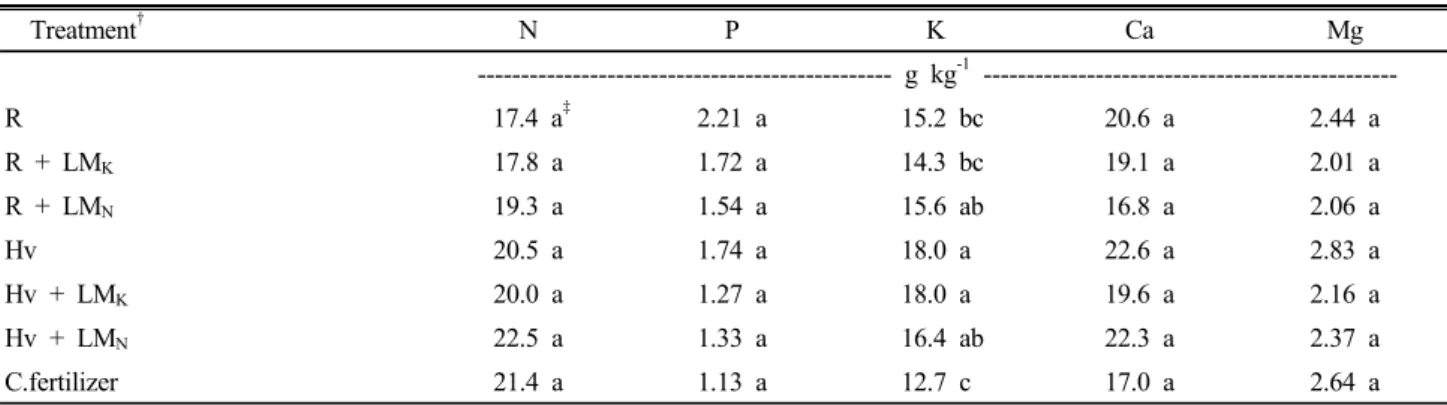
Table 4. Effect of cover crop species and liquid manure application rate on leaf mineral content in pear orchard (Aug. 6, 2014).
Treatment† N P K Ca Mg
--- g kg-1 ---
R 17.4 a‡ 2.21 a 15.2 bc 20.6 a 2.44 a
R + LMK 17.8 a 1.72 a 14.3 bc 19.1 a 2.01 a
R + LMN 19.3 a 1.54 a 15.6 ab 16.8 a 2.06 a
Hv 20.5 a 1.74 a 18.0 a 22.6 a 2.83 a
Hv + LMK 20.0 a 1.27 a 18.0 a 19.6 a 2.16 a
Hv + LMN 22.5 a 1.33 a 16.4 ab 22.3 a 2.37 a
C.fertilizer 21.4 a 1.13 a 12.7 c 17.0 a 2.64 a
†R: rye, Hv: hairy vetch, LMK: K2O requirement-based liquid manure application, LMN: N requirement-based liquid manure application, C.fertilizer: chemical fertilizer
‡Mean separation within columns by DMRT at P=0.05.
was measured by using a digital refractometer (PR-101, Atago, Japan) and titratable acidity was measured by titration to pH 8.2 with 0.1 M NaOH. It was finally converted into a percentage of malic acid equivalents.
Statistical analysis Analysis of variance of the data were performed using the SAS statistical package (version 9.2, SAS Institute, Cary, NC).
Results and Discussion
Effect of cover crop species and liquid manure application rate on green manure production and returnable nutrient rate Green manure production was more affected by cover crop species rather than by liquid manure application rate (Table 3). Accumulated dry weight of hairy vetch was about three times higher than that of rye. The three-year average yield of green manure between two perennial cover crops was different by 21% (Shinners et al., 2010). Returnable nutrient rate by cover crop showed similar results with the green manure production. Although there was no significant difference between
the same cover crop treatments in this experiment, rye tended to increase its drymass and returnable nutrient rate as liquid manure application rate increases. On the other hand, hairy vetch showed a decrease in them. The main factor related to green manure production is different depending on the species.
In rye, liquid manure application was more effective in increasing cover crop biomass and returnable nutrient content than cutting frequency. In contrast, the cover crop biomass and returnable nutrient content were more affected by cutting frequency rather than liquid manure application in hairy vetch (Lee et al., 2013).
Effect of cover crop species and liquid manure application rate on leaf mineral content in pear tree Leaf K content was higher in N based liquid manure application plot than in other treatments (Table 4). That is because SCB liquid manure features a relatively high percentage of K2O, although it contains low rate of N (Park et al., 2013). Other mineral contents of pear leaves were not different significantly, but leaf N content tended to be higher in hairy vetch treatments and chemical fertilizer than in rye treatments. It also tended to increase slightly as liquid manure application rate increases.
Table 5. Effect of cover crop species and liquid manure application rate on soil chemical properties in pear orchard (Jul. 31, 2014).
Treatment† pH EC OM NH4-N+NO3-N Av.P2O5
Ex.cation
K Ca Mg
1:5 dS m-1 g kg-1 --- mg kg-1 --- --- cmolc kg-1 ---
R 7.2 bc‡ 0.24 a 9.5 a 27.8 abc 232.4 a 0.32 c 4.87 a 1.48 a
R + LMK 7.5 a 0.32 a 9.3 a 21.0 bcd 228.4 a 0.55 bc 5.35 a 1.41 a
R + LMN 7.5 a 0.39 a 10.0 a 20.6 bcd 229.7 a 1.05 a 5.16 a 1.35 a
Hv 7.5 a 0.28 a 7.8 a 17.5 cd 219.7 a 0.52 bc 4.50 a 1.28 a
Hv + LMK 7.4 ab 0.28 a 10.9 a 16.3 d 232.5 a 0.42 c 5.70 a 1.56 a
Hv + LMN 7.3 bc 0.33 a 11.2 a 34.7 a 218.1 a 0.96 ab 5.37 a 1.44 a
C.fertilizer 7.2 c 0.31 a 11.1 a 29.1 ab 351.6 a 0.60 abc 5.73 a 1.06 a
†R: rye, Hv: hairy vetch, LMK: K2O requirement-based liquid manure application, LMN: N requirement-based liquid manure application, C.fertilizer: chemical fertilizer.
‡Mean separation within columns by DMRT at P=0.05.
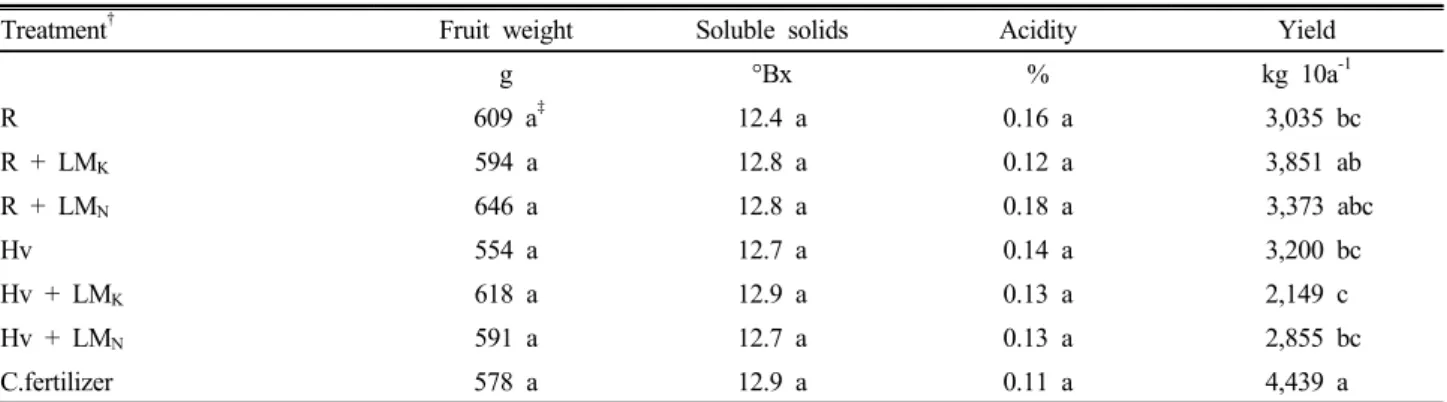
Table 6. Effect of cover crop species and liquid manure application rate on fruit quality and yield in pear orchard (Sep. 30, 2014).
Treatment† Fruit weight Soluble solids Acidity Yield
g °Bx % kg 10a-1
R 609 a‡ 12.4 a 0.16 a 3,035 bc
R + LMK 594 a 12.8 a 0.12 a 3,851 ab
R + LMN 646 a 12.8 a 0.18 a 3,373 abc
Hv 554 a 12.7 a 0.14 a 3,200 bc
Hv + LMK 618 a 12.9 a 0.13 a 2,149 c
Hv + LMN 591 a 12.7 a 0.13 a 2,855 bc
C.fertilizer 578 a 12.9 a 0.11 a 4,439 a
†R: rye, Hv: hairy vetch, LMK: K2O requirement-based liquid manure application, LMN: N requirement-based liquid manure application, C.fertilizer: chemical fertilizer
‡Mean separation within columns by DMRT at P=0.05.
Effect of cover crop species and liquid manure application rate on soil chemical properties Hv + LMN showed the highest inorganic nitrogen content of all the treatments, and soil ex- changeable K content increased as liquid manure application rate increases (Table 5). If liquid manure application is based on the N requirement, there is potential to increase soil ex- changeable K content (Park et al., 2013).
Effect of cover crop species and liquid manure application rate on fruit quality and yield of pear There was no significant difference in fruit quality between the treatments (Table 6).
Fertigating SCB liquid manure in peach orchard has positive effects on fruit weight and yield as chemical fertilizer (Park et al., 2013). However, further long-term study on the effect of the liquid manure application rate on fruit quality and yield based on the soil organic matter content will be needed. Total soluble solids-titratable acidity (TSS-TA) ratio of the juice of satsuma mandarin and specific gravity of fruit were negatively correlated to leaf N content, whereas TA content correlated positively with leaf N (Tachibana & Yahata, 1998).
Conclusion
Green manure production was higher in hairy vetch than in rye. K content of pear leaves and soil K2O increased in N requirement based liquid manure application treatments. The yield was higher in rye + liquid manure and fertilizer treatments, and fruit quality was not different between the treatments.
References
Hartwig, N.L. and L.D. Hoffman. 1975. Suppression of perennial legume and grass cover crops for no-tillage corn. Proc. Northeast.
Weed Sci. Soc. 29:82-88.
Hooda, P.S., N. Moynagh, I.F. Svoboda, and H.A. Anderson.
1998. A comparitive study of nitrate leaching form intensively managed monoculture grass and grass-clover pastures. J. Agric.
Sci. 131:267-275.
Jokela, W.E., J.H. Grabber, D.L. Karlen, T.C. Balser and D.E.
Palmquist. 2009. Cover crop and liquid manure effects on soil quality indicators in a corn silage system. Agron. J. 101:727-737.
Lee, S.E., J.M. Park, and D.G. Choi. 2012. Effect of SCB liquid manure application in pear orchard managed by cover crop system on tree growth, potential nutrient recovery and soil physicochemical properties. Korean J. Soil Sci. Fert. 45:779-786.
NIAST. 1988. Methods of soil chemical analysis. National Institute of Agricultural Science and Technology, RDA, Suwon, Korea.
Park, J.M., S.E. Lee, T.J. Lim, and J.S. Noh. 2013. Effect of Slurry Composting Biofiltration (SCB) Liquid Manure on Shoot Growth and Fruit Qualities of Peach (Prunus persica L.)
and Soil Chemical Properties in Orchard. Korean J. Soil Sci.
Fert. 45:530-535.
Shinners, K.J., G.C. Boettcher, R.E. Muck, P.J. Weimer, and M.D. Casler. 2010. Harvest and storage of two perennial grasses as biomass feedstocks. Trans. ASABE 53:359-370.
Tachibana, S. and S. Yahata. 1998. Effects of organic matter and nitrogen fertilizer applications on fruit quality of satsuma Mandarin in a high density planting. J. Jpn. Soc. Hortic. Sci.
67:671-676.