Effects of Winter Cover Crop of Ryegrass (
Lolium multiflorum
)and Soil Conservation Practices on Soil Erosion and Quality in the Sloping Uplands
Su-Jung Kim
1, Jae E. Yang
1,*, Chol-Soo Park
2, Yeong-Sang Jung
1and Byong-Ok Cho
11Division of Biological Environment, Kangwon National University, Chuncheon 200-701, Korea
2Bio-Resources Group, KT&G Central Research Institute, Suwon 441-480, Korea
Received March 2, 2007; Accepted March 12, 2007
Most of the uplands in alpine regions during off-season are left as bare soil and thus vulnerable to severe erosion due to the inherent topographical conditions. Appropriate management strategy to cope with this problem is urgently needed, yet few researches have been reported on the effects of winter cover crop and management on soil erosion. We assessed effects of ryegrass (Lolium multiflorum) as cover crop, green manure or mulching residue on soil erosion and quality through field and segment plot lysimeter experiments in alpine uplands. Ryegrass successfully adopted to winter in alpine region based on biomass, nutrient contents, and vigors of top and root systems.
Incorporation of ryegrass into soil maintained soil fertility, nutrient uptake, and yield of cabbage exerting potential use as green manure. Cultivation of ryegrass suppressed occurrence of Chinese cabbage pests. Surface coverage by ryegrass as cover crop and mulching residue significantly reduced soil loss up to 96%, when combined with soil conservation management practices. Results revealed maintaining cover crop over winter was beneficial in reducing soil erosion, and sustaining soil quality and Chinese cabbage productivity. This study suggested winter cover crop, followed by green manure and mulching, and conservation tillage system could be one of the best management practices in alpine sloping uplands cultivating Chinese cabbage.
Key words: alpine soils, annual ryegrass, cover crop, erosion, green manure, mulching
Uplands in Korea comprise about 740,000 ha, only 7%
of the total land area. About 62% of the uplands are located in slopes higher than 7% [NIAST, 1992]. Due to this topographical distribution and heavy rainfall, most of the uplands are vulnerable to severe erosion. About 20 Mg ha−1 of upland soils is estimated to erode annually in Korea [Yang and Jung, 2004], thus deteriorating the soil productivity and water quality of the agricultural watersheds.
In Korea, alpine areas are generally limited to lands higher than 400 m above the sea level. Due to the economic perspectives, areas of alpine agriculture have been extended to 37,000 ha, of which over 79% are located in the Kangwon Province [NIHA, 2002]. Alpine agriculture has been developed in the rough terrain of the
Kangwon Province, northeastern part of South Korea, to produce vegetable cash crops such as Chinese cabbage and radish, particularly during the summer season. Chinese cabbage is the most widely grown crop in this region [NIHA, 2002].
Alpine farming system in the Kangwon Province plays an important role in sustaining biodiversity as the traditional land management creates heterogeneity and niches, which are habitats for many different species adapted to this situation [Jung et al., 2002; Yang and Jung, 2004].
Because the cool and humid climate during summer provides adequate conditions for the development and growth of such cash crops [Yang et al., 2001], cropping system has, therefore, developed into mono- and intensive- culture system of vegetables in these regions.
Most of the cultivating lands are found in mountain foot slopes, valley, and rolling hills with a relief of 7% or higher slopeness [Cho, 1999; NIHA, 2002; Yang et al., 2001]. Many researchers have reported rapid deterioration of the soil qualities after the removal of surface plow layers by severe erosions [Joo et al., 2004; Park, 2002a,
*Corresponding author
Phone: 82-33-250-6440; Fax: 82-33-241-6640 E-mail: [email protected]
Abbreviations: LSD, least significant difference; NIAST, National Institute of Agricultural Science and Technology; NIHA, National Institute of Highland Agriculture.
b]. Soil erosion causes the losses of top soils and available nutrients, as well as being the source of non-point contaminants of the watersheds.
There have been urgent needs for appropriate measures to be established concerning conservations of soil and environmental quality in the alpine agricultural areas.
Several researchers have suggested strategies for the best management practices of vegetable cultivation in the alpine regions, such as cover crops, strip-cropping, terraces, diversion ditches, contour cultivation, grass buffer strip, and fallow [Joo et al., 2004; Park, 2002a, b], among which the cover cropping system was the most effective for reducing soil erosion caused by wind and snow melting during the farming off-season in the alpine regions [Jung et al., 2002; Lee et al., 2005; Yang and Jung, 2004]. Strong winds and heavy snowfall during winter have resulted in severe soil erosions, because soils usually remain bare. Importance of surface cover using plants has been stressed for the soil conservation [Cherr et al., 2006; Morgan, 2005; Rowe et al., 2006; Storey, 2003]; yet few researches have been reported on its efficiency for reducing soil erosion in winter.
Cover crop and mulching are managerial tools to cover the soil surface by growing plants and crop residues.
Cover crops are cultivated as a conservation measure during the off-season and as ground protection under trees [Morgan, 2005]. Cover crops are grown as winter annuals and ploughed to form green manure prior to sowing the main crop. Typical cover crops used are ryegrass, oats, hairy vetch, sweet clover, among others.
However, a high yielding winter cover crop could also potentially compete with and negatively impact the growth of the main crop such as Chinese cabbage, because compatibility of the crops planted in tandem is greatly affected by the management practices [Moore et al., 2004; Rowe et al., 2006].
To manage soil quality for Chinese cabbage growth in the sloping upland, where cropping system is frequently mono- and intensive-culture system of vegetables, in this study growth of annual ryegrass (Lolium multiflorum) as
a winter cover crop in combination with conservation management practices was assessed to protect soil surface from erosion and to capture available nutrients.
Materials and Methods
Field experiment. The field experiment was conducted in an alpine region of Bongpyeong, Pyongchang, during a growing season. Annual ryegrass seeds were sown at the rate of 160 kg ha−1 at the end of October on fields after harvesting the Chinese cabbages and cultivated until early May. The residues were then incorporated into the soil before cultivation of Chinese cabbages in late May.
Chinese cabbage (Braccica campestris) seeds were sown on two separate field plots: one was the field where annual ryegrass had been cultivated and incorporated into the soil, and the other was the field where the soil remained bare without cover crop. The first cutting of the ryegrass was done in late spring, and the cuttings were dried in the field for 2 weeks. The field-dried ryegrasses were then incorporated into the soil along with the remnants of the plant stem and root by operating the rotary tiller before new planting of Chinese cabbages.
Chinese radishes and common cabbages were also cultivated to compare their efficiencies in soil surface covering. The occurrence of infection by the general plant pests was examined. N-P-K fertilizers were applied at the rate of 320-200-270 kg ha−1 as recommended by the NIAST. The soils and plant samples including ryegrass and cabbage were collected and analyzed for the chemical characteristics following the procedures recommended by NIAST [2000]. The chemical and taxonomical properties of the alpine soil in Pyongchang are shown in Table 1.
Segment plot lysimeter experiments. In field experiment erosion measurements of soil obtained were erratic due to the topographical limitations in installing plume and gutter to collect the eroded soils during ryegrass cultivation. Therefore, we conducted additional segment plot lysimeter experiments for 3 years in the sloping uplands located at the experiment centers of Table 1. Chemical and taxonomical properties of the soils used for field and lysimeter experiments
Experiments Locations Taxonomy pH OM† Available
P2O5 K+ Ca2+ Mg2+
(1 : 5) g kg−1 mg kg−1 cmol(+) kg−1 Field Bongpyeong,
Pyongchang Imog Seireis, coarse loamy, mixed,
mesic famoly of Dystric Eutrochrepts 6.0 41 567.0 1.10 2.88 1.14 Lysimeter Hoengkye,
Pyongchang Shinbul Series, loamy skeletal, mixed,
mesic family of Humic Dystrudepts 5.5 51 027.3 0.23 4.00 1.20 Lysimeter Shinbuk,
Chuncheon Haggog Series, sandy skeletal, mixed,
mesic family of Aquic Udipsamments 6.3 54 199.0 0.49 2.56 1.40
†OM: organic matter.
National Institute of Highland Agriculture (Pyongchang) and of Kangwon National University (Chuncheon), respectively. The Hoengkye experiment included 12 segment plots, each treatment plot being 3.0 m wide by 15.0 m long. Each segment plot was separated with a steel sheet of 30 cm in height, half buried into the soil.
Slope of the field was 20%. At the end of each plot, plume and gutter were installed to collect the runoff and soils eroded. The plots were treated with different soil conservation managements such as tillage (no-till, up- down, slant or contour) combined with various surface cover treatments such as ryegrass growth, continuous fallow, minimum rice straw, ryegrass mulching, and mini- gravel bag. A 3- year crop rotation was potato-potato- Chinese cabbage. The experiment plots treated with various surface covers were as follows: minimum rice straw, 0.6 Mg ha−1; ryegrass mulching, 3.5 Mg ha−1; mini- gravel bag, 6 Mg ha−1.
Similar segment plot lysimeter experiment was conducted in Chuncheon. Ten plots, each 2.0 m wide by 10.0 m long, were prepared in the field at slope of 13%. The plots were treated with soil conservation managements of tillage (up-down, slant or contour) in combination with surface covers (continuous fallow, minimum rice straw, ryegrass mulching, mini-gravel bag, and minimum straw mulching). This study was conducted in conjunction with a larger field-scale project in the slopping uplands, following the layout details of Park [2002a, b]. The rotation of crops was potato-potato-Chinese cabbage. The efficiencies of ryegrass as cover crop, green manure, and mulching were assessed based on the changes in the parameters of soil fertility, runoff, and soil erosion. The chemical and taxonomical properties of the alpine soils in Pyongchang and Chuncheon are shown in Table 1.
Statistical analysis. For the field experiment, the effects of ryegrass on cabbage yield and soil quality in the
alpine regions was determined using PROC GLM [SAS Institute, 2001]. Fisher’s protected LSD was used as multiple comparison test at P< 0.05. Data were normally distributed and had equal variance using the test for homogeneity of variance.
Results and Discussion
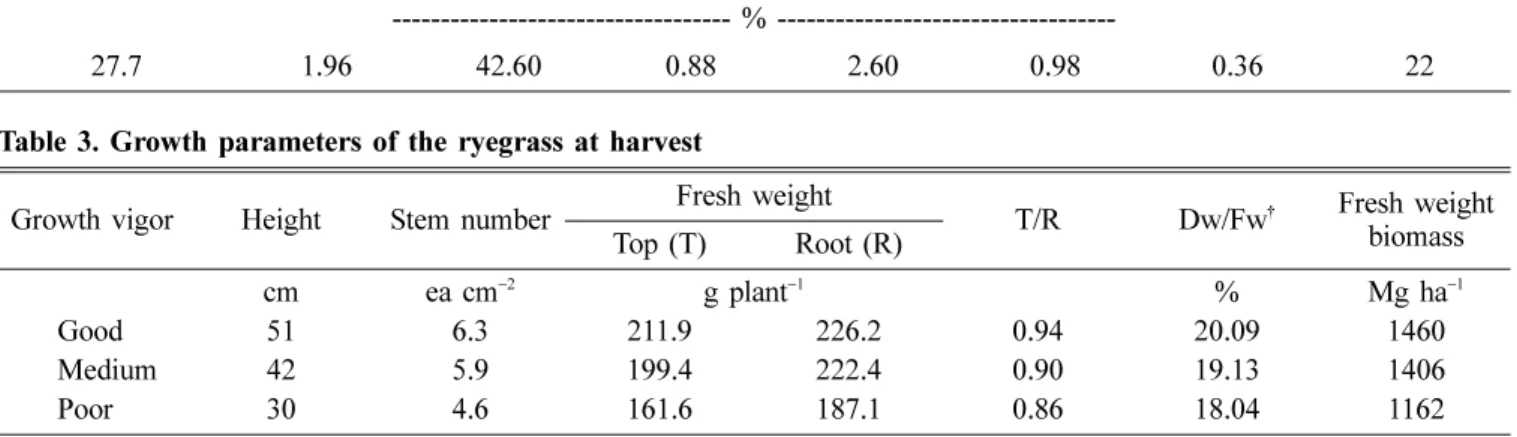
Ryegrass as cover crop and green manure. As shown in Table 2, chemical compositions of ryegrass were 1.96 and 42.60% of N and C, respectively, thus yielding the C/
N ratio of 22, which demonstrated a good potential for microbial decomposition when incorporated into soil for mineralization [Potash and Phosphate Institute, 2003].
Levels of phosphorus and cations were in the ranges classified by Jones, Jr [1991] as sufficient or high. Annual ryegrass contains more P than other less common cover crops, such as white clover and fescue grass [Bechmann
et al., 2005]. Cherr et al.[2006] suggested the ryegrass as a potential green manure for the following crops based on its nutrient values.
Table 3 shows the growth parameters of ryegrass by arbitrarily classifying the growth vigor into three groups.
For nearly 6 months, ryegrass grew 30~50 cm in height, yielding fresh weight biomass of 1,160~1,460 Mg ha−1, considered as a high yield for a short growing period [Cherr et al., 2006]. The ratios of top/root of the ryegrass were 0.86~0.94, possible indications of a strong root vigor. High vigor of the rooting system offers a strong potential to hold soil aggregates and improve soil structure to resist the erosivity caused by wind or water [Morgan, 2005; Storey, 2003]. It may be critical for the cover crop to establish quickly, thereby providing an early canopy cover and becoming aggressive enough to suppress weeds and develop a deep root system to improve the macro-porosity of the soil. The broadcast sowing of Table 2. Chemical compositions of the ryegrass at harvest
Moisture content Total N Total C P2O5 K2O CaO MgO C/N
--- % ---
27.7 1.96 42.60 0.88 2.60 0.98 0.36 22
Table 3. Growth parameters of the ryegrass at harvest
Growth vigor Height Stem number Fresh weight T/R Dw/Fw† Fresh weight
biomass Top (T) Root (R)
cm ea cm−2 g plant−1 % Mg ha−1
Good 51 6.3 211.9 226.2 0.94 20.09 1460
Medium 42 5.9 199.4 222.4 0.90 19.13 1406
Poor 30 4.6 161.6 187.1 0.86 18.04 1162
†Dw/Fw (%) = (Dry weight of ryegrass/Fresh weight of ryegrass) ×100
winter rye at a rate of 120~130 kg ha−1 as early as possible in the autumn was practiced to control wind erosion on the sandy soils of the northern Netherlands [Eppink and Spaan, 1989]. Early sowing is essential to obtain a good coverage at the end of December, because the climate in February thru March is generally too cold, dry, and windy for crop to grow. Maintaining a cover crop over winter instead of bare soil was also beneficial in reducing the leaching of nitrogen to groundwater [Morgan, 2005].
Vigorous development and growth of ryegrass above the ground as a cover crop reflected the same status of rooting systems. Therefore, well-developed top parts and roots of ryegrass were expected to affect the infiltration of rain water into the soil, which might lead to the prevention of soil erosion in the sloping alpine upland. In addition, ryegrass might be an effective barrier against wind erosion in winter (Table 3).
Table 4 compares the soil chemical properties of ryegrass and the control. Ryegrass cultivation had no significant effects on soil acidity and organic matter and micronutrient contents, whereas contents of available P2O5 and exchangeable K and Ca tended to increase.
These results show that cover crop growth did not change the soil fertility significantly in a single season; however, further study on the effects of incorporation on the following crop should be followed [Cherr et al., 2006;
McKenney et al., 1993]. A direct effect of cover crop on soil conservation might be better expectation than soil fertility improvement in a short term.
Ryegrass and cabbage yield. Table 5 and 6 respectively show the yield components and mineral compositions of Chinese cabbages grown with or without rye residue incorporation. There were no significant differences in leaf length, width, number, weight, and yield between Table 4. Changes in chemical properties of the soil at the time of harvest
Soil Treatments pH OM‡ Available
P2O5 K+ Ca2+ Mg2+ Fe2+ Mn2+
(1 : 5) % mg kg−1 cmol(+) kg−1 mg kg−1
Without rye residue 05.2 3.43 1407 0.62 2.76 0.95 52 19
With rye residue
incorporated 05.3 3.10 1492 1.25 2.92 0.16 43 17
LSD† 0.19 0.88 0386 0.61 0.86 0.25 5.1 3.2
†LSD: least significant difference at P< 0.05.
‡OM: organic matter.
Table 5. Yield components of the Chinese cabbage Soil treatments Leaf
length Leaf
width Outer leaf
number (A) Inner leaf
number (B) A/B Fresh
weight Yield Yield
index‡
cm % kg plant−1 Mg ha−1
Without rye residue 35.6 30.0 10.0 46.1 21.7 2.74 80.59 100
With rye residue
incorporated 34.3 27.9 09.8 43.8 22.4 2.76 81.18 101
LSD† 0.98 3.70 1.45 4.58 0.80 23.65
†LSD: least significant difference at P< 0.05.
‡Yield index = (average yield of each treatment/average yield of without rye residue) ×100 Table 6. Mineral compositions of Chinese cabbage
Soil treatments Total N P2O5 K2O CaO MgO
Inner
leaf Outer
leaf Inner
leaf Outer
leaf Inner
leaf Outer
leaf Inner
leaf Outer
leaf Inner
leaf Outer --- % --- leaf
Without rye residue 3.40 3.22 1.82 2.05 3.93 7.27 0.28 1.05 0.42 0.58
With rye residue
incorporated 2.97 3.44 1.78 0.09 3.93 7.17 0.41 1.59 0.46 0.54
LSD† 0.40 0.32 0.11 0.41 1.37 5.34 0.11 0.47 0.12 0.20
†LSD: least significant difference at P< 0.05.
both treatments. Furthermore, incorporation of ryegrass did not increase significantly the nutrient uptake, as in the case of yield components, even though mineral contents varied between inner and outer leaves. In spite of the above results, ryegrass incorporation treatment did not show any detrimental effects.
Although use of green manure was routinely credited to increase soil organic matter and microbial biomass pools, and thus yields of the following crop, the actual extent of such effects depended on management and environment as well as green manure biomass accumulation.
Additionally, the annual contribution of green manure residues might be relatively small compared with the preexisting soil organic matter pools, particularly after residue losses following decomposition [Cherr et al., 2006]. Incorporation of winter cover crop residues into soil showed, to some extents, the beneficial effect on the soil chemical properties and cabbage yield because soil biological and chemical reactions might take time [Morgan, 2005]. Thus, a long term and holistic approaches to assess the effects of winter cover crop as a green manure are necessary [Cherr et al., 2006; Morgan, 2005].
With the growth of crops, canopies develop naturally above the soil surface, acting as reducer of raindrop intensity. It may play an important role in preventing soil erosion. Radish, Chinese cabbage, and common cabbage vegetables cultivated in the ryegrass-incorporated plot covered 28 to 67% soil surface at harvest period, depending on the vegetable types (Table 7). The Chinese cabbage and common cabbage outperformed radish in covering the soil surface. The increments of surface coverage of Chinese cabbage from 30 d after transplant through harvest were similar to those of the common cabbage.
Results revealed that cropping system in the sloping uplands, by covering the soil surface, could be an important factor controlling soil erosion.
Plant diseases have been frequently reported in the alpine regions, where continuous and intensive cropping system was adopted [Cho, 1999; Ham, 1997; Yun et al., 1999]. The climate and soil conditions, favoring the development and growth of agricultural crops in a continuous mono-cropping system, were generally suitable for phytopathogenic agents to propagate [Ham,
1997]. Table 8 shows the effects of ryegrass on the occurrence of plant diseases common to the Chinese cabbage in alpine regions, expressed as either injuries or damages in the Chinese cabbage. Frequency of pathogenic symptoms were in the orders of soft rot > root blight >
virus, regardless of treatments. Ryegrass cultivation tended to decrease the frequencies of pathogenic symptoms in cabbages as compared to the control. No significant differences were observed among ryegrass incorporation treatments. Results indicated that the cultivation of ryegrass might suppress the frequency of Chinese cabbage pests to a limited extent. Yun et al. [1999]
reported that soil microorganisms, such as bacteria, actinomycetes, fungi, Pseudomonas spp. and Erwinia sp., were most abundant in the top 0~15 cm soil profile and soil microflora population was highly affected by different cropping systems. The number of Erwinia sp., known as one of the soil-born plant pathogenic bacteria, was more abundant in potato fields than Chinese cabbage- grown soil.
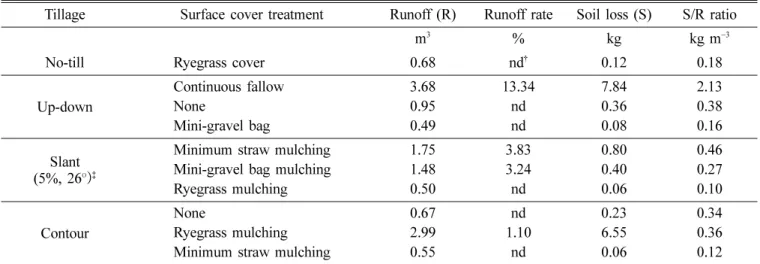
Ryegrass as a mulching residue on soil erosion. Table 9 and 10 show the effects of conservation treatments such as tillage and surface cover treatments on the average runoff and soil erosion in Chuncheon and Hoengkye areas, respectively. As compared to up-down tillage, contour tillage reduced significantly the runoff and soil erosion amounts. In the slant and contour tillages, ryegrass mulching was the most effective tool to reduce the ratio of soil erosion/runoff, indicating that amount of eroded soil was lowest in the contour-ryegrass mulching systems irrespective of the amount of runoff.
Table 7. Soil surface coverage ratios established by the following crops
Crop Soil coverage at different growth stages (DAT)†
0 15 30 Harvest
--- % ---
Radish 0 07.5 10.8 28.3
Chinese cabbage 0 10.3 31.9 59.2
Cabbage 0 20.0 48.3 66.6
†Days after transplant
Table 8. Occurrence of cabbage injuries and damages caused by diseases
Soil treatments Frequency of pathogenic symptoms
Virus Soft rot Root blight
--- % ---
Without rye residue 2.3 8.5 3.8
With rye residue incorporated 1.3 6.0 2.3
With rye residue not incorporated 1.1 6.3 2.9
Surface covers by minimum rice straw and mini-gravel bags mulching in the contour and slant tillage treatments were also very effective for reducing runoff and soil erosion, as compared with up-down tillage. There were variations in runoff and soil erosion between the two sites probably due to the differences in the precipitation, slope, soil compaction, topography, and cropping systems.
Surface covers by minimum rice straw and mini-gravel bags mulching in the contour and slant tillage treatments were also very effective for reducing runoff and soil erosion, as compared with the up-down tillage method.
Mulching is the covering of the soil with crop residues such as straw, stalks or standing stubble. The cover protects the soil from raindrop impact and reduces the velocity of runoff and wind. It was most useful as an alternative to cover crops in dry season, when insufficient rain prevented the establishment of a ground cover before the onset of heavy rain or strong winds, or when a cover crop competes for moisture with the main crop [Morgan,
2005; Yang and Jung, 2004]. Most applications of mulching involve spreading crop residues on the surface of the soil;
however, this method creates problems in drilling and planting through the mulch, unless specialized equipment is used. Alternative approach is to incorporate the mulch into the soil. Although this reduces the overall surface cover, the mulch elements help to bind the soil, simulating the effect of plant roots, and increase infiltration rates.
However, Morgan [2005] stated that incorporated mulches were less effective than surface mulches because of poor contact between soil and mulch, poor spreading on the surface, movement of mulch downward, washing out, and transporting downslope. When using mulches to control wind erosion, standing stubble is required to prevent mulches from blowing away. Considerable experimental evidences have shown that the rate of soil loss decreased exponentially with an increase in the percentage area covered by a mulch [Laflen and Colvin, 1981; Morgan, 2005; Wischmeier, 1973].
Table 9. Effects of conservation treatments on runoff and soil erosion (Chuncheon lysimeter plot)
Tillage Surface cover treatments Runoff (R) Runoff rate Soil loss (S) S/R ratio
m3 % kg kg m−3
Up-down Continuous fallow 14.15 64.37 150.10 10.610
Slant (5%, 26o)†
None (bare) 10.98 40.83 51.2 4.67
Minimum rice straw 9.26 40.53 12.7 1.37
Ryegrass mulching 16.50 56.80 13.8 0.83
Mini-gravel bag 07.75 36.65 20.8 2.68
Contour None 14.54 40.03 17.4 1.20
Ryegrass mulching 13.40 46.40 06.5 0.49
Minimum straw mulching 06.87 32.03 09.1 1.32
†Slope of slant was 5% and 26o to the contour of the plot
Table 10. Effects of conservation treatments on runoff and soil erosion (Hoengkye lysimeter plot)
Tillage Surface cover treatment Runoff (R) Runoff rate Soil loss (S) S/R ratio
m3 % kg kg m−3
No-till Ryegrass cover 0.68 nd† 0.12 0.18
Up-down Continuous fallow 3.68 13.34 7.84 2.13
None 0.95 nd 0.36 0.38
Mini-gravel bag 0.49 nd 0.08 0.16
Slant (5%, 26o)‡
Minimum straw mulching 1.75 3.83 0.80 0.46
Mini-gravel bag mulching 1.48 3.24 0.40 0.27
Ryegrass mulching 0.50 nd 0.06 0.10
Contour None 0.67 nd 0.23 0.34
Ryegrass mulching 2.99 1.10 6.55 0.36
Minimum straw mulching 0.55 nd 0.06 0.12
†nd: not determined.
‡Slope of slant was 5% and 26o to the contour of the plot
References
Bechmann ME, Kleinman PJA, Sharpley AN, and Saporito LS (2005) Freeze-thaw effects on phosphorus loss in runoff from manured and catch-cropped soils. Qual 34, 2301-2309.
Cherr CM, Scholberg JMS, and McSorley R (2006) Green manure approaches to crop production: A synthesis.
Agron J98, 302-319.
Cho BO (1999) Characterization of soil fertility and man- agement practices of alpine soils under vegetable cultiva- tions. Ph. D. Dissertation. Kangwon National University, Chuncheon, Korea.
Eppink A.AJ and Spaan WP (1989) Agricultural wind ero- sion control measures in the Netherlands. In Soil ero- sion protection measure in Europe. Soil Technology U.
Schwertmann et al. (eds.), Series 1, 1-13.
Ham YL (1997) Symposium for consistent production of vegetable crops in alpine soils. pp. 61-103. National Institute of Highland Agriculture, Rural Development Administration. Suwon, Korea.
Jones Jr JB, Wolf B, and Mills HA (1991) Plant analysis handbook. Micro-Macro Publishing, Inc., Athens, GA, Joo JH, Park C, Jung YS, Yang JE, Choi JD, Lee WJ, andUSA.
Kim SI (2004) Evaluation of the dressed soil applied in mountainous agricultural land. Korean J Soil Sci Fert37, 245-250.
Jung YS, Yang JE, Kim JJ and Park CS (2002) The best management practices in the alpine sloping lands to control soil erosion. Symposium on the soil conserva- tion and management strategies in the sloping lands.
Rural Development Administration, Suwon, Korea.
Laflen JM and Colvin TS (1981) Effect of crop residue on soil loss from continuous row cropping. Trans ASAE24, 605-609.
Lee JT, Lee GJ, Park CS, Hwang SW, and Yeoung YR (2005) Effect of hairy vetch (Vicia villosa Roth.) sod culture on reducing soil loss and providing nitrogen for Chinese cabbage in highland. Korean J Soil Sci Fert38, 294-300.
McKenney DJ, Wang SW, Drury CF, and Findlay WI (1993) Denitrification and mineralization in soil amended with legume, grass, and corn residues. Soil Sci Soc Am J
57, 1013-1020.
Moore KJ, White TA, Hintz RL, Patrick PK, and Brummer EC (2004) Sequential grazing of cool- and warm-season
pastures. Agron J96, 1103-1111.
Morgan RPC (2005) Soil erosion and conservation (3rd ed.) Blackwell Publishing, Malden, MA, USA.
National Institute of Agricultural Science and Technology (1992) Korean Soil Comprehensive Report (2nd ed.).
Rural Development Administration, Suwon, Korea.
National Institute of Agricultural Science and Technology (2000) Methods of soil and crop plant analysis. Rural Development Administration, Suwon, Korea.
National Institute of Highland Agriculture (2002) Technolo- gies for vegetable cultivation in the alpine highland.
Rural Development Administration, Suwon, Korea.
Park CJ (2002a) Case study on the best management prac- tice model for the environmentally sound conservation of soil and water quality. Ph.D. Dissertation, Kangwon National University, Chuncheon.
Park CS (2002b) Soil management practices to reduce water erosion from the sloped farmland in highland. Ph.D. Dis- sertation, Kangwon National University, Chuncheon.
Potash and Phosphate Institute (2003) Soil fertility manual.
Norcross, GA, USA.
Rowe DE, Fairbrother TE, and Sistani KA (2006) Winter cover crop and management effects on summer and annual nutrient yields. Agron J98, 946-950.
SAS Institute (2001) SAS/STAT User Guide. Version 8.2.
SAS Inst., Cary, NC.
Storey PJ (2003) The conservation and improvement of sloping land. vol. III, Practical application-Soil and water conservation. pp. 349. Science Publishers, Inc., Enfield, NH, USA.
Wischmeier WH (1973) Conservation tillage to control water erosion. In Proceedings, National conservation till- age conference. pp. 133-141. Soil Conservation Society of America, Ankeny, IA, USA.
Yang JE, Cho BO, Shin YO, and Kim JJ (2001) Fertility status in northeastern alpine soils of South Korea with cultivation of vegetable crops. Korean J Soil Sci Fert 34, Yang JE and Jung YS (2004) 1-7. Evolving sustainable produc- tion systems in sloping upland areas-Land classification issues and options. pp. 136-155, Asian Productivity Organization, Tokyo, Japan.
Yun SY, Kim JJ, Yang JE, Jung YS, and Choi JD (1999) Effect of different cropping system and soil manage- ment on soil chemical and microbiological quality assessment in the Daekwanryung upland soil. Korean J Soil Sci Fert32, 312-318.