Cutting Frequency and Liquid Manure Application on Green Manure Production of Rye and Hairy Vetch in Pear Orchard
Seong Eun Lee*, Jin Myeon Park, Jae Seung Noh, Tae Jun Lim, and Dong Geun Choi
1Horticultural & Herbal Crop Environment Division, National Institute of Horticultural & Herbal Science,
Suwon 441-440, Korea
1
Department of Horticulture, Chonbuk National University, Jeonju 561-756, Korea
(Received: August 1 2013, Accepted: September 9 2013)
Many organic fruit growers adopt cover cropping in their orchards to improve soil properties. A field experiment was conducted to determine the effects of cutting frequency of cover crop (CF) and liquid manure application (LM) on green manure production (GMP) and returnable nutrient content (RNC) in pear orchard.
The combined effects of CF and LM were tested at two levels, respectively, with liquid manure (L
1) and without liquid manure (L
0). After that, cover crops were cut once (C
1) and three times (C
3) in rye, and twice (C
2) and four times (C
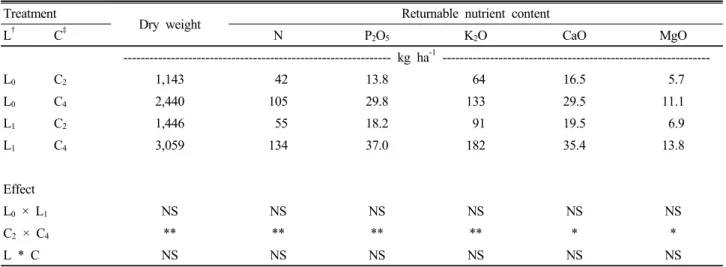
4) in hairy vetch. The result showed that main factors related to green manure production were different depending on the species. In rye, LM was more effective in increasing the dry weight of cover crop and RNC than CF. In contrast, the parameters were more affected by CF rather than LM in hairy vetch.
Thus, it is suggested that different management technique is needed depending on the cover crop species in order to maximize the green manure production in pear orchard.
Key words: Cover crop, Green manure, Cutting frequency, Liquid manure
Different response between cover crop species on green manure production.
Factor Rye Hairy vetch
Liquid manure application increased -
Cutting frequency of cover crop decreased increased
1)
*Corresponding author : Phone: +82312906225, Fax: +82312906259, Email: [email protected]
§
Acknowledgement: This work was funded and supported by RDA, Project PJ008297.
Table 1. Soil chemical properties of pear orchard used in this experiment.
pH Organic matter Avail. P
2O
5Exch. cation
K Ca Mg
1:5 g kg
-1mg kg
-1--- cmol kg
-1---
7.3 15.3 241 0.63 5.74 1.63
Table 2. Mineral content of SCB liquid manure used in this experiment.
T-N P
2O
5K
2O
--- g kg
-1---
0.28 0.23 3.14
Introduction
In recent years, many farmers have been seeking alter- natives to chemical fertilizer for successful organic fruit production. Cover cropping between tree rows can be an inexpensive and effective way to achieve the goal, because cover crops such as winter rye and hairy vetch bring many benefits to crop production. The introduction of cover crops into a cropping system provides and conserves nitrogen (N) for crops, reduces soil erosion, increases soil organic matter content, and controls weed (Hartwig and Hoffman, 1975). Legume cover crops have the potential for fixing N, a portion of which will be available for high-N-requiring crops. In addition, in areas where excess N is already a problem, the use of ground covers may provide a sink to tie up some of this excess N and hold it until the next growing season, when a crop that can make use of it might be planted (Hooda et al., 1998).
A few studies have investigated the effects of sowing time on the biomass of cover crops, but still much is unknown about what is the best management practice in order to maximize the production of green manure and returnable nutrient to the soil. The aim of this work was to evaluate the effects of cutting frequency and liquid manure application on green manure production of rye and hairy vetch in pear orchard.
Materials and Methods
Cover crop growth and sample preparation The experi- ment was carried out during 2012-2013 in a 17-year-old pear (Pyrus pyrifolia cv. Niitaka) orchard planted at a spacing of 5×1.7 m. The pear orchard was located in NIHHS, suwon, Korea. The seeds of rye (Secale cereale) and hairy vetch (Vicia villosa) were sown on October 24,
2012 after harvesting the fruits. 16 kg ha
-1of rye seed and 6 kg ha
-1of hairy vetch seed were used in this experiment.
The experimental design was a randomized factorial arrangement with three replicates and the treatments included two levels of liquid manure application (L
0and L
1) and two cutting intensities [ once (C
1) and three times (C
3) per season in rye, and twice (C
2) and four times (C
4) per season in hairy vetch]. Liquid manure was applied only in L
1plots twice a year, at the proportion of fall:spring=1:4, based on the soil K content, whereas L
0plots were not. The cover crops were cut and sampled when they are grown about 30 cm tall in C
3and C
4plot, while C
1plot was cut on May 22 and C
2was on May 22 and June 11, 2012. The investigated area for evaluating cover crop growth was 25 m
2per each plot.
The soil chemical properties of the pear orchard and the mineral content of SCB liquid manure used in this experiment is presented on Table 1 and 2, respectively.
Plant analysis Chemical analysis for determination of the mineral content of each sample was conducted according to methods of soil chemical analysis (NIAST, 1988).
Quantitative analysis of plant N followed Kjeldahl method. About 3 g catalyst mixture (K
2SO
4: CuSO
4= 9 : 1) and 10 mL concentrated sulfuric acid were added to 0.50 g of dry plant samples for digestion, and then the distillate obtained by Kjeldahl apparatus (Kjeltec 8400, Foss, Sweden) was titrated with standardized 0.1 N HCl.
Total P content in each plant sample was measured by the procedure of ammonium vanadate method and determined by reading the absorbance at 410 nm wavelength by colorimetry using UV/VIS spectrophotometer (Cintra 6, GBC, Australia). The cation (K, Ca and Mg) content in each cover crop was measured by ICP (SDS-720, GBC, Australia) after the digestion of plant samples by adding 10 mL 85:15 nitric-perchloric acid mixture (HNO
3-HClO
4) and the pyrolysis of intermediate substances obtained from the digestion process.
Statistical analysis Analysis of variance was performed
using the GLM procedure of the SAS statistical package
(version 9.2, SAS Institute, Cary, NC).
Table 3. Effect of cover crop species on the average of green manure production and returnable nutrient content.
Cover crop species Dry weight Returnable nutrient content
N P
2O
5K
2O CaO MgO
--- kg ha
-1---
Rye 415 5 3.4 12 1.2 0.8
Hairy vetch 2,022 84 24.7 118 25.2 9.4
Significance (t-test) * * ** ** ** **
NS, *, **
nonsignificant or significant at the P≤ 0.05, 0.01, respectively, by t-test.
Table 4. Effect of liquid manure application and cutting frequency on the dry weight of cover crop and returnable nutrient content in rye.
Treatment
Dry weight Returnable nutrient content
L
†C
‡N P
2O
5K
2O CaO MgO
--- kg ha
-1---
L
0C
1318 3.3 2.28 8.2 0.89 0.53
L
0C
3176 3.1 1.81 6.0 0.63 0.41
L
1C
1753 6.7 5.19 19.1 2.03 1.37
L
1C
3413 7.8 4.37 15.3 1.44 0.88
Effect
L
0× L
1** ** NS ** ** **
C
1× C
3* NS NS NS NS NS
L * C NS NS NS NS NS NS
†
Liquid manure application (L
0: control, L
1: LM-applied)
‡
Cutting frequency of cover crop (C
1: once, C
3: three times)
NS, *, **
nonsignificant or significant at the P≤ 0.05, 0.01, respectively.
Results and Discussion
Cover crop species on green manure production The effect of cover crop species on green manure production ( GMP) was significantly different depending on the species (Table 3). Hairy vetch was about 5 times larger in dry weight and 16 times higher in returnable N content than rye. About 50% increase of GMP was reported in rye cover crop by additional fertilization like SCB liquid manure, while hairy vetch showed only 24% increment (Lee et al., 2012). The relatively low dry weight of rye might be attributed to the nutritional status of cover crop related with soil nitrate, although there were other factors such as low temperature in early spring when the rye shows vigorous growth of the year. High rates of soil N increased N concentration of Orchard grass (Dactylis glomerata) blades and increased cover-grass growth, whereas various legume species were prevalent at the low rates because of its ability to perform N fixation. (Raese et al., 2007).
The difference in biomass production between cover crop species has also been reported in other studies. The
three-year average yield of green manure between two perennial cover crops was different by 21% (Shinners et al., 2010), and annual yield of organic matter and crude protein in the years following establishment were higher in lucerne than in fodder galega (Moller et al., 1997).
Cutting frequency and liquid manure in rye In rye, liquid manure application (LM) significantly increased GMP and returnable nutrient content ( RNC), except for phosphate (P
2O
5), However, high cutting frequency (CF) decreased GMP, whereas it did not affect RNC (Table 4).
These results are in agreement to the report demonstrating
the annual yield of fodder galega was greater at two
yearly cuts than at three and four yearly cuts, and the
concentration of crude fiber increased, while the
concentration of crude protein, easily decomposable
organic matter decreased when the yield increased by
delayed harvest of fodder galega, especially at the first
cut (Moller et al., 1997). It is because the biomass of
grass species harvested at mature stages is much greater
than harvested at immature stages (Shinners et al., 2010).
Table 5. Effect of liquid manure application and cutting frequency on the dry weight of cover crop and returnable nutrient content in hairy vetch.
Treatment
Dry weight Returnable nutrient content
L
†C
‡N P
2O
5K
2O CaO MgO
--- kg ha
-1---
L
0C
21,143 42 13.8 64 16.5 5.7
L
0C
42,440 105 29.8 133 29.5 11.1
L
1C
21,446 55 18.2 91 19.5 6.9
L
1C
43,059 134 37.0 182 35.4 13.8
Effect
L
0× L
1NS NS NS NS NS NS
C
2× C
4** ** ** ** * *
L * C NS NS NS NS NS NS
†
Liquid manure application (L
0: control, L
1: LM-applied)
‡
Cutting frequency of cover crop (C
2: twice, C
4: four times)
NS, *, **