Jour. Agri. Sci.
Chungnam Nat'l Univ., Korea Vol.29(2): 20~34 (2002)
착유우 사료에 대한 Aspergillus oryzae 발효물질 첨가가 in vitro 건물, 섬유소 및 단백질 소화율과 발효액의 pH에 미치는 영향
명윤아․박덕섭1․이수기․박종수․김용국*
The Effects of a Fermentation Product by Aspergillus oryzae on the in vitro Digestibilities of Dry Matter, Fiber and Protein and pH in the
Fermentation Fluid of Diets for Dairy Cows
Yoon-Ah Myung․Duk-Sub Park1․Soo-Kee Lee․Jong-Soo Park․Yong-Kook Kim*
ABSTRACT
This study was conducted to examine the effects of an Aspergillus oryzae fermentation culture on the in vitro digestibilities of dry matter, crude fiber, acid detergent fiber (ADF), neutral detergent fiber (NDF), crude protein, and pH in in vitro experiment of diets for dairy cows.
A fungal species, Aspergillus oryzae was supplied by Korea Research Institute of Bioscience and Biotechnology, Daejeon, Korea (KCTC 1229). The experimental diets were commercial compound feed (concentrate) and total mixed ration (TMR) for lactating cows, of which chemical analyses were determined at Research and Development Institute, Woosung Feed Co., Ltd., while the digestibilities were done at the laboratory of Chungnam National University. Aspergillus oryzae culture products were added to compound feed and TMR at the rate of 0, 1.0, 2.0, 3.0% respectively. The experimental diet with the rumen fluid sampled from Holstein fresian milking cows were used and
충남대학교 농업생명과학대학 동물자원학부(Dept. of Animal Sci. and Res. Coll of Agri. and Life Sci.
Chungnam Nat'l Univ. Daejeon, 305-764, Korea)
1) (주) 우성사료(Woosung Feed Co., Ltd.)
* 교신저자(E-mail: [email protected], Tel: 042-821-5781)
digested for 24 hrs, 48hrs and 72hrs in the shaking incubator. The residues of the digesta were digested for 48hrs in the incubator in which put 30ml of 0.1N HCl with 0.2% pepsin at 39℃. The final precipitates were dried for 48hrs in the drier at 60℃. These experimental procedures were triplicated to determine the in vitro digestibility of dry matter, crude fiber, ADF, NDF, crude protein and pH.
Compared to control diet, not added Aspergillus oryzae, the DM digestibility of fungal diets were improved 2.1%(63.1%), 9.7%(68.5%) and 9.0%(68.0%) for 24 hour fermentation in compound feed while 4.8%(60.0%), 6.4%(61.1%) and 2.9%(58.8%) in TMR. On the contrary, for 48 hour and 72 hour digestibilities, the effects of Aspergillus oryzae culture on the digestibility of dry matter were relatively lowered compared to 24 hour digestibility.
Referring to the digestibility of dietary fiber, Aspergillus oryzae was believed to significantly improve digestibilities of crude fiber, ADF and NDF. Those were increased up to 13.3%(53.3%) for 24 hour fermentation, while 2.4%(54.6%) for 3.0% added for 72 hour fermentation in compound feed.
However, there were no significant differences among the treatments for the inclusion rate of Aspergillus oryzae, even though the more inclusion rate, the better digestibility.
The protein digestibilities were significantly improved from 0.4%(79.7%) to 9.4%(71.8%) by adding Aspergillus oryzae into compound feed. However, there were no significant differences between the two experimental diets, 2.0% and 3.0% Aspergillus oryzae included diets. In case of TMR, the protein digestibilities were significantly improved from 4.0%(70.4%) to 6.3%(65.1%) by adding Aspergillus oryzae. However, there were no significant differences between the two experimental diets, 2.0% and 3.0% Aspergillus oryzae included diets.
In this study, there were no significant differences among the treatments in pH. On the contrary, there were slightly decrease in pH by adding Aspergillus oryzae into experimental diets but not significant.
Summarizing the results of this examination, Aspergillus oryzae fermentation culture is believed to improve the digestibilities of dry matter, fiber and crude protein in cattle diets. However, more detailed research for the mechanism of the fungal culture is required to improve ruminal environment.
서 론
최근의 한국 낙농산업은 경영상으로 여러가지 어려운 여건에 처해있다고 할 수 있다. 그 첫째는
원유의 수요공급 불균형에 의해 잉여원유가 증가 하는 것이고, 두번째는 조사료 수입과 공급의 불균 형과 국내 조사료 기반의 약화, 셋째는 낙농 폐기
물의 처리와 위생적인 환경 개선문제, 넷째는 노동 인구 절대 부족과 자동화 시설 등에 의해 노동 절 약형 경영방법에 대한 대처가 미흡한 것이라 할 수 있겠다.
이렇게 불리한 최악의 낙농경영 상황에서 소수 정예 고능력 젖소에 의한 생산성 향상은 국면타개 의 첩경이라는데 이론이 있을 수 없겠다. 그러한 고능력 젖소의 영양관리상의 가장 큰 문제점은 반 추위내 환경을 최적상태로 유지하면서 건물 및 에 너지 섭취량을 증대시키는 것이라고 할 수 있겠다.
최근에는 반추동물의 반추위내 환경을 개선시키고 소화율을 증대시킬 목적으로 수많은 생균제 (DFM: Direct fed microorganisms)들이 범람하고 있어 낙농가들에게 유익과 혼돈을 주고 있다. 그 중에서도 곰팡이 배양물을 반추동물 사료에 사용 한 것은 그 역사도 깊거니와 현재까지도 가장 널 리 사용되어지고 있다.
현재 사용되고 있는 곰팡이 배양물로는 Aspergillus oryzae와 Saccharomyces cerevisiae 배 양물 또는 추출물이 주류를 이루고 있다. 이들 배 양물의 공통점은 활성세포와 성장배지를 모두가 가지고 있다는 점이고, 차이점은 그 활성세포의 마 리수와 성장배지의 특성이 상이하다는 것이며, 이 모두 국내외에서 다양한 배지에서 배양되어 제품 화되고 있다.
Aspergillus oryzae는 종속영양을 하는 누룩곰팡 이로서, 국균(Kojic fungi)의 대표적인 균종이다 (Ogimoto와 Soichi, 1980; Newbold, 1990).
Aspergillus oryzae 발효 추출물을 젖소에게 급여 하면 건물 소화율이 증가된다고 보고되었다 (Gomez-Alarcon 등, 1987, 1990; Sievert와 Shaver, 1990; Van Horn 등, 1983, 1984;
Wiedmeier 등, 1987; Williams와 Newbold, 1990).
또한 Aspergillus oryzae 발효 추출물을 젖소에게
급여하면 사료 단백질 소화율을 유의적으로 증가 시킨다고 하였다(Gomez-Alarcon, 1988; Adams등, 1981; Harrison등, 1988; Chademana와 Offer, 1990; Edwards, 1990).
한편 Aspergillus oryzae 발효 추출물을 젖소에 게 급여하면 섬유소(ADF 및 NDF)의 소화율을 유의적으로 개선시킨다는 보고도 많다(Gomez- Alarcon, 1988; Adams 등, 1981; Van Horn 등, 1984; Weidmeier 등, 1987; Fondevila 등, 1990).
이 밖에도, Williams 등(1991)과 Frumholtz 등 (1989)에 의하면 Aspergillus oryzae 발효 추출물 을 젖소사료에 첨가하여 급여하면 반추위내 pH를 상승시켜 반추위내 미생물의 생육 환경을 개선시 킨다고 보고하였다.
따라서 본 연구는 Aspergillus oryzae 균을 이용 한 배양물을 제조한 후 착유우용 배합사료와 젖소 용 완전배합사료(TMR: Total mixed rations)에 첨가하여 in vitro 조건에서 건물, 섬유소, 단백질 소화율 및 발효위액의 pH에 미치는 영향을 구명 하고자 실시하였다.
재료 및 방법
1. Fungal 첨가제
Fungal 첨가제(Aspergillus oryzae, KCTC 1229) 는 한국 생명공학연구원에서 분양을 받아 수분 60%의 소맥피에 배양한 후 건조하여 사용하였다.
종균은 Potato Dextrose Agar (PDA)의 slant tube에 배양하여 4℃의 냉장고에 보관하면서 접종 균으로 사용하였다.
종균은 glucose-yeast extract(2% dextrose와 0.5% yeast extract) 액상배지 100㎖를 250㎖
Elenmyer flask에 넣고 121℃에서 20분간 멸균한
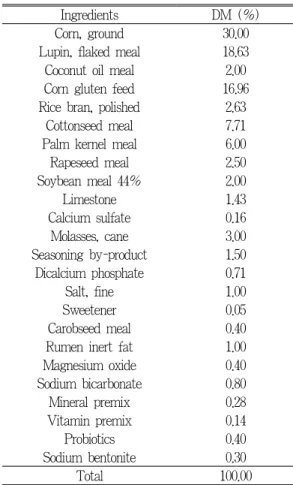
Table 1. Ingredient composition of compound feed for dairy cows
Ingredients DM (%)
Corn, ground 30.00
Lupin, flaked meal 18.63
Coconut oil meal 2.00
Corn gluten feed 16.96
Rice bran, polished 2.63
Cottonseed meal 7.71
Palm kernel meal 6.00
Rapeseed meal 2.50
Soybean meal 44% 2.00
Limestone 1.43
Calcium sulfate 0.16
Molasses, cane 3.00
Seasoning by-product 1.50
Dicalcium phosphate 0.71
Salt, fine 1.00
Sweetener 0.05
Carobseed meal 0.40
Rumen inert fat 1.00
Magnesium oxide 0.40
Sodium bicarbonate 0.80
Mineral premix 0.28
Vitamin premix 0.14
Probiotics 0.40
Sodium bentonite 0.30
Total 100.00
용액에 접종한 후 29℃ shaking water bath에서 2 일간 증식시켰다. 발효물질 제조는 건조 밀기울을 수분 60% 전후로 조절한 후 200g을 aluminium 접 시에 넣고 멸균 및 냉각 후 증식된 종균을 접종하 여 29℃에서 2일간 배양하였다. 충분히 균사가 증 식된 밀기울 배지를 55℃ 건조기에서 하루 이상 건조한 후에 1mm mash screen의 분쇄기에서 분 쇄하여 배양물로 사용하였다.
2. 시험사료 및 시료분석
본 연구에 사용된 배합사료는 시중에서 판매되
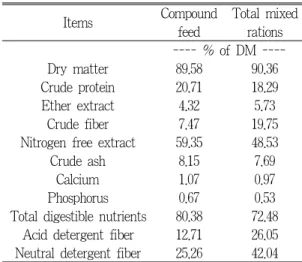
고 있는 착유우용 배합사료이고, TMR은 마로낙우 회(충북 보은)에서 제조·판매하고 있는 사료이며, 배합사료의 배합률, TMR의 배합률 및 영양소 함 량은 Table 1, Table 2 및 Table 3에 나타내었다.
시료의 일반성분 분석은 AOAC(1990) 방법으로 그리고 NDF와 ADF함량은 Goering과 Van Soest (1970) 방법으로 ㈜우성사료 중앙실험실에서 실시 하였다. 각 분석시료는 1mm mash screen의 시료 분쇄기 Cyclotec Sample Mill (Etecator, Sweden) 로 분쇄 후 사용하였다.
Table 2. Ingredient composition of total mixed ration
Ingredients % of DM
Compound feed1) 30.99
Cottonseed, whole grain 4.23
Alfalfa hay 5.63
Oat hay 5.63
Tall fescue hay 4.23
Citrus pulp, wet 13.02
Beet pulp 7.82
Brewers grain, wet 28.17
Trace element premix 0.28
Total 100.00
1) Compound feed for dairy cows by Woosung Feed Co., Ltd.
3. 시험방법
In vitro 소화 시험은 Tilley와 Terry(1963) 방법 에 의하여 실시하였는데 실험방법은 다음과 같다.
배합사료와 TMR을 각각 건조한 후 분쇄하여, Aspergillus oryzae 배양물 0, 1, 2 및 3%를 첨가한 후, 각 혼합물 2.00g 내외를 50ml 원심분리 tube에 넣고, Holstein 젖소에서 채취하여 여과시킨 위액 을 10ml씩 넣으면서 CO2 gas를 충분히 충진시켜 39℃의 진탕 배양기에서 24, 48 및 72시간 동안 소 화시켰다. Tube를 2500rpm/15min. 원심분리하여
Table 3. Chemical composition of compound feed and total mixed ration
Items Compound
feed
Total mixed rations ---- % of DM ----
Dry matter 89.58 90.36
Crude protein 20.71 18.29
Ether extract 4.32 5.73
Crude fiber 7.47 19.75
Nitrogen free extract 59.35 48.53
Crude ash 8.15 7.69
Calcium 1.07 0.97
Phosphorus 0.67 0.53
Total digestible nutrients 80.38 72.48 Acid detergent fiber 12.71 26.05 Neutral detergent fiber 25.26 42.04
pH 및 당도를 측정한 후, 원심분리 및 상층액 제 거를 2회 반복하였다. 마지막으로 남은 침전물에 0.2% pepsin이 들어있는 0.1N HCl 30ml를 넣고 39
℃ incubator에서 48시간 배양시킨 다음 다시 원심 분리 및 세척을 2회 실시한 후에 침전물을 60℃의 건조기에서 48시간 건조시켰다. 이와 같은 방법으 로 3회 반복 실험을 실시하였다.
4. 조사항목
1) In vitro 소화율은 각 24, 48 및 72시간 배양 후 소화되어 소실된 함량을 소화율로 계산하였는 데 계산공식은 다음과 같다.
* DM 소화율(%) = 시료중량-(residue 중량-balnk)
× 100 시료중량
* 섬유소 및 단백질
소화율(%) = 시료섬유소 및 단백질 중량 - (residue 섬유소 및 단백질 중량 - balnk) 시료섬유소 및 단백질 중량 ×100
2) pH는 시간별로 원심분리 후 상층액을 pH meter(TOA Electronic Ltd., Japan)로 측정하였다.
5. 통계분석
실험결과에 대한 통계처리는 Statistical Analysis System의 General linear models(SAS, 1987)를 사 용하였으며, 각 처리 평균간의 유의성은 Duncan's multiple range test(Duncan, 1955)에 의해 5% 수 준에서 검정되었다.
결과 및 고찰
1. 건물 소화율
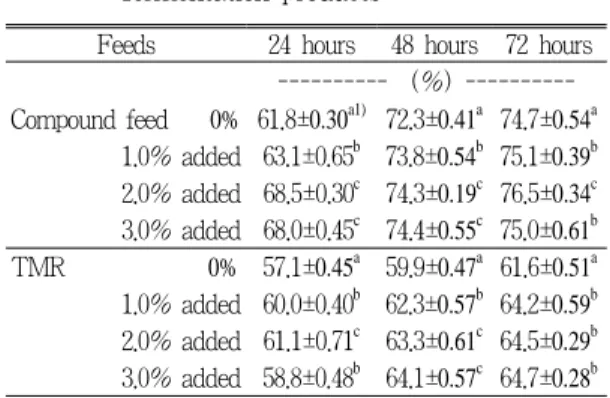
시중 유통중인 착유우용 배합사료와 TMR (total mixed rations)에 Aspergillus oryzae 발효물을 무 첨가, 1.0%, 2.0% 및 3.0%씩 첨가하여 24시간, 48 시간 72시간 동안 in vitro 배양하여 첨가수준별, 배양시간별 건물 소화율에 미치는 영향을 조사한 결과는 Table 4에 나타냈으며, 배합사료와 TMR사 료의 배합시간대별 건물 소화율 변화를 Figure 1 에 나타내었다.
배합사료의 건물 소화율은 Aspergillus oryzae 발효물을 첨가하지 않은 대조구에 비해 24시간에 서 2.1%(63.1%), 9.7%(68.5%) 및 9.0%(68.0%) 개선되었고, TMR은 4.8%(60.0%), 6.4%(61.1%) 및 2.9%(58.8%)의 유의적인 개선효과를 나타냈다 (P<0.05). 그러나 처리구의 경우 2.0% 첨가구 대 비 3.0% 첨가구에서의 유의적인 건물 소화율 개선
은 나타나지 않았다(P<0.05).
본 실험 결과는 Van Horn 등(1984)이 in vivo에
서 Aspergillus oryzae 첨가가 건물 소화율을 4.3%
향상시켰다는 결과보다 대부분 높은 결과를 보여 주고 있다.
Aspergillus oryzae 첨가가 배양시간대별 소화율 에 미치는 영향은 배합사료의 경우에는 24시간 배 양시가 48시간 및 72시간 배양시보다 개선폭이 증 가하는 경향을 보였다 (P<0.05). 이러한 사실은 in vivo 소화율 측정 자료 (Williams와 Newbold, 1990; Chademana와 Offer, 1990; Fondevila 등, 1990)와 in vitro 측정 자료 (Dawson, 1989)의 Aspergillus oryzae 배양물 첨가는 초기 분해율에 영향을 미친다는 결과와 일치한다. 이것은 곰팡이 배양물의 활성은 사료의 물리적 또는 화학적인 조 성에 직접 영향을 미치기보다는 반추위내 미생물 총의 활성에 영향을 미친다는 것을 나타내고 있다.
그럼에도 불구하고 TMR의 경우에는 72시간대 에서 Aspergillus oryzae 첨가가 건물 소화율 개선 폭이 거의 일정하게 유지되고 있어 앞으로 더욱더 많은 연구가 요구된다고 판단된다.
55.0 60.0 65.0 70.0 75.0 80.0
24 48 72
T ime ( h )
Digestibilities, %
C ompou n d fe e d 0% C ompou n d fe e d 1% a dde d C ompou n d fe e d 2% a dde d C ompou n d fe e d 3% a dde d
T M R 0% TM R 1% a dde d
T M R 2% a dde d TM R 3% a dde d
Figure 1. Changes in DM digestibilities of compound feed and total mixed ration for dairy cows added Aspergillus oryzae fermentation products.
Table 4. In vitro DM digestibilities of compound feed and total mixed ration for dairy cows added Aspergillus oryzae fermentation products
Feeds 24 hours 48 hours 72 hours --- (%) --- Compound feed 0% 61.8±0.30a1) 72.3±0.41a 74.7±0.54a
1.0% added 63.1±0.65b 73.8±0.54b 75.1±0.39b 2.0% added 68.5±0.30c 74.3±0.19c 76.5±0.34c 3.0% added 68.0±0.45c 74.4±0.55c 75.0±0.61b TMR 0% 57.1±0.45a 59.9±0.47a 61.6±0.51a 1.0% added 60.0±0.40b 62.3±0.57b 64.2±0.59b 2.0% added 61.1±0.71c 63.3±0.61c 64.5±0.29b 3.0% added 58.8±0.48b 64.1±0.57c 64.7±0.28b
1) Mean±SD.
abc Means in the same column with different superscripts are significantly different (P<0.05).
2. 섬유소 소화율 1) 조섬유
배합사료와 TMR 사료의 조섬유 소화율 변화를 조사하기 위해 Aspergillus oryzae 배양물을 무첨
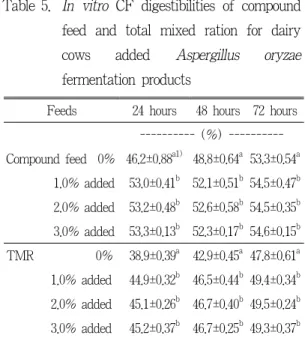
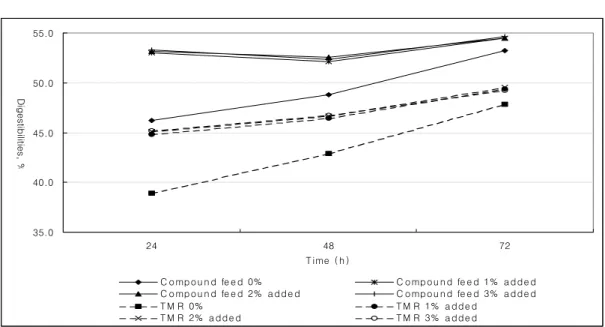
가(0%), 1.0%, 2.0% 및 3.0% 첨가하여 in vitro 상에서 실시한 실험결과를 Table 5에 나타냈다. 또 한 배양시간대별 변화를 Figure 2에 나타냈다.
배합사료중의 조섬유 소화율은 대조구와 처리구 모두에서 46.2%~54.6% 범위에 있는 반면, TMR 사료중의 조섬유 소화율은 38.9%~49.5%로 15.8%~9.3% 낮은 경향을 나타냈다.
Aspergillus oryzae 배양물 첨가수준별 조섬유 소화율은 대조구(무첨가구, 46.2%)에 비해 배합사 료 초기 배양인 24시간의 경우 1.0%, 2.0%, 3.0%
첨가시 12.8%(53.0%), 13.1%(53.2%), 13.3%
(53.3%), 48시간의 경우에는 대조구(48.8%)에 비 해 6.4%(52.1%), 7.2%(52.6%), 6.8%(52.3%), 그 리고 72시간의 경우에는 대조구(53.3%)와 비교하 여 2.3%(54.5%), 2.3%(54.5%) 및 2.5%(54.6%)의 유의적인 개선효과를 보였으나(P<0.05), 첨가수준 별 개선효과는 유의적인 차이가 없었다(P<0.05).
또한 TMR 사료의 경우에서는 배합사료와 유사 한 경향을 보였다. Aspergillus oryzae 배양물 첨가 시 섬유소 분해율은 cellulolytic bacteria가 대조구 (25.0×10⁸/㎖)에 비해 처리구(39.1×10⁸/㎖)에서 36.06% 증가함으로써 섬유소 분해율을 향상시켰다 고 보고한 Gomez-Alarcon 등(1987)의 실험결과와 일치하고 있다.
배양시간대별 조섬유 소화율은 초기 배양인 24 시간 대비 매 24시간마다 약 50% 정도의 개선효 과가 감소됨을 나타내고 있어서 곰팡이 배양물의 첨가효과는 초기 분해율에 더 많은 영향을 미친다 는 보고(Williams와 Newbold, 1990; Chademana 와 Offer, 1990; Fondevila 등, 1990; Dawson, 1989)와 일치하고 있다.
2) ADF
배합사료와 TMR에 Aspergillus oryzae 배양물
Table 5. In vitro CF digestibilities of compound feed and total mixed ration for dairy cows added Aspergillus oryzae fermentation products
Feeds 24 hours 48 hours 72 hours --- (%) --- Compound feed 0% 46.2±0.88a1) 48.8±0.64a 53.3±0.54a
1.0% added 53.0±0.41b 52.1±0.51b 54.5±0.47b 2.0% added 53.2±0.48b 52.6±0.58b 54.5±0.35b 3.0% added 53.3±0.13b 52.3±0.17b 54.6±0.15b TMR 0% 38.9±0.39a 42.9±0.45a 47.8±0.61a 1.0% added 44.9±0.32b 46.5±0.44b 49.4±0.34b 2.0% added 45.1±0.26b 46.7±0.40b 49.5±0.24b 3.0% added 45.2±0.37b 46.7±0.25b 49.3±0.37b
1) Mean±SD.
ab Means in the same column with different superscripts are significantly different (P<0.05).
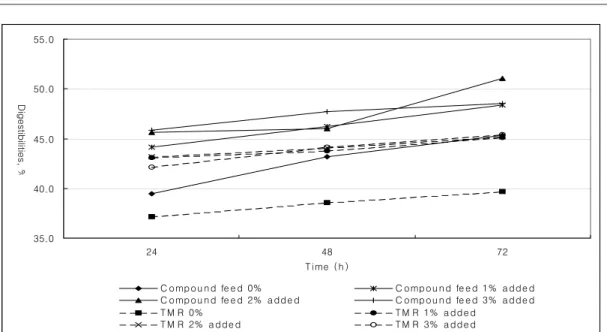
첨가 수준별 ADF 소화율에 미치는 in vitro 실험 결과를 Table 6에 나타냈다. 또한 배양시간대별 ADF 소화율의 변화를 보기 위해 Figure 3에 24시 간, 48시간 및 72시간별로 각각 나타냈다.
대조구(무처리) 포함 모든 처리구에서 ADF 소 화율은 37.2%~51.1%로 Gomez-Alarcon(1988)등 이 in vivo 실험결과 발표한 40.3%(무처리구)와 48.6%(Aspergillus oryzae 발효추출물 0.02% 첨가 구)의 ADF 소화율과 같은 경향을 보였다.
Aspergillus oryzae 배양물 처리수준별 배합사료 의 ADF 소화율은 배양 초기 24시간에 대조구 (39.5%)에 비해 1.0% 첨가시 10.5%(44.1%), 2.0% 첨가시 13.5%(45.7%), 3.0% 첨가시 13.9%(45.9%)의 유의적인 개선효과를 나타냈다 (P<0.05). 또한 TMR 사료의 ADF 소화율은 대조 구(37.2%) 대비 배양 24시간에 1.0% 첨가시
35.0 40.0 45.0 50.0 55.0
24 48 72
T ime ( h )
Digestibilities, %
C o mpou n d fe e d 0% C ompou n d fe e d 1% a d de d C o mpou n d fe e d 2% a dd e d C ompou n d fe e d 3% a d de d
T M R 0% T M R 1% a dde d
T M R 2% a dde d T M R 3% a dde d
Figure 2. Changes in CF digestibilities of compound feed and total mixed ration for dairy cows added Aspergillus oryzae fermentation products.
13.7%(43.1%), 2.0% 첨가시 13.9%(43.2%), 3.0%
첨가시 11.8%(42.1%)의 유의적인 개선효과를 나 타냈다(P<0.05).
이러한 결과는 곰팡이 배양물 첨가가 ADF 소화 율을 17.08% 개선시킨다고 보고한 Gomez- Alarcon(1988)의 in vivo 실험결과보다는 약간 낮 은 경향을 보였다.
배양 시간대별 ADF 소화율 변화를 보면, 배합 사료의 경우 배양초기 24시간 대비 48시간 및 72 시간의 소화율 개선효과가 약 45% 정도에 머무르 고 있어, 역시 Aspergillus oryzae 배양물은 배양초 기 소화율에 많은 영향을 미친다고 여겨진다.
또한 TMR 사료의 경우에는 배양초기 24시간 대비 48시간 및 72시간의 소화율 개선효과가 약 90% 정도에 머무르고 있음은 배양초기 대비 72시 간에도 소화율이 약 4~5%밖에 높지 않은 낮은 소화율에 기인된다고 여겨진다.
Table 6. In vitro ADF digestibilities of compound feed and total mixed ration for dairy cows added Aspergillus oryzae fermentation products
Feeds 24 hours 48 hours 72 hours --- (%) --- Compound feed 0% 39.5±0.27a1) 43.2±0.22a 45.3±0.17a 1.0% added 44.1±0.46b 46.2±0.52b 48.4±0.36b 2.0% added 45.7±0.39c 46.0±0.29b 51.1±0.31c 3.0% added 45.9±0.18c 47.7±0.19c 48.6±0.19b TMR 0% 37.2±0.44a 38.5±0.39a 39.7±0.45a 1.0% added 43.1±0.31b 43.8±0.16b 45.1±0.20b 2.0% added 43.2±0.21b 44.1±0.22b 45.2±0.17b 3.0% added 42.1±0.44b 44.2±0.47b 45.4±0.40b
1) Mean±SD.
abc Means in the same column with different superscripts are significantly different (P<0.05).
35.0 40.0 45.0 50.0 55.0
24 48 72
T ime ( h )
Digestibilities, %
C ompou n d fe e d 0% C ompou n d fe e d 1% a dde d
C ompou n d fe e d 2% a dde d C ompou n d fe e d 3% a dde d
T M R 0% T M R 1% a dde d
T M R 2% a dde d T M R 3% a dde d
Figure 3. Changes in ADF digestibilities of compound feed and total mixed ration for dairy cows added Aspergillus oryzae fermentation products.
3) NDF
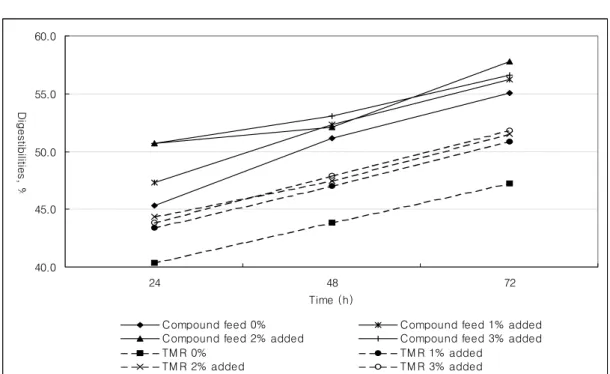
Aspergillus oryzae 배양물을 배합사료, TMR 사 료에 첨가수준별 NDF 소화율을 Table 7에 나타냈 고, 배양시간대별 NDF 소화율 변화를 Figure 4에 나타냈다.
배합사료의 NDF 소화율은 대조구(무첨가)와 첨 가구 모두에서 45.3%~57.8%인 반면에, TMR 사 료의 NDF 소화율은 40.4%~51.8%로 배합사료에 비해 10.9%~10.3% 낮게 나타났다.
Aspergillus oryzae 배양물 첨가수준별 NDF 소 화율을 보면 배양초기인 24시간대에 배합사료의 경우 무처리 대조구(45.3%)에 비해 1.0%, 2.0%, 3.0% 첨가시 각각 4.3%(47.3%), 10.7%(50.7%) 및 10.6%(50.7%)의 유의적인 향상이 나타났다 (P<0.05).
첨가수준별 비교시에는 1.0% 대비 2.0%와 3.0%
첨가시 NDF 소화율이 유의적인 차이가 인정되었
지만, 2.0%와 3.0% 첨가구간에는 유의차가 인정되 지 않았다(P<0.05).
TMR 사료의 경우는 24시간에서 무처리 대조구 (40.4%)에 비해 1.0%, 2.0%, 3.0%의 Aspergillus oryzae 배양물 첨가구에서 각각 7.0%(43.4%), 8.9%(44.3%), 7.9%(43.8%)의 유의적인 NDF 소 화율 개선이 인정되었다(P<0.05). 이러한 첨가 효 과는 Gomez-Alarcon (1988)이 발표한 11.21% 개 선(무처리 50.7%, Aspergillus oryzae 발효추출물 0.02% 첨가 5.71%)에 비해 다소 낮은 경향으로 나타났다.
이와 같이 곰팡이 배양물을 착유우용 완전배합 사료(TMR)에 첨가시 NDF 소화율이 Gomez- Alarcon(1988)의 성적보다 다소 낮게 나타나는 이 유는 국내 조사료의 열악함에 의한 lignin 등의 소 화가 불량한 섬유소 함량이 높은 것에 기인한다고 사료된다. Aspergillus oryzae 배양물 첨가 수준별
40.0 45.0 50.0 55.0 60.0
24 48 72
Time (h)
Digestibilities, %
Compound feed 0% Compound feed 1% added Compound feed 2% added Compound feed 3% added
TM R 0% TM R 1% added
TM R 2% added TM R 3% added
Figure 4. Changes in NDF digestibilities of compound feed and total mixed ration for dairy cows added Aspergillus oryzae fermentation products.
차이는 1.0% 대비 2.0% 및 3.0% 첨가시가 유의적 인 차이가 인정되지만 2.0%와 3.0% 처리구간에는 유의차가 인정되지 않았다. 이 같은 결과는 곰팡이 배양물을 착유우용 사료에 첨가하였을 때 NDF 소 화율이 증가된다고 보고한 Adams 등(1981), Van Horn 등(1984), Weidmeier 등(1987), Fondevila 등(1990) 및 Dawson (1989) 등의 연구 보고와 일 치하고 있다. 이와 같이 곰팡이 배양물을 착유우용 사료에 첨가하면 섬유소 분해율이 증가하는 것은 Harrison 등(1988)이 보고한 반추위내 총세균수가 60%, cellulolytic bacteria 수가 82% 증가했다는 것과 유관하다고 사료된다.
또한 배양 시간대별 NDF 소화율 변화는 TMR 사료의 경우에는 배합사료의 경우와는 상이하게 초기 24시간 배양시와 48시간 및 72시간 사이에
유의적인 차이가 인정되지 않았다.
Table 7. In vitro NDF digestibilities of compound feed and total mixed ration for dairy cows added Aspergillus oryzae fermentation products
Feeds 24 hours 48 hours 72 hours --- (%) --- Compound feed 0% 45.3±0.27a 1) 51.2±0.27a 55.1±0.30a
1.0% added 47.3±0.35b 52.3±0.32b 56.2±0.29b 2.0% added 50.7±0.35c 52.1±0.46b 57.8±0.43c 3.0% added 50.7±0.38c 53.1±0.17b 56.6±0.32b TMR 0% 40.4±0.40a 43.8±0.63a 47.2±0.35a 1.0% added 43.4±0.24b 47.0±0.17b 50.9±0.20b 2.0% added 44.3±0.35c 47.4±0.34c 51.5±0.35c 3.0% added 43.8±0.30c 47.9±0.29c 51.8±0.24c
1) Mean±SD.
abc Means in the same column with different superscripts are significantly different (P<0.05).
60.0 65.0 70.0 75.0 80.0 85.0
24 48 72
Time (h)
Digestibilities, %
Compound feed 0% Compound feed 1% added Compound feed 2% added Compound feed 3% added
TM R 0% TM R 1% added
TM R 2% added TM R 3% added
Figure 5. Changes in CP digestibilities of compound feed and total mixed ration for dairy cows added Aspergillus oryzae fermentation products.
3. 단백질 소화율
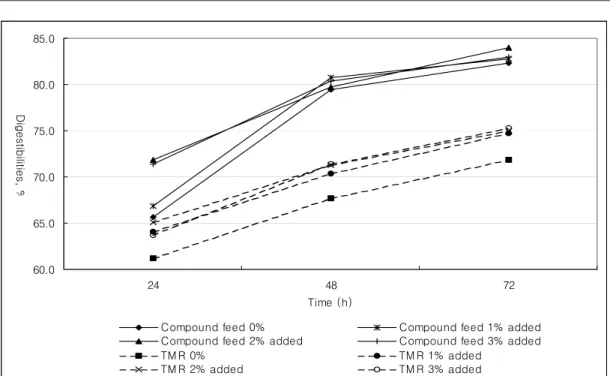
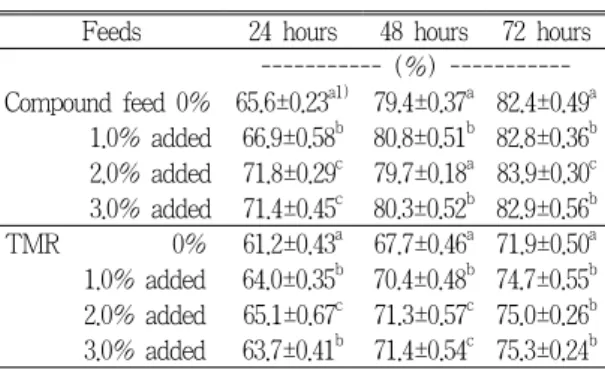
Aspergillus oryzae 발효물을 배합사료와 TMR 사료에 0%, 1.0%, 2.0% 및 3.0%씩 각각 첨가하여 배양 시간대별, 즉 24시간, 48시간 및 72시간의 단 백질 분해율을 Table 8에, 배합사료와 TMR사료의 배합시간대별 단백질 소화율 변화과정을 Figure 5 에 나타내었다.
단백질 소화율은 24시간대에 배합사료의 경우 무처리구에 비해 1.0%, 2.0%, 3.0% 첨가시 각각 1.9%(66.9%), 9.4%(71.8%), 8.8%(71.4%)로 유의 적인 증가율을 보였으나(P<0.05), 2% 첨가구와 3% 첨가구 사이에는 유의적인 차이가 없었다. 그 러나 48시간대와 72시간대의 경우 Aspergillus oryzae 발효물 첨가효과가 유의적인 증가를 보였 으나, 그 개선폭은 그다지 크지 않았다. 또한,
TMR의 경우에는 Aspergillus oryzae 발효물 첨가 효과가 24시간, 48시간, 72시간대에 모두 무처리구 대비 4.0%(71.9%:74.7%)~6.3%(61.2%:65.1%)의 유의적인 증가를 나타내었다. 이는 Gomez- Alarcon 등(1988)의 in vivo 실험에서 나타난 70.5%(무첨가구)와 77.6%(Aspergillus oryzae 발 효 추출물 0.02% 첨가구)에 비교하면 약간 높은 경향을 보이고 있다.
또한, 무처리구 대비 Aspergillus oryzae 발효물 1.0%, 2.0%, 3.0% 첨가구의 경우, 배합사료에서 0.4%(79.4%:79.7%)~9.4%(65.6%:71.8%)의 유의 적인 단백질 분해율 개선효과를 나타내어(P<0.05) Adams 등(1981), Harrison 등(1988), Chademana 와 Offer (1990) 및 Edwards 등(1990)의 연구결과 와 일치하였다.
Table 8. In vitro CP digestibilities of compound feed and total mixed ration for dairy cows added Aspergillus oryzae fermentation products
Feeds 24 hours 48 hours 72 hours --- (%) --- Compound feed 0% 65.6±0.23a1) 79.4±0.37a 82.4±0.49a
1.0% added 66.9±0.58b 80.8±0.51b 82.8±0.36b 2.0% added 71.8±0.29c 79.7±0.18a 83.9±0.30c 3.0% added 71.4±0.45c 80.3±0.52b 82.9±0.56b TMR 0% 61.2±0.43a 67.7±0.46a 71.9±0.50a 1.0% added 64.0±0.35b 70.4±0.48b 74.7±0.55b 2.0% added 65.1±0.67c 71.3±0.57c 75.0±0.26b 3.0% added 63.7±0.41b 71.4±0.54c 75.3±0.24b
1) Mean±SD.
abc Means in the same column with different superscripts are significantly different (P<0.05).
4. 반추위내 pH
배합사료와 TMR 사료에 Aspergillus oryzae 배 양물 첨가 수준별, 배양 시간별 in vitro액(발효액) 의 pH 변화를 Table 9에 나타냈다. 무처리구인 대 조구를 포함 모든 처리구에서 in vitro pH는 5.1~5.6으로 상당히 낮게 측정이 됐다. 이러한 측 정 결과는 반추위내 실제 pH 수치일 경우 산독증 을 유발할 수 있는 낮은 수치이지만, in vitro 상에 서 곰팡이 배양물이 pH 변화에 미치는 영향을 조 사하는데 의미가 있다고 여겨진다.
배합사료의 경우 Aspergillus oryzae 처리에 의 한 pH 수치는 모든 첨가수준 및 배양시간 24시간, 48시간 및 72시간에서 약간 낮은 결과를 나타내고 있으나 처리구간별 유의성은 인정되지 않았다.
TMR 사료의 경우에도 배합사료와 유사한 결과 를 나타냈는데 초기 배양 24시간에 Aspergillus oryzae 배양물 2.0% 첨가구에서만 무첨가구 5.51 보다 약간 높은 5.53을 기록하고 있으나 이 역시 유의적인 차이는 인정되지 않았다(P>0.05).
따라서 Aspergillus oryzae 발효물 첨가는 in vitro 반추위액의 pH에 영향을 미치지 않으므로 실제 젖소사양에서도 유사한 결과가 예측되나 확 실한 실험이 요구된다고 하겠다. 그러므로 본 발효 물은 pH에는 영향을 미치지 않으나 건물, 섬유소 및 단백질 소화율 향상에는 다소 효과가 있는 것 으로 결론을 내릴 수가 있다.
Table 9. Changes in pH of compound feed and total mixed ration for dairy cows added Aspergillus oryzae fermentation products Feeds 24 hours 48 hours 72 hours Compound feed 0% 5.32±0.11a1) 5.39±0.06a 5.09±0.08a
1.0% added 5.12±0.03b 5.38±0.03a 5.07±0.04a 2.0% added 5.17±0.09b 5.34±0.02b 5.07±0.01a 3.0% added 5.27±0.22c 5.38±0.04a 5.08±0.01a TMR 0% 5.51±0.06a 5.63±0.08a 5.35±0.01a 1.0% added 5.41±0.04b 5.55±0.01b 5.21±0.04b 2.0% added 5.53±0.13a 5.57±0.04b 5.24±0.04b 3.0% added 5.46±0.08c 5.57±0.04b 5.28±0.01c
1) Mean±SD.
abc Means in the same column with different superscripts are significantly different (P<0.05).
적 요
본 연구는 Aspergillus oryzae 배양물이 in vitro 건물, 섬유소 및 단백질 소화율과 pH에 미치는 영 향을 구명하고자 실시하였다. 균종 Aspergillus oryzae는 한국 생명공학연구원에서 분양받았으며, 본 연구에 사용된 사료는 시중 유통중인 착유우용 배합사료와 TMR 사료로서, 일반성분 분석은 ㈜우 성사료 중앙실험실에서 실시하였고, 건물, 섬유소 및 단백질 소화율 실험은 충남대학교 실험실에서 실시하였다.
배합사료와 TMR에 Aspergillus oryzae 배양물 0, 1.0, 2.0 및 3.0%를 첨가한 후, Holstein종 착유 우로부터 채취한 반추위액에 시료 2.0g 내외를 넣 어 진탕배양기에서 24, 48 및 72시간 소화시켰다.
침전물에 0.2% pepsin이 들어있는 0.1N HCl 30ml 를 넣고 39℃ incubator에서 48시간 소화시키고 나 서, 마지막으로 침전물을 60℃의 건조기에서 48시 간 건조시켰다. 실험은 3회 반복하여 실시하였다.
건물 소화율은 Aspergillus oryzae 발효물을 첨 가하지 않은 대조구에 비해 24시간 배양시킨 배합 사료의 경우 2.1%(63.1%), 9.7%(68.5%) 및 9.0%
(68.0%) 개선되었고, TMR은 4.8%(60.0%), 6.4%
(61.1%) 및 2.9%(58.8%)의 개선효과가 있었다.
이와 대조적으로, 48시간 및 72시간 배양시킨 시험 구의 건물 소화율에 Aspergillus oryzae 배양물이 미치는 영향은 24시간 배양시보다 상대적으로 낮 은 경향을 보였다.
섬유소 소화율에서 Aspergillus oryzae가 조섬유, ADF 및 NDF 소화율을 유의적으로 개선시킨다는 것을 알 수 있었다. 배합사료에서 3% 첨가구의 경 우 24시간 배양시 13.3%(53.3%), 72시간 배양시 2.4%(54.6%)까지 증가되었다. 하지만, 첨가수준에 따라 소화율이 높아졌음에도 불구하고 첨가수준별 개선효과에는 유의적인 차이가 없었다.
단백질 소화율은 Aspergillus oryzae 배양물 첨 가에 의해 배합사료에서 0.4%(79.7%)에서 9.4%
(71.8%)의 유의적인 개선효과를 나타내었지만, 2.0%와 3.0% 첨가구간의 유의적인 차이는 인정되 지 않았다. TMR의 경우에는 4.0%(70.4%)에서 6.3%(65.1%)의 유의적인 소화율 향상을 나타내었 지만 2.0%와 3.0% 첨가구간의 유의적인 차이는 인정되지 않았다.
본 연구에서, pH 처리구간 유의적인 차이는 없 었으나, Aspergillus oryzae 배양물 첨가에 따라
pH가 약간 감소하는 경향을 보였다. 그러므로 본 발효물은 pH에는 영향을 미치지 않으나 건물, 섬 유소 및 단백질 소화율 향상에는 다소 효과가 있 는 것으로 결론을 내릴 수가 있다.
참고문헌
1. 김용국, 김용인. 1993. Mycelium에 의한 Lignocellulose 물질로부터 양질의 발효사료 생 산. 한국낙농학회지. 15(4):251-260.
2. 김용국, 이수기. 1995. 착유우의 산유반응에 대 한 Fungal 첨가제의 효과. 한국축산학회지.
37(6):633-638.
3. 박덕섭, 김용국. 1998. Aspergillus oryzae 및 Formitella flaxinea 첨가제의 급여가 착유우의 유생산 및 반추위 발효특성에 미치는 영향. 한 국축산학회지. 40(6):617-626.
4. Adams, D. C., M. L. Galyean, H. E. Kiesling, J. D. Wallace and M. D. Finker. 1981.
Influence of viable yeast culture, sodium bicarbonate and monensin on liquid dilution rate, rumen fermentation and feedlot performance of growing steers and digestibility in lambs. J. Anim. Sci. 53:780-789.
5. AOAC. 1990. Official methods of analysis (5th ed.). Association of Official Analytical Chemists. Washington, D.C.
6. Chademana, I. and N. W. Offer. 1990. The effect of dietary inclusion of yeast culture on digestion in the sheep. Animal Production.
50:483-489.
7. Dawson, K. A. 1989. Modification of rumen function and animal production using live
microbial cultures as feed supplements California Animal Nutrition Conference. Fresno, California. pp. 25-43.
8. Duncan, D. B. 1955. Multiple range and multiple F tests. Biometrics. 11:1-42.
9. Edwards, I. E., J. H. Mutsvangwa, J. H.
Topps and G. F. M. Paterson. 1990. The effect of supplemental yeast culture (YEASACC®) on patterns of rumen fermentation and growth performance of intensively fed bulls. Animal Production.
50:579 (Abstr.).
10. Fondevila, M., C. J. Newbold, P. M. Hotten and E. Orskov. 1990. A note on the effect of Aspergillus oryzae fermentation extract on the rumen fermentation of sheep fed straw.
Animal Production. 52:422.
11. Frumholtz, P. P., C. J. Newbold and R. J.
Wallace. 1989. Effect of Aspergillus oryzae fermentation extract (AMAFERM®) on fermentation in the rumen simulation technique (Rusitec®). Anim. Prod. 48:159.
12. Goering, H. K. and P. J. Van Soest. 1970.
Forage fiber analysis (apparatus, reagents, procedures and some application). Agric.
Handbook 379. USDA. ARS. Washington, DC.
13. Gomez-Alarcon, R. A., C. Dudas and J. T.
Huber. 1987. Effect of Aspergillus oryzae (AMAFERM®) and yeast on feed utilization by Holstein cows. J. Dairy Sci. 70 (Suppl.
1):218 (Abstr.).
14. Gomez-Alarcon, R. A. G. 1988. Effects of Aspergillus oryzae on milk production, feed utilization and rumen fermentation in lactating
dairy cows. Ph. D. Dissertation. Univ. of Arizona, Tuscon., Ariz.
15. Gomez-Alarcon, R. A., C. Dudas and J. T.
Huber. 1990. Influence of cultures Aspergillus oryzae on rumen and total tract digestibility of dietary components. J. Dairy Sci. (73):703-710.
16. Harrison, G. A., R. W. Hemken, K. A.
Dawson, R. J. Haromon and Barker, K. B.
1988. Influence of addition of yeast culture supplement to diets of lactating cows on ruminal fermentation and microbial populations.
J. Dairy Sci. 71:2967-2975.
17. Newbold, C. J. 1990. Probiotics as feed additives in ruminant diets. 51st Minnesota Nutr. Conf. Bloomington, Minnesota.
18. Ogimoto K. and I. Soichi. 1980. Atlas of Rumen Microbiology. Japan Scientific Societies Press, Tokyo.
19. SAS®. 1987. User's Guide: Statistics. Version 6.01. SAS Inst., Inc., Cary, NC.
20. Sievert, S. J. and R. D. Shaver. 1990. Effects of nonfiber carbohydrate and Aspergillus oryzae fermentation extract on intake, milk production and digestion in lactating dairy cows. J. Dairy Sci. 73 (Suppl. 1):23 (Abstr.).
21. Tilley, J. M. A. and R. A. Terry. 1963. A two-stage technique for the in vitro digestion of forage crops. J. Brit. Grassl. Soc.
18:104-111.
22. Van Horn, H. H., B. Harris, J. R., K. E.
Manookian, S. P. Marshall, M. J. Taylor and W. J. Wilcox. 1983. Sugarcane silage, sodium hydroxide-and steam pressure-treated sugarcane bagasse, corn silage, cottonseed
hulls, sodium bicarbonate and Aspergillus oryzae product in complete rations for lactating cows. J. Dairy Sci. 66:1474-1485.
23. Van Horn, H. H., B. J. R. Harris, M. J.
Taylor, K. C. Bachman and C. J. Wilcox.
1984. By-product feeds for lactating dairy cows: Effects of cottonseed hulls, sunflower hulls, corrugated paper, peanut hulls, sugarcane bagasse, and whole cottonseed with additives of fat, sodium bicarbonate, and Aspergillus oryzae product on milk production. J. Dairy Sci. 67:2922-2938.
24. Wiedmeier, R. D., M. J. Aramble and J. L.
Walters. 1987. Effect of yeast culture and Aspergillus oryzae fermentation extract on ruminal characteristics and nutrient digestibility. J. Dairy Sci. 70:2063-2068.
25. Williams, P. E. V. and C. J. Newbold. 1990.
Rumen probiosis. The effects of novel microorganisms on rumen fermentation and ruminant productivity. In W. Haresign and D.
J. A. Cole. Recent advances in animal nutrition. Butterworth. Engl. pp. 211-225.
26. Williams, P. E. V., C. A. G. Tait, G. M.
Innes and C. J. Newbold. 1991. Effects of the inclusion of yeast culture (Saccharomyces cerevisiae plus growth medium) in the diet of dairy cows on milk yield and forage degradation and fermentation patterns in the rumen of sheep and steers. J. Anim. Sci.
69:3016.