This is an Open Access article distributed under the terms of the Creative Commons Attribution Non-Commercial License (http: //creativecommons.org/licenses/by- nc/4.0/) which permits unrestricted non-commercial use, distribution, and reproduction in any medium, provided the original work is properly cited.
Copyright: © 2019 Korean Journal of Agricultural Science
https://doi.org/10.7744/kjoas.20190024
ANIMAL
Effects of the autumn sowing date on grain yield and feed value of winter triticale ( X.
Triticosecale Wittm.) in the southeast of the Gyeongbuk province
Byamungu Mayange Tomple, Ik Hwan Jo*
Department of Animal Resources, Daegu University, Gyeongsan 38453, Korea
*Corresponding author: [email protected]
Abstract
The purpose of this research was to evaluate the effects of different sowing dates on growth characteristics, seed productivity and feed value of triticale in Gyeongbuk province. The experiment was conducted from September 2015 to July 2017, using triticale "Joseong"
cultivar of 150 kg of seed/ha and sown at 10 days intervals from different sowing dates (30th September, 10th, 20th and 30th October) in 2015 and 2016, respectively. The emergence date in the autumn season was 8 - 18 days after sowing in 2015 and 2016. The heading, flowering and maturing periods were the fastest on 30th September compared to the other sowing dates.
The average number of stem and panicle per unit area were 409.3 - 428.5 and 330.9 - 334.0 on 30th September and 10th October, which were higher than those sown on 20th and 30th October, 2015 and 2016, respectively (p < 0.05), and the average number of grain and kernel weight was 47.1 - 48.1 and 2.2 - 2.3 g on 30th September and 10th October, which were higher than the late sowing dates. In case of seed yield as affected by different sowing dates, the highest yield was found on the sowing plot of late September and 10th October, which were 5,680 and 5,918 kg/ha, respectively (p < 0.05). However, the average CP content was 10.7%, CF content was 2.8% and TDN content was 85.3. In conclusion, 30th September and 10th October were the appropriate sowing dates for a forage self-sufficiency system in Gyeongbuk.
Keywords: feed value, Gyeongbuk province, seed productivity, sowing date, triticale
Introduction
The agricultural specialization coefficient by region shows that the Gyeongsangbuk-do region has the most specialized Hanwoo in Korea and Gyeongju is the largest Hanwoo breeding area in Gyeongbuk (KOSIS, 2018). However, the production of forage in these areas is rarely performed and depends on foreign grain feedstuffs. It is necessary to improve the self-sufficiency rate of feed and to develop the productivity continuously (MAFRA, 2015). In particular, due to the weather conditions and land use in Korea, the winter feed OPEN ACCESS
Accepted: May 27, 2019 Revised: May 14, 2019 Received: March 21, 2019 DOI:
Citation: Tomple BM, Jo IH. 2019. Effects of the autumn sowing date on grain yield and feed value of winter triticale (X. Triticosecale Wittm.) in the southeast of the Gyeongbuk province. Korean Journal of Agricultural Science. https://
doi.org/10.7744/kjoas.20190024
distribution has a significant importance on plants.
For these reasons, in order to enhance the competitiveness of Korean cattle, triticale (X. Triticosecale Wittm.) can be used to reduce the cost of feedstuff and lower the cost of production (RDA, 2013). On the other hand, triticale is an intergeneric hybrid obtained from wheat and rye. The hope was that triticale would combine the high yield potential and good grain quality of wheat, the resistance and tolerance to the biotic and abiotic stresses of rye (Mergoum et al., 2009). Hexaploid triticale is grown in many parts of the world (Ammar et al., 2004) and is also used for food due to its high protein content and good quality. (Oplinger and Youngs, 1975).
The productivity of triticale forage is similar to that of wheat, barley and oats (Sapa et al., 1973; Brown and Almondares, 1976; Ciha, 1983), the dry matter yields and silage quantities are higher than those of other varieties
of wheat and the digestible dry matter is higher than that of rye (Bishinoi et al., 1978; Han et al., 2012).
In addition, triticale is known to have a great and longleaf than the other varieties (Ju et al., 2009) and due to its high ratio of leaves, it is considered to be highly preferential to livestock (Han et al., 2012). Grain from modern triticale varieties has been reported to be comparable in energy value to other cereal grains for use in mixed diets of beef and dairy cattle and its protein is well utilized (Gursoy and Yilmaz, 2002; Myer and Lozano, 2004).
In Korea until now, cultivated triticale "Sinkihomil" (Youn et al., 1986) and "Shinyoung" (Heo et al., 2002) have been reported to have a high productivity per unit area but the delay in harvest time during spring makes it difficult to cultivate; and it is a better ruminant feed than other cereals due to its high starch digestibility.
In recent years, early varieties (such as "Joseong") with high dry matter yield and seed productivity have been cultivated in a region with a minimum average temperature of - 10℃ in January, it is possible to cultivate plants in the northern region where winter is at its peak (Han et al., 2012). Kim (2014) reported that stable cultivation of triticale will be possible even in the coldest part of Korea and Fowler (1982) found out that optimum autumn sowing dates establish healthy and vigorous plants that allow achievement of maximum cold tolerance, complete verbalization, and optimum energy reserves for the following spring. Proper sowing date is important for maximizing winter cereal grain yields (Dahlke et al., 1993).
In order to expand the production base for sustainable farming in regional units, it is necessary to first estimate the production area of feed crops for each land use, establish an efficient farming system through selection and introduction of forage crops suitable for local environmental conditions. For seed, it is necessary to establish a technology system that can produce and expand the production base of stable forage resources.
Therefore the aim of this study was to investigate the impact of different autumn sowing dates on seed yield and feed value of winter triticale in the southeast of Gyeongbuk province, where we found a large number of Korean cattle, in order to develop a self-sufficient production and consumption system of forage crops in this region.
Materials and Methods
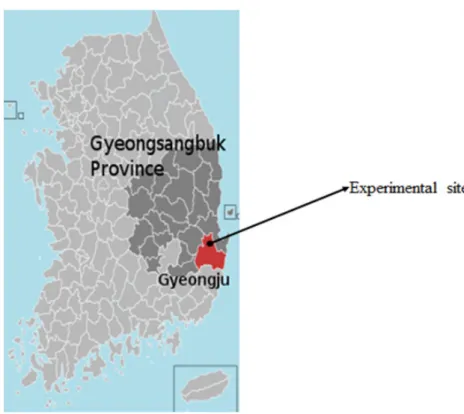
This research was carried out between 2015 - 2016 and 2016 - 2017 in the southeastern of Gyeongbuk province, specifically in Gyeongju city in South Korea at the Geological Coordinates: latitude 35°58'44.7" N and
longitude: 129°12'15.3" E (Fig. 1). The experiment species used in seed productivity and feed value according to different sowing dates were "Joseong" which is a variety of triticale (X. Triticosecale Wittm.). The soil in this study was a moderate mixture of sand and mud and its physicochemical characteristics are shown in Table 1. In 2015 the pH, organic matter (OM), electric conductivity (EC), total nitrogen content (T-N), the available phosphorus (P2O5) of soil was 7.4, 8.0 g/kg, 0.13 dS/m, 0.14%, and 451.3 mg/kg, respectively; and in 2016 was 7.6, 15 g/kg, 0.30 dS/m, 0.15%, and 451.3 mg/kg. On the other hand, the concentrations of calcium, potassium and magnesium ions were 7.62, 1.85, and 2.96 cmol+/kg in 2015, respectively, and slightly decreased to 4.9, 0.66, and 1.28 cmol+/kg in 2016, respectively.
Winter triticale of 150 kg of seed/ha were sown at 10 days intervals from different sowing dates (30th September, 10th, 20th, and 30th October) in 2015 and 2016 with a randomized block design in triplicates using nitrogen, phosphorus and potassium of 90, 74, and 39 kg/ha, respectively, according to the standard fertilizing amount for triticale and the planting density was 30 m2 (25 cm × 5 cm) according to the standard application rate of triticale.
Table 1. Soil properties of the experimental site.
Year pH(1 : 5) Organic matter
(g/kg) Electric conductivity
(dS/m) Total nitrogen
(%) Available P2O5
(mg/kg) Ca2+ K+ Mg2+
(cmol +/k g)
2015 7.04 8.0 0.13 0.14 451 7.6 1.85 2.96
2016 7.60 15 0.30 0.15 457 4.9 0.66 1.28
pH, potential of hydrogen; P2O5, available phosphorus.
Fig. 1. Location of the experimental site.
The growth surveys such as emergence date, lodging degree, heading date, flowering date, maturing date, plant height, stem length, panicle length, the number of stems and panicles per unit area (m2), effective stems, and seed yield survey such as the number grain, kernel weight, fertilizing rate, liter weight, 1000-kernel weight, immatured kernel weight and seed productivity were investigated according to the standardization of research survey on agricultural science and technology (RDA, 2012).
Samples were taken from each test section and dried in a 70℃ circulating air dryer for 72 hours or more and then weighed after drying. The obtained samples were first crushed by an electric mixer and then passed through a 2.0 mm standard, which was placed in a plastic sample storage bottle and the amount required for the experiment was used for sampling and analysis. The chemical composition analysis was performed according to scientific methods of AOAC (2000). The crude protein content was determined through Kjeldahl digestion method using quantitative determination of organic nitrogen. Fiber analysis like neutral detergent fiber (NDF) and acid detergent fiber (ADF) was made by Van Soest (1991) method and the total digestible nutrients (TDN) were calculated by the following formula of Linn and Martin (1989): TDN = 88.9 - (0.79 × ADF)
The data were analyzed using SAS program (version 9.1, SAS Institute Inc., Cary, USA) and the significant differences among the means were determined at 5% probability level by using least significant difference (LSD).
Results and Discussion
Average temperature and precipitation during the experimental period
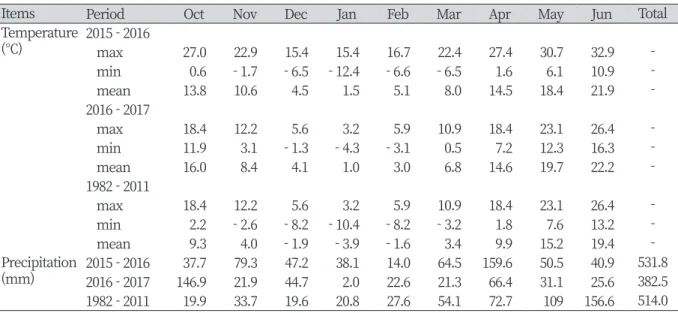
The climate characteristics of the research site are shown in Table 2. The mean temperatures of Gyeongju area from October 2015 to June 2016 and from October 2016 to June 2017 were 10.9 and 10.6℃, respectively, which showed the average temperature range of 4.6 to 4.9℃ higher than the average temperature for 30 years (average
Table 2. The mean temperature and rainfall data during the experimental period.
Items Period Oct Nov Dec Jan Feb Mar Apr May Jun Total
Temperature
(℃) 2015 - 2016
max 27.0 22.9 15.4 15.4 16.7 22.4 27.4 30.7 32.9 -
min 0.6 - 1.7 - 6.5 - 12.4 - 6.6 - 6.5 1.6 6.1 10.9 -
mean 13.8 10.6 4.5 1.5 5.1 8.0 14.5 18.4 21.9 -
2016 - 2017
max 18.4 12.2 5.6 3.2 5.9 10.9 18.4 23.1 26.4 -
min 11.9 3.1 - 1.3 - 4.3 - 3.1 0.5 7.2 12.3 16.3 -
mean 16.0 8.4 4.1 1.0 3.0 6.8 14.6 19.7 22.2 -
1982 - 2011
max 18.4 12.2 5.6 3.2 5.9 10.9 18.4 23.1 26.4 -
min 2.2 - 2.6 - 8.2 - 10.4 - 8.2 - 3.2 1.8 7.6 13.2 -
mean 9.3 4.0 - 1.9 - 3.9 - 1.6 3.4 9.9 15.2 19.4 -
Precipitation
(mm) 2015 - 2016 37.7 79.3 47.2 38.1 14.0 64.5 159.6 50.5 40.9 531.8
2016 - 2017 146.9 21.9 44.7 2.0 22.6 21.3 66.4 31.1 25.6 382.5
1982 - 2011 19.9 33.7 19.6 20.8 27.6 54.1 72.7 109 156.6 514.0
6.0℃, lowest - 3.9℃ and maximum 19.4℃). The highest temperatures were observed in June (21.9 and 22.2℃) and the lowest temperatures were 1.5 and 1.0℃, respectively. The total rainfall in the experimental period from 2015 - 2016 and 2016 - 2017 was 531.8 mm and 382.5 mm, respectively, and the total average rainfall for 30 years was 514 mm.
In particular, the average precipitation up to 4 months after sowing in 2015 - 2016 was favorable for initial growth due to the high precipitation 38.1 mm in comparison with the next year. The precipitation was generally lower one month after sowing and tended to be very low again at the maturing period of triticale.
The growth state of triticale as affected by different sowing dates
Table 3 shows the growth state of triticale as influenced by different sowing dates. According to sowing periods, the emergence date of triticale was observed on 8th October to 17th November 2015 and 2016, respectively. As the sowing period was delayed, the emergence date of triticale tended to be delayed. The emergence date of triticale appeared about a week after the sowing date of 30th September, 16 days after sowing date of 10th October but on 20th and 30th October, it took 9 to 18 days until the emergence date. In the case of emergence degree of triticale, the emergence rates were relatively good in the sowing area of October, but the rate was slightly poor on 30th September, 2015, due to the weakness of rain and herbicide. As the result, the lodging degree of triticale was relatively higher in 30th September than in October, which is presumed to be caused by the overgrowth of plants due to early sowing in autumn (Kim et al., 2006). Especially when the wheat is in the late growth stage, when the ears are exposed and the rain and wind are accompanied by the winds 10 to 20 days later, the lodging is the most intense and the decrease rate of dry matter is 20 to 50%. For these reasons, triticale has been shown to improve economic characteristics such as seed yield and dry matter, to improve plant length and quality during the cultivation and to improve nutritional factors and early reproduction (Mergoum et al., 2009).
The heading date of triticale was observed on 14th, 16th, 17th, and 20th April 2016 and on 18th, 20th, 21st, and 24th April 2017. However, the heading dates of 2015 - 2016 delayed by 4 days to that of 2016 - 2017. Weather conditions during the growing season seemed to influence the effects of delay in the growth state (Byamungu and Jo, 2018). Whereas, the flowering date of triticale was similar on 30th September and 10th October of both
Table 3. The growth state of triticale as affected by different sowing dates.
Year Seeding date Emergence date
(mon. day) Emergence degree
(1 - 3)y Lodging degree
(0 - 9)z Heading date
(mon. day) Flowering date
(mon. day) Maturing date (mon. day)
2015 - 2016 30 Sept. 10. 08 1 1 4. 14 4. 22 6. 07
10 Oct. 10. 16 3 0 4. 16 4. 22 6. 10
20 Oct. 10. 29 3 0 4. 17 4. 23 6. 10
30 Oct. 11. 16 3 0 4. 20 4. 26 6. 12
2016 - 2017 30 Sept. 10. 09 3 0 4. 18 4. 26 6. 03
10 Oct. 10. 17 3 0 4. 20 4. 26 6. 05
20 Oct. 10. 30 3 0 4. 21 4. 27 6. 05
30 Oct. 11. 17 3 0 4. 24 4. 28 6. 07
y 3 = Good, 1 = Bad.
z 0 (none), 1 (≤ 20%), 3: (21 - 40%), 5: (41 - 60%), 7: (61 - 80%), 9: (≥ 81%).
years. The number of days from heading to the flowering of triticale was 4 to 8 days. The fastest maturing date of triticale was observed on the sowing plot of 30th September of both years and it was similar on 10th and 20th October of both years. Therefore, depending on weather conditions mid - October sowing is also possible.
The growth characteristics of triticale as affected by different sowing dates
Table 3 shows the growth characteristics of triticale as influenced by different sowing dates. The average plant height and stem length of triticale from 2015 to 2017 were 126.0 cm and 116.3 cm on the sowing plot of 30th October, respectively, and was significantly higher than the other sowing plot (119.5 - 121.9 cm and 109.4 - 111.1 cm), whereas the average panicle length of triticale was significantly longer on 30th September (11.0 cm) than that of the other sowing plot (9.8 to 10.3 cm). The average of stem and panicle per unit area (m2) of triticale were significantly higher in the sowing date of 30th September and 10th October (428.5 and 409.3 cm), and sowing date of 20th and 30th October were 329.9 and 250.9 cm and 338 and 265.7 cm, respectively (p < 0.05). However, the stem and panicle per unit area (m2) of 2015-2016 were significantly higher than that of 2016 - 2017 (3.2 to 149.3 cm and 117.3 to 261.6 cm, respectively), and the stem and panicle per unit area (m2) were no significant difference 2016 - 2017. The phenomenon seems to decrease stem and panicle per unit area (m2) development is due to the insufficient precipitation and humidity in 2016 - 2017, during the period when triticale entered into the germination and vegetative growth period (Hsiao et al, 1976). The average effective stem of triticale was not significantly different between different sowing dates but was relatively higher in the sowing date of 10th October and 30th October from 2015 - 2016, which was 95.0%.
The yield components and grain yield of triticale by different sowing dates
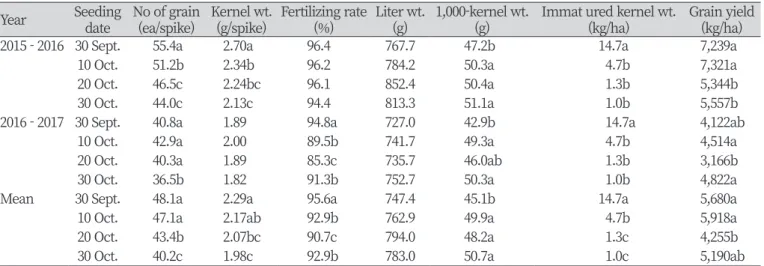
The effect of different sowing dates on the yield, yield components and seed yield of triticale are shown in Table 5. The average number of grain and kernel weight of triticale was the highest on the sowing plot of 30th September and 10th October, which were 48.1, 47.1 g and 2.3, 2.2 g, respectively, and 43.4 and 2.1 g on the
Table 4. The growth characteristics of triticale as affected by different sowing dates.
Year Seeding date Plant height(cm) Stem length
(cm) Panicle length
(cm) Stem/m2
(ea) Panicle/m2
(ea) Effective stems
2015 - 2016 30 Sept. 123.0b 111.4b 11.6a 503.2a 446.9a 89.3b(%)
10 Oct. 121.5bc 111.1b 10.3b 478.1a 453.9a 95.0a
20 Oct. 119.4c 109.2c 10.3b 331.5b 309.6b 93.3b
30 Oct. 129.4a 119.1a 10.3b 337.3b 319.7b 95.0a
2016 - 2017 30 Sept. 120.8b 110.5b 10.3a 353.9 221.1 62.8
10 Oct. 120.1b 109.7b 10.4a 340.5 208.0 60.7
20 Oct. 119.5b 109.7b 9.8b 328.3 192.3 57.6
30 Oct. 122.7a 113.4a 9.3c 338.7 211.7 63.0
Mean 30 Sept. 121.9b 111.0b 11.0a 428.5a 334.0a 76.0
10 Oct. 120.8bc 110.4bc 10.3b 409.3a 330.9a 77.9
20 Oct. 119.5c 109.4c 10.0bc 329.9b 250.9b 75.4
30 Oct. 126.0a 116.3a 9.8c 338.0b 265.7b 79.0
a - c: Means in a column with different letters are significantly different (p < 0.05).
sowing plot of 20th October and 40.2 and 2.0 g on the sowing plot of 30th October, respectively (p < 0.05). The number of grain and kernel weight was significantly higher in 2015 - 2016 than 2016 - 2017. The average fertilizing rate was 95.6% on the earlier sowing time of 30th September, which was higher than the other treatments (90.7 to 92.9%) (p < 0.05) and was no significant difference between the sowing date of 10th and 30th October. The liter weight was not significant difference between all the treatments but the average 1,000-kernel of triticale was significantly higher from 10th to 30th October (48.2 to 50.7 g) and the lowest was observed on 30th September, which was 45.1 g.
On the other hand, the average immatured kernel weight of triticale was significantly higher on the sowing plot of 30th September, which was 14.7 g and was significantly lower from 10th to 30th October (4.7 to 1.0 kg). Our findings are in total agreement with the results of Shin and Kurihara (1995) who pointed out that if the sowing date was early or late in autumn, the immatured kernel weights were increased. The seed yield of 2016 - 2017 decreased by 735 to 3117 kg/ha than that of 2015 - 2016, whereas, the average seed yield of triticale was 5,680 and 5,918 kg/ha on the sowing of 30th September and 10th October, respectively, and were significantly higher than the sowing of 20th and 30th October, which was 4,255 kg/ha and 5,190 kg/ha, respectively. In the study of Han et al. (2012), the seed yield of triticale 'cultivar' was 5.1 ton/ha, which was lower than the seed yield found on 30th September and 10th October of this experiment but similar to the sowing of 30th October, respectively.
In the previous study, Yun and Ataku (1998) found that the seed yield of triticale (X. Triticosecale Wittm.) decreased as the sowing period was delayed and Humphreys et al. (1994) reported that the number of grain and seed yield decreased as the number of tillers per unit area increased due to the excessive increase of nitrogen fertilizer as well as the different environmental conditions in the experiment area. In this experiment, it is considered that as the sowing date is delayed, the number of grain, kernel weight and seed yield decreased.
From the above results, according to the number of grain, kernel weight and seed yield of triticale, it is considered that the seed production of triticale in Gyeongju area is relatively higher from 30th September to 10th October.
Table 5. Yield components and seed yield of triticale as affected by different sowing dates.
Year Seeding
date No of grain
(ea/spike) Kernel wt.
(g/spike) Fertilizing rate
(%) Liter wt.
(g) 1,000-kernel wt.
(g) Immat ured kernel wt.
(kg/ha) Grain yield (kg/ha)
2015 - 2016 30 Sept. 55.4a 2.70a 96.4 767.7 47.2b 14.7a 7,239a
10 Oct. 51.2b 2.34b 96.2 784.2 50.3a 4.7b 7,321a
20 Oct. 46.5c 2.24bc 96.1 852.4 50.4a 1.3b 5,344b
30 Oct. 44.0c 2.13c 94.4 813.3 51.1a 1.0b 5,557b
2016 - 2017 30 Sept. 40.8a 1.89 94.8a 727.0 42.9b 14.7a 4,122ab
10 Oct. 42.9a 2.00 89.5b 741.7 49.3a 4.7b 4,514a
20 Oct. 40.3a 1.89 85.3c 735.7 46.0ab 1.3b 3,166b
30 Oct. 36.5b 1.82 91.3b 752.7 50.3a 1.0b 4,822a
Mean 30 Sept. 48.1a 2.29a 95.6a 747.4 45.1b 14.7a 5,680a
10 Oct. 47.1a 2.17ab 92.9b 762.9 49.9a 4.7b 5,918a
20 Oct. 43.4b 2.07bc 90.7c 794.0 48.2a 1.3c 4,255b
30 Oct. 40.2c 1.98c 92.9b 783.0 50.7a 1.0c 5,190ab
a - c: Means in a column with different letters are significantly different (p < 0.05).
Feed value of triticale as affected by different sowing dates
Table 6 shows the different feed value of triticale sown in 2015 and 2016 in Gyeongbuk province as influenced by sowing date. There were no significant differences between all the chemical compositions from different sowing dates and the average contents of crude protein (CP), ether extract (EE), crude fiber (CF) and crude ash (CA) of triticale were 10.69, 1.58, 2.79, and 2.06%, respectively. The average ADF and NDF of triticale were 4.53 and 27.81%, respectively, which were much lower compared to ADF (18.2 - 19.9%) and NDF (32.8 - 34.3%) found by Givens et al., 2003 on 2 varieties of oats. Also, the total digestible nutrient (TDN) content (85.32%) of triticale was significantly higher than the TDN content of rye cultivated under the same conditions in Gyeongsan and Yeongju, which was 52.5 - 54.2% and 48.7 - 49.6%. respectively (Oh et al., 2014). Therefore, the feed value of triticale sown in Gyeongju, Gyeongbuk province was considered to be excellent grain feed.
Taken together, these results indicate that for most livestock farmers who depend on monotonous forage crops, triticale is commonly distributed as feed crop seeds for the production of various forage crops. In addition, the ether extract content was lower than 5%, which is the inhibition level of cellulose decomposition, and it is expected that the increase in milk yield and the efficiency of fiber utilization will improve the maintenance rate.
Conclusion
In order to reduce the production cost of the forage and to increase economic efficiency in Gyeongju area, which is a representative area of Korean cattle breeding, the sowing date (30th September, 10th, 20th, and 30th October), growth characteristics, seed productivity and nutritional value of triticale (X. Triticosecale Wittm.) were investigated. The emergence date of triticale in autumn season appeared about a week after the sowing date of 30th September, 16 days after sowing date of 10th October but on 20th and 30th October, it took 9 to 18 days until the emergence date. A 20% lodging degree was observed in the sowing plot of 30th September 2015, but there was no lodging in autumn 2016. The heading, flowering and maturing date were the fastest on September 30th compared to other sowing dates, but the heading and flowering were earlier in autumn 2015 than the sowing dates in autumn 2016, whereas maturing date was the opposite. The average of stem and panicle per unit area (m2) of triticale were significantly higher in the sowing date of 30th September and 10th October, respectively (p < 0.05) and average number of grain and kernel weight were similar on September 30th and October 10th, but significantly higher than sowing date of October 20th and 30th, which were 40.2 to 43.4 and 2.0 to 2.1 g, respectively (p < 0.05).
Table 6. Feed value (chemical composition, %) of triticale as influenced by sowing dates.
Seeding date CP EE CF CA ADF NDF TDN
30 Sept. 10.91 1.80 2.84 2.05 4.60 27.01 85.26
10 Oct. 10.70 1.24 2.84 2.07 4.64 28.14 85.23
20 Oct. 10.70 1.72 2.81 2.11 4.37 26.81 85.45
30 Oct. 10.45 1.58 2.67 2.03 4.51 29.26 85.34
mean 10.69 1.58 2.79 2.06 4.53 27.81 85.32
CP, crude protein; EE, ether extract; CF, crude fiber; CA, crude ash; ADF, acid detergent fiber; NDF, neutral detergent fiber; TDN, total digestible nutrient = 88.9 - (0.79 × ADF %).
Seed yield were 5,680 and 5,918 kg/ha in the sowing plots of 30th September and 10th October, respectively, which were higher compared to the sowing plots of 20th October (4,255 kg/ha) and 30th October (5,190 kg/ha) (p
< 0.05). The feed value of different sowing dates was not significantly different between them and the average crude protein content, crude fat content, crude fiber content and TDN content was 10.7, 1.6, 2.8, and 85.3%, respectively.
Based on the above results, the optimum sowing date to obtain excellent seed yield of triticale in the South of Gyeongbuk province in autumn is on 30th September and 10th October.
Acknowledgements
This research was supported by Daegu University Research Grant, 2017.
Authors Information
Ikhwan Jo, https://orcid.org/0000-0002-2326-416X
Byamungu Mayange Tomple, https://orcid.org/0000-0002-3417-0097
References
Ammar K, Megoum M, Rajaram S. 2004. The history and evolution of triticale. In Mergoum M, Gomez- Macpherson H. (Eds.). Triticale improvement and production. 1st Ed. pp. 1-10. FAO, Rome, Italy.
AOAC (Association of Official Analytical Chemists). 2000. Official method of analysis. 17th ed. AOAC, Gaithersburg, USA.
Bishinoi UR, Chitapong P, Hughes J, Nishimura J. 1978. Quality of triticale and other small grain silage.
Agronomy Journal 70:439-441.
Brown AR, Almondares A. 1976. Quantity and quality of triticale forage compared to other small grain.
Agronomy Journal 6:264-266.
Byamungu MT, Jo IH. 2018. Enhancing seed productivity and feed value of oats (Avena sativa L.) with different seeding rate and nitrogen fertilizing levels in Gyeongbuk area. Journal of Agriculture and Life Science 52:61-72.
Ciha A. 1983. Forage production of triticale relative to other spring grains. Agronomy Journal 75:610-613.
[in Korean]
Dahlke BJ, Oplinger ES, Gaska JM, Martinka MJ. 1993. Influence of planting date and seeding rate on winter wheat grain yield and yield components. Journal of Production Agriculture 6:408-414.
Fowler DB. 1982. Date of seeding, fall growth, and winter survival of winter wheat and rye. Agronomy Journal 74:1060-1063.
Gursoy U, Yilmaz A. 2002. Determination of energy values and digestibility characteristics of triticale varieties. Journal Animal Science 80:396-399.
Han OK, Park TI, Park HH, Song TH, Ju JI, Jeung JH, Kang SJ, Kim DH, Choi HJ, Park NG, Kim KJ, Hwang JJ, Baek SB, Kwon YU. 2012. ‘Joseong’, A new early-heading forage triticale cultivar for paddy field of double cropping. Journal of the Korean Society of Grassland and Forage Science 32:193-202. [in Korean]
Heo HY, Park KG, Park HH, Kim MJ, Nam JH, Lee CK, Kim JG, Kwon YU. 2002. Cold tolerant, lodging resistant and high grain yielding new forage triticale variety ‘Shinyoung’. Treatment Crop Research 3:94-98. [in Korean]
Hsiao TC, Tereres E, Acevedo E, Henderson DW. 1976. Water stress and dynamics of growth and yield of crop plants. In Langee OL, Kappen L, Schulze ED. (Eds.). pp. 281-305. Water and plant life, Heidelberg, Germany.
Humphreys DG, Smith DL, Mather DE. 1994. Nitrogen fertilizer application and seeding date effects on oat grain milling quality. Agronomy Journal 86:838-843.
Ju JI, Choi HG, Gang YS, Lee JJ, Park KH, Lee HB. 2009. Changes of growth and forage yield at different cutting dates among five winter cereals for whole crop silage in middle region. Journal of the Korean Society of Grassland and Forage Science 29:111-120. [in Korean]
Kim SG, Kim JD, Kwon CH, Ha JK, Kim DA. 2006. Forage performance evaluation of rye cultivars with different sowing dates. Journal of the Korean Society of Grassland and Forage Science 26:31-38. [in Korean]
Kim YJ. 2014. Establishment of cropping system adequate to paddy soils in northern Gyeonggi-do area and evaluation on nitrogen budget. M.S. dissertation, Yonsei Univ., Wonju, Korea. [in Korean]
KOSIS (Korean Statistical Information Service). 2018. Statistics Korea. Assessed in http://www.kosis.kr/
eng/ on 21 November 2018.
Linn JG, Martin NP. 1989. Forage quality tests and interpretation. Bulletin AG-FO-2637. Minnesota Extension Service, University of Minnesota, Saint Paul, Minnesota, USA.
MAFRA (Ministry of Agriculture, Food and Rural Affairs). 2015. MAFRA Major Statistics. MAFRA, Sejong, Korea.
Mergoum M, Singh PK, Pena RJ, Lozano-del Rio AJ, Cooper KV, Salmon DF, Gomez Macpherson H. 2009.
Triticale: A "New" crop with old challenges. Handbook of plant breeding, In Cereals MJ Carena (ed.).
pp. 267-269. Springer, NY, USA.
Myer R, Lozano AJ. 2004. Triticale as animal feed. In Mergoum M and Gómez-Macpherson H (Eds.). pp. 49- 58. Triticale improvement and production. FAO Plant Production and Protection Paper No. 179. Food and Agriculture Organization of United Nations, Rome, Italy.
Oh MG, Jo IH, Hwangbo S. 2014. Effect of mixed-sowing of legume and applying of cattle manure on the productivity, feed values and organic Hanwoo carrying capacity of rye (Secale cereale L.). Korean Journal of Organic Agriculture 22:457-468. [in Korean]
Oplinger ES, Youngs VL. 1975. Performance of spring sown triticale, oats, barley and wheat. Agronomy Journal 67:724-726.
RDA (Rural Development Administration). 2012. Standardization for research survey on agricultural science and technology. pp. 339-358. RDA, Jeonju, Korea. [in Korean]
RDA (Rural Development Administration). 2013. The design of optimal management model of sectional self-supply forage for competitiveness of Korean beef cattle. p. 152. RDA, Jeonju, Korea. [in Korean]
Sapa VT, Sharma GC, Hughes J, Bradford RR. 1973. Triticale a wheat-rye hybrid. Journal of the Tennessee Academy of Science 48:59-61.
Shin MG, Kurihara H. 1995. Effective tillering pattern and grain yield on different seeding dates in barley.
The Korean Society of Crop Science 40:460-472. [in Korean].
Van Soest PJ, Robertson JB, Lewis BA. 1991. Methods for dietary fiber, neutral detergent fiber, and non- starch polysaccharides in relation to animal nutrition. Journal of Dairy Science 74:3583-3597.
Youn KB, Hwang JJ, Sung BR, Lee JH, Hur HS, Kim BY, Ahn WS, Kim YS, Cho CH. 1986. A good quality, lodging resistant and high yielding triticale variety "Sinkihomil" as soiling crop. Research Report (Crops), Rural Development Administration (RDA) 28:143-147. [in Korean]
Yun SG, Ataku K. 1998. Effect of planting dates and nitrogen fertilization rates on the forage yield and feeding value of introduced triticale. Journal of the Korean Society of Grassland and Forage Science 18:113-122. [in Korean]