• 검색 결과가 없습니다.

Analysis on Calcination of Cementitious Powder of Waste Concrete for Raw Cement

N/A
N/A
Protected

Academic year: 2021

Share "Analysis on Calcination of Cementitious Powder of Waste Concrete for Raw Cement"

Copied!
7
0
0

로드 중.... (전체 텍스트 보기)

전체 글

(1)

pISSN 1598-2033 eISSN 2233-5706 Journal of the Korea Institute of Building Construction, Vol. 14, No. 1

http://dx.doi.org/10.5345/JKIBC.2014.14.1.054 www.jkibc.org

Analysis on Calcination of Cementitious Powder of Waste Concrete for Raw Cement

Park, Dong-Cheon

1*

Kwon, Eun-Hee

1

Ahn Jae-cheol

2 1)

Department of Architectural Engineering, Korea Maritime and Ocean University, Youngdo-Gu, Busan, 606-791, Korea

1

Graduate School, Dong-A University, Saha-Gu, Busan, 602-714, Korea

2

Abstract

The purpose of this study is to examine whether cementitious powder separated from waste concrete can be used as an alternative raw material to limestone and reduce the usage of natural resource (limestone) and CO

2

emission based on recycling cementitious powder from waste concrete. Experiments actually analyzed the chemical composition of cementitious powder and performed hyperthermia analysis, measurement of free CaO and XRD analysis to measure the degree of recovery of hydration in the model of cementitious powder manufactured based on chemical composition.

These were performed in each cementitious powder model at different calcination temperatures such as 900℃, 1200℃, 1300℃, 1400℃ and 1450℃. Through the experiments, it was found that the recovery of hydration was at a level which can be used as the alternative raw material for limestone, but the replacement ratio was directly affected by the degree of mixing of fine aggregate in less than 150 ㎛, which cannot be separated from cementitious powder. It was shown that there was no difference in the production of compounds involved in hydration at calcination temperatures of 1200℃

or higher. Therefore, to pursue the replacement of limestone and reduction of greenhouse gas by recycling cementitious powder, the development of technology to efficiently separate aggregate fine powder is required.

Keywords : cementitious powder of waste concrete, recycled cement, powder of fine

1. Introduction

Measures for recycling waste concrete, which accounts for more than 60% of construction waste, are actively being studied these days in order to minimize the environmental load occurring in construction and in the construction process of eco-friendly structures. Through this process, the study reaches the practical stage to manufacture and reuse cyclic aggregate with high quality through a

Received : October 4, 2013

Revision received : December 31, 2013 Accepted : January 6, 2014

* Corresponding author : Park, Dong-Cheon

[Tel: 82-10-5533-9443, E-mail: [email protected]]

ⓒ2014 The Korea Institute of Building Construction, All rights reserved.

variety of recycling processes[1,2]. In addition, some studies to recycle the fine grain containing fine aggregate produced after manufacturing cyclic aggregate and the cementitious powder of paste ingredients in which fine aggregate ingredients are removed are being conducted. In such cases of recycling cementitious powder it was generally used as an alternative for silica flour in the manufacture of cement series products such as roadbed ash as inert filler or brick. Some studies are being conducted with the goal of utilizing recycled cement through low-temperature calcination process[3,4].

The amount of CO 2 emission depending on

decarbonation of limestone compared with the total

CO 2 emission was 67.5%. The amount of CO 2 emission

depending on combustion was 26.7% and CO 2 emission

(2)

Classification CaO SiO

2

Al

2

O

3

Fe

2

O

3

SO

3

Paste 47.70 18.20 3.86 2.63 0.00

Fine aggregate 1.32 75.10 12.10 2.03 0.00

Table 1. Chemical compositions of model waste cementitious powder

depending on electric power in plants was 5.8%.

Therefore, it was evaluated to be very significant in the reduction of greenhouse gas.

In this study, we would like to use the large amount of paste ingredients included in cementitious powder of waste concrete (consists of cement hydrate in which coarse aggregate and fine aggregate more than 150

㎛ are removed through recycling process of waste cement, and some fine aggregate cementitious powder; hereinafter, called waste cementitious powder) as an alternative raw material to limestone.

In this case, it is expected to have the effect of saving natural resources as a substitute for limestone, and reduce the greenhouse gas emissions caused by decarbonation reaction of limestone, according to the mechanism for hydration reaction of cement and recycled cement as shown in equations (1), (2) and (3).

Thus, this study analyzed the possibility of the use of waste cementitious powder mixed with cementitious powder of fine aggregate as raw material (Limestone) for cement through the optimal combination of cement raw material. In addition, we analyzed the possibility of saving limestone raw material through this process[5].

Manufacture of cement :CaCO 3

Heat → CaO+CO 2 ---- ⑴

Hydration of cement :CaO+H 2 O Heat Ca(OH) 2 +H 2 O -- ⑵

Manufacture of re-cement :Ca(OH) 2

Heat → CaO+H 2 O -- ⑶

2. Materials used

This study manufactured model waste cementitious powder and used it as raw material for experiment based on the chemical compositions of actual waste cementitious powder. Since formulation and age of

waste cementitious powder in each site were un- known and these values were not consistent, it was determined to be inappropriate for a comparative analysis on the addition ratio of fine aggregate and calcination temperature. The model waste cementi- tious powder used paste aged 6 months and fine ag- gregate less than 150㎛ based on previous studies.

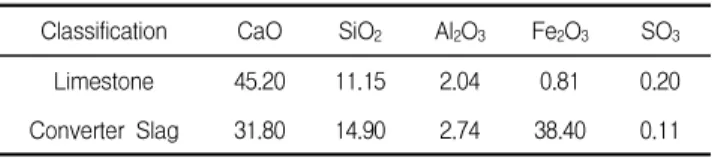
In addition, converter slag, which has high iron con- tent, was used to coordinate IM as an ingredient adjuster. Chemical compositions of the model waste cementitious powder and byproduct raw materials used in this study are shown in Tables 1 and 2.

Classification CaO SiO

2

Al

2

O

3

Fe

2

O

3

SO

3

Limestone 45.20 11.15 2.04 0.81 0.20

Converter Slag 31.80 14.90 2.74 38.40 0.11

Table 2. Chemical compositions of each raw material and ingredient adjuster

3. Experimental methods

In this study, actual waste cementitious powder

was first collected from 11 sites nationwide in Korea

and the chemical composition of the samples was

analyzed. The addition ratio of fine aggregate was

estimated through comparison with Portland cement

by using the SOLVER add-in in Excel using the

principle of GRG (Generalized Reduced Gradient)

Methods, and the model waste cementitious powder

was generated. At the same time, the effect on the

use of fine aggregate added to the waste cementitious

powder as an alternative material for limestone was

investigated. Multiple optimization for the

combination of raw materials was performed to make

(3)

Analysis on Calcination of Cementitious Powder of Waste Concrete for Raw Cement

recycled cement by using SOLVER add-in in EXCEL with converter slag utilizing waste cementitious powder as an alternative material for limestone[6].

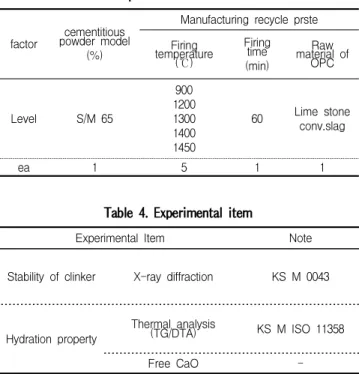
Raw material adjustment factor range was LSD (Lime Saturation Degree:(CaO - 0.7×S O 3 ) / (2.8SiO 2 + 1.18Al 2 O 3 + 0.65Fe 2 O 3 )×100) of 87.0, SM (Silica Modulus: SiO 2 / (Al 2 O 3 +Fe 2 O 3 )×100) of 3.0 and IM (Iron Modul: Al 2 O 3 / (Fe 2 O 3 )×100) of 1.10 on the basis of moderate heat cement with low LSD and high SM in order to maximize the amount of use of waste cementitious powder including large amount of SiO 2 [7]. In order to determine the degree of recovery of hydration of recycled cement, in this study, TG/DTA thermal analysis, Free CaO measurement, and X-ray diffraction analysis were performed. These were performed at different temperatures such as 900℃, 1200℃, 1300℃, 1400℃ and 1450℃ in order to determine the degree of recovery of hydration at each calcination temperature. Experimental items, experimental factors and levels are shown in Tables 3 and 4 below. The manufacturing process of clinker, model cementitious powder, used in this experiments is shown in Figure 1.

Table 3. Experimental factors and levels factor cementitious

powder model (%)

Manufacturing recycle prste Firing

temperature (℃)

Firing (min) time

material of Raw OPC

Level S/M 65

1200 900 1300 1400 1450

60 Lime stone conv.slag

ea 1 5 1 1

Table 4. Experimental item

Experimental Item Note

Stability of clinker X-ray diffraction KS M 0043

Hydration property Thermal analysis

(TG/DTA) KS M ISO 11358

Free CaO -

Figure 1. Flow chart of the manufacture of recycle cement model

4. Experimental results and analysis.

4.1 Chemical compositions of actual waste cementitious powder.

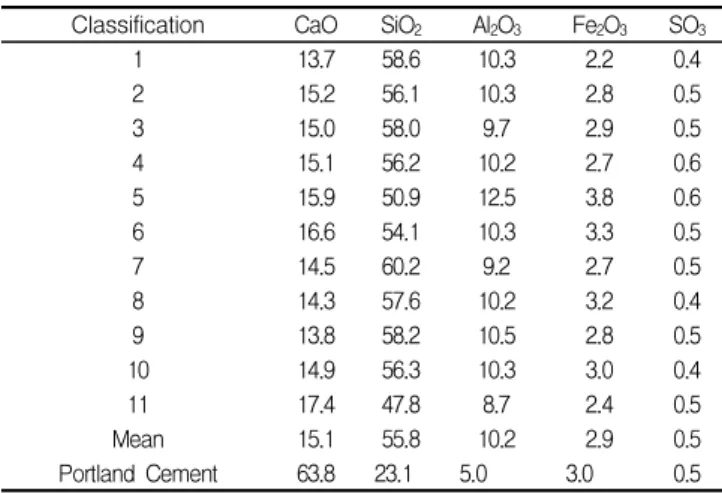
The results of an analysis on the chemical composi- tions of actual waste cementitious powder are shown in Table 5. Comparisons with the chemical composi- tion of Portland cement are shown in Figure 2. As shown in Figure 2, chemical composition of actual waste cementitious powder had approximately 30%

more SiO 2 , approximately 5% more Al 2 O 3 , approx- imately 43% less CaO and approximately 0.6% less Fe 2 O 3 compared with the levels found in Portland cement. This is thought to have been caused by the inclusion of cementitious fine aggregate which cannot be completely separated because of the similar grain size.

Through an analysis based on chemical composi-

tions of fine aggregate in Table 1 and the chemical

composition of original Portland cement in Table 6,

it was found that the mean of chemical composition

of actual waste cementitious powder showed the most

(4)

in all conditions to the addition ratio of fine aggregate . Despite a slight difference in the two values, all values of addition of 65% of fine aggregate are in- cluded in the actual waste cementitious powder.

Chemical compositions of waste cementitious powder model with fine aggregate are shown in Table 6.

Figure 2. Comparison of chemical composition of actual waste cementitious powder and original Portland cement

Table 5. Chemical composition of actual waste cementitious powder Classification CaO SiO

2

Al

2

O

3

Fe

2

O

3

SO

3

1 13.7 58.6 10.3 2.2 0.4

2 15.2 56.1 10.3 2.8 0.5

3 15.0 58.0 9.7 2.9 0.5

4 15.1 56.2 10.2 2.7 0.6

5 15.9 50.9 12.5 3.8 0.6

6 16.6 54.1 10.3 3.3 0.5

7 14.5 60.2 9.2 2.7 0.5

8 14.3 57.6 10.2 3.2 0.4

9 13.8 58.2 10.5 2.8 0.5

10 14.9 56.3 10.3 3.0 0.4

11 17.4 47.8 8.7 2.4 0.5

Mean 15.1 55.8 10.2 2.9 0.5

Portland Cement 63.8 23.1 5.0 3.0 0.5

Table 6. Chemical composition of waste cementitious powder models Classification CaO SiO

2

Al

2

O

3

Fe

2

O

3

SO

3

Fine aggregate 50% 24.5 46.7 8.0 2.3 0.0

Fine aggregate 60% 19.9 52.3 8.8 2.3 0.0

Fine aggregate 65% 17.6 55.2 9.2 2.2 0.0

Fine aggregate 70% 14.2 59.0 9.6 2.2 0.0

Fine aggregate 80% 10.6 63.7 10.5 2.2 0.0

ratio of fine aggregates

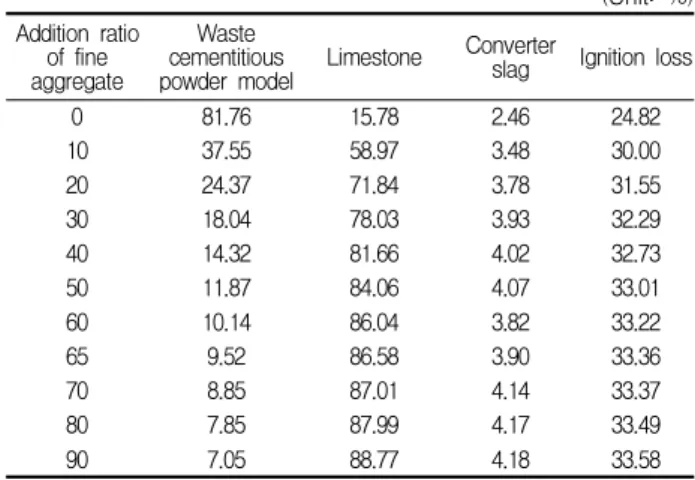
Combinations of raw materials were made in increments of 10% within the range of a 0%-90%

addition ratio of fine aggregate. As shown in Figure 3 and Table 7, as the addition ratio of fine aggregate was increased, the replacement ratio of waste cementitious powder for limestone was dramatically decreased. In particular, the waste cementitious powder model with a 65% addition ratio of fine aggregate could be used as the alternative raw material for limestone at the level of 9.52%. This was because it was difficult to fully synthesize to C 3 S and C 3 A because the amount of SiO 2 is increased and ingredients of CaO and Al 2 O 3 were decreased in waste cementitious powder due to the addition of the ingredient of fine aggregate. At the time, it was shown that the possibility of using SiO 2 as an alternative for clay of quartz rather than limestone was increased. Thus, to increase the utilization of the waste cementitious powder with high added value, it is thought that the grinding technology to efficiently separate fine aggregate from cement hydrates should be developed.

Figure 3. Combination of raw materials based on addition ratio

of fine aggregate

(5)

Analysis on Calcination of Cementitious Powder of Waste Concrete for Raw Cement

Table 7. Combination of raw materials based on addition ratio of fine aggregate

Addition ratio of fine aggregate

Waste cementitious

powder model Limestone Converter

slag Ignition loss

0 81.76 15.78 2.46 24.82

10 37.55 58.97 3.48 30.00

20 24.37 71.84 3.78 31.55

30 18.04 78.03 3.93 32.29

40 14.32 81.66 4.02 32.73

50 11.87 84.06 4.07 33.01

60 10.14 86.04 3.82 33.22

65 9.52 86.58 3.90 33.36

70 8.85 87.01 4.14 33.37

80 7.85 87.99 4.17 33.49

90 7.05 88.77 4.18 33.58

(Unit: %)

4.3 Free CaO measurement

Figure 4 shows the result of measurement of the contents of Free CaO at 900 ~ 1450℃. As shown in the Figure, as the calcination temperature was increased, the content of free CaO was decreased.

However, content of free CaO was reduced to 0.2~0.5% or almost became extinct at calcination temperatures of over 1450℃. However, for clinker used in this study it showed more than 2%, which was significantly high. In addition, Burnability (BI) was calculated as 40.96, which was somewhat lacking when compared with the levels in existing studies of 48~52. It was thought that the SiO 2 included as the form of Quartz crystal caused in fine aggregate had low reactivity with CaO.

Figure 4. Free CaO of clinker with each firing temperature

4.4 Differential thermal analysis.

To determine the reactivity of combined raw mate- rials, differential thermal analysis was conducted and the results are shown in Figure 5. The temperatures at which major reactions occurred were shown in Table 8. The formation and decomposition of com- pounds confirm generally suitable temperatures.

After adherent moisture of clay minerals was va- porized at 452.05℃, endothermic peak caused by de- carbonation of limestone was observed at 763.63℃.

Exothermic peak caused by C 2 S was observed at 1272.9℃. In addition, endothermic peak caused by formation of liquid phase of C 3 A and C 4 AF was ob- served at 1354.74℃. Thermal decomposition temper- ature of limestone was determined to be relatively low when compared with results of the study of Ahn, Ji Whan et al. The reason was that L.S.D. was set at 87, which was a low level, as moderate thermal cement was mixed with raw material. When compared with the results of the study conducted by J. A. Imlach et al., C 3 A and C 4 AF formed liquid phase at a relatively high temperature, because it was mixed at S.M. of 3.0, a high level. In addition, CaCO 3 decomposition reaction was 39.93% at 763.63℃, which was similar to the previous study.

CaCO

3

decomposition C

2

S

formation Liquid phase

Temperature(℃) 763.63 1272.9 1354.74

Table 8. Differential Thermal Analysis of waste cementitious powder model raw material

4.5 X-Ray diffraction analysis.

XRD pattern of clinker at each calcination temper-

ature is shown in Figure 6. As shown in the Figure,

a large amount of SiO 2 and CaO, which did not have

any reactivity at 900℃, existed, and β-C 2 S phase,

which was some linker mineral phase, appeared

slightly. However, the major ingredients did not seem

to be reactive yet. Despite this, it was shown that

(6)

β-C 2 S as diffraction peaks of SiO 2 and CaO were reduced. In the case of C 3 A, diffraction peaks were shown at 1300 and 1400℃, but became extinct at 1450℃.

In general, the amount of C 2 S reached a maximum at 1200℃. As the liquid phase began to be generated at 1250℃, the reaction of C 2 S and CaO was facilitated so that the amount of C 3 S tended to increase.

However, the amount of C 2 S and C 3 S was constant at over 1200℃, because the cause was thought to be the same result found in Free CaO analysis.

Figure 5. TG-DTA curves of raw material

Figure 6. XRD pattern of clinker with each firing temperature

The following conclusions were obtained through the above experiments.

1) Through the analysis of the chemical compositions of cementitious powder of waste concrete, CaO and SiO 2 are found to be the main ingredients, as had been shown in the existing studies. Content of CaO is significantly decreased but content of SiO 2 is significantly increased. Mix ratio of fine aggregate and fine powder is found to be approx- imately 65 %.

2) By attempting to chemically optimize recycled cement for multi-purpose use, it is found that cement of moderate heat with values of LSD:87, SM:3, IM:1.1 can be produced. It is found that the replacement rate of cementitious powder for limestone is dramatically reduced when the mix- ing ratio of fine aggregate is increased.

3) In the differential thermal analysis of the compo- sition of raw materials, exothermic peak caused by C 2 S formation is observed at 1272.9℃.

Endothermic peak caused by formation of liquid phase is observed at 1354.74℃.

4) The analysis of free CaO showed that the content of free CaO is reduced with increasing calcination temperature. However, it has a relatively low burnability of 40.96.

5) Through X-ray diffraction analysis of the re- cycled cement, it was found that compounds composed of cement such as C 2 S, C 3 S and C 3 A can be synthesized. However, there is no sig- nificantly big change at 1200℃ or higher.

The investigations described above showed that

recycled cement can be utilized as an alternative raw

material to limestone. However, to increase the re-

placement ratio, fine powder of fine aggregate should

(7)

Analysis on Calcination of Cementitious Powder of Waste Concrete for Raw Cement

be efficiently separated from the waste cementitious powder.

Acknowledgement

This work was supported by the National Research Foundation of Korea(NRF) grant funded by the Korea government(MEST) (No. NFR-2013-0014286)

This research was supported by Korea Ministry of Land, Transport and Maritime Affairs through grant B01 of Construction Technology Innovation Program.

References

1. Park CW. Recycling Technology of Cementitious Powder for Completely Recycling of Concrete Waste. Journal of The Korea Institute of Building Construction. 2005 Sep;5(3):109-17.

2. Han KK. A Study on Sources of Construction Wastes and Recycling Strategy. Journal of Korea institute of Ecological Architecture and Environment. 2008 Oct;8(5):69-76.

3. Ahn JC, Oh SG, Kang BH. Characteristics of Hydration of Recycled Cement using by Product Cementitious Powder of Actual Waste Cement. Journal of Architectural Institute of Korea (structural system). 2005 Sep;21(9):121-8.

4. Choi TH. The Study on the Fire Resistance of Mortar using of Discarded EPS Powder . Journal of Architectural Institute of Korea (structural system). 2010 Dec;2010(1):399-403.

5. Oh SG. Study on Recovery of Hydration of Recycled Cement using Cementitious Powder of Waste Cement. Journal of Architectural Institute of Korea (structural system). 2002 Oct;18(10):53-60.

6. Lee SH. Study on Feed Mix Program and Growth Modelling System of Layer using Excel Solver [master’s thesis]. [Sunchon (Korea)]:

Sunchon National University; 2009. 42 p.

7. Ahn JW. Study on Making Paste Cementitious Powder collected

from Waste Cement for Cement Materials. Journal of the Korean

Ceramic Society. 2003 Jul;40(8):804-10.

수치

Table 2. Chemical compositions of each raw material and ingredient adjuster
Figure 1. Flow chart of the manufacture of recycle cement model
Table 5. Chemical composition of actual waste cementitious powder Classification CaO SiO 2 Al 2 O 3 Fe 2 O 3 SO 3
Table 7. Combination of raw materials based on addition ratio of fine aggregate
+2

참조

관련 문서

It considers the energy use of the different components that are involved in the distribution and viewing of video content: data centres and content delivery networks

After first field tests, we expect electric passenger drones or eVTOL aircraft (short for electric vertical take-off and landing) to start providing commercial mobility

If there are no results in each case, then your query result is identical to the answer query result, and therefore your query is correct (or at least, it is good enough that

1 John Owen, Justification by Faith Alone, in The Works of John Owen, ed. John Bolt, trans. Scott Clark, "Do This and Live: Christ's Active Obedience as the

The correct typing results for the DNA samples are listed in Table 1 for all STR loci in the Powerplex 16 multiplexes.(Table 1.) The multiplex typing results based on the

In conclusion, the growth and yield of potato was not different between mixed fertilizer(chemical fertilizer : liquid pig manure = 1:1) and the

Thirdly, it appeared that social support had meaningful effect on self-efficacy and the quality of life, and in the case of the difference analysis by

(6) Choice of fine aggregate content (S/a, 잔골재율 ) with known volumes of coarse aggregate, water, cement and air & Unit water mass. (7) Estimation of unit volume of