pISSN 1598-2033 eISSN 2233-5706 Journal of the Korea Institute of Building Construction, Vol. 11, No. 6
http://dx.doi.org/10.5345/JKIBC.2011.11.6.597 www.jkibc.org
A Proposal of Repair Cost Estimating Criteria for Persistent Defects in Apartment Houses
1)Lee, Hae-Jin Lim, Nam-Gi*
Department of Architectural Engineering, Tongmyong University, Nam-Gu, Busan, 608-711, Korea
Abstract
It has been often noted as a problem that as there are no objective and clear criteria for the repair cost estimate of persistent defects, when a claim arises in relation to an apartment construction, significantly different amounts of compensation may be given for similar defects based on the experience and tendencies of the construction experts asked to make a judgment. For this reason, this research aims to present defect managers with a more reasonable and objective estimation criteria and a system to determine the repair cost of defects based on an analysis of relevant factors. The research findings show that the historical cost system is applied first, and then a standard of estimation is used to estimate the cost for the items that are not included in the historical cost system. The criteria for the repair cost for each defect is as follows: the repair cost for defects arising from a regulation violation is determined by calculating the reconstruction cost of the parts in question after demolishing them; the repair cost for progressive defects is determined based on a contribution ratio proportional to the age of the building; the repair cost for repetitive defects is calculated by considering an alternative to maximize the intended function of the defective parts; and the repair cost for value depreciation defects is determined based on the ratio of the warranty period to the lapsed years.
However, repair cost estimation for dual value depreciation defects should be studied in future research.
Keywords: persistent defects, repair cost, repair cost estimating criteria, estimation methods
1. Introduction
1.1 Research Background and Objective
The performance requirements of completed buildings have been raised as quality of life has increased, which often leads to disputes between the parties concerned on aspects ranging from structural, functional, and aesthetic quality to usability. It is noted that most such disputes relate to persistent defects, such as irreparable, progressive and repetitive defects. The lawsuits on such defects tend to take a much longer period of
Received : August 26, 2011
Revision received : September 30, 2011 Accepted : October 5, 2011
* Corresponding author : Lim, Nam-Gi [Tel: 82-51-629-2463, E-mail: [email protected]]
ⓒ2011 The Korea Institute of Building Construction, All rights reserved.
time to be settled than those on other matters because the lack of a clear-cut criteria for repair cost estimation can give rise to many different interpretations on a defect[1]. In particular, the causes of persistent defects found in apartment buildings can fall into faulty construction resulted from problems in drawings and dissatisfaction with the completed quality of temporary or general construction resulting from the lack of detailed drawings. In addition, the high number of complex factors – faulty construction or misuse that can cause a persistent defect – makes it difficult to establish which party should take the full responsibility for the defect. The dispute settlement procedure between residents and construction companies has left much to be desired in Korea compared to in other developed countries. For this reason, a more thorough preparation of strategic
measures for disputes on construction defects is required[2].
As mentioned earlier, a defect can be interpreted differently depending on the subjective opinion of a court appraiser who is asked to make a judgment, which has made the parties involved in persistent defect lawsuits lose confidence in construction experts. As there are no objective criteria for the repair cost estimate for each defective item, even construction experts have different opinions about defects based on their personal experiences and tendencies. Moreover, the time taken to give a ruling may vary depending on the knowledge on the construction field of the judge who gives a final ruling, which makes it impossible to consider the ruling as having been given based on objective and reasonable judgment. In addition, the legal costs of persistent defects alone amount to KRW 1 trillion, resulting in social and economic losses[3].
For these reasons, a systematic procedure should be prepared to deal with disputes arising from construction defects.
Hence, this research aims to present defect managers with a repair cost estimation criteria and a system for persistent defects found in completed apartment buildings.
1.2 Research Scope and Methods
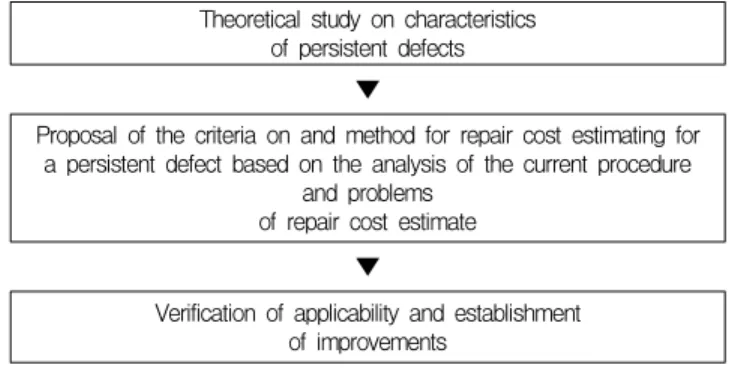
This research presents a repair cost estimation criteria, and its scope spans from the proposal of a repair cost estimation criteria based on the analysis of the current conditions and problems of current repair cost estimation methods to verification of the proposed criteria through a survey. The research methods used in this research include a literature review, advice from professionals to propose repair cost estimation criteria for each defect, and a survey of construction professionals to verify the validity of the criteria, which can be summarized as in Figure 1.
Theoretical study on characteristics of persistent defects
▼
Proposal of the criteria on and method for repair cost estimating for a persistent defect based on the analysis of the current procedure
and problems of repair cost estimate
▼
Verification of applicability and establishment of improvements
Figure 1. Research Flow
1.3 Review of precedent research
From the review of precedent research, although the problems of a class action lawsuit, defect types, and problems in defect appraisal can be found in A Study on Defect Criteria and Improvement[1];
An Empirical Study on Problems and Improvements of the Dispute Procedure on an Apartment Building Defect[4]; A Study on Cost Estimation in Case of the Cancellation of the Contract[5]; and A Study on the Appraisal Criteria for Concrete Crack Tolerance[6], any concrete solution to construction appraisers and lawsuit parties has left much to be desired, and repair cost estimation criteria that have not yet been dealt with in the precedent research are proposed in this study.
2. Persistent defects in building construction
2.1 Definition of persistent defects
A persistent defect is defined in this research as a defect that is repetitively found even after a round of regular repair. Defects can be divided into four categories: irreparable defects that cannot be corrected because they arise from a violation of regulations or require too much repair cost;
progressive (expansive) defects that expand in size due to their potential causes; repetitive defects that occur continuously; and value depreciation defects that decrease the value of the building itself.
Once a defect is found, the defective item is
specified as one of the four persistent defects by inspecting whether or not it violates any of the regulations stipulated in construction-related laws, and by analyzing the defect’s causes and forms and the stage at which it occurred, either at the planning or design stage, at the construction stage, or during use, in consideration of the tolerance of each item.
In general, the characteristics of a defect found in an apartment building should be analyzed by general judgment. However, if there are no clear-cut, objective criteria for a defect, the defect can be specified based on the appraiser's experiences and knowledge[7].
2.2 Types of persistent defects
Table 1. Types of persistent defects
Type Pattern Picture Description
Defect cause by regulation violation
Insufficient space between buildings
The space between an apartment building and an annex should be distanced wider than its
height, but there are some cases which cannot be satisfied due to the site circumstance.
It falls into the defect of regulation violation because it cannot secure
the right to enjoy light and view of residents living in a low floor.
Progres sive defects
Cracks and caused by rebar rust due to insufficient thickness of
reinforced concrete
The swelled and rust rebar makes the concrete
wall crack due to its insufficient thickness. The
cracks and rust are in progression even after a
regular repair.
Efflorescence of waterproofing concrete used on the floor
of the underground
parking lot
Epoxy, the floor hardener, comes off and the endocrine-disrupting chemicals come out as a
form of dust, which is a serious environmental issue. In addition, the dust reacts with the residual epoxy to form
efflorescence.
Repetitive defects
Water leak on the ceiling
and the floor of the underground
parking lot
Breaks of the waterproofing layer and the cracks on the floor of
the underground parking lot lead to water leak,
Other water leaks continue to be found after a regular repair
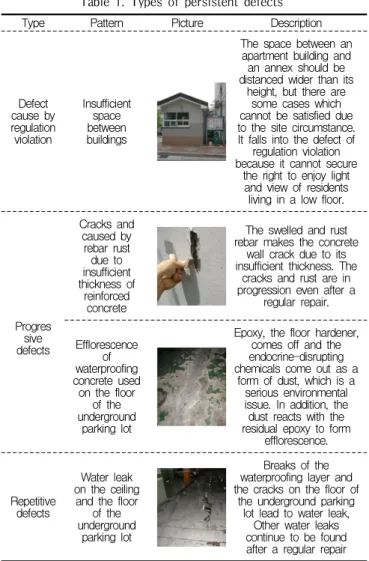
As shown in Figure 1, there are four different categories of persistent defects: irreparable defects arising from a violation of regulations including infringement of the right to sunshine, ventilation or fine view; progressive defects like rust that are shown to be progressing even after a round of repair; repetitive defects like water leakage that are shown on other areas after a round of regular repair; and value depreciation defects arising from inappropriate use of materials or misconstruction.
3. Repair cost estimation criteria for persistent defects
3.1 Defect determination criteria
As there are no clear and concrete criteria in Korea to which disputing parties can refer, the Ministry of Land, Transportation and Maritime Affairs asked the Korea Infrastructure Safety Corporation and the Korea Institute of Construction Engineering and Management to suggest opinions on defect determination procedure and criteria for 6 defects by type. The following are the criteria generally used to determine a defect in Korea.
First, there are the defects found in an apartment building that has been originally constructed as shown in the initial design drawing but that has become severely deformed over time to the point that it cannot function properly. Second, there are the defects that do not meet the requirements, either of related laws and regulations or of drawings and specifications, as well as construction performance, quality and unit price stipulated in the agreement or related documents. Third, there are the defects that relate to improper function despite their not being stipulated in any agreement, drawing or specification.
3.2. Repair cost estimating procedure
3.2.1 Review of agreements, drawings and specifications and related regulations and laws
The most frequently mentioned cause of lawsuits related to construction defects is the lack of a clearly defined objective, scope and responsibility of each party of a construction project stipulated in an agreement. For this reason, it is important to prioritize the design drawings[8], and then stipulate the prioritized order of drawings and specifications in the agreement (including letter of contract, bidding documents, special terms and conditions, general terms and conditions) because an agreement supersedes other forms of promises.
When apartment buildings are built with materials that differ from the ones determined at the time of payment or approval of the construction, without due process of consent to the change, and then are sold, the defective items should be compared with those approved in the drawings. If, in the process of apartment construction based on the approved drawings (before inspection), it is inevitably necessary to change the material shown in the drawings to a new one due to the liquidation of a supplier or the scarcity of the material, the change must be reported to the expected residents. At this time, the substituted material should be equivalent to the original material or better[4] in accordance with general construction-related regulations and laws.
3.2.2 Principles of repair cost estimation for persistent defects
Compared with that specified in the agreement or design drawings, when the actual performance of an item does not meet the minimum level of performance expected or shown in the agreement, it is classified as a defect. The repair cost estimation for a persistent defect is determined as
follows:
1) Compensation for a repair or damages is equivalent to the actual repair cost.
2) Compensation for an irreparable defect (or too excessive compensation demanded) is estimated to be the discrepancy between the construction cost with no defect and the actual construction cost.
3) Compensation for functionality that does not meet the promised level due to unplanned construction is estimated to be reconstruction cost after partially demolishing the parts in question.
4) Compensation for a defect arising from the unplanned construction that works properly but is different from that in the agreement is determined to be the discrepancy between the construction cost as planned and the actual construction cost.
3.2.3 Time of repair cost estimation
The repair cost is basically estimated at the time of payment for the construction stipulated in the agreement[6]. Table 2 shows the repair cost estimate time other than the time of payment. The time of payment can vary depending on the consent of disputing parties, which in principle should be confirmed by the judging panel. The repair cost estimation can differ depending on the time at which the estimation is conducted due to the fluctuation of material and labor cost. For this reason, the repair cost estimation for a defect or compensation in a lawsuit is generally done at the time of claim of the defect or damage. Thus, the time is important, because the scope and content of repair is set at the time the claim is first raised, and because the compensation for the defect is determined accordingly.
Table 2. Timing of repair cost estimating No. Lawsuit type by appraisal At the time of payment
of construction cost 1 Defect lawsuit At the time of claim of repair
2 Additional construction lawsuit At the time of agreement of additional construction
3 Safety-related lawsuit At the time of claim of an illegal act
4 Lawsuit of undone construction
At the time of claim of return of undone construction cost
3.2.4 Criteria for construction cost statement The construction cost statement is drawn up in accordance with the regulations of accounting established by the Ministry of Strategy and Finance for Contracts to which the State is a party, and the standard costs should be calculated as shown in Table 3. In addition, standard costs in general construction should be estimated based on a standard of estimate, historical cost, an actual transaction cost and an estimated value.
Table 3. Estimation criteria for persistent defect costs 1 In case of an appropriate transaction in the market, the actual
transaction cost is used.
2
In case of a newly developed or special product for which there is no actual transaction cost in the market, the cost
calculated based on the cost accounting is used.
3
In case of a construction project, the historical cost system approved by the chief of central governments based on the accumulated data from construction projects already performed
4
In case of the items unable to apply the cost system regulated by Article 1 and Article 3, actual transaction cost or quotation
price such as appraisal price or service charge
As indicated in Table 3, the costs should be estimated based on the actual transaction cost in the market, but as there is no fixed cost for materials, and this may vary depending on the party who places the order or who draws up the statement, it is therefore impossible to apply a fixed cost system in reality. Recently, the Korean government has confirmed and announced work types applicable to the historical cost and their unit prices among the work types whose design
processes can be standardized and the costs of which are not significantly affected by other factors every 6 months (in February and August every year), and actively encourages companies to utilize the historical cost system when they draw up a statement based on actually agreed unit costs by work type, including material cost, labor cost and expenses for machinery. Table 4 shows a comparison between a standard of estimate and the historical cost system.
Table 4. Comparison on cost estimation between using unit price and using historical cost data
Item Unit price Historical cost system
Unit price estimate
Estimated based on a Unit price
Estimated based on actual costs by work type
Direct cost Separation of material cost from labor cost
Unit cost of material cost, labor cost and expenses
included Indirect cost
(Overhead expenses)
By item of expenditure Based on historic cost
3.3 Repair cost estimation criteria for persistent defects
The repair cost estimation criteria for persistent defects are used to estimate the expenses required to restore an actually identified and measured defect to the quality level agreed in the contract by using a general method and materials equivalent to those stipulated in the contract.
3.3.1 Estimation method
When performing an appraisal in a construction dispute, the repair cost can be estimated based on the specification agreed upon between the parties, a standard of estimation under the design specification, or the historical cost system to which actually contracted costs are applied. The followings are the details of the three systems [2].
1) The method of using the specification agreed between the parties
A specification is drawn up upon the agreement
between the contract parties. It is necessary to establish a mutual understanding of the construction between the owner and the contractor, and to specify the agreed terms and conditions when the calculation of quantity and the statement is drawn up. Therefore, when defective items are included in the specification, the number of defects is multiplied by the contracted unit price to estimate the repair cost. However, not all of the defect items are included in the specification, which may lead to a dispute between the two parties.
2) The method and problems of a standard of estimate
When there is no detailed specification, according to Article 5 of the Enforcement Regulation of the Act for Contracts to Which the State is a Party (determination of standard costs based on actual transaction costs and the historical cost system), the following are applied after taking contract content, characteristics and site circumstances into account in a comprehensive manner.
① The costs researched and announced by Administrator of Public Procurement Service
② The costs researched and announced by an organization or agency registered to the Minister of Strategy and Finance, that is fully qualified for the standard set by Minister of Strategy and Finance
③ The costs directly researched and identified by chief official or contract official in charge of each office of central governments based on the actual transaction costs from two or more service providers
3) Method and problems of the historical cost system The historical cost system approved by a chief of the central government is established based on the historical costs data accumulated from the already implemented construction projects. It is utilized to estimate standard cost of a similar construction based on actual unit cost by work type. There may
be differences in the weight to be applied depending on the type of construction. The historical unit price is updated twice a year, and work types are continuously excavated and added.
However, the historical cost system is appropriate for cases in which the repair cost is directly calculated and an order for the repair is placed, but utilization of the construction revision index should be considered depending on the characteristics, size and region of a construction project[5].
3.3.2 Repair cost estimation criteria for persistent defects
Currently, there is a diversity of opinions on the calculation method of repair cost and legal ground.
In particular, divergent opinions on and appraisals of the repair cost estimation for persistent defects may give one party disadvantage or property damage due to an unreasonable appraisal. The repair cost estimation for a defect may differ by construction expert and legal expert, by region, or by court ruling.
1) Repair cost estimation criteria for a defect of regulation violation
A defect of regulation violation is a defect caused by constructing a building structure that differs from the structure shown in the initially intended drawing and specification, which has a great impact on the residents and communal life.
However, not all items that differ from the original drawing and specifications can be determined to be a defect. Despite a slight difference, if an item works properly in terms of functionality, aesthetics, or safety, it cannot be determined as a defect. An irreparable defect such as violation of the space between buildings or violation of the story height of underground parking lot is not objectively subject to a repair due to its nature, so the right to remedy the
defect does not exist. That is, when fixing the defect would require an entire building to be demolished and a new building rebuilt, repair is impossible and any defects related to the regulation violation shall be a claim for damages.
However, the quantitative calculation method of a claim for damages is not specifically stipulated.
2) Repair cost estimation criteria for a progressive defect
When a repair cost is estimated only for the current state of the defect, the possible defects that may occur in the future are not included. For instance, a defect caused by rust of rebar due to the insufficient thickness of reinforced concrete is small at the beginning, but expands over time.
However, a repair cost based on arbitrary guesswork of the range of the future progression can be excessive. Therefore, the cause of the defect found should first be diagnosed by partly demolishing the wall, and then the repair cost should be estimated by taking such factors as the severity and progression of rust and the warranty period of the item into account.
3) Repair cost estimation criteria for repetitive defects
Cracks on the basement parking lot and slab cracks can bring about leaks on other parts repetitively, even after a round of regular repair.
The defects result from the incomplete finish, and it is almost impossible to restore the defective part to an impeccable state by demolishing and rebuilding it. Therefore, an alternative measure should be taken to restore as much function as possible. The repair cost for a repetitive defect such as leaks is calculated as a maintenance cost based on indirect expenses spent based on the table of durable years of the building to minimize the causes.
4) Repair cost estimation criteria for value depreciation defect
If a repair for defects is impossible or not allowed, or if an outstandingly low quality compared to the intended one in the drawing, specification and agreement still exists even after a repair, the value of the building is depreciated by the defects.
If the building was built using materials that differ from those stipulated in the drawing and specification, the building is depreciated by as much as the cost discrepancy between the unplanned construction and the planned construction.
Accordingly, the cost discrepancy is considered as the standard estimate[9].
4. Proposal of repair cost estimation criteria for persistent defects
The repair cost estimation criteria for each persistent defect are presented based on the review of the precedent research and opinions from construction professionals.
4.1 Composition of repair costs for persistent defects
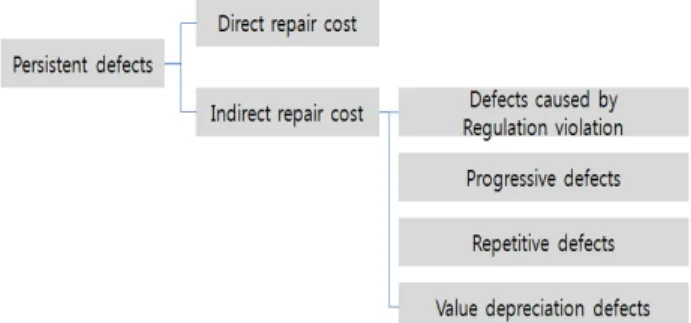
A repair cost for an apartment building may vary depending on characteristics of the construction site, drawings and specifications, and terms and conditions. A direct repair cost is a repair cost for completely repairable defects, whereas an indirect repair cost is a repair cost for potential and repetitive defects. The composition of repair costs for persistent defects is shown in Figure 2.
Figure 2. The repair costs of persistent defect
4.2 Repair cost estimation methods for persistent defects
The repair cost for a persistent defect should be estimated based not only on quality difference between the defect and the originally promised quality in the agreement, drawing and specification in terms of functionality, aesthetics, and performance, but also on any of whole or partial defects that may possibly occur in the future related to the defect found.
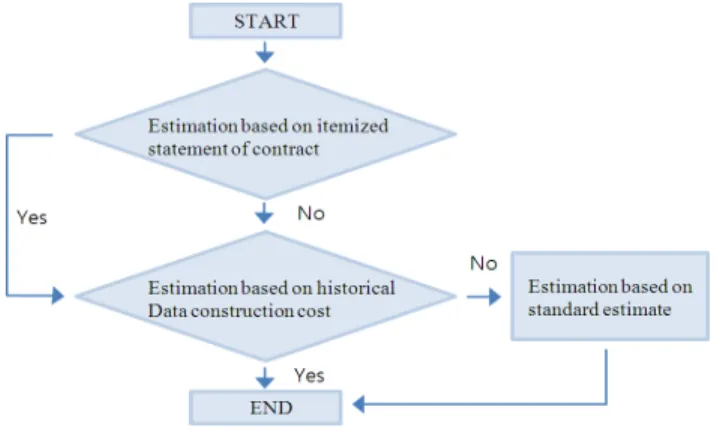
The repair cost estimation should be conducted depending on the circumstances of the repair request, terms and conditions of the contract, but the repair cost for the defect against earned value and contract amount is estimated based on the specification. Recently, not only estimated construction cost but also repair cost is calculated using the weighted ratio of 55 percent of the historical cost and 45 percent of a standard of estimate, respectively. The historical cost is slightly more weighted[11]. Therefore, as the historical cost is utilized more often in the repair cost estimation for an apartment building, the historical cost system is applied first, and the items that are not included in the historical cost system are calculated based on a standard of estimate, as shown in Figure 3.
① Repair cost (Specification)
=Number of defects found ⨯ unit price on specification
② Repair cost (Historical Cost)
= Number of defects found ⨯ historical unit cost
③ Repair cost (Standard of Estimate )
= Number of defects found x (manhour x material cost)+ number of defects found ⨯ (manhour x labor cost of standard of estimate)+ amount spent⨯(unit cost of standard of estimate)
Figure 3. Repair cost estimating process
4.2.2 Repair cost estimation method by defect Repair cost can be divided into two types as shown in Figure 2: one for a direct defect and the other for an indirect defect.
1) Direct repair cost
The repair cost for a direct defect can be estimated by using the conventional repair cost estimation method.
2) Indirect repair cost
① Repair cost for regulation violation defects Any part of a building that is constructed differently from the original drawing and specification, which leads to any violation of various regulations and laws, including Construction Laws and Building Code Requirement for Structural Concrete, is determined as a defect.
There are no clear-cut methods for calculating the repair cost in a quantitative manner and compensating the damages for the violated parts.
The repair cost estimation for defects is done based on the reconstruction cost of the regulation-violating part after demolishing it.
B = (Bc⨯f) + (Bc⨯g) --- (1)
Here,
․B : regulation violation repair cost
․Bc⨯f : demolition cost of the specific area in violation alone ․Bc⨯g : reconstruction fee of the specific area
② Repair cost for progressive defects
Ceiling deflection or rust of rebar caused by
insufficient thickness of reinforced concrete is small at the beginning but expands in size and area over time. The range of the defect should be determined by accurately identifying the causes and forms of the defect, and analyzing the surrounding area. The range is calculated by multiplying the area or the length by a certain ratio, a contribution rate in proportion to the lapsed year. As the warranty period is generally less than 4 years, the length of cracks per unit area dramatically decreases after the 5th year from completion[13].Therefore, it is reasonable that the possible progression is estimated by using a contribution rate of 40 percent fort he 1st year, 30 percent for the 2nd year, 20 percent for the 3rd year and 10 percent for the 4th year.
C = Aa + (Aa⨯Ga) --- (2)
Here,
․C : Progressive (extended) flaw cost ․Aa : direct flaw repair cost
․Ga : Contributing rate of lapsed year (first year 40%, second year 30%, third year 20%, fourth year 10%)
③ Repair cost for repetitive defects Of the defect types, repetitive defects are defects that occur repetitively, even after a round of regular repair. It is impossible to rebuild the defective parts after demolishing them, and therefore, an alternative measure should be taken to enable the parts serve their intended function to the fullest.
As a result, administrative expenses should be added, which are estimated as maintenance cost based on indirect expenses spent based on the table of durable years of the building to maximize the function. However, as the building is being depreciated at the same time, the cost resulting from depreciation itself should also be estimated and subtracted.
D = Aa + Da + Daa + E --- (3)
Here,
․D : Repeated flaw cost ․Aa : direct flaw repair cost
․Da : cost of alternative construction method ․Daa(construction method maintenance) =
{charge for electricity + labor charge (3 engineers) + equipment fee (0.2 EA)}
․E : cost of value depreciation repair
④ If a repair for defects is impossible or not allowed, and if quality is outstandingly low compared to the quality level specified in the drawing and specification or agreement, even after a round of repair, the value of the building is depreciated by the defects, and thus the depreciated value resulting from the defects should be compensated. As for the repair cost for the defects of parts constructed differently from those in the drawing and specification or agreement, the reconstruction cost is estimated as shown in the Equations below.
E1 = Mm + En / Fn --- (4) E2 = Mn + En / Fn --- (5)
Here,
․E1 : Cost of value depreciation flaw proposal 1 ․E2 : Cost of value depreciation flaw proposal 2
․Mm : Cost difference between the design drawings and the actual construction
․Mn : Cost of reconstruction ․En : Warranty on each similar trade ․Fn : Years of building content
First, for the defects arising from a different construction method or technique, the reconstruction cost is estimated for the part that does not provide the originally intended function, and then by using the ratio of the warranty period to durable years of the building, repair cost should be accurately estimated using Eq.(5) if the defect is found during the warranty period within which the building has been depreciated. Second, for the repair cost for defects of materials that differ in
size or type from those stipulated in the drawing, specification, and the agreement, there is no significant difference in function. The cost discrepancy between the unplanned construction and the construction as planned is calculated using Eq.(4).
4.3 Verification of validity
In order to verify the repair cost estimation criteria presented in this paper, a survey of construction professionals was conducted. However, as mentioned previously, there are so many different types of persistent defects that it may be difficult for respondents answering the survey to specify a repair cost estimation method. Therefore, the validity of the criteria presented in this paper was surveyed by presenting actual cases to which the criteria were applied.
4.3.1 Summary of the survey
A survey was conducted of people who have completed a course in professional construction project management and people who are currently working as court appraisers. The respondents consisted of 5 people with 10 to 15 years of experience in the construction field (12.5%), 14 people with 15 to less than 20 years of experience (35%), and 21 people with more than 20 years of experience (50%).
The criteria were actually applied to the apartment buildings with reinforced concrete structural wall systems that have 320 households.
They were completed in March of 2007. The residents in the apartment buildings filed a lawsuit against the construction company for persistent defects. The repair cost for the persistent defects of the buildings was estimated by request of the court.
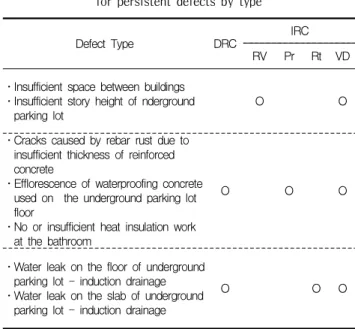
Table 5. Case analysis of the repair cost for persistent defects by type
Defect Type DRC
IRC RV Pr Rt VD
․Insufficient space between buildings
․Insufficient story height of nderground parking lot
O O
․Cracks caused by rebar rust due to insufficient thickness of reinforced concrete
․Efflorescence of waterproofing concrete used on the underground parking lot floor
․No or insufficient heat insulation work at the bathroom
O O O
․Water leak on the floor of underground parking lot - induction drainage
․Water leak on the slab of underground parking lot - induction drainage
O O O
{Direct repair cost(DRC), Indirect repair cost(IRC), Regulation on violation(RV), Progressive(Pr), Repetitive(Rt), Value depreciation(VD)}
Table 5 indicates the persistent defect items drawn in the course of the appraisal of the apartment buildings above to apply the repair cost estimation criteria proposed in this research. The repair cost is divided into direct repair cost and indirect repair cost. Direct repair cost refers to the cost generally spent in a round of actual repair, while indirect cost refers to the cost for recurrence and repetitiveness in the future.
A repair cost for each persistent defect type can be calculated using the equations: Eq.(1) is used for regulation violation defects, Eq.(2) for progressive defects, Eq.(3) for repetitive defects and Eq.(4) and Eq.(5) for value depreciation defects.
4.3.2 Result of the survey
The survey revealed that 75 percent of respondents said that using the historical cost system is appropriate for estimation, while 20 percent said that using a standard of estimate is appropriate.
Figure 4. Appropriateness of the estimation methods
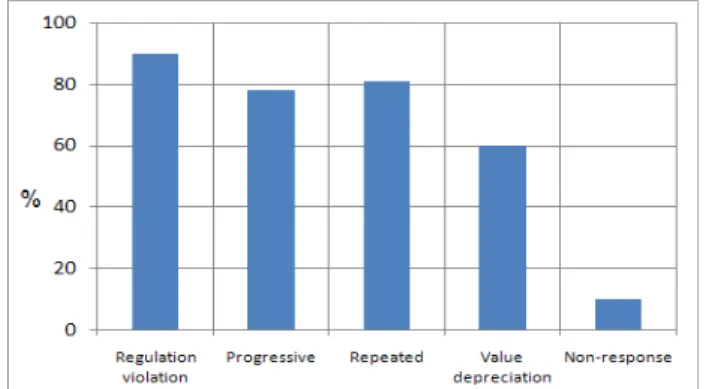
In terms of the appropriateness of the indirect repair cost estimation method presented in this research, as shown in Figure 5, 90 percent of respondents evaluated it as appropriate for regulation violation defects; 78 percent evaluated it as appropriate for progressive defects; 82 percent evaluated it as appropriate for repetitive defects;
and 60 percent evaluated it as appropriate for value depreciation defects. 77.5 percent of respondents evaluated the estimation methods as appropriate overall.
Figure 5. Appropriateness for each of the repair cost estimating for the persistent defect
From the survey conducted on specialists in the construction field, it is verified that the repair cost estimation methods for regulation violation defects, progressive defects and repetitive defects are appropriate, since approximately 80 percent of respondents evaluated them as appropriate.
However, the estimation method for value
depreciation defects was verified as insufficient, since only 60 percent of respondents evaluated it as appropriate.
5. Conclusion
As there are no clear-cut criteria for repair cost estimation, when a dispute arises due to a defect, the repair cost is estimated differently based on the appraiser’s experience and tendency.
Reasonable and systematic methods of repair cost estimation for persistent defects are urgently needed in consideration of the rising number of lawsuits and the related economic loss. This study proposes repair cost estimation methods for persistent defects, and the appropriateness of these was verified through case analysis and survey. The research findings are as follows.
First, repair cost estimation methods for persistent defects are proposed. In the process of estimation, historical cost system is applied first, and then a standard of estimate is applied to estimate the repair cost for items that are not included in the historical cost system.
Second, of the repair cost estimation for persistent defects, the repair cost for regulation violation defect is estimated as the cost required for demolishing and rebuilding the violated parts, while the repair cost for progressive defects is estimated by using the contribution rate of the lapsed years.
Third, the repair cost for repetitive defects is estimated as the cost required to adopt an alternative to minimize the defect.
Finally, of the value depreciation defects, the repair cost for material-related defects is estimated as the cost difference between the originally intended material and the actually installed material. Survey respondents indicated
that the proposed repair cost estimation methods are appropriate overall.
We expect that the repair cost estimation methods proposed in this paper will serve as more reasonable criteria for construction appraisers as well as defect managers of apartment buildings. In addition, by imprinting the seriousness of a dispute in the minds of construction experts, it is expected that they will work to reduce disputes in advance by paying more attention at the stages of planning, design, construction and maintenance. Owners, designers, supervisors, CMs and contractors should work to raise their ability and competence to deliberate and negotiate the other party’s demands in preparation for a possible dispute.
요 약
공동주택의 건설 분쟁(Claim)발생 시 지속적으로 발생하 는 하자의 보수비용 산정 방안에 대한 객관적 기준이 없어 건설전문가들도 각자의 경험과 성향에 따라 다양하게 판단 하게 되므로 문제점을 발생 시키고 있다. 따라서 본 연구에 서는 이에 대한 분석을 통하여 보수비용 산정기준과 방안을 제시한 후 건축물 하자관련 담당자들에게 합리적인 하자 판 단기준을 제안 하고자 한다. 연구결과, 실적공사비를 우선 적용하며 실적공사비에 없는 항목은 표준품셈을 활용하여 산정한다. 지속형 하자 유형인 법규위반 하자의 보수비용 산정은 위반 건물부위만 철거하여 재시공하는 비용을 산정 하고, 진행성(확대)하자는 건물 준공의 경과연수에 비례하여 기여율로 산정하며, 반복성 하자는 하자를 최소화시키는 방 법의 설비공법을 대안으로 강구하여 산정하고, 가치감소 하 자는 내용연수대비 하자보증기간의 비율로 산정하는 방법을 제안하였다. 이중 가치감소하자 보수비용의 산정은 향후 보 다 많은 연구가 필요할 것으로 사료된다.
키워드 : 지속형하자, 보수비용, 산정기준, 산정방안 References
1. Kim ON. A Study on the Standard of the Flaw Judgment and
Improvement Plan of Condominium [Master's Thesis]. Seoul (Korea): Kwangwoon University; 2010. 139 p.
2. Lee SB. A study on the calculating damages due to termination of a contract in construction projects.
Architectural Institute of Korea. 2003 May:19(5)129-36.
3. Korea Institute of Construction Engineering and Management. Korea Infrastructure Safety and Technology Corporation. A public hearing for the provision of assessment manual for defects of an apartment building. Seoul (Korea):
Korea Institute of Construction Engineering and Management; 2010. 2 p.
4. Yun HI. An Empirical Study on the Problems and Improvement Methods of the Disputes over Defects in Apartment Houses [dissertation]. Seoul (Korea): Gyeonggi University; 2007. 127 p.
5. Lee HI. A Study on the Cost Estimation in case of Termination in the Building Construction Contract [dissertation]. Seoul (Korea): Myongji University; 2001. 174 p.
6. Kim WG. A Study on the Appraisal Criteria in Relation with the Concrete Tolerance Crack: Engineering and Legal Perspectives [Master's Thesis]. Seoul (Korea): Kwangwoon University; 2008. 94 p.
7. Yun JY. Construction Disputes Related Law (Legal Issues and Litigation Practices of Construction Disputes). 3rd ed. Seoul (Korea): Park Young Sa; Chapter 6 General Theory on Defects Liability; 2008. p. 232-40.
8. The Ministry of Land, Transportation and Maritime Affairs.
Standards for Preparing Design Documents, No. 2003-11 Clause 9(Notification). Gwacheon (Korea): The Ministry of Land, Transportation and Maritime Affairs; Jan. 24, 2003.
9. The Ministry of Land, Transportation and Maritime Affairs.
Construction Law (Housing Act): No, 38-3:Article 38(Last Revision Date). Gwacheon (Korea): The Ministry of Land, Transportation and Maritime Affairs; Jan. 11, 2007.
10. Seoul Central District Court. Construction Practical Training Kit for Appraisers. Seoul (Korea): Seoul Central District Court; Jan. 23, 2006. p. 4-6.
11. The Ministry of Land, Transportation, and Maritime Affairs.
Historical Data Construction Cost, Statistics. Gwacheon (Korea): The Ministry of Land, Transportation and Maritime Affairs; 2010. p. 2.
12. The Korea Appraisal Board. Material Fixed Asset Table of Durable Years(Revised Version). Seoul (Korea): The Korea Appraisal Board (Korea); 1999. p. 14.