• 검색 결과가 없습니다.

A Study on the Information Security Control and Management Process in Mobile Banking Systems

N/A
N/A
Protected

Academic year: 2021

Share "A Study on the Information Security Control and Management Process in Mobile Banking Systems"

Copied!
15
0
0

로드 중.... (전체 텍스트 보기)

전체 글

(1)

A Study on the Information Security Control and Management Process in Mobile Banking Systems

So Young Kim

, Myong Hee Kim

††

, Man-Gon Park

†††

ABSTRACT

According to the development of information processing technology and mobile communication technology, the utilization of mobile banking systems is drastically increasing in banking system. In the foreseeable future, it is expected to increase rapidly the demands of mobile banking in bank systems with the prevalence of smart devices and technologies. However, the keeping ‘security’ is very important in banking systems that handles personal information and financial assets. But it is very difficult to improve the security of banking systems only with the vulnerabilities and faults analysis methods of information security. Hence, in this paper, we accomplish the analysis of security risk factor and security vulnerability that occur in mobile banking system. With analyzed results, we propose the information security control and management processes for assessing and improving security based on the mechanisms which composes mobile banking system.

Key words: Fault Mechanism; Hazard Factors; Information Security; Mobile Banking Process; Risks and Vulnerabilities; Security Threats Factors

※ Corresponding Author : Man-Gon Park, Address : (608-737) Yongso-Ro 45, Nam-Gu. Busan, Rep. of Korea, TEL: +82-51-629-6240, FAX : +82-51-628-6155, E-mail : [email protected]

Receipt date : Nov. 27, 2014, Approval date : Jan. 29, 2015

Dept. of Information Systems, Pukyong Nat. Univ., Rep.

of Korea (E-mail : [email protected])

†††

Dept. of IT Convergence and Application Engineering, PuKyong Nat. Univ., Rep. of Korea

(E-mail : [email protected])

†††

Dept. of IT Convergence and Application Engineering, PuKyong Nat. Univ., Rep. of Korea

※ This work was supported by National Research Foundation (NRF) of Korea(2013K1A3A1A09076037).

1. INTRODUCTION

Recently thanks to the development of informa- tion processing technology and mobile communi- cation technology, it is possible for bank users to use mobile banking services anywhere and any- time with a big convenience. Mobile banking means banking services with wireless and online networks, it expanded as a newly emerged banking service and then received lots of attention gradually.

The IC chip-based mobile banking service started in 2003. A special embedded IC chip issued by the bank is used as a security enhanced storage device, and this chip stores essential financial in- formation for bank transactions such as account information. A PIN is needed to access information inside the chip. The VM mobile banking service

started in 2007. VM differs from the IC-based banking service in that it only uses software to en- able the financial transactions such as balance in- quiry, and transfer of funds on the mobile device.

It uses middleware programs such as WIPI that

are created specifically for mobile banking. The

VM mobile banking service not only authenticates

the user through accredited certificates and secure

cards but also conducts mobile phone self-au-

thentication through SMS, and downloads and in-

stalls VM mobile banking software via call back

URLs. Now on mobile banking services, financial

institutions conduct the transactions through mo-

bile banking application equipped with mobile op-

erating system such as iOS and android in smart

devices, and offer a wide variety of services which

are account inquiry, transferring, credit card, fund

(2)

Table 1. The Trends of Clients Enrolled on Mobile Banking Services (Unit: 1,000)

Service Delivery Systems 2010 2011 2012 2013

IC Chip 4,579 4,434 4,376 4,328

VM 8,561 8,946 8,749 8,421

Smart Devices 2,609

(16.6%) 10,358

(43.6%) 23,966

(64.6%) 37,185

(74.5%)

Total 15,749 23,738 37,091 49,934

Source: The Bank of Korea (2013)

transactions same as general banking services.

Table 1 shows the number of clients enrolled on mobile banking services are increasing more and more, in the future the use of mobile banking based on smart devices is soaring sharply.

However, on the back side of mobile banking conveniences, the threats of mobile banking se- curity are increasing gradually due to personal in- formation is saved on mobile devices. Moreover, as the security threats are intellectualizing, ad- vancing, security technologies for preventing per- sonal information leakage and monetary damages became inevitable. In domestic case, from 2011 second half year the appearance of malicious code on smartphone is expected and will be spread rapidly. According to 2013 predicted analysis of banking IT information security trend, malicious code and hacking technology for threatening finan- cial information are detected in overseas country 2010, by expanding intrusion paths with Wi-Fi, blue-tooth, mobile communications services on mobile devices, more strengthened security coun- teracted system for improving confidentiality, reli- ability and integrity is required after making public scenarios about banking security threat, which re- veal threatening factors and vulnerabilities in mo- bile environment, and countermeasures.

Hence, in this paper, we propose what future strengthened banking security system do after an- alyzing vulnerabilities and problems of current banking security system based on analysis of risk factors, information security control and manage- ment process in order to build strengthened in- formation security management process of mobile

banking. And we show visualized figures of in- formation security control and management mech- anism and propose that improved plan of in- formation security control and management based on analysis of mobile banking security risk factors and vulnerabilities after classifying each function of mobile banking security system through fault mechanism.

2. RELATED WORKS

Information Security means that protecting in- formation system from unauthorized access and by acquiring availability, integrity and confidentiality, information security can be improved. Information security control and management are essential for information security of improved banking system, here information security control and management mean controlling and managing risk factors which degrade availability, integrity and confidentiality, so goal of this process is to protect confidential in- formation, asset from unauthorized access. But there are a lot of threatening factors due to absence of information security control and management.

First, the destruction of component and infra- structure on information security. Second, the damage which from human failure factors due to insufficient staff training and in-acquaintance of tools. Last, the unauthorized attacks such as hack- ing or malicious virus which are on banking in- formation system [1-3].

For preventing these risks, we can categorize

three types of information security control. First,

physical control which means prevention from in-

(3)

Fig. 1. Information Security Control and Governance Process Diagram.

Fig. 2. Configuration Chart of Mobile Banking System

Fig. 3. Mobile Banking Operation System Configuration.

trusion of unauthorized access internally. For ex- ample, file backup, security guard. Second, core technical control which uses hardware/software technology. For example, access control, anti-virus software and encryption technology. Last, admin- istrative control which are management restriction and security policy. It aims at assuring that user can get access authority. For example, security awareness, technology training, security policy and procedure, supervision, which all are user-oriented technologies controlling user’s behavior.

Fig. 1 shows general information security con- trol and management process, through this, we can improve the security of banking system and then offer secure banking services to users. However, these processes are totally different by financial in- stitutions although they have similarities. Because financial institutions have each and their own risk factors considering their locations, features of their location, their services, their business goal and technical structure. Also there is an information security management system for improving in- formation security. It manages risk factors which exist in banking system. This composes security management, security countermeasure, security maintenance, security analysis, security com- pliance and security training [3-4]. With these effi- cient security systems and policies, information security policy is being established and security technologies are developing constantly in order to improve and advance information security.

2.1 Mobile Banking System

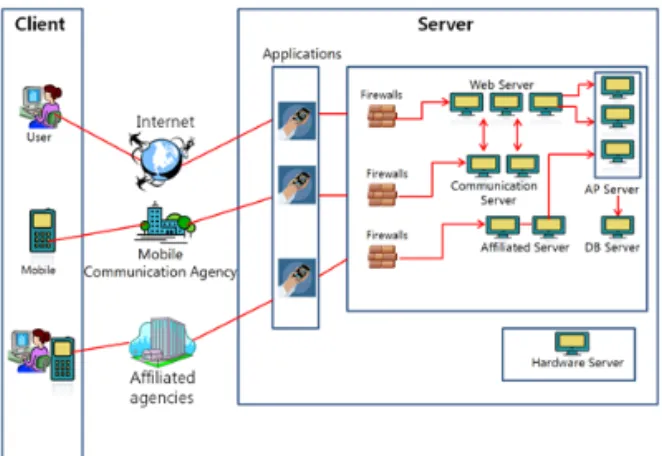
Recently with the consistent development of mobile devices and IT technology, mobile banking in banking industries is instituted and then now banking services using mobile devices is possible anywhere and anytime. Fig. 2 shows architecture of mobile banking and mobile banking system is based on two types of technologies. These are ac- cessibility and remoteness.

For performing banking services, it needs web server, application server and database. Users of bank have to use their own mobile devices through mobile network for their transactions and commu- nicate with core system of bank for processing these transactions as depicted in Fig. 3. The meth- od how mobile banking system composes their services is that by using web, applications and web applications.

In domestic areas, mostly web-application meth-

(4)

Table 2. Three Steps of Mobile Banking Process

Steps Contents of Mobile Banking Process

User Authentication

The link with user and bank is encrypted using public/private key on mobile network.

Server side on mobile banking requires authentication, user give personal information to bank and can enroll. And then, user on mobile can get authentication, bank confirms who is user passing on whole user’s information. Lastly, server side on mobile banking can offer related data to users. Here, means of authentication is accredited certificate, account password and security card, One Time Password and so on.

Transaction request of user

User selects services which they want to transact. Server side on mobile banking requires re-authentication for confidential transaction. Here, re-authentication assures authenticated transaction.

Transaction processing of bank

Server side on mobile banking requires details about services which user asks for; also user passes on details to bank and transmits. Finally, the server requires

re-authentication.

Source: Kaspersky Security Bulletin (2012) Fig. 4. Increase of Android Malware.

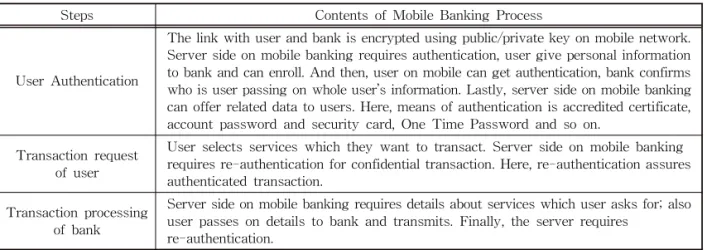
od is used. On web-application method, it trans- mits and processes transaction information on the web, it operates each and own security module on the application [3-4]. Then the mobile banking process is composed of three steps ([5-7]) as shown in Table 2.

2.2 Risks and Vulnerabilities on Mobile Banking Systems

Threats of security are increasing and security system in bank is very vulnerable according to prevalence of mobile banking. The damages such as a leakage of personal information and a new type of fraud are happening targeting mobile de- vices where personal data are loaded and so these are to be protected before being attacked from new type of threats. In mobile devices, major risks are malicious software, security policy violation, weak structure of wireless network, weak structure of payment system, SMS vulnerabilities, and Hard- ware/Software/Operating systems vulnerabilities.

Fig. 4 shows that the number of malicious software which is risk factors in android operating system in 2012 are increasing sharply than in 2011. It also shows seriousness of security threats on mobile banking system [7-9].

Security threats in mobile devices are catego- rized mobile device system threat, user information threat, malicious code and malicious software

threat, network transmission threat and physical threat like Table 3 by types of attack.

The researches about information security con- trol and management are implementing con- tinuously as an alternative preventing from se- curity threats. Now, a lot of security systems are developed, however the stronger information se- curity control and management are, the higher lev- el of security threats and risks are. Therefore, it is urgent that we should improve information se- curity of banking system through more enhanced information security control and process.

3. FAULT MECHANISM AND HAZARD FACTORS OF INFORMATION SECURITY CONTROL AND MANAGEMENT

It is very important to detect the security vul-

(5)

Table 3. Security Threats Factors in Mobile Banking ([10-15])

Type of Threat Threat Factors

Mobile System Device Threat

Threats such as access to other application’s process and memory, intrusion of malicious code and leakage of confidential information are exposed easily according to falsification of platform.

Financial information of user is transmitted by outside attack in falsified application and exposed. File system without a permit accesses to file information and after acquiring authority of administrator, drains information of accredited certificate, application file.

(Example) Malicious application which disguised it as a MADDEN NFL 12- If user installs this application, installed application sends message and incurs charge.

User Information Threat

A leakage of confidential information in user’s system memory makes other process access easily, so threats of memory which has confidential information can happen.

A leakage of user information is transmitted through network or recorded in mobile devices after collecting input data by using techniques.

(Example) 2013 10th March, malicious application personating unpaid balance of national pension- After accessing to accredited certificate, photos, memo folders in smartphone and compacting, these are transmitted to remote site.

Malicious Code and Malicious Software

Threat

Risk factors can intrude through linkage between devices, SMS route, and E-mail route through phishing, pharming, sniffing, and smishing.

(Example) Malicious code ‘Chest’ targeting for small sum money payment in smartphone- After depriving user of personal information, it induces user to pay small sum money regularly.

Network Communication Threat

It can acquire personal information through transmitted plain text confidential data using tool. Moreover, it can acquire information through attacks, intrusion such as mobile DDOS from outside using network where security is weak.

(Example ) 2014 3.20 chaos- with big scale malicious code attacks, personal information of millions of people is leaked due to congestion of financial, broadcasting institution’s computer network.

Physical Threat

A robbery and loss can occur because it is easy to access to other people’s devices which have mobility. Also, infection from a removable disk can occur.

(Example) In 2008, McDonald’s crew in Arkansas State, America took a phone of man and spread nude photos which are saved on his phone.

nerabilities caused by faults from information se- curity control and management. Also, the process of analyzing and resolving the security vulner- abilities should be handled importantly because faults can effect system and threaten the security.

The security vulnerabilities get resolved with the following four processes as below.

∙ Detect: It detects events and investigate causes of faults.

∙ Isolate: It separates and isolates faults which are possible to happen.

∙ Inform: It informs happened faults to managing and operation system in detail.

∙ Resolve: It counteracts and resolves detected

faults as fast as it can.

Here, risk factors mean factors which threaten, intrude into system and have a bad influence on system. If these states are ‘Active’, it causes seri- ous situation. For this reason, we should find risk factors as well as faults and should analyze, coun- teract them. Through these procedures, we have to manage and control information security efficiently.

The security risk factors and faults exist by

each function system in banking services. We

classify security risk factors and faults in detail

and suppose information security control and man-

agement process by tables as below [4].

(6)

3.1 User Authentication

User account and password are essential factors for user authentication as a first step in using banking services. Especially, password is very im- portant to protect users in security system. Now when user uses banking service, account and password of user are formed according to policies about ‘User account and Password’. Department where it manages these policies should have a con- ference about polices regularly and propose polices which have more improved contents of policies.

The goal of this regulated polices is to build a strong security and then protect users. In <User Authentication> function, the most important thing is to authenticate user’s identity. User Authentica- tion is a procedure that makes sure whether user who is permitted access is or not, this procedure is progressing with 3 steps as below.

[Step 1] After entering ID/PWD, authenticate user.

[Step 2] Enter One Time Password as a second authentication.

[Step 3] Authenticate with accredited certificate for intensify authentication.

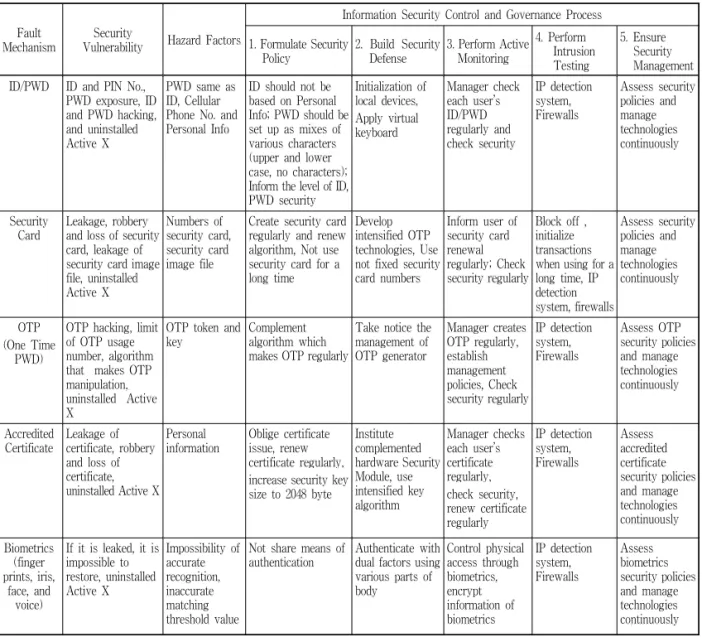
The way of ID/Password is commercialized normally, but nowadays the ways of accredited certificate, security card, OTP and biometrics are mostly used [3,11,16-18]. Table 4 depicts the in- formation security control and governance accord- ing to security vulnerability and hazard factors un- der fault mechanism in user authentication phase.

3.2 Access Control

Access control is physical and electronic system to control access to network. Physical access con- trol means normally locking the door, on computer, means controlling network security. Access con- trol system which is spread to computer network has core center and core center operates system.

Manager authorizes staffs to access using manag- ing software systems.

For example, banking system which has many staffs and customers uses numerous access control system to block unauthorized user access. Here, access control classifies three parts on system: op- erating system, middleware and hardware as shown in Table 5. First, access control in operating system typically controls using mechanism such as

‘Kerberos’ algorithm which obtains security. Next, access control in middleware operates in database.

Lastly, access control in hardware operates phys- ical access control [3,11,19].

3.3 Hardware Systems

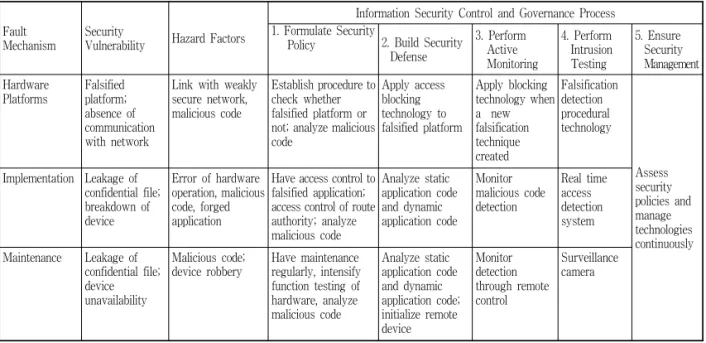
Each system on computer has more than 200 hardware/software systems and IT services. These are applied on banking system and banking serv- ices are processed. Each hardware system has its function and as the function operates, risk factors and vulnerabilities exist certainly. Vulnerabilities of information security in hardware systems occur at hardware platform, hardware operation and hardware maintenance steps as shown in Table 6.

We say that as the role of mobile device is im- portant, information security technologyand policy become inevitable on mobilebanking services [3, 11-12].

3.4 Operating System

Operating system on mobile device is open API, security vulnerabilities are exposed and it supports user connection environment of network. Operat- ing system has the simplest interface between user and device while many steps are progressing through process management, memory manage- ment, device management, and storage manage- ment as shown in Table 7. Security vulnerabilities on operating system can occur at three types as below [11-12,20].

∙ Single-user, single task system: Normally, it al- lows one user each computer

∙ Single-user, multitasking system: It is basic

(7)

Table 4. Information Security Control and Management Process According to Security Vulnerability and Hazard Factors in User Authentication

Fault

Mechanism Security

Vulnerability Hazard Factors

Information Security Control and Governance Process 1. Formulate Security

Policy 2. Build Security

Defense 3. Perform Active Monitoring

4. Perform Intrusion Testing

5. Ensure Security Management ID/PWD ID and PIN No.,

PWD exposure, ID and PWD hacking, and uninstalled Active X

PWD same as ID, Cellular Phone No. and Personal Info

ID should not be based on Personal Info; PWD should be set up as mixes of various characters (upper and lower case, no characters);

Inform the level of ID, PWD security

Initialization of local devices, Apply virtual keyboard

Manager check each user’s ID/PWD regularly and check security

IP detection system, Firewalls

Assess security policies and manage technologies continuously

Security

Card Leakage, robbery and loss of security card, leakage of security card image file, uninstalled Active X

Numbers of security card, security card image file

Create security card regularly and renew algorithm, Not use security card for a long time

Develop intensified OTP technologies, Use not fixed security card numbers

Inform user of security card renewal regularly; Check security regularly

Block off , initialize transactions when using for a long time, IP detection system, firewalls

Assess security policies and manage technologies continuously

OTP (One Time

PWD)

OTP hacking, limit of OTP usage number, algorithm that makes OTP manipulation, uninstalled Active X

OTP token and

key Complement

algorithm which makes OTP regularly

Take notice the management of OTP generator

Manager creates OTP regularly, establish management policies, Check security regularly

IP detection system, Firewalls

Assess OTP security policies and manage technologies continuously

Accredited

Certificate Leakage of certificate, robbery and loss of certificate, uninstalled Active X

Personal

information Oblige certificate issue, renew certificate regularly, increase security key size to 2048 byte

Institute complemented hardware Security Module, use intensified key algorithm

Manager checks each user’s certificate regularly, check security, renew certificate regularly

IP detection system, Firewalls

Assess accredited certificate security policies and manage technologies continuously Biometrics

(finger prints, iris,

face, and voice)

If it is leaked, it is impossible to restore, uninstalled Active X

Impossibility of accurate recognition, inaccurate matching threshold value

Not share means of

authentication Authenticate with dual factors using various parts of body

Control physical access through biometrics, encrypt information of biometrics

IP detection system, Firewalls

Assess biometrics security policies and manage technologies continuously

form, one user can perform many tasks

∙ Multi-user, multitasking system: Operating system manages requests of many users, a number of security controls are operating not to affect other users

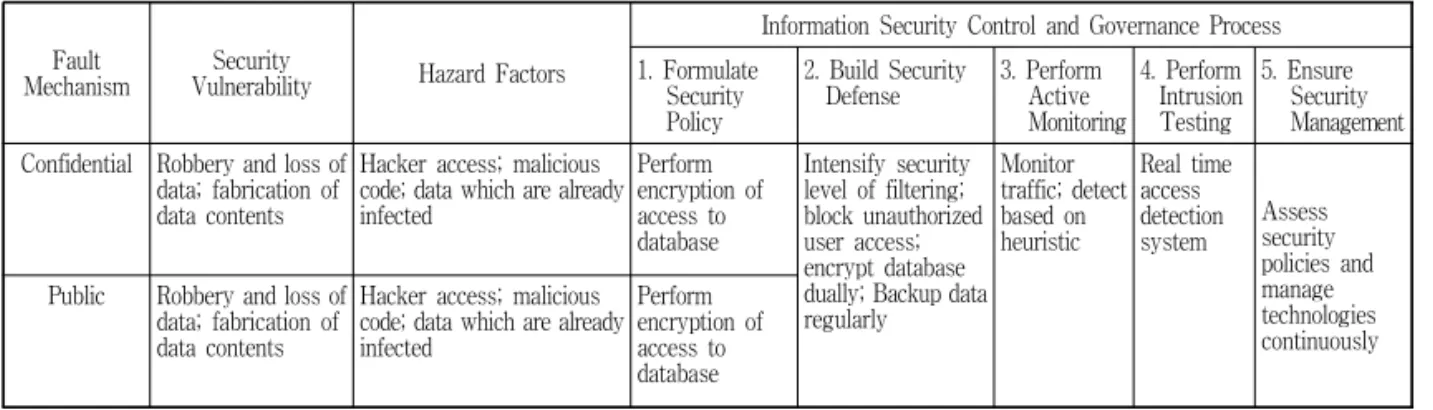
3.5 Data Classification

Data classification is one of the control methods which protect confidentiality of information.

Regardless of classification, all classification in- tegrity and accuracy should be protected. Infor- mation can be categorized confidential information

and public information as shown in Table 8.

Confidential information has data which are very

important or sensitive to handle. For example, per-

sonal information, system access information, file

encrypted key file etc. Next, the other information

is public information. Advantage of data classi-

fication is that risk management is easier and it

is possible to shorten time which user accesses

data. Therefore, although procedure of data classi-

fication is very complicated and takes a long time,

it is very important task for information security

on banking services [3,11,21].

(8)

Table 5. Information Security Control and Management Process According to Security Vulnerability and Hazard Factors in Access Control

Fault

Mechanism Security

Vulnerability Hazard Factors

Information Security Control and Governance Process 1. Formulate

Security Policy 2. Build Security Defense

3. Perform Active Monitoring

4. Perform Intrusion Testing

5. Ensure Security Management Operating

System Robbery of file records about customers;

intrusion from open API environment

Open API, information of rigged mobile OS log, malicious code

Prohibit from reading other user file; prohibit from using other user memory; prohibit from using other user device

Build trusted computing technology; isolate process; authorize file system

Encrypt file system;

operate security sand box system;

operate remote control

Code signature;

rehearse simulation hacking scenario; IP detection system;

Firewalls

Assess security policies and manage technologies continuously Middleware Hacking of file

managing database; intrusion

Attempts of each system log-on

Only authorized

user can access Build dual computing technology;

authorize access of DB

Encrypt database system, operate remote control

IP detection system

Hardware Error of mobile device operation;

unawareness of instructions, robbery, loss of devices

Malicious code

and malware Set up the encrypted pattern;

password on device;

Finger-prints and voice

authentication

Intensify physical access control technologies

Encrypt mobile

devices Surveillance camera, X-ray inspection

Table 6. Information Security Control and Management Process According to Security Vulnerability and Hazard Factors in Hardware Systems

Fault

Mechanism Security

Vulnerability Hazard Factors

Information Security Control and Governance Process 1. Formulate Security

Policy 2. Build Security Defense

3. Perform Active Monitoring

4. Perform Intrusion Testing

5. Ensure Security Management Hardware

Platforms Falsified platform;

absence of communication with network

Link with weakly secure network, malicious code

Establish procedure to check whether falsified platform or not; analyze malicious code

Apply access blocking technology to falsified platform

Apply blocking technology when a new falsification technique created

Falsification detection procedural technology

Assess security policies and manage technologies continuously Implementation Leakage of

confidential file;

breakdown of device

Error of hardware operation, malicious code, forged application

Have access control to falsified application;

access control of route authority; analyze malicious code

Analyze static application code and dynamic application code

Monitor malicious code detection

Real time access detection system

Maintenance Leakage of confidential file;

device unavailability

Malicious code;

device robbery Have maintenance regularly, intensify function testing of hardware, analyze malicious code

Analyze static application code and dynamic application code;

initialize remote device

Monitor detection through remote control

Surveillance camera

3.6 Virus Detection and Control

Recently more and more malicious virus and malicious software affect information security system, they are threatening security system as form of them are diversifying. Malicious software means software which interrupts user’s work and

damages system after being installed on computer or mobile devices. They have damages from simple advertisement pop-ups to system intrusion. Types of malicious software are virus, adware, spyware, Trojan horse, spam, phishing, pharming, and so on.

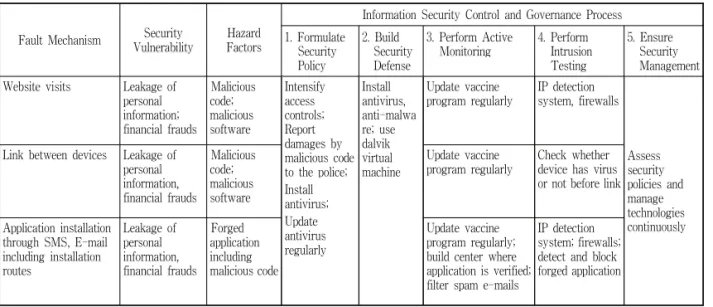
And intrusion routes are website visits, downloads

(9)

Table 7. Information Security Control and Management Process According to Security Vulnerability and Hazard Factors in Operating System

Fault

Mechanism Security

Vulnerability Hazard Factors

Information Security Control and Governance Process 1. Formulate

Security Policy 2. Build Security

Defense 3. Perform Active

Monitoring 4. Perform Intrusion Testing

5. Ensure Security Management Processor

Management Authority threat by sharing with user ID;

unseen process performance;

malfunction of process function

OS log information;

browser history

Prohibit other user from reading file, using memory; and using device

Authorize file system, isolate process; allow to eliminate potential risk factors

Operate security sand box system;

encrypt file system; authorize route

Real time access detection system

Assess security policies and manage technologies continuously Memory

Management unseen process performance;

malfunction of process function

OS log information;

browser history

Prohibit other user from using memory

Build virtual memory technology;

encrypt file system

Operate security sand box system;

encrypt file system

Real time access detection system

Device

Management Falsified platform, leakage of confidential file;

unavailability of device

Robbery and loss of devices;

malicious code;

forged application

Prohibit other user

from using device Protect key Chain

data; remote wipe Provide API of managing device by OS; encrypt file using SHA-1 and hash function

Surveillance camera

Storage

Management Leakage of confidential file; disc space hacking

OS log information;

browser history

Prohibit other user from reading file;

prohibit other user from using memory

Encrypt disc

access Operate security sand box system;

encrypt disc access

Real time access detection system

Table 8. Information Security Control and Management Process According to Security Vulnerability and Hazard Factors in Data Classification

Fault

Mechanism Security

Vulnerability Hazard Factors

Information Security Control and Governance Process 1. Formulate

Security Policy

2. Build Security

Defense 3. Perform Active Monitoring

4. Perform Intrusion Testing

5. Ensure Security Management Confidential Robbery and loss of

data; fabrication of data contents

Hacker access; malicious code; data which are already infected

Perform encryption of access to database

Intensify security level of filtering;

block unauthorized user access;

encrypt database dually; Backup data regularly

Monitor traffic; detect based on heuristic

Real time access detection system Assess

security policies and manage technologies continuously Public Robbery and loss of

data; fabrication of data contents

Hacker access; malicious code; data which are already infected

Perform encryption of access to database

and installation of software, link with network as shown in Table 9. Through these routes, they de- ceive users, and then extract personal information and these routes are more diversifying. Financial institutions are extremely interested in information security, nowadays solutions of eliminating risk factors are released and interests about these sol- utions are rising gradually [3,7,11,13].

3.7 Database

Database is a storage area of all data; also it is

one of the main systems which operate control for

data security. Factors which affect database are

access of unauthorized user, excess of user access,

wrong system design and SQL performance and

vulnerability of protocol. It is highly interested in

database and database security because database

in banking system handles sensitive, massive in-

formation as shown in Table 10. If database in-

(10)

Table 9. Information Security Control and Management Process According to Security Vulnerability and Hazard Factors in Virus Detection and Control

Fault Mechanism Security

Vulnerability Hazard Factors

Information Security Control and Governance Process 1. Formulate

Security Policy

2. Build Security Defense

3. Perform Active

Monitoring 4. Perform Intrusion Testing

5. Ensure Security Management Website visits Leakage of

personal information;

financial frauds

Malicious code;

malicious software

Intensify access controls;

Report damages by malicious code to the police;

Install antivirus;

Update antivirus regularly

Install antivirus, anti-malwa re; use dalvik virtual machine

Update vaccine

program regularly IP detection system, firewalls

Assess security policies and manage technologies continuously Link between devices Leakage of

personal information, financial frauds

Malicious code;

malicious software

Update vaccine

program regularly Check whether device has virus or not before link

Application installation through SMS, E-mail including installation routes

Leakage of personal information, financial frauds

Forged application including malicious code

Update vaccine program regularly;

build center where application is verified;

filter spam e-mails

IP detection system; firewalls;

detect and block forged application

Table 10. Information Security Control and Management Process According to Security Vulnerability and Hazard Factors in Database

Fault

Mechanism Security Vulnerability Hazard Factors

Information Security Control and Governance Process 1. Formulate Security

Policy

2. Build Security Defense

3. Perform Active Monitoring

4. Perform Intrusion Testing

5. Ensure Security Management Plan database Data leakage, violation

of laws of personal information protection;

spread a database security policy

False designed policies and disciplines

Define database security rules; compose organization of database security

Control access authority of database security policy and guidelines

Operate audit monitoring of internal security

Trace the collected data route and detect whether it has malicious code or not

Assess database security policies and manage technologies continuously Design

database Data leakage, violation of laws of personal information protection;

spread a database security design policy

False designed policies and disciplines

Define access control rules; define encryption key and algorithm;

design simulated hacking scenario

Control access authority of database security policy and guidelines

Operate audit monitoring of internal security

Trace the collected data route and detect whether it has malicious code or not Build database Data leakage, inflow of

malicious code, DBMS source code leakage;

Not implementation of examining

environment which embodies database

Unauthorized access, false cipher text

Build environment which embodies database; examine and complement environment which embodies database;

perform the test which applies simulated hacking;

Approve database tasks;

encrypt key;

prevent detour access; delete original data

Operate audit monitoring of internal security

Outside access detection system

Operate and manage database

Inflow of malicious code, leakage of data, exposure of database security vulnerability

Impaired database;

records of failed database services;

unauthorized access

After maintaining, improving and complementing embodied technology factor; making operating reports

Authenticate user; control access of user log; backup database

Monitor operation state and result of technology

Outside access detection system

cludes confidential information which classified by data classification, backup should be performed in

order to prepare for instant changes of system,

network periodically. Now institutions where it

(11)

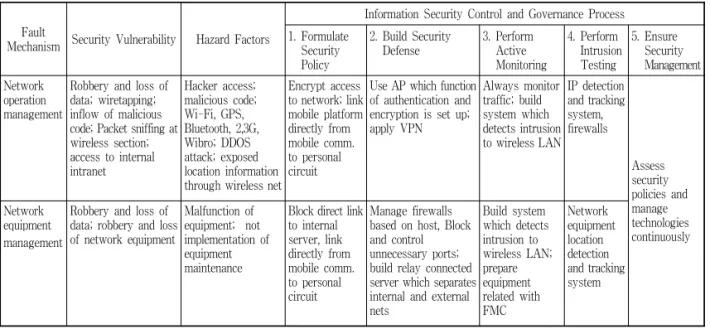
Table 11. Information Security Control and Management Process According to Security Vulnerability and Hazard Factors in Network Systems

Fault

Mechanism Security Vulnerability Hazard Factors

Information Security Control and Governance Process 1. Formulate

Security Policy

2. Build Security

Defense 3. Perform

Active Monitoring

4. Perform Intrusion Testing

5. Ensure Security Management Network

operation management

Robbery and loss of data; wiretapping;

inflow of malicious code; Packet sniffing at wireless section;

access to internal intranet

Hacker access;

malicious code;

Wi-Fi, GPS, Bluetooth, 2,3G, Wibro; DDOS attack; exposed location information through wireless net

Encrypt access to network; link mobile platform directly from mobile comm.

to personal circuit

Use AP which function of authentication and encryption is set up;

apply VPN

Always monitor traffic; build system which detects intrusion to wireless LAN

IP detection and tracking system, firewalls

Assess security policies and manage technologies continuously Network

equipment management

Robbery and loss of data; robbery and loss of network equipment

Malfunction of equipment; not implementation of equipment maintenance

Block direct link to internal server, link directly from mobile comm.

to personal circuit

Manage firewalls based on host, Block and control unnecessary ports;

build relay connected server which separates internal and external nets

Build system which detects intrusion to wireless LAN;

prepare equipment related with FMC

Network equipment location detection and tracking system handles personal information should oblige en-

cryption of personal information and when they can save the data into local network of banking system, all data can be handled safely only if data meet standards of data encryption and various degree of risk analysis. However, if financial institutions where they deem speed as important encrypt, quantity of data will be increased greatly, perform- ance of server will deteriorate and cost will increase. Also financial institutions could not find perfect solution until now, therefore it is essential to prepare a countermeasure about this problem [3, 11,22].

3.8 Network Systems

For using banking services, network systems became inevitable and it offers a lot of con- veniences to users by providing network access environment. But while interest about network se- curity is steadily increasing, threats are also in- creasing sharply. It is essential to build secure net- work between internet and user in banking in- formation security. Here, network is all devices which block intrusion signal, allow remote access, block and prevent possible attacks.

Every personal information should be trans- mitted with encryption through network and should not be exposed to outside by decrypting to plain text while transmitting as shown in Table 11.

Now financial institutions are using a lot of cipher- ing algorithms and hash functions in order to transmit data securely applying cipher technology at communication section [3,12,23].

3.9 Backup Restoration

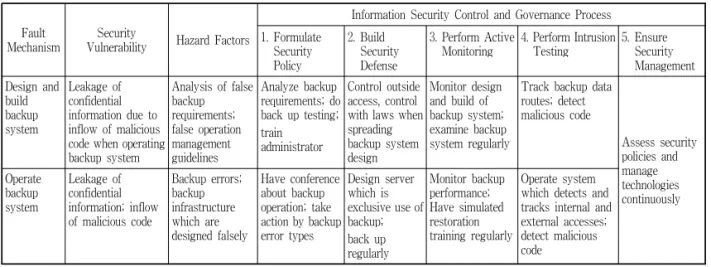
It is very important to back up in advance in order to prepare for system failure and disaster in banking system. Recently after ‘3.20 Cyber Terror’, financial institutions have greatly emphasis on ur- gency and necessity of backup restoration system.

Backup system means all hardware, software and infrastructure systems for backing up, moreover its types and components are a lot [3,7,24-25].

Information security control and management process according to security vulnerability and hazard factors in backup restoration is shown in Table 12.

Now financial institutions build more than 300

virtual servers and dispersed 3,500 business use PC

enterprise backup restoration systems at more than

(12)

Table 12. Information Security Control and Management Process According to Security Vulnerability and Hazard Factors in Backup Restoration

Fault

Mechanism Security

Vulnerability Hazard Factors

Information Security Control and Governance Process 1. Formulate

Security Policy

2. Build Security Defense

3. Perform Active

Monitoring 4. Perform Intrusion Testing 5. Ensure

Security Management Design and

build backup system

Leakage of confidential information due to inflow of malicious code when operating backup system

Analysis of false backup requirements;

false operation management guidelines

Analyze backup requirements; do back up testing;

train administrator

Control outside access, control with laws when spreading backup system design

Monitor design and build of backup system;

examine backup system regularly

Track backup data routes; detect malicious code

Assess security policies and manage technologies continuously Operate

backup system

Leakage of confidential information; inflow of malicious code

Backup errors;

backup infrastructure which are designed falsely

Have conference about backup operation; take action by backup error types

Design server which is exclusive use of backup;

back up regularly

Monitor backup performance;

Have simulated restoration training regularly

Operate system which detects and tracks internal and external accesses;

detect malicious code

200 branches all over the country. By doing this, they can improve stability, operational easiness, security of personal information for future banking systems. Based on analysis of risk factors and vul- nerabilities through 9 departmentalization of each mechanism in mobile banking systems, we propose practical processes for information security control and management in mobile banking systems as above Tables 4-12 and visualize these processes as shown in Fig. 5.

Fig. 5. Information Security Control and Management Process on Mobile Banking System.

4. CONCLUSIONS

Recently the use of mobile banking services is more and more increasing depending on the devel- opment of mobile devices and technologies.

However, risk factors which intrude banking sys- tem are developed, expanded and they are threat- ening users gradually. Because users who use banking services want to get services securely, want their personal information to be protected safely anywhere and anytime with convenience, interests about information security are increasing steadily.

In this paper, we specifically find factors which threaten mobile banking security through the anal- ysis of risk factors of mobile banking security by functions of banking services which information security should be applied and security vulner- abilities caused by these risk factor, the infor- mation security control and management process.

With these, we can analyze problems and vulner- abilities of current mobile banking system. Also by analyzing risk factors and making the information security control and management process for man- aging, controlling mobile banking security system, we can find all causes of system defect occurrence easily and prepare a strong countermeasure about security threats and intruding factors.

Hence in this paper, we propose some important

points which should be secured in mobile banking

services. In the future, main task is to improve in-

frastructure security technologies of mobile bank-

ing systems. This means that we should build in-

(13)

tegration test and verify the security of mobile de- vices by mobile devices, platforms before develop- ing applications. Next, we need a security- strengthened system in wireless LAN such as net- work intrusion detection or building a responding system for acquiring safety of wireless network.

At the operational management side, operating se- curity conference among security companies, mo- bile device manufacturing companies and tele- communication companies should be revitalized in order to build a well-organized security manage- ment system.

Lastly, it is greatly important to develop new se- curity control and management methods which se- curity protection level is advanced by researching and analyzing threatening factors and vulner- abilities of mobile banking security systems through risk analysis and fault analysis, also con- tinuous control and management about current se- curity services and technologies.

REFERENCES

[ 1 ] H. Y. Min, J. H. Park, D. H. Lee, and I.S. Kim,

“Outlier Detection Method for Mobile Banking with User Input Pattern and E-finance Tran- saction Pattern,” Journal of Internet Comput- ing and Services, Vol. 15, No. 1, pp. 157-170, 2014.

[ 2 ] J. S. Seong, “A Study on the Prevention of Security Incident,” Journal of Security Eng- ineering, Vol. 9, No. 6, pp. 503-510, 2012.

[ 3 ] Certified Information System Banker-Rules and Syllabus (2007), Indian Institute of Bank- ing and Finance, http://www.iibf.org.in/docu- ments/ceisb-module1.pdf (accessed on Nov., 20, 2014).

[ 4 ] K. Biri and G. M. Trenta, Corporate Information Security Governance in Swiss Private Banking, Master’s Thesis of Executive MBA Program of the University of Zürich, 2004.

[ 5 ] J. Nie and X. Hu, “Mobile Banking Informa-

tion Security and Protection Methods,”

Proceeding 2008 International Conference on Computer Science and Software Engineering, pp. 587-590, 2008.

[ 6 ] H. G. Shin, “Year 2013 Predictive Analysis of Information Security Trends in Banking IT,”

J ournal of Payment Settlement and IT, Korea Financial Telecommunications and Clearings Institute, Vol. 51, pp. 581-86, 2013.

[ 7 ] H. G. Shin, “Year 2014 Predictive Analysis of Information Security Trends in Banking IT,”

Journal of Payment Settlement and IT, Korea Financial Telecommunications and Clearings Institute, Vol. 55, pp. 90-126, 2014.

[ 8 ] Security of Mobile Banking and Payments, http://www.sans.org/reading-room/white- papers/ecommerce/security- mobile-bank- ing-payments-34062 (accessed on Oct., 24, 2014).

[ 9 ] K. H. Lee and Y. Y. Kim, “The State of Mobile Banking Service in Domestic Banks,” Journal of Information and Communication Policy, Korea Information Society Development Institute, Vol. 14, No. 18, pp. 2-15, 2002.

[10] C. S. Park, “The Policy Direction of Smart Security,” J ournal of the Telecommunication Technology Association, Vol. 133, pp. 23-27, 2011.

[11] M. H. Kim, W. Toyib, and M.G. Park, “An Integrative Method of FTA and FMEA for Software Security Analysis of a Smart Phone,” Korean Information Processing Society Transactions on Computer and Communication Systems, Vol. 2, No. 12, pp.

541-552, 2013.

[12] B. K. Lee, A Research on Discovering New Vulnerabilities and Analyzing Methods in Domestic Mobile Environment, KISA-WP- 2012-0009, Research Report of the Korea Internet & Security Agency, 2012.

[13] J. C. Ryu, A Study of Malware Detection

Based on Mobile OS, KISA-WP-2010-0057,

(14)

Research Report of the Korea Internet &

Security Agency, 2010.

[14] S. W. Na, Y. H. Lee, and S. J. Ji, Security Issue and Counterstrategies of Smartphone and Mobile Office, CIO Report of National Information Society Agency, 2010.

[15] K. Streff and J. Haar, “An Examination of Information Security in Mobile Banking Architectures,” Journal of Information Sys- tems Applied Research, Vol. 2, No. 2, pp. 1- 16, 2009.

[16] J. H. Lee, “Usage and Problems of Authenti- cation Certificate on Smart Environment,”

J ournal of Internet and Security Focus, Korea Internet and Security Agency, Vol. 3, pp. 23- 53, 2013.

[17] H. R. Yeom, A Research on Security Criteria for Extension to Electronic Authentication Method Usage-Based, KISA-WP-2011-0019, Research Report of the Korea Internet &

Security Agency, 2011.

[18] S. M. Jang and M. G. Park, “A Study on the Fault Analysis and Security Assessment for Smart Card Management System,” Journal of Korea Multimedia Society, Vol. 17, No. 1, pp.

52-59, 2014.

[19] R. J. Anderson, Security Engineering: A

Guide to Building Dependable Distributed Systems, 2

nd

Edition, Wiley Publishing, India- napolis, Indiana, 2008.

[20] A. Silberschatz, P. B. Galvin, and G. Gagne, Operating System Concepts, 7th Edition, John Wiley and Sons, Inc., Hoboken, New Jersey, 2005.

[21] Data Classification of Information Security Glossary (2014), RUsecure™ Security Policy World, http://www.yourwindow.to/informa- tion-security/gl_dataclassification.htm (acc- essed on November 12, 2014).

[22] Database Security of Enterprise Risk Mana- gement (2010), http://www.emrisk.com/sites/

default/files/newsletters/ERMNewsletter_

March_2010.pdf (accessed on Nov., 12, 2014).

[23] Securing the Network Perimeter of a Com- munity Bank, http://www.sans.org/reading- room/ whitepapers/firewalls/securing-net- work-perimeter-community-bank-33248 (accessed on November 12, 2014).

[24] W .C. Preston, Executive Brief on VMware Backup and Recovery: Challenges and Solu- tions, VMware® Partner, 2011.

[25] W. C. Preston, Backup Hardware, Backup &

Recovery, O’Reilly®, Canada, 2007.

(15)

So Young Kim

She graduated with the B.E. in IT Convergence & Application Engineering at the Pukyong National University, Rep. of Korea in 2014.

She is a research member of the Software Engineering and Mul- timedia Information Systems Lab. as well as a master degree student of the Dept. of Information Systems, Graduate School, Pukyong National University, Rep.

of Korea.

Her research interests are in Software Security, Software Safety, and Big Data Analysis Methods.

Myong-Hee Kim

She graduated with the B.E. in Information Communication Eng- ineering at the Dongseo Univer- sity, and received M.S. degree in Computer Science and Ph. D. in Information Systems from the Pukyong National University, Busan, Rep. of Korea. She was a Post Doctoral Re- searcher at the University of Colorado-Denver, USA.

She is a lecturer of the Department of Information Systems, Graduate School, Pukyong National Univer- sity. Also she was a lecturer of the Department of Computer Science and Engineering at the University of Colorado-Denver, USA. She served as an Assistant Faculty Consultant and a professional specialist in Information Communication Technology and Web- Based Multimedia Ttechnologies for CPSC which is an Inter-Governmental International Organization for Human Resources Development in Asia and the Pacific Region.

Man-Gon Park

He is a head professor of the Dept. of IT Convergence and Application Engineering, Col- lege of Engineering, Pukyong National University, Republic of Korea since 1981. Also he was the president and chairman of the Korea Multimedia Society (KMMS). He served as the Director General and CEO of the Colombo Plan Staff College for Technician Education (CPSC) from 2002 to 2007, which is an intergovernmental interna- tional organization of 29 member governments for Human Resources Development in Asia and the Pacific Region. He has been the visiting professor at the Department of Computer Science, University of Liverpool, UK; exchange professor at the Department of Electrical and Computer Engineering, University of Kansas, USA; and visiting scholar at the School of Computers and information science, University of South Australia; visiting professor at the Department of Computer Science and Engineering, University of Colorado, Denver, USA.

He was dispatched to Mongolia and People’s Rep. of

China by KOICA on various projects as information

systems consultant. He has also embarked on consult-

ing works and conducted training programs in ICT on

individual capacity for Korean groups of companies,

governmental and non-governmental agencies and

other institutions in Korea. His main areas of research

are software reliability engineering, software safety

and security engineering, business process reengin-

eering, Internet and web technology, multimedia in-

formation processing technology, and ICT-based hu-

man resources development

수치

Table 1. The Trends of Clients Enrolled on Mobile Banking Services  (Unit: 1,000)
Fig. 2. Configuration Chart of Mobile Banking System
Fig. 4 shows that the number of malicious software which is risk factors in android operating system in 2012 are increasing sharply than in 2011
Table 3. Security Threats Factors in Mobile Banking ([10-15])
+7

참조

관련 문서

The study derived the problems according to results of field-centered synthetic analysis on yellow croakers of fishery system currently used in Chujado, Korea

In this study, we propose a reliability demonstration test plan based on the accelerated random-effects Wiener process model.. First, we present a motivating

and Gold, F.(1985), Bank Branch Operating Efficiency: Evaluation with Data Envelopment Analysis, Journal of Banking and Finance , Vol.. F.(1992), Quantifying Management Role

The preceding sections have demonstrated analysis and solutions of some security problems in virtualization system: 1) For isolation of security perception units, an

– CP인 경우 ABCP, 출자증권인 경우 ABS출자증권, 수익증권인 경우 ABS수익증권 – 기초자산이 저당채권인 경우 MBS(mortgage-backed securities).. •

Computer security; distributed control systems (DCS); industrial control systems (ICS); information security; network security; programmable logic controllers

The security, integrity, and reliability of financial information relies on proper access controls, change management, and operational controls.. The importance and

Special Report on Climate Change, Desertification, Land Degradation, Sustainable Land Management, Food Security, and Greenhouse Gas Fluxes in Terrestrial