1. 서 론
미세조류의 산업적 이용분야는 건강식품, 의 약식품, 양식사료 등으로 다양하며, 최근에는 차 세대 바이오매스로써 바이오디젤, 바이오플라스 틱 생산 등 활용범위를 넓혀가고 있다(Rossler, 1990; Chisti, 2007; Aaronson and Dubinsky, 1982). 또한 기존 활성슬러지 공법의 문제점인 슬 러지 처리, 부영양화 발생 등의 문제점을 개선하 기 위한 대책으로 미세조류를 이용한 하수처리공
법이 시도되고 있다.(Kang et al., 2012; Abreu et al., 2012)
현재 하수처리를 위해 사용되는 대부분의 미 세조류는 광합성을 하고, CO2를 고정하여 성장 하는 autotrophic 미세조류이다. 그러나 미세조 류는 종 특성에 따라 autotrophic 조건뿐 아니 라 heterotrophic과 mixotrophic 조건에서도 성장이 가능하다(Andrade and Costa, 2007).
그 중에서도 mixotrophic 미세조류는 식(1)과 같 이 유기탄소와 무기탄소를 동시에 흡수하여 au- totrophic과 heterotrophic이 복합된 형태의 대 사과정을 한다(Chojnacka et al., 2004). 또한 mixotrophic 미세조류는 autotrophic 미세조류
•Received 18 December 2012, revised 4 February 2013, accepted 8 February 2013.
* Corresponding author: Tel:+82-31-201-2497, Fax: +82-31-203-4589, E-mail: [email protected]
Effects of pH and aeration rates on removal of organic matter and nutrients using mixotrophic microalgae
Mixotrophic 미세조류를 이용한 유기물 및 영양염류 제거에 미치는 pH 및 폭기의 영향
Sunjin Kim·Yunhee Lee·Sun-Jin Hwang
*
김선진·이윤희·황선진*
Department of Environmental Science and Engineering, Center for Environmental Studies, Kyung Hee University
경희대학교 공과대학 환경공학과·환경연구센터
Abstract : Specific growth rate and removal rate of nitrogen and phosphorus of Chlorella sorokiniana, Chlorella vulgaris, Senedesmus dimorphus those are able to metabolite mixotrophically and have high nitrogen and phosphorus removal capacity were examined. Based on the results, one microalgae was selected and conducted experiments to identify the operating factors such as pH and aeration rate. The specific growth rate and phosphorus removal rate of C. sorokiniana significantly presented as 0.29 day
-1and 1.65 mg-P/L/day, while the nitrogen removal rate was high as 12.7 mg-N/L with C. vulgaris. C. sorokiniana was chosen for appropriate microalgae to applying for wastewater treatment system and was cultured in pH ranged 3 to 11. High specific growth rate and removal rate of nitrogen and phosphorus were shown at pH 7 as 0.71 day
-1, 7.61 mg-N/L/day, and 1.24 mg-P/L/day, respectively. The specific growth rate examined with aeration rate between 0 and 2 vvm (vol/vol-min) highly presented as 1.2 day
-1with 1.5 ~ 2 vvm, while the nitrogen removal rate was elevated with 0.5 vvm as 9.43 mg-N/L/day.
Key words : Aeration rate, Advanced wastewater treatment, Chlorella sorokiniana, Mixotrophic microalgae, pH
주제어 : 폭기량, 하폐수고도처리, 클로렐라 소로키니아나, 혼합영양미세조류, 수소이온농도,
소, 인 제거에 효과적이다(Wang et al., 2012).
그러나 아직까지 mixotrophic 미세조류의 대사 특성 및 하폐수고도처리 적용에 관한 연구는 미 비한 실정이다.
bHCO3+cCH2O → (b+(c-a))C(biomass) + 3OH-+aCO2 식(1)
Mixotrophic 미세조류 성장에 영향을 미치는 주요인자로는 유기탄소, 무기탄소 그리고 빛이 며, 그 외에도 pH, 온도, 폭기량 등이 성장에 영 향을 미친다(Park et al., 2010).
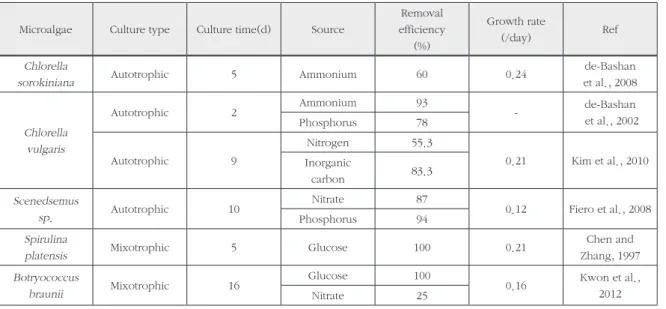
Mixotrophic으로 대사가 가능한 미세조류에는 Chlorella sp., Scenedemus sp., Spirulina sp., Botrycococcus braunii 등이 있으며, 이 들 종의 질소, 인 및 유기물 제거능을 Table 1에 나타냈다. 이를 바탕으로 본 연구에서는 mix- otrophic 대사가 가능한 미세조류 중에서 질소, 인 제거능이 우수한 C. sorokiniana, S. di- morphus, C. vulgaris를 대상 미세조류로 선 정했다. 선정된 3종의 미세조류에 대한 기본특 성 및 적용분야는 다음과 같다. C. sorokiniana 는 직경 2 ∼ 10 μm 크기의 구형으로, 지질함
폐수처리보다는 바이오연료 생산에 관한 연구 가 많이 진행되고 있다(Mata et al., 2010). C.
vulgaris 역시 직경 2 ∼ 10 μm의 구형으로 지질함량은 5 ∼ 58 %(dry weight biomass) 로 건강보조식품과 의약원료물질, 화장품 원료 등의 산업적 이용률이 높다(Maruyama et al., 1989; Endo et al., 1977). S. dimorphus의 경 우 10 ∼ 20 μm의 크기로 2, 4, 8, 또는 16개 의 단세포가 나란히 연결된 형태를 띠며 지질함 량이 19.6 ∼ 21.1 %(dry weight biomass)로 높아 바이오연료의 원료물질로써 이용되고 있다 (Pickett-Heaps, 1975; Mata et al., 2010).
본 연구에서는 미세조류를 이용한 하폐수고 도처리를 위해 mixotrophic으로 성장이 가능한 미세조류 문헌연구를 통해 선정하고, 선정된 미 세조류의 운전인자 파악을 위해 pH와 폭기량에 따른 성장특성 및 유기물, 질소, 인 제거능을 평 가하였다.
2. 실험방법
2.1 미세조류 배양
미세조류 중에서 mixotrophic으로 대사가 가
Microalgae Culture type Culture time(d) Source
Removal efficiency
(%)
Growth rate
(/day) Ref
Chlorella
sorokiniana Autotrophic 5 Ammonium 60 0.24 de-Bashan
et al., 2008
Chlorella vulgaris
Autotrophic 2 Ammonium 93
- de-Bashan
et al., 2002
Phosphorus 78
Autotrophic 9
Nitrogen 55.3
0.21 Kim et al., 2010 Inorganic
carbon 83.3
Scenedsemus
sp. Autotrophic 10 Nitrate 87
0.12 Fiero et al., 2008
Phosphorus 94
Spirulina
platensis Mixotrophic 5 Glucose 100 0.21 Chen and
Zhang, 1997 Botryococcus
braunii Mixotrophic 16 Glucose 100
0.16 Kwon et al., Nitrate 25 2012
Table 1. Literature review about wastewater treatment using microalgae
능하고, 질소, 인 제거능이 높은 Chlorella so- rokiniana, Chlorella vulgaris, Scenedemus dimorphus를 선정했다.
C. sorokiniana(AG20740), C. vulgaris(AG 10194)는 국내 생명자원센터에서 분양받았고, S. dimorphus는 한국해양연구원에서 분양받 아 BG11배지에서 지속적으로 계대 배양했다. 이 때 배지는 120 ℃에서 20분간 멸균한 후 사용 했다.
1 L 삼각플라스크에 working volume을 600 mL로 실험을 진행했고, 무기탄소원으로 NaH- CO3를 0.5 g-C/L, 유기탄소원으로 글루코즈를 0.5 g-C/L 주입했으며, 질소는 NaNO3를 40 mg-N/L, 인은 K2HPO4를 5 mg-P/L 주입해 주었다. 초기 미세조류 접종농도는 150 mg/L, 반응기 교반속도는 140 rpm, 온도는 25 ℃ 그 리고 광도는 100 μmol/m2/sec로 24시간 조사 해주었으며, pH는 24시간마다 7로 조절하여 batch test로 6일간 실험했다.
2.2 운전인자 파악을 위한 실험조건
무기탄소원으로 NaHCO3를 1 g-C/L, 유기 탄소원으로 글루코즈를 1 g-C/L 주입해주었으 며, 질소는 NaNO3로 40 mg-N/L, 인은 K2H- PO4로 5 mg-P/L를 설정해주었다. 광도 및 교 반속도는 미세조류 배양시와 동일한 조건으로 운전했다.
2.2.1 수소이온농도 (pH)
적정 pH 파악을 위해 HCl과 NaOH를 이용하 여 pH를 3, 5, 7, 9, 11로 달리하여 batch test 로 4일간 실험을 진행했다. 이때 반응기 교반속 도 140 rpm으로 교반했으며, pH는 48시간 동 안은 12시간마다 48시간 이후에는 24시간마다 조절해주었다.
2.2.2 폭기량 (Aeration rate)
적정 폭기량 파악을 위해 산기석이 장착된 air pump를 이용하여 유량을 0, 0.5, 1, 1.5, 2 vvm(vol/vol·min)으로 설정하여 pH 실험과 동일하게 batch test로 4일간 실험을 진행했다.
폭기량 실험시 교반은 해주지 않고, 폭기만 해주 었다. pH는 48시간 동안은 12시간마다 48시간 이후에는 24시간마다 HCl과 NaOH를 이용하여 7로 조절해주었다.
2.3 분석방법
미세조류 성장량 측정을 위해 10 mL의 샘플 을 0.47 μm GF-C filter에 여과한 후, 여과 된 여지를 105 ℃에서 2시간 건조하여 측정한 건조무게로부터 계산하여 도출했다. 글루코즈는 DNS법으로 UV spectrometer(HS3300, Hu- mas Co.)를 이용하여 575 nm에서 분석했고, 질소와 인은 수질분석 Kit법을 이용하여 water analyzer(model HS-3300, HUMAS Inc.)로 분석했다.
미세조류의 비증식속도(Specific growth rate, μ)는 식(2)를 이용하여 계산했다(권 등, 2012)
μ=In(X-X0)/(t-t0) 식(2)
여기서, X는 t(day)시간의 미세조류 건조중 량이고, X0는 t0(day)시간의 미세조류 건조중량 이다. 식(2)를 이용하여 계산된 최대 비증식속도 는 대수성장기의 비증식 속도 값 중 가장 큰 값 을 이용했다.
3. 결과 및 고찰
3.1 하폐수고도처리에 적합한 mixotrophic 미세 조류 선정
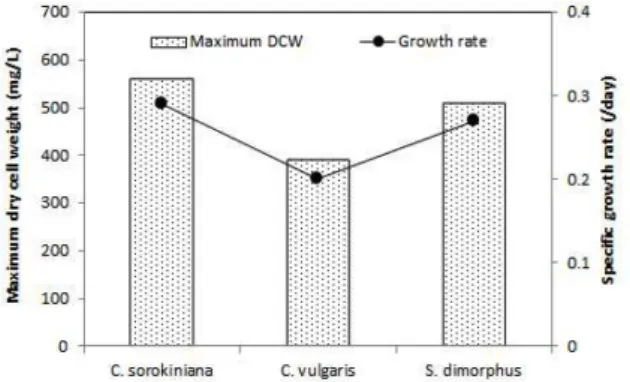
C. sorokiniana, C. vulgaris, S. dimor- phus를 동일한 조건에서 배양했을 때 최대 성 장량 및 비성장률을 Fig. 1에 나타냈다. 최대 성
garis가 390 mg/L, S. dimorphus가 510 mg/
L로 나타났으며, 비성장률은 C. sorokiniana 가 0.29 day-1, C. vulgaris가 0.21 day-1, S.
dimorphus가 0.27 day-1로 C. sorokiniana가 가장 높게 나타났다. 글루코즈와 질소, 인은 미 세조류 종에 관계없이 100 % 제거율을 나타냈으 나, Table 2에서와 같이 유기물과 질소, 인의 제 거속도는 다소 차이를 나타냈다. 글루코즈와 인 제거속도는 각각 0.56 g/L/d, 1.65 mg-P/L/d 로 C. sorokiniana가 가장 높았으며, 질소 제거 속도는 C. vulgaris가 12.7 mg-N/L/d로 가장 높게 나타났다. 따라서 하폐수고도처리 적용을 위해 성장률 및 유기물과 인 제거능이 우수한 C.
sorokiniana를 선정하여 하폐수고도처리 적용 시 운전인자 파악을 위한 실험을 진행했다.
3.2.1 수소이온 농도(pH)
Mixotrophic 조건에서 C. sorokiniana를 초 기 pH 3 ∼ 11의 범위로 운전했을 때 도출된 최 대 성장량과 비성장률을 Fig. 2에 나타냈다. 최 대 성장량은 pH 9에서 1,150 mg/L로 가장 높 은 성장량을 나타냈으며, pH에 따라서는 pH 7 에서 1,025 mg/L, pH 5에서 880 mg/L, pH 11 에서 640 mg/L, pH 3에서 355 mg/L의 최대 성장량을 나타냈다. 비성장률은 pH 5 ∼ 9 범위 에서 약 0.7 day-1로 비슷한 값을 나타냈으며, pH 3과 7에서는 약 0.2 day-1의 낮은 비성장률 을 나타냈다. C. sorokiniana는 pH 7과 9에서 가장 활발한 성장을 보였으며, pH 3의 산성조건 과 pH 11의 알칼리 조건에서는 C. sorokiniana 의 성장이 저조한 것으로 나타났다. Park et al.
(2010)은 pH 6.5 이하의 산성조건과 pH 9.5 이 상의 알칼리 조건에서 Nannochloropsis ocu- lata의 성장이 둔화되었다고 보고했는데, 본 연 구에서 이용한 C. sorokiniana는 pH 5 ∼ 9의 넓은 pH 범위에서 저해 없이 성장이 가능한 것 으로 판단된다.
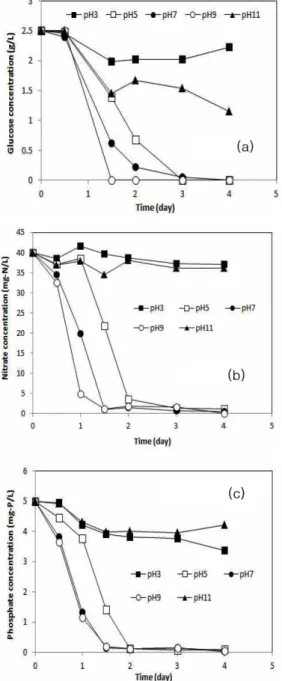
pH에 따른 C. sorokiniana의 글루코즈와 질 소, 인 농도를 Fig. 3에 나타냈다. 글루코즈의 경 우 pH 9에서 1.5일 만에 100 % 제거율을 나타냈 으며, pH 7과 pH 5에서는 3일 만에 100 %로 제 거되었다. pH 11 조건에서 55 %의 제거율을 보
Fig. 1. Maximum dry cell weight and specific growth rate de- pending on microalgae species
Microalgae sp. C. soroki-
niana C. vulgaris S. dimorphus Glucose removal
rate (mg/L/day) 560 410 530
Nitrate removal
rate (mg-N/L/day) 9.65 12.7 9.75
Phosphate removal rate (mg-P/L/day)
1.65 1.20 1.23
Table 2. Removal rates of glucose, nitrogen and phosphorus depending on microalgae species
Fig. 2. Maximum dry cell weight and specific growth rate of C.
sorokiniana by pH in mixotrophic cultivation
였고, pH 3에서는 20 %의 제거율로 제거효율이 낮게 나타났다. 질소와 인의 경우 pH 9와 7에서 1.5일 만에 빠르게 제거되는 것으로 나타났으며, pH 5에서는 이틀 만에 제거되었다.
반면, pH 3과 11에서는 C. sorokiniana의 성 장량 결과와 동일하게 활성 pH 범위를 벗어나 질소와 인이 제거되지 않은 것으로 판단된다.
Table 3은 pH에 따른 C. sorokiniana의 글 루코즈와 질소, 인 제거속도를 산출한 것으로 글루코즈 제거속도는 pH 9에서 0.83 g/L/d로 가장 높았으며, 질소와 인의 경우는 pH 7에서 7.61 mg-N/L/d 및 1.24 mg-N/L/d로 다소 높게 나타났다.
일반적으로 미세조류 배양을 위한 적정 pH 범 위는 7 ∼ 9로 알져져 있으나(Patricke et al., 1996), C. sorokiniana의 경우 pH 5 ∼ 9의 넓 은 범위에서 성장이 가능하며, pH 3 및 11과 같 은 강산성과 강알칼리 조건에서는 C. soroki- niana가 성장하기에 부적합한 것으로 나타났다.
일반적으로 하수처리장의 유입수 pH는 6.5 ∼ 7.5 정도이기 때문에 추후 C. sorokiniana의 하 폐수처리 적용이 가능할 것으로 판단된다.
3.2 폭기량 (Aeration rate)
Fig. 4는 mixotrophic 조건에서 C. soroki- niana 배양시 폭기량에 따른 최대 성장량과 비 성장률을 나타낸 것으로 폭기시가 미폭기시 보 다 2배 이상 높게 나타났다.
폭기량이 0 vvm일 경우 최대 성장량은 295 mg/L로 가장 낮은 성장을 보였으며, 0.5 및 1 vvm에서는 약 650 mg/L, 1.5 및 2 vmm에서 는 약 800 mg/L의 최대 성장량을 나타냈다. 비 성장률 역시 0 vvm에서는 0.2 day-1의 가장 낮 은 성장률을 나타냈고, 0.5 및 1 vvm에서는 약 1 day-1, 1 및 2 vvm에서는 약 1.2 day-1의 비성
Fig. 3. Variation of (a) glucose, (b) nitrate and (c) phosphate con- centration by pH
pH 3 5 7 9 11
Glucose removal
rate (mg/L/day) 100 620 620 830 280
Nitrate removal rate (mg-N/L/
day)
0.08 7.18 7.61 7.49 0.84
Phosphate removal rate (mg-P/L/day)
0.41 1.23 1.24 1.24 0.19
Table 3. Removal rates of glucose, nitrate and phosphate of C.
sorokiniana by pH
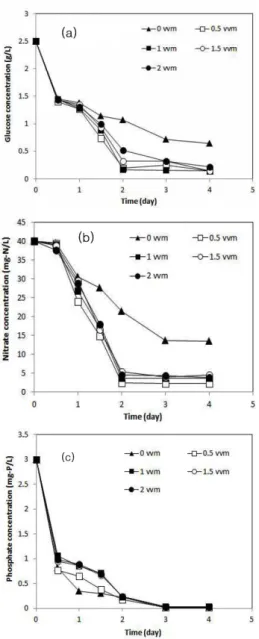
Fig. 5는 mixotrophic 조건에서 C. soroki- niana 배양시 폭기량에 따른 글루코즈와 질소, 인 농도를 나타낸 것이다. 글루코즈는 폭기량에 관계없이 90 % 이상의 제거율을 나타냈으며, 미 폭기시에는 74 %의 제거율을 나타냈다.
질소와 인의 경우 폭기량에 관계없이 제거량 과 제거속도가 비슷했으며, 인은 미폭기시에도 모두 제거되었다. 미세조류에 의한 인 제거에 영 향을 주는 요인으로는 pH와 금속이온농도, 탄산 염 농도 등이 있다(Larsdotter, 2007). PO43-형 태인 인은 pH 9이상에서 양이온을 띄는 금속이 온과 결합하여 응집침전 되거나 세포내 흡착하 여 제거된다(Semerjian et al., 2003). 본 연구 에서 성장량 및 질소 제거율이 낮은 미폭기 조건 에서 인이 모두 제거된 것은 낮은 인의 농도가 금속이온과 결합하여 응집침전 되었거나, 미세 조류에 흡착된 것으로 판단된다.
Table 4는 폭기량에 따른 C. sorokiniana의 글루코즈 및 질소, 인 제거능을 나타낸 것이다.
글루코즈와 인의 경우 폭기량에 따라 큰 차이를 보이지 않았고, 질소제거속도는 0.5 vvm에서 가장 높게 나타났으나 그 차이는 크지 않았다.
그러나 미폭기시의 결과가 좋지 않기 때문에 추 후 하폐수고도처리에 적용함에 있어 질소, 인 제 거효율을 높여주기 위해서는 0.5 vvm 이상의 폭기가 필요할 것으로 판단되며, 특히 성장량을 증대시켜주기 위해서는 1 vvm 이상의 폭기가 필 요할 것으로 판단된다.
Fig. 4. Maximum dry cell weight and specific growth rate of C.
sorokiniana by aeration rates
Fig. 5. Variation of (a) glucose, (b) nitrate and (c) phosphate con- centration of C. sorokiniana by aeration ratios
Aeration rate
(vvm) 0 0.5 1 1.5 2
Glucose removal
rate (mg/L/day) 464 589 589 589 570
Nitrate removal rate (mg-N/L/
day)
6.63 9.43 9.09 8.86 9.01
Phosphate removal rate (mg-P/L/day)
0.71 0.71 0.71 0.70 0.69
Table 4. Removal rates of glucose, nitrate and phosphate of C.
sorokiniana by aeration rates
4. 결 론
본 연구에서는 하수고도처리에 적합한 mix- otrophic 미세조류로 C. sorokiniana를 선정하 여 하폐수고도처리시 pH 및 폭기량이 미세조류 성장 및 N, P 제거에 미치는 영향을 파악하기 위하여 실험을 수행했다. pH 3 ∼ 11의 조건에 서 C. sorokiniana를 배양한 결과, pH 5 ∼ 9 에서 높은 성장량과 질소, 인 제거능을 나타냈으 며, pH 3과 11에서는 성장에 저해를 받는 것으 로 나타났다. pH 7에서 비성장률은 0.7 day-1로 가장 높았으며, 질소 제거속도 7.61 mg-N/L/
day로 가장 우수한 제거능을 나타냈다. 폭기량 에 따른 실험결과 폭기량에 관계없이 폭기를 해 준 경우가 미폭기시 보다 2배 이상 높은 성장률 을 나타냈다. 또한 유기물과 질소, 인 제거속도 역시 폭기를 해준 경우가 높게 나타났다. 0.5 ∼ 2 vvm 조건에서 폭기량에 관계없이 성장률 및 질소, 인 제거속도는 비슷하였으나, 질소, 인 제 거효율을 높여주기 위해서는 0.5 vvm 이상, 성 장량 증대를 위해서는 1 vvm 이상의 폭기가 요 구되는 것으로 나타났다.
따라서 C. sorokiniana를 mixotrophic 조 건으로 유입 pH가 5 ∼ 9인 하폐수처리장에 적 용이 가능할 것으로 판단되며, 성장량 및 질소, 인 제거효율과 운전비용 사이의 관계를 고려하 여 폭기량을 조절해줄 필요가 있을 것으로 사료 된다.
사 사
이 논문은 환경부의 폐기물에너지화·자원화 전문인력양성사업으로 지원되었습니다.
참고문헌