치약에 대한 YD-38 세포주를 활용한 새로운 구강 점막 자극 시험방법
남 기 백
†
⋅조 선 아⋅조 준 철⋅김 찬 호⋅김 유 진⋅이 존 환⋅신 계 호(주)아모레퍼시픽 기술연구원
(2012년 6월 29일 접수, 2012년 7월 30일 수정, 2012년 12월 7일 채택)
The New in vitro Oral Irritation Test Method for Toothpaste using YD-38 Oral Mucosal Cell Line
Gi Baeg Nam
†
, Sun-A Cho, Jun-Cheol Cho, Chanho Kim, Yoo-Jin Kim, John Hwan Lee, and Kyeho ShinR&D Center, Amorepacific Coporation, 314-1, Bora-dong, Giheung-gu, Yongin-si, Gyeounggi-do 449-729, Korea (Received June 29, 2012; Revised July 30, 2012; Accepted December 7, 2012)
요 약: 우리는 평생 동안 하루도 빠짐없이 치약과 같은 구강관리 제품들을 사용한다. 이와 같이 매일 입에 사용되는 제품의 안전성이 담보되어야 함은 매우 중요한 일이다. 이전까지 이루어진 동물시험이나 임상시험에서 치약 내 계면 활성제 등에 의한 구강 자극이 유발될 수 있음이 알려져 있다. 하지만, 동물복지를 위하여 유럽 화장품 법안은 화장품 과 그에 사용하는 원료에 대한 동물 시험을 금지했다. 그로 인해 여러 분야에서 동물을 대체하거나 동물의 사용을 줄일 수 있는 동물대체 시험법의 개발이 활발하게 이루어지고 있다. 하지만, 현재까지 구강 점막 독성을 측정할 수 있는 방법으로 임상시험과 동물시험이 있었으며, 최근에는 구강 점막 조직 모델이나 구강 세포들을 활용한 방법들이 연구되고 있다. 이번 연구의 목적은 구강관리 제품의 안전성을 확보할 수 있는 동물대체 시험법을 개발하는 것이다.
구강 세포주(YD-38 cell)를 활용해 불용성 물질을 포함한 치약에 대한 시험이 가능하도록 구강 점막 자극 시험법을 개발하였고, 이 시험법으로 이전에 이루어진 동물시험에서 자극유발원으로 알려진 물질에 의한 자극을 구별해낼 수 있었다. 또한, 유아와 어린이 치약의 자극 수준이 일반 성인 치약에 비해 낮음을 증명하였다. 이 결과를 바탕으로 동물을 사용하지 않고 인체에 대한 위해성을 줄일 수 있도록, 구강관리 제품의 구강 점막 자극 수준을 평가할 수 있는 이 시험법이 하나의 새로운 구강 자극 시험 방법으로 사용될 수 있으리라 사료된다.
Abstract: Through our entire life, oral care products such as toothpaste are used. Thus the safety of oral care products used every day to our mouth is very important. As the previous study in animal tests or clinical trials, surfactant in toothpaste may cause the oral irritation. However, EU cosmetics legislation prohibits animal testing of cosmetics and its ingredient for animal welfare. Therefore the development of alternative
in vitrotest has been actively performed to replace or reduce using the animal in many areas. However, the way to evaluate oral mucosal toxicity has been done using animal models or clinical trials from now on. Even more, the experiment with human oral 3D tissue or human oral cell line is used recently. The aim of this study is the development of oral mucosal irritation method without using animal for the safety of the oral care product. We developed
in vitrotest method for oral irritation by using human oral cell line (YD-38 cell) acceptable to toothpaste which contains insoluble material. By the results of this assay, we could discriminate toothpaste with or without irritating substance as same manner in animal studies reported previously. In addition, we confirmed that toothpaste for babies and children toothpaste irritated oral musoca lower than the general adult toothpaste. The present study suggest that this new
in vitromethod by using human oral cell line (YD-38 cell) could be used for evaluation of oral irritation without using animal.
Keywords:
oral irritation, YD-38, toothpaste, alternative
1)
† 주 저자 (e-mail: [email protected])
Category Toothpaste A Toothpaste B Toothpaste C Toothpaste D Abrasives
Flavorants Humectants Humectants Thickening agents Thickening agents Thickening agents
Perfume Preservatives
Water Surfactants
Calcium Carbonate Sodium Saccharin
Glycerin Sorbitol Xanthan Gum Cellulose Gum hydrated silica
Perfume Methyl Paraben
Water None
Calcium Carbonate Sodium Saccharin
Glycerin Sorbitol Xanthan Gum Cellulose Gum hydrated silica
Perfume Methyl Paraben
Water SLS* 1 %
Calcium Carbonate Sodium Saccharin
Glycerin Sorbitol Xanthan Gum Cellulose Gum hydrated silica
Perfume Methyl Paraben
Water SLS 2 %
Calcium Carbonate Sodium Saccharin
Glycerin Sorbitol Xanthan Gum Cellulose Gum hydrated silica
Perfume Methyl Paraben
Water SLS 4 %
* Sodium Lauryl Sulfate (SLS)
Table 1. Main Component of the Toothpastes Used in This Study
1. 서 론
치약 같은 구강 세정제품은 현대인의 개인위생 관리 에 필수불가결한 것으로 하루도 거르지 않고 사용되고 있다. 유아기부터 노년기에 이르기까지 평생을 걸쳐 구 강에 사용되는 이러한 제품들의 안전성이 확보되어야 함은 두말할 필요가 없을 것이다. 하지만, 계면활성제와 같은 치약 내 사용 원료에 의해 구강 점막 자극이 유발 될 수 있음이 과거 동물 시험 및 임상 시험, 세포 시험 에서 보고된 바 있다[1-3].
이러한 구강 점막 자극을 평가하기 위하여 과거에는 전통적으로 햄스터와 같은 실험동물들을 활용하여 인 체에 대한 위해성을 평가해 왔었다[4,5]. 하지만, 유럽 화장품법(2003년)의 7차 개정에서 2009년 3월부터 화 장품 및 그 원료에 대한 동물실험을 금지하도록 정하고 있으며, 반복투여독성(repeat-dose toxicity)과 생식독 성(reproductive toxicity), 독성역학(toxicokinetic) 시 험은 2013년부터 단계적으로 적용하도록 하고 있다. 국 내법에서는 화장품과 그에 사용하는 원료의 동물실험 에 대한 위와 같은 규정이 명시되어 있지는 않으나, 국 내외적으로 실험동물 복지에 대한 사회적인 관심이 크 게 증대되고 있는 추세에 발맞추어 나가기 위해서는 안 전성 평가의 여러 분야에서 동물실험 대체법의 개발이 시급하다. 이로 인해 관련 분야에서 3R (Replacement, Reduction, and Refinement)에 입각한 실험동물의 사 용을 대체하고, 줄여주고, 또한 실험동물의 고통을 경감 할 수 있는 동물실험 대체법 연구가 활발히 이루어지고 있으며, 구강 자극을 연구하기 위해 인공 구강 점막 조
직이나 구강 세포주를 활용하려는 노력이 진행되고 있 다[6-9].
이번 연구는 이러한 실험동물의 복지 증대와 구강 제 품의 인체 안전성을 확보하기 위한 구강 독성 평가 분 야 동물실험 대체법 개발을 위해 시작되었다. 피부 조 직과 다른 구조를 가지는 구강 점막 조직의 특성을 고 려하여 인간 유래 구강 세포주를 활용하여 독성 평가 시험법을 확립하고, 이 시험법을 통해 현재 시판되고 있는 여러 종류의 치약 제품의 안전성을 시험하는 것이 이번 연구의 주요한 목적이다.
2. 재료 및 방법
2.1. 세포주 및 배양
인간 아랫잇몸상피세포주(human lower gingiva epi- thelial cell)인 YD-38 cell (한국세포주은행, KCLB No.
60508)을 사용하였다. 한국세포주은행의 표준배양조건 에 따라 배양 배지인 RPMI 1640 (ATCC, USA)에 L- glutamine (300 mg/L, GIBCO, USA)과 25 mM HEPES (Sigma, USA), 25 mM NaHCO
3
(Sigma, USA), 10 % 우태아혈청 (fetal bovine serum; FBS, GIBCO, USA), 1 % 페니실린-스트렙토마이신 (Penicillin-Streptomy- cin, Lonza, USA)를 첨가하여 37 ℃, 5 % CO2
조건 하 에서 배양하였다.2.2. 시험물질의 준비
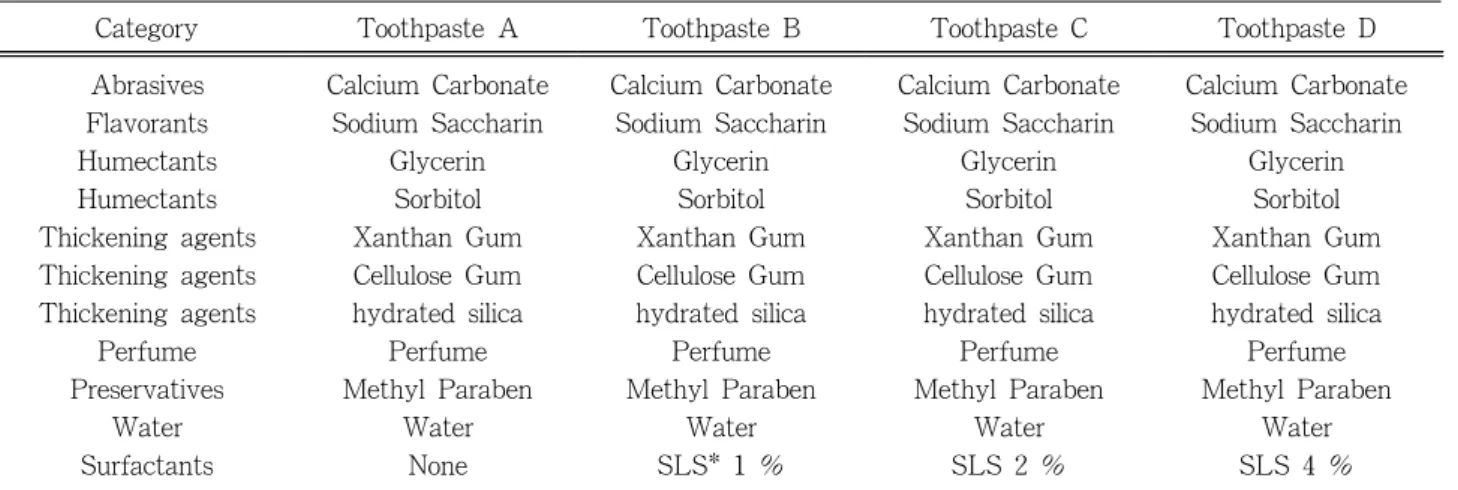
불용성 물질을 포함하는 치약의 처리 조건을 잡기 위 한 계면활성제의 함량에 변화를 둔 4종(계면활성제 함
No. Category Name Toothpaste 1
Toothpaste 2 Toothpaste 3 Toothpaste 4 Toothpaste 5 Toothpaste 6 Toothpaste 7 Toothpaste 8 Toothpaste 9 Toothpaste 10 Toothpaste 11 Toothpaste 12 Toothpaste 13 Toothpaste 14 Toothpaste 15 Toothpaste 16 Toothpaste 17 Toothpaste 18 Toothpaste 19 Toothpaste 20 Toothpaste 21
Babies Babies Children Children Children Children Children Children Organic Organic Organic Whiteing Whiteing Whiteing Gum care Gum care Gum care Gum care Plaque care Plaque care Plaque care
Babies' Toothpaste 1 Babies' Toothpaste 2 Children's Toothpaste 1 Children's Toothpaste 2 Children's Toothpaste 3 Children's Toothpaste 4 Children's Toothpaste 5 Children's Toothpaste 6 Organic Toothpaste 1 Organic Toothpaste 2 Organic Toothpaste 3 Whiteing Toothpaste 1 Whiteing Toothpaste 2 Whiteing Toothpaste 3 Gum care Toothpaste 1 Gum care Toothpaste 2 Gum care Toothpaste 3 Gum care Toothpaste 4 Plaque care Toothpaste 1 Plaque care Toothpaste 2 Plaque care Toothpaste 3
* The toothpaste were classified in 6 categories by using age and effectiveness.
Table 2. List of 21 Toothpastes
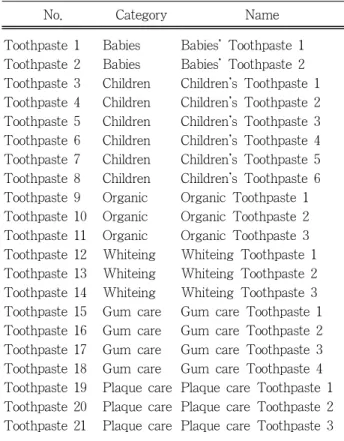
량 0, 1, 2, 4 %)의 치약을 사용하였고, 제형 내 성분명 은 Table 1에 나타내었다. 그리고 현재 국내에 시판되 고 있는 치약 21종을 선정하여 사용 연령에 따라 유아 와 어린이, 성인으로 분류하였고, 성인 치약은 기능별로 유기농과 미백, 잇몸, 치석으로 구분하여 총 6가지 카테 고리로 분류하였다. 분류된 각각의 카테고리별로 2 ~ 6종의 치약을 선정하여 시험하였다(유아용 2종, 어린이 용 6종, 유기농 3종, 미백 3종, 잇몸질환 4종, 치석 3종).
상세 리스트는 Table 2에 표시하였다.
분광광도계로 흡광도 측정시 방해하는 물질인 치약 제형 구성요소 중 불용성 성분만을 선택적으로 제거하 기 위하여 원심분리기(5810R, Eppendorf, Germany)를 사용해 1,200 rpm, 7 min간 원심분리하여 연마제를 가 라앉힌 후 상층액만 취하여 준비한다.
2.3. 시험 물질 처리 및 세포 독성 시험(MTT assay) 96 well culture plate에 1.5 × 10
4
cells/100 µL/well 의 밀도로 YD-38 세포를 분주한 후, 37 ℃, 5 % CO2
조건 하에서 24 h 동안 배양한다(배양 1일). 배지를 제 거한 후 200 µL의 멸균된 인산염완충용액(Phosphate buffered saline; PBS, Lonza, USA)으로 각 well을 1회 세척한 다음 새로운 배양 배지를 well당 100 µL씩 넣어 주고 시험물질과 양성대조군을 1/2 농도로 연속희석하 여 처리한 후 24 h 동안 추가배양한다(배양 2일). 배양 3일째에 처리한 물질이 든 배지를 제거하고, 200 µL의 멸균된 인산염완충용액으로 각 well을 3회 세척하여 잔 류물질이 없도록 깨끗이 제거한다. 3-(4,5-dimethyl- thiazol-2-yl)-2,5-diphenyltetrazolium bromide (MTT, sigma, USA)를 50 µg/100 µL/well의 농도로 시험 배 지에 희석하여 처리한 후 3 h 동안 배양한다. 배지를 제 거한 다음, 0.04 N HCl-isopropanol을 100 µL/well로 넣 어준 후 차광상태로 30 min간 1,200 rpm으로 흔들어 추 출한다. 570 nm 파장에서 흡광도를 분광광도계(Spec- traMax190, Molecular Devices, USA)를 이용하여 측정 한다.
세포생존율(cell viability; CV)은 아래 공식에 따라 계산하였다. 그리고, 세포생존율이 50 %인 농도(CV
50
) 는 각 희석 농도의 CV값을 바탕으로 계산하여 시험물 질의 구강 점막 자극을 상대 비교하는 지표로 사용한다.세포 생존율(cell viability; CV) =
100 × [ O.D.
시험군
/ O.D.음성대조군
]2.4. 통계처리
통계분석은 미니탭(MINITAB
Ⓡ
release 14.2, LEAD Technologies, Inc., USA) 통계프로그램을 이용하여 기 술통계량을 계산하였다.3. 결과 및 고찰
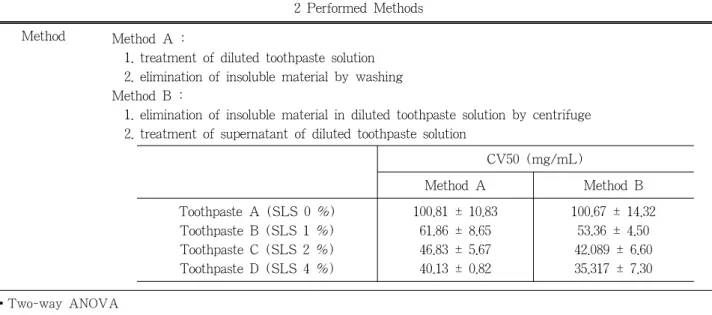
3.1. 처리 조건에 따른 치약 4종의 세포 독성 결과 불용성 성분이 치약을 처리 후 분광광도계로 흡광도 측정시 방해하는 것을 막기 위해 원심분리를 통해 불용 성 성분을 제거한 치약 희석액과 불용성 성분을 제거하 지 않은 치약 희석액을 사용하여 시험하였다. 불용성 성분을 제거하지 않은 치약은 처리 후 세척시 파이펫을 이용해 수동으로 치약 잔유물을 완전히 제거해주었다.
시험된 4종의 치약의 결과는 Table 3과 같다. 시험방 법에 대한 유의성검정에서 이원배치법(two-way ANOVA) 분석에 의해 유의확률이 0.251로 시험방법에 따른 결과 의 차이는 없다. 치약 제형 내 SLS 함량에 대한 유의성
2 Performed Methods Method Method A :
1. treatment of diluted toothpaste solution 2. elimination of insoluble material by washing Method B :
1. elimination of insoluble material in diluted toothpaste solution by centrifuge 2. treatment of supernatant of diluted toothpaste solution
CV50 (mg/mL)
Method A Method B
Toothpaste A (SLS 0 %) Toothpaste B (SLS 1 %) Toothpaste C (SLS 2 %) Toothpaste D (SLS 4 %)
100.81 ± 10.83 61.86 ± 8.65 46.83 ± 5.67 40.13 ± 0.82
100.67 ± 14.32 53.36 ± 4.50 42.089 ± 6.60 35.317 ± 7.30
∙ Two-way ANOVA
- Method :
p-value = 0.251
- SLS concentration in toothpastes :
p-value = 0.000 - Method * SLS conc. :
p-value = 0.695
Table 3. Calculated CV50 (mg/mL) Results of 4 Toothpastes by 2 Different Methods (mean ± SD, N = 3)
Figure 1. The rank correlation between % composition of SLS in toothpastes and calculated CV50 (mg/mL) of YD-38 cell culture (correlation coefficient = -0.852, p-value = 0.148).
검정에서 유의확률이 0.000으로 SLS 함량에 따른 계산 된 CV50값은 유의한 차이가 있다는 결론을 유의수준 5
%에서 내릴 수 있다. 또한 시험방법과 치약 제형 내 SLS 함량의 교호작용은 유의확률이 0.695로 교호작용 에 의한 효과는 있다고 보기 어렵다. 이 결과를 종합해 볼 때, 불용성 성분을 제거한 치약 희석액을 처리한 경 우와 불용성 성분을 제거하지 않은 채 처리 후 세척 시 수동으로 잔유물을 제거한 경우에서 통계적으로 유의 한 차이가 나타나지 않아, 통계적으로 같은 결과를 얻 었다. 이 결과를 바탕으로 고농도 치약 희석액 처리 시 잔유하는 불용성 성분으로 인한 흡광도 측정 방해 요인 을 제거할 수 있게 되었다(Table 3). 또한, 치약 제형 내 계면활성제 함량과 구강 세포 독성은 역의 상관관계를 가지게 나타났다(Figure 1). 계면활성제의 함량 증가에 따른 구강 세포독성 자극이 증가하는 이 결과는 계면활 성제를 포함하는 치약과 계면활성제를 포함하지 않는 치약을 사용한 임상 시험에서 계면활성제를 포함한 치 약을 일정 기간 사용한 후에 구강 점막 자극 유발이 보 고된 이전의 임상 시험 결과가 구강 세포주를 활용한 in vitro 시험법에서도 재현 가능함을 보여준다.
3.2. 시판 중인 카테고리별 치약 21종 세포 독성 결과 시판 중인 대표적인 치약 21종을 치약 카테고리별로
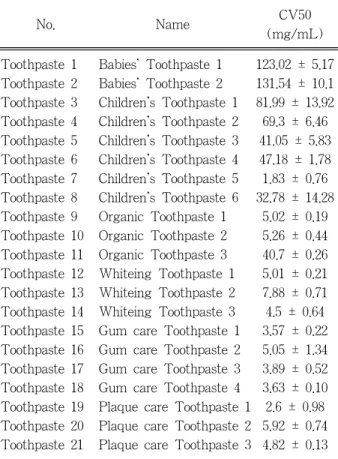
구분하였고, 시험한 치약의 결과는 Table 4, Figure 2와 같다. 계산된 CV50 범위는 1.83 ~ 131.54 mg/mL까지 넓게 나타났으며, 세포독성이 가장 강한 치약과 가장 약한 치약 간에 약 100배의 차이를 나타내었다. 또한, 유아․어린이 치약 8종의 세포독성 결과는 일반 성인 치약인 미백․잇몸질환․치석치약 10종과 비교하여 이 표본 T검정(2-sample t-test) 결과 통계적으로 유의한 차이를 보였다(Table 5). 이 결과는 유아․어린이 치약 이 일반 성인 치약에 비해 낮은 수준의 구강 세포 독성
No. Name CV50 (mg/mL) Toothpaste 1
Toothpaste 2 Toothpaste 3 Toothpaste 4 Toothpaste 5 Toothpaste 6 Toothpaste 7 Toothpaste 8 Toothpaste 9 Toothpaste 10 Toothpaste 11 Toothpaste 12 Toothpaste 13 Toothpaste 14 Toothpaste 15 Toothpaste 16 Toothpaste 17 Toothpaste 18 Toothpaste 19 Toothpaste 20 Toothpaste 21
Babies' Toothpaste 1 Babies' Toothpaste 2 Children's Toothpaste 1 Children's Toothpaste 2 Children's Toothpaste 3 Children's Toothpaste 4 Children's Toothpaste 5 Children's Toothpaste 6 Organic Toothpaste 1 Organic Toothpaste 2 Organic Toothpaste 3 Whiteing Toothpaste 1 Whiteing Toothpaste 2 Whiteing Toothpaste 3 Gum care Toothpaste 1 Gum care Toothpaste 2 Gum care Toothpaste 3 Gum care Toothpaste 4 Plaque care Toothpaste 1 Plaque care Toothpaste 2 Plaque care Toothpaste 3
123.02 ± 5.17 131.54 ± 10.1 81.99 ± 13.92 69.3 ± 6.46 41.05 ± 5.83 47.18 ± 1.78 1.83 ± 0.76 32.78 ± 14.28
5.02 ± 0.19 5.26 ± 0.44 40.7 ± 0.26 5.01 ± 0.21 7.88 ± 0.71 4.5 ± 0.64 3.57 ± 0.22 5.05 ± 1.34 3.89 ± 0.52 3.63 ± 0.10 2.6 ± 0.98 5.92 ± 0.74 4.82 ± 0.13 Table 4. Calculated CV50 (mg/mL) Results of 21 Toothpastes (mean ± SD, N = 6)
Figure 2. The calculated CV50 (mg/mL) results of 21 tested toothpastes.
이 있음을 나타낸다.
Table 5. 2 Devided Group by Toothpaste Category (mean ± SD, N = 6)
Group Toothpaste CV50 (mg/mL)
Group 1*
Group 2*
Toothpaste 1 ~ 8 Toothpaste 12 ~ 21
61.70 ± 44.0 4.69 ± 1.47
2 sample t-test,
p< 0.005
Group 1* (Babies' and Children's Toothpaste)
Group 2* (Whitening, Gum Care, Plaque Care Toothpaste)
4. 결 론
본 연구를 통하여 in vitro 구강세포주를 활용한 시험 에서 장애 요인인 불용성 물질을 포함하는 시료의 시험 이 가능하도록 monolayer 구강 세포주를 활용한 구강 독성 시험법을 확립하였다. 또한, 계면활성제에 의해 구 강 점막 자극이 유발되는 임상 시험의 결과와 상관성을 가지는 계면활성제 함량과 구강 세포 독성 간의 정의 상관관계를 밝혀냄으로서 계면활성제에 의한 구강 점 막 자극의 유발과 구강 세정 제품의 구강 점막 자극을 완화하기 위한 주요 요인이 계면활성제에 있음을 세포 독성 시험법을 통해 증명하였다. 게다가 저자극을 추구 하는 유아․어린이․유기농 치약 제품군이 일반 타 치 약에 비해 적은 구강 세포 독성이 나타남을 처음으로 보고하였다.
이상의 결과를 바탕으로 동물을 사용하지 않고 인체 에 대한 위해성을 줄일 수 있도록, 구강관리 제품의 구 강 점막 자극 수준을 평가할 수 있는 이 시험법이 하나 의 새로운 구강 점막 자극 시험 방법으로 사용될 수 있 으리라 사료된다.
참 고 문 헌
1. I. Rantanen, K. Jutila, I. Nicander, J. Tenovuo, and E. Soderling, The effects of two sodium lauryl sul- phate-containing toothpastes with and without betaine on human oral mucosa in vivo, Swedish Denal Journal, 27, 31 (2003).
2. E. E. Ahlfors, J. E. Dahl, and T. Lyberg, The de- velopment of T cell-dominated inflammatory re- sponses induced by sodium lauryl sulphate in mouse oral mucosa, Archives of oral biology, 57(6), 796 (2012).
3. E. Ahlfors and C. Czerkinsky, Contact sensitivity in the murine oral mucosa. I. An experimental model of delayed-type hypersensitivity reactions at mucosal surfaces, Clin Exp Immunol., 86(3), 449 (1991).
4. P. Bourrinet, JP. Conduzorgues, H. Dutertre, J.
Macabies, P. Masson, J. Maurin, and O. Mercier, Interlaboratory study for the assessment of poten- tial irritative properties of hygiene products on the hamster cheek pouch, Lab Anim. Sci., 45(1), 36 (1995).
5. R. J. Veys, J. H. Baert, and J. A. De Boever, Histological changes in the hamster cheek pounch epithelium induced by topical application of so- dium laul sulphate, Int. J. Path., 75, 203 (1994).
6. M. Klausner, S. Ayehunie, B. A. Breyfogle, P. W.
Wertz, L. Bacca, and J. Kubilus, Organotypic hu- man oral tissue models for toxicological studies, Toxicology in Vitro, 21, 938 (2007).
7. T. Tsutsui, Y. Tanaka, A. Ushimura, T. Ide, M.
Matsumura, and J. C. Barrett, In vitro cytotoxicity of diverse preparations used in dental practice to human gingival keratinocytes, Toxicology in Vitro, 11(4), 393 (1997).
8. K. Moharamzadeh, H. Colley, C. Murdoch, V.
Hearnden, W. L. Chai, I. M. Brook, M. H. Thor- nhill, and S. MacNeil, Tissue-engineered Oral Mucosa, Journal of Dental Research, 86, 115 (2007).
9. J. P. Babich and H. Babich, Sodium lauryl sulfate and triclosan : In vitro cytotoxicity studies with gingival cells, Toxicology Letters, 91(3), 189 (1997).