DEU-7 Derived from Ulmus macrocarpa Improved Immune Functions in Cyclophosphamide-treated Mice
Kyung-Hwa Kang1,5, Ji Su Go1, Inhwan Lee2,5, Sang Ho Lee1, Sung Do Lee2,5, Deok Won Kim2,5, Jong-Hwan Lee3,5, HyeJin Hwang4,5, Sook Kyung Hyun4,5, Byoung Woo KIM5, Chul Min Kim6 and Kyung Tae Chung2,5*
1Department of Korean Physiology, Dong-Eui University, Busan 614-714, Korea
2Department of Clinical Laboratory Science, Dong-Eui University, Busan 614-714, Korea
3Department of Biotechnology and Bioengineering, Dong-Eui University, Busan 614-714, Korea
4Department of Food and Nutrition, Dong-Eui University, Busan 614-714, Korea
5Research Center for Anti-aging Technology Development, Dong-Eui University, Busan 614-714, Korea
6Department of Biochemistry, School of Medicine, Pusan National University, Yangsan 626-870, Korea Received July 29, 2015 /Revised September 30, 2015 /Accepted September 30, 2015
The present study investigated the immunomodulatory properties of four different medicinal plants in a cyclophosphamide-treated Balb/c mouse model. One of the four plants, Ulmus macrocarpa, showed partial resistance against immune suppression induced by cyclophosphamide. The bark of U.
macrocarpa, commonly known as the Chinese elm, has been used as a pharmaceutical material in Korean traditional medicine to treat bacterial inflammation and induce wound healing. In this study, water extract of U. macrocarpa, named DEU-7, was used for its immunomodulating functional activity.
DEU-7 increased the weight of the spleen and the number of splenocytes but did not significantly af- fect the liver, kidney, and thymus in vivo. A splenocyte viability assay confirmed that DEU-7 influ- enced ex vivo splenocyte survival. DEU-7 also increased the levels of cytokines, such as IL-2 and IL-4, and immunoglobulins, such as IgM, IgG, and IgA. These results indicated that DEU-7 is involved in the activation of T and B lymphocytes. In addition, DEU-7 was able to maintain the production of cytokines, such as TNF-α, IL-12, and IFN-γ, in the condition of cyclophosphamide-induced immune suppression, suggesting that DEU-7 activated innate immune cells, even under immune suppression.
We concluded that DEU-7 aids immunological homeostasis, thereby preventing immune suppression, and aids both innate and adaptive immune response by maintaining the levels of various cytokines and immunoglobulins. Consequently, it is worth investigating the potential of DEU-7 as a supple- mental source for immune-enhancing agents.
Key words : Cytokines, immunomodulator, immunoglobulins, immunosuppression, Ulmus macrocarpa
*Corresponding author
*Tel : +82-51-890-2681, Fax : +82-51-890-2622
*E-mail : [email protected]
This is an Open-Access article distributed under the terms of the Creative Commons Attribution Non-Commercial License (http://creativecommons.org/licenses/by-nc/3.0) which permits unrestricted non-commercial use, distribution, and reproduction in any medium, provided the original work is properly cited.
Journal of Life Science 2015 Vol. 25. No. 10. 1156~1163 DOI : http://dx.doi.org/10.5352/JLS.2015.25.10.1156
Introduction
The immune response is categorized as innate immunity and acquired immunity. Innate immunity is a non-specific response that is characterized by phagocytosis and is also called natural immunity [31]. Acquired immunity is a specif- ic immune response by B and T cells. In contrast to innate immunity, it can effectively inhibit the repetitive invasion of the same antigen, which is due to the memory function
generated by the intrusive antigen. Innate immunity and ac- quired immunity are closely related to coordinated host de- fense mechanism against pathogens [20, 23, 31]. This study aims to find a new substance that can be a potential ther- apeutic agent against aging diseases by enhancing the im- mune response, which must be increased as a human being grows older. We selected four different kinds of medicinal plants known to enhance immune function in traditional folk medicine. Alpinia officinarum is a medicinal plant that assists the digestive function that is called galangal root. It has been known to inhibit the growth of hemolytic strepto- coccus and diphtheria [11, 28]. Zanthoxylum schinifolium, Chinese pepper, is used mainly as a spice and has been known to sterilize and detoxify. But recent studies revealed that it has anti-cancer effects [30]. Scutellaria baicalensis Georgi has an anti-inflammatory effect [19], and many stud-
ies showed the results of the therapeutic effects on lung, ovarian and uterine cancer [6, 21]. Ulmus macrocarpa, known as the Chinese elm, has been used in traditional folk medi- cine to treat skin wounds and anti-inflammation [17, 18].
Water extracts of these four medicinal plants were des- ignated to DEU-2, 3, 4 and 7 and we investigated whether DEU-2, 3, 4 and 7 have an effect on immune responses in an immune suppressed mouse model.
Cyclophosphamide is efficient in inhibiting the immune system and is used in the treatment of cancer. It has been known to reduce the production of lymphocytes in the spleen and lymph node. The appropriate treatment concen- tration of cyclophosphamide was determined based on the various experimental studies [4, 7, 12, 16]. An in vivo test was performed by feeding the mice DEU-2, 3, 4 and 7 once a day. One of the four DEU extracts, DEU-7 affected changes in the weight of the spleen and production of cytokines and immunoglobulins. Many studies suggested previously that Ulmus macrocarpa has anti-inflammation effects [8, 15, 23]
and anti-cancer effects [1, 14]. However, most studies have not suggested the mechanism influenced by Ulmus macro- carpa. Therefore, we investigated the mechanism by DEU-7 in immunomodulating function and propose the possibility of its use in immune enhancing substances.
Materials and Methods
Animals
Male Balb/c mice were purchased from Samtako, Inc.
(Osan, Korea). Mice used in all experiments were 12 weeks old. These mice were housed in a specific pathogen-free fa- cility with the appropriate temperature and humidity, and allowed free access to food and water. The mice for this study (DEU-R2013-002) were approved by the Institutional Animal Care and Use Committee at Dong-Eui University.
Preparation of DEU extracts
Dried samples of Alpinia officinarum, Zanthoxylum schinifo- lium, Scutellaria baicalensis Georgi, Ulmus macrocarpa Hance were purchased from Dae-Han herbal medicine Inc. (Busan, Korea), and the samples were stored in Dong-Eui University (No, 20140204). Three kilograms of dried samples were add- ed to 10 L of water, and extracted twice repeatedly for 3 hr at 80℃. The extract was filtered and concentrated under reduced pressure at below 45℃ using the Rotary vacuum evaporator (Eyela, Japan). The concentrates were dried using
a freeze-dryer at -80℃, resulting in about 320 g of water extracts obtained. We labeled each Alpinia officinarum, Zanthoxylum schinifolium, Scutellaria baicalensis Georgi, and Ulmus macrocarpa extract as DEU-2, 3, 4 and 7, respectively.
In vivo Immunomodulation test of the immun- osuppressive mouse model
Six mouse groups (n=6 in each group) were divided. One control (normal) group was without any treatment. Another group was treated with only cyclophosphamide (cyclophos- phamide group) as an immunosuppressant. Four other groups were treated with cyclophosphamide and DEU-2, 3, 4 or 7 (DEU group). On day 0, five groups were intra- peritoneal injected with cyclophosphamide at a dose of 100 mg/kg, and the normal group was injected with saline (10 ml/kg). Feeding of DEU groups started from day 1 with a 300 mg/kg dose and was carried out until day 14. The normal and cyclophosphamide groups were fed 0.5 ml dis- tilled water per day. Body weights of mice were measured once in three days, and on day 15 organs were removed from all mice. Each organ was weighed, and splenocytes were separated from spleens using mesh screen and RBC lysis. The RBC lysis buffer was purchased from the Biolegend Inc. (CA, USA). Splenocytes were cultured in RPMI 1640 media and then used in the viability assay. Body weights of mice were presented as the body index by stat- istical analysis.
Cell viability assay
Mouse splenocytes were seeded into a 96 well plate at a density of 1×10⁶ cells/ml. Cells were treated with phytohe- magglutinin (PHA, 10 μg/ml), lipopolysaccharide (LPS, 20 μg/ml) or DEU-7 extract (200 μg/ml) for 48 hr at 37℃ CO2
incubator. Live cells at each time point were measured by MTT assay. Briefly, the Cell Titer 96®AQueous One Solution Reagent (Promega, USA) was added to each well of 96 well plates. The plate was incubated for 3 hr at 37℃, and then measured for absorbance at 490 nm.
Measurement of cytokine levels and immunoglobulins The levels of total interleukin (IL)-2, IL-4, IL-6, IL-10, IL-12, interferon-gamma (IFN-γ), and TNF-α in blood plas- ma of mice were measured using commercially available en- zyme-linked immunosorbent assay (ELISA) kits (BD Biosci- ences Pharmingen, CA, USA) following the manufacturer’s instructions. The concentrations of each cytokine were calcu-
Fig. 1. A comprehensive overview of in vivo test design for 15 days. Six mouse groups were divided. One normal group was without any treatment. Another group was treated with only cyclophosphamide. Four other groups were treated with cyclo- phosphamide and DEU-2, 3, 4 or 7. On day 0, five groups except the normal group were injected i.p. with 100 mg/kg of cyclophosphamide. Each DEU-2, 3, 4, and 7 group was fed at a dose of 300 mg/kg/day for 14 days. Body weight was measured once every three days. Six mice per group used.
lated from the co-responding standard curves. Immunoglob- ulin levels were measured similarly using commercially available ELISA kits (Immunology Consultants Laboratory Inc., OR, USA).
Statistical analysis
Statistical analysis was determined by three independent experiments and each experiment had eight mice per group.
P-values were determined through the one-way ANOVA, and less than 0.01 were considered statistically significant.
P-values represented as an asterisk (*) or #.
Results
DEU-7 increased viability of mouse splenocytes To examine the function of DEU extracts derived from four kinds of plants, in vivo test was performed for 15 days.
On day 0, all mouse groups except for the normal group were injected with cyclophosphamide to suppress the im- mune response. Mice were then fed the DEU extracts at a dose of 300 mg/kg for two weeks. Body weights of mice were measured once every three days, but there was no sig- nificant difference in the experimental groups (Fig. 1). At 15 days, mice were dissected and their organs weighed. The weights of liver and kidney were unchanged, but the spleen
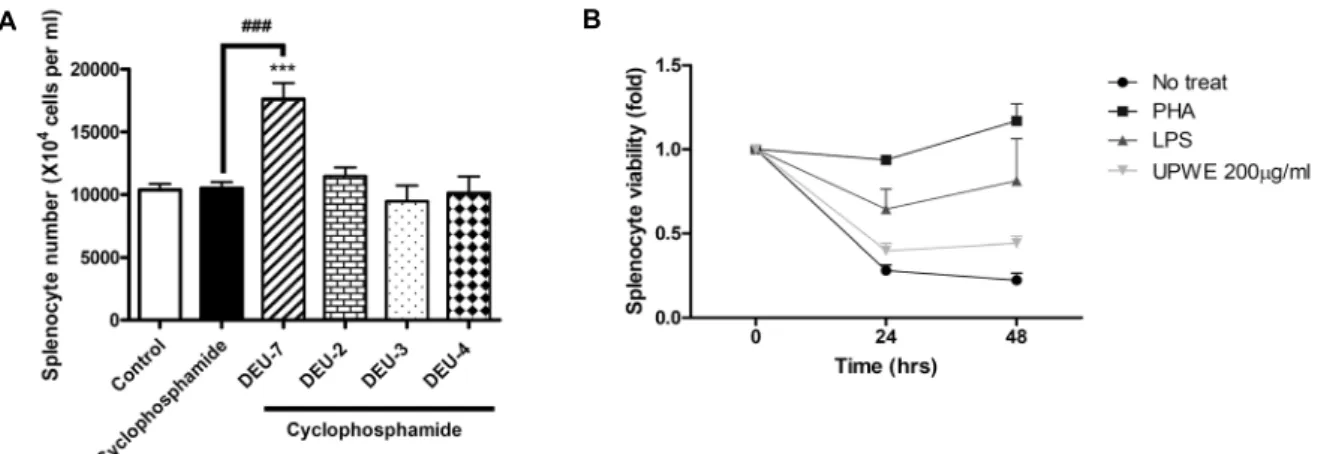
weight was changed by DEU-3 and DEU-7 (Fig. 2). To con- firm the results of the spleen, the splenocytes were separated from spleen. The results of the splenocyte counting were higher in the DEU-7 group but not the DEU-2, 3, 4 groups (Fig. 3A). In order to confirm these results, the splenocytes were separated from normal mice and treated with PHA and LPS as a positive control and DEU-7. Viability assay was then performed. As a result, viability of splenocytes was greater by DEU-7 over 48 hr when compared to the normal group (Fig. 3B). These results suggested that the change of spleen index by DEU-7 treatment is closely associated with the increase of splenocyte number.
DEU-7 increased the levels of cytokines and immunoglobulins
Spleen is a secondary lymphoid organ and composed of many immune cells such as T, B, dendritic cells and macrophages. We tested activation of these cells by measur- ing cytokines and immunoglobulins. Cytokine and im- munoglobulin levels in the blood were measured by ELISA.
DEU-7 noticeably increased the levels of IL-2, IL-4, IL-6 and IL-12 in the blood and an increase of IFN-γ was shown.
Other DEU extract groups showed similar cytokine levels with the cyclophosphamide group (Fig. 4). The results of DEU-7 suggested that it has a sufficient role to maintain T
Fig. 2. DEU-7 influenced the organ index. At 15 days, mice were dissected. The organ weights were measured and calculated for the organ index. DEU-7 increased the weights of the spleen. P values are indicated by **p<0.001 compared to the control.
A B
Fig. 3. DEU-7 increased splenocyte proliferation. (A) After dissection, the spleen was removed and splenocytes were counted using a hemocytometer. (B) DEU-7 increased in vitro viability of splenocytes. All experiments were performed in triplicate and repeated twice. P values are indicated by *** p<0.0001 compared to the control. P values for cyclophosphamide represents
### p<0.0001.
cell mediated immunity because IL-2 and IL-4 affect on T cells. DEU-7 increased the levels of the immunoglobulins (Fig. 5). The levels of IgG and IgM were increased to the control level by DEU-7 treatment, and completely restored the level reduced by cyclophosphamide. IgA level was not statistically significant; however, mean value of DEU-7 was
greater than IgA level of cyclophosphamide group. There- fore, DEU-7 has the effect of promoting B cell immunity un- der the condition of cyclophosphamide treatment.
DEU-7 recovered the reduction of immune response caused by cyclophosphamide
Fig. 4. DEU-7 increased cytokine levels. Cytokine levels in blood were measured using ELISA. DEU-7 increased the levels of cytokines related to B and T cell immunity under immunosuppressed condition. The levels of IL-2, 4, and 6 were significantly increased by DEU-7. P values are indicated by * p<0.01, *** p<0.0001 compared to the control. P values for cyclophosphamide represents
## p<0.001, ### p<0.0001.
Fig. 5. DEU-7 increased the immunoglobulin levels in blood. Immunoglobulin levels were assayed using ELISA. DEU-7 recovered each IgA, IgG and IgM level to the normal levels in the immunosuppressed group. P values are indicated by *p<0.01, **p<0.001, compared to the control. P values for cyclophosphamide represents ##p<0.001.
Natural killer cell (NK cell) is one of major innate immune cells and its activation is regulated by TNF-α and IL-12. IFN- γ is the principal cytokine secreted by activated NK cells and its major function is to activate macrophages. Macrop-
hages secret TNF-α and IL-12 and NK cells secret IFN-γ, which create a system of positive feedback in innate immune network. Cyclophosphamide reduced the levels of TNF-α, IL-12 and IFN-γ. However, DEU-7 restored the levels of
Fig. 6. DEU-7 increased NK cell-related cytokine levels that were reduced by cyclophosphamide. P values are indicated by ***p<0.0001 compared to the control. P values for cyclophosphamide represent ###p<0.0001.
TNF-α, IL-12 and IFN-γ unlike the other DEU extracts (Fig.
6). These data suggested that DEU-7 could have the ability to restore on the innate immune response inhibited by cyclophosphamide.
DEU-7, no other DEUs, did recover the levels of various cytokines and immunoglobulins to their normal levels close- ly through the stimulation of immune cells. Therefore, DEU-7 has the ability to maintain the homeostasis in the combination of innate immunity and adaptive immunity.
Discussion
Well-known traditional medicinal plants are good sources for screening functional compounds. We selected four differ- ent medicinal plants after literature survey and in vitro screening of a plant extracts library which was in-house prepared.
For this experiment, we used the immune-suppressed mouse model by cyclophosphamide treatment. Cyclophos- phamide is a known immunosuppressant as well as an an- ti-cancer agent in low doses. The immune suppression by cyclophosphamide targets lymphocyte and neutrophil pop- ulations in the blood and the inhibition of macrophage mi- gration [12, 26, 32]. The cyclophosphamide tends to decrease body weight of the experimental mouse group depending on its doses and injection times. Our experimental model was designed to mimic mild suppression of immune re- sponses under normal condition. A single dose of 100 mg/kg cyclophosphamide IP administration did not cause body weight loss or organ indices but caused the levels of cytokines and immunoglobulins. Only DEU-7 appeared to prevent cyclophosphamide immune suppression. Interestingly,
even under the cyclophosphamide treated condition DEU-7 increased the number of splenocytes suggesting not only protecting from cyclophosphamide but also stimulating im- mune cells in spleen. Also, DEU-7 partially recovered the levels of IL-2, IL-4, IL-6 and IL-12 which were reduced by cyclophosphamide. These cytokines are related to T cell mediated immunity, and involved in the T cell proliferation and differentiation [13, 20]. In addition, cytokines play roles in the B cell differentiation to the antibody secreting plasma cell [24, 29]. In consist with these results DEU-7 increased the levels of immunoglobulins equal to the normal levels under the cyclophosphamide treated condition. It implies that DEU-7 could be related to B cell differentiation and the antibody class switching [2, 33]. The spleen is the main place for B cell activation [3, 22, 27]. However, DEU-7 had no effect on IL-10 (Fig. 4). IL-10 has been found to act as the inhibitory factor of pro-inflammatory cytokines such as IL-2, TNF-α and IFN-γ [9]. Therefore, this result can support the increase of IL-2, TNF-α and IFN-γ by DEU-7.
NK cells are the killer lymphocytes of the innate immune response and comprise 5-25% of the lymphocytes in the blood. They are stimulated by IL-12 and TNF-α, both of which are produced by macrophages and release IFN-γ upon stimulation [10]. In this experimental model cyclo- phosphamide reduced the levels of these cytokines, which has been reported before [4, 13, 19]. DEU-7 restored the lev- els of IL-12 and TNF-α and IFN-γ under the cyclo- phosphamide treated condition. The recovery by DEU-7 treatment was not as much as the normal levels but sig- nificantly near to or half of the normal levels. These data suggested that DEU-7 would stimulate macrophages and in turn macrophages stimulate NK cells resulting keep the in-
nate immune working.
We had not solved yet how DEU-7 can maintain high lev- els of various cytokines or the normal levels of im- munoglobulins because of early phase of in vivo study. In vitro mechanism study is undergoing at the present time.
But it is clear that DEU-7 was able to maintain homeostasis of immune response under the immune-suppression drug treatment, which is promising the DEU-7 as a new ther- apeutic agent. In further study, we will establish the mecha- nism for promoting immune response by DEU-7.
Acknowledgement
This work was supported by the R&D program of MOTIE/KIAT (N0000697, Establishment of Infra Structure for Anti-aging Industry Support).
References
1. Ahn, J., Lee, J. S. and Yang, K. M. 2014. Ultrafine particles of Ulmus davidiana var. japonica induce apoptosis of gastric cancer cells via activation of caspase and endoplasmic retic- ulum stress. Arch. Pharm. Res. 37, 783-792.
2. Arpin, C., Dechanet, J., Van Kooten, C., Merville, P., Grouard, G., Briere, F., Banchereau, J. and Liu, Y. J. 1995.
Generation of memory B cells and plasma cells in vitro.
Science 268, 720-722.
3. Bakhiet, M. and Taha, S. 2008. A novel nervous system-in- duced factor inducing immune responses in the spleen.
Immunol. Cell Biol. 86, 688-699.
4. Balow, J. E., Hurley, D. L. and Fauci, A. S. 1975. Cyclophos- phamide suppression of established cell-mediated im- munity. Quantitative vs. qualitative changes in lymphocyte populations. J. Clin. Invest. 56, 65-70.
5. Brown, M. K. and Naidoo, N. 2012. The endoplasmic retic- ulum stress response in aging and age-related diseases.
Front. Physiol. 3, 263.
6. Chen, H. M., Hsu, J. H., Liou, S. F., Chen, T. J., Chen, L.
Y., Chiu, C. C. and Yeh, J. L. 2014. Baicalein, an active com- ponent of Scutellaria baicalensis Georgi, prevents lysophos- phatidylcholine-induced cardiac injury by reducing reactive oxygen species production, calcium overload and apoptosis via MAPK pathways. BMC Complement. Altern. Med. 14, 233.
7. Cho, C. W., Rhee, Y. K., Kim, Y. C., Han, C. J., Shin, K.
S. and Hong, H.D. 2013. Immunomodulatory effects of poly- saccharides derived from persimmon leaves on cyclo- phosphamide-induced immunosuppressed mice. Kor. J. Food Sci. Technol. 45, 636-641.
8. Cho, E. J., Park, M. S., Kim, S. S., Kang, G., Choi, S., Lee, Y. R., Chang, S. J., Lee, K. H., Lee, S. D., Park, J. B. and Jeon, B. H. 2011. Vasorelaxing activity of Ulmus davidiana ethanol extracts in rats: activation of endothelial nitric oxide
synthase. Kor. J. Physiol. Pharmacol. 15, 339-344.
9. Choe, J. and Choi, Y. S. 1998. IL-10 interrupts memory B cell expansion in the germinal center by inducing differ- entiation into plasma cells. Eur. J. Immunol. 28, 508-515.
10. Domogala, A., Madrigal, J. A. and Saudemont, A. 2015.
Natural killer cell immunotherapy: from bench to bedside.
Front. Immunol. 6, 264.
11. Eumkeb, G., Sakdarat, S. and Siriwong, S. 2010. Reversing β- lactam antibiotic resistance of Staphylococcus aureus with galangin from Alpinia officinarum Hance and syner- gism with ceftazidime. Phytomedicine 18, 40-45
12. Heylmann, D., Bauer, M., Becker, H., van Gool, S., Bacher, N., Steinbrink, K. and Kaina, B. 2013. Human CD4+CD25+
regulatory T cells are sensitive to low dose cyclo- phosphamide: implications for the immune response. PLoS ONE 8, e83384.
13. Hotamisligil, G. S. 2006. Inflammation and metabolic disorders. Nature 444, 860-867.
14. Jung, H. J., Jeon, H. J., Lim, E. J., Ahn, E. K., Song, Y. S., Lee, S., Shin, K. H., Lim, C. J. and Park, E. H. 2007. Anti-an- giogenic activity of the methanol extract and its fractions of Ulmus davidiana var. japonica. J. Ethnopharmacol. 112, 406-409.
15. Kim, Y. C., Lee, M. K., Sung, S. H. and Kim, S. H. 2007.
Sesquiterpenes from Ulmus davidiana var. japonica with the inhibitory effects on lipopolysaccharide-induced nitric oxide production. Fitoterapia 78, 196-199.
16. Lagrange, P. H., Mackaness, G. B. and Miller, T. E. 1974.
Potentiation of T-cell-mediated immunity by selective sup- pression of antibody formation with cyclophosphamide. J.
Exp. Med. 139, 1529-1539.
17. Lee, E. H., Park, C. W. and Jung, Y. J. 2013. Anti-in- flammatory and immune-modulating effect of Ulmus da- vidiana var. japonica Nakai extract on a macrophage cell line and immune cells in the mouse small intestine. J.
Ethnopharmacol. 146, 608-613.
18. Lee, S. J. and Lim, K. T. 2007. Glycoprotein isolated from Ulmus davidiana Nakai regulates expression of iNOS and COX-2 in vivo and in vitro. Food. Chem. Toxicol. 45, 990-1000.
19. Muluye, R. A., Bian, Y. and Alemu, P. N. 2014. Anti-in- flammatory and antimicrobial effects of heat-clearing Chinese herbs: a current review. J. Tradit. Complement. Med.
4, 93-98.
20. Muralidharan, S. and Mandrekar, P. 2013. Cellular stress re- sponse and innate immune signaling: integrating pathways in host defense and inflammation. J. Leukoc. Biol. 94, 1167- 1184.
21. Peng, Y., Guo, C. S., Li, P. X., Fu, Z. Z., Gao, L. M., Di, Y., Ju, Y. K., Tian, R. and Xue, J. J. 2014. Immune and Anti-oxidant functions of ethanol extracts of Scutellaria baica- lensis georgi in mice bearing U14 cervical cancers. Asian Pac.
J. Cancer Prev. 15, 4129-4133.
22. Pillai, S., Cariappa, A. and Moran, S. T. 2005. Marginal zone B cells. Annu. Rev. Immunol. 23, 161-196.
23. Pulendran, B. and Ahmed, R. 2006. Translating innate im- munity into immunological memory: implications for vac-
초록:면역억제 마우스 모델에서 왕느릅나무 유래 DEU-7의 면역기능 증강
강경화1,5․고지수1․이상호1․이인환2,5․이성도2,5․김덕원2,5․이종환3,5․황혜진4,5․현숙경4,5․김병우5․ 김철민6․정경태2,5*
(1동의대학교 한의학과, 2 동의대학교 임상병리학과, 3 동의대학교 생명공학과, 4 동의대학교 식품영양학과, 5 동의대
학교 항노화산업 지원센터, 6부산대학교 의과대학)
고량강(Alpinia officinarum), 산초(Zanthoxylum schinifolium), 황금(Scutellaria baicalensis Georgi), 왕느릅나무 (Ulmus macrocarpa Hance), 네 종류의 식물성 한방 약재의 면역증강효능을 cyclophosphamide를 처리한 동물모델 을 이용하여 조사하였다. 실험은 cyclophosphamide로 면역억제를 유도한 후 네 종류의 한방 약재를 식이하여 cy- clophosphamide에 의해 억제된 면역인자의 회복 여부를 조사하였다. 네 종류의 한방 약재를 동일한 방법으로 열 수 추출한 후 동일한 농도로 마우스에 처리하였다. 이 중 왕느릅나무 열수 추출물(DEU-7)이 cyclophosphamide의 영향으로 면역 억제된 마우스에서 면역인자 혈중 농도를 정상치 준하는 또는 가깝게 유지하는 것으로 나타내었 다. DEU-7에 의해 비장의 무게와 비장세포수는 증가하였으나 간과 흉선과 같은 다른 장기에는 통계적으로 유의 한 변화가 없었다. Ex vivo 조건에서 DEU-7은 비장세포의 사멸을 지연시키는 것으로 나타났다. 중요한 면역인자 인 IL-2와 IL-4 cytokine은 면역억제로 농도가 감소되었으나 DEU-7이 약 2배와 3배 향상시키는 것으로 나타났으 며, 이는 정상치의 약 1/2 수준이었다. IgM과 IgG의 농도는 cyclophosphamide 처리로 정상치의 약 1/2로 떨어졌 으나, DEU-7에 의해서 정상치와 동일한 농도로 증가하였다. IL-2와 IL-4 결과에서 DEU-7은 T 림프구에 영향을 줄 수 있다고 생각되며, 또한 IgM과 IgG의 결과로서 B 림프구에 영향을 줄 수 있다고 생각된다. 선천성 면역에 중요한 면역인자인 TNF-α, IL-12과 IFN-γ 역시 cyclophosphamide에 의해 농도가 감소되었으나 DEU-7에 의해 정상치에 가깝게 회복되었다. 따라서, DEU-7은 면역 억제 또는 감소된 상태를 정상 상태로 회복 또는 유지하는 기능이 있는 것으로 생각된다.
cine development. Cell 124, 849-863.
24. Randall, T. D., Lund, F. E., Brewer, J. W., Aldridge, C., Wall, R. and Corley, R. B. 1993. Interleukin-5 (IL-5) and IL-6 de- fine two molecularly distinct pathways of B-cell differ- entiation. Mol. Cell Biol. 13, 3929-3936.
25. Reimold, A. M., Iwakoshi, N. N., Manis, J., Vallabhajosyula, P., Szomolanyi-Tsuda, E., Gravallese, E. M., Friend, D., Grusby, M. J., Alt, F. and Glimcher, L. H. 2001. Plasma cell differentiation requires the transcription factor XBP-1.
Nature 412, 300-307.
26. Schuetze, S. M., Zhao, L., Chugh, R., Thomas, D. G., Lucas, D. R., Metko, G., Zalupski, M. M. and Baker, L. H. 2012.
Results of a phase II study of sirolimus and cyclo- phosphamide in patients with advanced sarcoma. Eur. J.
Cancer 48, 1347-1353.
27. Shapiro-Shelef, M. and Calame, K. 2005. Regulation of plas- ma-cell development. Nat. Rev. Immunol. 5, 230-242.
28. Srividya, A. R, Dhanabal, S. P, Misra, V. K. and Suja, G.
2010. Antioxidant and Antimicrobial Activity of Alpinia officinarum. Indian J. Pharm. Sci. 72, 145-148
29. Takatsu, K. 1997. Cytokines involved in B-cell differ-
entiation and their sites of action. Proc. Soc. Exp. Biol. Med.
215, 121-133.
30. Tang, M., Wang, Z., Zhou, Y., Xu, W., Li, S., Wang, L., Wei, D. and Qiao, Z. 2013. A novel drug candidate for Alzheim- er's disease treatment: gx-50 derived from Zanthoxylum bungeanum. J. Alzheimers Dis. 34, 203-213.
31. Twigg, H. L. 3rd. 2004. Macrophages in innate and acquired immunity. Semin. Respir. Crit. Care Med. 25, 21-31.
32. Yoshimoto, M., Takao, S., Hirata, M., Okamoto, Y., Yamashita, S., Kawaguchi, Y., Takami, M., Furusawa, H., Morita, S., Abe, C. and Sakamoto, J. 2012. Metronomic oral combina- tion chemotherapy with capecitabine and cyclopho- sphamide: a phase II study in patients with HER2-negative metastatic breast cancer. Cancer Chemother. Pharmacol. 70, 331-338.
33. Young, F., Ardman, B., Shinkai, Y., Lansford, R., Blackwell, T. K., Mendelsohn, M., Rolink, A., Melchers, F. and Alt, F.
W. 1994. Influence of immunoglobulin heavy-and light-chain expression on B-cell differentiation. Genes Dev.
8, 1043-1057.