Production and Characterization of Extracellular Polysaccharide Produced by Pseudomonas sp. GP32
Myoung Eun Lee, Hyun Don Lee and Hyun-Hyo Suh*
Department of Environmental Engineering, Gyeongnam National University of Science and Technology, Jinju 660-758, Korea Received July 28, 2015 /Revised September 4, 2015 /Accepted September 5, 2015
A strain GP32 which produces a highly viscous extracellular polysaccharide was conducted with soil samples and identified as Pseudomonas species. The culture flask conditions for the production of ex- tracellular polysaccharide by Pseudomonas sp. GP32 were investigated. The most suitable carbon and nitrogen source for extracellular polysaccharide production were galactose and (NH
4)
2SO
4. The opti- mum carbon/nitrogen ratio for the production of extracellular polysaccharide was around 50. The opti- mum pH and temperature for extracellular polysaccharide production was 7.5 and 32℃, respectively.
In batch fermentation using a jar fermentor, the highest extracellular polysaccharide content (15.7 g/l) was obtained after 70 hr of cultivation. The extracellular polysaccharide produced by Pseudomonas sp.
GP32 (designated Biopol32) was purified by ethanol precipitation, cetylpyridinium chloride (CPC) pre- cipitation, and gel permeation chromatography. Biopol32, which has an estimated molecular weight of over 3×10
7datons, is a novel polysaccharide derived from sugar components consisting of gal- actose, glucose, gulcouronic acid and galactouronic acid in an approximate molar ratio of 1.85 : 3.24 : 1.00 : 1.42. The solution of Biopol32 showed non-Newtonian characteristics. The viscosity of Biopol32 exhibited appeared to be higher at all concentration compared to that of zooglan from Zoogloea ramigera. An analysis of the flocculating efficiency of Biopol32 in industry wastewater (food, textile, and paper wastewater) revealed chemical oxygen demand (COD) reduction rates 58.4-67.3% and sus- pended solid (SS) removal rates 82.6-91.3%. Based on these results, Biopol32 is a possible candidate for industrial applications such as wastewater treatment.
Key words :
Apparent viscosity, bacterial polysaccharide, flocculating efficiency, polysaccharide production
*Corresponding author
*Tel : +82-55-751-3340, Fax : +82-55-751-3484
*E-mail : [email protected]
This is an Open-Access article distributed under the terms of the Creative Commons Attribution Non-Commercial License (http://creativecommons.org/licenses/by-nc/3.0) which permits unrestricted non-commercial use, distribution, and reproduction in any medium, provided the original work is properly cited.
Journal of Life Science 2015 Vol. 25. No. 9. 1027~1035 DOI : http://dx.doi.org/10.5352/JLS.2015.25.9.1027
Introduction
Microbial extracellular polysaccharides are produced by various genera of microorganisms. Many microorganisms (bacteria, yeast and fungi) have an ability to synthesize ex- tracellular polysaccharides and excrete them out of the cell either as soluble or insoluble polymers [7]. Because of their wide diversities in structure and physical properties of mi- crobial extracellular polysaccharides have found a wide range of applications in the food, pharmaceutical and other industries [7, 11]. These polysaccharides produced by bac- teria have characteristic rheological and physiological prop- erties which are different from those of natural gums and synthetic polymers. They are biodegradable and generally
not harmful to the environment. Some of these applications include their use as emulsifiers, stabilize, binders, gelling agents, flocculants, lubricants, and film former, thickening and suspending agents [3, 19]. These biopolymers are rap- idly emerging as a new and industrially important source of polymeric materials which are gradually becoming eco- nomically competitive with traditional natural gums pro- duced for marine algae and other plants [13]. Owing to their diversity in structure, physico-chemical properties and rheo- logical properties, microbial extracellular polysaccharides have found a wide range of application. Especially, xanthan gum produced by Xanthomonas compestris is in commercial production and have been in uses for oil drilling and recov- ery, paint, detergent, adhesive, rheology control, flocculant, plasma expander [1, 3, 21, 22]. Therefore, there have been lots of efforts to search new and novel polysaccharides of microbial origin, which are able to replace the hydrophilic gums of plants and algae.
Organic synthetic high-poymer floccuants are frequently used because they are inexpensive and highly effective [8].
Some of them are not easily degraded in nature and some
of the monomers derived from synthetic polymers are harm- ful to the human body [8, 9]. In recent years, to solve these environmental problems, utilization of flocculants produced by microorganisms has been anticipated due to their bio- degradability and the harmlessness of their degradation in- termediates to the environment [9]. Naturally occurring, generally safe and biodegradable flocculants are used for im- provement of food process, but have only weak flocculating activities. Therefore, developments of biodegradable and safe flocculants that do not cause problems in environmental pollution and toxicity and also have strong flocculating ac- tivities are required. Microbial flocculants have shown to be very efficient in coagulation of kaolin and in removal of mi- croorganisms in various fermentation industries. Kurane et al. [9, 10] reported that Rhodococcus erythropolis produced a flocculant which was effective for various colloidal suspen- sions and pigments. A polysaccharide that was obtained from Alcaligenes latus B-16 showed flocculating and wa- ter-absorbing activities [17].
In this paper, the screening and characteristics of ex- tracellular polysaccharide from bacteria are reported. This extracellular polysaccharide was purified, characterized, and examined for its flocculating activity for postulating its pos- sible industrial applications.
Materials and Methods
Screening of strain producing extracellular poly- saccharide
Extracellular polysaccharide-producing bacteria were iso- lated from soil samples. Soil samples were collected from many places in Korea. After serial dilution of collected sam- ples with 0.85% physiological saline solution, aliquot of each preparation was inoculated in screening medium (glucose 30 g/l, NH
4NO
31.0 g/l, K
2HPO
40.5 g/l, KH
2PO
40.5 g/l, MgSO
4˙7H
2O 0.1 g/l, Agar 15 g/l). The culture temperature and initial pH were 30℃ and 7.0, respectively. After incubat- ing at 30℃ for 3 days, mucoid colonies were selected. One loop of mucoid colonies was transferred to 250 ml Erlenmeyer flask containing 50 ml of screening medium and cultivated at 30℃ for 3 days, at 150 rpm in rotary shaking incubator. Finally, strain producing high viscous ex- tracellular biopolymer was selected.
Identification of isolated strain
Identification of isolated strain was based on morpho-
logical and physiological characteristics of strain, according to Bergey’s Manual of Systematic Bacteriology [18]. The che- motaxonomical characteristics of the strain were examined by the procedures of MacFaddin [12], and Tamaoka and Komagata [24].
Measurement of cell growth
The optical cell density was measured at a wavelength of 660 nm using a spectrophotometer (UV-160A, Shimadzu, Japan) for estimation of the cell growth. Dry cell weight was measured as follows ; 10 ml of culture broth was centrifuged at 9,000×g for 10 min, and packed cells were washed with saline solution followed by distilled water. The washed cells were dried by desiccation at 105℃ to a constant weight prior to measuring the dry weight.
Determination of extracellular polysaccharide amount The total accumulated carbohydrate in the culture broth was measured by the phenol-sulfuric acid method [4] after cells were removed by centrifugation. The amount of ex- tracellular polysaccharide was estimated using an equivalent amount of glucose as the standard.
Isolation and purification of extracelluar polysaccharide In order to remove the bacterial cells, the culture broth was diluted to with ten volume of distilled water. The most of the bacterial cells were removed by centrifugation at 9,000×g for 30 min. The cell free culture broth was pre- cipitated by addition of two volume of ethanol. The pre- cipitated crude extracellular polysaccharide was dried with vacuum evaporator, and redissolved in distilled water. Then, 10% cetylpyridimium chloride (CPC) solution was added until no more precipitate was formed. The insoluble ex- tracellular polysaccharide-CPC complex was collected by centrifugation, and redissolved in a 10% sodium chloride solution. The extracellular polysaccharide was dialyzed against distilled water for desalting. Purified extracellular polysaccharide was obtained by freeze-drying and used as a sample for further analyses.
Measurement of apparent viscosity and molecular weight
The apparent viscosity of cell-free solution was measured
by Brookfield Digital Rheometer (model DVⅢ, USA) equip-
ped with a much-sample adapter (spindle SC4-34) and
small-sample adapter (spindle SC4-18). Unless otherwise
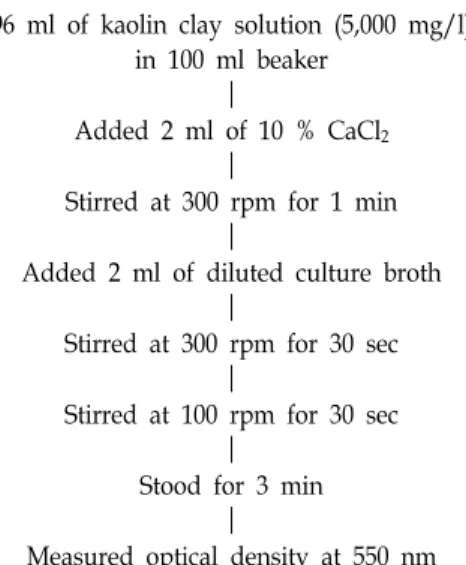
96 ml of kaolin clay solution (5,000 mg/l) in 100 ml beaker
Added 2 ml of 10 % CaCl2
Stirred at 300 rpm for 1 min
Added 2 ml of diluted culture broth
Stirred at 300 rpm for 30 sec
Stirred at 100 rpm for 30 sec
Stood for 3 min
Measured optical density at 550 nm
Fig. 1. Procedure of flocculating activity measurement.
stated, measurements were carried out at 25℃ with the sam- ple volume of 8 ml. A high performance liquid chromatog- raphy (HPLC) (LC10, Shimadzu, Japan) equipped with PL-GFC 1000Åcolumn (8 μ, 10×325 mm) (Polymer Laboratory, U.S.A.) and refractive index detector (RID-6A, Shimadzu, Japan), was employed for investigating the molecular weight (MW) distribution of Biopol32. Ten microliters of the sample solution were injected and eluted with HPLC grade water at a flow rate of 1 ml/min at room temperature. The molec- ular weight markers used were dextrans (Sigma Chem. Co., U.S.A.) of 2,000, 580, 143, 73, and 15 kDa. The molecular weight of Biopol 32 was determined by comparing its re- tention time with those of the standards.
Preparation of Biopol32 hydrolysate
Purified Biopol32 was dissolved in 20 ml of distilled, de- ionized water (ddH
2O, 0.2%, w/v) and then hydrolyzed at 121℃ for 1 hr after adding an equal volume of 4.0 M tri- fluoroacetic acid (TFA). Insoluble materials were removed by centrifugation at 35,000× g for 30 min and supernatant was filtered through a 0.2-μm pore-size filter. The filtrate was dried on Speed Vac and redissolved in ddH
2O. ). The completely remove residual TFA, this procedure was re- peated 4 times. For thin-layer chromatographic (TLC) analy- sis of the TFA-hydrolysate, the TLC plate used was plate coated with silica gel as the solid support and detection re- agent used was the mixture contained diphenylamine, ani- line and phosphoric acid. The loading volume of standard sugars was conducted by 20 μl of standard sugar solution (1%, w/v) and separating solvent system was acetonilrile (HPLC grade) : water (HPLC grade), 85 : 15 (v/v). The com- ponent test of TFA-hydrolysate was performed by HPLC (LC10, Shimadzu, Japan) fitted with refractive index detector. The sugar components of the hydrolysate was ana- lyzed byμ-spherogel carbohydrate column 6.5 mm×300 mm (Beckman Co. U.S.A.). The solvent was HPLC grade water and injection volume was 20 μl. The flow rate of solvent was 0.5 ml/min and the operating temperature was 80℃.
Measurement of flocculating activity
To measurement of flocculating activity was based on the flocculation process of wastewater treatment, and adjusted to laboratory the procedure, as depicted by Fig. 1. Standard substance used was kaolin clay (Junsei chemical Co.) and flocculating activity was investigated by flocculation of kao- lin clay suspended solution by multi-point stirrer (PMC in-
dustries Inc.). Flocculating activity was measured as optical density of supernatant at 550 nm by spectrophotometer (UV-160A, Shimadzu, Japan) and the calculation of flocculat- ing activity was based on the following equation. The control was treated with distilled water and the sample was treated with the supernatant of culture broth.
Flocculating activity = 1/A - 1/B
Where A is the optical density of sample and B is that of a control.
Flocculation test for industrial wastewater
For the evaluation of industrial applicability of Biopol32, the flocculating efficiency was examined using industrial wastewater such as food wastewater, textile wastewater and paper waste water. Food wastewater, textile wastewater and paper waste water were analyzed before use for flocculating test. The chemical oxygen demand (COD) and suspended solid (SS) of food wastewater were 5,480 mg/l and 1,028 mg/l, respectively. The COD and SS of textile waster were 289 mg/l and 153 mg/l. The those of paper wastewater were 254 mg/l and 89 mg/l, respectively. And the flocculation conditions of Biopol32 was optimized for each wastewater.
Results and Discussion
Screening of the extracellular polysaccharide- producing bacteria
For the screening of extracellular polysaccharide-produc-
ing bacteria, more than 82 bacterial strains which excreted
mucous material on the agar plate of the screening medium
Table 1. Taxonomic properties of strain GP32
Characteristics Strains GP32
Morphological Gram staining Shape
Size (cell diameter, μm) (cell length, μm) Flagella number Spore
Motility Acid fast Cultural Colony color Growth in air Growth anaerobically Growth at 4℃
Growth at 25℃
Growth at 40℃
Growth at 50℃
Growth at 7% NaCl Physiological
Catalase Oxidase
O/F (Oxidation/Fermentation) Carbohydrates, acid form glucose
fructose lactose sucrose xylose inositol
Gelatin liquefaction Starch hydrolysis Voges-Proskuer reaction Nitrate reduction Indole reduction Urase
Chemical
Mol% G+C of DNA
- rod 0.6~0.8 1.5~3.0
1
-
+
-
yellow-tinge
+
-
+
+
+
-
-
+
+ O
+
+
-
+
+
+
+
-
-
+
-
+
62
1 2 3 4 5 6 7 8 9
Carbon source
Cell concentration (g-DCW/l)
0.0 0.5 1.0 1.5 2.0 2.5 3.0
Polysaccharide concentration (g/l)
0 2 4 6 8 10
Fig. 2. Effect of carbon sources on the extracellular poly- saccharide. Carbon sources were added to the basal me- dium at the concentration of 20 g/l. Initial pH and tem- perature were at 7.5 and 32℃, respectively. The num- bers : 1(None), 2(glucose), 3(fructose), 4(galactose), 5(mannose), 6(Rhammnose), 7(Lactose), 8(sucrose), 9(soluble starch). The symbols : (□) cell concentration, (■) : polysaccharide concentration.
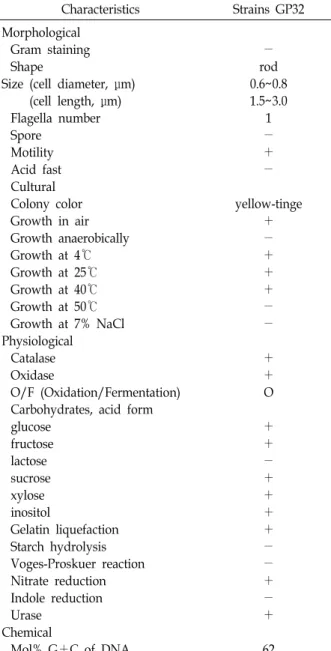
were isolated from soil samples. A mucoid colony on the agar plate presumed extracellular polysaccharide producer was cultured in 50 ml of the liquid culture. For selection, materials produced from each isolate were tested for vis- cosity and extracellular polysaccharide productivity. Among the materials tested, mucoid from the strain GP32 showed the highest viscosity (4,170 cp) and extracellular poly- saccharide production (5.61 g/l-broth). From these results, strain GP32 was selected to be the most suitable candidate as a practical biopolymer producer. The morphological and physiological characteristics of strain GP32 were inves- tigated (Table 1). Colony types on common solid medium were large, convex and yellow tinge. Strain GP32 was rod
shaped (0.6~0.8×1.5~3.0 μm) and Gram-negative. Growth oc- curred at 4℃, 25℃, and 40℃ but not at 50℃. The isolated strain was able to liquefy gelatin and to form nitrate. The strain showed a negative reaction in Voges-Proskauer, starch hydrolysis and indol reduction, and produced acid from glu- cose, fructose, sucrose, xylose and inositol. The mole% G plus C of the DNA of strain GP32 was found to be 62%
; the mol% G plus C of the DNA of Pseudomonas sp. ranges from 59 to 68 mole% [18]. When the keys to the genera listed in Bergey’s Manual [18] were traced on the basis of the these results, strain GP32 was identified as Pseudomonas species, and designated as Pseudomonas sp. GP32.
Effect of carbon and nitrogen sources on the ex- tracellular polysaccharide production
Carbon and nitrogen sources is the important factor in production of extracellular polysaccharide by micro- organisms [14, 28]. The assimilation of various carbon and nitrogen sources by as Pseudomonas sp. GP32 was examined in the flask culture. To find a suitable carbon source for the extracellular polysaccharide production, Pseudomonas sp.
GP32 was cultivated in the medium containing various car- bon sources such as glucose, fructose, sucrose, galactose, lac- tose, mannose, rhamnose and soluble starch. Each carbon source was added to the medium at a concentration 20 g/l.
When the cells were grown in the galactose containing me-
dium, the extracellular polysaccharide production (7.8 g/l)
was the highest among those tested (Fig. 2). On the other
C/N ratio
0.0 20.0 40.0 60.0 80.0 100.0
Cell concentration (g-DCW/l)
0.0 1.0 2.0 3.0 4.0 5.0
Polysaccharide concentration (g/l)
0 5 10 15 20
Apparent viscosity (cp)
0 2000 4000 6000 8000
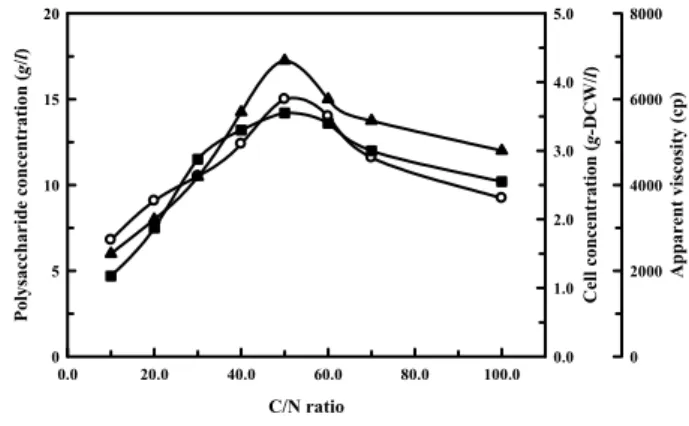
Fig. 3. Effect of C/N ratio on the extracellular polysaccharide production. Cells were incubated with shaking at 32℃
for 3 d in the culture medium containing (NH4)2SO4 of various concentration. Symbols : (○) cell concentration, (■) polysaccharide concentration, (▲) apparent viscosity.
hand, fructose, mannose, sucrose and rhamnose we not much favorable for either extracellular polysaccharide pro- duction or cell growth. Therefore, galactose was used as the carbon source for extracellular polysaccharide production.
Glucose and galactose have been reported to be good sub- strates for extracellular polysaccharide production Alcaligenes cupidus KT201 [26]. We further examined the effect of carbon concentration on the extracellular polysaccharide production since there have been reported broad ranges of optimal con- centration depending on the microorganisms [8]. The effec- tive concentration of galactose on the extracellular poly- saccharide production was investigated with culture me- dium containing 10, 20, 30, 40, 50, and 60 g/l. The concen- tration of nitrogen source (NH
4NO
3) was fixed to 1.0 g/l.
The highest extracellular polysaccharide production (10.9 g/
l) was reached at 30 g/l galactose and cell concentration was 2.8 g/l. The addition of more than 40 g/l galactose de- pressed the production of extracellular polysaccharide. As nitrogen sources were the important factor in extracellular polysaccharide biosynthesis and cell growth [28], the effect of nitrogen sources on extracellular polysaccharide pro- duction and cell growth were investigated. Extracellular pol- ysaccharide production and cell growth was maximum with (NH
4)
2SO
4, and nitrogen source was determined as (NH
4)
2SO
4, The nitrogen sources for Pseudomonas sp. GP32 differed from the nitrogen source (NH
4NO
3) for Paecilomyces sp. [25] and Zoogloea MP6 [27].
In general, extracellular polysaccharide production is fav- oured by a high ratio of carbon to nitrogen in many bacterial species and also in some fungi [27]. Production of ex- tracellular polysaccharide was greatly influenced and stim- ulate by the limitation of nitrogen sources [1]. In order to determine the optimum carbon to nitrogen ratio for the pro- duction of extracellular polysaccharide by Pseudomonas sp.
GP32, several media containing different C/N ratio with (NH
4)
2SO
4as a nitrogen source were investigated. Initial C/N ratios were adjusted to 10, 20, 30, 40, 50, 60, 70, 80, 90, and 100. The concentration of galactose was fixed to 30 g/l. The effects of C/N ratio on cell growth and extracellular polysaccharide production of Pseudomonas sp. GP32 are summarized in Fig. 3. The optimum C/N ratio for ex- tracellular polysaccharide was obtained at around 50.
Production of extracellular polysaccharide was greatly influ- enced and stimulated by the limitation of nitrogen sources.
Consequently, it appears that the extracellular poly- saccharide may have been produced under the condition of
nitrogen limitation. This result suggests that the ratios of extracellular polysaccharide to cell is maintained high under the condition of relatively low nitrogen. Similar patterns have been also observed with other extracellular poly- saccharides [15, 21].
Batch Fermentation for extracellular polysaccharide production
While the growth conditions of Pseudomonas sp. GP32 was similar to that of general bacteria as slightly acidic and neu- tral ranges of pH and mesophiles, the growth ranges of Pseudomonas sp. GP32. was as pH 5~9 and 25~35℃. The opti- mum medium at the flask level for the production of ex- tracellular polysaccharide was as follows : 30 g/l galactose, 0.6 g/l (NH
4)
2SO
4, 1.5 g/l K
2HPO
4, 0.08 g/l KH
2PO
4, 0.15 g/l MgSO
4∙7H
2O, 0.1 g/l MnSO
4∙4~5H
2O, 0.05 g/l NaCl.
The initial pH was 7.5 and the culture temperature was 32℃.
By using this medium, the extracellular polysaccharide was
produced in a yield 2.8 fold higher than that with the basal
medium. To examine the pattern of the extracellular poly-
saccharide production in detail, batch fermentations were
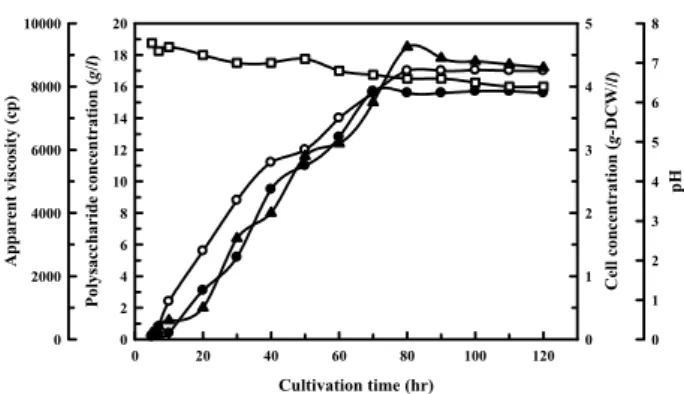
carried out in a jar fermentor (Fig. 4). In the jar-fermentor
culture, the culture broth became progressively viscous with
the production of extracellular polysaccharide. The cell con-
centration increased gradually with the extension of culti-
vation time and reached the maximum value of 4.25 g/l after
80 hr of cultivation. The concentration of extracellular poly-
saccharide increased in proportion to the increasing cell con-
centration and reached the maximum level of 15.7 g/l after
70 hr of cultivation. It was apparent that extracellular poly-
saccharide by Pseudomonas sp. GP32 was definitely
Cultivation time (hr)
0 20 40 60 80 100 120
Cell concentration (g-DCW/l)
0 1 2 3 4 5
Polysaccharide concentration (g/l)
0 2 4 6 8 10 12 14 16 18 20
Apparent viscosity (cp)
0 2000 4000 6000 8000 10000
pH
0 1 2 3 4 5 6 7 8
Fig. 4. Change of extracellular polysaccharide and apparent vis- cosity according to the culture time in a jar fermentor.
Cells were incubated at 32℃ for 120 hr in the optimized medium. An optimized medium contained 30 g/l gal- actose, 0.6 g/l (NH4)2SO4, 1.5 g/l K2HPO4, 0.08 g/l KH2PO4, 0.15 g/l MgSO4∙7H2O, 0.1 g/l MnSO4∙ 4~5H2O, 0.05 g/l NaCl. The initial pH was maintained at 7.5. Symbols : (○) cell concentration, (●) poly- saccharide concentration, (▲) apparent viscosity, (□) pH.
Retention time (min)
5.0 5.5 6.0 6.5 7.0 7.5 8.0 8.5 9.0
Molecular weight (Dalton)
103 104 105 106 107 108
Fig. 5. Estimation of molecular weight of Biopol32 by gel-per- meation HPLC with PL-GFC column. Symbols : (○) Biopol32 (▼) 2,000 kDa, (△) 580 kDa, (■) 143 kDa, (□) 73 kDa, (◆) 15 kDa.
growth-dependent. This result indicates that the concen- tration of extracellular polysaccharide from Pseudomonas sp.
GP32 is much higher than that of other polysaccharide pro- ducing microorganisms [2, 23]. The viscosity of the culture broth at that time was 92,600 centipoise. The production of extracellular polysaccharide by Pseudomonas sp. GP32 was parallel to cell concentration, a large amount of extracellular polysaccharide was released at the exponential phase. In the case of Rhodococcus erythropolis, an extracellular poly- saccharide appears to be released into the culture broth in proportion to cell growth in the stationary phase [10]. These results suggested that the production mechanism of ex- tracellular polysaccharide of those microorganisms might be different.
Molecular weight and sugar component of Biopol32 The extracellular polysaccharide produced by Pseudo- monas sp. GP32 was purified by ethanol precipitation and cetylpyridinium chloride (CPC) precipitation and gel per- meation chromatography. The purified extracellular poly- saccharide were combined and lyophilized (the final prepa- ration was designated Biopol32). The molecular weight of Biopol32 was estimated by high performance gel permeation chromatography with dextrans as standards. Biopol32 is ex- tremely high molecular weight carbohydrate polymer and was measured about 3×10
7Da by comparison with standard dextrans (Fig. 5). Generally, the molecular weight of a poly- saccharide is related to the chain length of the polymer,
which is an important factor in the industrial applications.
The molecular weight of Biopol32 in present study is similar to that of extracellular polysaccharide from Penibacillus sp.
[20].
For component sugars analysis of Biopol32, chromato- graphic analysis was conducted after complete hydrolysis and the result was compared with authentic sugar standards.
The acid hydrolysate was subjected to the thin layer chroma- tography (TLC) analysis. The loading volume of standard sugars was conducted by 20 μl of standard sugar solution (1%, w/v) and the separating solvent system was acetonitrile : water (85 : 15, v/v). The constituent sugars by TLC were determined as galactose, glucose, galactounonic acid and glucouronic acid. High performance liquid chromatography (HPLC) of Biopol32 was conducted after complete hydrol- ysis. As shown in Fig. 6, Biopol 32 was found to be hetero- polysaccharide composed of galactose, glucose, glucouronic acid and galactouronic acid. The molar ratios of galactose, glucose, glucouronic acid and galactouronic acid were ap- proximately 1.85 : 3.24 : 1.00 : 1.42.
Apparent viscosity of the extracellular polysaccharide
Apparent viscosity of polysaccharides is an important
functional property in fluid. The study of apparent viscosity
has practical significance in relation to process engineering,
new product development, and quality control. Changes in
apparent viscosity can be used to monitor the changes in
physicochemical interactions between polysaccharide or
conformational changes of component in solution of dis-
persion [6]. Among the rheological properties, apparent vis-
A
B
Fig. 6. Sugar component analysis of Biopol32 hydrolysate. A : HPLC chromatogram of standard carbohydrate, B : HPLC chromatogram of TFA-hydrlyzed purified Biopol 32. (Peak 1) glucouronic acid, (Peak 2) galactouronic acid, (Peak 3) glucose, (Peak 4) galactose.
Shear rate (1/sec)
1 10 100
Apparent viscosity (cp)
10 100 1000 10000
Fig. 7. Relationship between shear rate and apparent viscosity at the different concentration of Biopol32 from Pseudomonas sp. GP32 and zooglan from Zoogloea ramigera. Symbols : (◆) 0.05 % Biopol32, (◇) 0.05% zoo- glan, (▼) 0.1% Biopol32, (▽) 0.1% zooglan, (■) 0.2%
Biopol32, (□) 0.2% zooglan, (▲) 0.3% Biopol32, (△) 0.3%
zooglan, (●) 0.5% Biopol32, (○) 0.5% zooglan.
cosity is an important factor which can measure rheological characteristics of polymer solutions. The characteristic flow behavior of the Biopol32 solution has been studied in com- parison with the zooglan solution form Zoogleoa ramigera.
The Biopol32 solution and zooglan solution were pseudo- plastic non-Newtonian fluids at concentrations above 0.05 g/l, respectively. Fig. 7 shows a plot of an apparent viscosity
against the shear rate with varying concentrations of Biopol32. At each shear rate, the apparent viscosity of the extracellular polysaccharide solution was found to be about 3 times higher than the zooglan solution at each concen- tration. The values of apparent viscosity of different types of polysaccharides are remarkably different at the same concentration. It was proposed to be determined according to structural differences such as molecular weight, dis- tribution of side chains, charge density, and shape of the linkage [16]. Apparent viscosity of Biopol32 solution de- creased rapidly with increasing shear rate at all concen- trations tested. A decrease in apparent viscosity with an in- crease in shear rate may indicate the degree of orientation of the molecule, the change in the shape of flexible mole- cules, and the effect of flow on intermolecular interaction.
The thixotropic effect is more dominant at higher concen- trations of extracellular polysaccharide. These phenomena indicated that Biopol32 and zooglan had the highest degree of pseudoplasticity, identified as shear thining, among the characters of non-Newtonian fluids. The effect of the shear rate on apparent viscosity is greater than on that of zooglan, indicating that the Biopol32 molecule is highly charged and asymmetric. From these rheological properties, Biopol32 can be considered to be a new polysaccharide which shows a high apparent viscosity. It has several important properties such as a high viscosity at low concentrations, low viscosity at high shear rates, and high viscosity at low shear rates.
Flocculating activity of the extracellular polysaccharide
Many different flocculants have been used in wastewater
treatment and down stream processing techniques. The cul-
ture broth of Pseudomonas sp. GP32 was tested for its ability
to flocculate kaolin clay. Pseudomonas sp. GP32 was showed
high flocculating activity (flocculating activity (1/O.D) ; 6.23)
on the test material. To elevate the industrial applicability
of Biopol32, its flocculating efficiency was examined using
wastewaters from the food, textile, and paper industries. In
a jar test, coagulation and flocculation were accomplished
at room temperature. The reagent dosing, mixing
(destabilization), and the subsequent sedimentation (phase
separation) took place in the same reaction chamber. The
efficiency of the flocculation process in the jar test was eval-
uated on the basis of the chemical oxygen demand (COD)
and suspended solids (SS) before and after treatment. The
optimized condition and treatment efficiency on the food,
textile, and paper wastewater were shown Table 2, re-
Table 2. Flocculation effect on the treatment of industrial wastewater of extracellular polysaccharide from Pseudomonas sp. GP32
Wastewater Food wastewater Textile wastewater Paper wastewater
Optimal Treatment condition Coflocculant CaCl2 concentration Flocculant Concentration Flocculation efficiency COD reduction rate SS removal rate
15.0 mM 15.5 mg/l
58.4%
87.2%
17.0 mM 21.3 mg/l
47.7%
82.6%
12.0 mM 2.0 mg/l
67.3%
91.3%
spectively. The sorts and concentration of Biopol32 and co- flocculant depend on the sorts of wastewater and at the opti- mal treatment condition, the concentration of each Biopol32 was 15.5 mg/l (food wastewater), 21.3 mg/l (textile waste- water), and 2.0 mg/l (paper wastewater) and the concen- tration of each coflocculants was 15.0 mM CaCl
2·2H
2O (food wastewater), 17.0 mM CaCl
2·2H
2O (textile wastewater), and 12.0 mM CaCl
2·2H
2O (paper wastewater). As shown in Table 2, the flocculating efficiency of Biopol32 in food wastewater was showed COD reduction rate (58.4%) and SS removal rate (87.2%). In case of textile wastewater, the COD reduc- tion rate and SS removal rate of Biopol32 was 47.7 % and 82.6%, respectively. In case of paper wastewater, COD re- duction rate was 67.3% and SS removal rate was 91.3%.
Based on these results, extracellular polysaccharide (Biopol32) from Pseudomonas sp. GP32 was applicable con- sidered a possible candidate for industrial application.
Acknowledgement
This work was supported by a Research Grant of Gyeongnam National University of Science and Technology (2014 year).
References
1. Andrew, J. R., Drozd, J. W., Jones, C. W. and Linton, J. D.
1988. Growth efficiency of Xanthomonas compestris in con- tinuous culture. J. Gen. Microbiology 134, 1055-1061.
2. Ashtaputre, A. A. and Shah, A. K. 1995. Studies on a vis- cous, gel-forming exopolysaccharide from Sphingomonas paucimobilis GS1. Appl. Environ. Microbiol. 61, 1159-1162.
3. Becker, A., Katzen, F., Puhler, A. and Lelpi, L. 1998. Xanthan gum biosynthesis and application : A biochemical/genetic prospective. Appl. Microbiol. Biotechnol. 50, 145-152.
4. Chaplin, M. F. and Kennedy, J. F. 1968. Phenol-sulfuric acid assay. p. In M. F. Chaplin and J. F. Kennedy (eds), Carbohydrate Analysis : A Practical Approach. IRL Press, Washington, DC., U.S.A.
5. Chen, R. H., Ker, Y. C. and Wu, C. S. 1990. Temperature
and shear rate affecting the viscosity and secondary struc- tural changes soy 11S globulin measured by a cone-plate viscometer and fourier transform infrared spectroscopy.
Agric. Biol. Chem. 54, 1165-1176.
6. Crescenzi, V. 1995. Microbial polysaccharides of applied in- terest : On going research activities in Europe. Biotechnol.
Prog. 11, 251-259.
7. Dearfield, K. L. and Ambermathy. 1988. Acrylamide its me- tabolism, development and reproductive effects, genotox- icity, and carcinogenicity. Mutant Res. 195, 45-77.
8. Kennedy, J. F. and Bradshow. 1984. Progress in industrial microbiology. Bushell, M. E. (ed.) Elsevier. 19, 319-365.
9. Kurane, R., Takeda, K. and Suzuki, T. 1986. Screening for and characteristics of microbial flocculants. Agr. BIol. Chem.
50, 2301-2307.
10. Kurane, R., Toeda, K., Takeda, K. and Suzuki, T. 1986.
Culture conditions for production of microbial flocculant by Rhodococcus erythropolis. Agric. Biol. Chem. 50, 2309-2313.
11. Lawson, C. J. and Shurtland, I. W. 1978. Polysaccharides, pp. 327-397, Rose, A. H. (ed), Economic Microbiology, vol.
2, Academic Press, New York.
12. MacFaddin, J. F. 1984. Biochemical tests for identification for medical bacteria. 2nd eds,.Williams & Wilkins Co., Baltimore, Maryland.
13. Margaritis, A. and Pace, G. W. 1985. Micorbial polysaccha- rides, pp. 1005-1044. In: Murray, M. Y. (ed.), Comprehensive Biotechnology, The principles, applications and regulations of bio- technology in industry, Agriculture and Medicine.
14. Marshall, K. and Weigel, H. 1980. Evidence of multiple branching in the levan elaborated by Streptococcus salivarius strain 51. Carbohyd. Res. 83, 321-326.
15. McNeil, B. and Kristanian, B. 1989. Temperature effect on pulluan formation by Aureobasidium pullulans in stirred tanks. Enzyme Microb. Technol. 12, 521-526.
16. Moorhouse, R. 1987. In M. Yalpany (ed.), Industrial poly- saccharide, Structure property relationships of family of mi- crobial polysaccharides, pp.187-206. Elsevier, Amsterdam.
17. Nohata, Y. and Kurane, B. 1993. Culture conditions for pro- duction and purification of bioabsorbent from Acaligenes la- tus B-16. J. Ferment. Bioeng. 77, 390-393.
18. Peter, H. A. S., Nicholas, S. M., Sharpe, M. E. and Holt, J. F. 1986. Bergey's manual of systematic bacteriology, Williams and Wikins Co., Baltimore, Maryland.
19. Rehm, B. H. A. and Valla, S. 1997. Bacterial alginates : Biosynthesis and application. Appl. MIcrobiol. Biotechnol. 48,
초록: Pseudomonas sp. GP32에 의해 생산된 세포 외 다당류의 생산 및 특성
이명은․이현돈․서현효*
(국립경남과학기술대학교 환경공학과)
미생물유래 다당류 생산균주를 분리하기 위해 전국 각지의 토양시료로부터 가장 높은 점성과 다당류 생산성을 나타내는 균주 GP32를 분리하였으며, 분리균주 GP32의 동정을 분리균주의 형태학적, 생리학적 특성을 조사한 결 과, Pseudomonas 속 세균으로 확인되었으며 최종적으로 Pseudomonas sp. GP32로 명명하였다. 플라스크 수준에서 Pseudomonas sp. GP32의 다당류 생산을 위한 가장 적합한 탄소원과 질소원은galactose와 (NH
4)
2SO
4를 이용하였을 때 가장 많은 다당류를 생산하는 것으로 확인되었으며, 다당류 생산을 위한 최적의 C/N ratio는 50이었다. 다당 류 생산을 위한 최적 pH와 온도는 각각 7.5와 32℃였다. 최적화된 배지를 이용한 fermentor 배양에서 다당류 생산 은 배양 70시간에 최고치를 나타내었으며, 이때 다당류 생산량은 15.7 g/l이었다. Pseudomonas sp. GP32로부터 생산된 다당류는 ethanol 침전, cetylpyridimium 침전과 gel permeation chromatography를 통하여 정제하였으며, 정제된 다당류는 Biopol32로 명명하였다. Biopol 32의 분자량은 3×10
7datons이었으며, Biopol32가 함유하고 있는 구성당은 galactose : glucose : gulcouronic acid : galactouronic acid 등이 1.85 : 3.24 : 1.00 : 1.42의 몰비로 함유되 어있다. Biopol32 용액은 의가소성 성질을 갖는 고분자 화합물로서 Zoogloea ramigera가 생산하는 생물고분자인 zooglan보다 모든 농도에서 높은 점성을 나타내었다. Biopol32의 실제 폐수처리현장에서 응집제로의 사용 가능성 을 검토하기 위하여 식품폐수, 섬유폐수와 제지폐수를 대상으로 응집효율을 조사한 결과, 높은 COD 감소율 (58.4~67.3%)과 SS제거율(82.6~91.3%)를 나타내어 실제 산업폐수에서 뛰어난 응집효율을 나타내었다.
281-288.
20. Seo, W. T., Kahang, G. G., Nam, S. H., Choi, H. H., Kim, S. W. and Park, Y. H. 1999. Isolation and characterization of a novel exopolsaccharide-producing Penibacillus sp. WN9 KCTC 8591P. J. Microbiol. Biotechnol. 9, 820-825.
21. Souw, P. and Demain, A. L. 1979. Nutritional studies on xanthan production by Xanthomonas compestris NRRL B1459.
Appl. Environ. Microbiol. 37, 1186-1192.
22. Speer, R. A. and Tung, M. A. 1986. Concentration and tem- perature dependence of low behavior of xanthan gum dispersions. J. Food. Sci. 56, 96-103.
23. Tait, M. I. Sutherland, I. W. and Clarke-Sturman, A. 1986.
Effect of growth condition on the production, composition and viscosity of Xanthomonas compestris exopolysaccharide.
J. Gen. Microbiol. 132, 1483-1492.
24. Tamaoka, K. and Komagata, K. 1984. Determination of DNA base composition by reversed-phase high-performance liq- uid chromatography. FEMS Microbiol. Lett. 25, 125-128.
25. Takagi, H. and Kadowaki, K. 1985. Purification and chem- ical properties of a flocculant produced by Paecilomyces.
Agric. Biol. Chem. 49, 3159-3164.
26. Toeda, K. and Kurane, R. 1991. Microbial flocculant from Alcaligenes cupidus KT201. Agric. Biol. Chem. 55, 2793-2799.
27. Unz, R. F. and Farrah, S. R. 1976. Exopolymer production and flocculation by Zoogloea MP6. Appl. Environ. Microbiol.
31, 623-626.
28. Williams, A. G. and Wimpenny, J. T. T. 1977. Exopolysac- charide production by Pseudomonas NCIB 11264 grown on batch culture. J. Gen. Microbiol. 102, 13-21.