ⓒ2010 The Korean Society of Dyers and Finishers 1229-0033/2010-12/306-313
Abstract― To achieve color diversification of natural dyeing, color mixture dyeing with Indigo and Japanese pagoda tree is applied to wool and silk fabrics. After dyeing with Japanese pagoda tree extract solution of 5~25%(o.w.f.), the indigo dyeing was carried out up to four times. Alternatively after repeat dyeing with indigo one to seven times, the dyeing with Japanese pagoda tree extract solution was applied in 5 steps(5~25%). In color mixture dyeing, the dye uptake of wool fabrics appears higher than that of silk. The sequence of Japanese pagoda tree extract dyeing after Indigo dyeing was generally higher dye uptake compared with that of Indigo dyeing after Japanese pagoda tree extract dyeing. For wool and silk fabric, the pre-dyeing with Japanese pagoda tree solution was more effective for color diversification but the pre-dyeing with Indigo was more effective for the exhibition of intermediate color shade.
Keywords: wool, silk, Indigo, Japanese pagoda tree, K/S value
Fabric Dyeing with Indigo and Japanese pagoda tree for Color mixture (Ⅱ)
‐- Treatment on Protein Fibers -
Sun Young An, Jung Sook Bae and Man Woo Huh
1,†Dept. of Fashion Design, Daegu University
1Dept. of Textile & Fashion Technology, Kyungil University
(Received: November 10, 2010/Revised: December 9, 2010/Accepted: December 21, 2010)
1. Introduction
Dyeing is a means of expressing human-beings;
decorational instinct and beauty, and natural dyestuff has mainly been used before synthetic dyestuff development. As an eco-friendly material, natural dyestuff has merits of nature conservation, value adding of dressing, appliances of natural resource, and so on. Color material extracted from existing animals, plants and minerals in nature has been used for natural dyeing, and it bears the marks of age in Korea. Because natural dyeing material is usually extracted from plants, it has many functional merits such as anti- bacterial activity, deordorization and anti-a llergic activity. Thus, research on natural dyeing materials has recently increased in order to decrease harm due to dyeing wastewater and water pollution which come out of synthetic dyeing material. In addition to the merits, natural dyeing material can achieve different color effects from synthetic material's effects. But, we may have more difficulty storing and extracting natural materials than synthetic ones. Among many difficulties for
†Corresponding author. Tel.: +82-53-850-7204; Fax.: +82-53-850-7605; e-mail: [email protected]
industrialization of natural dyeing material, various color realization and its reproducibility have been the most important concern1-10).
Thus, in this research, mixture dyeing of Indigo's blue color and Japanese pagoda tree's yellow color were applied to cotton and linen which are natural cellulose fibers, and to rayon which was a reproduced cellulose fiber3). After that, color changes of natural material in those cellulose textile were checked for color diversi- ficational possibility. Mixture dyeing of Indigo and Japanese pagoda tree's colors to wool and silk was done to find color diversificational and representational possibility of green color, which is the intermediate color of Indigo's blue and Japanese pagoda tree's yellow.
2. Experimental
2.1 Specimens and Dyeing material
2.1.1 SpecimensSilk, which was purchased in Sombe, was used for this research after scouring, and wool, which was also purchased in Sombe, was used without
Material Weave Density(/inch2) Weight
(g/㎡) Thickness
Warp Weft (㎜)
Wool plain 142 136 102±5 0.25±0.02
Silk plain 104 78 42±2 0.11±0.01
Table 1. Characteristics of fabrics
scouring. Scouring of silk was processed with 5%(o.w.f.) power soap and 8%(o.w.f.) Na2CO3 in the conditions of bath ratio 1:50, treated tem- perature 95∼100℃ and 1 hour scouring treatment.
Each fabric sample's characteristic is shown in Table 1.
2.1.2 Dyeing material
To achieve specifically quantified dyeing conditions and color reproduction, Japanese pagoda tree's extracted powder was purchased from Mikwang International Co. Ltd. and Indigo powder was purchased in Sombe.
2.2 Experimental methods
2.2.1 Preparation of dyeing solution
After dissolving Na2S2O4 (Sodium Hydrosulfite) 5g in distilled water 1ℓ of temperature 35~40℃, fermented and dried Indigo powder 2.5g was put into the liquid and the Indigo dyeing solution's pH was adjusted to 11~12 pH mixed with NaOH 3g and the liquid was stirred for an hour and put for two hours in a normal condition. After that, only the upper liquid of the mixture was used as stock solution. Japanese pagoda tree's extracted powder which is adjusted to concentration range 5~25%(o.w.f.) was prepared and used.
2.2.2 Dyeing of Fabrics
Color mixture dyeing was fulfilled in two ways: (i) post-dyeing with Japanese pagoda tree with Indigo, and (ii) vice versa. In Indigo dyeing, Indigo's color covers the pre-dyed color in color mixture dyeing if concentration becomes higher.
So, to avoid this situation, concentration was diluted to lower levels as in 2.2.1. In addition, to check the possibility of color diversification to exhibit intermediate color of the two materials, mixture dyeing was done. Finally, repeated mixture
dyeing was also fulfilled to obtain an appropriate number of dyeing and concentration.
After dyeing uptake was done with Indigo under the conditions of bath ratio 1:50, treated time 10 minutes and room temperature, the treated fabric was washed with distilled water a few times.
After that, the fabric was oxidized until blue shade was obtained. After this processing, it was neutralized in solution of 0.1% acetic acid and washed enough.
The same dyeing processing was repeated in 1, 3, 5, and 7 times respectively. The result of this treatment ranges from light indigo color to 4 degreed deeper colors.
For Japanese pagoda tree dyeing, dyeing solution was prepared under the conditions of 5 different dye bath concentration[5. 10, 15, 20, 25%(o.w.f.)], and bath ratio 1:50. In this processing, when distilled water reached 40℃, the powder dyeing material was added and dissolved completely.
after that the dyeing the temperature of dye bath was raised up to 60℃ and, at the temperature, the fabric samples were dyed for 60 minutes.
2.3 Measurement and Analysis
2.3.1 K/S value measurementBy using Computer Color Matching System (Spectra Flash 600 Plus, Data Color Co. USA), dye uptake(henceforth, K/S) was calculated by standard reflectance obtained from a 400nm wavelength.
where, K : absorption coefficient of dyed material S : scattering coefficient of dyed material R : reflectance
2.3.2 color difference (ΔE) and H(V/C) measurement
By using Computer color matching system (Color Quest XE. Hunterlab. USA), color difference (henceforth, ΔE) and H(V/C) were measured in the colorimetric data L*, a*, b*.
3. Results and Discussion
3.1 Dyeing ability of wool and silk with Japanese pagoda tree according to concentration
Fig. 1 showed the results measured on apparant color which was obtained from woo and silk's dye uptake under the treating conditions of Japanese pagoda tree dyeing material 5~25% (o.w.f.), bath ratio 1:50, 60℃ and 60 minutes. Because K/S values were proportional to the concentration of dyeing material, dye uptake was higher as K/S values increased. For wool and silk, the higher the concentration of Japanese pagoda tree extract solution became, the more the amount of uptake became. The increasing amount of wool fabric's dye uptake was a little higher than that of silk's.
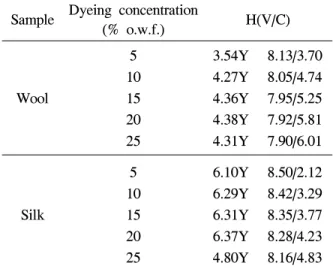
Table 2 showed H V/C Value of wool and silk fabrics according to change of dyeing con- centration. Each wool and silk fabric depending on each concentration was included in a range of all its Munsell color values within Y, and the whiteness of wool and silk got lower as the concentration of Japanese pagoda tree dyeing
Fig. 1. Relationship between K/S value and dye concentration of wool and silk fabrics(Japanese pagoda tree).
Sample Dyeing concentration
(% o.w.f.) H(V/C)
Wool
5 10 15 20 25
3.54Y 4.27Y 4.36Y 4.38Y 4.31Y
8.13/3.70 8.05/4.74 7.95/5.25 7.92/5.81 7.90/6.01
Silk
5 10 15 20 25
6.10Y 6.29Y 6.31Y 6.37Y 4.80Y
8.50/2.12 8.42/3.29 8.35/3.77 8.28/4.23 8.16/4.83 Table 2. H V/C Value of wool and silk fabrics according to change of dyeing concentration
solution for both wool and silk became higher.
Chroma got a tendency to increase as dyeing concentration increased.
3.2 Dye ability of wool and silk in repeated dyeing with Indigo dyeing solution
Fig. 2 showed changes of dye uptake when wood and silk were dyed repeatedly until 7 times with Indigo dyeing solution under the conditions of bath ratio 1:50 and treated 10 minutes at room temperature. From the results of Fig. 1, we figured out that, although K/S value of wool increased according to dyeing repeated times, the degree of K/S value increase became less after three times of repeated dyeing than before three times. For silk fabric, the K/S values increased a little before 5 repeated times, but decreased after 5 times. When we checked dye uptake according to repeated dyeing, wool fabric showed higher dye uptake than silk fabric. It was thought that, even though wool and silk fabrics all have amide and amino groups, wool has relatively more dye uptake site than silk due to its fine structure.
Table 3 show the results of repeated dyeing with Indigo until 7 times in order to obtain H V/C value difference of wool and silk fabrics. As the number of dyeing times increased, whiteness got a tendency to decreased and chroma got a tendency increased.
Fig. 2. Relationship between repeating times of the indigo dyeing and K/S value of wool and silk fabrics.
Sample Repeating times H(V/C)
Wool
1 3 5 7
9.37B 0.59PB 0.68PB 0.99PB
6.13/3.88 5.06/4.67 4.77/4.71 4.50/4.72
Silk
1 3 5 7
7.28B 7.46B 7.71B 7.17B
6.91/4.99 6.57/5.27 6.44/5.21 6.54/5.42 Table 3. H V/C value of dyed wool and silk fabrics for different repeating times of the indigo dyeing
3.3 Dye ability of mixture dyed fabrics in the treatment order of Indigo post-dyeing after concentration-leveled Japanese pagoda tree
To mix up Indigo and Japanese pagoda tree colors, two ways were tried in the following orders: (i) post-dyeing with Indigo after Japanese pagoda tree, and (ii) vice versa. Fig. 3 and 4 show changes of dye uptake of wool and silk when post-dyeing with Indigo was fulfilled to the fabrics pre-treated with Japanese pagoda tree of 5-leveled concentration under the conditions of treated temperature 60℃, and treated time 60 minutes. When the repeated time of Indigo were constant, dye uptake of both wool and silk increased as the concentration of Japanese pagoda tree's solution was raised. On the other hand, dye uptake showed different results depending on which fabric was dyed according to the number of the repeated times of Indigo dyeing when the
concentration levels of Japanese pagoda tree's solution was constant. Therefore, we observed that K/S value of silk reached the highest in the conditions of concentration of Japanese pagoda tree 25%(o.w.f.), and one time dyeing with Indigo.
That is, the higher concentration level of Japanese pagoda tree solution was raised and the less the repeated times of Indigo dyeing was, the higher K/S values were achieved. Considering dye uptake of each fabric, wool showed higher than silk.
Table 4 and 5 showed post-dyeing results of Indigo in 1~4 times for the treated wool and silk pre-dyed with Japanese pagoda tree solution of 5 different levels(5%~25%) in color dyeing con- centration. When Indigo solution was applied to the dyed fabrics with Japanese pagoda tree of 5 different levels of concentration, only one time Indigo dyeing caused the yellow color of pre- dyed fabric to disappear, so that either only the color of Indigo or the intermediate color, greenish
Fig. 3. K/S value of wool fabrics dyed with Japanese pagoda tree after indigo.
Fig. 4. K/S value of silk fabrics dyed with Japanese pagoda tree after indigo.
Dyeing concentration(% o.w.f.)
Repeating
times L* a* b* △E H(V/C)
Control - 89.51 -1.18 9.41 0.00 4.28Y(8.84/1.16)
5%
1 2 3 4
65.15 57.49 50.11 47.65
-11.32 -10.41 -8.98 -8.45
7.38 -1.72 -10.01 -11.22
26.47 35.13 44.61 47.23
1.46G(6.35/2.04) 5.40BG(5.58/2.09)
5.23B(4.86/3.14) 6.22B(4.62/3.30)
10%
1 2 3 4
64.15 56.20 49.86 48.20
-12.67 -12.41 -10.65 -10.01
0.05 6.21 -5.91 -7.72
29.37 35.30 43.55 45.58
3.5BG(6.25/2.35) 2.93G(5.45/2.30) 0.28B(4.83/2.66) 2.48B(4.67/2.83)
15%
1 2 3 4
61.88 54.73 51.54 48.27
-11.56 -12.82 -10.47 -10.99
24.76 12.96 -6.19 -4.54
33.27 36.84 42.08 44.62
3.47GY(6.02/3.71) 8.33GY(5.31/2.80) 0.78B(5.00/2.68) 8.52BG(4.68/2.54)
20%
1 2 3 4
62.27 55.14 51.00 48.18
-12.62 -12.76 -11.06 -12.70
28.03 17.38 -4.59 1.24
34.92 37.13 42.15 43.68
3.33GY(6.06/4.19) 6.44GY(5.35/3.19) 8.66BG(4.94/2.56) 0.44BG(4.67/2.47)
25%
1 2 3 4
62.13 54.97 51.00 48.58
-8.50 -11.75 -12.74 -12.13
32.79 21.86 5.17 -0.89
36.74 38.20 40.43 43.60
9.83Y(6.4/4.51) 4.52GY(5.33/3.51)
4.21G(4.94/2.43) 3.55BG(4.71/2.46) Table 4. Color values of wool fabrics dyed with Japanese pagoda tree after indigo
Dyeing concentration(% o.w.f.)
Repeating
times L* a* b* △E H(V/C)
Control - 91.13 -0.17 4.28 0.00 2.44Y(9.00/0.54)
5%
1 2 3 4
71.15 67.67 64.45 66.01
-14.90 -16.24 -15.75 -15.83
-10.00 -1.22 -16.29 -14.91
28.64 28.96 37.12 35.28
2.81B(6.95/3.97) 4.46BG(6.60/3.12)
5.08B(6.28/5.29) 4.59B(6.43/5.05)
10%
1 2 3 4
70.80 65.28 64.29 66.19
-17.15 -19.81 -17.20 -16.63
-8.65 9.37 -14.17 -12.74
29.47 32.86 36.75 34.39
0.91B(6.92/4.12) 3.43G(6.36/3.61) 3.66B(6.26/5.08) 3.33B(6.45/4.75)
15%
1 2 3 4
67.19 62.65 63.98 65.54
-19.30 -18.06 -18.36 -18.08
22.23 16.10 -12.12 -11.67
35.51 35.65 36.56 35.07
7.80GY(6.55/4.36) 9.50GY(6.10/3.71) 2.20B(6.23/4.86) 2.15B(6.39/4.76)
20%
1 2 3 4
69.76 66.87 63.95 66.21
-19.55 -19.66 -19.34 -19.34
3.84 -3.92 -10.24
-9.27
28.85 32.18 36.29 34.24
8.86G(6.81/3.54) 6.39BG(6.52/4.00)
0.71B(6.23/4.73) 0.21B(6.45/4.59)
25%
1 2 3 4
67.09 63.91 65.06 66.41
-16.17 -21.33 -20.10 -20.17
33.30 14.50 -6.20 -6.94
40.94 35.96 34.44 33.72
4.19GY(6.54/5.11) 1.24G(6.22/4.14) 7.95BG(6.34/4.30) 8.51BG(6.47/4.43) Table 5. Color values of silk fabrics dyed with Japanese pagoda tree after indigo
yellow or green, appeared. The fabrics of post- dyeing with Indigo after Japanese pagoda tree showed two peculiar effects: (i) various color representation distributed in the range of 6.22B~
9.83Y for wool and 2.81B~4.19GY for silk and (ii) effective intermediate color representation between Indigo blue and Japanese pagoda tree yellow.
3.4 Dye ability of mixture dyed fabrics with Japanese pagoda tree of leveled concentration after repeated pre-dyeing with Indigo
Fig. 5 and 6 showed changes of dye uptake for wool and silk when post-dyeing with Japanese pagoda tree of leveled concentration(5~25%) was applied to the fabrics pre-dyed with Indigo in 1~7 times. When the concentration of Japanese pagoda tree was constant, dye uptake of wool increased as the number of Indigo dyeing times was raised. On the other hand, dye uptake of silk showed trivial differences as Indigo dyeing was repeated. Especially, wool fabric showed big increase in dye uptake compared with the case of Indigo post-dyeing after Japanese pagoda tree pre-dyeing.
Compared with wool, silk showed lower dye uptake, because silk had lower amount of functional group that could do ion-bond.
Table 6 and 7 showed the results of post- dyeing with Japanese pagoda tree after repeated Indigo dyeing in 1-7 times. Deeply dyed fabrics obtained by doing 4 different repeated Indigo dyeing in 1, 3, 5 and 7 times were dyed with Japanese Indigo tree of 5~25% concentration levels in the conditions of treated temperature 60℃
and treated time 60 minutes, so that 20 color samples of each fabric were obtained. In the case of Indigo post-dyeing, H(V/C) value of wool ranged between 9.83Y~6.22B. In the case of Japanese pagoda tree post-dyeing, H(V/C) value of wool ranged between 8.82GY~0.92B and that of silk were between 0.69BG~5.33GY.
For wool and silk, the case of post-dyeing with Indigo after Japanese pagoda tree pre-dyeing showed better color diversification effect than the
case of vice versa treatment order. Regarding the intermediate color representation, the case of post- dyeing with Japanese pagoda tree after Indigo pre-dyeing resulted in better effects. Regarding repeated dyeing with Indigo and Japanese pagoda tree, less repeated times of Indigo and lower levels of Japanese pagoda tree concentration were preferred in order to save the dyeing material and to make dyeing easier.
Because the repeated dyeing with high con- centrated Indigo solution covered the existing whole surface color, less than 1~5 repeated times of Indigo pre-dyeing were performed to obtain various and intermediate color representational effects for both wool and silk. In the case of pre-dyeing with Japanese pagoda tree, the number of repeated times with Indigo was more effect in between 1 and 3 times, in order to obtain color diversification effect and various intermediate colors for both wool and silk.
Fig. 5. K/S value of wool fabrics dyed with indigo after Japanese pagoda tree.
Fig. 6. K/S value of silk fabrics dyed with indigo after Japanese pagoda tree.
Repeating times
Dye
concentration(% o.w.f.) L* a* b* △E H(V/C)
Control - 89.51 -1.18 9.41 0.00 4.28Y(8.84/1.16)
1
5%
10%
15%
20%
25%
60.57 61.74 60.86 61.22 58.73
-11.16 -12.74 -13.30 -13.83 -14.75
3.27 12.24 15.39 19.66 20.83
31.22 30.21 31.68 32.64 35.53
6.67G(5.89/1.99) 8.82GY(6.00/2.60) 7.49GY(5.92/2.94) 6.34GY(5.95/3.44) 6.39GY(5.70/3.73)
3
5%
10%
15%
20%
25%
50.64 50.14 49.35 49.55 49.85
-10.65 -12.92 -14.14 -15.23 -15.88
-3.23 1.56 5.86 9.38 11.83
41.95 41.83 42.34 42.36 42.36
7.17BG(4.91/2.31) 9.99G(4.86/2.50) 3.99G(4.78/2.71) 1.54G(4.80/3.04) 0.43G(4.83/3.28)
5
5%
10%
15%
20%
25%
48.12 47.38 46.58 47.02 46.37
-10.06 -11.64 -13.52 -14.54 -15.42
-5.36 -1.01 4.43 8.84 10.57
44.83 44.64 44.95 44.55 45.44
9.96BG(4.66/2.47) 3.71BG(4.59/2.37) 5.43G(4.52/2.60) 1.56G(4.56/2.91) 0.90G(4.49/3.16)
7
5%
10%
15%
20%
25%
45.33 45.16 45.14 44.19 44.11
-10.00 -12.40 -14.22 -14.93 -15.27
-6.30 -0.63 4.15 7.68 9.92
47.71 46.83 46.55 47.39 47.54
0.92B(4.40/2.59) 3.04BG(4.38/2.50)
6.16G(4.38/2.74) 2.33G(4.29/2.94) 1.15G(4.28/3.0) Table 6. Color values of wool fabrics dyed with indigo after Japanese pagoda tree
Repeating times
Dye
concentration(% o.w.f.) L* a* b* △E H(V/C)
Control - 91.13 -0.17 4.28 0.00 2.44Y(9.00/0.54)
1
5%
10%
15%
20%
25%
72.46 72.23 70.86 71.59 70.61
-8.56 -10.38 -11.53 -11.04 -12.17
5.02 10.13 11.63 18.18 20.89
20.48 22.26 24.36 26.32 29.00
2.13G(7.09/1.46) 8.83GY(7.06/2.02) 8.60GY(6.92/2.31) 5.55GY(7.00/2.85) 5.33GY(6.90/3.26)
3
5%
10%
15%
20%
25%
69.14 68.80 67.91 68.38 68.01
-8.85 -10.07 -11.33 -11.65 -12.95
1.12 7.43 9.82 13.75 15.07
23.85 24.62 26.35 27.18 28.53
0.69BG(6.75/1.56) 0.70G(6.72/1.83) 9.60GY(6.63/2.16) 7.42GY(6.67/2.51) 7.53GY(6.64/2.80)
5
5%
10%
15%
20%
25%
67.37 67.05 65.69 66.42 65.90
-7.89 -9.40 -11.78 -12.24 -12.69
-1.86 2.76 9.44 11.07 13.60
25.72 25.83 28.43 28.33 29.66
7.16BG(6.57/1.59) 6.81G(6.54/1.62) 0.09G(6.40/2.21) 9.29GY(6.47/2.40) 8.08GY(6.42/2.66)
7
5%
10%
15%
20%
25%
68.85 68.55 68.47 68.42 68.23
-8.42 -10.35 -11.77 -12.41 -12.42
-1.54 5.38 9.76 13.78 16.69
24.46 24.79 26.04 27.49 28.78
6.44BG(6.72/1.65) 2.90G(6.69/1.78) 9.92GY(6.68/2.22) 7.87GY(6.68/2.62) 6.68GY(6.66/2.90) Table 7. Color values of silk fabrics dyed with indigo after Japanese pagoda tree
4. Conclusions
To achieve mixture dyeing we used Indigo's blue color and Japanese pagoda tree's yellow color. For stock solutions, we made four different concentration levels for Indigo, and five levels for Japanese pagoda tree. By using these stock solutions, we assessed the dyeability of wool and silk fabrics. The results were as followed:
1. The dye uptake of sample fabrics dyed with Japanese pagoda tree's extract solutions was higher for wool than for silk. The dye uptake of sample fabrics repeatedly dyed with Indigo was also higher for wool than for silk.
2. In color mixture dyeing the dye uptake of each dyeing appeared higher for wool than for silk. The sequence of Japanese pagoda tree dyeing after Indigo dyeing appeared higher dye uptake than that of Indigo dyeing after Japanese pagoda tree dyeing in overall. Especially for wool fabric, the dyeing of Japanese pagoda tree after Indigo dyeing showed far more dye uptake than the reverse sequential dyeing.
3. In the mixture dyeing with Indigo and Japanese pagoda tree, the range of diverse color dis- tribution increased in the case of Japanese pagoda tree dyeing after Indigo, when com- pared with the order of Indigo dyeing after Japanese pagoda tree. I concluded that, in color mixture dyeing, pre-dyeing with Japanese pagoda tree solution was more effective for color diversification for wool and silk fabric, but pre-dyeing with Indigo was more effective for intermediate color shade exhibition.
Acknowledgements
The authors express their gratitude to the research foundation of Daegu University and Kyungil University for providing grant for this study.
References
1. A. S. Kim, The Study on the Dyeing Pro- perties of Natural Dyes(Ⅱ), Textile Coloration and Finishing, 7(4), 16-24(1995).
2. B. H. Kim and S. S. Cho, Dyeing of Silk Fabrics with Amur cork Tree, Textile Coloration and Finishing, 8(1), 26-33(1996).
3. J. S. Bae, Fabric Dyeing with Indigo and Japanese Pagoda Tree for Color Mixture (Ⅰ)- Treatment on Cellulose Fabrics-, Textile Coloration and Finishing, 21(2), 29-39(2009).
4. J. S. Bae and M. W. Huh, Dyeing of Wool and Nylon Fabrics with Chinese Tree Extract, J. Kor. Home Economics Association, 41(2), 107-121(2003).
5. M. J. Kwak and S. H. Lee, Natural Dyeing of Chitosan Crosslinked Cotton Fabrics(Ⅲ), J.
Kor. Society Clothing Industry, 10(4), 544-551 (2008).
6. M. H. Han, The Dyeability and Antibacterial
․Deodorization Activity of Silk Fabrics by Gromwell Extracts, Textile Coloration and Finishing, 12(5), 29-35(2000).
7. S. C. Choi and J. S. Jung, Studies on Antimicrobial from Extracts of Impatiens Balsamina(Ⅰ), J. Korean Fiber Soc., 34(6), 393-399(1997).
8. S. Y. Kim, Natural Dyeing of Silk Fabric using Gardenia Blue Dye, J. of Kor. Society for Clothing Industry, 6(6), 778-784(2004).
9. T. J. Jeon, K. Y. Lim, S. I. Eom, and K. J.
Yoon, Expansion of the Range of Natural Dyes by Mordanting and Dyeing with Mixtures, J. Korean Fiber Soc., 33(1), 351- 355(1996).
10. Y. S. Shin, K. H. Son and D. I. Yoo, Dyeing Properties and Storage Stability of Leaf Powder Prepared from Dyers's Knotweed(Ⅱ), Textile Coloration and Finishing, 21(4), 23-32(2009).