*Corresponding Author : Yoon Ho Nam([email protected]) Received May 7, 2019
Accepted June 20, 2019
Revised June 3, 2019 Published June 28, 2019
The Effects of Korean Teachers’ Physical Activity on Job Burnout
Yoon Ho Nam
Instructor, Department of Physical Education, Korea University
한국 교사들의 신체활동이 직무탈진에 미치는 영향
남윤호
고려대학교 체육교육과 강사
Abstract The purpose of this study is to determine the impact of physical activity on relieving job burnout among teachers in Korea. To examine this impact, 527 Korean teachers were used in the data analysis. An exploratory factor analysis and internal consistency analysis were employed to verify the validity and reliability of the Maslach Burnout Inventory (MBI-ES), and a t-test and one-way ANOVA were conducted to find the mean differences according to gender, school level, and length of teaching experience. The impact between factors was also verified through correlation and regression analyses.
The results of the analyses showed that first, female teachers and teachers with less teaching experience had higher degree of burnout and fewer physical activities compared to male teachers and teachers with longer teaching experience, respectively. Second, teachers’ level of moderate-to-vigorous physical activity (MVPA) was negatively correlated with burnout factors. Third, teachers’ vigorous physical activity negatively affected depersonalization factors while teachers’ sedentary activity positively affected depersonalization factors.
Key Words : Korean teachers, Physical activity, Burnout, Teaching experience, Job stress
요 약 본 연구는 한국 교사들의 탈진을 완화시키는데 신체활동이 어떠한 영향을 주는지 알아보는데 목적이 있다.
이러한 목적을 규명하기 위해 한국 교사 527명의 자료가 분석에 이용되었다. 자료처리는 탐색적 요인분석, 문항내적일 관성분석을 실시하여 탈진설문지(MBI-ES)의 타당도와 신뢰도를 검증하였고, 성별, 학교급, 교직기간 특성에 따른 평균 의 차이를 알아보기 위해 독립 t-test, one-way ANOVA를 실시하였다. 그리고 상관분석과 회귀분석을 통해 요인들 간의 미치는 영향을 검증하였다. 분석 결과, 첫째, 성별의 차이는 남교사보다 여교사가, 교직기간은 긴 것보다 짧을수록 탈진의 정도가 높고 신체활동이 낮은 것으로 나타났다. 둘째, 교사들의 중·고강도 신체활동은 탈진 하위요인들과 부적 상관이 있는 것으로 나타났다. 셋째, 교사들의 고강도 신체활동은 비인격화 요인에 부적인 영향을 주는 것으로 나타났 고, 교사들의 좌식행동은 비인격화 요인에 정적인 영향을 주는 것으로 나타났다.
주제어 : 한국 교사, 신체활동, 탈진, 교직경험, 직무스트레스
1. Introduction
There has been a recent increase in the
number of workers who suffer from fatigue based on symptoms such as emotional burnout, cynical emotions, or a reduced sense of accomplishment,
particularly among vulnerable groups including professional emotional workers like teachers and doctors[1]. This has led to increased interest in
“burnout syndrome,” in which workers suddenly become overcome by lethargy[2]. Burnout syndrome refers to a state of burnout in modern society, where a person who used to focus on one task suddenly becomes lethargic, filled with self-loathing, and rejects their job because of extreme physical and emotional fatigue. Reports have shown that about 85% of workers in Korea working an average of 10 hours or more per day experience burnout syndrome due to job stress[3]. Burnout is a result of continuous, repetitive, and emotional pressure during the process of maintaining a close relationship with people over a long period[4]. The term was first introduced in the 1960s, but it became more noteworthy when it was made official by[5], a German-American psychologist and mental health physician, for the workplace. In 1974, Freudenberger discovered the phenomenon of emotional and physical exhaustion wherein service providers, including himself, working at an alternative healthcare center lost their will to work for no clear reason and treated patients with a cold-hearted demeanor[5]. Thus, he defined “burnout” as a state of emotional, physical, and psychological exhaustion exhibited when job-related stress is not handled effectively[6]. Moreover, [7] defined burnout as a response to job-related stress and as a loss of interest in the employees with whom they work.
Maslach noted that Freduenberger’s definition of burnout overlooks the emotional aspect, and developed the Maslach Burnout Inventory (MBI), including emotional factors as sub-factors[8].
The scale consists of emotional exhaustion, which is a sense of emotional fatigue and burnout; depersonalization, which is a lack of emotion toward others; and loss of personal accomplishment, wherein the individual is unable to experience any sense of accomplishment
while working with other people[8]. [9] pointed out that the quality of education might decrease because of the low morale and physical and emotional exhaustion among teachers due to burnout. Therefore, the problem of being burned out cannot be overlooked when demanding higher quality work from teachers. Because teaching is the manifestation of knowledge and techniques without regulated content or methodologies, most teachers experience issues that occur as a result of their teaching profession. Moreover, despite numerous issues related to education, because teachers are unable to express these issues externally, their internal and psychological conflict is becoming more severe[10,11]. Thus, teachers experience an extensive and high level of stress and burnout based on the nature of their job, more so than do workers in other industries. The social expectations placed on teachers means they are unable to freely partake in social activities and must always be careful with their words and actions. This may critically affect their mental health, causing depression, job dissatisfaction, anxiety, intent to change jobs, and burnout during the process of teaching many students or in times of conflict with their superiors or colleagues[12]. [13] reported that stress may decrease work performance, and such behaviors may increase burnout among teachers in the future. [14] also noted that teachers who experienced burnout had a negative attitude toward new change, rarely gave compliments, and were not receptive of students’ opinions, thereby creating a negative learning environment. In other words, burnout among teachers negatively impacts both the teacher and students. [15]
adapted the Teacher Stress Inventory by [16], to explore teachers’ stress factors, finding that student relationship factors, unfair treatment of the teaching profession, tedious tasks, class management, and class preparation were the stress factors they experienced. [17] reported
seven stress factors, namely unreasonable behaviors, foul behaviors and attitudes among students, sense of shame regarding the teaching profession, problems with the class subject, excessive class-related tasks, difficulty with student management, and parent interference. [18] contended that stress and burnout are widespread among teachers and an important research subject. [19]
added that a third of teachers experience stress as a result of the class. This applies to new and experienced teachers, who experience job burnout in situations with job stress[20]. These studies show that teachers experience stress and burnout related to their life as a teacher[21]. [22]
noted that when teachers experienced negative emotions due to job stress, this may lead to burnout in serious cases, which will reduce the quality of their classes and cause job dissatisfaction, job isolation, physical and emotional issues, and even retirement. Moreover, [23] found that the level of stress and responses differ for each individual experiencing the same stressful situation. [24] reported that stress coping strategies are not fixed, but differ according to the individual and are exhibited differently depending on the time and situation.
This implies that each individual’s degree of stress and job burnout may differ for the same stress factors. Clinically recognized methods of resolving stress and burnout include sufficient sleep, stress relief through physical activity, proper diet, and appropriate human interaction[25,26].
Of these, regular physical activity is known to have positive effects on stress relief and job burnout[27]. Several local and international studies confirm that physical activity reduce job burnout and have positive physical (e.g., increased stamina, improved sleep, etc.) and psychological (e.g., self-perception of physical image, improved mood, etc.) effects[28-30].
Research on the burnout experienced by teachers in Korea include studies focusing on special teachers[31,32], physical education or
sports teachers[33-36], teachers at child care centers[37-39], and other studies that focus on various types of teachers[40,41]. However, the majority of these studies are related to stress and burnout based on the characteristics of the subjects, and there is a lack of research examining the relationship with physical activity, which is a means of relieving stress and burnout.
Thus, the purpose of this study is to determine the impact of physical activity on the job burnout experienced by teachers in Korea.
Furthermore, this study will also provide basic data for developing programs that are useful for relieving burnout by examining the relationship between physical activity and burnout.
2. Methods
2.1 Participants
To achieve the purpose of this study, teachers at elementary, middle, and high schools in Korea were selected as the participants for this study.
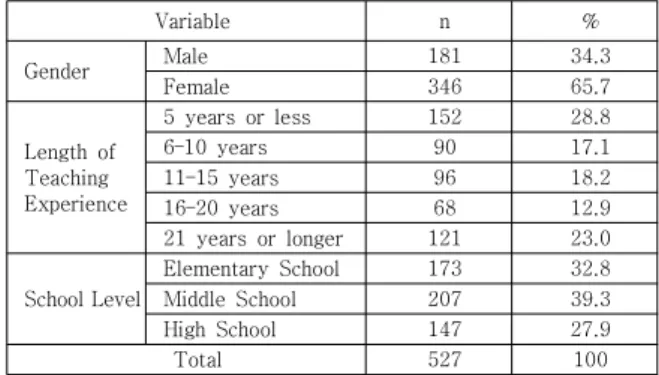
Purposive and non-probability sampling methods were employed to sample 550 participants. The sampled participants were asked to fill out a self-administered survey, and after excluding incomplete responses from the collected data, 527 participants were selected for the analyses in this study. Table 1 provides the general characteristics of these participants.
Table 1. General Characteristics of Participants
Variable n %
Gender Male 181 34.3
Female 346 65.7
Length of Teaching Experience
5 years or less 152 28.8
6–10 years 90 17.1
11–15 years 96 18.2
16–20 years 68 12.9
21 years or longer 121 23.0
School Level
Elementary School 173 32.8
Middle School 207 39.3
High School 147 27.9
Total 527 100
2.2 Measures 2.2.1 Burnout
The Maslach Burnout Inventory for Educators Survey [MBI-ES] was used to measure burnout in this study[42]. The MBI-ES is measured on a seven-point scale. It is a restructured version of the MBI, which was developed to measure burnout in various service fields, to fit the educational environment. It consists of 22 items pertaining to 3 subfactors - emotional exhaustion (EE), depersonalization (DP), and loss of personal accomplishment (PA). Nine questions deal with emotional exhaustion, five with depersonalization, and eight with the loss of personal accomplishment. The configuration of questions in the MBI-ES is shown in Table 2.
Table 2. Configuration of Questions in the MBI-ES
Variable Question No. No. of
Questions Emotional
Exhaustion (EE)
1, 2, 3, 6, 8, 13, 14, 16, 20 9
Depersonalization
(DP) 5, 10, 11, 15, 22 5
Loss of Personal Accomplishment
(PA)
4, 7, 9, 12, 17, 18, 19, 21 8
Total 22
2.2.2 Subjective Physical Activity
To measure the level of physical activity, this study used the Global Physical Activity Questionnaire (GPAQ), which was developed by the WHO in 2002[43]. This questionnaire is a tool that measures the amount of physical activity participants involved in based on different domains (job, transit, leisure activities, sedentary activity). This standardized questionnaire is currently used in 50 countries.
Subjects indicate how many days (days per week) and the average amount of time (hours and minutes) they participate in vigorous intensity and moderate-intensity activities for ten minutes continuously in an average week. Unlike the International Physical Activity Questionnaire (IPAQ), since this questionnaire asks about their
activities “in an average week,” rather than “in the past seven days,” the point at which the questionnaire is answered does not have a large impact[44]. It provides an analysis for each domain of the questionnaire.
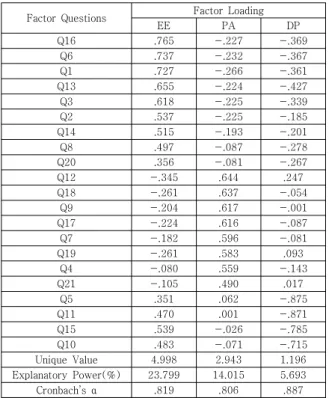
2.2.3 Validity and Reliability of the Measure An exploratory factor analysis (EFA) was conducted to verify the validity of the MBI-ES measure used in this study. The maximum likelihood method was employed to extract factors, and the direct oblimin method for the rotation method to verify validity. Kaiser-Meyer-Olkon (KMO) and Bartlett sphericity tests were conducted to determine the fitness of each factor. An eigenvalue of 1 or higher and factor loading of 0.4 or higher were applied as the standard to determine questions with low multicollinearity and commonality.
Cronbach’s α coefficient verified the reliability of each variable’s internal consistency through the EFA. Table 3 provides the results of the validity and reliability analyses.
Table 3. MBI-ES Factor Analysis and Reliability Analysis
Factor Questions Factor Loading
EE PA DP
Q16 .765 -.227 -.369
Q6 .737 -.232 -.367
Q1 .727 -.266 -.361
Q13 .655 -.224 -.427
Q3 .618 -.225 -.339
Q2 .537 -.225 -.185
Q14 .515 -.193 -.201
Q8 .497 -.087 -.278
Q20 .356 -.081 -.267
Q12 -.345 .644 .247
Q18 -.261 .637 -.054
Q9 -.204 .617 -.001
Q17 -.224 .616 -.087
Q7 -.182 .596 -.081
Q19 -.261 .583 .093
Q4 -.080 .559 -.143
Q21 -.105 .490 .017
Q5 .351 .062 -.875
Q11 .470 .001 -.871
Q15 .539 -.026 -.785
Q10 .483 -.071 -.715
Unique Value 4.998 2.943 1.196
Explanatory Power(%) 23.799 14.015 5.693
Cronbach’s α .819 .806 .887
KMO Sample Fitness Measurement = 0.891, Bartlett Sphericity Test
= 7241.901 =563.290, =150, =.001, Cumulative Explanatory Power =43.508
Table 4. Differential Analysis According to General Characteristics of Teachers
Category Burnout Physical Activity (for 7 days)
EE DP PA Vigorous Moderate Low Sedentary
Male 1.48±.969 2.67±1.333 4.06±1.034 256.87±197.29 237.33±189.81 380.21±108.52 280.61±174.41 Female 1.61±1.071 3.23±1.446 4.12±.994 189.44±134.85 157.89±91.70 219.34±102.14 286.04±160.07
t -1.437 -4.410*** -.674 4.522*** 2.948** 5.458*** -.364
Elementary (a) 1.59±1.085 3.35±1.552 4.26±.978 190.83±182.15 160.84±152.97 260.00±186.09 280.69±176.05 Middle (b) 1.34±.850 2.87±1.417 4.21±.969 271.88±132.76 231.06±111.64 312.46±132.65 288.26±168.58 High (c) 1.85±1.141 2.86±1.228 3.75±1.022 190.28±123.72 180.00±143.25 250.56±129.70 281.97±148.04
F 10.881*** 6.760** 12.578*** 1.065 2.258 2.967 .114
Post-hoc c>a,b a>b,c a>b,c - - - -
5 years or less (d) 1.70±1.100 3.28±1.463 4.04±.904 216.85±225.03 225.63±191.55 257.17±173.77 304.54±176.27 6-–0 years (e) 1.63±.937 2.93±1.348 3.93±1.100 200.48±211.42 152.50±127.63 275.59±144.86 315.33±104.08 11–15 years (f) 1.46±1.003 3.04±1.492 4.31±.904 190.73±205.12 166.00±125.47 241.79±192.38 286.25±143.11 16–20 years (g) 1.30±.938 2.90±1.331 4.18±.989 209.23±177.74 186.06±141.07 298.82±107.34 268.82±127.43 21 years or longer (h) 1.56±1.079 2.81±1.424 4.08±1.129 275.41±226.62 210.46±134.24 328.22±209.24 241.74±146.47
F 2.074 2.141* 1.925 .859 1.195 .187 3.585**
Post-hoc - d>g,h - - - - e>f,g,h
*p<.05 **p<.01 ***p<.001
After removing item number 22 with low multicollinearity and commonality, 21 questions and 3 factors were retained as the subfactors of MBI-ES, including emotional exhaustion (EE; nine questions), loss of personal accomplishment (PA;
eight questions), and depersonalization (DP; four questions), as shown in Table 3. The Cronbach's α for each subfactor was between 0.806–0.887, indicating a high level of reliability.
2.3 Data Analysis
The SPSS 23.0 statistics package program was used for the analysis conducted for the purposes of this study. To assess participants’ characteristics, a frequency analysis was conducted. Furthermore, to assess the validity and reliability of the instrumentation, an EFA and internal consistency analysis (Cronbach’s α) were performed. Next, to examine differences between groups according to individual characteristics, an independent t-test and one-way ANOVA were conducted.
After performing a correlation analysis to understand the degree of correlation between variables, a multiple regression analysis was also conducted to verify the relationship between
variables. The level of significance was set to α
=0.05.
3. Results
3.1 Differences Based on General Characteristics of Teachers
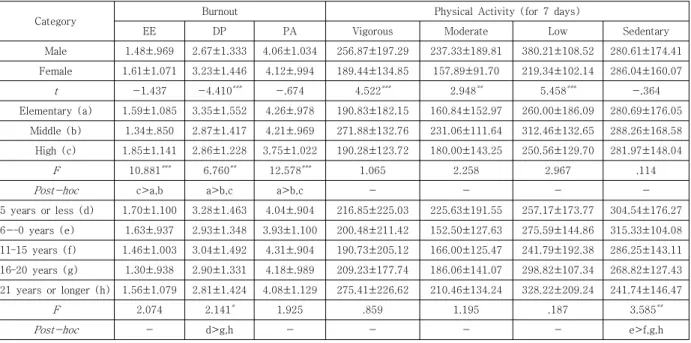
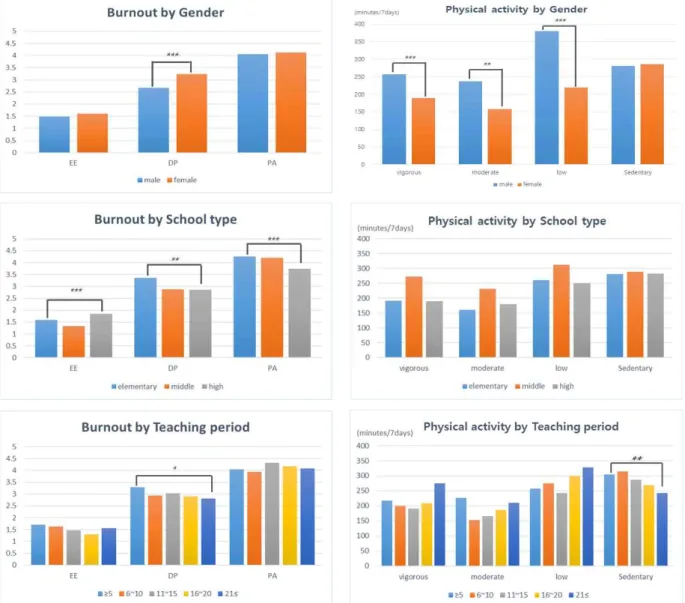
Table 4 and Figure 1 provide the results of the independent t-test and one-way ANOVA performed to assess the gap between groups according to teachers’ general characteristics (gender, school level, years of teaching experience).
As shown in Table 4, the analysis of differences in burnout according to gender revealed significantly more depersonalization behaviors among female teachers than male teachers. Analyzing the differences in physical activity according to gender revealed that male teachers participated in significantly more vigorous-intensity, moderate- intensity, and low-intensity physical activity.
The results of analyzing differences in burnout according to school level showed that emotional exhaustion was significantly higher among high school teachers than among elementary school
Fig. 1. Differences According to General Characteristics of Teachers and middle school teachers. Furthermore,
depersonalization and loss of personal accomplishment were significantly greater among elementary school teachers than middle school and high school teachers.
Analyzing the differences in physical activity according to school level revealed no significant difference, but middle school teachers seemed to participate in more physical activity on average than their elementary school or high school counterparts.
The analysis of differences in burnout based on years of teaching experience indicated that depersonalization behaviors were significantly
higher among teachers with 5 or less years of experience than those teaching for 16–20 years or 21 years or longer. Analyzing the differences in physical activity according to years of teaching experience showed that teachers who have taught for 6-10 years participated in significantly more sedentary activity than those who had taught for 11-15 years, 16-20 years, and 21 years or longer.
3.2 Correlation Between Physical Activity and Burnout Among Teachers
Pearson’s correlation analysis was performed
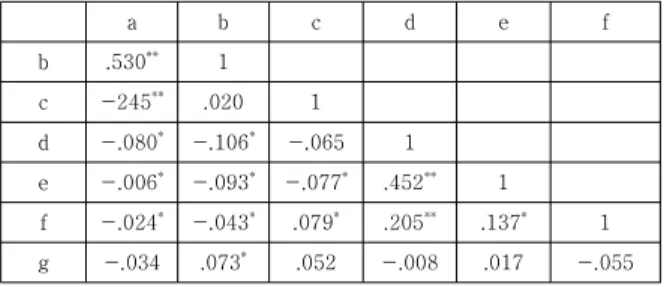
to assess the relationship between each variable in this study. The results are provided in Table 5.
Examining the correlation between physical activity and burnout factors indicated that vigorous-intensity and moderate intensity activity have a negative correlation with all subfactors, while low-intensity activity has a negative correlation with emotional exhaustion and depersonalization and a positive correlation with loss of personal accomplishment. Sedentary activity has a negative correlation with emotional exhaustion and a positive correlation with depersonalization and loss of personal accomplishment.
Table 5. Correlation Analysis Between Each Factor
a b c d e f
b .530** 1
c -245** .020 1
d -.080* -.106* -.065 1 e -.006* -.093* -.077* .452** 1
f -.024* -.043* .079* .205** .137* 1
g -.034 .073* .052 -.008 .017 -.055
a: Emotional Exhaustion, b: Depersonalization, c: Loss of Personal Accomplishment, d: High-intensity, e: Medium-intensity, f: Low-intensity, g: Sedentary
**p<.01
3.3 Causal Relationship Between Physical Activity and Burnout Among Teachers Table 6 provides the results of the multiple regression analysis performed to assess the impact of physical activity on burnout among teachers.
3.3.1 Results of multiple regression analysis of physical activity and burnout among teachers in Korea
The results of the multiple regression analysis of physical activity and burnout among Korean teachers in Table 6 show that vigorous-intensity activity had a significant negative effect on depersonalization (β=-0.148). The results were not statistically significant, but also negatively influenced emotional exhaustion (β=-0.021) and
loss of personal accomplishment (β=-0.087). The explanatory power of the regression model was 3.2% (R2=.032).
Moderate-intensity and low-intensity activity did not significantly impact burnout factors.
Sedentary activity had a significant positive effect on depersonalization (β=.121), and while the results were not statistically significant, they had a negative effect on emotional exhaustion (β
=-.091) and positive effect on loss of personal accomplishment (β=.027). The explanatory power of the regression model was 1.3% (R2=.013).
Table 6. Multiple Regression Analysis of Burnout and Physical Activity of Teachers in Korea
Independent Variable
Dependent
Variable B SE β t p
Physical Activity
Vigoro us
Constant 269.604 50.780 5.309 .001 EE -3.794 11.981 -.021 -.317 .752 DP -19.519 8.382 -.148 -2.329 .020 PA -16.108 10.457 -.087 -1.540 .124 R2=.032, Adjusted R2=.024, F=3.888, p=.009
Moder ate
Constant 267.571 62.539 4.278 .001 EE 7.760 14.350 .040 .541 .589 DP -17.563 10.307 -.119 -1.704 .089 PA -9.993 12.764 -.049 -.783 .434 R2=.014, Adjusted R2=.004, F=1.387, p=.247
Low
Constant 236.635 75.282 3.143 .002 EE -.073 18.546 .001 -.004 .997 DP -21.256 12.638 -.095 -1.682 .093 PA 20.513 15.520 .065 1.322 .187 R2=.013, Adjusted R2=.007, F=2.006, p=.112
Sedent ary
Constant 246.155 35.743 6.887 .001 EE -14.605 8.577 -.091 -1.703 .089 DP 14.014 6.022 .121 2.327 .020 PA 4.462 7.469 .027 .597 .550 R2=.013, Adjusted R2=.008, F=2.368, p=.070
4. Discussion
The aim of this study was to investigate the relationship between physical activity and burnout among Korean teachers. This study analyzed mean differences based on gender, school level, and length of teaching experience.
Furthermore, correlation and regression analyses were performed to determine the impact between factors. The following discussion is based on the results obtained.
First, female teachers reported higher levels of burnout and fewer physical activity involvement compared to male counterparts. However, the results of a study by [45] revealed that there is no positive association between physical activity and stress and burnout for women. This highlights a need that additional research is necessary to firmly establish the relationship between physical activity and burnout for women. Also, teachers with less teaching experience showed higher degree of burnout and lower physical activity level than teachers with longer teaching experience.
This implies that teachers with less teaching experience have higher burnout because of excessive administrative tasks alongside their classes or by performing tasks they are not yet familiar with.
Previous studies reported that teachers experience a significant amount of stress and burnout due to personal environmental factors[46].
Second, physical activity was inversely related with teacher burnout among Korean teachers, indicating that teachers can minimize stress and burnout to some extent through physical activity.
Specifically, apart from low-intensity and sedentary activity, physical activity was negatively correlated with the subfactors of burnout. Previous studies corroborated this finding that engaging in regular moderate-to-vigorous physical activity (MVPA) plays a critical role in reducing stress and burnout[47,48].
Third, teachers’ vigorous physical activity negatively influenced on depersonalization. This study verifies previous evidence that strenuous physical activity is effective in decreasing psychological-related outcomes (i.e., burnout)[49].
Higher-intensity activity leads to improvements in reduced burnout, especially for depersonalization.
Furthermore, teachers’ sedentary lifestyles positively impacted on depersonalization. There
is preliminary evidence that reduced time spent in sedentary activity weakened the burnout rate[50]. This finding aligns with our study that increments in sedentariness is associated with higher burnout.
Contrary to our findings, a considerable amount of research supports that meditation programs such as yoga helps to reinforce the resilience to prevent burnout[51]. A recent review by [52] illustrated that, to date, there is no consensus in relation to the optimal dose of physical activity that buffers burnout.
Holtermann and colleagues demonstrated that physical activity has a negative correlation with factors with long-term harmful effects on the human body, such as chronic risk factors and mental stress, and that job-related tasks have a positive correlation with these risk factors[53].
Therefore, burnout increases as a result of prolonged-exposure to mental stress from the work setting. Physical activity is an important coping medium that helps reduce stress and burnout.
5. Conclusion and Recommendations
The purpose of this study was to identify the relationship between physical activity and burnout among Korean teachers and to verify the results. Data were collected from 527 teachers in Korea. The results of the analysis are as follows.
First, higher degree of burnout and lower levels of physical activity were manifested in female teachers and novice teachers compared to male counterparts and experienced teachers, respectively.
Second, teachers’ level of MVPA was inversely correlated with burnout factors.
Third, teachers’ vigorous physical activity had a negative effect on depersonalization factors while teachers’ sedentary activity had a positive effect on depersonalization.
Despite these meaningful results, this study had the following limitations.
First, the results were obtained through a cross-sectional design; thus, it is difficult to assume any cause-and-effect relationship. In the future, a longitudinal design can be used for inferences regarding causal relationships.
Second, various predictive factors were not considered. In future research, predictive factors must be added from various perspectives to systematically analyze the burnout mechanism.
Third, since the characteristics of each teacher’s class subject and individual background were not differentiated, the results cannot be generalized to the population. Therefore, future studies should employ additional information on subjects’ characteristics and backgrounds.
Fourth, the physical activity questionnaire employed in this study was a self-reported measure, and thus cannot precisely reveal whether the burnout experienced by teachers is positively relevant. Hence, future studies should employ a more objective tool to test physical activity.
REFERENCES
[1] N. Y. Lee, J. H. Kim & H. J. Mun. (2019). Exploration of Emotional Labor Research Trends in Korea through Keyword Network Analysis. Journal of Convergence for Information Technology, 9(3), 68–74.
[2] N. H. Jo & E. Y. Na. (2017). Analysis of Domestic Research on Depression and Stress : Focused on the Treatment and Subjects. Journal of Convergence for Information Technology, 7(6), 53–59.
[3] J. T. Shin. (2014. 12. 12.). Workers who are overwhelmed with work must watch out for the
‘Burnout Syndrome’. Moodeungilbo. p. 10.
[4] C. Maslach. (1976). Burned–Out. Human Behavior, 9(5), 16–22.
[5] H. J. Freudenberger. (1974). Staff Burnout. Journal of Social Issues, 30(1), 159–165.
[6] H. J. Freudenberger. (1977). Burn-Out: The Organizational Menace. Training and Development Journal, 31(7), 26-27.
[7] C. Maslach, W. B. Schaufeli & M. P. Leiter. (2001). Job Burnout. Annual Review of Psychology, 52(1), 397–
422.
[8] C. Maslach & S. E. Jackson. (1981). The Measurement of Experienced Burnout. Journal of Organizational Behavior, 2(2), 99–113.
[9] C. L. Cooper & S. Cartwright. (2008). The oxford handbook of Organizational Wellbeing. Oxford : Oxford University Press.
[10] S. Veenman. (1984). Perceived Problems of Beginning Teachers. Review of Educational Research, 54(2), 143–
178.
[11] E. H. Seo. (2002). The study on the relation among cognitive style, major, and academic adjustment of undergraduates. Master’s Thesis. Yonsei University, Seoul.
[12] J. M. Han. (2005). A Study on Social Workers' Job Satisfaction –Focused on the Southern Region of Kyonggi Province-. Master’s thesis. Kyung Hee University, Seoul.
[13] J. J. Blase (1982). A social–psychological grounded theory of teacher stress and burnout. Educational Administration Quarterly, 18(4), 93–113.
[14] V. H. Mancini, D. A. Wuest, K. W. Vantine & E. K.
Clark. (1984). The Use of Instruction and Supervision in Interaction Analysis on Burned Out Teachers: Its Effects on Teaching Behaviors, Level of Burnout, and Academic Learning Time. Journal of Teaching in Physical Education, 3(2), 29–46.
[15] J. H. Kim. (1991). Relationship between teachers’ job stresses and psychosomatic symptoms, burnout.
Doctoral dissertation. Chung–Ang University, Seoul.
[16] C. Kyriacou & J. Sutcliffe. (1978). A Model of Teacher Stress. Educational Studies, 4(1), 1–6.
[17] J. G. Tak & P. S. Shin. (1999). Impact of the Cause of Job Stress in High School Teachers on Mental Health.
Korean Journal of Psychology: Health, 4(1), 110–122.
[18] C. Kyriacou. (2001). Teacher Stress: Directions for Future Research. Educational Review, 53(1), 27–35.
[19] G. Borg. (1990). Psychophysical Scaling with Applications in Physical Work and the Perception of Exertion. Scandinavian Journal of Work, Environment
& Health, 55–58.
[20] I. A. Friedman. (2000). Burnout in Teachers: Shattered Dreams of Impeccable Professional Performance.
Journal of Clinical Psychology, 56(5), 595–606.
[21] I. S. Schonfeld. (2001). Stress in 1st–year Women Teachers: The Context of Social Support and Coping.
Genetic, Social, and General Psychology Monographs, 127(2), 133–168.
[22] D. W. Chan. (2003). Hardiness and its Role in the Stress–Burnout Relationship Among Prospective Chinese Teachers in Hong Kong. Teaching and
Teacher Education, 19(4), 381–395.
[23] E. J. Jung. (2004). Emotion and stress coping strategies as a moderator in relation between job stressors and job burnout. Master’s Thesis. Korea University, Seoul.
[24] Lazarus, R. S., Cohen, J. B., Folkman, S., Kanner, A &
Schaefer, C. (1980). Selye's guide to stress research.
New York city : Van Nostrand Reinhold.
[25] C. M. Bernaards, M. P. Jans, S. G. Van den Heuvel, I.
J. Hendriksen, I. L. Houtman & P. M . Bongers. (2006).
Can Strenuous Leisure Time Physical Activity Prevent Psychological Complaints in a Working Population?
Occupational and Environmental Medicine, 63(1), 10–
16.
[26] W. J. Brown, J. H. Ford, N. W. Burton, A. L. Marshall
& A. J. Dobson. (2005). Prospective Study of Physical Activity and Depressive Symptoms in Middle–Aged Women. American Journal of Preventive Medicine, 29(4), 265–272.
[27] Y. K. Kim. (2018). The Relationship among Estimated Intensity of Physical Activity, Stress Response and Positive Psychological Capital. Journal of Digital Convergence, 16(11), 581–588.
[28] T. K. Kim & J. S. Moon. (2018). The Effect of Mindfulness Training on the Job Stress, Burnout, Teacher Efficacy of Middle School and High School Teachers. Journal of Digital Convergence, 16(4), 363–
369.
[29] J. B. Lee & O. S. Cho. (2018). The Influence of Interpersonal Relationship of Fusion-Integrated Generation of Youths on the Organizational Commitment – Focusing on the Mediating Effects of the Work Environment and the Moderating Effects of Gender –. Journal of Convergence for Information Technology, 8(1), 281–290.
[30] A. SanchezVillegas, I. Ara, F. Guillen–Grima, M. Bes–
Rastrollo, J.J. Varo–cenarruzabeitia & M.A. Martinez–
Gonzalez. (2008). Physical Activity, Sedentary Index, and Mental Disorders in the SUN Cohort Study.
Medicine & Science in Sports & Exercise, 40(5), 827–
834.
[31] H. Yoon & Y. S. Huh. (2012). Relationships among job demands, teachers' experience, burnout, and job satisfaction of special education teachers compared with general education teachers. The Journal of Inclusive Education, 7(2), 143–164.
[32] J. K. Kim, Y. S. Kang, S. W. Ahn, & J. G. Park. (2006).
Burnout among Resource Room Teachers in Regular School Settings. Korean Journal of Special Education, 41(3), 321–334.
[33] I. H. Kim & G. S. Cho. (2010). The Relationships among Role Stress, Job Burnout and Stress Coping Strategy of School Athletic Supervisors. Journal of Korean Society for the Study of Physical Education, 15(1), 371–384.
[34] E. G. Choi. (2003). Relationship Between Role Stress
and Job Burnout in Sports Department Teachers:
Analysis on the Mediating Effect of Social Support.
Korean Journal of Sport Psychology, 14(4), 159–173.
[35] N. R. Won, H. Y. Hwang, D. G. Kim & H. I. Kwon.
(2015). The Comparison of Emotional Labor and Emotional Exhaustion between Middle School Physical Education Teachers and School Sports Club Instructors. Korean Journal of Sport Pedagogy, 22(2), 127–145.
[36] A. S. Lee & J. G. Song. (2009). Relationships Between Self-Efficacy and Burnout in Elementary Physical Education Specialists. Korean Journal of Sport Pedagogy, 16(3), 47–64.
[37] S. Y. Shim. (1999). Impact of Exhaustion on the Job Transfer of Childcare Teachers According to Work Conditions and Individual Characteristics. Korean Journal of Child Studies, 20(3), 339–349.
[38] S. Y. Cho. (2005). Job Satisfaction and Exhaustion in Childcare Teachers. Korean Journal of Human Ecology, 14(1), 69–79.
[39] H. M. Yoon & H. G. Kwon. (2003). Job Stress and Job Satisfaction Among Childcare Teachers. Korean Journal of Human Ecology, 12(3), 303–319.
[40] H. M. Ryu (2003). Study on Personality Types, Social Support for Job Stress and Burnout of Middle and High School Teachers. Master’s Thesis. Sogang University, Seoul.
[41] M. H. Kim. (1991). Teacher Stress and Burnout.
Master’s Thesis. Yonsei University, Seoul.
[42] C. Maslach, S. E. Jackson & M. P. Leiter. (1996). MBI:
Maslach Burnout Inventory. Palo Alto : CPP.
[43] T. Armstrong & F. Bull. (2006). Development of the World Health Organization Global Physical Activity Questionnaire (GPAQ). Journal of Public Health, 14(2), 66–70.
[44] S. D. Herrmann, K. J. Heumann, C. A. Der Ananian &
B. E. Ainsworth. (2013). Validity and reliability of the global physical activity questionnaire(GPAQ).
Measurement in Physical Education and Exercise Science, 17(3), 221–235.
[45] A. Hubbs, E. I. Doyle, R. G. Bowden & R. D. Doyle.
(2012). Relationships among Self-esteem, Stress, and Physical Activity in College Students. Psychological reports, 110(2), 469-474.
[46] A. E. Iancu, A. Rusu, C. Măroiu, R. Păcurar & L. P.
Maricuțoiu. (2018). The Effectiveness of Interventions aimed at Reducing Teacher Burnout: A meta–analysis.
Educational Psychology Review, 30(2), 373–396.
[47] P. Schnohr, T. S Kristensen, E. Prescott & H. Scharling.
(2005). Stress and Life Dissatisfaction are Inversely Associated with Jogging and Other Types of Physical Activity in Leisure Time–The Copenhagen City Heart Study. Scandinavian Journal of Medicine & Science in Sports, 15(2), 107–112.
[48] K. Wijndaele et al. (2007). Association Between Leisure Time Physical Activity and Stress, Social Support and Coping: A Cluster–Analytical Approach.
Psychology of Sport and Exercise, 8(4), 425–440.
[49] C. M. Bernaards, M. P. Jans, S. G. Van den Heuvel, I.
J. Hendriksen, I. L. Houtman & P. M. Bongers. (2006).
Can Strenuous Leisure Time Physical Activity Prevent Psychological Complaints in a Working Population?
Occupational and Environmental Medicine, 63(1), 10-16.
[50] M. Hallgren et al. (2016). Exercise, Physical Activity, and Sedentary Behavior in the Treatment of Depression: Broadening the Scientific Perspectives and Clinical Opportunities. Frontiers in Psychiatry, 7,(36)
DOI: 10.3389/fpsyt.2016.00036
[51] R. A. Cocchiara et al. (2019). The Use of Yoga to Manage Stress and Burnout in Healthcare Workers: A Systematic Review. Journal of Clinical Medicine, 8(3), 284.
[52] L. M. Naczenski, J. D. de Vries, M. L. van Hooff & M.
A. Kompier. (2017). Systematic Review of the Association Between Physical Activity and Burnout.
Journal of Occupational Health, 59(6), 477-494.
[53] A. Holtermann et al. (2013). Does the Benefit on Survival from Leisure Time Physical Activity Depend on Physical Activity at Work? A Prospective Cohort Study. PLoS One 8(1), e54548.
DOI : 10.1371/journal.pone.0054548
남 윤 호(Yoon Ho Nam) [정회원]
․ 2013년 2월 : 용인대학교 특수체육 교육과 (체육학사)
․ 2015년 8월 : Iowa State University Department of Kinesiology (체육 학 석사)
․ 2018년 3월 ~ 현재 : 고려대학교 체 육학과 박사과정
․ 2019년 3월 ~ 현재 : 고려대학교 체육교육과 강사
․ 관심분야 : 스포츠교육학, 특수체육, 신체활동
․ E-Mail : [email protected]