논문 2011-48SC-3-5
불확실 비선형 플랜트를 위한 포화 함수에 의한 새로운 강인한 연속 가변구조제어시스템
( A New Robust Continuos VSCS by Saturation Function for Uncertain Nonlinear Plants )
이 정 훈
* * ( Jung-Hoon Lee )
요 약
본 연구에서는 수정된 상태변수 의존 비선형 형을 바탕으로 부정합조건 불확실성과 정합조건 외란을 갖는 비선형 시스템의 제어를 위한 새로운 둔감한 비선형 연속 가변구조제어기의 체계적인 설계를 제안한다. 부정합조건 불확실과 정합조건 외란 비 선형 시스템을 상태변수 의존 비선형 시스템 형으로 표현한 후 체계적인 둔감한 새로운 제어기 설계를 한다. 대상 시스템의 확장을 위하여 비선형 시스템 함수의 불확정성을 상태변수 의존 항과 비의존 항 두 부분으로 나눈다. 본 비선형 제어는 제어 결과 동특성을 선형으로하기 위하여 그리고 슬라이딩 모드 존재조건을 쉽게 만족시키기 위하여 변환된 선형 슬라이딩 면을 선 정한다. 선정된 슬라이딩 면 위에 슬라이딩 존재조건과 폐루프 지수 안정성을 만족하는 제어입력을 제안한다. 정리를 통하여 증명한다. 본 제어의 실용성을 위하여 가변구조제어의 내재된 특성인 제어입력의 불연속성을 극적으로 개선한다. 설계 예와 시 뮬레이션 연구를 통하여 제안된 제어기의 유용성을 입증한다.
Abstract
In this note, a systematic design of a new robust nonlinear continuous variable structure control system(VSCS) based on the modified state dependent nonlinear form is presented for the control of uncertain affine nonlinear systems with mismatched uncertainties and matched disturbance. After an affine uncertain nonlinear system is represented in the form of state dependent nonlinear system, a systematic design of a new robust nonlinear VSCS is presented. The uncertainty of the nonlinear system function is separated into the tow parts, i.e., state dependent term and state independent term for extension of target plants. To be linear in the closed loop resultant dynamics and in order to easily satisfy the existence condition of the sliding mode, the transformed linear sliding surface is applied. A corresponding control input is proposed to satisfy the closed loop exponential stability and the existence condition of the sliding mode on the linear transformed sliding surface, which will be investigated in Theorem 1. For practical application, the discontinuity of the control input as the inherent property of the VSS is improved dramatically. Through a design example and simulation studies, the usefulness of the proposed controller is verified.
Keywords : uncertain nonlinear system, variable structure system, sliding mode control, mismatched uncertainties
Ⅰ. Introduction
Stability analysis and controller design for uncertain nonlinear systems is open problems now
[1]
.*
정회원, 국립 경상대학교 제어계측공학과
(Dept of Control & Instrum. Eng., Gyeongsang National University)
접수일자: 2011년1월21일, 수정완료일: 2011년5월12일
So far numerous design methodologies exist for the controller design of nonlinear systems
[2]
. These include any of a huge number of linear design techniques[3~4]
used in conjuction with gain scheduling[5]
; nonlinear design methodologies such as Lyapunov function approach[1~2, 6~7, 10~11]
, feedback linearization method[8~10]
, dynamics inversion[10]
,backstepping
[11]
, adaptive technique which encompass both linear adaptive[13]
and nonlinear adaptive control[14]
, and sliding mode control[15~26]
etc[27~29]
.The sliding mode control(SMC) can provide the effective means to the problem of controlling uncertain nonlinear systems under parameter variations and external disturbances
[15~17]
. One of its essential advantages is the robustness of the controlled system to variations of parameters and external disturbances in the sliding mode on the predetermined sliding surface,s
=0 [18]
. In [19], for nonlinear output regulator scheme, sliding mode approach is applied. The underlying concept is that of designing sliding submanifold which contains the zero tracking error submanifold. The convergence to a sliding manifold can be attained relying on a control strategy still based on a simplex of control vectors for multi input uncertain nonlinear systems in [20].Lu and Spurgeon in 1997 considered the robustness of dynamic sliding mode control of nonlinear system which are in differential input-out form with additive uncertainties in the model
[21]
. The discrete-time implementation of a second-order sliding mode control scheme is analyzed for uncertain nonlinear system, in [22]. Flemming surveyed so called soft variable structure controls, compared them to other[23]
. For 2nd order uncertain nonlinear system with mismatched uncertainties, a swichting control law between a first order sliding mode control and a second order sliding mode control is proposed to obtain the globally or locally asymptotic stability[24]
. The optimal SMC for nonlinear system with time-delay is suggested in [25]. The nonlinear time varying sliding sector is designed for a single input nonlinear time varying input affine system which can be represented in the form of state dependent linear time variant system with matched uncertainties[26]
. For uncertain affine nonlinear system with mismatched uncertainties and matched disturbance, a design of the SMC is reported[30]
.In this technical note, the described target plant is extended rather than [30] in view of the handling
capability. The uncertainty of the nonlinear system function is separated into the two parts, i.e., state dependent term and state independent term. A systematic design of a new nonlinear continuous VSCS based on modified state dependent nonlinear form is presented for the control of uncertain affine nonlinear systems with mismatched uncertainties and matched disturbance. After an affine uncertain nonlinear system is represented in the form of modified state dependent nonlinear system, a systematic design of a new nonlinear VSCS is presented. To be linear in the closed loop resultant dynamics and in order to easily satisfy the existence condition of the sliding mode, the linear transformed sliding surface is applied. A corresponding discontinuous control input is proposed to satisfy the closed loop exponential stability and the existence condition of the sliding mode on the linear transformed sliding surface, which will be investigated in Theorem 1. To remove the chattering problems of the discontinuous input as an inherent property of the VSS, an effective continuous approximation is made. Through a design example and simulation studies, the usefulness of the proposed controller is verified. The organization of the this paper is as follows. In section Ⅱ, a descriptions of plants, linear transformed sliding surface, and a corresponding control input are presented as the main results. A design example and simulation study is carried out in section Ⅲ. Finally a concluding remarks are given in section Ⅳ.
Ⅱ. A Nonlinear Continuous Variable Structure Control System(VSCS)
1. Description of plants
Consider an affine uncertain nonlinear system
′ ′
(1)
where ∈
is the state, is its initial state,∈
is the control, ′ ∈
and ∈
≥ , ≠ for ∈
andfor ≥ are of suitable dimensions, and ′
implies bounded matched external disturbances.
Assumption [26]
A1:
′ is continuously differentiable.
Then, uncertain nonlinear system (1) can be represented in more affine nonlinear system of modified state dependent coefficient form
[27~28, 30]
∆
∆
∆ ′
(2)
∆
∆
∆ ′
(3)
where
and
is each nominal value such that′ ∆ ∆ (4a)
∆ (4b)
respectively,
∆
and∆
are mismatched uncertainties, ∆
is matched uncertainties,′ is matched external disturbance, and is the lumped totally mismatched uncertainties, respectively. The uncertainty of ′ is separated into the tow parts as in (4a). The form of (4a) can handle more general plants than that of [27] and [28] so it is extended. The assumptions are made to clearly describe the plant under consideration
Assumption:
A2: The pair
is controllable for
∈
and for ≥ A3: The lumped uncertainties
is bounded A4:
is bounded if
is bounded.
A5: The nominal value of
is constant, i.e.,
.
For a non zero column vector as the design parameter later in sliding surface, the following
assumptions are satisfied
A6:
and
have the full rank, i,e are invertibleA7:
∆ ∆
and∆
≤ .
2. Linear Transformed Sliding Surface
To control uncertain nonlinear system (1) or (2) with resultant linear dynamics, the linear sliding surface used in this design is as follows:
(5)
which is transformed one[15]
so as to satisfy the existence condition of the sliding mode on the predetermined sliding surface for uncertain nonlinear system (2)[32]
. The equivalent control input of the linear transformed sliding surface is obtained by using
[15]
as
∆
∆
′(6)
This control input can not be implemented because of the uncertainties and external disturbance, but only used to obtaining the ideal sliding dynamics. The ideal sliding mode dynamics of the sliding surface (5) can be derived by the equivalent control approach
[16]
as
(7)
, (8)
(9)
where
is the state of the ideal sliding mode dynamics for ≥
where
is the reaching time.The solution of (6) identically defines the sliding
surface after reaching. Hence to design the sliding surface as stable, this ideal sliding dynamics is designed to be stable. To choose the stable gain based on the Lyapunov stability theory
[10~11]
, the ideal sliding dynamics (7) is represented by using the nominal plant of (2) as
(10)
To select the stable gain, take a Lyapunov function candidate
[10~11]
as
(11)
The derivative of (11) becomes
(12)
If one takes the control input as
(13)
and
for ∈
and for ≥ is
(14)
then
≤
m in
≤
(15)
Therefore the stable gain is chosen as
or
(16)
3. Control Input
The corresponding control input is proposed as follows:
∆
(17)
where
is a static nonlinear feedback gain,
∆
is a state dependent switching gain, is a feedback gain of the sliding surface itself, and is a sliding surface dependent switching gain, respectively as
or
(18)
∆
∆ (19)
∆
≥ min ∆
max ∆
∆
≤ min ∆
min ∆
∆
(20)
(21)
min
∆
max
∆ ′ (23)
The real sliding dynamics by the proposed control (17) with the linear transformed sliding surface (5) is obtained as follows:
∆
∆
′
∆ ∆
∆
′
∆ ∆
∆
∆
∆
∆ ′
∆
∆
∆
∆
∆
∆
∆
′
∆
sin (24)
The closed loop stability by the proposed controlinput with sliding surface together with the existence condition of the sliding mode will be investigated in next Theorem 1.
Theorem 1: If the sliding surface is designed in the stable, i.e. stable design of
, the proposed input with Assumption A1-A7 satisfies the existence condition of the sliding mode on the sliding surface and exponential stability.Proof; Take a Lyapunov function candidate as
(25)
Differentiating (25) with respect to time leads to and substituting (24) into (26)
∆
∆
∆
∆
∆
∆
′
∆
≤
min
∆
(26)
From (26), the following equation is obtained as
≤ (27)
≤
(28)
And the second order derivative of
becomes
∞(29)
and by Assumption A4
is bounded which completes the proof of Theorem 1.The switching of discontinuous part of the control input (17) results in the chattering problems because that may be harmful to practical plants. Hence the continuous approximation of the switching part of the discontinuous input is essentially necessary. Using
the saturation function, one can effectively make the input be continuous for practical application as
∆
(30)
for a positive suitable constant , which is different from that of Chern & Wu's continuous approximation
[31]
. The discontinuity of the control input can be dramatically improved without severe performance deterioration.Ⅲ. Design Example and Simulation Studies
Consider a second order affine uncertain nonlinear system with mismatched uncertainties and matched disturbance
sin
sin
(31)
sin
sin
sin
sin sin Since (31) satisfy the Assumption A1, (31) is represented in state dependent coefficient form as
sin
sin
sin sin
sin
sin
sin
(32)
where the nominal parameter
and
and mismatched uncertainties ∆
and∆ , and matched uncertainty
∆
are
, ,
∆
sin
sin
,
∆
sin
sin
(33)
∆
sin sin
To design the stable transformed linear sliding
surface,
is selected as
(34)
in order to have the two poles at and . The P in (11) is chosen as
(35)
so as to be
(36)
Hence, the continuous feedback gain is chosen as
(37)
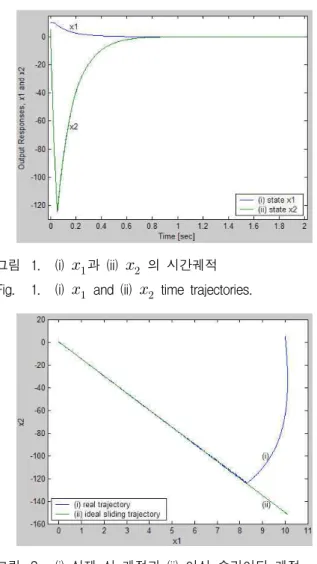
Therefore, the coefficient of the linear transformed그림 1. (i)
과 (ii)
의 시간궤적 Fig. 1. (i)
and (ii)
time trajectories.그림 2. (i) 실제 상 궤적과 (ii) 이상 슬라이딩 궤적 Fig. 2. (i) real phase trajectory and (ii) ideal sliding
trajectory.
sliding surface is determined as
(38)
The selected gains in the discontinuous control
그림 3. 슬라이딩 면 Fig. 3. Sliding surface.
그림 4. 불연속 제어입력
Fig. 4. Discontinuous control input.
그림 5. [31]에 의한 (i)
과 (ii)
의 시간궤적 Fig. 5. (i)
and (ii)
time trajectories by [31].input (17) satisfying the equations (19)-(23) are as follows:
∆
i f i f
,
∆
i f i f
(39)
(40)
(41)
The simulation is carried out under 0.1[msec]sampling time and with
initial state.Fig. 1 shows (i)
and (ii)
time trajectories. The phase trajectory(i) and ideal sliding trajectory(ii) are depicted in Fig. 2. The sliding surface
is shown in Fig. 3. The control input is depicted in Fig. 4. The그림 6. [31]의 (i) 실제 상 궤적과 (ii) 이상 슬라이딩 궤 적
Fig. 6. (i) real phase trajectory and (ii) ideal sliding trajectory by [31].
그림 7. [31]에 의한 슬라이딩 aux Fig. 7. Sliding surface by [31].
large chattering of the discontinuous control input is harmful to real plants, which means that the
그림 8. [31]의 연속 입력
Fig. 8. Continuous control input by [31].
그림 9. 제안된 연속 제어 입력에 의한 (i)
과 (ii)
Fig. 9. (i)
and (ii)
time trajectories by proposedcontinuous input.
그림 10. 제안된 연속 제어 입력에 의한 실제 상 궤적 Fig. 10. (i) real phase trajectory by continuous input and
(ii) ideal sliding trajectory.
그림 11. 제안된 연속제어 입력에 의한 슬라이딩 면 Fig. 11. Sliding surface by proposed continuous input.
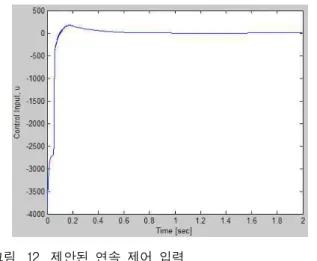
그림 12. 제안된 연속 제어 입력
Fig. 12. Proposed continuously implemented control input.
continuous approximation is essentially required. As the previous continuous VSS results for comparison, Fig. 5 shows the output response by Chern & Wu's method for . The phase trajectory is shown in Fig. 6. The sliding surface is depicted Fig.7. The continuous control input is shown Fig. 8. For
, Fig. 9 shows the output response by the proposed continuously implemented input (30). The phase portraits are depicted in Fig. 10. The controlled system continuously slide on the sliding surface without chattering after first reaching. The almost continuous sliding surface is shown in Fig. 11 and the effectively continuously implemented input for practical application is depicted in Fig. 12. Comparing Fig. 12 with Fig. 4, the chattering of control input is removed clearly. From the simulation studies, the effectiveness of the proposed VSCS is proven.
Ⅳ. Conclusions
In this note, a systematic design of a new robust nonlinear extended VSCS based on modified state dependent nonlinear form is presented for the control of uncertain affine nonlinear systems with mismatched uncertainties and matched disturbance.
After an affine uncertain nonlinear system is represented in the form of state dependent nonlinear system, a systematic design of a new robust nonlinear VSCS with the transformed linear sliding surface is suggested. The uncertainty of the system function is separated into the two part, i.e., state dependent term and state independent term, which can describe more general system than that of [30].
A discontinuous control input corresponding to the transformed linear sliding surface is proposed. The closed loop exponential stability by the proposed control input with transformed linear sliding surface together with the existence condition of the sliding mode on the selected sliding surface will be investigated in Theorem 1 for all mismatched uncertainties and matched disturbance. For practical application of the proposed VSCS to real plants, the harmful chattering of the discontinuous is effectively improved without severe performance loss by the new form being different from that of Chern &
Wu's
[31]
. Through a design example and simulation studies, the usefulness of the proposed controller is verified. The continuous nonlinear VSCS can be practically applicable to the real plant.참 고 문 헌
[1] M. Vidyasagar, “New Directions of Research in Nonlinear System Theory,” Proc. of the IEEE vol.74 no.8 pp.1060-1091, 1986.
[2] P Kokotovic and M. Arcak, “Constructive Nonlinear Control: a Historical Perspective,”
vol.37, pp.637-662, 2001.
[3] B. D. O. Anderson and J. B. More, Optimal Control, Prentice-Hall, 1990.
[4] I. Horowitz, “Survey of Quantitative Feedback
Theory(QFT), Int. J. Control, vol.53, no.2 pp.255-291, 1991.
[5] W. J. Rugh and J. Shamma, “Research on Gain Scheduling,” Automatica, vol.36, pp.1401-1425, 2000.
[6] X. Cai, R. Lin and S. Su, “Robust stabilization for a class of Nonlinear Systems, IEEE CDC pp.4840-4844, 2008.
[7] S. Gutman, “Uncertain dynamical Systems:A Lyapunov Min-Max Approach,” IEEE Trans.
Autom. Contr, AC-24, no. 1, pp.437-443, 1979.
[8] L. R. Hunt, R. Su, and G. Meyer, “Global Transformations of Nonlinear Systems,” IEEE Trans. Autom. Contr, AC-28, no. 1, pp.24-31, 1987.
[9] A Isidori, Nonliear Control System, 2e Springer-Verlag, 1989.
[10] J. J. E. Slottine and W Li, Applied Nonlinear Control, Prentice-Hall, 1991.
[11] H. K. Khalil, Nonlinear Systems, 2e Prentice-Hall, 1996.
[12] L. Lijun and X Chengkand, “Robust Backstepping Design of a Nonlinear Output Feedbcak System,” IEEE CDC 2008, pp.5095-5099.
[13] K. S. Narendra, “Parameter Adaptive Control-the End...or the Beginning?” Proc. 33rd IEEE CDC, 1994.
[14] Q. Zheng and F. Wu, “Lyapunov Redesign of Adpative Controllers for Polynomial Nonlinear systems,” Proc. IEEE ACC 2009, pp.5144-5149.
[15] V.I. Utkin,, Sliding Modes and Their Application in Variable Structure Systems. Moscow, 1978.
[16] Decarlo, R.A., Zak, S.H., and Mattews, G.P.,
“Variable Structure Control of Nonlinear Multivariable Systems: A Tutorial,” Proc. IEEE, 1988, 76, pp.212-232.
[17] Young, K.D., Utkin, V.I., Ozguner, U, “A Control Engineer's Guide to Sliding Mode Control,” 1996 IEEE Workshop on Variable Structure Systems, pp.1-14
[18] Drazenovic, B.:The invariance conditions in
variable structure systems, Automatica, 1969, (5), pp.287-295.
[19] B. C. Toledo and R. C. Linares, “On Robust Regulation via sliding Mode for Nonlinear Systems,” System & Control Letters, vol.24, pp.361-371, 1995.
[20] G. Bartolini and A Ferrara, “On Multi-Input Sliding Mode Control of Uncertain Nonlinear Systems,” Proc. IEEE 34th CDC, p.2121-2124, 1995.
[21] X. Y. Lu and S. K. Spurgeon, “Robust Sliding Mode Control of Uncertain Nonlinear System,”
System & control Letters, vol.32, pp.75-90, 1997.
[22] G. Bartolini A. Pisano, E. Usai, “ Digital Second-Order sliding Mode Control for Uncertain Nonlinear Systems,” Automatica, vol.37 pp.1371-1377, 2001.
[23] J. Adamy and A. Flemming, “Soft Variable Structure Control:a survey,” Automatica, vol.40, pp.1821-1844, 2004.
[24] Y. Wang, C. Jiang, D. Zhou, F. Gao, “Variable Structure Control for a Class of Nonlinear Systems with Mismatched Uncertainties,”
Applied Mathematics and Computation, pp.1-14, 2007.
[25] G. Y. Tang, R. Dong, and H. W. Gao, “Optimal sliding Mode Control for Nonlinear System with Time Delay,” Nonlinear Analysis: Hybrid Systems, vol.2, pp891-899, 2008.
[26] Y. D. Pan, K. D. Kumar, G. J. Liu, and K.
Furuta, “Design of Variable Strucutre Control system with Nonlinear Time Varying sliding Sector,” IEEE Trans. Autom. Contr, AC-54, no.
8, pp.1981-1986, 2009.
[27] X. Hu and C. Martin, “ Linear Reachability Versus Global Stabilization,” IEEE Trans.
Autom. Contr, AC-44, no. 6, pp.1303-1305, 1999.
[28] Y. M. Sun, “ Linear Controllability Versus Global Controllability,” IEEE Trans. Autom.
Contr, AC-54, no. 7, pp.1693-1697, 2009.
[29] W. H. Chen, D. J. Ballance, and P. J. Gawthrop,
“Optimal Control of Nonlinear System:A
저 자 소 개
이 정 훈
(정회원)1988년 경북학교 전자공학과 학사 졸업.
1990년 한국과학기술원(KAIST) 전기및전자공학과 석사졸업.
1995년 한국과학기술원(KAIST) 전기및전자공학과 박사 졸업.
1995년~현재 국립 경상대학교 제어계측공학과 교수, 공학연구원 연구원
<주관심분야 : 가변구조제어이론의 개발과 전동 기, 로봇 등 모션제어응용, 비선형제어>
Predictive Control Approach,” Automatic, vol. 39, pp633-641, 2003.
[30] J. H. Lee, “A New Robust Variable Structure Controller for Uncertain Affine Nonlinear Systems with Mismatched Uncertainties,” KIEE, vol.59, no.5, pp.945-949, 2010.
[31] Chern, T.L. and Wu., Y.C., “Design of Integral Variable Structure Controller and Application to Electrohydraulic Velocity Servosystems,” IEE Proceedings-D, 1991, 138, No.5, pp.439-444.
[32] J. H. Lee, “A Poof of Utkin's Theorem for a MI Uncertain System,” KIEE, vol.59, no.9, pp.1680-1685, 2010.