http://dx.doi.org/10.12925/jkocs.2016.33.2.286
대장균 베타-갈락토시데이즈를 이용하여 합성된 1, 2-Hexanediol Galactoside의 NMR Spectroscopy 및 Mass spectrometry
김이옥․이향렬․정경환
✝ 한국교통대학교 생명공학과(2016년 5월 16일 접수; 2016년 5월 24일 수정; 2016년 6월 16일 채택)
NMR Spectroscopy and Mass Spectrometry of 1, 2-Hexanediol Galactoside synthesized using Escherichia coli β-Galactosidase
Yi-Ok Kim․Hyang-Yeol Lee․Kyung-Hwan Jung✝
Department of Biotechnology, Korea National University of Transportation, Jeungpyung, Chungbuk 368-701, Republic of Korea
(Received May 16, 2016; Revised May 24, 2016; Accepted June 16, 2016)
요 약 : 화장품용 방부제로 사용하고 있는 1, 2-hexanediol (HD)에 높은 농도의 lactose (300 g/l)를 넣고, 재조합 대장균 β-galactosidase (β-gal)를 이용하여 galactose 한 분자를 결합시키는 transgalactosylation 반응을 시켜서, 1, 2-hexanediol galactoside (HD-gal)을 합성하였다. 그리고, 합성 된 HD-gal 분자를 확인하기 위하여, HD-gal에 대한 NMR (1H- and 13C-) 스펙트럼 분석과 mass 스 펙트럼 분석을 실시하였다. HD-gal의 1H NMR 스펙트럼에서 HD에 갈락토실화가 되었음을 보여주는 다양한 피크를 확인하였다. 1H NMR 스펙트럼의 다운필드인 δH 4.44 ppm과 δH 3.96~3.58 ppm에서 나타나는 다양한 피크들은 HD에 갈락토실화가 되었다는 것을 잘 암시하고 있으며, 또한 1H NMR 스 펙트럼의 업필드에서 나타나는 δH 1.60~1.35 ppm과 0.92 ppm의 피크는 HD의 CH2와 CH3 작용기로 부터 나타나는 피크로써 HD가 본 물질에 존재한다는 것을 나타내고 있다. 13C NMR 스펙트럼에서는 HD-gal의 알파-아노머와 베타-아노머의 구조에서 기인하는 총 21의 카본피크가 나타났고, 각 아노머 마다 12개의 카본이 존재하는데 이중 δC 68.6, 60.9 and 13.2 ppm에 보이는 3개의 카본은 겹쳐서 나 타나 총 24개의 피크 중 21개가 나타났다. 또한, 질량스펙트럼 분석에서는 protonated HD-gal인 281.1601 (m/z)의 peak를 확인할 수 있었다. 이를 종합하면, NMR (1H- and 13C-) 스펙트럼 분석 결 과와 질량분석 결과들은 우리가 기대했던 HD-gal의 구조와 매우 잘 일치하고 있다는 것을 알 수 있었 다. 앞으로 추가적으로, 세균에 대한 minimum inhibitory concentrations (MICs) 조사와 human skin cell에 대한 독성연구를 추가적으로 진행할 예정이며, 이러한 결과를 근거로 항균력을 유지하면서 피부세 포에 대한 독성이 감소된 화장품용 방부제의 연구/개발이 계속되기를 기대하고 있다.
주제어 : 1, 2-헥산디올 갈락토사이드, 베타-갈락토시데이즈, 핵자기공명분석, 질량분석, 화장품용 방부제
✝
Corresponding author
(E-mail: [email protected])
Abstract : 1, 2-Hexanediol galactoside (HD-gal) has been synthesized from 1, 2-hexanediol (HD), a cosmetic preservative, using recombinant
Escherichia coli
β-galactosidase (β-gal) at the high lactose concentration (300 g/l). To confirm the molecular structure of synthesized HD-gal, NMR (1H- and 13C-) spectroscopy and mass spectrometry of HD-gal were conducted. 1H NMR spectrum of HD-gal showed multiple peaks corresponding to the galactocyl group, which is an evidence of galactocylation on HD. Downfield proton peaks at dH 4.44 ppm and multiple peaks from dH 3.96~3.58 ppm were indicative of galactocylation on HD. Up field proton peaks at dH1.60~1.35 ppm and 0.92 ppm showed the presence of CH2 and CH3 protons of HD. 13C NMR spectrum revealed the presence of 21 carbons suggestive of α- and β-anomers of HD-gal.
Among 12 carbon peaks from each anomers, the 3 peaks at dC 68.6, 60.9 and 13.2 ppm were assigned to be overlapped showing only 21 peaks out of total 24 peaks. The mass value (protonated HD-gal, m/z = 281.1601) from mass spectrometry analysis of HD-gal, and 1H and
13C NMR spectral data were in well agreement with the expecting structure of HD-gal. For further study, the minimum inhibitory concentrations (MICs) of HD-gal against bacteria will be investigated, and, in addition, cytotoxicity to human skin cells of HD-gal will be examined. It is expected that it will eventually be able to develop a new cosmetic preservative, which have low cytotoxicity against human skin cell and maintains antimicrobial effect.
Keywords : 1, 2-Hexanediol galactoside, β-Galactosidase, NMR spectroscopy, Mass spectrometry, Cosmetic preservative
1. 서 론
1, 2-hexanediol (HD)는 화장품에 방부제(살 균/보존제)로 주로 사용되고 있으며, 사용 농도는 1-2% 정도 이다. 이러한 1, 2-alkanediol 계열 의 화합물에서 alkyl chain의 길이가 길어질수록 독성이 높아지며, 몇 가지 1, 2-alkanediol을 혼 합하여 사용하면, 피부에 대한 독성이 있는 것으 로 알려져 있다[1-3]. 본 연구팀에서는 보다 안 전한 방부제 연구/개발을 위하여, HD 분자에 한 분자의 galactose를 효소를 이용하여 결합시킨, 1, 2-hexanediol galactoside (HD-gal)를 만드는 연 구를 진행하여왔다[4]. HD 뿐만 아니라, chlorphenesin (CPN)과 phenoxyethanol (PE) 같 은 화장품에 쓰이는 방부제에도 galactose를 한 분자 결합시켜서, chlorphenesin galactoside (CPN-gal)와 phenoxyethanol galactoside (PE-gal)를 같은 방법으로 이미 합성하였다[5, 6]. 합성된 CPN-gal과 PE-gal의 특성을 분석하 여 보면, 원래 가지고 있던 CPN과 PE의 항균력 에는 큰 변화가 없고, 피부세포에 대한 독성이 감소하는 긍정적인 결과를 얻었다[7, 8]. 이러한 결과는 transgalactosylation 반응에 의하여 만들
어진 CPN-gal과 PE-gal 분자의 피부세포 독성 이 galactose 결합에 의하여 감소되었다는 것을 보여주는 결과라 할 수 있다. 이미 많은 연구에 서 이러한 galactosylation이 의약품의 약물 특성 을 변화시킬 수 있고, 보다 좋은 방향으로 의약 품 분자의 특성을 개선 할 수 있다고 보고하고 있다[9-13].
본 연구의 transgalactosylation 반응에 사용한
효소는 재조합 대장균에서 발현된 β
-galactosidase (β-gal)이며, 선행연구에서 보고 한 것과 같이 대장균 세포 내에 inclusion body 형태로 발현되고, 활성 증진을 위하여 발현속도를 조절하였고, inducer (D-arabinose) 첨가 후, inducer analog를 첨가하여 발현시켰다[14].
Transgalactosylation 반응을 시킬 때에는 β-gal 을 정제 하지 않고, 재조합 대장균 세포 자체를 직접 사용하였다. 그리고 lactose 농도를 300 g/l 정도 첨가하여, reverse hydrolysis 반응에 의하여 transgalactosylation 반응이 일어나도록 하였다.
본 연구에서는 HD-gal 합성에 대한 몇 가지 선행연구에 대한 후속 연구를 진행하였다. 첫 번 째 선행연구에서는 β-gal 포함하는 재조합 대장 균을 이용하여 transgalactosylation 반응으로
HD-gal이 합성된다는 사실을 실험적으로 확인하 였고[4], 두 번째 연구로 합성된 HD-gal을 solvent extraction과 silica gel chromatography 를 이용하여, 효과적으로 분리/정제하는 방법에 대하여 연구 중에 있다. 본 연구에서는 순수 분 리된 HD-gal에 대한 1H- and 13C-NMR (nuclear magnetic resonance) spectroscopy, 그 리고 mass spectrometry 연구를 수행하였다. 이 를 통하여, HD-gal 분자에 한 분자의 galactose 가 어떻게 결합하고 있는지에 대한 실험적 증거 를 제시하려고 하였다. 앞으로 이러한 결과를 근 거로 피부에 대한 독성이 감소된 화장품용 방부 제 개발의 과학적 기초자료를 제공할 수 있을 것 으로 생각되며, HD-gal에 대한 항균시험과 세포 독성 실험 등을 추가로 실시할 수 있을 것으로 생각된다.
2. 실험방법
2.1. 시약
1, 2-Hexanediol은 Sigma-Aldrich (St Louis, MO, USA)에서 구입하였고, HD-gal 정제를 위 한 Silica gel은 Zeochem (Uetikon am See, Switzerland)의 ZEOprep 60 (60-200 μm)을 사용하였고, 기타 본 연구에 사용한 시약들은 reagent-grade를 사용하였다.
2.2. β-Gal을 생산하는 재조합 대장균
대장균의
araBAD
프로모터 시스템에 의하여 발현이 조절되는 vector를 사용하여E. coil
을 발 현 숙주로 하여 재조합 β-gal 효소를 발현하였 다. 재조합 대장균제작과 재조합 β-gal을 함유한E. coil
의 배양방법 등에 대하여서도 선행연구에 서 자세히 기록하였다[14, 15].2.3. β-Gal 함유 대장균을 이용한 HD-G 합성 및 정제
15 ml conical tube에 300 g/l lactose, 4.8 U/ml β-gal, 75 mM HD를 녹인 후, shaking incubator (37℃, 100 rpm) 에서 48 시간 동안 반응시켜 HD-gal을 합성하였다. 기타 자세한 반 응 조건과 반응물에서 순수한 HD-gal의 분리 정 제 방법에 대하여서는 선행연구에 자세히 기술하 였다[4].
2.4. 1H- and 13C-NMR spectroscopy 400 MHz NMR Spectrometer (Bruker Ascend 400, Bruker, Germany)를 이용한
1H-NMR과 13C-NMR 분석을 하였다. 이 때, 사용한 solvent는 D2O이며, 정제된 HD-gal을 약 20 mg 1000 μl D2O에 녹여 NMR 시료로 사 용하였다.
2.5. Mass spectrometry
SYNAPT G2 (Waters, UK) mass spectrometer를 사용하여 정제된 HD-gal의 질량 분석을 실시하였다. Ionization source는 ESI (electrospray ionization)으로, analyze type은 time of flight (TOF)로 하여 분석하였다.
3. 결과 및 고찰
3.1. 1H- and 13C-NMR spectroscopy
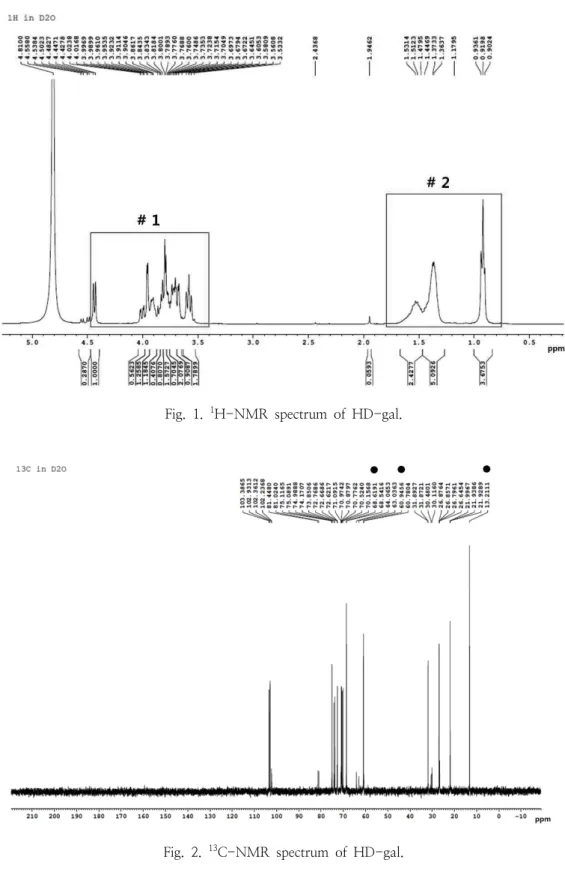
1H-NMR 스펙트럼은 HD에 galactosylation이 되었음을 보여주는 다양한 피크가 나타나 있다 (Fig. 1). 1H-NMR 스펙트럼의 다운필드인 δH
4.44 ppm과 3.96~3.58 ppm에서 나타나는 다양 한 피크들은 HD에 galactosylation이 되었다는 것을 잘 암시하고 있다(#1 peaks in Fig. 1). 또 한 1H-NMR 스펙트럼의 업필드에서 나타나는 δH 1.60~1.35 ppm과 0.92 ppm의 피크는 HD 의 CH2와 CH3 작용기로부터 나타나는 피크로써 HD-gal이 본 물질에 존재함을 알 수 있다(#2 peaks in Fig. 1). 1H NMR (400 MHz, D2O) 4.44 (d, 1H,
J
=7.7 Hz), 3.96 (d, 1H,J
=3.0 Hz), 3.92~3.90 (m, 1H), 3.86~3.76 (m, 2H), 3.79 (d, 1H,J
=4.4 Hz), 3.74~3.70 (m, 2H), 3.68 (d, 1H,J
=2.9 Hz), 3.58 (t, 1H,J
=8.8 Hz), 1.60~1.45 (m, 2H), 1.40~1.35 (m, 4H), 0.92 (t, 3H,J
=6.7 Hz).13C-NMR 스펙트럼은 HD-gal의 α-anomer
와 β-anomer의 구조에서 기인하는 총 21 개의 탄소 피크가 나타났다. 각 anomer 마다 12 개의 탄소가 존재하는데 이중 δC 68.6, 60.9 그리고 13.2 ppm에 보이는 3개의 탄소는 겹쳐서 나타나 총 24 개의 피크 중 21개가 나타났다 (black dots in Fig. 2). 이로써, 본 물질에 HD-gal이 존 재하고 있고, HD의 galactosylation이 되었다는 것을 확인 할 수 있다 (Fig. 2). 13C NMR (100 MHz, D2O) α-anomer; 103.4, 75.1, 74.2,
Fig. 1. 1H-NMR spectrum of HD-gal.
Fig. 2. 13C-NMR spectrum of HD-gal.
Fig. 4. Transgalactosylation reaction of HD using
E. coli
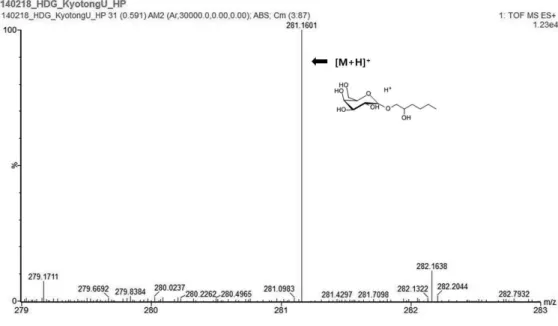
β-gal.Fig. 3. Mass spectrum of HD-gal using ESI-MS. Arrow indicates a peak of protonate HD-gal ([M+H]+). In addition, molecular structure of HD-gal is shown below the arrow.
72.7, 70.9, 70.5, 68.6, 60.9, 31.9, 26.9, 21.9, 13.2. β-anomer; 102.9, 75.1, 73.9, 72.6, 70.8, 70.2, 68.6, 60.9, 31.9, 26.9, 21.9, 13.2.
그러나, NMR 스펙트럼 결과에서는 HD 분자의 어떤 hydroxyl group (-OH)에 galactose가 결합 했는지에 대한 증거를 찾을 수 없었다. 하지만 선행연구 결과에서는 β-gal에 의하여 CPN의 primary alcohol group에 galactose가 결합한다는 보고가 있다[16, 17]. 그래서, HD-gal도 primary alcohol group에 galactose가 결합했을 것으로 추 론할 수 있다.
3.2. Mass spectrometry
Fig. 3과 같이 질량분석기 (ESI-MS)를 통해 정제한 HD-gal 분석의 질량을 분석한 결과 281.1601 (m/z)의 peak를 얻을 수 있었다. 이 질량 peak는 다음과 같이 추론 할 수 있었다
[118.174 (1, 2-hexanediol) + 180.156 (galactose) - 18.01528 (water) + 1.007276 (H+) = 281.3219762]. 그래서 이 peak를 HD-gal의 protonated form 이라고 확인하였고, 재조합 대장균 β-gal에 의해 HD-gal이 합성되 었음을 확인하였다.
4. 결 론
NMR (1H- and 13C-) spectroscopy와 mass spectrometry 분석을 통하여, 재조합 대장균 β -gal을 이용하여 HD의 hydroxyl group에 galactose 한 분자를 결합시켜 합성한 HD-gal 분자구조와 질량을 확인하였다. 그리고, 이러한 transgalactosylation 반응을 Fig. 4와 같이 추론 할 수 있었다. 본 연구를 통하여, 이미 연구한
CPN-gal [7]과 PE-gal [8] 같이 항균력은 유지 하면서, 피부세포에 대한 독성이 감소된 화장품용 방부제 개발을 기대하고 있다.
감사의 글
본 연구는 2016년 한국교통대학교 지원을 받 아 수행하였음.
References
1. W. Johnson Jr., W. F. Bergfeld, D. V.
Belsito, R. A. Hill, C. D. Klaassen, D.
Liebler, J. G. Marks Jr., R. C Shank, T.
J. Slaga, P. W. Snyder, and F. A.
Andersen, Safety Assessment of 1, 2-Glycols as Used in Cosmetics.
Int. J.
Toxicol.
, 31(5 Suppl), 147S (2012).2. E. Lee, S. An, S.-A. Cho, Y. Yun, J. Han, Y. K. Hwang, H. K. Kim, and T. R. Lee, The Influence of Alkane Chain Length on the Skin Irritation Potential of 1, 2-Alkanediols,
Int. J. Cosmet. Sci
., 33(5), 421 (2011).3. S. B. Levy, A. M. Dulichan, and M.
Helman, Safety of a Preservative System containing 1, 2-Hexanediol and Caprylyl glycol,
Cutan. Ocu.l Toxicol.
, 28(1), 23 (2009).4. Y. -O. Kim and K. –H. Jung, Enzymatic Synthesis of 1, 2-Hexanediol Galactoside by Whole cells of β-Galactosidase- containing Recombinant
Escherichia coli
.J.
Life Sci.
, 26(5), 608 (2016).5. S. –E. Lee, H. –Y. Lee, and K. –H. Jung, Production of Chlorphenesin Galactoside by Whole Cells of β-Galactosidase- containing
Escherichia coli
,J. Microbiol.
Biotechnol.
, 23(6), 826 (2013).6. H. –Y. Lee and K. –H. Jung, Enzymatic Synthesis of 2-Phenoxyethanol Galactoside by Whole Cells of β-Galactosidase- containing
Escherichia coli
,J. Microbiol.
Biotechnol.
, 24(9), 1254 (2014).7. S. –E. Lee, T. M. Jo, H. –Y. Lee, J. Lee, and K. –H. Jung, β-Galactosidase- catalyzed Synthesis of Galactosyl Chlorphenesin and its Characterization,
Appl. Biochem. Biotechnol.
, 171(6), 1299 (2013).8. K. –H. Jung and H. –Y. Lee,
Escherichia coli
β-Galactosidase-catalyzed Synthesis of 2-Phenoxyethanol Galactoside and its Characterization,Bioprocess Biosyst. Eng.
, 38(2), 365 (2015).9. G. D. Benjamin and M. A. Robinson, Drug Delivery Systems based on Sugar-macromolecule Conjugates,
Curr.
Opin. Drug Discov. Devel.
, 5(2), 279 (2002).10. J. Huang, F. Gao, X. Tang, J. Yu, D.
Wang, S. Liu, and Y. Li, Liver-targeting Doxorubicin-conjugated Polymeric Prodrug with pH-Triggered Drug Release Profile,
Polym. Int.
, 59(10), 1390 (2010).11. D. Melisi, A. Curcio, E. Luongo, E.
Morelli, and M. G. Rimoli, D-Galactose as a Vector for Prodrug Design,
Curr.
Top. Med. Chem.
, 11(18), 2288 (2011).12. L. F. Tietze and K. Schmuck, Prodrugs for Targeted Tumor Therapies: Recent Developments in ADEPT, GDEPT and PMT,
Curr. Pharm. Design
, 17(32), 3527 (2011).13. L. Q. Yan, N. Li, and M. H. Zong, First Enzymatic Galactosylation of Acyclic Nucleoside Drugs by β-Galactosidase:
Synthesis of Water-soluble β-D- Galactosidic Prodrugs,
Biotechnol.
Bioprocess Eng.
, 19(4), 586 (2014).14. K. –H. Jung, Enhanced Enzyme Activities of Inclusion Bodies of Recombinant β -Galactosidase
via
the Addition of Inducer Analog after L-Arabinose Induction in thearaBAD
Promoter System ofEscherichia coli
,J. Microbiol. Biotechnol.
, 18(3), 434 (2008).15. K. –H. Jung, J. -H. Yeon, S. –K. Moon, and J. -H. Choi, Methyl α-D- Glucopyranoside Enhances the Enzymatic
Activity of Recombinant β-Galactosidase Inclusion Bodies in the
araBAD
Promoter System ofEscherichia coli
.J. Ind.
Microbiol. Biotechnol.
, 35(7), 695 (2008).16. N. Bridiau, S. Taboubi, N. Marzouki, M.
D. Legoy, and T. Maugard, β -Galactosidase Catalyzed Selective Galactosylation of Aromatic Compounds,
Biotechnol. Prog.
, 22(1), 326 (2006).17. C. Scheckermann, F. Wagner, and L.
Fischer, Galactosylation of Antibiotics using the β-Galactosidase from