• 검색 결과가 없습니다.

The Relationship Between Visitors' Environmental Attitudes and Their Recreational Motivations: A Case Study in a Korean National Park

N/A
N/A
Protected

Academic year: 2021

Share "The Relationship Between Visitors' Environmental Attitudes and Their Recreational Motivations: A Case Study in a Korean National Park"

Copied!
7
0
0

로드 중.... (전체 텍스트 보기)

전체 글

(1)

163

J OURNAL OF K OREAN

F OREST S OCIETY

The Relationship Between Visitors’ Environmental Attitudes and Their Recreational Motivations: A Case Study in a

Korean National Park

Won Sop Shin 1 *, Heon Gyo Kwon 2 and Hang Yeol Han 3

1 Department of Forest Science, Chungbuk National University, Cheongju 361-763, Korea

2 National Park Research Institute, Korea National Park Service, Namwon, Chonbuk 590-811, Korea

3 Department of Forestry, Kyungpook National University, Daegu 702-701, Korea

Abstract : This study examines the relationships between visitors’ environmental attitudes as measured by the new environmental paradigm (NEP) and their recreational motivations based on data collected from a national park in South Korea. The data analysis indicated that visitors’ environmental attitudes and motivation were multi-dimensional structures. The NEP composed of three factors named ‘Humans over Nature’, ‘Balance of Nature’, and Limit to Growth’. Visitors’ motivation also composed of four factors representing ‘Achievement and Stimulation’, ‘Escape and Enjoying Nature’, ‘Social and Leadership’, and

‘Family’. However, there were significant correlations among the factors, suggesting they were independent each other. There were also significant differences in visitors’ motivation due to their level of environmental attitudes.

Key words : Enjoying nature, forest recreation, Halla-san, NEP, REP, visitors’ motivation, visitors’ envi- ronmental attitudes

Introduction

Why is the recreationist participating in the activity in the area? To better answer this question, a behavioral approach was proposed whereby recreation is defined as

“an experience that results from recreational engage- ments” (Driver & Toucher 1970). This approach is based on psychological theory which suggests that most human behavior is goal-oriented or driven by motivation (Ajzen 1991). Expectancy-value theory (Fishbein & Ajzen 1975) states that individuals may have a variety of motives for participating in an activity. Furthermore, Ditton et al.

(1992) argued that persons within that activity may seek totally different outcomes.

Stankey & Schreyer (1987) considered motives to be a predisposition to fulfill specific types of needs. Rea- sons for participating in forest recreation have also been called recreation experience preferences (REF), empha- sizing the voluntary nature of behavior based on those preferences (Driver & Brown 1978). REP is based on the concept that recreation is more than participation in an activity, and should be reviewed as an experience

providing various rewards or outcomes to participation (Driver & Brown 1978). That is, we engage in specific recreation activity because we desire outcomes that we perceive will occur as a result of that activity. Therefore, focusing on these outcomes, motivations have been referred to as desired outcomes and desired consequences (Driver & Brown 1978).

It is also important that motivation is the effect of non- motivational factors on motivation (Graefe et al. 2000).

Variables traditionally used as independent variables (i.e., those that might influence motivations) include past experience, skill level, group type and demographics.

For example, Shin (1994) found that motivations for mountaineering vary with level of experience and fre- quency of participation. The size of the group and whether the group consists of friends, family or strangers affect motivations with the chosen recreation activity (Schuett 1994).

Although many previous studies have examined the relationships between forest recreational motivations and other non-motivational variables, the relationship between motivations and visitors’ values and attitudes has been rarely examined. Blamey & Braithwaite (1997), in examin- ing potential outdoor recreation markets from the per- spective of social values as opposed to the traditional

*Corresponding author

E-mail: [email protected]

(2)

variables (i.e., past experience, skill level, group type and demographics), outlined two paths of psychographic inquiry in describing outdoor recreationists’ lifestyles.

The first path focused on needs and motives that lead to satisfy these needs, while the other focused on human values and attitudes. However, few studies have been conducted to investigate the relationship between envi- ronmental attitudes and forest or outdoor recreation motivations.

According to Ajzens’ (1991) theory of planned behav- ior (TPB), an individual’s behavior is largely dependent on his/her intention to perform that behavior which, in turn, is determined by the person’s attitudes toward the behavior. Thus, those who hold positive environmental attitudes are more likely to have a desire to learn and experience nature (Eagles & Higgins 1998) or have an intention to pursue an environmentally friendly behavior associated with forest recreation. Therefore, the purpose of this study is to examine the extent to which environ- mental attitudes as measured by the new environmental paradigm (NEP) are related to forest recreation motiva- tion measured by recreational experience preferences (REP), using data collected from Halla-san National Park in Korea.

In Korea, participation in forest recreation activities has increased dramatically over the past few decades, and the current growth rate has been projected to increase further. For example, in the year of 2007, the number of visitations to 103 recreational forests across Korea was 5,775,417, increasing 13.8% of the previous year (Korea Forest Service 2008). Traditional forest recreation activ- ities, such as hiking and camping in national parks and recreational forests, which are the major outdoor deliv- ery systems in Korea, are expected to show substantial increase (Korea National Park Research Institute 2007).

To meet visitors’ needs and optimize their recreation sat- isfaction, managers must be able to identify the motiva- tions driving to forest recreation areas. Understanding what visitors seek through recreation can provide useful guidance to a variety of planning and management tasks, such as measuring supply and demand for forest recre- ation, developing management objectives, and prevent- ing and managing conflicts between visitors.

Methods 1. Study area

Hallasan National Park consists of 149 square kilome- ters of rugged mountains and valleys in Jeju Island, South Korea. The summit (1,950 meters) of the moun- tain is the highest point in South Korea. The mountain is located exactly in the middle of the island and can be accessed from all sides fairly easily. Hallasan is one of

the most popular mountains for hiking in Korea, partic- ularly with all the local vacationers who come to Jeju Island on holidays and for honeymoons. Hallasan National Park has a wide range of attractions and has a large number of visitors throughout the year (804,887 visitors in 2007). Park visitors engage in pursuits such as day-hiking, backpacking, and nature-picturing. Park manag- ers are faced with conflicts from visitor pressure for ser- vices and facilities, and the capacity of the park to meet visitor expectations. A key reason why this park was selected for the study is that the popularity of the park has generated heavy use with a potential of overuse and serious environmental degradation. The results of this visitors’ motivation examination will help park managers to define clear management objectives and how to meet them.

2. Instruments

Respondents’ environmental attitudes were measured using Korean NEP scale. The Korean NEP scale devel- oped by Shin (2001) based on the original NEP scale (Dunlap et al. 2000). The NEP scale consists of 12 items, with each item having five answer categories ranging from

“strongly agree” to “strongly disagree”. The score of 12 would mean a strong attitude that humans are above nature and therefore don not have to care as they use up resources. By contrast, a score of 60 would mean that the strongest attitude that humans are a part of nature and therefore must consider it in the use of resources.

Hallsan National Park visitors’ motivations were mea- sured using a 17-item scale selected from the REP scales (Manfredo et al. 1996). Each item was measured using 5-point Likert type scale ranging from 1 (strongly dis- agree) to 5 (strongly agree).

3. Data collection

The sample of 422 visitors to Hallasan National Park was surveyed during the spring and summer of 2008.

Contact with survey respondents was made at trailheads by trained interviewers. The selected visitors were first briefed about the study, and those agreeing to participate were then interviewed. The interview refusal rate was less than 1%. Non-response bias is therefore low.

The sampling scheme for the survey was stratified by survey sites, weekday-weekend use, and relative use throughout the day. Each day of the sampling period was divided into two sampling blocks: morning (7:30 a.m. to 12:30 p.m.) and afternoon (1:00-6:00 p.m.). The selec- tion of sampling sites was based on use estimates obtained from park managers. The historic use patterns for each sampling site determined how much time would be spent at each interview location. For example, if 10%

of an area’s previous use was at trailhead A, then 10%

(3)

Enviornmental Attitides and Recreational Motivations 165 of the interview effort occurred at trailhead A.

4. Data analysis

Data analysis consisted of several steps. First, the NEP scale and REP scale were factor analyzed using a prin- cipal component factor analysis (with varimax rotation) with an eigenvalue of 1.00 or more being used to iden- tify potential factors. Second, based upon the results from the principal component analysis, factor scores were computed for Pearson’s correlation coefficients to exam- ine scales’ internal consistency. Third, respondents were classified into three groups-low score NEP group, mid- dle score NEP group, and high score NEP group- based on total NEP scores using 33 and 66 percentiles (Kim et

al. 2006). Finally, Duncan’s one-way analysis of vari- ance was performed test to determine any differences in the recreational motivation factor scores by level of environmental attitudes (i.e., low score NEP group, mid- dle score NEP group, and high score NEP group).

Results 1. Socio-demographic characteristics

The population for this study consisted of visitors to Hallasan National Park. There were 422 respondents in this study: 66 per cent were men, 34 per cent were

women. Majority of the respondents were in their age of 50s (32 per cent), 40s (30 per cent) and 30s (21 per cent). Most of the respondents were high school (36.5 per cent) or college (59.8 per cent) graduates. These demographic characteristics are similar to those found in previous national park visitor studies in Korea (Kwon et

al. 2003, Shin et al. 2001).

In terms of occupation, the majority of respondents were employed in a company or a corporation (25.4 per cent) and in government sectors (21.8 per cent). Approx- imately 62.5 per cent of the respondents were white-col- lar workers. In addition, 62.5 per cent of the respondents reported having a monthly personal income between 2 millions Won (approximately US$2,000) and 4 millions Won (approximately US$4,000).

Most of the respondents visited to the park with friends (29.9 per cent) or family members (24.6 per cent). Regard- ing to duration of staying in the park, majority of the respondents reported two (36.1 per cent) or three (40.3 per cent). Finally, almost all respondents were urban res- idents.

2. Environmental attitudes and motivation factor anal- yses Principal-components factor analyses were performed to identify the number and nature of the constructs under-

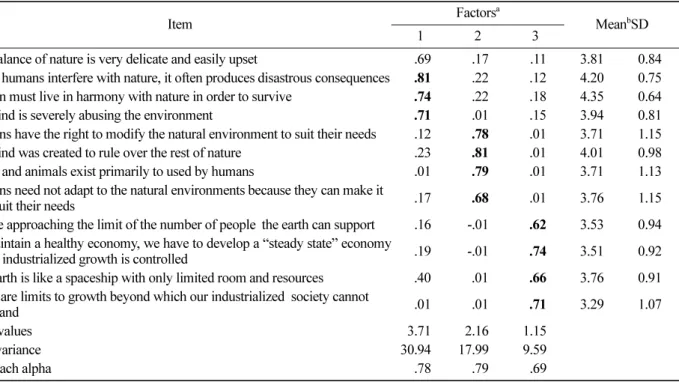
Table 1. New Environmental paradigm factor loading items on rotated (Varimax) Factors.

Item 1 Factors 2 a 3 Mean b SD

The balance of nature is very delicate and easily upset .69 .17 .11 3.81 0.84 When humans interfere with nature, it often produces disastrous consequences .81 .22 .12 4.20 0.75 Human must live in harmony with nature in order to survive .74 .22 .18 4.35 0.64

Mankind is severely abusing the environment .71 .01 .15 3.94 0.81

Humans have the right to modify the natural environment to suit their needs .12 .78 .01 3.71 1.15

Mankind was created to rule over the rest of nature .23 .81 .01 4.01 0.98

Plants and animals exist primarily to used by humans .01 .79 .01 3.71 1.13

Humans need not adapt to the natural environments because they can make it

to suit their needs .17 .68 .01 3.76 1.15

We are approaching the limit of the number of people the earth can support .16 -.01 .62 3.53 0.94 To maintain a healthy economy, we have to develop a “steady state” economy

where industrialized growth is controlled .19 -.01 .74 3.51 0.92

The earth is like a spaceship with only limited room and resources .40 .01 .66 3.76 0.91 There are limits to growth beyond which our industrialized society cannot

expand .01 .01 .71 3.29 1.07

Eigenvalues 3.71 2.16 1.15

% of variance 30.94 17.99 9.59

Cronbach alpha .78 .79 .69

a Items that have a high loading on a factor are in bold-face type.

Factor 1= Humans over Nature Factor 2= Balance of Nature Factor 3= Limit to Growth

b Possible score range from 1.00 to 5.00

(4)

lying environmental attitudes (NEP) and motivation (REP), and to identify those items that constitute identifiable sets of environmental attitudes and recreational motivations.

The results of the factor analyses for the NEP and REP scales are presented in Table 1 and Table 2, respectively.

As reported in Table 1 the 12 NEP items loaded on three factors, which are labeled ‘Humans over Nature’, ‘Balance of Nature’, and ‘Limit to Growth’. Factor 1, accounting for 30.94 per cent of total variance, is comprised of four items which represent a theme of “Human over Nature”. Factor 2, accounting for 17.99 per cent of total variance, describes a “Balance of Nature” theme. Factor 3, with 9.59 per cent of total variance, portrays a “Limits to Growth” theme.

The Cronbach’s alpha values for each of the three factors are 0.78, 0.79, and 0.69, respectively, suggesting adequate internal reliability. The factor structure of the NEP is gen- erally consistent with Shin’s (2001) previous finding on Korean national park visitors. This, to some extent, sup- ports to validity and generalizability of the NEP as it applied to Korean people.

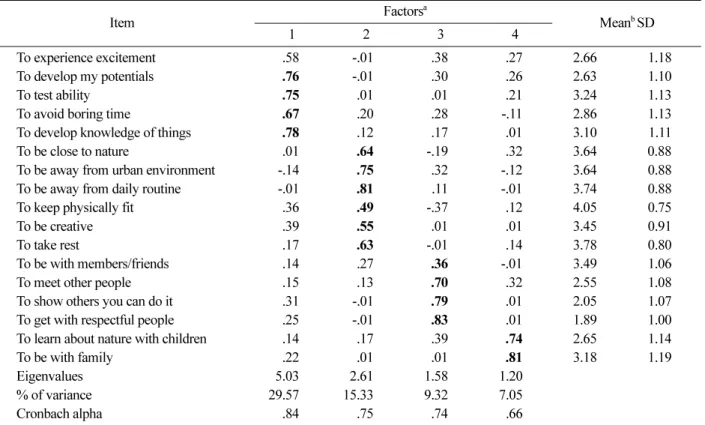
Regarding 17 REP items, four factors were obtained, namely ‘Achievement and Stimulation’, ‘Escape and Enjoy- ing Nature’, ‘Social and Leadership’, and ‘Family’. The four factors explain 62.27 per cent of the total variance, with factor 1 (i.e., Achievement and Stimulation), account-

ing 29.57 per cent, the largest portion of all four factors.

The Chronbach’s alpha values of the four factors are 0.84, 0.75, 0.74, and 0.66, respectively, suggesting ade- quate internal reliability. The relatively low alpha value for the fourth factor is because of the small numbers of items loading on the factor.

3. Correlation analyses among factors

Correlation coefficients among the factors for NEP and REP scales were obtained to examine internal con- sistency. As it can be seen in Table 3 and Table 4, fac- tors in each scale were statistically significantly inter- correlated, suggesting interdependence and internal con- sistency. For example, ‘Humans over Nature’ and ‘Bal- ance of Nature’, and ‘Limits to Growth’ in NEP were Table 2. Forest recreation motivation factor loading items on rotated (Varimax) factors

Item 1 2 Factors a 3 4 Mean b SD

To experience excitement .58 -.01 .38 .27 2.66 1.18

To develop my potentials .76 -.01 .30 .26 2.63 1.10

To test ability .75 .01 .01 .21 3.24 1.13

To avoid boring time .67 .20 .28 -.11 2.86 1.13

To develop knowledge of things .78 .12 .17 .01 3.10 1.11

To be close to nature .01 .64 -.19 .32 3.64 0.88

To be away from urban environment -.14 .75 .32 -.12 3.64 0.88

To be away from daily routine -.01 .81 .11 -.01 3.74 0.88

To keep physically fit .36 .49 -.37 .12 4.05 0.75

To be creative .39 .55 .01 .01 3.45 0.91

To take rest .17 .63 -.01 .14 3.78 0.80

To be with members/friends .14 .27 .36 -.01 3.49 1.06

To meet other people .15 .13 .70 .32 2.55 1.08

To show others you can do it .31 -.01 .79 .01 2.05 1.07

To get with respectful people .25 -.01 .83 .01 1.89 1.00

To learn about nature with children .14 .17 .39 .74 2.65 1.14

To be with family .22 .01 .01 .81 3.18 1.19

Eigenvalues 5.03 2.61 1.58 1.20

% of variance 29.57 15.33 9.32 7.05

Cronbach alpha .84 .75 .74 .66

a Items that have a high loading on a factor are in bold-face type.

Factor 1= Achievement and Stimulation; Factor 2= Escape and Enjoying Nature; Factor 3= Social and Leadership; Factor 4= Family

b Possible score range from 1.00 to 5.00

Table 3. Correlation matrix among the three factors of environmental attitudes (NEP)

Humans

over Nature Balance

of Nature Limit to Growth Humans Over Nature 1.00

Balance of Nature 0.39*** 1.00

Limit to Growth 0.42*** .05 1.00

*** .001; ** .01; * .05

(5)

Enviornmental Attitides and Recreational Motivations 167

highly correlated. However, ‘Balance of Nature’ and ‘Limits to Growth’ did not show any correlation statistically. In terms of recreational motivation (REP), all four factors were statistically significantly inter-correlated each other.

In other words, four factors of recreationists’ motivations were highly independent each other.

4. Environmental attitudes and motivation

Table 5 presents the summary of ANOVA statistics con- cerning any differences in each factor of recreational motivation among respondent environmental level groups.

Respondents were classified into three groups-low score NEP group, middle score NEP group, and high score NEP group-based on total NEP scores using 33 and 66 percen- tiles (cf. Kim et al. 2006, Luo & Deng 2008).

All factors, except ‘Family’, showed significant differ- ences due to respondents’ environmental attitude levels (see Table V, p .05). Higher environmental attitude respondents tended to rate ‘Escape and Enjoying Nature’

motivation more important than those of lower environ- mental attitude respondents. On the other hand, lower environmental attitude respondents tended to rate

‘Achievement and Stimulation’ and ‘Social and Leader- ship’ motivation more important than those of higher environmental attitude respondents. However, motivation for ‘Being with Family’ is not significantly different due to respondents’ level of the environmental attitudes.

Discussion

This study identified the factors structures comprised of visitors’ environmental attitudes measured by NEP

(Dunlap et al. 2000) and recreational motivation mea- sured by REP (Manfredo et al. 1996) to Hallasan National Park in Jeju Island, South Korea. This study also exam- ined the relationships between the visitors’ level of envi- ronmental attitudes and their recreational motivation.

The data indicate that visitors’ environmental attitudes and motivation were multi-dimensional structures. How- ever, there were significant correlations among the fac- tors, suggesting they were independent each other. There were also significant differences in visitors’ motivation due to their level of environmental attitudes. For exam- ple, visitors’ with higher environmental attitude tended to report ‘Escape and Enjoying Nature’ motivation more important than those of lower environmental attitude.

Two propositions were made to enhance the predictive power of environmental attitudes in relation to forest recreation motivation. The propositions are: (1) environ- mental attitudes and as well as forest recreational moti- vation should be measured rather generally; and (2) the recreational motivation should be influenced by visitors’

environmental attitudes. The result of this study supports all two propositions.

In terms of the psychometric properties of the NEP and REP, the results from this study are no large differ- ences in previous studies. In a study of developing Korean NEP scale, using a sample of visitors to a national park in South Korea, Shin (2001) reported three factors and similar factor structures from this study. More recently, Luo & Deng (2008) also supports three factor structures in NEP with data from a sample of visitors to a national park in China. Regarding REP, Luo & Deng (2008) modified the original REP (Manfredo et al. 1996) to Table 4. Correlation matrix among the four factors of recreation motivation (REP)

Achievement

& Stimulation Escape &

Enjoying Nature Social &

Leadership Family

Achievement & Stimulation 1.00

Escape & Enjoying Nature 0.26*** 1.00

Social & Leadership 0.49*** 0.12* 1.00

Family 0.41*** 0.24*** 0.39*** 1.00

*** .001; ** .01; * .05

Table 5. Analysis of variance (ANOVA) for Forest recreation motivation by environmental attitudes levels

Motivation Factors a L-Group (n=104) Mean ±SD M-Group (n=98) Mean ±SD H-Group (n=126) Mean ±SD F Prob.

Achievement & Stimulation 15.13±3.90 14.49±4.75 13.57±4.53 3.69* .026

Escape & Enjoying Nature 22.39±3.10 22.88±3.35 23.13±3.41 1.39* .025

Social & Leadership 10.87±2.93 09.64±2.86 09.11±2.92 10.62*** .001

Family 05.99±1.84 05.53±1.94 05.71±2.08 1.380 .252

a Possible ranges of each factor scores: Achievement and Stimulation=5-25; Escape and Enjoying Nature=6-30; Social and Leader- ship=4-20; Family=2-10

*** .001; ** .01; * .05

(6)

administer to Chinese samples and reported four factor structures, as the same of this study. On the basis of these findings, the NEP and REP can be recommended for further use in South Korea.

Research on environmental attitudes in the context of recreation in general, and forest recreation in particular has emerged as an important topic in recent years. How- ever, few studies have been attempted to connect visi- tors’ attitudes toward the environment to their recreational motivation, although Formica and Uysal (2002) encour- aged researchers to incorporate environmental attitudes into recreation studies since one’s attitude about nature and use of resources may influence destination selection process. In response to this request, this study examined visitors’ environmental attitudes and their recreation motivations, and the relationship between the two.

As Stein and Lee (1995) have argued, managers can- not provide fulfillment of visitors’ motivation or need directly but they can manage recreation settings to create opportunity for the visitors to fulfill particular motiva- tion or need. The results of this study are useful to man- agers in their efforts to provide recreation opportunities for visitors to achieve beneficial outcomes through ful- filling their recreational motivation.

The results of this study can be of help not only in park management but also park planning. For example, the relationship between visitors’ environmental attitudes and motivation difference could be used by park or for- est recreation planners to develop criteria on how rec- reation resource attributes fulfill to visitors’ motivation or needs. Designation of zoning and other management alternatives to prevent visitors’ conflicts can be decided by managers based on such attitude-motivation informa- tion. Research on how such linkages guide park plan- ning would be of use.

Acknowledgement

This work was supported by the research grant of the Chungbuk National University in 2008.

Literature Cited

1. Ajzen, I. 1991. The theory of planned behavior. Orga- nizational Behavior and Human Decision Processes 50:

179-211.

2. Blamey, R.K. and Braithwaite, V.A. 1997. A social val- ues segmentation of the potential ecotourism market.

Journal of Sustainable Tourism 5: 29-45.

3. Graefe, A.R., Thapa, B., Confer, J.J. and Absher, J.D.

2000. Relationships between trip motivations and selected variables among Allegheny National Forest visitors.

USDA Forest Service Proceedings RMRS-P-15.

4. Ditton, R., Loomis, D. and Choi, S. 1992. Recreation specialization: re-conceptualization from a social world perspective. Journal of Leisure Research 24: 33-51, 107-112.

5. Driver, B.L. & Brown, P. 1978. The opportunity spec- trum concept in outdoor recreation supply inventories:

a rationale. Proceedings of the Integrated Renewable Resource Inventories Workshop. USDA Forest Service General Technical Report RM-55, 24-31.

6. Driver, B.L. and Toucher, R. 1970. Toward a behav- ioral interpretation of recreational engagement, with implications for planning. Elements of Outdoor Recre- ation Planning. Ann Arbor, MI: University Microfilms, 9-13.

7. Dunlap, R.E., Van Liere, K.D., Mertig, A.G. and Jones.

R.E. 2000. Measuring endorsement of the new ecolog- ical paradigm: a revised NEP scale. Journal of Social Issues 56: 425-442.

8. Eagles, P.F.J. and Higgins, B.R. 1998. Ecotourism mar- ket and industry structure. In Ecotourism: a guide for planners and managers, Volume 2, edited by K. Lind- berg, M.E. Wood, and D. Engldrum. North Bennington, VT: Ecotourism Society, pp.11-43.

9. Fishbein, M. and Ajzen, I. 1975. Belief, attitude, inter- action and behavior: An introduction to theory and research. Addison-Wesley Publishing, Reading, MA.

ISBN 0201020890.

10. Formica, S. and Uysal, M. 2002. Segmentation of trav- elers based on environmental attitudes. Journal of Hos- pitality and Leisure Marketing 9: 35-49.

11. Kaplan, R. and Kaplan, S. 1995. The experience of nature: a psychological perspective. Ulrich’s, Ann Arbor, MI. ISBN 0-914004-51-4.

12. Kim, H., Borges, M.C. and Chon, J. 2006. Impacts of environmental values on tourism motivation. Tourism Management 27: 957-967.

13. Korea Forest Service. 2008. Forestry Statistics. Deajeon, Korea.

14. Korea National Park Research Institute. 2007. Research report on crowding in national parks. Namwon, Korea.

15. Kwon, H.G., Shin, W.S. and Kim, J.J. 2003. The iden- tification and evaluation of urban forest benefits using Delphi survey method. Journal of Korean Foresters Society 92: 355-361.

16. Luo, Y. and Deng, J. 2008. The new environmental paradigm and nature-based tourism motivation. Journal of Travel Research 46: 392-402.

17. Manfredo, M.J., Driver, B.L. and Tarrant, M.A. 1996.

Measuring leisure motivation: a meta-analysis of the recreational experience preference scale. Journal of Leisure Research 28: 188-213.

18. Schuett, M.A. 1994. Environmental preference and risk

recreation. Journal of Environmental Education 25: 9-

14.

(7)

Enviornmental Attitides and Recreational Motivations 169 19. Shin, W.S. 1994. The Influence of past experience lev-

els on attitudes toward environment and park manage- ment. Journal of Korean Foresters Society 83: 344-356.

20. Shin, W.S. 2001. Reliability and factor structure of a Korean version of the new environmental paradigm.

Journal of Social Behavior and Personality 16: 9-18.

21. Shin, W.S., Jaakson, R. and Kim, E.I. 2001. Benefits- based analysis of visitor use of Sorak-san National Park in Korea. Environmental Management 28: 413-419.

22. Stankey, G. & Schreyer, R. 1987. Attitudes toward wil-

derness and factor affecting visitor behavior: a state of knowledge review. Proceedings-National Wilderness Research Conference: Issues, State-of-Knowledge, Future Direction. USDA Forest Service General Technical Report INT-220, 246-293.

23. Stein, T. and Lee, M.E. 1995. Managing recreation resources for positive outcomes. Journal of Park and Recreation Administration 13: 52-70.

(Received January 7, 2009; Accepted February 18, 2009)

수치

Table 1. New Environmental paradigm factor loading items on rotated (Varimax) Factors.
Table 3. Correlation matrix among the three factors of environmental attitudes (NEP)
Table 5. Analysis of variance (ANOVA) for Forest recreation motivation by environmental attitudes levels

참조

관련 문서

The purpose of this study is to investigate changes in listening, reading achievement, and learning attitudes of Korean elementary students who enrolled in

Second, to see a similarity factor among the relation between a factor which forms peer group and the attitudes toward school life, in case of the

This study examines the relationship between self-efficacy and creativity of general characteristics of school dance classes of middle school students, and

New environmental and climate change research institutes and a recycling experience center will open within this year in Incheon Metropolitan City.. First,

Purpose: The aim of this study is to identify the relationship between knowledge and awareness of radiation department students and their intent in

This study aims for investigating the relationship between the satisfaction based on one’s participation in physical education class and a physical self-concept

457.657 Civil and Environmental Project Management Department of Civil and Environmental Engineering..

Objective: The purpose of this study is to investigate the relationship between depression and evening meals for adult women by using the National Health and Nutrition Survey