I. 서 론
최근 건축물 옥상 및 노면 주차장 등에서 가장 많이 적용되고 있는 방수는 우레탄 도막방수로 우리나라 건
설방수에서 약 25% 이상의 점유율을 차지하고 있다 (Wang, 2015). 우레탄 도막방수는 폴리올(polyol, -OH 기)과 이소시아네이트(isocyanate, -N=C=O 기)의 반응 에 의해 만들어진 폴리우레탄(우레탄 결합(-NHCOO-)을
https://doi.org/10.15269/JKSOEH.2020.30.2.134
건설현장 우레탄 방수작업자의 휘발성 유기화합물 및 톨루엔 디이소시아네이트 노출평가
박현희1,2ㆍ황은송1ㆍ노지원1ㆍ장광명1ㆍ박승현1ㆍ윤충식2*
1산업안전보건연구원, 2서울대학교 보건대학원
Exposure Assessment of Solvents and Toluene Diisocyanates among Polyurethane Waterproofing Workers in the Construction industry
Hyunhee Park1,2ㆍEunsong Hwang1ㆍJiwon Ro1ㆍKwangmyung Jang1ㆍSeunghyun Park1ㆍChungsik Yoon2*
1Occupational Safety and Health Research Institute
2Graduate School of Public Health, Seoul National University
ABSTRACT
Objectives: The objective of this study was to evaluate volatile organic compounds (VOCs) and toluene diisocyanates (TDIs) exposure among polyurethane waterproofing workers in the construction industry.
Methods: Task-based personal air samplings were carried out at seven construction sites using organic vapor monitor for VOCs (n=88) and glass fiber filters coated with 1-(2-pyridyl)piperazine(1-2PP) for TDIs (n=81). The concentration of VOCs and TDIs were shown for four different work types(mixing paint, primer roller painting, urethane resin spread painting, painter assistant) at five different worksites (rooftop, ground parking lot, piloti, bathroom, and swimming pool). The two TDI sampling methods (filter vs impinger) were evaluated in parallel to compare the concentrations.
Results: The geometric mean(GM) concentration of VOCs Exposure Index (EI) was highest for primer roller painting (1.4), followed in order by, urethane resin spread painting (0.85), mixing paint (0.53), and painter assistant (0.35) by work types . The GM of VOCs EI was highest for bathroom (1.4) followed in order by, swimming pool (0.85), piloti (0.89), ground parking lot (0.82) and rooftop (0.57) by worksites. The GM of 2,4-/2,6-TDI concentration was 0.052 ppb and 0.432 ppb each. There was no statistical difference in TDIs concentrations among worksites. The concentration of 2,6-TDI was ten times higher than that of 2,4-TDI. The concentration of 2,6-TDI by impinger method was 5.7 times higher than that by filter method.
Conclusions: In this study, we found 38.6% of the VOCs samples exceeded the occupational exposure limits and 19.8% of the 2,6-TDI samples exceeded 1 ppb among polyurethane waterproofing workers. The most important determinants that increase the concentration of VOCs and TDIs was indoor environment and primer painting work.
Key words: construction workers, polyurethane waterproofing, Toluene diisocyanates(TDIs), Volatile organic compounds(VOCs)
*Corresponding author: Chungsik Yoon, Tel: 02-880-2734, E-mail: [email protected]
Graduate School of Public Health, Seoul National University, Seoul, Republic of Korea. Gwanak-ro 1, Gwanak-gu, Seoul, 08826, Republic of Korea
Received: May 27, 2020, Revised: June 10, 2020, Accepted: June 20, 2020
Hyunhee Park https://orcid.org/0000-0003-1506-9505 Eunsong Hwang https://orcid.org/0000-0003-3487-2096 Jiwon Ro https://orcid.org/0000-0002-5946-0429 Kwangmyung Jang https://orcid.org/0000-0002-6452-0537 Seunghyun Park https://orcid.org/0000-0002-6515-4428 Chungsik Yoon https://orcid.org/0000-0001-7822-0079 This is an Open-Access article distributed under the terms of the Creative Commons Attribution Non-Commercial License (http://creativecommons.org/licenses/by-nc/3.0) which permits unrestricted non-commercial use, distribution, and reproduction in any
가지는 고분자물질)이 고무와 같은 탄성을 얻게되어 일 정한 방수막을 형성하는 공법이다(Toutanji et al., 2013). 폴리우레탄은 변형이나 열에 대한 내구성이 좋 고, 도막외관 및 작업성이 우수한 특성이 있다(Seo et al., 2008). 우레탄 도료는 1액형과 2액형 도료로 구분 되는데, 1액형은 경화제가 미리 반응되어 있어, 희석제 만 섞어 도포한 후 자연 건조되면서 도막을 형성하는 반면, 2액형은 주제와 경화제를 현장에서 교반하여 화 학적 반응을 통해 빠르게 경화시켜 도막을 형성하는 방 법이다. 대부분의 국내 건설현장에서는 경화시간이 빠 르고, 품질이 우수한 2액형의 도료를 주로 사용한다 (Kim, 2014). 다만, 2액형 도료의 경화제로 사용되는 이소시아네이트가 미반응되어 교반 및 도포 작업 중 작 업자에게 노출될 수 있는 우려가 있다. 이소시아네이트 는 반응성이 매우 큰 저분자물질로 –NCO기의 수에 따 라 모노이소시아네이트(monoisocyanates, one NCO), 디이소시아네이트(diisocyanates, two NCO) 및 폴리 이소시아네이트(polyisocyanates, multi NCO)로 구 분할 수 있는데, 폴리우레탄을 형성하기 위한 반응에서 는 디이소시아네이트가 사용된다(Bello et al., 2004).
이소시아네이트는 호흡기 및 피부에 감작(sensitization) 을 일으키고, 직업성 천식을 유발하는 대표적인 물질로 (Stocks et al., 2015), 극히 낮은 농도에서도 천식을 유발하는 것으로 알려져 있다(Lemiere et al., 2002).
특히, 톨루엔 디이소시아네이트(Toluene Diisocyanate, TDI)는 반응성이 풍부하고 가격이 저렴하여 널리 사용 되는데, 국제암연구소(International Agency for Research on Cancer, IARC)에서 정한 발암 가능 물질(Group 2B, IARC, 1999)로도 알려져 있어 산업보건학적인 측 면에서 많은 관심을 가져야 하는 물질이다(Jeong et al., 2012). 그동안 국내에 보고된 이소시아네이트 관련 논문은 대부분 분석방법과 관련된 연구(Lee et al., 1994; Byun et al., 1996; Kang & Kim, 1999; Lee et al., 2001; Yun et al., 2006, Kim et al., 2013;
Park et al., 2013)가 가장 많았고, 뇨 중 대사산물 연 구(Park et al., 2002; Park et al., 2003; Lee et al., 2016) 등이 있었다. 공기 중 노출평가연구는 우레탄 폼 제조방식에 따른 디이소시아네이트 평가(Jeong et al., 2012), 가구, 악기, 기계기구 등 도장 작업의 공기 중 TDI 평가(Kim et al., 2009; Park et al., 2002; Lee et al., 2000) 등이 있었다. 국외 연구로는 자동차 수리 (Woskie et al., 2004; Liu et al., 2009; Whitaker
et al., 2012), 항공기(Bennett et al., 2016) 도장 등 에서 이소시아네이트류가 평가되었으나, 건설현장 우레 탄 방수작업의 노출평가 보고는 없었다.
또한, 우레탄 방수작업에서는 우레탄 수지 및 경화제 를 용해 또는 분산시키는 매체로 다양한 유기용제류 (solvent)가 사용되는데, 작업자가 사용직전 혼합하고, 직접 도포하는 방식으로 작업 중 휘발성 유기화합물 (Volatile Organic Compounds, VOCs)에 고농도로 노출될 가능성이 있다. VOCs는 피부, 폐, 신장 및 중추 신경 장해를 유발하는 것으로 알려져 있고(Winder &
Turner, 1992), 특히 신경계 독성 영향은 2차적으로 작업자의 빈번한 넘어짐과 미끄러짐을 유발하게 되어 안전사고로 이어질 우려도 있다(Wolfford. 1996). 그 동안 자동차 수리(Keer et al., 2018), 조선소(Ahn et al., 2019; Chang et al., 2002). 교량건설(Qian et al., 2010; Riala et al., 1984) 등의 도장작업자에 대한 노 출평가가 보고된 바 있었으나, 건설현장 우레탄 방수작 업 중 작업공간 및 작업내용에 따른 VOCs 노출평가 보 고는 없었다. 이번 연구에서는 건설업 우레탄 방수작업 자의 VOCs 및 2,4-/2,6-TDI 노출농도 수준을 파악하 여 건설현장 근로자의 직업성 질환 발생과의 연관성 등 규명 및 작업환경개선방안 자료로 활용하고자 한다.
Ⅱ. 대상 및 방법
1. 연구대상
아파트 신축현장 7개소의 옥상(rooftop), 노면 주차 장(ground parking lot), 필로티(piloti) 내부, 세대안 욕실(bathroom) 및 지하 수영장(swimming pool) 바 닥 우레탄 방수작업을 연구대상으로 하였다. 평가 작업 은 도료 교반(mixing paint), 프라이머 도포(primer roller painting), 우레탄 수지 도포(urethane resin spread painting), 도장 보조(painter assistant), 작 업장 지역시료(area)로 나누어 평가하였다. 우레탄 도 막방수는 프라이머 도포 및 우레탄 수지 도포의 순서로 이루어지는데 프라이머 도포는 바닥과의 접착력을 높이 기 위해 가장 먼저 도포하는 도료로 톨루엔, 자일렌, 메 틸에틸케톤, 에틸벤젠 등 용제류를 약 50~60%, 톨루엔 2,4/2,6-디이소시아네이트를 약 10~20% 함유하고 있 었고 롤러(roller)를 이용하여 작업하였다. 우레탄 수지 도포는 주제와 경화제를 혼합하여 사용하는데, 톨루엔, 자일렌, 에틸벤젠 등 용제류가 약 30~35%, 톨루엔
2,4/2,6-디이소시아네이트가 약 10~30%, 폴리프로필 렌글리콜, 탄산칼슘, 카올린(고령토) 등이 제품에 따라 다양한 성분으로 구성되어 있었고 고무판 형태의 스프레 더(spreader)를 이용하여 작업하였다. 다만 도료의 구 성성분 중에는 영업비밀로 공개되지 않는 정보가 많아 작업자별 취급도료의 구성성분을 특정화하지 못하였다.
2. 시료채취 및 분석
시료채취는 2014년 5월~7월(1차) 및 2018년 4월~
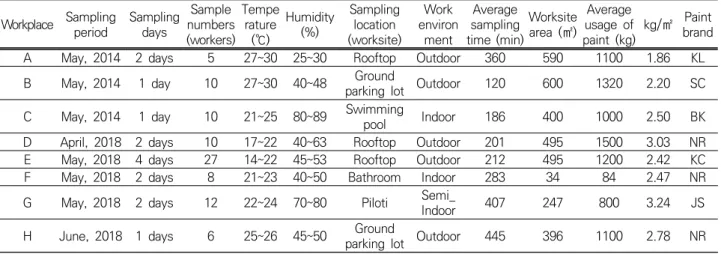
6월(2차)에 두 차례 실시되었다. 1차 평가에서는 VOCs 에 대한 평가만 이루어졌고, 2차 평가에서는 VOCs와 2,4-/2,6-TDI에 대해서 진행하였다. 시료채취는 도장 작업이 진행되는 시간동안 실시하였고, 연속작업이 진 행되는 경우 6시간 이상 측정을 실시하였다. 작업자 개 인시료 채취방법으로 측정하면서, 일부 TDI 시료는 지역 시료 채취방법으로 필터(filter)와 액체포집(impinger) 방법을 병행 평가하여 두 평가방법간의 농도 수준을 비 교하였다. 평가대상 현장별 측정시기, 작업장 특성, 시 료채취시간 등은 Table 1과 같다.
1) 공기 중 휘발성 유기화합물
수동식시료채취기(Organic Vapor Monitor; 3M 3500, Canada)를 사용하여 시료를 채취하고, 가스크 로마토그래피(Gas Chromatography, GC 6890 &
7890A, Agilent Tech, USA)의 불꽃이온화검출기 (Flame Ionization Detector) 및 질량분석기(Mass Spectrometer Detector)를 사용하여 분석하였다. 분 석조건은 Table 2와 같다. 분석 대상물질은 수동식시 료채취기 사용방법으로 분석 가능한 물질과 도료의 구성
성분을 고려하여 아세톤(acetone), 메틸에틸케톤(methyl ethyl ketone), 초산 에틸(ethyl acetate), 노말헥산 (n-hexane), 트리클로로에틸렌(trichloroethylene), 벤젠(benzene), 메틸이소부틸케톤(methyl isobuthyl ketone), 초산 이소부틸(isobutyl acetate), 톨루엔 (toluene), 초산 부틸(n-butyl acetate), 퍼클로로에틸 렌(perchloroethylene), 에틸렌글리콜모노부틸에테르 아세테이트(ethylene glycol methyl ether acetate), 에틸벤젠(ethyl benzene), 자일렌(xylene), 스티렌 (stylene)의 15가지 물질에 대하여 분석을 실시하였다.
각 VOCs의 혼합물질평가를 위하여 검출된 각 물질의 농도를 노출기준으로 나누어 합산하여 노출지수 (Exposure Index, EI)를 산출하여 (Equation-1)과 비 교하였으며, 이 지수가 1을 초과하는 경우, VOCs 농도 가 기준을 초과하는 것으로 평가하였다.
... (Equation -1)
여기서 C는 각 유기화합물 성분의 측정값, OEL (Occupational Exposure Limits)은 각 유기화합물의 노출기준을 의미한다.
2) 공기 중 2,4-/2,6-디이소시아네이트
(1) 개인시료 채취(OSHA-ID 42) 측정 및 분석 개인시료 채취를 위한 측정 및 분석은 OSHA-ID 42 (OSHA, 1983)에 따라 실시하였다. 채취매체는 1,2PP (1-(2-pryridyl) piperazine) 0.1 ㎎이 코팅된 유리섬 유여과지(37 ㎜, SKC Inc., USA)를 개방형 카세트
Workplace Sampling period Sampling days
Sample numbers (workers)
Tempe rature (℃)
Humidity (%)
Sampling location (worksite)
environ Work ment
Average sampling time (min)
Worksite area (㎡)
Average usage of
paint (kg) kg/㎡ Paint brand
A May, 2014 2 days 5 27~30 25~30 Rooftop Outdoor 360 590 1100 1.86 KL
B May, 2014 1 day 10 27~30 40~48 Ground
parking lot Outdoor 120 600 1320 2.20 SC
C May, 2014 1 day 10 21~25 80~89 Swimming
pool Indoor 186 400 1000 2.50 BK
D April, 2018 2 days 10 17~22 40~63 Rooftop Outdoor 201 495 1500 3.03 NR
E May, 2018 4 days 27 14~22 45~53 Rooftop Outdoor 212 495 1200 2.42 KC
F May, 2018 2 days 8 21~23 40~50 Bathroom Indoor 283 34 84 2.47 NR
G May, 2018 2 days 12 22~24 70~80 Piloti Semi_
Indoor 407 247 800 3.24 JS
H June, 2018 1 days 6 25~26 45~50 Ground
parking lot Outdoor 445 396 1100 2.78 NR
Table 1. Target monitoring workplace
(open-face cassette)에 장착하고 고유량 시료채취기 (Escort Elf Sampling pump; MSA, USA)를 사용하여 유량을 각 2 L/min으로 설정하여 채취하였다. 채취된 시료는 카세트 마개를 막고 햇빛으로부터 차단하여 실 험실로 운반하고 냉장 보관하였다. 현장 공시료 및 실험 실 공시료를 분석하여 보정을 실시하였다. 시료채취기는 유량보정기(Dry cal, Defender 520-M; MesaLabs, USA)를 사용하여 시료채취 전, 후에 보정을 실시하였 다. 시료의 분석은 형광검출기(fluorescene detector) 가 장착된 고성능액체크로마토그래피(HPLC, Acquity UPLC H-Class; Waters USA)를 사용하였다. 상세한 분석조건은 Table 3과 같다.
(2) 지역시료 채취(NIOSH #5522) 측정⋅분석 지역시료 채취를 위한 측정 및 분석은 NIOSH # 5522(NIOSH, 1998)에 따라 실시하였다. 채취매체는 25 ml 임핀저(impinger)에 흡수액으로 Tryptamine/
DMSO(Demethyl Sulfoxide)를 20 ml 주입하였고,
고유량 시료채취기(Escort Elf Sampling pump;
MSA, USA)를 사용하여 유량을 각 1.2~1.5 L/min으로 설정하여 채취하였다. 시료는 햇빛으로부터 차단하여 실험실로 운반하고 냉장 보관하였다. 현장 공시료 및 실 험실 공시료를 분석하여 공시료에 대한 보정을 실시하 였다. 시료채취기는 유량보정기(Dry cal, Defender 520-M; MesaLabs, USA)를 사용하여 시료채취 전, 후 에 보정을 실시하였다. 분석은 형광검출기가 장착된 고성 능액체크로마토그래피(HPLC, Acquity UPLC H-Class;
Waters USA)를 사용하였다. 상세한 분석조건은 Table 3과 같다.
3. 자료분석
측정자료는 정규성 검정(Shapiro-Wilk test)을 실시 하여 분포 특성을 살펴보았으며, 분석물질에 따라 정규 분포 또는 대수정규분포를 따르지 않는 평가그룹이 존 재하였다. 다만, 자료의 형태가 대수정규분포에 가까워, 로그 변환한 뒤 분산분석(ANOVA) 및 T-검정(T-test)
Classification First measurement Second measurement
Instrument GC 6890
(Agilent Technologies, USA) GC 7890A
(Agilent Technologies, USA)
Analytical condition
Detector Flame Ionization Detector (FID) Mass Spectrometer Detector(MSD)
; Agilent 5975C inert XL with Triple-Axis Detector Inlet 200℃, Column flow: 1 ㎖/min 270℃, Column flow: 1 ㎖/min
Oven 40℃ (5 min)
10℃/min to 130℃ (1 min) 20℃/min to 230℃ for (7 min)
40℃ (5 min)
8℃/min to 250℃ (10 min) Detector
Temperature: 230℃
H2 Flow: 40 ㎖/min Air Flow: 450 ㎖/min
Make up Flow(N
2): 29 ㎖/min
- Column DB-624 (60 m x 0.25 mm x 1.4 μm)
DB-WAX (30 m x 0.25 mm x 1.0 μm) HP-5MS (30 m x 0.25 mm x 0.25 μm) Table 3. Analytical instrument and conditions for isocyanates
Analysis device Acquity UPLC H-Class(Waters)
Analysis condition
Mobile phase 0.01 M ammonium acetate in 37.5/62.5 ACN/water(v/v) adjusted to pH 6.2 with acetic acid
Flow rate 0.4 ml/min
Detector Fluorescence deterctor - 240 nm excitation - 370 nm emission
Column BEH C18 (2.1x100mm, 1.7um)
Table 2. Analytical instrument and conditions for volitile compounds
을 통해 그룹간 평균농도을 비교하였고, 비모수 검정방 법인 Kruskal-Wallis rank test를 병행하여 차이를 살 펴보았다.
그룹별 평균값은 산술평균(arithmetic mean, AM), 표 준편차(standard deviation, SD), 기하평균(geometric mean, GM), 기하표준편차(geometric standard deviation, GSD), 중위수(median) 등으로 정리하여 부록으로 제시하 였다(Appendix 1-6). 검출한계 미만인 시료는 검출한계의 1/2로 변환하여 자료 처리하였으며(Cohen, 1961;
Hornung & Reed, 1990), 자료 분석을 위한 통계처리
및 그래프 작성은 PASW version 18.0(SPSS Ins, Chicago, IL, USA)과 Sigma Plot version 14.0(Systat Software Inc.;San jose, CA, USA)을 이용하였다.
Ⅲ. 결 과
1. 휘발성 유기화합물 노출평가 결과
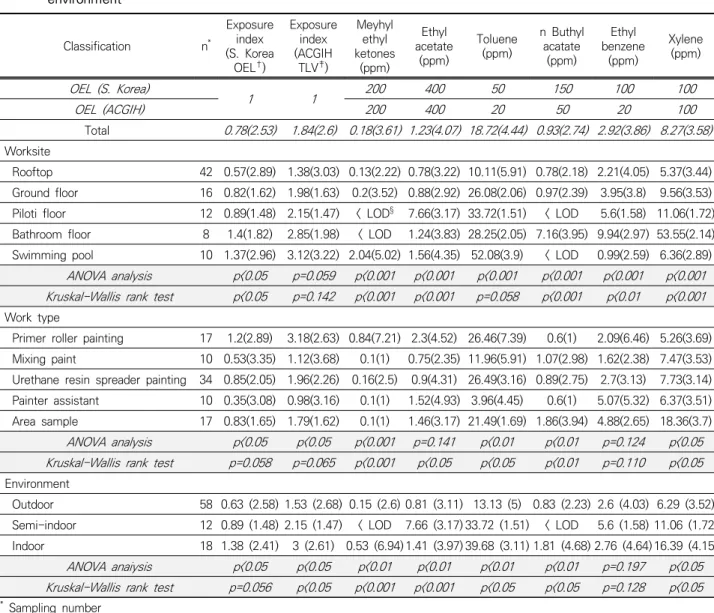
우레탄 도막 방수작업에서 채취한 총 88개 VOCs 시 료의 분석 결과(Table 4, Appendix 1-3), 톨루엔, 자 일렌, 메틸에틸케톤, 에틸벤젠, 초산에틸, 초산부틸 성분
Classification n*
Exposure index (S. Korea
OEL†)
Exposure index (ACGIH
TLV‡)
Meyhyl ethyl ketones
(ppm)
Ethyl acetate
(ppm)
Toluene (ppm)
n Buthyl acatate
(ppm)
Ethyl benzene
(ppm)
Xylene (ppm)
OEL (S. Korea)
1 1 200 400 50 150 100 100
OEL (ACGIH) 200 400 20 50 20 100
Total
0.78(2.53) 1.84(2.6) 0.18(3.61) 1.23(4.07) 18.72(4.44) 0.93(2.74) 2.92(3.86) 8.27(3.58)
WorksiteRooftop 42 0.57(2.89) 1.38(3.03) 0.13(2.22) 0.78(3.22) 10.11(5.91) 0.78(2.18) 2.21(4.05) 5.37(3.44) Ground floor 16 0.82(1.62) 1.98(1.63) 0.2(3.52) 0.88(2.92) 26.08(2.06) 0.97(2.39) 3.95(3.8) 9.56(3.53) Piloti floor 12 0.89(1.48) 2.15(1.47) < LOD§ 7.66(3.17) 33.72(1.51) < LOD 5.6(1.58) 11.06(1.72) Bathroom floor 8 1.4(1.82) 2.85(1.98) < LOD 1.24(3.83) 28.25(2.05) 7.16(3.95) 9.94(2.97) 53.55(2.14) Swimming pool 10 1.37(2.96) 3.12(3.22) 2.04(5.02) 1.56(4.35) 52.08(3.9) < LOD 0.99(2.59) 6.36(2.89)
ANOVA analysis p<0.05 p=0.059 p<0.001 p<0.001 p<0.001 p<0.001 p<0.001 p<0.001 Kruskal-Wallis rank test p<0.05 p=0.142 p<0.001 p<0.001 p=0.058 p<0.001 p<0.01 p<0.001
Work typePrimer roller painting 17 1.2(2.89) 3.18(2.63) 0.84(7.21) 2.3(4.52) 26.46(7.39) 0.6(1) 2.09(6.46) 5.26(3.69) Mixing paint 10 0.53(3.35) 1.12(3.68) 0.1(1) 0.75(2.35) 11.96(5.91) 1.07(2.98) 1.62(2.38) 7.47(3.53) Urethane resin spreader painting 34 0.85(2.05) 1.96(2.26) 0.16(2.5) 0.9(4.31) 26.49(3.16) 0.89(2.75) 2.7(3.13) 7.73(3.14) Painter assistant 10 0.35(3.08) 0.98(3.16) 0.1(1) 1.52(4.93) 3.96(4.45) 0.6(1) 5.07(5.32) 6.37(3.51) Area sample 17 0.83(1.65) 1.79(1.62) 0.1(1) 1.46(3.17) 21.49(1.69) 1.86(3.94) 4.88(2.65) 18.36(3.7)
ANOVA analysis p<0.05 p<0.05 p<0.001 p=0.141 p<0.01 p<0.01 p=0.124 p<0.05 Kruskal-Wallis rank test p=0.058 p=0.065 p<0.001 p<0.05 p<0.05 p<0.01 p=0.110 p<0.05
EnvironmentOutdoor 58 0.63 (2.58) 1.53 (2.68) 0.15 (2.6) 0.81 (3.11) 13.13 (5) 0.83 (2.23) 2.6 (4.03) 6.29 (3.52) Semi-indoor 12 0.89 (1.48) 2.15 (1.47) < LOD 7.66 (3.17) 33.72 (1.51) < LOD 5.6 (1.58) 11.06 (1.72) Indoor 18 1.38 (2.41) 3 (2.61) 0.53 (6.94)1.41 (3.97) 39.68 (3.11) 1.81 (4.68) 2.76 (4.64)16.39 (4.15)
ANOVA anaiysis p<0.05 p<0.05 p<0.01 p<0.01 p<0.01 p<0.01 p=0.197 p<0.05 Kruskal-Wallis rank test p=0.056 p<0.05 p<0.001 p<0.001 p<0.05 p<0.05 p=0.128 p<0.05
* Sampling number
†Occupational exposure limits
‡American conference of governmental industrial hygienist Threshold limit value
§ Limit of Detection
Table 4. Geometric mean(GM) and geometric standard deviation(GSD) of VOCs concentration by worksite, work type and work
environment
(a) Worksite
(b) Work type
(c) Work environment
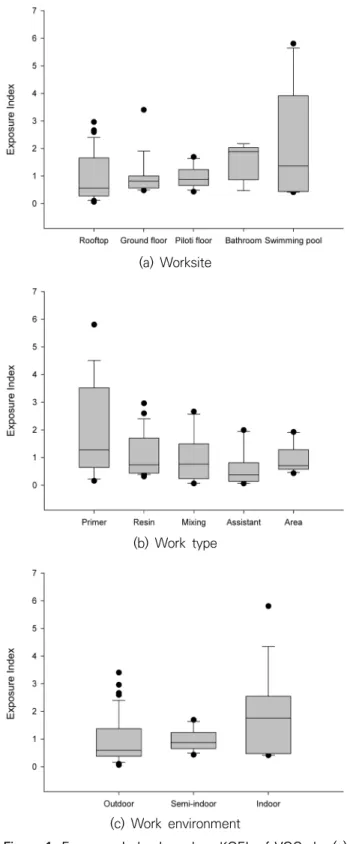
Figure 1. Exposure Index based on KOEL of VOCs by (a) worksite, (b) work type and (c) work environment conditions
※ The boxes show the 25th and 75th percentiles and whiskers indicate 10th and 90th percentiles. Median is indicated by the line inside the box.
이 검출되었으며, 각 성분별 GM(범위)은 18.72(1.5~
285.5) ppm, 8.27(1.68~113.98) ppm, 0.18(0.1~12.06) ppm, 2.92(0.3~103.14) ppm. 1.23(0.11~42.21) ppm, 0.93(0.6~26.77) ppm 이었다. 이들을 국내 노출기준 (Korea Occupational Exposure Limits, KOEL:
MoEL, 2020)을 적용하여 EI를 평가한 결과, GM 0.78 (GSD 2.53) 이었으며, EI가 1을 초과하는 시료가 34개 (38.6%), 2를 초과하는 시료가 12개(13.6%) 있었다. 다 만, EI를 미국 정부산업위생전문가협의회(American Conference of Govermental Industrial Hygienists, ACGIH)에서 정한 노출기준(Threshold Limit Values, TLVs: ACGIH, 2018)에 따라 산출하면, 톨루엔(50→
20 ppm), 초산부틸(150→50 ppm), 에틸벤젠(100→
20 ppm)의 노출기준 차이로, EI의 GM이 1.84로 국내 OEL 적용 결과보다 2배 이상 높았다. 혼합물질 평가에 가장 큰 영향을 미치는 물질은 톨루엔으로 50 ppm을 초과하는 시료가 25개(28.4%) 있었고, 에틸벤젠과 자일 렌도 각 2개 시료가 100 ppm을 초과하였다.
VOCs 평가 결과를 작업 장소, 작업내용 및 실내외 환경으로 구분하여 평가하면, Figure 1과 같다. 작업 장소에 따른 EI(KOEL 적용)의 GM(GSD)은 세대안 욕 실 1.4(1.82) > 실내 수영장 1.37(2.96) > 필로티 내부 0.89(1.48) > 지상 주차장 0.82(1.62) > 옥상 0.57 (2.89) 순으로 높았다. 작업 장소에 따른 EI 값은 통계 적으로 유의하게 달랐는데(p<0.05), 옥상 작업에서 유 의하게 낮았다. 작업내용에 따라 살펴보면, 프라이머 도 포 1.2(2.89) > 우레탄 수지 도포 0.85(2.05) > 작업장 내 지역시료0.83(1.65) > 도료 교반작업 0.53(3.35) >
도장 보조 작업 0.35(3.08) 순으로 높았다. 작업내용에 따른 EI 값은 통계적으로 유의하게 달랐으며(p<0.05), 프라이머 도포작업이 유의하게 높았다. 작업공간을 실 내작업(indoor), 반실내작업(semi-indoor)과 실외작업 (outdoor)으로 구분하여 살펴보면, 실내작업이 1.38 (2.41) > 반 실내작업 0.89(1.48) > 실외작업 0.63(2.58) 순이었다. 실내외 환경에 따른 노출농도 수준은 통계적 으로 유의하게 다른 것으로 평가되었다 (p<0.05).
2. 톨루엔 디이소시아네이트 노출평가 결과
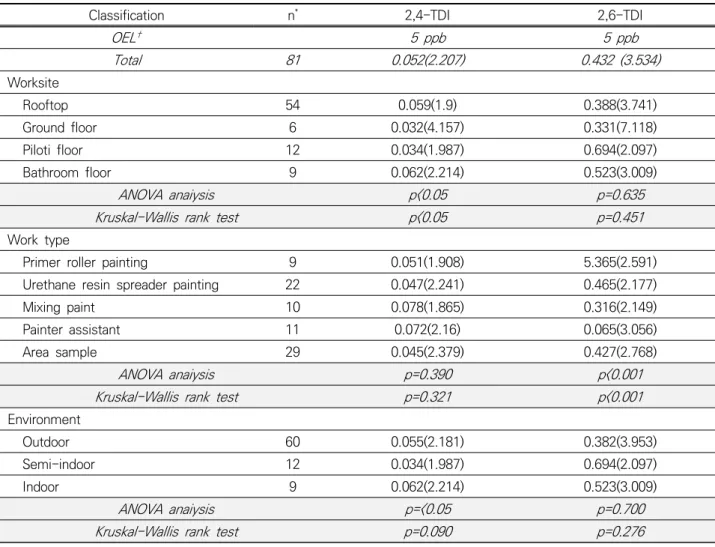
우레탄 도막 방수작업에서 채취한 총 81개 톨루엔 2,4/2,6 – 디이소시아네이트(2,4/2,6-TDI, OEL: 5 ppb) 시료의 분석결과(Table 5, Appendix 4-6), GM(범위) 는 2,4-TDI 0.052(0.003~0.5) ppb 이었고, 2,6-TDI
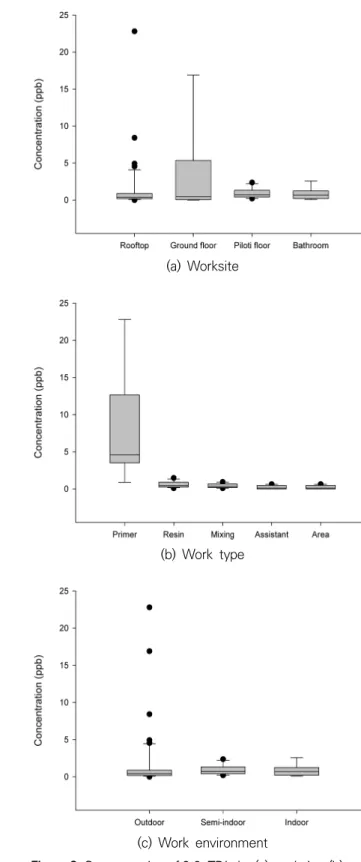
0.432(0.003~22.81) ppb이었다. 2,4-TDI 농도는 작 업장소에 따라 통계적으로 유의하게 달랐으나(p<0.05), 작업내용에 따른 차이는 없었다. 반면, 2,6-TDI는 작업 장소에 따라 통계적으로 유의하게 다르지 않았으나, 작 업내용에 따라서는 통계적으로 유의하게 달랐는데, 특히 프라이머 도포작업에서 높았다(p<0.001)(Figure 2~3).
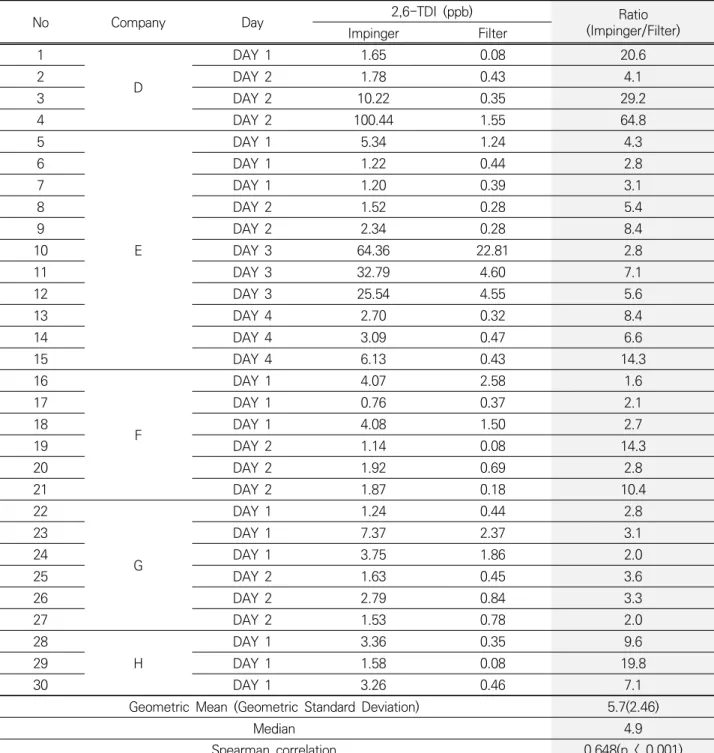
지역시료 로 평가한 필터 및 액체포집법 분석결과를 살 펴하면, 필터법으로 평가한 2,6-TDI 자료만 대수정규 분포하는 특성이 있었다. 2,6-TDI 농도는 액체포집법 이 필터법보다 GM 5.7배(GSD 2.455) 더 높았다 (Table 6). 평가방법간 상관관계 분석결과(spearman correlation), r = 648(p<0.001)로 강한 상관관계가 있 음을 확인할 수 있었다.
Ⅳ. 고 찰
아파트 신축현장의 옥상, 지상 주차장, 필로티, 세대 안 욕실 및 지하 수영장 바닥 우레탄 방수작업을 대상 으로 도장작업자의 VOCs 및 2,4-/2,6-TDI 노출수준 을 평가하였다. VOCs의 혼합물질 노출지수(EI)의 GM 은 KOEL의 약 78%수준이었으며, OEL을 초과하는 시 료가 전체시료의 약 38.6%로 작업환경관리가 요구되는 수준이다. 더욱이, EI를 미국 ACGIH TLVs에 따라 산 출하면, EI의 GM이 1.84로 OEL의 약 2배 수준으로 매 우 높았다. 혼합물질 평가에 가장 큰 영향을 미치는 물 질은 톨루엔으로 전체시료의 GM은 18.72 ppm 수준이 었으나 GSD 4.44로 농도의 범위가 매우 넓었다. 특히,
Classification n
*2,4-TDI 2,6-TDI
OEL
†5 ppb 5 ppb
Total 81 0.052(2.207) 0.432 (3.534)
Worksite
Rooftop 54 0.059(1.9) 0.388(3.741)
Ground floor 6 0.032(4.157) 0.331(7.118)
Piloti floor 12 0.034(1.987) 0.694(2.097)
Bathroom floor 9 0.062(2.214) 0.523(3.009)
ANOVA anaiysis p<0.05 p=0.635
Kruskal-Wallis rank test p<0.05 p=0.451
Work type
Primer roller painting 9 0.051(1.908) 5.365(2.591)
Urethane resin spreader painting 22 0.047(2.241) 0.465(2.177)
Mixing paint 10 0.078(1.865) 0.316(2.149)
Painter assistant 11 0.072(2.16) 0.065(3.056)
Area sample 29 0.045(2.379) 0.427(2.768)
ANOVA anaiysis p=0.390 p<0.001
Kruskal-Wallis rank test p=0.321 p<0.001
Environment
Outdoor 60 0.055(2.181) 0.382(3.953)
Semi-indoor 12 0.034(1.987) 0.694(2.097)
Indoor 9 0.062(2.214) 0.523(3.009)
ANOVA anaiysis p=<0.05 p=0.700
Kruskal-Wallis rank test p=0.090 p=0.276
*
Sampling number
†
Occupational exposure limits
Table 5. Geometric mean(GM) and geometric standard deviation(GSD) of isocyanates by worksite, work type and work
environment (unit: ppb)
(a) Worksite
(b) Work type
(c) Work environment
Figure 2. Concentration of 2,4-TDIs by (a) worksite, (b) work type and (c) work environment conditions
※ The boxes show the 25th and 75th percentiles and whiskers indicate 10th and 90th percentiles. Median is indicated by the line inside the box.
(a) Worksite
(b) Work type
(c) Work environment
Figure 3. Concentration of 2,6-TDIs by (a) worksite, (b) work type and (c) work environment conditions
※ The boxes show the 25th and 75th percentiles and
whiskers indicate 10th and 90th percentiles. Median is
indicated by the line inside the box.
지하수영장 방수작업에서 톨루엔의 최고 농도(285.5 ppm)는 ACGIH OEL(20 ppm)의 10배 이상으로 검출 되었다. 건설현장 도장작업 중 환기가 불충분한 공간에 서 방수작업을 시행할 경우 일반 방독마스크가 아닌 송 기마스크를 지급하여 착용하도록 작업환경관리가 필요 하다. Ahn et al.(2019)의 연구에서는 조선소 도장작업
자를 대상으로 VOCs 농도를 평가하였는데, 스프레이 (spray) 도장작업자의 EI GM이 0.71(KOEL 적용)로 이번 연구의 우레탄 방수 작업자 노출수준과 유사하였 다. 일반적으로 도료를 스프레이 방법으로 도포할 때 VOCs의 노출농도가 높은 것으로 알려져 있는데(Keer et al., 2018), 이번 연구의 우레탄 방수작업은 롤러
No Company Day 2,6-TDI (ppb) Ratio
(Impinger/Filter)
Impinger Filter
1
D
DAY 1 1.65 0.08 20.6
2 DAY 2 1.78 0.43 4.1
3 DAY 2 10.22 0.35 29.2
4 DAY 2 100.44 1.55 64.8
5
E
DAY 1 5.34 1.24 4.3
6 DAY 1 1.22 0.44 2.8
7 DAY 1 1.20 0.39 3.1
8 DAY 2 1.52 0.28 5.4
9 DAY 2 2.34 0.28 8.4
10 DAY 3 64.36 22.81 2.8
11 DAY 3 32.79 4.60 7.1
12 DAY 3 25.54 4.55 5.6
13 DAY 4 2.70 0.32 8.4
14 DAY 4 3.09 0.47 6.6
15 DAY 4 6.13 0.43 14.3
16
F
DAY 1 4.07 2.58 1.6
17 DAY 1 0.76 0.37 2.1
18 DAY 1 4.08 1.50 2.7
19 DAY 2 1.14 0.08 14.3
20 DAY 2 1.92 0.69 2.8
21 DAY 2 1.87 0.18 10.4
22
G
DAY 1 1.24 0.44 2.8
23 DAY 1 7.37 2.37 3.1
24 DAY 1 3.75 1.86 2.0
25 DAY 2 1.63 0.45 3.6
26 DAY 2 2.79 0.84 3.3
27 DAY 2 1.53 0.78 2.0
28
H
DAY 1 3.36 0.35 9.6
29 DAY 1 1.58 0.08 19.8
30 DAY 1 3.26 0.46 7.1
Geometric Mean (Geometric Standard Deviation) 5.7(2.46)
Median 4.9
Spearman correlation 0.648(p < 0.001)
Table 6. Comparison of filter and impinger methods of TDIs
(roller) 및 스프레더(spreader)를 이용한 작업이었음에 도 유사한 노출농도 수준을 나타내었다. Uang et al.(2006)의 연구에서는 비행기 동체의 도장작업 시 VOCs 농도를 평가하였는데, 프라이머를 바르는 작업에 서 톨루엔 농도(AM±SD)가 6.55±2.44 ppm(Boeing 747-400), 10.72±8.28 ppm(Airbus A300)이었고, 표면도장작업에서는 5.93±7.23 ppm(Boeing 747-400), 5.16±2.81 ppm(Airbus A300)으로 보고하여 이번 연 구보다 낮은 수준이었다.
VOCs의 농도는 작업공간 중 옥상에서 가장 낮고, 세대내부 욕실 및 지하 수영장에서 높아 작업장 환기조 건이 가장 큰 환경변수임을 알 수 있었다. 작업내용에 따른 VOCs의 노출농도는 교반, 우레탄 수지 도포, 보 조 작업자 간에는 통계적으로 유의한 차이가 없었지만, 프라이머 도포 작업 시 통계적으로 유의하게 높았는데, 이는 프라이머 도료에 유기화합물이 함량이 높고 롤러 를 사용하여 작업시간이 긴 것이 원인으로 평가된다.
이번 연구를 통해 건설현장 우레탄 방수작업자의 VOCs 노출 감소를 위한 작업환경관리가 필요함을 알 수 있고, 특히 환기가 부족한 실내공간(세대내부, 지하 공간 등) 및 프라이머(하도) 작업에서 적절한 환기장치 의 사용, 공기정화기능이 있는 호흡보호구 등의 사용이 요구된다.
다만, 본 연구에서 VOCs 평가는 작업 중 움직임이 많은 건설현장 근로자들의 작업특성을 반영하여 시료채 취 시 불편함을 최소화한 수동식시료채취기(OVM)를 사용하였으나, 활성관을 이용한 능동식 시료채취방법보 다 평가결과의 정확도에는 여러 제한점이 있을 수 있다.
수동식 시료채취방법이 일반적으로 기류가 높은 옥외작 업이거나 움직임이 많은 작업의 경우 채취효율이 향상 되어 능동식 시료채취방법보다 높은 농도수준으로 평가 된다는 보고가 있고, 또는, 고농도이거나, 일부 극성물 질의 경우 활성탄관보다 낮은 농도수준을 보인다는 연구 결과도 있다(Jang & Kim 2005). 그러나, 일부 유기용 제에 대해서 미국산업안전보건청(Occupational Safety and Health Administration,OSHA)에서 공식적으로 사용이 인정되고, 국내에서도 고용노동부에서 작업환경 측정에 수동식 시료채취기 사용을 허용하고 있다. 수동 식 시료채취기의 결과를 능동식 방법의 결과와 비교할 때는 주의하여야 한다. 본 연구결과는 수동식 채취기를 일관적으로 사용하여 농도의 경향이나 직무 및 작업환 경 간 차이는 확인 가능하였다.
우레탄 방수 작업자의 2,4/2,6-TDI 노출평가 결과, 전체시료 GM은 각 0.052 ppb, 0.432 ppb으로 KOEL (5 ppb)의 10% 미만으로 낮았지만, 2,6-TDI 전체시료 중 3개 시료(3.7%)가 KOEL을 초과하였다. Lemiere et al.(2002) 등의 연구에서 이소시아네이트는 1 ppb 이하의 낮은 농도에서도 호중구(neutrophilic)의 기능 적 및 염증성 변화로 천식유발이 가능하다고 보고하였 고, Stocks et al.(2015)은 이소시아네이트에 노출되는 모든 근로자는 위험이 매우 낮거나 없다하더라도 주기 적인 건강진단을 통한 감시체계 운영이 필요하다고 하 였다. ACGIH는 2,4/2,6-TDI의 TLVs를 2015년부터 1 ppb(흡입성 입자)로 낮추어 지정하였다(ACGIH, 2018). 이번 연구의 2,6-TDI GM은 1 ppb의 약 50%
수준이었으며, 16개 시료(19.8%)가 1 ppb를 초과하였 다. 2,4/2,6-TDI 농도를 비교하였을 때 2,6-TDI가 2,4-TDI보다 약 10배 이상 높은 농도수준을 나타내었 다. Kim et al.(2009)의 연구에서 목재가구, 선반제조, 악기 제조업, 자동차 정비업의 도장작업을 대상으로 TDI를 평가한 결과 2,6-TDI(0.12~5.89 ppb)가 2,4- TDI(0.08~0.14 ppb)보다 약 5~10배 높았다고 보고하 였다. Park et al.(2003)의 연구에서도 우레탄 도료를 사용하는 도장작업에서 공기 중 2,4-TDI는 0.23±0.43
㎍/㎥, 2,6-TDI는 10.30±10.00 ㎍/㎥으로 40배 이상 높은 농도수준임을 보고하였다. 2,6-TDI는 2,4-TDI와 비교하여 메틸기에 대한 이소시아네이트기의 위치 및 증기압이 더 높아 공기 중 휘발이 더 용이한 것으로 알 려져 있으며(Kang & Kim, 1996; Kim et al, 2009), 실험실에서 실시한 분석방법 비교연구에서 2,6-TDI가 2,4-TDI와 비교하여 회수율이 더 높은 특성이 있다고 보고된 바 있다(Byun et al., 1996). 또한, 일반적인 중 합반응에서 2,4-TDI가 2,6-TDI보다 반응성이 좋기 때 문에 미반응된 2,6-TDI가 공기 중에 증발되어 농도가 더 높다는 보고도 있었다(Park et al., 2003). 그동안 국내 산업안전보건법에서 2,4-TDI만 허용기준 설정물 질로 관리해왔으나, 최근 2,6-TDI가 허용기준 설정물 질로 추가되어 이소시아네이트 노출 근로자에 대한 건 강관리가 강화되었다(MoEL, 2019).
공기 중 이소시아네이트 측정 분석은 다양한 방법이 존 재하는데, 연구자마다 서로 다른 방법과 기준을 적용하여 연구결과를 비교하는데 한계가 있다(Bello et al., 2004).
이소시아네이트는 단량체(monomer)와 최대 10개의 단 량체가 결합된 중합체(oligomer)로 구분할 수 있고, 방향
족(aromatic; 2,4-/2,6-TDI, 4,4’-diphenylmethane diisocyanate(MDI))과 포화(saturated) 이소시아네이 트를 지칭하는 지방족(aliphatic; 1,6-hexamethylene diisocyanate(HDI), isophorone diisocyanate (IPDI), methylenedicyclohexyl diisocyanate (HMDI)) 및 지 환족(alicyclic) 등으로 다양하여, 측정, 분석방법에 따라 평가할 수 있는 성분이 달라진다. 가장 대표적으로 활용되 는 방법이 미국산업안전보건청에서 사용하는 OSHA-ID 42방법이며, 이는 현재 안전보건기술지침(Kosha- guide) 에 의한 국내 허용기준 설정물질인 2,4/2,6-TDI 의 공정시험방법(A-76-2019, A-77-2019; KOSHA, 2019)이기도 하다. 다만, OSHA- ID 42 방법은 필터를 이용하여 채취가 간단하고 개인시료 채취가 가능한 장점 은 있으나 2 ㎛미만의 작은 입자와 이소시아네이트 단량 체만 채취가 가능한 한계가 있다. 반면 액체포집법은 개인 시료 채취는 어려우나, 2 ㎛이상의 큰 입자의 채취가 가능 하고 단량체 뿐 아니라 중합체의 채취도 가능한 장점이 있다. 이번 연구에서는 사업장별 각 3개씩의 지역시료채 취를 별도로 실시하여 액체포집법과 필터법을 비교하였 는데, 2,6-TDI의 평가결과에서 액체포집법이 필터법보다 약 5.7배가 농도가 높았다. 2,4-TDI의 경우 필터와 액체 포집법간의 상관성이 약하고, 필터법에서 농도수준이 극 히 낮았던 제한점이 있어 직접적인 비교는 어려웠다. Kim et al.(2009)의 연구에서도 액체포집법으로 평가한 시료 가 필터법보다 약 1,5배 더 높았다고 보고하였고, Lee et al.(2000)의 연구에서도 2,6-TDI의 경우 두 방법간의 차 이가 기하평균으로 약 5배정도 발생한다고 보고하였다.
최근에는 필터와 임핀저를 병렬로 두고 시료를 채취하는 NIOSH #5525 또는 두가지 종류의 필터(PTFE, Glass Fiber)를 병렬로 사용하는 ASTM D 5932 또는 ISO 17735 방법으로 시료를 채취하여 보고하는 자료가 증가 하고 있다. 다만 이러한 방법은 분석과정이 매우 복잡하 고, 이물질에 의한 간섭 및 회수율이 낮은 문제점을 가지 고 있다고 보고된 바 있다(Roh & Streicher, 1999). 이번 연구에서 2,4-TDI 농도는 노출기준과 비교하면 낮은 수 준이었으나, 2,6-TDI는 일부시료가 노출기준을 초과하였 고, 천식을 유발할 수 있는 것으로 알려진 1 ppb 이상의 농도도 전체시료의 약 20%가 검출되어 우레탄 방수 작업 장에 대한 관리 및 작업자의 철저한 건강감시가 필요함을 알 수 있었다. 또한, 단량체뿐 아니라 중합체 등 다양한 이소시아네이트에 대한 측정, 분석방법에 대한 연구 및 국외에서 적용하고 있는 총 이소시아네이트(-NCO)로의
노출기준(70 ㎍/㎥)을 설정하는 방안(Bello et al., 2004) 등에 대한 추후 연구가 필요하다.
Ⅴ. 결 론
본 논문은 아파트 건설현장 우레탄 방수작업자의 VOCs 및 2,4-/2,6-TDI 노출수준을 평가하였으며 주 요 평가내용은 다음과 같다.
1. 우레탄 방수작업에서 채취한 총 88개 VOCs 시료 분석 결과, 톨루엔, 자일렌, 메틸에틸케톤, 에틸벤젠, 초 산에틸, 초산부틸 성분이 검출되었으며, 각 성분별 GM (범위)은 18.72(1.5~285.5) ppm, 8.27(1.68~113.98) ppm, 0.18(0.1~12.06) ppm, 2.92(0.3~103.14) ppm.
1.23(0.11~42.21) ppm, 0.93(0.6~26.77) ppm 이었고, VOCs의 혼합물질 노출지수(EI) GM(GSD)은 KOEL 적 용 시 0.78(2.53)이었다.
2. 톨루엔은 25개(28.4%) 시료가 50 ppm을 초과하 였고, 에틸벤젠과 자일렌은 각 2개 시료가 100 ppm을 초과하였다. VOCs의 혼합물질 노출지수(EI)가 1을 초 과하는 시료는 전체시료의 38.6%이었다.
3. 우레탄 방수작업에서 채취한 총 81개 2,4-/2,6- TDI 시료 분석 결과, 각 성분별 GM(범위)은 0.052 (0.003~0.5) ppb, 0.432(0.003~22.81) ppb이었고, 2,6-TDI 시료 중 16개(19.8%)는 ACGIH TLV인 1 ppb를 초과하였다.
4. 작업내용에 따른 농도 비교 시, 프라이머 도포작업 에서 VOCs와 TDI 농도가 가장 높게 평가되었으며, 작 업공간에 따라서는 실내공간인 세대내부 욕실 및 지하 수영장 작업에서 VOCs 농도가 높았으나, TDIs 농도는 작업공간에 따른 차이는 없었다.
5. 2,4-/2,6-TDI 농도를 비교하였을 때 2,6-TDI 농도 가 2,4-TDI 농도보다 10배 이상 높은 수준을 나타내었고, 액체포집법으로 평가한 시료의 농도가 필터법보다 약 5.7 배 더 높았다. 필터법에 의한 TDI의 평가는 2 ㎛미만의 작은 입자와 이소시아네이트 단량체만 채취가 가능한 한 계가 있으므로, TDI의 노출평가 시, 입자의 크기 및 특성 등을 고려한 평가방법 선정이 매우 중요하다.
이번 연구결과를 통해 건설현장 우레탄 방수작업자들 의 VOCs 및 TDIs 노출수준이 작업자의 건강에 해로운 영향을 미칠 수 있는 수준임을 확인하였다. 노출농도에
영향을 미치는 주요 요인은 실내환경 등 작업공간의 특 성과 도료의 구성성분 임을 알 수 있었다. 향후 건설현 장 우레탄 방수작업 시, 독성이 낮은 도료 선정, 적절한 환기장치의 사용, 공기정화기능이 있는 호흡보호구 등 의 사용 등이 요구된다.
References
Ahn J, Park D, Kang T. Characteristics of workers’
exposure concentration and daily variations to organic solvents in shipbuilding painting processes.
J Korean Soc Occup Environ Hyg, 2019;29(4):
488-499, https://doi.org/10.15269/JKSOEH.2019.
29.4.488
American Conference of Govermental Industrial Hyginists (ACGIH). Threshold limit values for chemical substances and physical agents and biological exposures indices. ACGIH, 2018, page 59
Bello D, Woskie SR, Streicher RP, Liu Y, Stowe MH, Eisen EA, Ellenbecker MJ, Sparer J, Youngs F, Cullen MR, Redlich CA. Polyisocyanates in occupational environments: a critical review of exposure limits and metrics. Am J Ind Med. 2004;46(5):480-91, https://doi.org/10.1002/ajim.20076
Bennett JS, MArlow DA, Nourian F, Hammond J.
Hexavalent chromium and isocyanate exposures during military aircraft painting under crossflow ventilation. J Occup Environ Hyg, 2016;13(5):
356-371, https://doi.org/10.1080/15459624.2015.
1117617
Byun HJ, Yoon CS, Paik NW. A comparison of sampling and analytical methods for airborne isocyanates.. J Korean Soc Occup Environ Hyg, 1996;22(2):32-42 Chang KS, Roh Y, Koh SB. Comparison of sampling
performance of passive monitor and charcoal tubes for airborne organic solvents from the painting process in ship building industry. J Korean Soc Occup Environ Hyg, 2002;12(1):210-219
Cohen AC. Tables for maximum likelihood estimates singly truncated and singly censored samples. 1961, Technometics 3:535-541
Hornung RW, Reed LD. (1990) Estimation of average concentration in the presence of nondetectable values. Appl Occup Environ Hyg; 5: 46–51, https://doi.org/10.1080/1047322X.1990.10389587 IARC. Agents Classifed by the IARC Monographs,
Volumes 1–125 [Accessed 2020 April 24). Available from: URL: https://monographs.iarc.fr/list-of- classifications/
Jang SH, Kim HA. Comparison between the charcoal tube sampling methods and the diffusive sampler, and the applicability of diffusive sampler in the field. J Korean Soc Occup Environ Hyg, 2005: 15(3):
261-269
Jeong JY, Park SW, Lee JE, Lee GY. Diisocyanate exposure assessment for polyurethane foam manufacturing workers. J Korean Soc Occup Environ Hyg, 2012: 22(3): 209-216
Kang HK, Kim H. Assessment of total isocyanates by OSHA and NIOSH analytical methods: accuracy and precision and airborne concentrations by process. J Korean Soc Occup Environ Hyg, 1999;9(2):1-18 Keer S, Taptiklis P. Glass B, Mclean D, McGlothlin JD.
Determinants of airborne solvent exposure in the collision repair industry. Annals of Work Exposures and Health, 2018;62(7):871–883, https://doi.org/
10.1093/annweh/wxy047
Kim CN. Comparison of working environment measurement and analysis –TDI, Research report.
Ocupational Safety and Health Research Institute, Kim SH, Won JW, Kim CN, Jung WJ, Roh J. Comparison 2009 of toluene diisocyanate concentrations collected with different sampling methods by work process.
JJ Korean Soc Occup Environ Hyg, 2013: 23(2):
95-102
Kim YS, Han CG. A study on the physical property by construction condition of urethane waterproofing membrane. Journal of Korea institue for Structural Maintenance Inspection, 2013;17(6):138-144 Kim YS. KS quality criteria improvement by weathering
evaluation of domestic exposure type polyurethane waterproofing materials. Thesis, 2014. Graduate School, Cheongju University
Kosha Guide. Mesurement and Analysis for Toluene 2,4-Diisocyanate(KOSHA GUIDE: A-76-2019).
KOSHA, 2019
Kosha Guide. Mesurement and Analysis for Toluene 2,6-Diisocyanate(KOSHA GUIDE: A-77-2019).
KOSHA, 2019
Lemière C, Romeo P, Chaboillez S, Tremblay C, Malo J-L.
Airway inflammation and functional changes after exposure to different concentrations of isocyanates.
J Allergy Clin Immunol. 2002;110:641–646, https://
doi.org/10.1067/mai.2002.128806
Lee EJ, Yoo CY, Han YS, Cho YB. The determination of methyl isocyanate in the workplace by gas chromatography with flame ionization detector. J Korean Soc Occup Environ Hyg, 2001;11(3):
249-253
Lee JS. Kim BW, Shin J, Baek J, Shin JH. Biological monitoring of workers exposed to diisocyanates using urinary diamines. J Korean Soc Occup Environ Hyg, 2016; 26(2):178-187, https://doi.org/10.15269/
JKSOEH.2016.26.2.178
Lee N. Research on specific chemical substances analytical methods-Exposure evaluation and characteristics of isocyanate compounds in wood furniture manufacturing plants. Research report.
Ocupational Safety and Health Research Institute, Lee SJ, Lee KM, Roh YM. Simultaneous determination 2000 of isocyanates by high performance liquid chromatography. J Korean Soc Occup Environ Hyg, 1994;4(2):137-147
Liu H, Liang Y, Bowes S, Xu H, Zhou Y, Armstrong TW.
Benzene exposure in industries using or manufacturing paint in China-a literature review, 1956-2005. J Occup Environ Hyg, 2009;6(11):
659-70, https://doi.org/10.1080/15459620903249646 Ministry of Employment and Labor(MoEL). Exposure
limits of chemical and physical factors(notice 2020-48). The Ministry of Employment and Labor, Ministry of Employment and Labor(MoEL). Occupatioanal 2020 environment measurement and quality control regulations(notice 2020-44). The Ministry of Employment and Labor, 2020
NIOSH. ISOCYANATES issue 2, 15 January 1998.
https://www.cdc.gov/niosh/docs/2003-154/pdfs /5522.pdf
OSHA. Diisocyanates-1,6-Hexamethylene Diisocyanate (HDI), Toluene-2,6-Diisocyanate (2,6-TDI), Toluene- 2,4-Diisocyanate (2,4-TDI). OSHA, 1983, https://
www.osha.gov/dts/sltc/methods/organic/org042/
org042.html
Park KC, Kim CN, Kim HS, Kim HR, Roh J. Correlation between toluene diisocyanate in air and urinary toluene diamine by air sampling methods. J Korean Soc Occup Environ Hyg, 2003;13(1):82-89
Park HS, Won JW, Kim CN, Roh J. A Comparison of collection concentrations based on airborne toluene diisocyanates measurement methods. J Korean Soc Occup Environ Hyg, 2013;23(4):341-347
Park JH. Biological monitoring for exposure to TDI among painters using urethane paints and coatings. Thesis, 2002. Graduate School of public health, Yensei University
Roh YM, Streicher RP. Development of a method for analyzing total isocyanate in air using 9- Anthracenylmethyl 1-Piperazinecarboxylate (PAC):
Part 1 Reaction Conditions and Stability. J Korean Soc Occup Environ Hyg, 1999;9(2):167-176 Seo SH, Suh CS, Park JH. The reactivity of different
polyols for paint to polyisocyanate. J. Korean Ind.
Eng. Chem., 2008;19(4):388-396
Stocks SJ, Jones K, Piney M, Agius RM. Isocyanate exposure and asthma in the UK vehicle repair industry. Occup Med (Lond). 2015 Dec;65(9):713-8, https://doi.org/10.1093/occmed/kqv108
Toutanji HA, Choi H, Wong D, Gilbert JA, Alldredge DJ.
Applying a polyurea coating to high-performance organic cementitious materials. Construction and Building Materials, Jan, 2013;.38:1170-1179, https://doi.org/10.1016/j.conbuildmat.2012.09.041 Uang SN, Shih TS, Chang CH, Chang SM, Tsai CJ,
Deshpande CG. Exposure assessment of organic solvents for aircraft paint stripping and spraying workers. Sci Total Environ, 2006;356(1-3):38-44, https://doi.org/10.1016/j.scitotenv.2005.02.029 Qian H, Fiedler N, Moore DF, Weisel CP. Occupational
exposure to organic solvents during bridge painting.
Ann Occup Hyg. 2010 Jun;54(4):417-26, https://
doi.org/10.1093/annhyg/meq021
Riala R, Kalliokoski P, Pyy L, Wickström G. Solvent exposure in construction and maintenance painting.
Scand J Work Environ Health. 1984 Aug;10(4):
263-6, doi:10.5271/sjweh.2332
Yun JS, Park JH, Lee KM, Choi HS, Cho YB. Gas chromatographic analysis of TDI, MDI and HDI using 2-chlorobenzyl alcohol and 2,4-dichlorobenzyl alcohol derivatives. J Korean Soc Occup Environ Hyg, 2006;16(3):222-232
Wang KS. A study on property of non-exposure poly urethane rubber waterproof material by amount of organic solvent and curing time. Thesis, 2015.
Graduate School of Industry & Engineering. Seoul National University of Science & Technology Wang SW, Qian H, Weisel C, Nwankwo C, Fiedler N.
Development of solvent exposure index for construction painters. J Occup Environ Hyg. 2011 Jun;8(6):375-86
Winder C, Turner PJ. Solvent exposure and related work practices amongst apprentice spray painters in automotive body repair workshops. Ann Occup Hyg.
1992 Aug;36(4):385-94, https://doi.org/10.1080/
15459624.2011.583488
Whittaker CR, Whittaker SG, Ceballos DM, Weiland EC, Flack SL. Airborne Isocyanate Exposures in the Collision Repair Industry and a Comparison to Occupational Exposure Limits. J Occup Environ Hyg.
2012 ; 9(5): 329–339, https://doi.org/10.1080/15
459624.2012.672871
Wolford R. Intervention research in construction: a hypothetical case study of painters. Am J Ind Med.
1996 Apr;29(4):431-4, https://doi.org/10.1002/
(SICI)1097-0274(199604)29:4<431::AID-AJIM32>
3.0.CO;2-0
Woekie SR, Sparer J, Gore RJ, Stowe M, Bello D.
Determinants of isocyanate exposure in auto body
repair and refinishing shops. Ann. occup. Hyg, 2004:48(5):393–403, https://doi.org/10.1093/annhyg/
meh021
<저자정보>
박현희(연구위원), 황은송(연구원), 노지원(연구원), 장광명 (연구원), 박승현(실장), 윤충식(교수)
Type of
Worksite Classification Exposure Index (S. Korea OEL)
Exposure Index (ACGIH TLV)
Methyl ethyl ketone
(ppm)
Ethyl acetate
(ppm) Toluene (ppm)
n Buthyl acatate
(ppm)
Ethyl benzene
(ppm)
Xylene (ppm)
OEL
*(S. Korea)
1 1 200 400 50 150 100 100
OEL (ACGIH
†) 200 400 20 50 20 100
Rooftop
n‡ 42 42 42 42 42 42 42 42
AM§±SD** 0.92±0.85 2.33±2.24 0.25±0.6 2.99±8.58 34.52±44.84 1.38±2.68 8.9±22.46 12.64±19.81 GM††(GSD) 0.57(2.89) 1.38(3.03) 0.13(2.22) 0.78(3.22) 10.11(5.91) 0.78(2.18) 2.21(4.05) 5.37(3.44)
Median 0.56 1.34 0.1 0.5 11.68 0.6 1 2.36
Range 0.07~2.96 0.16~7.4 0.1~3.85 0.5~39.63 1.5~146.41 0.6~13.99 0.52~103.14 1.93~82.79
Ground floor
n 16* 16* 16 16 16* 16 16 16*
AM±SD 0.95±0.7 2.27±1.56 0.51±0.83 2.18±4.97 33.66±27.71 1.52±1.77 7.21±6.28 18.46±21.51 GM(GSD) 0.82(1.62) 1.98(1.63) 0.2(3.52) 0.88(2.92) 26.08(2.06) 0.97(2.39) 3.95(3.8) 9.56(3.53)
Median 0.82 1.78 0.1 0.5 25.13 0.6 5.66 10.15
Range 0.48~3.4 1.06~7.64 0.1~3.03 0.5~20.42 7.74~118.21 0.6~6.05 0.47~19.68 2~81.44
Piloti floor
n 12* 12* 12 12* 12* 12 12* 12
AM±SD 0.95±0.38 2.3±0.9 < LOD‡‡ 13.45±14.11 36.49±15.71 < LOD 6.07±2.27 12.27±4.84 GM(GSD) 0.89(1.48) 2.15(1.47) < LOD 7.66(3.17) 33.72(1.51) < LOD 5.6(1.58) 11.06(1.72)
Median 0.88 2.14 < LOD 6.76 31.65 < LOD 5.95 12.23
Range 0.43~1.7 1.07~4.08 < LOD 1.32~42.21 18.45~69.56 < LOD 1.78~10.42 2.56~21.16
Bathroom floor
n 8* 8* 8 8 8* 8* 8 8*
AM±SD 1.59±0.66 3.34±1.56 < LOD 3.14±5.3 34.65±22.86 12.36±9.78 13.72±7.65 66.46±39.59 GM(GSD) 1.4(1.82) 2.85(1.98) < LOD 1.24(3.83) 28.25(2.05) 7.16(3.95) 9.94(2.97) 53.55(2.14)
Median 1.89 3.63 < LOD 0.5 32.77 11.8 16.09 71.4
Range 0.48~2.18 0.77~5.32 < LOD 0.5~15.85 8.08~80.64 0.6~26.77 1~21.2 17.11~113.98
Swimming pool
n 10 10 10 10* 10 10 10 10
AM±SD 2.19±1.99 5.33±4.99 5.04±5.36 3.19±3.08 102.4±101.4 < LOD 1.39±0.98 9.53±7.06 GM(GSD) 1.37(2.96) 3.12(3.22) 2.04(5.02) 1.56(4.35) 52.08(3.9) < LOD 0.99(2.59) 6.36(2.89)
Median 1.37 3.28 2.13 1.74 61.61 < LOD 1.48 10.31
Range 0.41~5.81 0.85~14.39 0.35~12.06 0.11~7.05 10.92~285.5 < LOD. 0.3~2.66 1.68~18.73
ANOVA analysis p<0.05 p=0.059 p<0.001 p<0.001 p<0.001 p<0.001 p<0.001 p<0.001 Kruskal-Wallis rank test p<0.05 p=0.142 p<0.001 p<0.001 p=0.058 p<0.001 p<0.01 p<0.001
* Occupational exposure limits
†American conference of governmental industrial hygienist
‡Sample number,
§ Arithmatic mean
** Standard deviation
††Geometraic mean
‡‡Limit of detection
Appendix 1. Concentration of VOCs by type of worksite
Work type Classification
Exposure Index (S. Korea
OEL)
Exposure Index (ACGIH
TLV)
Methyl ethyl ketone
(ppm)
Ethyl acetate
(ppm)
Toluene (ppm)
n Buthyl acatate
(ppm)
Ethyl benzene
(ppm)
Xylene (ppm)
OEL (S. Korea)
1 1 200 400 50 150 100 100
OEL (ACGIH) 200 400 20 50 20 100
Primer roller painting
n 17 17 17 17 17 17 17 17
AM±SD 1.87±1.67 4.7±4.05 3.33±4.59 6.35±10.04 78.95±85.44 < LOD 11.3±25.12 14.36±26.01 GM(GSD) 1.2(2.89) 3.18(2.63) 0.84(7.21) 2.3(4.52) 26.46(7.39) < LOD 2.09(6.46) 5.26(3.69)
Median 1.27 3.14 1.32 1.74 52.18 < LOD 1 2.33
Range 0.16~5.81 0.53~14.39 0.1~12.06 0.5~39.63 1.5~285.5 < LOD 0.3~103.14 1.68~82.79
Urethane resin spreader
painting
n 34 34 34 34 34 34 34 34
AM±SD 1.1±0.79 2.65±2 0.32±0.66 4.4±10.32 43.93±40.64 2.22±5.12 5.08±5.87 14.01±17.56 GM(GSD) 0.85(2.05) 1.96(2.26) 0.16(2.5) 0.9(4.31) 26.49(3.16) 0.89(2.75) 2.7(3.13) 7.73(3.14)
Median 0.74 1.74 0.1 0.5 25.1 0.6 2.29 10.51
Range 0.32~2.96 0.41~7.4 0.1~3.85 0.11~42.21 1.5~146.41 0.6~26.77 0.52~21.2 1.93~96.1
Mixing paint
n 10 10 10 10 10 10 10 10
AM±SD 0.9±0.83 2.09±2.13 < LOD 1.16±1.4 35.43±44.67 2.35±4.23 2.5±2.94 14.25±16.35 GM(GSD) 0.53(3.35) 1.12(3.68) < LOD 0.75(2.35) 11.96(5.91) 1.07(2.98) 1.62(2.38) 7.47(3.53)
Median 0.76 1.5 < LOD 0.5 15.79 0.6 1 10.51
Range 0.07~2.66 0.16~6.66 < LOD 0.5~4.18 1.5~131.43 0.6~13.99 1~8.58 2~54.17
Painter assistant
n 10 10 10 10 10 10 10 10
AM±SD 0.6±0.65 1.69±1.89 < LOD 5.96±12.24 12.84±23.01 < LOD 17.41±31.54 14.61±24.76 GM(GSD) 0.35(3.08) 0.98(3.16) < LOD 1.52(4.93) 3.96(4.45) < LOD 5.07(5.32) 6.37(3.51)
Median 0.38 0.97 < LOD 0.5 1.5 < LOD 5.34 6.25
Range 0.07~1.99 0.16~6.17 < LOD 0.5~39.63 1.5~73.38 < LOD 1~103.14 2~82.79
Area sample
n 17 17 17 17 17 17 17 17
AM±SD 0.94±0.53 2.01±1.03 < LOD 2.96±4.44 24.06±10.72 4.66±6.75 7.17±6.11 34.8±36.29 GM(GSD) 0.83(1.65) 1.79(1.62) < LOD 1.46(3.17) 21.49(1.69) 1.86(3.94) 4.88(2.65) 18.36(3.7)
Median 0.71 1.71 < LOD 1.23 24.4 0.6 5.35 21.82
Range 0.43~1.93 0.77~3.99 < LOD 0.5~18.24 7.74~43.86 0.6~20.9 1~19.95 2~113.98
ANOVA analysis p<0.05 p<0.05 p<0.001 p=0.141 p<0.01 p<0.01 p=0.124 p<0.05
Kruskal-Wallis rank test p=0.058 p=0.065 p<0.001 p<0.05 p<0.05 p<0.01 p=0.110 p<0.05
Appendix 2. Concentration of VOCs by work type
Work
environment Classification
Exposure Index (S. Korea
OEL)
Exposure Index (ACGIH
TLV)
Methyl ethyl ketone
(ppm)
Ethyl acetate
(ppm)
Toluene (ppm)
n Buthyl acatate
(ppm)
Ethyl benzene
(ppm)
Xylene (ppm)
OEL (S. Korea)
1 1 200 400 50 150 100 100
OEL (ACGIH) 200 400 20 50 20 100
Total
n 88 88 88 88 88 88 88 88
AM±SD 1.14±1.03 2.75±2.57 0.81±2.37 4.3±8.99 42.36±51.82 2.21±4.71 7.79±16.09 18.19±25.33 GM(GSD) 0.78(2.53) 1.84(2.6) 0.18(3.61) 1.23(4.07) 18.72(4.44) 0.93(2.74) 2.92(3.86) 8.27(3.58)
Median 0.74 1.78 0.1 0.5 24.31 0.6 2.29 9.27
Range 0.07~5.81 0.16~14.39 0.1~12.06 0.11~42.21 1.5~285.5 0.6~26.77 0.3~103.14 1.68~113.98
Outdoor
n 58 58 58 58 58 58 58 58
AM±SD 0.93±0.81 2.32±2.06 0.32±0.67 2.77±7.72 34.29±40.6 1.42±2.45 8.44±19.33 14.25±20.27 GM(GSD) 0.63(2.58) 1.53(2.68) 0.15(2.6) 0.81(3.11) 13.13(5) 0.83(2.23) 2.6(4.03) 6.29(3.52)
Median 0.59 1.46 0.1 0.5 17.9 0.6 1 4.46
Range 0.07~3.4 0.16~7.64 0.1~3.85 0.5~39.63 1.5~146.41 0.6~13.99 0.47~103.14 1.93~82.79
Semi_Indoor
n 12 12 12 12 12 12 12 12
AM±SD 0.95±0.38 2.3±0.9 < LOD. 13.45±14.11 36.49±15.71 < LOD 6.07±2.27 12.27±4.84 GM(GSD) 0.89(1.48) 2.15(1.47) < LOD 7.66(3.17) 33.72(1.51) < LOD 5.6(1.58) 11.06(1.72)
Median 0.88 2.14 < LOD 6.76 31.65 < LOD 5.95 12.23
Range 0.43~1.7 1.07~4.08 < LOD 1.32~42.21 18.45~69.56 < LOD 1.78~10.42 2.56~21.16
Indoor
n 18 18 18 18 18 18 18 18
AM±SD 1.92±1.54 4.45±3.9 2.85±4.64 3.17±4.07 72.29±82.82 5.83±8.69 6.87±8.02 34.84±38.98 GM(GSD) 1.38(2.41) 3(2.61) 0.53(6.94) 1.41(3.97) 39.68(3.11) 1.81(4.68) 2.76(4.64) 16.39(4.15)
Median 1.76 3.49 0.36 1.12 41.9 0.6 2.35 16.88
Range 0.41~5.81 0.77~14.39 0.1~12.06 0.11~15.85 8.08~285.5 0.6~26.77 0.3~21.2 1.68~113.98