• 검색 결과가 없습니다.

Effect of Preparation Parameters of Sulfur Cathodes on Electrochemical Properties of Lithium Sulfur Battery

N/A
N/A
Protected

Academic year: 2021

Share "Effect of Preparation Parameters of Sulfur Cathodes on Electrochemical Properties of Lithium Sulfur Battery"

Copied!
6
0
0

로드 중.... (전체 텍스트 보기)

전체 글

(1)

Vol. 13, No. 3, 2010, 169-174 DOI:10.5229/JKES.2010.13.3.169

− 169 −

Effect of Preparation Parameters of Sulfur Cathodes on Electrochemical Properties of Lithium Sulfur Battery

Xiaohui Zhao, Dul-Sun Kim, Hyo-Jun Ahn

, Ki-Won Kim

, Chang-Soo Jin

††

, and Jou-Hyeon Ahn*

Department of Chemical and Biological Engineering and Engineering Research Institute, Gyeongsang National University, 900, Gajwa-dong, Jinju 660-701, Republic of Korea

School of Materials Science and Engineering, Gyeongsang National University, 900, Gajwa-dong, Jinju 660-701, Republic of Korea

††

Korea Institute of Energy Research, Taejon 305-343, Republic of Korea

(Received June 23, 2010 : Accepted August 23, 2010)

Abstract : Sulfur cathodes were prepared by ball milling method with different types of electronic conductors and binders in different ball milling time. The sulfur cell with a cathode prepared in 45 min ball milling time gave an initial discharge capacity of 794 mAh/g with Super-P as an electronic conductor and poly(vinylidene fluoride) as a binder. The cathode with multi-walled carbon nanotube as an electronic conductor showed an initial discharge capacity of 944 mAh/g and a discharge capacity of 300 mAh/g after 20 cycles. Cathodes with poly(ethylene oxide) and poly(vinylidene fluoride) as binders showed different cycle performance.

Keywords : Lithium sulfur battery, Electronic conductor, Binder, Ball milling time, Cycle property

1. Introduction

Lithium sulfur batteries (Li/S) capture great attraction in the energy storage area due to its high theoretical capacity, easy availability, low cost and non- toxicity. Moreover, the combination of lithium metal with a theoretical specific capacity of 3830 mAh/g as anode and elemental sulfur (S

8

) with a theoretical specific capacity of 1675 mAh/g as a cathode in a battery can generate a theoretical specific energy of as high as 2600 Wh/kg making the Li/S batteries one of the most attractive candidate for the next generation batteries.

1)

However, conductive materials like carbon powders must be homogenously blended with sulfur to impart proper conductivity for the cathode due to the low electrical conductivity (5 × 10

−30

S/cm at 25

o

C) of sulfur. Carbon black like Super-P with high purity and void volume was commonly used to prepare the cathode of good property, while carbon nanotube like multi-walled carbon nanotube (MWNT) with long electronic-connection chains and a large surface area can absorb the discharge products,

polysulfides and prevent the isolation of sulfur in the cathode.

2)

In previous study, carbon nanofiber (CNF) with excellent electrical conductivity and mechanical strength

3)

, and mesoporous carbon CMK-3 with uniform pore diameter, high pore volume, interconnected porous struc- ture and high conductivity

4)

were also used as elect- ronic conductors.

To provide integrity to the mixture of sulfur and carbon, an appropriate binder material is also necessary. Different types of polymeric materials have been applied as binders in sulfur cathode formulations such as poly(ethylene oxide) (PEO)

5)

, poly(vinylidene fluoride) (PVdF)

6)

, polytetraflu- oroethylene (PTFE)

7)

, polyvinylpyrrolidone (PVP)

8)

and styrene-butadiene rubbers

9)

to enhance the mechanical integrity of the electrode and to form conductive network between the active material and conductive agent.

Ball milling as a simple method to prepare electrode has been highlighted to be important in achieving high dis- charge capacity.

10)

Cheon et al. studied sulfur cathode with ball milling method and observed that ball milling resulted in improved cycle life of the cell by providing uniform car- bon distribution and structural integrity for the cathode.

11)

Higher sulfur content is preferred in terms of a higher

*E-mail: [email protected]

(2)

specific energy for the cell, and hence, in this study, a sulfur electrode containing 70 wt% of sulfur was prepared.

Typical Super-P and multi-walled carbon nanotube (MWNT) were chosen as electronic conductors; PVdF and PEO were used as binders. The effect of ball milling time, electronic conductors and binders on the electro- chemical properties of Li/S batteries was investigated in detail.

2. Experimental

2.1. Materials

Elemental sulfur (99.98%, Aldrich) was dried at 50

o

C, Super-P carbon black and MWNT were dried at 250

o

C for 4 h in air, and PVdF was dried at 80

o

C for 24 h under vacuum before use. PEO, lithium trifluoromethanesul- fonate (LiCF

3

SO

3

) (Aldrich), tetra(ethylene glycol) dimethyl ether (TEGDME) (Aldrich), and N-methyl-2- pyrrolidone (NMP), Acetonitrile (ACN) were used as received.

2.2. Preparation of sulfur cathodes

A sulfur electrode was prepared from slurry containing 70 wt% elemental sulfur, 20 wt% electronic conductor and 10 wt% binder in NMP (ACN for PEO). The slurry was mixed using a spex ball mill with a ball-to-powder weight ratio of 8 : 1 for certain time and then cast onto an aluminum current collector. After being dried for 12 h at 60

o

C in an oven and further at 50

o

C under vacuum for 4 h, the sulfur cathode film so obtained was cut into circular discs with an area of 0.95 cm

2

and a mass of ca.

1.2 mg for further use. For comparison, sulfur electrodes with PVdF and PEO as binders, Super-P and MWNT as electronic conductors were prepared with different ball milling time. For brevity, the compositions of the sulfur cathodes are given in Table 1.

2.3. Cell fabrication

Li/S cells were fabricated by stacking cathode, anode, and separator. Two-electrode electrochemical stainless steel (SS) Swagelok

®

cells were assembled with lithium metal as anode, Celgard

®

-2400 as separator and sulfur electrode

as a cathode. The solution of 1M LiCF

3

SO

3

in TEGDME was used as an electrolyte. The cells were assembled in an argon-filled glove box.

2.4. Characterization

The surface morphology of the sulfur cathode was observed from scanning electron microscope (SEM, JEOL JSM 5600) and an acceleration voltage of 20 kV was used.

X-ray diffraction (XRD) patterns of the samples were recorded on X-ray diffractometer (XRD, D8 Discover with GADDS Bruker AXS) over a range of 10-90

o

at room temperature. Electrochemical impedance spectra (EIS) of the cells were measured by using an IM6 impedance analyzer over the frequency range 100 mHz-2 M Hz at an amplitude of 5 mV. Cyclic voltammetry (CV) study of Li/S cells was carried out at a scan rate of 0.1 mV/s between 1 and 3 V. Electrochemical performance tests were carried out with WBCS3000 battery cycler (WonA Tech. Co.) with cut-off voltages between 1.5 and 2.8 V at 1/16 C-rate at room temperature.

3. Results and Discussion

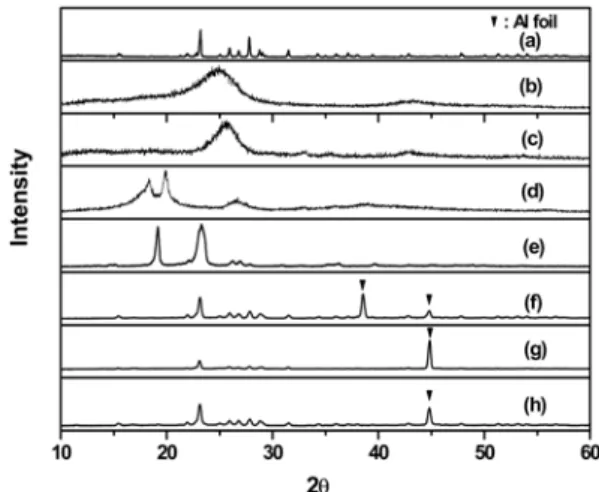
XRD patterns observed for raw materials and sulfur cathodes are shown in Fig. 1. Analysis of the elemental sulfur provides two prominent peaks at 23.4

o

and 28.0

o

, which correspond to Fddd orthorhombic structure.

12)

It is clearly seen that XRD patterns of both Super-P and MWNT showed the characteristic of an amorphous struc- ture with a broad peak at 2 θ = 24.3

o

and 2 θ = 25.2

o

, respect- ively. The binder PVdF showed crystalline structure with

Fig. 1. XRD patterns of (a) sulfur, (b) Super-P, (c) MWNT, (d) PVdF, (e) PEO, and sulfur cathodes, (f) S1, (g) S2, (h) S3.

Table 1. Compositions of sulfur cathodes

Cathode Electronic conductor Binder Ball milling time

S1 Super-P PVdF 0.5 ~ 5 h

S2 MWNT PVdF 0.5 ~ 3 h

S3 Super-P PEO 0.75 h

(3)

two sharp peaks at 18.3

o

, 19.9

o

and a broad peak at 26.1

o

, and the two sharp peaks at 19.2

o

and 23.3

o

indicated the crystalline structure of PEO. The pattern of the cathodes S1, S2 and S3 predominantly showed the characteristic peaks of sulfur, with the peak positions remaining the same as in the case of elemental sulfur. Therefore, it is suggested that the crystal structure of sulfur is unchanged and no new phase is formed during cathode preparation with different electronic conductors and binders.

2)

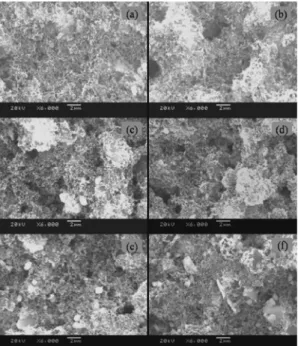
In order to find the optimum ball milling time, the sulfur cathode with Super-P as an electronic conductor and PVdF as a binder (S1) was taken for investigation. SEM images of sulfur cathodes with different ball milling time were shown in Fig. 2. The sulfur and Super-P carbon are distinguished by bright and dark areas in the electrodes, respectively. It was found that the particle size decreased with increasing ball milling time. With longer ball milling time, the surface of the cathode had a visible change that bare sulfur particles appeared. This is likely that longer ball milling time at high rotation speed causes sulfur aggregation. As shown in Fig. 2, the ball milling time for 0.5 h or 0.75 h showed uniform surface without bare sulfur particles, which indicated it is enough ball milling time to get homogenous slurry.

Fig. 3 showed the cycle performance of Li/S cells with sulfur cathodes prepared in different ball milling time

from 0.5 h to 5 h. It is observed that with increasing ball milling time, the discharge capacity decreased. For all the cells, the discharge capacity decreased with increasing cycle number and stabilized around 300 mAh/g. Li/S cell with the cathode S1 prepared in ball milling time 0.75 h showed the highest initial discharge capacity of 794 mAh/g.

For the sulfur cathode prepared in 5 h ball milling time, the discharge capacity was low and kept at about 220 mAh/g.

By comparison, sulfur cathodes S1 prepared in ball milling time 0.5 h and 0.75 h showed better performance.

The cyclic voltammograms of Li/S cells with S1 in different ball milling time as cathodes were presented in Fig. 4. All cathodes showed two cathodic peaks at 1.8 and 2.4 V as well as an anodic peak at around 2.5 V, respec- tively. The cathodes in 1 h and 3 h ball milling time ex-

Fig. 2. SEM images of sulfur cathodes S1 prepared in different ball milling time (h), (a) 0.5, (b) 0.75, (c) 1, (d) 2, (e) 3, (f) 5.

Fig. 3. Cycle performance of sulfur cathode S1 prepared in different ball milling time.

Fig. 4. Cycle voltammograms of sulfur cathodes S1 prepared

in different ball milling time.

(4)

hibited higher anodic current, but showed a little lower cathodic current. Therefore, the current difference bet- ween the cathodic peak and anodic peak was higher for S1 in 1 h and 3 h ball milling time among all other cathodes, which would result in worse cycle performance. In the case of S1 in 0.5 h and 0.75 h ball milling time, the voltam- mogram shape was more symmetrical than S1 with 1 h, 3 h and 5 h ball milling time. Moreover, S1 in 0.75 h ball milling time showed the highest cathodic current, resulting in better sulfur utilization and higher discharge capacity.

It further confirmed that 0.75 h can be selected to be the proper ball milling time to prepare good sulfur cathodes.

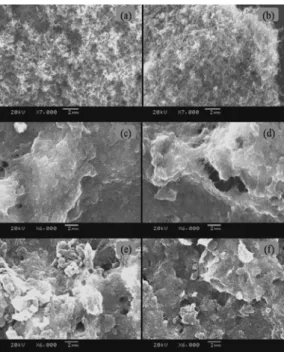
As shown in Fig. 5(a) and (b), Super-P particles have a sub-micron sized diameter and a large surface area while MWNT has morphology with tubular structure. Due to distinguished structural difference between them, different ball milling time was also applied to prepare sulfur cathode S2 and their SEM images were shown in Fig. 5(c) to (f). Compared to the sulfur cathode S1 shown in Fig. 2, cathode S2 seemed to be difficult to get a uniformly dispersed surface morphology with ball milling method. Moreover, the morphology of the S2 was also dependent on ball milling time and smooth surface in ball milling time less than 1 h (Fig. 5(c), (d)) was obtained while aggregated clusters appeared with longer ball milling

time as shown in Fig. 5(e) and (f).

Cycle performance of sulfur cathode S2 prepared in different ball milling time was shown in Fig. 6. The Li/S cell with S2 in 1 h ball milling time as a cathode showed the best cycle performance and got an initial discharge capacity of 944 mAh/g higher than S1, and that may because MWNT formed more effective electronically conductive network and furthermore improved the capacity.

2)

Moreover, the cathode S2 in 0.5 h ball milling time gave the worst electrochemical behavior probably because the raw materials in the cathode were not well and evenly dispersed. With longer ball milling time more than 2 h, the discharge capacity decreased. Li/S cell with S2 in 1 h ball milling time showed stabilized discharge capacity of 300 mAh/g after 20 cycles, while Li/S cell with S1 in 0.75 h ball milling time got a higher capacity of 350 mAh/g after 20 cycles. The capacity fading of the cathode with MWNT was higher than that of S1 with Super-P which demonstrated that Super-P is better electronic conductor than MWNT.

SEM images of sulfur cathodes S1 and S3 with PVdF and PEO as binders in ball milling time 0.75 h were

Fig. 5. SEM images of electronic conductor powders (a) Super-P, (b) MWNT and sulfur cathodes S2 with MWNT in different ball milling time (h), (c) 0.5, (d) 1, (e) 2, (f) 3.

Fig. 6. Cycle performance of sulfur cathode S2 prepared in different ball milling time.

Fig. 7. SEM images of sulfur cathodes with different binders,

(a) S1 and (b) S3.

(5)

shown in Fig. 7. Both S1 and S3 showed similar surface structure with uniform and porous morphology.

EIS analysis of Li/S cells with cathodes S1 and S3 prepared in 0.75 h was carried out and the time-dependent interfacial resistance was shown in Fig. 8. The impedance spectra exhibit a semi-circular loop and the diameter gives interfacial resistance. It is evident that S1 displayed a much lower interfacial resistance (300 Ω) than that of S3 (600 Ω) at the first few hours due to the lower viscosity of PVdF than PEO which further affected the cathode morphology.

In the following few days, the resistance of S1 increased with time until it got the highest of 1500 Ω at the 48 h, and then kept decreasing while for S3, the resistance increased as well and then decreased after 24 h. The increase of resistance might result from the morphological change of the sulfur cathode during discharge and charge processes.

2)

The surface of sulfur cathode was covered with lithium polysulfides produced during the discharging pro- cess of Li/S cells, which resulted in the change of the interfacial resistance.

13)

After certain time, the interface both of the cathodes S1 and S3 got stable, and hence the resistance went steady.

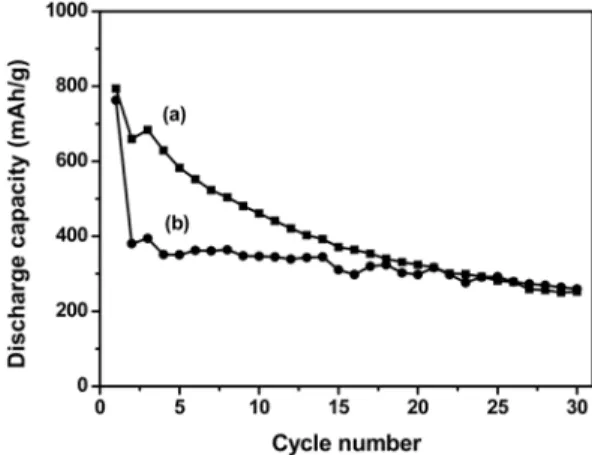
Li/S cells with S1 and S3 as cathodes gave different cycle life properties as observed from Fig. 9. Due to the good adhesion ability of PVdF and PEO binder, both of Li/S cells with cathodes S1 and S3 showed high and comparative initial discharge capacity. Li/S cell with cathode S1 got a continuous decreasing performance in the cycle life. For Li/S cell with cathode S3, it showed an initial discharge capacity of 763 mAh/g and then following a sharp fade staying stable around 300 mAh/g. It is likely that the sulfur cathode made of both PVdF and PEO binders failed to help holding back the soluble lithium polysulfide formed during the discharge process, which diffused away from the cath- ode to liquid electrolyte, thereby reducing the capacity.

10)

4. Conclusions

Sulfur cathodes for Li/S batteries were prepared by ball milling method. Different ball milling time was applied, in which 0.75 h was proved to be the proper time to get good property of sulfur cathode with Super-P as an elect- ronic conductor and PVdF as a binder with an initial dis- charge capacity of 794 mAh/g. As conductive agents, Super-P and MWNT were used. For the sulfur cathode with MWNT, ball milling time of 1 h was proper to get homogenous cathode with an initial discharge capacity of 944 mAh/g and a discharge capacity of 300 mAh/g after 20 cycles, while the cathode with Super-P got a lower initial capacity, but a higher capacity of 350 mAh/g after 20 cycles. The cathode with PEO as a binder showed higher interfacial resistance than the cathode with PVdF. After the first cycle, the discharge capacity of PEO-based cathode sharply decreased and got stable at around 300 mAh/g while the discharge capacity of PVdF-based cathode Fig. 8. Time dependent interfacial resistance of sulfur cathodes

(a) S1 and (b) S3.

Fig. 9. Cycle performance of sulfur cathodes (a) S1 and (b) S3.

(6)

exhibited a slightly decreasing trend with cycling.

Acknowledgements

This work was supported by the Next Generation Military Battery Research Center program of Defense Acquisition Program Administration and Agency for Defense Development.

References

1. G. A. Nazri and G. Pistoia, (Eds), ‘Lithium batteries:

Science and Technology’, Kluwer Academic Publishers, New York, 350 (2004).

2. L. Yuan, H. Yuan, X. Qiu, L. Chen, and W. Zhu, ‘Impro- vement of cycle property of sulfur-coated multi-walled carbon nanotubes composite cathode for lithium/sulfur batteries’ J. Power Sources, 189, 1141(2009).

3. Y. J. Choi, K. W. Kim, H. J. Ahn, and J.H. Ahn,

‘Improvement of cycle property of sulfur electrode for lithium/sulfur battery’ J. Alloys Compd., 449, 313 (2008).

4. X. Ji, K.T. Lee, and L.F. Nazar, ‘A highly ordered nano- structured carbon-sulphur cathode for lithium-sulphur batteries’ Nature Mater. 8, 500 (2009).

5. H. S. Ryu, Z. Guo, H. J. Ahn, G. B. Cho, and H. Liu,

‘Investigation of discharge reaction mechanism of lithium|liquid electrolyte|sulfur battery’ J. Power Sources, 189, 1179 (2009).

6. J. W. Choi, G. Cheruvally, D. S. Kim, J. H. Ahn, K. W. Kim, and H. J. Ahn, ‘Rechargeable lithium/sulfur battery with

liquid electrolytes containing toluene as additive’ J. Power Sources, 183, 441 (2008).

7. X. He, J. Ren, L. Wang, W. Pu, C. Jiang, and C. Wan,

‘Expansion and shrinkage of the sulfur composite electrode in rechargeable lithium batteries’ J. Power Sources, 190, 154 (2009).

8. N. I. Kim, C. B. Lee, J. M. Seo, W. J. Lee, and Y. B. Roh,

‘Correlation between positive-electrode morphology and sulfur utilization in lithium-sulfur battery’ J. Power Sources, 132, 209 (2004).

9. S. E. Cheon, K. S. Ko, J. H. Cho, S. W. Kim, E. Y. Chin, and H.T. Kim, ‘Rechargeable lithium sulfur battery I.

structural change of sulfur cathode during discharge and charge’ J. The Electrochem. Soc., 150, A796 (2003).

10. S. E. Cheon, J. H. Cho, K. S. Ko, C. W. Kwon, D. R.

Chang, H. T. Kim, and S. W. Kim, ‘Structural Factors of Sulfur Cathodes with Poly(ethylene oxide) Binder for Performance of Rechargeable Lithium Sulfur Batteries’ J.

Electrochem. Soc., 149, A1437 (2002).

11. S. E. Cheon, S. S. Choi, J. S. Han, Y. S. Choi, B. H. Jung, and H. S. Lim, ‘Capacity Fading Mechanisms on Cycling a High-Capacity Secondary Sulfur Cathode’ J. Electrochem.

Soc., 151, A2067 (2004).

12. J. W. Choi, J. K. Kim, G. Cheruvally, J. H. Ahn, H. J. Ahn, and K. W. Kim, ‘Rechargeable lithium/sulfur battery with suitable mixed liquid electrolytes’ Electrochim. Acta, 52, 2075 (2007).

13. H. S. Ryu, H. J. Ahn, K. W. Kim, J. H. Ahn, K. K. Cho, and T. H. Nam, ‘Self-discharge characteristics of lithium/

sulfur batteries using TEGDME liquid electrolyte’ Electro-

chim. Acta, 52, 1563 (2006).

수치

Fig. 1. XRD patterns of (a) sulfur, (b) Super-P, (c) MWNT, (d) PVdF, (e) PEO, and sulfur cathodes, (f) S1, (g) S2, (h) S3.
Fig. 2. SEM images of sulfur cathodes S1 prepared in different ball milling time (h), (a) 0.5, (b) 0.75, (c) 1, (d) 2, (e) 3, (f) 5.
Fig. 6. Cycle performance of sulfur cathode S2 prepared in different ball milling time.
Fig. 9. Cycle performance of sulfur cathodes (a) S1 and (b) S3.

참조

관련 문서

Specifically, Mises showed that the effect of inflation was not the same in the different periods since German people at that time had changed the expectation of

The proposal of the cell theory as the birth of contemporary cell biology Microscopic studies of plant tissues by Schleiden and of animal tissues by Microscopic studies of

It plays a central role in degradation of short-lived and regulatory proteins important in a variety of basic cellular processes, including regulation of the cell

The index is calculated with the latest 5-year auction data of 400 selected Classic, Modern, and Contemporary Chinese painting artists from major auction houses..

It considers the energy use of the different components that are involved in the distribution and viewing of video content: data centres and content delivery networks

After first field tests, we expect electric passenger drones or eVTOL aircraft (short for electric vertical take-off and landing) to start providing commercial mobility

1 John Owen, Justification by Faith Alone, in The Works of John Owen, ed. John Bolt, trans. Scott Clark, "Do This and Live: Christ's Active Obedience as the

Second, the analysis of the differences in sports participation time showed statistically significant differences in the operation of the competition and