금강수계의 토지이용 및 수질구배에 따른 돌부착 돌말류의 분포특성
조인환*ᆞ황순진**ᆞ김백호***ᆞ김용재****,†
*한양대 환경과학과
**건국대 환경과학과
***한양대 생명과학과
****대진대 생명과학과
Distribution of Epilithic Diatom Communities in Relation to Land-Use and Water Quality in the Geum River System, South Korea
In-Hwan Cho*․Soon-Jin Hwang**․Baik-Ho Kim***․Yong-Jae Kim****,†
*Department of Environmental Science, Hanyang University, Seoul 133-791, Korea
**Department of Environmental Science, Konkuk University, Seoul 143-701, Korea
***Department of Life Science, Hanyang University, Seoul 133-791, Korea
****Department of Life Science, Daejin University, Gyeonggi, 487-711, Korea (Received 26 February 2014, Revised 19 April 2014, Accepted 22 April 2014)
Abstract
To study the distribution characteristics of diatom communities in relation to the gradient of water quality and land-use, water samples and epilithic diatoms were collected from 90 sites including mainstream and tributaries, in the Geum River System (GRS) during no rainfall, May 2011. Of 239 taxa identified, Achnanthes convergens and Cymbella minuta were dominated over all the sites. Cluster analysis on the GRS divided into three groups. Group 1 (G1) is the mountainous upstream, a relatively good water quality, and mainly consisted of saproxenous species. Group 2 (G2) is the urban sites, polluted (high in electric conductivity, total phosphate and soluble reactive phosphorus), and saproxenous and common species. Group 3 (G3) is the agriculture sites, and polluted (turbidity, total nitrogen, nitrate), and saprophilous species. There were some discrepancies between abiotic and biotic variables in GRS; biologically similar between G1 and G2, but abiotically similar between G2 and G3. These differences may attribute to not only physiological characteristics of diatom cells, but complicate relationships between microhabitat and water quality. Thus, an urgent development of generalized or standardized methods to diminish the differences between epilithic diatom community and environments is advent.
Key words : Cluster Analysis, Epilithic Diatom, Geum River System, Indicator Species Analysis, Land-use, Water Quality
1. Introduction
1)오랫동안 인간활동은 하천이나 강에 의존되어 왔으며 따 라서 하천과 이들의 배후습지를 포함한 유수계의 구조와 생태계는 항상 크게 영향을 받고 있다. 우리나라 하천은 인간의 영향이 비교적 적은 산간계류를 제외하고는 대개 도시와 농업지역을 통과하여 바다로 유입되는 이른바 산간 하천, 도시하천, 농촌하천 등으로 구분된다. 일반적으로 도 심지를 지나는 하천들은 도로공사, 친수환경 조성, 수변공 사, 자원채취 등에 의한 구조변경 및 수질악화로 하천초기 의 생태적 구조와 기능을 유지하기 어렵다(Grimm et al., 2000; Ometo et al., 2000).
금강수계는 전라북도 장수군 장수읍에서 발원하여 군산- 장항을 거쳐 황해로 유입되는 우리나라 4대 하천 중의 하
†To whom correspondence should be addressed.
나이다. 유역면적은 9,885 km
2, 길이 401 km에 이른다. 주요 지류는 상류로부터 무주남대천, 봉황천, 초강천, 보청천, 미 호천, 갑천, 유구천, 지천천, 백마강, 논산천 등이 있다. 상 류역은 산간지역으로 용담댐과 대청댐 같은 다목적댐이 건 설되어 있으며, 중류역에는 대도시[대전광역시(갑천)와 충주 시(미호천)]와 소규모 산업시설이 집중되어 있다. 한편 하 류역에는 계룡, 논산, 강경, 함열, 익산, 군산 등의 농촌형 도시와 농업지대가 자리잡고 있으며, 최하류에는 군산시와 장항군을 연결하는 하구언댐이 건설되어 있다. 금강수계는 주로 도시와 농경지(논, 밭)를 통과하므로 이로 인한 화학 비료, 농약 등 농자재가 하천으로 유입되어 수질오염의 원 인이 되고 있다(Han et al., 1997). 최근에는 충남 연기군, 공주시와 청원군 일부 지역에 세종특별자치시가 건설되면 서 주택 및 상가건설이 활발하게 진행되고 있어 금강수계 의 수질오염이 점차 증가될 것으로 예상된다(Yi, 2013).
돌말류는 지구 전체 탄소고정양의 20%를 차지하며, 강과
하천에서 미세조류 중 가장 다양한 분류군이고(Leland and
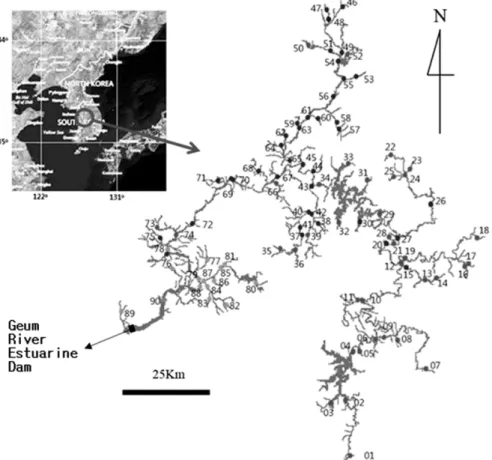
Fig. 1. Map showing the sampling sites of water and epilithic diatoms in the Geum river system in South Korea from April to May 2011. Red (G1), blue (G2), and yellow-green (G3) in color were groups that divided by cluster analysis with diatom data.
Porter, 2000), 1차 생산자로서 수서곤충, 어류 등 상위인자 의 먹이원으로 하천생태계의 근간을 이루고 있다(Stevenson et al., 1996). 또한 돌부착 돌말류는 암석에 장기간 부착하 며, 수온, 영양염, 유속, 유량 등 환경변화에 대해 민감하게 반응하고, 다른 생물군보다 교란에 대한 회복속도가 빠르기 때문에(Allan, 1995; Bott, 1983; Hill et al., 1995) 오염 또는 환경의 상태 변화에 대해 지표생물로 사용되고 있다(Watanabe and Asai, 1990; Watanabe et al., 1990).
금강수계의 수질 및 생물조사는 비교적 활발하게 진행되 어 왔으나(Han and An, 2013; Han et al., 1997; Kim et al., 1997; Na and Lee, 2011; Yi, 2013), 식물플랑크톤(Kim et al., 1996; Lee and Boo, 2000)과 부착돌말(Kim et al., 2000)에 대한 연구 등은 적었으며 조사지점 또한 제한적이었다. 따라 서 본 연구는 금강수계 상류에서 하구역까지 본류와 지류를 포함한 총 90개 지점을 대상으로 하천주변의 토지이용과 수 질구배에 따른 돌부착 돌말류 군집의 분포특성을 이해하기 위하여, 강우영향이 적은 2011년 봄(4~5월)에 상류에서부터 하류방향으로 2박 3일동안 집중적인 조사를 실시하였다.
2. Materials and Methods
2.1. 조사지점의 선정
각 조사지점의 돌부착 돌말류 및 환경요인 조사는 2011
년 4월부터 5월 사이에 1회씩 실시하였으며, 조사지점은 금강의 본류와 지류를 포함하여 총 90개 지점을 선정하였 고(Fig. 1) 기질은 수심 30~50 cm, 유속 10~50 cm/sec 여울 지역에서 상부가 평편한 자갈을 채취하였다. 동시에 하폭, 수심, 토지이용도 등을 측정하였다. 토지이용도(%)는 조사 지점을 중심으로 반경 1 km 범위를 농경지(agriculture), 도 시(urban), 숲(forest) 등으로 구분하고 각 항목별 상대적 비 율(%)을 계산하였다.
2.2. 수질조사 및 분석
조사지점의 수온, 용존산소량, pH, 전기전도도, 탁도 등은
휴대용 수질측정기 Horiba U-50 (HORIBA Ltd., Japan)을
이용하여 현장에서 직접 측정하였다. BOD는 Winkler-azide
법에 따라 현장에서 직접 채수한 시료를 300ml- BOD병에
넣고 냉암조건을 유지하면서 실험실로 운반한 후, 20°C
incubator에서 통기조건하에 5일 동안 암조건에서 배양하여
채수 당일 고정한 시료의 용존산소량을 비교하여 계산하였
다(APHA, 1995). 영양염의 경우 Standard method에 의거하여
NO
3-N은 Cadmium reduction법, NH
3-N은 Colorimetric법,
총질소는 Cadmium reduction법, PO
4-P는 Ascorbic acid법,
TP는 persulfate 분해 후 Ascorbic acid법으로 각각 Spectro-
photometer (SP2770i Youngwoo, Korea)를 이용하여 측정하
였다(APHA, 1995).
2.3. 돌부착 돌말류 채집 및 분석
돌부착 돌말류를 채집하기 위한 기질은 각 조사 지점에 서 수심 20~30 cm 에서 최소 1주일 이상 수중에 잠겨있었 고, 물의 흐름과 동일하고 상부가 고르고 넓은 자연석을 대 상으로 선정하였다. 부착 돌말류를 채집하기 위해 수중에서 기질의 상부에 5×5 cm
2의 고무판을 올려 고정한 후 그 외 부분을 iron brush로 제거하였다. 고무판을 누른 상태로 세 척된 기질을 입구가 넓은 플라스틱 통으로 옮겨 담아 부드 러운 솔과 현장수를 이용하여 기질 표면을 조심스럽게 긁 어 모아 250 mL의 샘플병에 옮겨 담은 후 Lugol’s solution 으로 고정하여 실험실로 운반하였다. 운반된 시료는 KMnO
4를 촉매제로 이용하여 산처리(Hendey, 1974)를 한 다음 봉 입제 Naphrax
Ⓡ(Brunel Microscopes Ltd, England)를 이용 하여 영구표본을 제작하였다. 돌부착 돌말류는 광학현미경 (Nikon E600, Japan)을 이용하여 1000배하에서 동정 및 분 류하였고, 세포밀도는 동정과정에서 표본당 출현종의 상대 밀도(Relative abundance)를 구하였다. 각 기질당 최소 500 개 이상의 살아있는 세포의 개체수를 S-R chamber를 이용 하여 도립현미경(CKX41, Japan)에서 계수하고 여기에 각 종들의 상대빈도를 곱하여 각 출현종의 최종밀도를 계산하 였다. 단 유기물을 포함하지 않은 세포는 모두 죽은 세포 로 처리하여 산정에 포함시키지 않았다. 한편, 돌말군집의 특성을 파악하기 위하여 각 지점의 출현종수 및 개체수를 이용하여, 우점종 및 우점도 지수(McNaughton, 1967), 다양 도 지수(Shannon and Weaner, 1948), 풍부도 지수 (Margalef, 1958) 및 균등도 지수(Pielou, 1975)를 각각 산 출하였으며, 군집간의 유사성을 계산하기 위하여 군집분석 (Cluster analysis)을 실시하였다. 또한 군집분석에 의해 그 룹화된 각 그룹간의 환경 및 생물요인간의 평균 차이를 비교 하기 위하여 ANOVA를 실시하였고, 모든 과정은 SPSS software (ver. 21. SPSS Inc. Korea)를 이용하였다.
2.4. 엽록소 및 유기물함량 분석
엽록소 및 유기물함량 분석은 정량 채집한 시료를 고정하 지 않고 냉암조건을 유지한 채 실험실로 운반하여 실시하였 다. 엽록소는 아세톤추출법에 따라 잘 흔들어준 시료의 10 mL를 GF/C filter paper (Whatman Inc., England)로 여과하여 90% 아세톤으로 24시간 동안 4°C의 냉암소에서 추출한 후 원심분리기(MF80 Hanil science Inc., Korea)를 이용하여 20 분간 원심분리하였다. 상등액의 흡광도는 Spectrophotometer (SP-2700i Youngwoo. Korea)를 이용하여 750 nm, 663 nm, 645 nm, 630 nm에서 측정 하였으며, 이것을 이용하여 엽록 소 농도를 계산하였다(APHA, 1995). 유기물함량(Ash free dry matter, AFDM)은 시료의 10 mL를 GF/C filter paper에 여과한 후, 105°C에서 24시간 동안 건조시킨 후 측정한 무게 (A1)와 이를 다시 550°C 화로에서 1시간 동안 태운 후 측정 한 무게(A2)의 차이로 계산하였다(APHA, 1995).
2.5. 돌부착 돌말류와 환경의 관계
각 그룹별로 환경요인이 돌부착 돌말류 군집에 미치는
영향을 파악하기 위하여 정준상관분석(Cannonical Corres- pondence Analysis)을 실시하였으며(Ter Braak, 1987), 각 axis의 통계적 유의성을 검정하기 위해 Monte-Carlo test를 실시하였다. 자료는 90개 조사지점에서 출현한 모든 종을 대상으로 하였으며, 분석을 위하여 현존량을 Log(n+1)로 변환하였다. 또한 각 군집을 대표하는 돌부착 돌말류를 선 정하기 위해 지표종분석(Indicator species analysis)을 실시 하였으며 지표값이 25% 이상이고 다른 그룹보다 5배 이상 높은 값을 가지는 종(good indicator)을 지표종으로 선정하 였다(Dufrene and Legendre, 1997). 이들의 유의성 평가를 위해 Monte Carlo test를 실시하였다. 이상의 분석을 위해 PC-Ord Package (ver 4.25 Mjm Soft, USA)를 이용하였다.
3. Results and Discussion
3.1. 돌부착 돌말류의 출현 특성
금강수계 본류와 지류를 포함한 총 90개 지점에서 출현한 돌부착 돌말류는 총 239분류군으로 1강 2목 9과 41속 201 종 33변종 2품종 3아종이었으며, 전체 우점종은 Achnanthes
convergens (총 현존량의 12.2%), Cymbella minuta (11.4%)였다. 이러한 특성은 다른 국내 주요하천 (한강, 낙동강, 영 산강, 섬진강 등)과 비슷한 결과이다(Hwang et al., 2011).
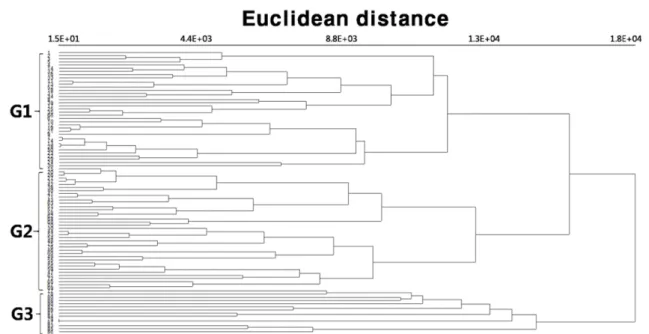
각 조사지점에서 출현된 종수와 현존량(개체수)을 이용 하여 cluster analysis를 실시한 결과, 13% 수준에서 크게 3 개 그룹(G)으로 구분되었으며, G1은 37개 지점, G2는 39 개 지점 그리고 G3는 14개 지점으로 각각 구성되어있다 (Fig. 2). 각 그룹의 물리적 또는 사회지리적 특성을 보면, G1은 금강수계의 상류에 위치한 대청호와 용담호를 포함 하여 주로 산간지역이었고 지류는 무주남대천, 보청천, 영 동천, 초강 등이 있다. G2는 대전, 청주, 공주 등과 같은 대도시를 관통하는 중류지점으로 갑천, 유구천, 미호천 등 이 유입되고 있다. 한편 G3는 논산, 강경, 서천, 군산 등의 중소도시와 농경지가 주로 집중되어 있는 하류역으로 강 경천, 논산천, 노성천 등이 유입되고 있다. 결국 금강수계 의 돌부착 돌말류의 분포는 비록 그룹간 조사지점수가 차 이를 보였으며 예상했던 것처럼 사회지리적인 특성도 뚜 렷하게 구분되었다.
각 그룹에서 출현된 돌부착 돌말류의 총 현존량의 3% 이 상을 차지하는 주요 종들의 상대빈도는 다음과 같다(Fig. 3).
G1에서는 Cymbella minuta (23.64%), Achnanthes convergens (13.42%), Achnanthes minutissima (12.41%), Nitzschia spp.
(9.69%), Navicula contenta (7.26%), Cocconeis placentula
var. euglypta (3.30%) 순이었으며, 이들 중에 Achnanthes
convergens, Achnanthes minutissima, Cymbella minuta 등은낙동강 상류(Lee, 1998), 광천(Lee and Chung, 1993), 신천
(Choi et al., 1993), 금호강(Chung et al., 1993) 등에서 우
점종으로 보고된 바 있다. G2에서는 Navicula cryptocephala
(14.14%), Achnanthes convergens (13.95%), Gomphonema
parvulum (10.79%), Nitzschia spp. (8.42%), Navicula contenta(5.51%), Achnanthes subhudsonis (5.34%), Cyclotella mene-
Fig. 2. Dendrogram of diatom-based stream sites classification using Ward linkage-Euclidean distance method. Total 90 sites were divided into three groups; G1=37 sites, G2=39 sites, and G3=14 sites, respectively.
Fig. 3. Relative abundance of major epilithic diatoms (>3% of total in each group) in the Geum river system in South Korea from April to May 2011. Each group was divided by cluster analysis with number of species and abundance of diatom appeared in each sampling site.
ghiniana (3.94%), Melosira varians (3.89%), Cocconeis pla- centula var. euglypta (3.71%), Fragilaria pinnata (3.38%)
등의 순이었으며 Navicula cryptocephala 는 임진강(Lee and Yoon, 2002), 신천(Choi et al., 1993), 섬진강(Lee and Yoon, 2002) 등에서 공통적으로 우점하였다. 한편 G3에서는
Melosira varians (5.70%), Cyclotella meneghiniana (3.44%)등으로 섬진강(Lee et al., 2000) 등에서 우점종으로 출현한
바 있다. 전체적으로 보면 금강수계 주요종들은 주로 Cymbella,
Achnanthes, Nitzschia, Navicula, Cyclotella, Gomphonema, Melosira, Cocconeis, Fragilaria 속으로 이루어졌으며 국내전역에 걸쳐 공통적으로 우점하는 종들이었다.
각 그룹간 돌말군집 특성을 비교한 결과(Table 1), 세 그
룹의 평균 밀도(현존량)는 그룹간에 유의한 차이를 보이지
않았다. 출현 종수는 G3가 G1-G2보다 (F=4.452, P=0.014),
Table 1. Diatom community indices (±S.E) in three groups divided by cluster analysis based on the epilithic diatom community in the Geum river in Korea from April to May 2011
Community G1 G2 G3 F P
No. species 21.4 ± 0.7a 22.8 ± 0.9ab 26.1 ± 1.6b 4.452 0.014
Abundance (104cells/cm2) 37.1 ± 7.0 37.5 ± 6.1 21.7 ± 1.6 1.026 0.363
Dominance 0.51 ± 0.02a 0.49 ± 0.02a 0.19 ± 0.01b 44.465 0.000
Diversity 0.99 ± 0.03a 1.02 ± 0.03a 1.31 ± 0.02b 22.897 0.000
Richness 3.91 ± 0.14 4.12 ± 0.2 4.71 ± 0.29 2.932 0.059
Evenness 0.75 ± 0.02a 0.75 ± 0.02a 0.93 ± 0.01b 24.946 0.000
Small alphabets (a, b and c) were Tukey’s post-hoc test
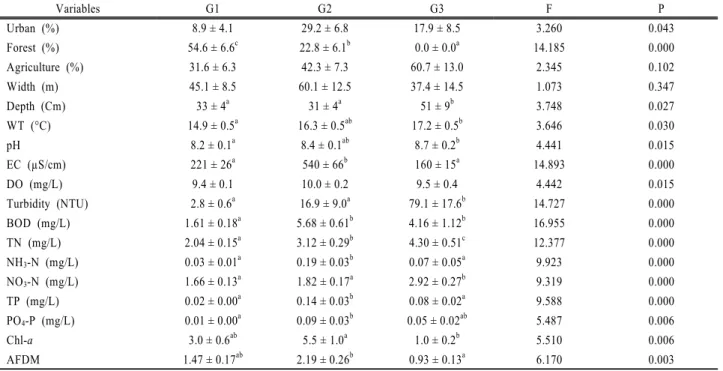
Table 2. Biological and environmental variables (±SE) in the Geum river in Korea from April to May 2011
Variables G1 G2 G3 F P
Urban (%) 8.9 ± 4.1 29.2 ± 6.8 17.9 ± 8.5 3.260 0.043
Forest (%) 54.6 ± 6.6c 22.8 ± 6.1b 0.0 ± 0.0a 14.185 0.000
Agriculture (%) 31.6 ± 6.3 42.3 ± 7.3 60.7 ± 13.0 2.345 0.102
Width (m) 45.1 ± 8.5 60.1 ± 12.5 37.4 ± 14.5 1.073 0.347
Depth (Cm) 33 ± 4a 31 ± 4a 51 ± 9b 3.748 0.027
WT (°C) 14.9 ± 0.5a 16.3 ± 0.5ab 17.2 ± 0.5b 3.646 0.030
pH 8.2 ± 0.1a 8.4 ± 0.1ab 8.7 ± 0.2b 4.441 0.015
EC (µS/cm) 221 ± 26a 540 ± 66b 160 ± 15a 14.893 0.000
DO (mg/L) 9.4 ± 0.1 10.0 ± 0.2 9.5 ± 0.4 4.442 0.015
Turbidity (NTU) 2.8 ± 0.6a 16.9 ± 9.0a 79.1 ± 17.6b 14.727 0.000
BOD (mg/L) 1.61 ± 0.18a 5.68 ± 0.61b 4.16 ± 1.12b 16.955 0.000
TN (mg/L) 2.04 ± 0.15a 3.12 ± 0.29b 4.30 ± 0.51c 12.377 0.000
NH3-N (mg/L) 0.03 ± 0.01a 0.19 ± 0.03b 0.07 ± 0.05a 9.923 0.000
NO3-N (mg/L) 1.66 ± 0.13a 1.82 ± 0.17a 2.92 ± 0.27b 9.319 0.000
TP (mg/L) 0.02 ± 0.00a 0.14 ± 0.03b 0.08 ± 0.02a 9.588 0.000
PO4-P (mg/L) 0.01 ± 0.00a 0.09 ± 0.03b 0.05 ± 0.02ab 5.487 0.006
Chl-a 3.0 ± 0.6ab 5.5 ± 1.0a 1.0 ± 0.2b 5.510 0.006
AFDM 1.47 ± 0.17ab 2.19 ± 0.26b 0.93 ± 0.13a 6.170 0.003
WT : water temperature, DO : dissolved oxygen, EC : electric conductivity, BOD : biochemical oxygen demand, TN and TP : total nitrogen and phosphorus, Chl-a : chlorophyll-a, AFDM : ash-free dry-matter
Small alphabets (a, b and c) were Tukey’s post-hoc test
균등도 지수는 G3가 G1-G2보다 (F=24.946, P<0.001), 우점 도 지수는 반대로 G1-G2가 G3보다 각각 유의하게 높았다 (F=44.465, P<0.001). 한편 다양도 지수는 G2-G3가 G1보다 유의하게 높았다(F=22.897, P<0.001). 결국, 금강수계의 돌 부착 돌말류의 분포는 상류(산간하천), 중류(도시하천), 하 류(농촌하천) 등으로 사회지리적 특성을 보였으나, 그룹간 에 뚜렷한 현존량의 차이가 없고 군집지수 역시 상류와 하 류간에만 차이가 있을 뿐, 상류-중류 또는 중류-하류간에는 유의한 차이를 보이지 않았다.
3.2. 돌부착 돌말류의 지표성
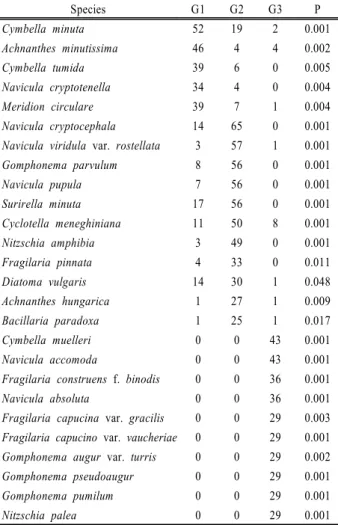
각 그룹의 돌부착 돌말류 지표종을 파악하기 위하여 생 물자료를 이용하여 지표종 분석(Indicator species analysis)을 실시한 결과 각 그룹을 대표하는 지표종(지표값)은 Table 3 과 같다. G1에서는 Cymbella minuta (52%), Achnanthes minu-
tissima (46%), Meridion circulare (39%), Cymbella tumida(39%), Navicula cryptotenella (34%) 등이었다. Cymbella
minuta 는 대표적인 호청수성종이고, pH에 대하여 광적응성
이며(Watanabe, 2005), Meridion circulare 는 청정한 유수역
을 선호하고(Patrick and Reimer, 1966), Cymbella tumida
는 빈영양과 중영양수역을 선호하며(Krammer, 2002), Navi-
cula cryptotenella 는 유기오염이 심한 수역에서는 출현하지않았다 (Lange-Bertalot, 2001). G2에서는 Navicula cryptoce-
phala (65%), Navicula viridula var. rostellata (57%), Navicula pupula (56%), Bacillaria paradoxa (25%) 등 총 11종으로나타났다. Navicula viridula var. rostellata 는 중성 및 약알
칼리성 수역에서 분포하며(Patrick and Reimer 1966), Navi-
cula pupula 는 넓은 생태범위를 갖는 보편종이며 높은 전기전도도 수역에서 생육한다(Taylor et al., 2007). Bacillaria
paradoxa 는 전기전도도가 높은 담수나 기수역에서 생육하며,광염성이고, 호알카리성이다(Krammer and Lange-Bertalot,
1988). G3에서는 Fragilaria capucina var. gracilis (29%),
Fragilaria construens f. binodis (36%), Gomphonema augurvar. turris (29%), Hannaea arcus (29%), Navicula accomoda
Table 3. Indicator values (%) for the most important species (P < 0.05) clustered Geum river system in Korea from April to May 2011. Monte Carlo simulations (999 permutations) were used to assess the signi- ficance of each species as an indicator for each sites group
Species G1 G2 G3 P
Cymbella minuta 52 19 2 0.001
Achnanthes minutissima 46 4 4 0.002
Cymbella tumida 39 6 0 0.005
Navicula cryptotenella 34 4 0 0.004
Meridion circulare 39 7 1 0.004
Navicula cryptocephala 14 65 0 0.001
Navicula viridula var. rostellata 3 57 1 0.001
Gomphonema parvulum 8 56 0 0.001
Navicula pupula 7 56 0 0.001
Surirella minuta 17 56 0 0.001
Cyclotella meneghiniana 11 50 8 0.001
Nitzschia amphibia 3 49 0 0.001
Fragilaria pinnata 4 33 0 0.011
Diatoma vulgaris 14 30 1 0.048
Achnanthes hungarica 1 27 1 0.009
Bacillaria paradoxa 1 25 1 0.017
Cymbella muelleri 0 0 43 0.001
Navicula accomoda 0 0 43 0.001
Fragilaria construens f. binodis 0 0 36 0.001
Navicula absoluta 0 0 36 0.001
Fragilaria capucina var. gracilis 0 0 29 0.003 Fragilaria capucino var. vaucheriae 0 0 29 0.001 Gomphonema augur var. turris 0 0 29 0.002
Gomphonema pseudoaugur 0 0 29 0.001
Gomphonema pumilum 0 0 29 0.001
Nitzschia palea 0 0 29 0.001
(43%) 등 14종으로 나타났다. Fragilaria capucina var. gracilis 는 주로 부영양수역에서 생육하며(Krammer and Lange- Bertalot, 1991), Fragilaria construens f. binodis 는 중부수 성 또는 중영양성 수역에서 분포하고 호알칼리성 종이다 (Van Dam et al., 1994). 한편 Gomphonema augur var. turris 는 중성 pH에서 주로 분포한다(Patrick and Reimer, 1975).
3.3. 토지이용과 수환경
각 그룹의 토지이용도와 수질환경의 평균값을 비교하면 다음과 같다(Table 2). 토지이용도는 앞에서 언급한 바와 같이 각각 G1은 숲, G2는 도시, G3는 농경지 등이 가장 높은 비율을 차지하여 상류부터 하류까지 국내 하천의 토 지이용 및 사회지리적 특성을 나타냈다. 수질환경은 G1의 경우, 세 그룹 중 BOD, TN, PO
4-P 등이 가장 낮았으며 소 양호(Kim et al., 2002)와 섬진강(Lee et al., 2000)의 상류 와 유사한 수준으로 양호한 수질을 나타냈다. G2는 전기전 도도, TP, PO
4-P, Chl-a, AFDM 등이 다른 그룹에 비해 상 대적으로 높았는데, 특히 전기전도도는 미호천(지점 63,
2086 µS/cm)에서 가장 높았고, TP, PO
4-P 등은 미호천 지 류인 칠장천(지점 47, TP: 0.863 mg/L, PO
4-P : 0.775 mg/L) 에서 높았다. Shin et al., (2012)은 미호천의 유입이 금강 본류의 전기전도도, TN, TP에 영향을 미친다고 분석하였 고, Kim et al. (2000)의 연구에서도 미호천의 유입이 금강 본류의 TN, TP의 농도를 증가시켰다. 이런 특성은 본 연구 결과와도 유사한 결과이다. 한편 G3는 수온, 탁도, TN, NO
3-N가 상대적으로 가장 높았으며, 주로 생활 및 축산계 하수 유입이 원인이며(Kim, Kim, Oh et al., 2007), 낙동강 (Kim, Kim, Lee et al., 2007)과 영산강(Jung et al., 2012) 의 하류 구간과 유사한 수준을 나타냈다. 이러한 패턴은 비록 크기는 작지만 도시를 관통하여 흐르는 남한강 상류 의 섬강 수계와 가장 비슷하였다(Min et al., 2012). 또한 수온, pH (G1/G2-G3), 수심, 탁도, NO
3-N (G1-G2/G3), 전기 전도도, TP, NH
3-N (G1-G3/G2), BOD (G1/G3), PO
4-P (G1/G2), Chl-a, AFDM(G2/G3) 등에 의하여 각 그룹의 환경이 구분 되었다. 전체적으로 금강수계는 숲 비율이 가장 높은 G1은 청정한 수질을 보인 반면, G2의 생활하수(TP, PO
4-P)와 G3 의 농업하수(TN, NO
3-N)의 지속적인 유입으로 인한 오염 된 수질을 나타낸 것으로 사료되었다.
3.4. 돌부착 돌말류와 환경의 관계
각 그룹의 환경요인이 돌부착 돌말류 군집(출현종수 및 현존량)에 미치는 영향을 파악하기 위하여 CCA를 실시한 결과(Fig. 4), 크게 두 영역으로 구분되었다. Axis2를 경계 로 G1과 G2는 좌측에 위치하고(영역1), G3는 우측에 각각 위치하였다(영역2). 영역1에 대해서는 숲, 하폭, 전도도, Chl-a 와 AFDM 등이, 영역2에 대해서는 수심, 수온, pH, TN 과 NO
3-N 등이 각각 높은 상관을 보였으며(Fig. 4(a)), Axis1에 대해서는 숲, pH, 전기전도도, 탁도, TN, NO
3-N 과 AFDM 등이, Axis 2에 대해서는 NH
3-N 등이 각각 유의한 상관을 나타냈다(Fig. 4(b)). 결국 금강수계의 돌부착 돌말 류의 분포는 독립성이 강한 G3와 유사성(출현종수, 우점종, 다양도 등)이 높은 G1-G2로 구분되는 반면, 수환경은 양호 한 수질을 보였던 G1 과 상대적으로 오염이 심한 G2(인계 열)와 G3(질소계열)로 구분되었다.
본 연구는 돌부착 돌말류 분포에 미치는 수환경의 영향
을 파악하기 위하여 금강수계를 대상으로 조사한 것으로
출현된 부착돌말류의 종수 및 현존량을 근거로 군집분석
을 하였으며, 분류된 각 cluster의 환경이 이들에게 어떤
영향을 미치는 지 CCA분석을 통해 입증한 것이다. 하지만
단 1차례의 조사결과만을 토대로 부착돌말류의 분포와 환
경과의 상관 관계를 규정하는 것은 미흡한 점이 많다. 또
한 조사지점 수, 수질(영양염), 물리적 환경(유속, 광도, 포
식자 등)은 물론 미소서식처와 수질간의 관계 역시 부착돌
말류의 분포에 큰 영향을 미친다고 판단된다. 추후 금강수
계의 하천 생태계 관리 및 보존을 위하여 표준화된 부착
돌말류 조사방법을 통한 보다 장기적이고 인과관계가 잘
알려진 환경요소에 대한 조사도 병행되어야 할 것으로 사
료되었다.
(a) (b)
Fig. 4. Results of CCA. a) Ordination diagram showing the distribution of epilithic diatom communities in each group in the Geum river system in South Korea from April to May 2011. b) Correlation coefficients between biotic and abiotic variables (*P<0.05, **P<0.01). WT : water temperature, EC; electric conductivity, NTU : Turbidity, TN : total nitrogen, Chl-a; chlorophyll-a, NH : NH
3-N, N
3: NO
3-N, AFDM; ash-free dry-matter, sp: number of species.
Conclusion
금강수계의 돌부착 돌말류의 분포특성을 파악하기 위하 여 2011년 4월~5월(갈수기) 동안 본류와 지류를 포함한 90 개 지점의 토지이용, 수질 및 돌부착 돌말류 조사를 동시 에 실시하여 다음과 같은 결과를 얻었다. 출현한 돌부착 돌말류는 총 239분류군으로 1강 2목 9과 41속 201종 33변 종 2품종 3아종이었으며, 전체 우점종은 Achnanthes conver-
gens (총 현존량의 12.2%), Cymbella minuta (11.4%)로 밝혀졌다. 출현종수와 현존량을 이용한 군집분석 결과, 크게 3개 그룹(G)으로 구분되었으며 G1은 상류지점으로 수질은 양호하고 호청수성 돌부착 돌말류가 주로 출현하였다. G2는 도시를 관통하는 지점들로 구성되었으며, 전기전도도, TP, PO
4-P 등이 높았고 호청수성 또는 보편종 등이 주로 분포 하였다. 한편 G3는 농경지를 지나가는 지점들로 구성되었 고 탁도, TN, NO
3-N 등이 높았으며 호오탁성 돌부착 돌말 류가 주로 분포하였다. 하지만 돌부착 돌말류의 군집은 G1 과 G2 사이에 유사성이 높은 반면, 수환경은 G2와 G3이 서로 비슷하였다. 이러한 차이는 돌부착 돌말류가 갖는 세 포의 형태적, 생리적 특성은 물론 미소서식처와 수질간의 복잡한 관계에서 비롯된 것으로 판단되어 표준화된 조사방 법 및 개발이 요구되었다.
Acknowledgement
이 논문은 2014학년도 대진대학교 학술연구비 지원에 의 한 것임.
References
Allan, J. D. (1995). Stream ecology: Structure and function of running waters, Chapman and Hall, pp. 83-108.
America Public Health Association (APHA). (1995). Standard Methods for the Examination of Water and Wastewater, America Public Health Association, Washinton, D.C. USA.
Bott, T. L., Barnes, J. R., and Minshall, G. W. (1983). Primary productivity in streams, Stream ecology : Application and testing of neral Ecological Theory, Plenum press, New York, USA.
Choi, J. S., Chung, J., and Kim, D. H. (1993). Comparison of Water Quality by Epilithic Diatom Community in the Sinchun river, Korean Journal of Limnology, 26(3), pp. 165-173.
[Korean Literature]
Chung, J., Choi, J. S., and Lee, J. H. (1993). Assessment for Water Quality of the Kumho River Using Epilithic Diatom Assemblage Index to Organic Water Pollution (DAlpo), The Korean Journal of Environment Biology, 11(1), pp. 43-58.
[Korean Literature]
Dufrene, M. and Legendre, P. (1997). Species assemblages and indicator species: the need for flexible asymmetrical approach, Ecological Monographs, 67(3), pp, 345-366.
Grimm, N. B., Grove, J. M., Pickett, S. T. A., and Redman, C.
L. (2000). Integrated approaches to long-term studies of urban ecological systems, Journal of BioSciences, 50(7), pp. 71-584.
Han, J. H. and An, K. G. (2013). Chemical Water quality and fish community characteristics in the Mid- to Downstream reach of Geum river, The Korean Journal of Environment Biology, 31(3), pp. 180-188. [Korean Literature]
Han, K. W., Cho, J. Y., and Kim, S. J. (1997). Effects of Farming on Soil Contamination and Water Quality in Keum
River Districts, Korean Journal of Environmental agriculture, 16(1), pp. 19-24. [Korean Literature]
Hendey, N. I. (1974). The permanganate method for cleaning freshly gathered diatoms, Microscopy, 32, pp. 423-426.
Hill, W. R., Ryan, M. G., and Schilling, E. M. (1995). Light limitation in a stream ecosystem: Responses by primary producers and consumers, Ecological Society of America, 76(4), pp. 1297-1309.
Hwang, S. J., Kim, N. Y., Yoon, S. A., Kim, B. H., Park, M.
H., You, K. A., Lee, H. Y., Kim, H. S., Kim, Y. J., Lee, J., Lee, O. M., Shin, J. K., Lee, E. J., Jeon, S. L., and Joo, H.
S. (2011). Distribution of benthic diatoms in Korean rivers and streams in relation to environmental variables, Annales de Limnologie-International Journal of Limnology, 47(S1), pp. S15-S33.
Jung, J. W., Lim, B. J., Cho, S. H., Choi, J. H., Song, K. D., Ha, D. W., Kim, H. S., Park, S. H., Hwang, T. H., Jung, S.
J., and Lee, D. J. (2012). The Influence of Land Use on Water Quality in the Tributary of the Yeongsan River Basin, Korean Journal of Limnology, 45(4), pp. 412-419. [Korean Literature]
Kim, B. H., Choi, M. K., Chung, Y. T., Lee, J. B., Wui, I. S., and Kil, B. S. (1997). Phytoplankton community structure and dynamics in the upper Keum and Mankyeong river system, Journal of Environmental Science, 6, pp. 47-56.
[Korean Literature]
Kim, H. S., Kim, Y. I., Oh, H. J., and Lee, S. J. (2007).
Demonstration of methodology for Priority Selection of Water Quality Management of Stream in the Watershed, Proceedings of the 2007 Co-Conference of the Korean Society on Water Environment and Korean Society of Water and Wastewater, Korean Society on Water Environment and Korean Society of Water and Wastewater, pp. 11-17 [Korean Literature]
Kim, J. H., Kim, C. Y., Lee, S. T., Choi, C. M., Jung, G. B., Lee, J. S., and Kim, W. I. (2007). Properties of Water Quality and Land Use at the Rural Area in the Nakdong River Watershed, Korean Journal of Environmental Agri- culture, 26(2), pp. 99-106. [Korean Literature]
Kim, J. H., Lee, S. J., and Oh, H. M. (2000). Dynamics of epilithic algal community in the Geum river, Korea, The Korean Society of Phycology, 15(4), pp. 287-297. [Korean Literature]
Kim, J. M., Park, J. D., Noh, H. R., and Han, M. S. (2002).
Changes of Seasonal and Vertical Water Quality in Soyang and Paldang River- reservoir System, Korean Journal of Limnology, 35(1), pp. 10-20. [Korean Literature]
Kim, J. T., Park, E. R., Cho, H. S., and Boo, S. M. (1996). The phytoplankton community structure in the main stream of the Kumgang river, Korea, Korean Journal of Limnology, 29(3), pp. 187-195. [Korean Literature]
Krammer, K. (2002). Diatoms of Europe. Diatoms of the Euro- pean inland waters and comparable habitats, Vol. 3. Cymbella, Gantnet Verlag, A.R.G., Ruggell, K. G. and Koeltz Scientific Book, Konigstein, pp. 584.
Krammer, K. and Lange-Bertalot, H. (1988). Bacillariophyceae. 2.
Teil. Bacillariaceae, Epithemiaceae, Surirellaceae. In: Süss- wasserflora von Mitteleuropa, Ettl, H., Gerloff, J., Heynig,
H., and Mollenhauer, D. (eds), Gustav Verlag, Stuttgart, New York, pp. 596.
Krammer, K. and Lange-Bertalot, H. (1991). Bacillariophyceae 4. Teil : Achnanthaceae Kritische Eragãnzungen zu Navicula (Lineolatae) und Gomphonema, Süßwasserflora von Mittel- europa, Band 2/4, Ettl H., Gerloff J., Heying H. and Mollen- hauer D. (eds.) Gustav Fischer Verlag, Stuugart/New York, pp. 437.
Lange-Bertalot, H. (2001). Navicula sensu strict 10 Genera Separated from Navicula sensu stricto, Frustulia, In: Lange- Bertalot, H. (eds.) Diatoms of Europe, Diatoms of the European Inland Waters and comparable Habitats 2, pp. 1-526.
Lee, J. H. (1998). Epilithc diatoms in the Naktodng river and its value of the diatom assemblage index of organic water pollution (DAIpo), Korean Journal of Limnology, 31(1), pp.
38-44. [Korean Literature]
Lee, J. H. and Chung, J. (1993). Community Structure of the Epilithic Diatoms from the Kwangchon River in Kyngsang- buk-do Province, Korea, Korean Journal of Limnology, 26(3), pp. 223-233. [Korean Literature]
Lee, K. and Yoon, S. K. (2002). Seasonal Changes of the Phytoplankton Community in the Imjin River, Korean Journal of Limnology, 35(2), pp. 111-122. [Korean Literature]
Lee, K. B., Kim, B. H., Lee, D. B., and Choi, M. K. (2000).
Ecological Studies on the Epilithic Algal and Change of Agricultural Irrigation Water Quality in the Seomjin River, Korean Journal of Environmental agriculture, 19(4), pp.
276-283. [Korean Literature]
Lee, S. K. and Boo, S. M. (2000). Study of Phytoplankton Biomass in Kuem River, Korean Journal of Environment Biology, 18(3), pp. 347-353. [Korean Literature]
Leland H. V. and Porter S. D. (2000). Distribution of benthic algae in the upper Illinois River basin in relation to geology and land use, Freshwater Biology, 44(2), pp. 279-301.
Margalef, R. (1958). Information theory in ecology, General Systems: Yearbook of the International Society for the Sys- tems Sciences, 3, pp. 36-71.
McNaughton, S. J. (1967). Relationships among functional properties of Californian grassland, Nature, 216, pp. 168-169.
Min, H. N., Kim, N. Y., Kim, M. K., Lee, S. W., Hwang, G. S., and Hwang, S. J. (2012). Relation of Stream Shape Complexity to Land Use, Water Quality and Benthic Diatoms in the Seom River Watershed. Korean Journal of Limnology, 45(1), pp. 110-122. [Korean Literature]
Na, J. E. and Lee, H. Y. (2011). Distribution of benthic algae in tidal flats of Saemangeum lake, Korea, The Korean Journal of Environment Biology, 29(1), pp. 46-51. [Korean Literature]
Ometo, J. P. H. B., Martinelli, L. A., Ballester, M. V., Gessner, A., Krrusche, A. V., Victoria, R. L., and Williams, M. (2000).
Effects of land use on water chemistry and macroinverte- brates in two streams of the Piracicaba River basin, south-east Brazil, Journal of Freshwaler Biology, 44(2), pp.
327-337.
Patrick, R. and Reimer, C. W. (1966). The diatoms of the United States (exclusive of Alaska and Hawaii). Volume 1: Syste- matic descriptions of diatoms of the taxonomic orders Fragi- lariales, Eunotiales, Achnanthales, and Navicuales (family Naviculaceae), The Academy of Natural Sciences, Philadelphia.
Patrick, R. and Reimer, C. W. (1975). The diatom of the United States. vol. 2/1: Entomoneidaceae, Cymbellaceae, Gomphone- maceae, Epithemiaceae, The Academy of Natural Sciences, Philadelphia.
Pielou, E. C. (1975). Ecological diversity, New York: Wiley.
Shannon, C. E. and Weaver, W. (1948). A mathematical theory of communication, Bell System, 318, pp. 432-379.
Shin, M. S., Lee, Y. K., Park, J. H., and Kim, B. C. (2012).
Primary Productivity of phytoplankton in a Eutrophic River(Kum River System), Journal of Korean Society on Water Environment, 28(1), pp. 10-17. [Korean Literature]
Stevenson, R. J., Bothwell, M. L., Lowe, R. L., and Thorp, J. H.
(1996). Algal ecology: Freshwater benthic ecosystem, CA:
Academic press, San Diego.
Taylor, J. C., Harding, W. R., and Archibald, C. G. M. (2007).
An illustrated guide to some common diatom species from South Africa, Water Research Commission.
Ter Braak, C. J. F. (1987). Data analysis in community and landscape ecology, Jongnam R. H. G., Ter Braak C. J. F. and
van Tongeren, O. F. R(eds.), Pudoc, Wageningen, pp. 91-173.
Van Dam, H., Mertens, A., and Sinkeldam, J. (1994). A coded checklist and ecological indicator values of freshwater diatoms from the Netherlands, Netherlands ournal of Aquatic Ecology, 28(1), pp. 117-133.
Watanabe, T. (2005). Picture book and ecology of the freshwater diatoms, Uchida Rokakuho Pulishig, Tokyo, pp. 784.
Watanabe, T. and Asai, K. (1990). Numerical simulation using diatom assemblage of organic pollution in stream and lakes, The Review of inquiry and Research, 52, pp. 99-139.
Watanabe, T., Asai, K., and Houki, A. (1990). Numerical simula- tion of organic pollution in flowing waters, In Encyclopedia Environmental Control Technology, 4, Hazardous Waste Con- tainment and Treatment, Cheremisinoff, P.N. (ed.), Gulf Publishing Company, Houston pp. 251-281.
Yi, S. J. (2013). Establishment of water quality standards and water quality target in the Geum-river basin, Journal of Korean Society on Water Environment, 29(3), pp. 438-442.
[Korean Literature]