산후 우울증의 한방 치료에 대한 무작위대조군연구 중심의 연구 동향
1 경희대학교 대학원 임상한의학과, 2 경희대학교 한의과대학 부인과교실 최석영 1 , 박경선 2 , 황덕상 2 , 이진무 2 , 이창훈 2 , 장준복 2
ABSTRACT
Research Trends of Randomized Controlled Trials on Traditional Korean Medicine Treatment for Postpartum Depression
Seok-Young Choi 1 , Kyoung-Sun Park 2 , Deok-Sang Hwang 2 , Jin-Moo Lee 2 , Chang-Hoon Lee 2 , Jun-Bock Jang 2
1 Dept. of Clinical Korean Medicine, Graduate School, Kyung Hee University
2 Dept. of Gynecology, College of Korean Medicine, Kyung Hee University Objectives: The purpose of this study was to analyze the research trends of randomized controlled trials on Traditional Korean Medicine treatment for postpartum depression in women.
Methods: In order to investigate the effect of Traditional Korean Medicine on postpartum depression, randomized controlled trials on postpartum depression were searched using domestic and foreign search engines and a total of 11 studies were selected.
Results:
1. There were 6 studies comparing Traditional Korean Medicine treatment methods with western medicine: fluoxetine hydrochloride (4), paroxetine (1), and mirazapine (1).
2. There were 5 studies comparing methods of Traditional Korean Medicine or sham acupuncture: 1 study evaluated the efficacy of Balance Acupuncture and Guipi Decoction , 1 study compared the effects of conventional acupuncture and Dispersing Liver Regulating Spirit Acupuncture, 1 study evaluated the efficacy of acupuncture and Heat-sensitive Moxibustion, 1 study compared the effects of conventional acupuncture and Musical Electroacupuncture, and 1 study compared the effects of conventional acupuncture and non-invasive sham acupuncture.
3. Postpartum depression is closely related to Heart and Liver, and there were many studies using acupoints Taichong (LR3) and Shenmen (HE7). Cranial acupoints Baihui (DU20) and Yintang (EX-HN3) were also frequently used.
4. Xiaoyaosan and Guipi Decoction were used in herbal medicine treatment for postpartum depression.
5. Novel treatment methods such as Heat-sensitive Moxibustion and Musical Electroacupuncture were used to treat postpartum depression.
Conclusion: Traditional Korean Medicine treatment is a good treatment option for postpartum depression. Further systematic studies are needed to establish the basis for Traditional Korean Medicine treatment for postpartum depression.
Key Words: Postpartum Depression, Randomized Controlled Trials, Acupuncture Treatment, Herbal Medicine
1)
Corresponding author(Jun-Bock Jang) : Kyung Hee University Korean Medicine Hospital, 23, Kyungheedae-ro, Dongdaemun-gu, Seoul, Republic of Korea
Tel : 02-958-9159 E-mail : [email protected]
Ⅰ. 서 론
산후 우울증(Postpartum depression, PPD) 은 삶에 장애를 초래하지만 치료가 가능한 정신 질환으로 분만의 가장 대표적인 합 병증 중 하나이며 1) , 출산 후 여성의 13%
(8명 중 1명)에서 발생한다 2) . 산후 우울 증은 대다수의 산모들에서 발생하는 산후 우울감(baby blues)과 구별되어야 하는데, 산후 우울감은 울음, 슬픔, 짜증, 불안, 혼란과 같은 증상이 나타나지만 분만 후 4일 경을 정점으로 하여 열흘 정도 지나면 자연스럽게 사라지는 일시적인 기분 장애 로 지속적인 영향을 미치지 않는다 3) . 반면, 산후 우울증은 출산 전후기에 나타나는 우울 장애로, 우울한 기분, 흥미 상실, 식 욕 감퇴, 체중 감소, 수면장애, 과도한 죄 책감, 정신운동의 지연, 불안 및 초조, 자 살에 대한 반복적인 사고 등의 증상들이 최소 2주 이상 지속되면서 일상생활에 심 한 장해를 초래하는 경우를 이른다. 최 근 개정된 정신질환 진단 및 통계 편람 (Diagnostic and Statistical Manual of Mental Disorder 5th edition, DSM-V) 4) 에 서는 산후 우울증의 발생 시기를 기존의
‘분만 후에서 4주 이내’에서 ‘임신 도중 혹은 분만 전후 4주’로 어느 때나 증상이 촉발될 수 있다고 하였다. 그러나 대부 분의 전문가들은 여전히 분만 후 1년 이 내에 어느 때나 나타나는 우울 증세라 진단한다 5) .
산모는 산후 우울증의 증상으로 인해 정서적인 고통을 겪게 되고, 개인의 삶의 질이 떨어지게 될 뿐만 아니라 남편 및 유아와의 관계에도 크게 부정적인 영향 을 미치게 된다. 모자관계에 미치는 해로
운 영향의 결과는 아동의 인지발달 지연과 정서적 문제 및 행동이상의 발생 가능성 을 높이기도 한다 6) . 산후 우울증의 높은 유 병률과 부정적인 결과를 고려할 때, 효과 적인 치료와 예방이 중요하다. 서양의학에 서는 약물 요법이 우울증의 표준 치료로 간주되며 널리 사용되고 있지만, 산후의 여성들은 약물의 부작용이나 모유 수유 에 미칠 영향에 대한 우려 때문에 항우 울제의 복용을 꺼리는 경우가 많다 7) .
침, 뜸, 한약 등의 한의학적 치료는 산 모와 아이 모두에게 안전하면서 효과적인 치료 방법으로 산후 우울증 치료에 중요 한 역할을 할 수 있기 때문에 지금까지 보 고된 한의학적 처지의 안전성 및 임상적 효능을 객관적으로 평가하는 국내외의 임 상 연구를 대상으로 살펴보았다. 국내에서 는 산후 우울증 환자 치료에 대한 임상 증 례만 다수 있었고, 외국, 특히 중국에서는 산후 우울증의 치료에 대한 다양한 임상 연 구가 활발하게 진행되고 있었다. 김 등 8) 은 2014년도에 산후 우울증 치료에 대한 2004 년도부터 2013까지 중의학의 임상연구 동 향에 대한 문헌고찰을 한 바 있으나, 본 연 구에서는 중국 논문으로 한정하지 않고 한 의학적 처치에 대한 안전성과 임상적 효능 을 객관적으로 평가할 수 있는 무작위대조 군 연구들을 고찰하고 추후 진행되어야 할 연구의 방향을 제시하고자 하였다.
Ⅱ. 방 법
1. 문헌 선정 기준
산후 우울증에 대해 침, 뜸, 한약 등의
한의학적 치료를 중재 시술로 하여 임상
효능을 검증하기 위한 무작위대조군연구
를 대상으로 하였다. 논문이 작성된 언어 는 한국어, 영어, 중국어로 제한하였다. 문 헌 선정 과정에서 중복 게재된 경우, 치료 과정에 대한 설명이 불충분한 경우, 원문 이 제공되지 않는 경우의 논문은 제외하 였다.
2. 문헌 검색 방법
국내 데이터베이스로는 Korean Studies Information Service System(KISS), 전 통의학 정보포털 오아시스(oasis.kiom.re.kr), 대한한방부인과학회지를 검색하고, 국외
데이터베이스로는 Pubmed, Cochrane Library, CNKI를 사용하였다. 관련 문헌의 검색은 각 데이터베이스의 자료 제공일로부터 2018년 3월 31일까지 발간된 논문을 대상으로 하 였다. KISS, 오아시스, 한방부인과학회지에 서는 검색어를 ‘산후 우울’, ‘산욕 우울’, ‘출 산 우울’로 하였으며, 해외 논문은 ‘postpartum depression' OR ‘postpartum blues' OR ‘baby blues' OR ‘maternity blues' OR ‘postpartum psychosis' AND ‘acupuncture' OR ‘herb*
med*' OR ‘moxibustion' OR ‘electroacupuncture' OR ‘pharmacopuncture'로 검색하였다.
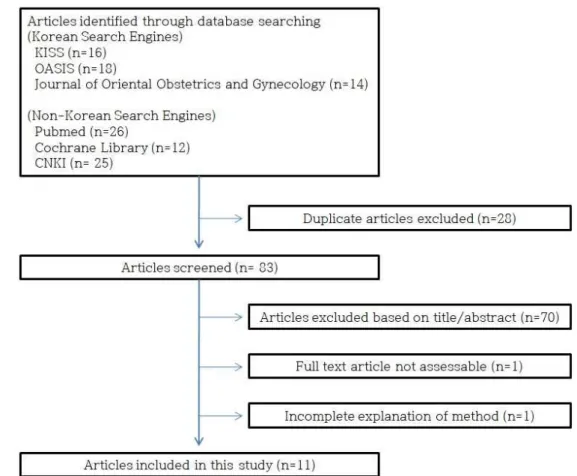
Fig. 1. Flowchart of selection process.
3. 최종 논문 선정
데이터베이스 검색을 통해 총 111편의 논문이 검색되었으며, 중복 논문 28편을
제외한 83편의 논문 중 제목과 초록을 통
해 산후 우울증 여성을 대상으로 한 무작
위대조군연구를 선별하였다. 그 결과 13편
의 논문이 선정되었고, 원문을 확인할 수 없는 논문 1편과 처치 방법에 대한 설명 이 불충분한 논문 1편을 제외한 11편의 논문이 최종적으로 선정되었다(Fig. 1).
Ⅲ. 결 과
1. 발표 연도 및 연구 국가에 따른 분류 최종 선정된 논문을 연도별로 살펴보면 2010년에는 3편, 2011년에는 1편, 2012년 에는 2편, 2014년에서 2016년까지는 각각 1편씩, 2017년에는 2편 발표되었다. 국가 별로 분류해보면 11편 중 1편은 홍콩, 10 편은 중국에서 시행된 연구였다.
2. 연구 디자인에 따른 분류
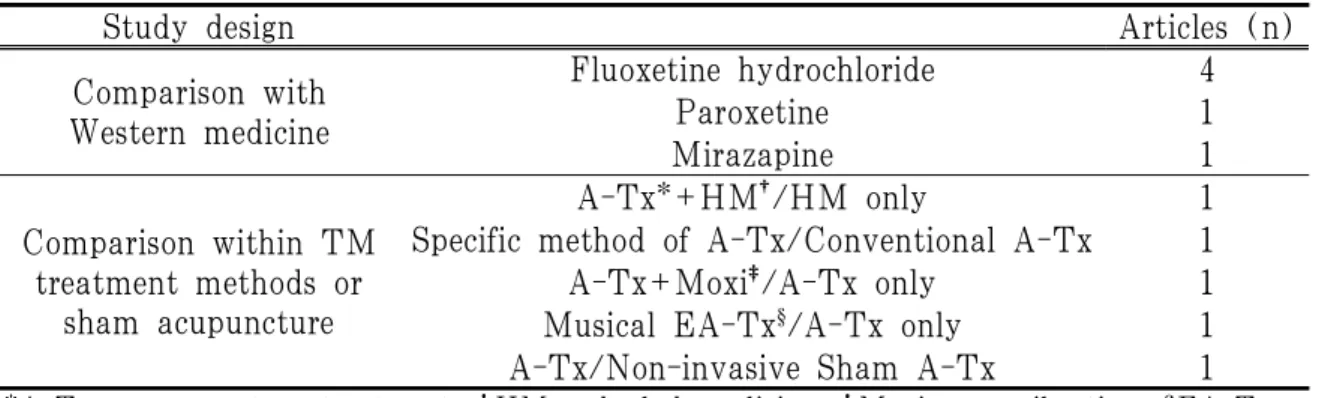
논문 중 양약의 효능과 비교한 연구는 총 6편으로, fluoxetine hydrochloride과 비 교한 논문이 4편, paroxetine과 mirazapine 과 비교한 연구가 각각 1편씩이었다. 한 의학적 처치간 혹은 가침치료와 효능을 비교한 연구가 총 5편으로, 귀비탕과 함께 평형침법의 효능을 평가한 연구가 1편, 일반 침치료와 疏肝調神침법을 비교한 연구가 1편, 침치료와 함께 간접구의 효 능을 평가한 연구가 1편, 침치료와 음악 전침치료를 비교한 연구가 1편, 침치료와 비침습적가침치료를 비교한 연구가 1편 이었다(Table 1).
Study design Articles (n)
Comparison with Western medicine
Fluoxetine hydrochloride 4
Paroxetine 1
Mirazapine 1
Comparison within TM treatment methods or
sham acupuncture
A-Tx*+HM † /HM only 1 Specific method of A-Tx/Conventional A-Tx 1 A-Tx+Moxi ‡ /A-Tx only 1 Musical EA-Tx § /A-Tx only 1 A-Tx/Non-invasive Sham A-Tx 1
*A-Tx : acupuncture treatment, †HM : herbal medicine, ‡Moxi : moxibustion, §EA-Tx : electroacupuncture treatment