⋅Corresponding author: Mi-Sook Shin, Department of Rebabilitation Medicine, Pusan National University Korean Medicine Hospital, 20, Geumo-ro, Mulgeum-eup, Yangsan 626-789, Korea
Tel: +82-55-360-5555, Fax: +82-55-360-5519 E-mail: [email protected]
⋅Received September 4, 2012, Revised December 17, 2012, Accepted December 18, 2012
This work was supported by 2012 Pusan National University.
Hospital Clinical Research Grant.
요추 추간판 탈출증의 한의학적 치료에 대한 국내연구동향
조형준1ㆍ설재욱2ㆍ신미숙3
1부산대학교 한의학전문대학원, 2청연한방병원, 3부산대학교 한방병원 한방재활의학과
Research Trends on the Treatment of Lumbar Herniated Intervertebral Disc in Korean Medicine
Hyoung-Jun Cho1, Jae-Uk Sul2, Mi-Sook Shin3
1School of Korean Medicine, Pusan National University, 2Chung-Yeon Oriental Hospital,
3Dept. of Rebabilitation Medicine, Pusan National University Korean Medicine Hospital
Abstract
Objectives : To research trends of studies on treatments of lumbar herniated intervertebral disc in Korean medicine.
Methods : We searched papers using Korean Traditional Knowledge Portal, OASIS, KISS. We used “low back pain”, “radiculopathy”, “lumbar herniated intervertebral disc” as keyword.
Limitations were as follows; Domestic studies, published from 2000 to 2011, mentioning the treatments of lumbar herniated intervertebral disc in Korean medicine. This study researched and classified the papers according to the fields of the treatment and methods of study.
Results : The results were obtained as below ; 1. The number of papers published in 2000 was only three, but steadily increased to 15 in 2010 and the total number of papers was 93. 2.
When categorized according to the fields of treatment, 93 researches are classified as acupuncture, moxibustion, Chuna therapy, drug, various physical therapies and collaborative Oriental-Western medicine therapy. 3. When categorized according to the methods of study, 70 researches were the simple case report and non-RCT(non-randomized controlled trial) were 11 and RCT(randomized controlled trials) has been reported in 11 researches. 4. General assessment tools were VAS, ODI before, however these days, Physical examination(ROM, SLRT, etc.), Radiologic tests(MRI, X-ray), DITI etc. are used more in order to evaluate objective therapeutic effects.
Conclusions : These results indicate that researches on lumbar herniated intervertebral disc in Korean medicine have been investigated by various method and steadily increasing.
Key words : low back pain, radiculopathy, lumbar herniated intervertebral disc
I. 서 론
급만성 요통은 일상생활을 수행하는 데에 많은 영향을 미치는데, 그 원인은 매우 다양하다1). 근육 과 인대 손상에 의한 염좌와 같은 일반적인 요통 의 이환율은 50~80%이며, 신경병증에 의한 하지 방사통을 동반한 요통의 이환율은 10~15% 내외이
Fig. 1. Flow chart of the trials selection proess.
다1). 하지방사통을 동반한 요통은 낮은 이환율에도 불구하고 일반적인 요통에 비해 유병 기간이 길고, 통증으로 인한 불편감이 크며 수술적인 처치 이후 에도 후유증이나 부작용이 커서 치료와 재활에 긴 시간이 소요되므로 하지방사통을 동반한 요추 추 간판 탈출증의 보다 효과적인 치료를 탐색하기 위 한 많은 연구가 행해지고 있고 그 중요성 역시 지 속적으로 제기되고 있다2).
요추 추간판 탈출증은 주로 하위 요추부 추간판 의 퇴행성 변화나, 외력에 의해서 섬유륜의 중앙, 내측 또는 외측섬유의 파열로 수핵의 일부 또는 전부가 탈출을 일으켜 경막이나 신경근을 압박하 여 신경증상을 유발하는 질환이다2,3). 치료는 크게 수술적 치료와 비수술적 치료로 나눌 수 있으며, 후자가 80~90% 정도의 치료율을 보이는 것으로 알려져 있어서, 대표적인 보존치료인 한의학적 접 근법에 관심이 증대되고 있다4).
추간판 탈출증에 대한 한의학적 치료에는 침구 치료, 약물치료, 침도요법, 약침요법, 봉독요법, 추 나요법, 한방물리요법 등이 있으며 이 치료법들은 임상에서 복합적으로 적용되거나 현대의학적 치료 와 병행되는 한양방 협진의 형태로 이루어지는 경 우가 흔하다. 본 연구에서는 2000년부터 2011년까 지 국내 주요 한의학 학술지에 게재된 요추 추간 판 탈출증의 한의학적 치료와 관련된 최근의 임상 연구들을 치료분야별로 분류하고 그 연구 경향을 분석하여 약간의 지견을 얻었기에 아래와 같이 보 고하는 바이다.
II. 문헌검색
2000년에서 2011년까지 국내 주요 한의학 학술 지에 게재된 논문들 중에서 요통, 그 중에서도 요 추 추간판 탈출증과 관련된 한의학 논문을 검색하 여 수집하고, 치료유형, 연구형태, 평가도구 등을 비교 분석하여 정리하였다. 구체적으로 자료를 검 색하여 분류한 방법은 다음과 같다.
국내 논문 검색 DB는 한국 전통지식 포탈 (Korean Traditional Knowledge Portal) 및 전통의 학정보포탈(OASIS), 한국학술정보(주)(KISS) 등 3개의 인터넷 사이트를 이용하여 국내에서 발표된
논문을 검색하였다. 검색어로는 ‘추간판’ 뿐아니라, MeSH 검색을 통해 요추 추간판 탈출증에서 병발 되는 요통(low back pain)과 방사통(radiculopa- thy)을 검색어로 하였으며, 검색 민감도를 높이기 위해 배통(back pain)까지 추가로 검색을 시행하였 다.
각 DB에서 1차 검색된 논문 중 2차로 요추 추 간판 탈출증의 한의학적 치료와 관련된 논문 93편 만을 선별하고, 선별된 논문들에 대해, 연구 분야 에 따라 크게 침치료 연구, 뜸치료 연구, 약물치료 연구, 추나 연구, 복합한방치료 연구, 한양방 협진 치료 연구, 기타 연구로 나누어 비교 분석하였으며, 연구 방법에 따라 단순 증례보고(case report), 무 작위 대조군 임상연구(RCT; randomized con- trolled trials), 비무작위 대조군 임상연구(non- RCT)로 분류하여 정리하였다.
III. 연구내용 1. 게재년도 및 학회지분석
2000년부터 2011년까지 검색된 논문은 총 93편이 었다. 연도별 발표 게재된 논문 개수에서 2000년 3 편에 불과하던 논문의 수가 해마다 증가추이를 보 이며 조금씩 증가해 2010년에는 15편으로 요추 추 간판 탈출증의 한의학적 치료에 대한 연구자들의 관심이 증가한 것으로 평가될 수 있다.
또한 최종 선별된 논문 93편은 국내 주요 학술 지에 게재되어 있었는데, 대한침구학회지가 32편으 로 가장 많았으며, 척추신경추나의학회지가 27편으 로 그 뒤를 이었다. 한방재활의학과학회지 12편, 대 한약침학회학회지 5편, 한방척추관절학회지 4편, 대
Title(year) Form Case
number Evaluation index Remark
Cho et al. (2007)5) Case report 3 VNRS, Work Time M.S.T.
Jang et al. (2003)6) Case report 30 SLRT, ADF, APF Scalp Acup.
Han et al. (2005)7) Case report 1 SLRT, Bragard Test Sa-am / Dongssi
Chae et al. (2001)8) RCT 29 VAS Body
Acup.
Yun et al. (2001)9) Non-RCT 30 Grade 4 A-Shi
Point.
Jang et al. (2007)10) Case report 1 VAS, Cobb's angle, lower leg length
A-Shi Point.
Yun et al. (2010)11) RCT 30 VAS, ODI Sa-am / Banggwang- jeonggyeok
Jang et al. (2002)12) RCT 29 EVA, VAS EVA(Meridian) Yun et al. (2010)13) RCT 63 VAS, ODI, Odem's degree Acupotomy Jang et al. (2008)14) Case report 1 SLRT, PRS, ODI Acupotomy Kyak et al. (2008)15) Case report 4 VAS, ODI, 5-point likert scale Acupotomy
Lee et al. (2008)16) Case report 3 VAS Acupotomy
ADF : Ankle dorsiflextion, APF : Ankle plantarflextion, DITI : Digital infrared thermal imaging, EAV: Electro- acupuncture according to voll, M.S.T : Motion style treatment, ODI : Oswestry disability index, PRS : Pain rating score, ROM : Range of motion, SLRT : Straight leg raising test, VAS : Visual analog scale, VNRS : Verbal numerical rating scale.
Table 1. Acupuncture Clinical Research List
0 2 4 6 8 10 12 14 16
2000 2001 2002 2003 2004 2005 2006 2007 2008 2009 2010 2011
Fig. 2. Number of clinical research for treatment of Korean medicine in lumbar herniated intervertebral disc.
전대학교 한의학연구소 문헌집 2편, 대한스포츠한 의학회지 2편이 게재되었다. 그 외에도 경락경혈학 회지, 경원대학교한의학연구소논문집, 대한한방내 과학회지, 대한한의학회지, 동의생리병리학회지, 복 치의학회지, 사상체질의학회지, 세명대학교한의학 연구소논문집, 한방성인병학회지 등에 각 1편씩 게 재되어 있었다.
2. 연구 분야에 따른 분석
연구 분야에 따른 분석에서 침, 뜸, 추나, 각종 물리요법 등을 병행 치료한 한의학적 보존 치료법 의 요추 추간판 탈출증에 대한 유효성 평가 연구 가 34건(35%)으로 가장 많았고, 침연구 31건 (33%), 추나요법 14건(15%), 뜸연구 3건(3%) 약
Title(year) Form Case
number Evaluation Index Remark
Song et al. (2009)21) RCT 30 VAS, SLRT Soyeom
Choi et al. (2007)22) Case report 1 VAS, ROM, SLRT, Bragard Test Carthami Flos Go et al. (2002)23) Case report 20 DITI, SLRT, ODI, VAS Scolopendrid Kim et al. (2004)24) Case report 50 VAS,ODI,ROM, SLRT Scolopendrid Go et al. (2003)25) Case report 70 DITI, SLRT, ODI Scolopendrid
Jeon et al. (2011)26) RCT 20 NRS, ODI ShinBaro
Kim et al. (2005)27) Non-RCT 30 VAS, ODI Bee Venom
Bae et al. (2002)28) Non-RCT 24 SLRT, Grade 5 Bee Venom Yoon et al. (2000)29) Case report 1 VAS, SLRT, ROM Bee Venom
You et al. (2006)30) RCT 35 SLRT, VAS, ODI Bee Venom
Cha et al. (2004)31) Non-RCT 29 VAS, ODI Bee Venom
Yoon et al. (2006)32) Case report 1 MRI, X-ray Bee Venom Lim et al. (2002)33) Case report 1 DITI, MRI, X-ray Bee Venom
Cha et al. (2006)34) Non-RCT 18 VAS, ROM Bee Venom
Chun et al. (2003)35) Case report 20 VAS, PRS, DITI Bee Venom Lee et al. (2004)36) Case report 20 VAS, Grade 5 Bee Venom Lee et al. (2001)37) Case report 1 VAS, ROM Bee Venom Sin et al. (2011)38) RCT 34 VAS, Aberdeen LBP scale Bee Venom
Lee et al. (2003)39) Case report 1 MRI Bee Venom
DITI : Digital infrared thermal imaging, LBP : Low back pain, M.S.T : Motion style treatment, NRS : Numerical rating scale, ODI : Oswestry disability index, PRS : Pain rating score, ROM : Range of motion, SLRT : Straight leg raising test, VAS : Visual analog scale.
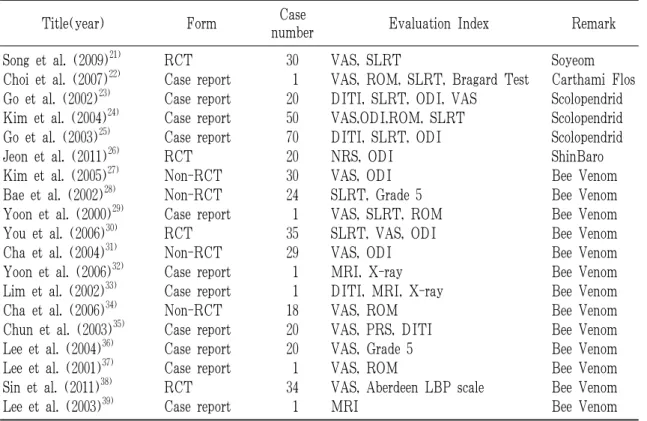
Table 2. Pharmacopuncture Clinical Research List
물연구 1건(1%)의 순이었으며, 한양방 협진 3건 (3%), 기타 연구도 8건이었다. 치료방법에 따른 세 부적 연구내용은 아래와 같다.
1) 침치료 연구
침치료에 관련된 연구는 31건으로 일반 침치
료5-12)에 관한 연구가 8건, 침도요법13-16)에 관한 연
구가 4건이었다. 특히 침도요법의 경우 4건 모두 2008년 이후의 문건으로 3건의 증례보고14-16)가 2008년에 게재되었고, 2010년에는 RCT 임상연구논 문13)이 게재되어 최근에 주목받는 시술로 유추될 수 있다. 일반 침치료에 관한 연구는 일반 침치료12) 의 효과에서부터 동작침법(MST; Motion Style Treatment)5), 두침법6), 사암침법7,11), 동씨침법7), 체질침8), 아시혈9,10)에 관한 연구 등으로 다양했으 며, VAS나 ODI 등의 여러 평가도구를 통해 치료
효과를 객관적으로 측정한 결과 치료종료 후 증세 가 호전되었음을 보고하고 있었다.
약침에 관한 연구는 19건으로 봉독약침27-39) 연 구가 13건, 소염약침21), 홍화약침22), 오공약침23-25)이 각각 3건, 신바로약침26)이 1건 보고되었다. 요추 추 간판 탈출증 치료에는 봉독약침이 가장 많이 사용 되고 있었으며, VAS감소, ROM증가 등의 다양한 평가 척도의 개선이 있었다. 이 중 RCT 임상연구 는 2009년 소염약침에 대한 연구와 2011년 신바로 약침에 대한 연구가 있었으며, 2006년30), 2011년38) 에는 봉독약침에 대한 RCT 임상연구도 보고되었 다.
2) 뜸치료 연구
뜸치료 연구는 1건의 증례보고(case report)19)와 2건의 RCT 임상연구17,18) 등 총 3건이 보고되었다.
Title(year) Form Case number Evaluation index Remark
Lee et al. (2011)17) RCT 95 NRS, ODI Sinseon
Kim et al. (2011)18) RCT 32 VAS, ODI Indirect
Park et al. (2007)19) Case report 1 VAS, SLRT, Sit Time Direct NRS : Numerical rating scale, ODI : Oswestry disability index, SLRT : Straight leg raising test, VAS : Visual analog scale.
Table 3. Moxibustion Clinical Research List
Title(year) Form Case
number Evaluation index Remark Lee et al. (2007)40) Case report 3 VAS, ODI Spine
Decompression Sin et al. (2009)41) Case report 1 VAS, SLRT, ODI, ROM Kyungkuen
Chuna
You et al. (2004)42) Case report 1 VAS, SLRT Flexion Distraction Tech Kim et al. (2006)43) Case report 1 VAS Flexion Distraction Tech Kim et al. (2003)44) Non-RCT 30 VAS, ODI Chuna
Lee et al. (2007)45) Non-RCT 30 VAS, Grade 5 Chuna.
Hwang et al. (2007)46) Case report 2 VAS Mckenzie Method Kim et al. (2006)47) Case report 3 VAS Mckenzie
Method Pil et al. (2009)48) Non-RCT 6 VAS, ODI Decompression Won et al. (2007)50) Case report 15 VAS, RDQ Decompression Park et al. (2008)51) Case report 1 VAS, Modified Rathel Index Chuna Jung et al. (2006)52) Case report 1 VAS, MRI Chuna Kim et al. (2010)53) Case report 7 VAS, ODI Decompression
DITI : Digital infrared thermal imaging, M.S.T : Motion style treatment, ODI : Oswestry disability index, RDQ : The Roland-Morris disability questionnaire, ROM : Range of motion, SLRT : Straight leg raising test, VAS : Visual analog scale.
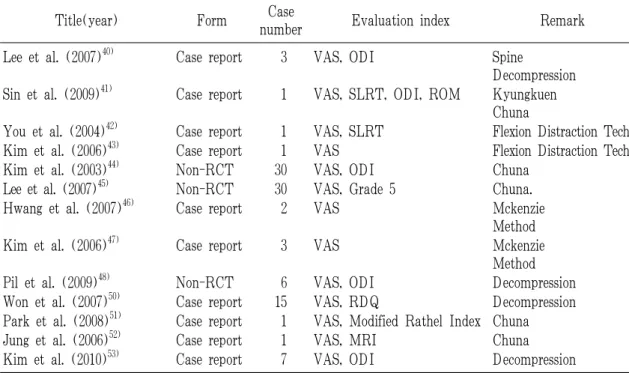
Table 4. Chuna therapy Clinical Reserach List
RCT 임상연구는 모두 2011년에 보고된 것으로 요 추 추간판 탈출증에 관한 뜸치료의 효과가 최근에 와서야 보다 관심있게 다루어지고 있음을 알 수 있었다. 뜸치료를 제외한 다른 한의학적 치료를 수 행한 대조군에 비해 RCT 임상연구 2건 모두에서 뜸치료가 유의한 치료효능을 보인 것으로 보고되 었고 연구에 선정된 뜸치료의 종류는 신선구법17), 간접구법18), 직접구법19) 등으로 다양하였다.
3) 약물치료 연구
2000년 이후 요추 추간판 탈출증 치료에 대한 여러 보존적 치료를 병행하는 논문에 비해 단독 약물의 효능 검증 문건20)은 딱 1건 있었다. 내용은 十棗湯 투약을 통한 증례보고로 호전 치험례 5예 에 대한 임상 관찰 보고서였다.
Title(year) Form Case
number Evaluation index Remark Lyu et al. (2009)91) Case report 5 VAS, RMDQ Sling exercise Ban et al. (2010)92) Non-RCT 74 ODI, SF-36, VAS Smoking Kim et al. (2004)93) Case report 1 VAS, DITI Soeumin patient Yang et al. (2010)94) Case report 40 VAS, Grade 4 Sling exercise Jang et al. (2006)95) Case report 1 VAS Patient undergoing Park et al. (2010)96) Case report 1 VAS, ODI, RMDQ Pregnant
Cho et al. (2006)97) Case report 1 VAS, ROM, SLRT Taping therapy Cho et al. (2003)98) Case report 1 VAS Rainbow therapy DITI : Digital infrared thermal imaging, ODI : Oswestry disability index, ROM : Range of motion, RMDQ : The Roland-Morris disability questionnaire, SLRT : Straight leg raising test, VAS : Visual analog scale.
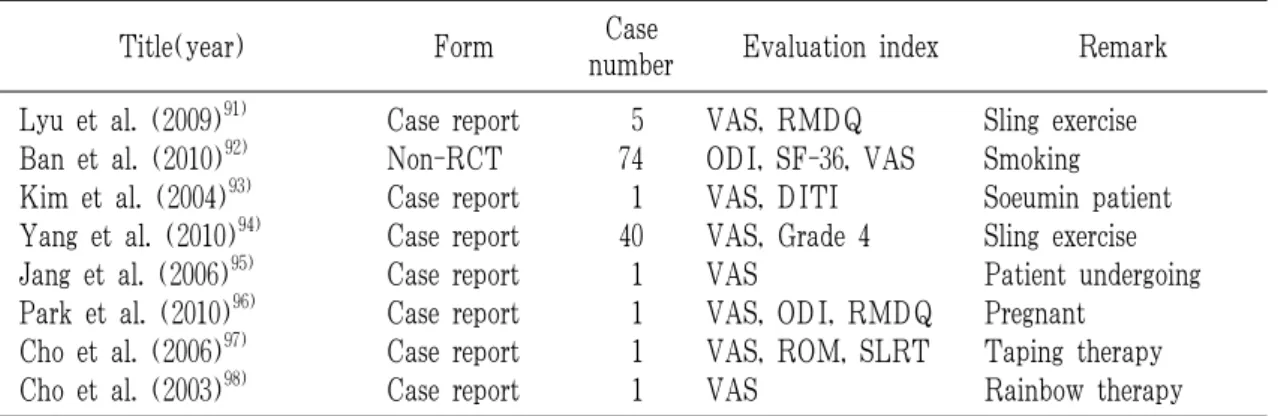
Table 5. Others Clinical Reserach List
4) 추나 연구
요추 추간판 탈출증의 치료에 많이 사용되는 것 으로 알려져 있는 추나요법40-53)에 대한 문건은 14 건이었다. 단순 임상보고(case report)의 형태가 대 부분이었으며, Non-RCT 임상연구44,45,48)는 3편 있 었으나, RCT 임상연구는 한 건도 보고되지 않았 다. 대신 감압요법40,49,50,53)
에 관한 연구가 많았으며, 골곡신연기법42,43,45), 요추신연고정법44), Mckenzie46,47) 에 관한 연구, 감압요법과 일반적 추나요법과의 비 교연구48) 등이 있었다.
5) 한의학적 병행치료 연구
요추 추간판 탈출증의 한의학적 치료에 대한 임 상보고 형식의 증례보고54-87)는 34건이었으며, 특정 한 한의학적 치료에 대한 연구가 아닌 여러 병행 치료의 효능을 보고하는 연구들이었다. 치료법으로 는 침, 전침, 약침, 약물, 뜸, 추나, 한방물리요법 등 을 환자의 증상에 따라 다양하게 적용한 후, 이러 한 보존적 치료법의 유효성 여부를 평가하였다.
2000년 이후 요추 추간판 탈출증에 대한 이러한 증 례보고 34건의 증례의 총합은 639예였으나 각 증례 의 정황이 달라 증례를 통합한 객관적인 결과로서 의 효과성을 언급하기에는 어려움이 있었다.
6) 한양방 협진치료 연구
요추 추간판 탈출증의 한양방 협진치료에 대한
문건은 3건으로 2000년88,90)에 2건, 2010년89)에 1건 의 보고가 있었으며, 한약과 양약을 복합처방했을 때의 효능을 비교 분석한 결과 단독처방에 비해 복합처방이 보다 우수한 치료 효능을 보인다고 하 였다.
7) 기타 연구
요추 추간판 탈출증에 관한 여러 임상연구 중에 는 전통적인 한의학적 치료 효능 이외에 슬링치료 효과에 관한 연구91,94), 흡연과의 상관성 연구92), 사 상의학을 활용한 임상보고93), 추나 치료 후 악화된 임상보고95), 임신환자에 대한 연구96), 테이핑치료법97) Rainbow요법98) 등이 있었다.
3. 연구방법에 따른 분석
검색된 93편의 논문을 연구방법에 따라 분류해 보면 증례보고가 71편으로 가장 많았으며, Non- RCT와 RCT 임상연구가 각각 11편 발표되었다.
치료 주제에 따른 체계적 문헌고찰 연구는 없었다.
전체의 75%에 해당하는 증례보고 문헌은 1예 보고 부터 193예의 증례를 모아 발표한 다례보고까지 다 양하였으며, 2000년 발표된 증례의 총수는 958예였 으나, 치료방법과 환자의 병정이 다양하여 표준화 된 연구에는 적합하지 않을 것으로 생각된다.
일반 침치료 등의 일반적인 한의학적 치료군을 대조군으로 설정하고, 이러한 치료에 부가적으로
Title Total
participants Trial group n Control group n Outcome measure(p value) Cha
et al. (2006)34)
18 BVP 10 MA 8 VAS, ROM(p<0.05)
Bae
et al. (2002)28)
24 BVP 12 MA 12 SLRT, Grade 5(p<0.05)
Kim
et al. (2003)44)
30 Chuna+CT 15 CT 15 VAS, ODI(p<0.05)
Ri
et al. (2007)45)
30 Chuna+CT 15 CT 15 VAS(p<0.05)
Ban
et al. (2010)92)
74 Smoking 40 Non-smoking 34 ODI, SF-36, VAS(p<0.05) Pil
et al. (2009)48)
6 Chuna 3 COMT 3 VAS, ODI(p<0.05)
Cha
et al. (2004)31)
29 BVP+MA 16 MA 13 VAS, ODI(p<0.05)
Kim
et al. (2005)27)
30 Proximalacupoints 15 Distal acupoints 15 VAS, ODI(p>0.05) Li
et al. (2000)88)
60 Western+KM 33 KM 27 Grade 4(p<0.05)
Li
et al. (2010)89)
18 Western+KM 9 KM 9 VAS, PRS, DITI(p<0.05) Yun
et al. (2001)9)
30 Ah-Shi Points+MA 15 MA 15 Grade 4(p<0.05)
BVP : Bee venom pharmacopuncture, COMT : Compressing therapy, CT : Conservative treatment, DITI : Digital infrared thermal imaging, KM : Korean medicine, MA : Manual acupuncture, ODI : Oswestry disability index, PRS : Pain rating score, ROM : Range of motion, SLRT : Straight leg raising test, VAS : Visual analog scale.
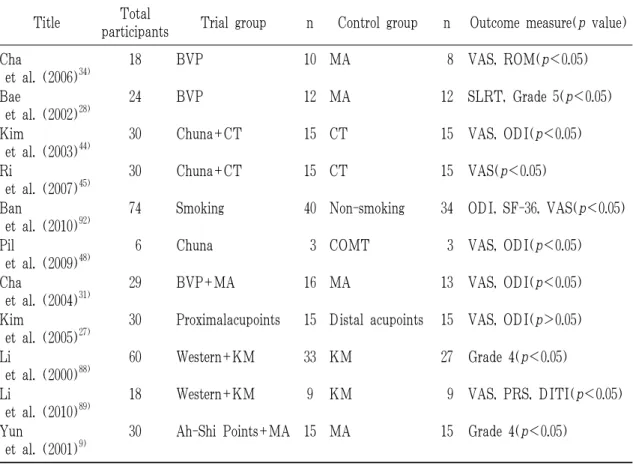
Table 6. Characteristics of Reviewed Non-RCTs of Korean Medicine for the Lumbar Herniated Inter- vertebral Disc
약침21,26,28,31,34)
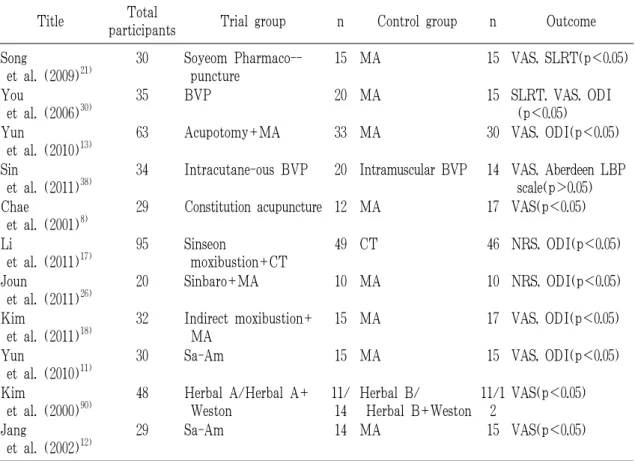
, 뜸17,18), 추나요법44,45,48), 침도요법13), 아시혈치료9) 등을 추가로 시행한 연구에서 모두 유의한 치료효과를 보였으며, 일반 침치료군을 대 조군으로 설정하고 효능을 비교한 사암침11,12),
약침26,30)치료군 또한 대조군에 비해 유의한 치료
효능을 보였다. 한의학적 치료만을 수행한 대조군 에 비해 한양방 협진88,89)치료를 수행한 치료군 역 시 유의한 치료효능을 보여주었다. 다만, Non- RCT 임상연구로 시행된 원위취혈에 대한 근위취 혈의 효능27)비교와 RCT 임상연구로 시행된 봉독 약침에 대한 피내주사와 근육내 주사와의 효능34) 비교연구는 치료 효능면에서 유의성 있는 차이가 없었다. 각 논문들은 다양한 평가 척도를 활용하여
대조군에 대한 실험군의 치료 효능을 보여주었으 나, 각각의 논문들은 각 논문마다 평가 척도가 다 르고, 평가척도가 같다 하더라도 개별 논문마다 정 의를 달리하여 적용하는 문제점이 있었다.
4. 평가척도 분석
평가척도는 크게 요추 추간판 탈출증을 진단하 기 위한 척도와 한의학적 치료 후 치료의 정도를 정량적으로 나타내기 위한 평가척도로 나눌 수 있 는데, 여기서 말하는 평가척도란 후자를 의미한다.
본 논문에서 비교 분석된 임상연구에서는 여러 가 지 다양한 평가척도(evaluation index)가 요추 추간
Title Total
participants Trial group n Control group n Outcome Song
et al. (2009)21)
30 Soyeom Pharmaco-- puncture
15 MA 15 VAS, SLRT(p<0.05) You
et al. (2006)30)
35 BVP 20 MA 15 SLRT, VAS, ODI
(p<0.05) Yun
et al. (2010)13)
63 Acupotomy+MA 33 MA 30 VAS, ODI(p<0.05)
Sin
et al. (2011)38)
34 Intracutane-ous BVP 20 Intramuscular BVP 14 VAS, Aberdeen LBP scale(p>0.05) Chae
et al. (2001)8)
29 Constitution acupuncture 12 MA 17 VAS(p<0.05) Li
et al. (2011)17)
95 Sinseon
moxibustion+CT
49 CT 46 NRS, ODI(p<0.05)
Joun
et al. (2011)26)
20 Sinbaro+MA 10 MA 10 NRS, ODI(p<0.05)
Kim
et al. (2011)18)
32 Indirect moxibustion+
MA
15 MA 17 VAS, ODI(p<0.05) Yun
et al. (2010)11)
30 Sa-Am 15 MA 15 VAS, ODI(p<0.05)
Kim
et al. (2000)90)
48 Herbal A/Herbal A+
Weston
11/
14
Herbal B/
Herbal B+Weston 11/1
2
VAS(p<0.05) Jang
et al. (2002)12)
29 Sa-Am 14 MA 15 VAS(p<0.05)
BVP : Bee venom pharmacopuncture, CT : Conservative treatment, LBP : Low back pain, MA : Manual acupuncture, NRS : Numerical rating scale, ODI : Oswestry disability index, SLRT : Straight leg raising test, VAS : Visual analog scale.
Table 7. Characteristics of Reviewed RCTs of Korean Medicine for the Lumbar Herniated Intervertebral Disc
판 탈출증의 한의학적 치료의 유의성 여부를 판단 하는 지표로 각각 다르게 사용되었다. 가장 많이 사용된 평가척도는 VAS(Visual Analog Scale)이다.
VAS는 통증에 대한 평가를 환자의 주관에 따라 시행하기 위하여, 간단한 구조와 사용하기 편리함, 짧은 평가 시간 등의 장점으로 연속적으로 통증을 측정할 때 가장 많이 사용된다40). 통증 강도의 변 화뿐만 아니라 시간, 빈도, 동작의 값들 중 어떠한 변화라도 예민하게 표현되며, 신뢰도가 높고 기록 하기 용이하여 임상적으로 유용한 PRS(pain rating score)35) 역시 여러 편의 논문에서 사용하였 다. 또한 spinal disorder에 condition-specific하게 사 용되는 요통 평가 도구인 ODI(Oswestry disability
index)26)와 24개의 설문항목으로 되어 있는 RMDQ(the Roland-Morris disability question- naire)91)도 많이 사용되었는데, 특히 주로 일상생활 의 장애 개선 정도를 평가척도인 ODI는 VAS만큼 이나 각종 논문에서 요추간판 탈출증의 치료효과 를 검증하기 위한 지표로 많이 활용되고 있었다.
이 외에도 환자의 주관적 통증의 정도를 평가하는 지표로서 통증의 정도를 환자로 하여금 0에서 10까 지의 숫자로 말하도록 하는 방법인 언어숫자통증 등급(VNRS : verbal numerical rating scale)5)과 삶의 질 평가 척도인 SF-3692)도 활용되었다.
환자의 주관적 평가와 다른 객관적 평가척도로 는 이학적 검사, 영상 의학적 진단도구, DITI
(digital infrared thermal imaging)99) 등이 사용되었 다. 이학적 검사에 대한 지표로는 SLRT(straight leg raising test)이 가장 많이 사용되었으며, ROM (range of motion), Bragard Test, Patrick sign 등 도 보조적으로 사용되었으며, 영상의학적 진단도구 인 MRI(magnetic resonance imaging), X-ray 등도 평가도구로 활용되어 보다 객관성을 확보하려는 시도가 있었다. 이 외에도 동통의 단계를 4나 5단 계로 나누어 표시하는 Grade 4, Grade 5, 그리고 도수근력검사(MMT : Manual Muscle Testing) 등 도 이용되었다.
IV. 고 찰
2011년 보건복지부의 한방 의료 이용 및 한약 소비 실태조사 결과발표에 따르면 40, 50, 60대 중 장년층이 한방 의료 기관을 가장 많이 이용하고 그 중에서도 요통 환자들의 이용률이 가장 높은 것으로 조사되었다100).
최근 요통을 비롯한 다양한 질환군에서 현대 의 학을 보완하는 대체 의학의 역할이 점차 늘어가는 가운데, 높은 수준의 의학적 근거를 구비한 대체 의학의 연구결과도 점차 많이 보고되고 있다. 본 논문에서는 2000년 이후 요추 추간판 탈출증으로 진단을 받은 환자들을 대상으로 한 한의학적 치료 의 최근 동향을 살펴봄으로서 지난 10여 년간의 성 과와 발전을 고찰하고, 요추 추간판 탈출증의 한의 학적 치료에 대한 연구의 방향을 제시함으로서 향 후 연구의 질적 향상을 도모하고자 하였다.
2000년부터 2011년까지 게재된 논문은 총 93편으 로 2000년 이후 꾸준히 증가 추세였으며, 논문의 형식을 살펴보면 71편의 논문이 증례보고 문헌이 며, non-RCT 임상연구와 RCT 임상연구가 각각 11편으로 총 22편이었다. RCT 임상연구는 기존의 한의학적 보존치료를 수행한 치료군과 기존의 치 료법에 봉독약침28,31,34), 추나요법44,45), 침도요법49) 등을 부가하여 치료하였을 때 치료효과가 더 유의 하게 나타나는지 여부를 알아보는 연구와 기존의 침법과 특정 침법을 비교해 보는 연구9), 봉독약침 의 근위취혈과 원위취혈의 효능차이를 비교하는 연구27), 양약과 한약을 병용했을 때의 효능을 비교
하는 연구88,89), 흡연군과 비흡연군의 비교연구92) 등 이 수행되었다. 2000년 이후 발표된 RCT 연구는 각 연구의 분석증례가 50명을 넘는 연구는 2편13,17) 에 불과했으며 100증례 이상을 비교분석한 논문 은 없었다. 나머지 50증례 이하로 연구된 논문 들8,11,12,18,21,26,30,38,90)
은 증례가 적어 확실한 유의성을 논하기에 미흡한 점이 있었다. 또한 치료기간 역시 9일18), 13일17), 14일26), 30일30) 등으로 대부분 짧고, 이후 환자 상태에 대한 추적 관찰이 제대로 이루 어져 있지 않아서 연구 설계상의 한계를 보여주었 다. 또한 보다 많은 증례의 실험군과 대조군, 보다 충분한 연구기간을 확보하여 환자의 치료경과를 치료시점부터 일정기간 후의 추이관찰까지 수행하 기 위해서는 다양한 기관의 연구 참여가 더욱 격 려되어야 할 것으로 사료된다.
치료 분야에 따른 분류에서는 침, 뜸, 약침, 봉 독, 추나, 한방 물리요법 등을 병행한 한의학적 보 존적 치료법이 요추 추간판 탈출증 환자에게 효능 이 있는지 여부를 보고하는 형태의 연구54-87)가 34 건으로 가장 많았고 다음으로는 침연구5-16,21-39)
31 건, 추나요법40-53) 14건, 뜸연구17-19) 3건, 약물연구20) 1건의 순이었으며, 한양방 협진연구88-90) 3건, 기타
연구91-98)도 8건으로 분류할 수 있었다.
가장 많은 증례보고는 복합적으로 한방치료를 시행하고 그 치료효과를 보고하는 형식의 연구로 총 34건이었고 증례 수로는 639예였다. 또한 치료 효과를 평가하는 방법에 대해서도 2000년 초반에는 통일되어 있지 않다가 점차 VAS나 ODI 등의 평 가도구를 공통적으로 사용하고 있었다. 다만, 연구 의 구체적인 시행방법이나 기술의 방법이 통일되 지 않고 각 연구에 사용된 진단기기가 MRI, X- ray, DITI 등으로 다양했으며 환자의 주관적 통증 의 정도를 나타내는 평가도구들이 주로 사용되어, 각 논문들 간에 일관되고 표준화된 결과를 도출하 기에는 무리가 많이 있어보였다.
보고된 31건의 침연구 중 19건이 약침 연구였으 며, 그중 13건27-39)이 봉독에 대한 연구로 요추 추 간판 탈출증 환자에게 봉독이 많이 사용되고 있음 을 알 수 있다. 봉독에 관한 2개30,38)의 RCT 연구 에서 봉독약침이 일반 침치료에 비해서는 유의성 있는 효능을 나타내었으나30), 봉독약침의 피내 주
사와 근육내 주사와의 효능을 비교하는 연구38)에서 는 유의성 있는 차이가 없는 것으로 보고되었는데, 이는 향후 봉독 연구에 참고할만한 사항이라 사료 된다. 약침의 효능을 검정하는 문건으로는 오공약
침23-25)이 3건 있었으며, 소염약침21), 홍화약침22), 그
리고 척추전문 한방병원의 청파전이라는 복합 처 방을 증류 추출한 신바로약침26)에 대한 연구가 각 각 1건씩 있었다. 약침이 아닌 일반 침치료에 대한
연구5-16)는 총 13건이었는데, 크게는 일반 침치료의
효능연구5-12)가 9건, 침도요법13-16)에 대한 연구가 4
건이었다.
침도요법은 1976년 중국의 북경 중의약대학 교 수였던 朱漢章이 한의학의 침법을 응용하여 만든 새로운 치료법으로, 조직의 유착을 박리하여 원래 의 동적 상태로 회복시켜 주고 병소 부위를 소통 시켜 기혈을 순조롭게 통하게 하는 시술16)인데, 2008년부터 꾸준히 보고되고 있어, 최근에 요추 추 간판 탈출증의 치료에 많이 시도되고 있으며, 그 효능도 꾸준히 보고되고 있는 것으로 보인다. 침치 료의 효능에 대한 연구는 증례보고5,6,7,10)가 4건, Non-RCT 임상연구9)가 1건, RCT 임상연구8,11,12)가 3건으로 지속적으로 활발하게 연구되고 있음을 알 수 있었다. 침법의 종류에 따라서도 동작침법 (MST)5), 두침법6), 사암침법7,11), 동씨침법7), 체질 침8), 아시혈9,10)연구 등이 있어서 요추 추간판 탈출 증을 치료하는 침치료의 효능 연구가 비교적 활발 함을 알 수 있었다. 다만, 아쉬운 점은 임상에서 많이 활용되는 전침에 대한 연구가 없었는데, 이는 향후 반드시 추가되어야 할 연구 분야로 생각된다.
또한 2001년 처음 출판된 STRICTA(STandards for Reporting Interventions in Clinical Trials of Acupuncture; 침 임상연구에서 중재 보고를 위한 표준) 보고지침은 침 관련 임상연구보고의 완벽성 과 투명성을 향상시켜 연구의 질적 향상을 담보토 록 하고 있다. 발표된 침연구 논문에서 각각의 논 문들이 저자마다의 기준에 의해 연구를 수행함으 로서 각 연구들의 통일된 치료효능을 검증하는데 한계를 드러내고 있기 때문이다. 통일된 연구규정 에 따른 체계적 연구가 시행될 때, 요추 추간판 탈 출증 환자의 한의학적 치료에 대한 가이드라인 구 축에 한걸음 더 가까이 다가설 수 있을 것으로 기
대해본다.
추나요법에 대한 연구40-53)도 14건이 있었는데, 그 중 감압요법에 관련된 연구40,48,49,50,53)
가 5건으로 비교적 활발히 연구되고 있었는데 감압요법이란 기존 견인치료의 문제점을 기술적으로 해결하여 특정 요추간판에 감압을 적용함으로써 그 치료효 과를 극대화한 치료법을 말한다. 대표적인 운동요 법인 Mckenzie식 운동요법은 단지 신전운동에만 국한되는 것이 아니라 몇몇 운동은 척추에 대한 고유수용성 인지를 증가 시키고 척추 주위 근육을 강화하는 것을 목표로 하고 있는데 이에 대한 연
구46,47)가 2건 있었다. 그 이외에, 굴곡신연기법에
의한 연구42-45) 3건, 요추신연고정법에 관한 연구44) 1건, 일반적인 추나치료에 대한 효능비교연구51,52)가 2건 더 있었다. 추나요법에 대한 논문은 대부분 2006년 이후의 것이었고, 추나요법에 대한 논문이 적지 않았음에도 불구하고 RCT 임상연구가 한 건 도 없었다. 이는 추나요법 치료에 대한 적절한 대 조군 설정의 어려움을 포함하여 연구방법 개발에 의 어려움 때문으로 사료된다.
한양방 협진에 대한 연구는 2000년88,90) 2건, 2010 년89) 1건으로 총 3건이 있었다. 3건의 연구 모두 한약과 양약을 병행 투여했을 때 효능을 보여주는 논문이었다. 2000년에 발표된 2건을 제외한다면 2001년 이후 지금까지 단 1건만이 보고된 것인데, 실제로 추간판 탈출증에 협진이 지속적으로 증가 하는 추세에 반하여 이에 관련된 협진 연구가 상 당히 부족한 실정임을 시사하고 있으며 향후 척추 질환에 대한 한양방 협진을 위한 협진 프로토콜 개발과 협진 모델 구축 등을 포함한 추가적인 연 구가 필수적으로 이루어져야 할 것으로 기대된다.
또한 본 논문에서 밝힌 것처럼 요추 추간판 탈 출증에 대한 한의학적 치료에는 침치료, 뜸치료, 추나요법, 약물치료 등 다양한 치료중재가 있고, 향후 양약과 한약의 병행치료의 효과뿐 아니라, 침, 뜸, 추나 등 다른 한의학적 치료법과의 병행치료 연구가 추가로 수행되어야 할 것이다. 이러한 추가 적 연구가 충분히 쌓여야만 협진에 대한 당위성을 협진 파트너인 현대의학 전공자들에게 전달하고 그럼으로써 보다 효율적인 협진이 이루어질 수 있 을 것이다.
뜸치료에 대한 연구17-19)는 3건이 있었는데 신선 구법17), 간접구법18), 직접구법19) 관련 연구가 각각 1건씩 있었다. 신선구법17)이란 <동의보감>의 십종 요통에 기재된 방법으로 환자의 상태에 따라 혈위 가 변하지 않는 구법이다. 3편의 논문에서 요추 추 간판 탈출증에 대한 뜸의 효능이 유의한 것으로 보이는 임상사례는 모두 128예였는데, 이는 요추 추간판 탈출증에 뜸치료가 꾸준히 시행되어 왔음 을 보여주는 수치이다. 다만, 뜸치료에 대한 연구 가 3건에 불과하여, 좀 더 객관적인 뜸치료의 효능 을 언급하려면 보다 많은 임상연구가 필요하다.
약물의 효능에 대한 단독 연구20)는 1건에 불과 했는데, 한의학 치료의 특성상 침, 뜸, 약물 뿐 아 니라 각종 물리요법까지 병행하여 환자를 치료하 기 때문에 약물에 대한 단독 치료의 효과를 보고 하고 있는 연구는 많지 않았던 것으로 사료된다.
요추 추간판 탈출증에 대한 기타 연구로는 슬링
치료91,94), 흡연과의 상관성 연구92), 사상의학 측면
에서의 임상보고93), 추나 치료 후 악화된 임상보고95), 임신환자에 대한 연구96), 테이핑치료법97), Rainbow 요법98) 등이 있었다.
본 연구는 최근 10여 년 동안의 국내에서 발표 된 논문만을 그 대상으로 수행하였으므로 연구대 상 설정에 있어서 범위상의 협소함으로 인한 한계 를 가지고 있다. 향후, 국외의 보다 다양한 연구들 을 모두 아우르는 후속 연구가 반드시 이루어져야 하며 그래야만, 요추 추간판 탈출증에 대한 보다 정확한 한의학적 치료법을 정립할 수 있을 것이라 생각된다.
V. 결 론
2000년부터 2011까지 보고된 요추 추간판 탈출 증의 한의학적 치료에 대한 임상연구를 수집하고 분석하여 아래와 같은 결과를 도출하였다.
1. 요추 추간판 탈출증에 대한 한의학 연구 보고는 2000년부터 해마다 증가하여 요추 추간판 탈출 증의 한의학적 치료에 대한 연구가 활성화되고 있는 것으로 보인다.
2. 치료방법에 따른 분류에서는 침, 뜸, 약침, 봉독, 추나, 각종 물리요법 등을 병행한 다양한 한의
학적 보존치료가 요추 추간판 탈출증 환자에게 효능이 있는지를 평가하는 임상 연구가 34건으 로 가장 많았고, 단독치료에 대한 보고로는 침 연구 31건, 추나요법 14건, 뜸연구 3건, 약물연구 1건의 순이었으며, 그 이외에 한양방 협진연구 3 건과 기타도 8건이 있었다.
3. 연구 유형에 따른 분류에서는 증례보고가 71건 이었으며 Non–RCT 임상연구가 11건, RCT 임 상연구가 11건이었다.
4. 평가지표에 따른 분류에서는 환자의 주관적 요 통의 정도를 평가하는 VAS, ODI가 가장 높은 빈도로 사용되었으며, 최근에는 치료에 대한 객 관적 효능을 평가하기 위한 이학적 검사(ROM, SLRT 등), 영상의학적 진단(MRI, X-ray), 체 열 촬영(DITI) 등이 사용되었다.
감사의 글
This work was supported by 2012 Pusan National University. Hospital Clinical Research Grant.
본 연구는 2012년 부산대학교병원 임상연구비 지원으로 이루어졌음.
참고문헌
1. Park CY, Moon JH. Rehabilitation medicine.
Seoul : hanmibook. 2008 : 908.
2. The Korean Academy of Oriental Rehabi- litation Medicine. Oriental Rehabilitation Me- dicine. Seoul : Koonja. 2011 : 56.
3. Orthopedics. The Korean Orthopaedic Associa- tion. Seoul : Recent medical history. 2006 : 623-5.
4. Saal JA, Saal JS. Nonoperated treatment of herniated lumbar intervertebral disc with radi- culopathy. An Outcom Study. 1989 ; 14(4) : 431-7.
5. Cho JH, Lee HE, Song JH, Moon JY, IM MJ, Gang I, et al. The clinical report on 3 cases of the patient of extruded disc treated
with motion style treatment. The Journal of Korean Society of Chuna Manual Medicine for Spine & Nerves. 2007 ; 2(2) : 131-40.
6. Jang SG, Kim YH, Kang JH, Kim JH, Lim YG, Lee H, et al. A clinical report on 30 cases with H.I.V.D by scalp acupuncture. The Journal of Korean Acupuncture and Moxi- bustion Society. 2003 ; 20(5) : 252-60.
7. Han JC, Song HS. The effect of sa-am acupuncture and dongssi acupuncture treat- ment on a HIVD patient. The Journal of the Association of the Spine & Joint Korean Medicine. 2005 ; 2(1) : 97-101.
8. Chae SJ, Kim NO, Park YC, Son SS.
Comparison of the improvement of subjective symptoms between body acupuncture group &
8 constitution acupuncture group. The Journal of Korean Acupuncture and Moxibustion Society. 2001 ; 18(3) : 48-55.
9. Yoon GB, Cho MLN, Jung H. The clinical study on the efficiency of the A-Shi point.
The Journal of Korean Acupuncture and Moxibustion Society. 2001 ; 18(1) : 226-36.
10. Jang JH, Jung JE, Park HH, Kim SH, Kim MC. A Clinical study of patient with lumbar herniation of intervertebral disc combined with functional scoliosis by treating Ah-Shi points of the muscles that induce unilateral pelvic obliquity. The Journal of the Korean Academy of Oriental Rehabilitation Medicine. 2007 ; 17(2) : 223-31.
11. Yoon KS, Lee H, Kang JH, Choi SY.
Comparison study on 30 cases of HIVD patients with restricted on SLRT by Sa-Am acupuncture Banggwangjeonggyeok and general acupuncture. The Journal of Korean Acupunc- ture and Moxibustion Society. 2010 ; 27(5) : 79-87.
12. Jang BS, Jin GS, Kim JU, Yang MB, Kim ID, Moon HC, et al. Clinical study on the remedial effect of oriental medicine used
EAV(Meridian). The Journal of Korean Acupuncture and Moxibustion Society. 2002 ; 19(6) : 80-96.
13. Yoon JY, Kim DH, Kim HU, Kim SS, Park SU, Kim EG, et al. The clinical effects of acupuncture and acupotomy therapy for HIVD. The Journal of Korean Acupuncture and Moxibustion Society. 2010 ; 27(4) : 85- 97.
14. Jang EH, Kim SC, Lim NL, Na WM, Lim SI, Sin JB, et al. Case study of oriental medicine treatment with acupotomy therapy of the herniated lumbar intervertebral disc patient. The Journal of Korean Acupuncture and Moxibustion Society. 2008 ; 25(4) : 171-81.
15. Gwak BM, Hong KU. Four case of HIVD- lumbar spine patient treated with acupotomy.
The Journal of Korean Acupuncture and Moxibustion Society. 2008 ; 25(4) : 149-56.
16. Lee GM, Kim DH, Kim HU, Yeom SC, Kim HS, Kim DE, et al. The study on the effect of acupotomy in lumbar HIVD. The Journal of Korean Acupuncture and Moxibustion Society. 2008 ; 25(4) : 183-90.
17. Lee SY, Park SH, Han SY, Park JY, Lee HJ.
A case-control study of the effect of cotreat- ment with sinseon moxibustion on low back pain of HIVD patients. The Journal of Korean Acupuncture and Moxibustion Society.
2011 ; 28(4) : 77-83.
18. Kim MS, Park SY, Choi US, Yoon GJ, Juen SC, Lee TH, et al. Clinical effects of indirect moxibustion treatment with general acupunc- ture on HIVD patients in comparison with general acupuncture only. The Journal of Korean Acupuncture and Moxibustion Society.
2011 ; 28(1) : 65-75.
19. Park SH, Jang SY, Cha JH, No JD, Lee EY.
A clinical study on lumbar herniation of inter- vertebral disc treated with direct moxibustion.
Semyung school literature of Oriental Medicine home. 2007 ; 10 : 17-24.
20. No UJ, Lee JH. A clinical study on 5 cases of herniated lumbar intervertebral disc treated with Sipjo-tang(Shizao-tang). The Journal of Bokchi Society. 2010 ; 2(1) : 25-41.
21. Song HG, Choi SY, Kang JH, Lee H. The effect of the acupuncture therapy in combination with soyeom pharmacopuncture therapy on the improvement of the symptoms of the patients with herniated intervertebral disk of L-spine in his initial stage of hospitalization. The Journal of Korean Phar- macopuncture institute. 2009 ; 12(4) : 111-8.
22. Choi SJ, Lee SH, Park JH. The case report about herniated inter-vertebral disc treated with pharmacopuncture therapy. Kyungwon University Journal of the Institute of Oriental Medicine. 2007 ; 11(1) : 109-20.
23. Go GH, Park SY, Choi HG, So GS, Hwang WJ, Lee GM, et al. Clinical study on treatment of HIVD of lumbar spine using Scolopendrid berbal acupuncture. The Journal of Korean Acupuncture and Moxibustion Society. 2002 ; 19(3) : 192-206.
24. Kim SN, Kim SC, Choi HG, So GS, Lim JA, Moon HC, et al. Clinical study on effect of scolopendrid aquacupuncture classified by the type of lumbar disc herniation. The Journal of Korean Acupuncture and Moxibustion Society : 2004 ; 21(5) : 79-99.
25. Go KH, Park SY, Choi HG, So GS, Hwang UJ, Hwang UJ, et al. The clinical study on treatment of HIVD of lumbar spine using Scolopendrid Herbal Acupuncture. The Journal of Korean Pharmacopuncture Institute. 2003 ; 6(1) : 19-32.
26. Jeon BC, Kim ES, Kim DS, Kim TH, Kim JY. Effectiveness of ShinBaro pharmaco- puncture on lumbar spinal herniated inter- vertebral disc : a randomized controlled trial.
The Journal of Korean Society of Chuna manual Medicine for Spine & Nerves. 2011 ; 6(2) : 109-19.
27. Kim GU, Seo BM, Yoon JS, Lee YK, Choi SH, Lee KM, et al. The comparison of bee venom herbal-acupuncture therapy between neighboring acupuncture points and neighbo- ring-remote acupuncture points on the treat- ment of lumbar spine herniation of nucleus pulpous. The Journal of Korean Acupuncture and Moxibustion Society. 2005 ; 22(6) : 181- 7.
28. Bae EJ, Jo HY, Jin JD, Sin MG, Han SG, Yang GY, et al. A clinical study carried out common acupuncture therapy and bee - venom acupuncture on HNP of L-spine. The Journal of Korean Acupuncture and Moxibu- stion Society. 2002 ; 19(1) : 54-64.
29. Yoon HS, Park DS. A case of the bee venom herbal acupuncture for the patients with severe pain and sciatica due to HIVD of L-Spine. The Journal of Society of Herbal Geriatric. 2000 ; 6(1) : 150-61.
30. You SM, Lee JY, Gwan GL, Lee HS.
Comparative study of acupuncture, bee venom acupuncture, and bee venom pharmacopuncture on the treatment of herniation of nucleus pul- pous. The Journal of Korean Acupuncture and Moxibustion Society. 2006 ; 23(5) : 39-54.
31. Cha SD, Jung SM, Kim GO, Kim GS, Kim NO. The comparison of effectiveness between acupuncture and its cotreatment with bee venom aqua-acupuncture therapy on the treatment of herniation of nucleus pulpous.
The Journal of Korean Acupuncture and Mo- xibustion Society. 2004 ; 21(1) : 149-58.
32. Yoon JI, Song HS. Clinical study on treat- ment of HIVD of lumbar spine 1 case using Bee-venom. The Journal of the Association of the Spine & Joint Korean Medicine. 2006 ; 3(1) : 103-7.
33. Lim JG, Cho GC, Park UN, Wang OH, Jang HS. A clinical study on the patient of sequestrated disc treated by bee venom therapy-according to a radiological change.
The Journal of Korean Acupuncture and Moxibustion Society. 2002 ; 19(6) : 256-63.
34. Cha JH, Jang SY, Lee TH, We JS, Lee EY.
The comparison of effective between acupunc- ture and bee venom acupuncture on the treatment of acute lumbar herniation of inter- vertebral disc. The Journal of Korean Phar- macopuncture Institute. 2006 ; 9(2) : 67-71.
35. Chun HJ, Hwang U, Kim JS, Nam SS, Kim YS. Clinical evaluation of herniation of nucleus purposus patients treated by Bee venom therapy. The Journal of Korean Acupuncture and Moxibustion Society. 2003 ; 20(5) : 63-72.
36. Lee GM, Lee GS, Youm SC, Jang JH, Yoon JY, Whang BC, et al. A clinical study of bee-venom acupuncture treatment on protru- sion disc patients. The Journal of Korean Acupuncture and Moxibustion Society. 2002 ; 21(5) : 13-25.
37. Lee BH, Kim CH, Sou JC, Yoon HM, Jang GJ, Song CH, et al. A case of the reduction of symptoms, but nochange on the CT scanning in HNP by oriental medical treat- ment added Mori cortex-Bee venom acupunc- ture. The Journal of Korean Pharmacopunc- ture institute. 2001 ; 4 : 17-25.
38. Sin WY, Lee SM, Kim JH, Kim SJ, Choi EJ, Jung TY, et al. Comparative study of effects on intracutaneous bee venom pharmacopunc- ture and intramuscular bee venom pharma- copuncture in lumbar disc herniation. The Journal of Korean Acupuncture and Moxi- bustion Society. 2011 ; 28(3) : 1-11.
39. Lee SH, Lee GM, Lee GS, Lee DY, Jang HH, Kim YJ. Case report on absorption of extruded disc in extrusion type HNP of
L-spine patient treared by oriental medicine treatment with Bee Venom acua-acupuncture therapy. The Clinical Journal of Korean Acupuncture and Moxibustion Society. 2003 ; 1 : 100-8.
40. Lee GH, Kim CY, Kim GY, Nam HW, Jung YH, Go YT. Case report of L-spine HIVD treated with spine decompression. The Journal of Korean Society of Chuna manual Medicine for Spine & Nerves. 2007 ; 2(1) : 39-47.
41. Sin JM, Kwang MS, Song YK. A case report on HIVD patient treated by conservative oriental medical treatment with kyungkuen chuna. The Journal of Korean Society of Chuna manual Medicine for Spine & Nerves.
2008 ; 3(1) : 83-94.
42. You S, Lee MJ. A Clinical case study using only flexion-distraction technique for reptured intervertebral lumbar disc. The Journal of The Korean Academy of Oriental Rehabilitation Medicine. 2004 ; 14(1) : 177-83.
43. Kim SJ, Min BG, Yoon IJ, O MS. A case report on the thoracic & lumbar disc and scoliosis treated by flexion-distraction tech- nique. The Journal of Korean Society of Chuna manual Medicine for Spine & Nerves.
2006 ; 1(2) : 73-80.
44. Kim JH, Cho ML, Chae WS. The clinical effects of chuna treatment for HNP. The Journal of Korean Acupuncture and Moxi- bustion Society. 2003 ; 20(3) : 229-37.
45. Lee GJ, Lee BE, Jang G, Song YG, Lim HH.
A clinical study on the effect of chuna to herniated lumbar disc patients. The Journal of Korean Society of Chuna manual Medicine for Spine & Nerves. 2007 ; 2(2) : 79-88.
46. Hwang HJ, Hou KH, Gm DH. Two cases on tortipelvis caused by lumbar disc herniation - using mckenzie method treatment. The Journal of Korean Society of Chuna manual Medicine for Spine & Nerves. 2007 ; 2(1) : 85-97.
47. Kim DP, Gm DH. Effects of mckenzie method treatment on functional lumbar sco- liosis by herniated lumbar disc ; three cases report. The Journal of the Korean Academy of Oriental Rehabilitation Medicine. 2006 ; 16(2) : 167-79.
48. Pil GH, Kim E, Song YS, Kim DE. Clinical Case report on comparison between 6 herniated lumbar disc patients which were divided into two groups each treated by decompression therapy and chuna treatment.
The Journal of Korean Society of Chuna manual Medicine for Spine & Nerves. 2009 ; 4(1) : 75-84.
49. Gwak SY, Gang SH. Survey results on utilization of oriental medicine and herbal consumption. Department of Health and Hu- man Services. 2011 ; 1 : 29-39.
50. Won SG, Park DS, Pil GH, Song YS, Koen YM, Park TY. The clinical effects of non sugical spinal decompression treatment on HIVD. The Journal of Korean Society of Chuna Manual Medicine for Spine & Nerves.
2007 ; 2(2) : 41-7.
51. Park HH, Jung JE, Jung WH, Kim MC. A clinical study of foot drop patient with herniated intervertbral lumbar disc treated by chuna & general oriental therapy. The Journal of Korean Society of Chuna manual Medicine for Spine & Nerves. 2008 ; 3(1) : 19-28.
52. Jung B, Jung SH, Lee JS. Magnetic resonance imaging follow-up study on the case of protruded lumbar intervertebral disc herniation through chuna therapy. The Journal of the Korean Academy of Oriental Rehabilitation Medicine. 2006 ; 16(3) : 149-57.
53. Kim E, Juen GS, Song YS. Case report of 7 herniated lumbar disc patients treated by decompression therapy and chuna treatment.
The Journal of Korean Society of Chuna manual Medicine for Spine & Nerves. 2010 ;
5(2) : 95-102.
54. Kang JH, Sang SG, Lim YG, Lee H, Lee HL.
The clinical study on 1 case of HNP patient with sequela of epidural block. Korean Oriental Medical Society. 2004 ; 25(1) : 213-9.
55. Kim SY, Lee H. Clinical study on 3 cases of HIVD patients recommended to a operation.
Daejeon University Oriental Medicine, In- stitute of Literature Home. 2006 ; 15(1) : 53-8.
56. Byoun EJ, Song HS, Lee SN, Kim GH.
Clinical studies on 5 cases of HIVD of lumbar spine with severe straight leg raising test. The Clinical Journal of Korean Acupuncture and Moxibustion Society. 2003 ; 1 : 62-70.
57. Kim ES, Han GW, Lee H, Jung HS, Lee HE, Cho JH, et al. Two cases of patients visiting with herniated intervertebral disc of lumbar spine showing symptoms opposed to radiolo- gical findings. The Journal of Korean Society of Chuna Manual Medicine for Spine &
Nerves. 2009 ; 4(2) : 185-96.
58. Hong SS, Jin ES. The case report of conservative treatment on failed back surgery syndrome. The Journal of Korean Society of Chuna Manual Medicine for Spine & Nerves.
2009 ; 4(2) : 163-72.
59. Lee JH, Min GS, Kim SY, Kim SJ. The case report on 3 case of conservative treatment on failed back surgery syndrome. The Journal of Korean Society of Chuna manual Medicine for Spine & Nerves. 2010 ; 5(2) : 57-68.
60. You GG, Park MJ, Jung IM, Yeom SL, Keon YD. A case report of oriental medical treatment for the left lower limb monoplegia after herniated intervertebral disc operation at L-spine. The Journal of the Korean Academy of Oriental Rehabilitation Medicine. 2011 ; 21(4) : 227-39.
61. Kim JH, Lee SM, Sin HY, Choi EJ, Kim SJ,
Jeng TY, et al. A clinical case study of patient that not improved foot drop after herniated intervertebral lumbar disc surgery.
The Journal of Korean Pharmacopuncture institute. 2011 ; 28(2) : 173-81.
62. Kim SJ, Lee H. The clinical study on 193 cases with herniated lumbar disc. Journal of the Institute of Oriental Medicine of Daejeon University. 2010 ; 19(1) : 119-28.
63. Lee EG, Choi EH, Lee JE, Jeon JH, Lee SW, Lee SM, et al. The clinical study on 137 cases of herniated lumbar disc patients. The Journal of Korean Acupuncture and Moxibustion Society. 2008 ; 25(3) : 127-38.
64. Nam JW, Kim WU, Han GW, Kim ES, Woo JH, Lee JS, et al. Clinical observation on 44 patients with lumbar herniated intervertebral disc treated by conservative oriental medical treatment. The Journal of Korean Society of Chuna Manual Medicine for Spine & Nerves.
2011 ; 6(2) : 71-8.
65. Yoon HS, Kim S, Ban HJ, Kim Y, Park WS.
The clinical reporf about the changes in MRI of 3 cases of herniated lumbar disc patients treated by conservative oriental medical treat- ment. The Journal of Korean Society of Sport of Oriental Medicine. 2010 ; 10(1) : 69-82.
66. Keon HJ, Park YH. Clinical study for patients with lumbar disc herniation on change of magnetic resonance imaging at one year after conservative treatment. The Journal of the Korean Academy of Oriental Rehabili- tation Medicine. 2011 ; 21(2) : 253-63.
67. Keon HJ, Jung HC, Kim HJ, Park YH, Gm DH, Lee MJ. Clinical study for patients with lumbar disc herniation on change of magnetic resonanse lmaging after conservative treatment.
The Journal of the Korean Academy of Oriental Rehabilitation Medicine. 2009 ; 19(3) : 81-90.
68. Woo JH, Lee H, Jung HS, Kim ES, Han
GW, Lee JS, et al. The clinical case report on a patient with HIVD(Herniated Intervertebral Disc) and Schwannoma, treated by conserva- tive oriental medical treatment. The Journal of Korean Society of Chuna manual Medicine for Spine & Nerves. 2010 ; 5(1) : 111-24.
69. Lim GM, Moon SJ, Joun GS, Sin HG, Go YS. A clinical case of oriental medical treatment on failed back surgery syndrome.
The Journal of Korean Society of Chuna manual Medicine for Spine & Nerves. 2011 ; 6(2) : 23-32.
70. Kim WY, Han SY, Kim GY, Lee JH, Lee HJ, Kim CY. A clinical study of 17 cases of patients with big toe extensor muscles weakness caused by lumbar disc herniation.
The Journal of Korean Acupuncture and Moxibustion Society. 2009 ; 26(4) : 19-27.
71. Hong SY, Park SH, An KH, Song YK, Lim HH. Magnetic resonance imaging follow-up study on the case of oriental medical treated lumbar intervertebral disc herniation. The Journal of The Korean Academy of Oriental Rehabilitation Medicine. 2003 ; 13(1) : 161-70.
72. Yoon YS, Park WS, Ha IH, Lee JS, Sin HD.
A clinical study on the effect of korean medical treatments for patients with lumbar disc herniation. The Journal of the Korean Academy of Oriental Rehabilitation Medicine.
2008 ; 18(1) : 153-61.
73. Yoon YS, Lee JS, Ha IH, Kim JW, Keon HJ.
A comparative study with lumbar disc her- niation under conservative treatment accor- ding to the duration. The Journal of the Korean Academy of Oriental Rehabilitation Medicine. 2008 ; 18(4) : 135-45.
74. Lee H, Cho JH, Lee HE, Jeong HS, Kim ES, Han KW, et al. A clinical study of two foot drop patients with herniated intervertebral lumbar disc treated by acupuncture treatment
on peroneus longus muscle. The Journal of Korean Society of Chuna manual Medicine for Spine & Nerves. 2009 ; 4(2) : 173-84.
75. Kang MJ, Gong DH, Kim WY, Cho TY, Nam HW. The case report of conservative treatment on the herniation of intervertebral disc patient after the fusion surgery of a lumbar segment. The Journal of Korean Society of Chuna manual Medicine for Spine
& Nerves. 2010 ; 5(2) : 127-34.
76. Lee GH, Kim GY, Kim WY, Kim CY, Lee HJ, Yem TW. The clinical study on difference of sex, age, medical history, part, or type in patients with lumbar spine herniation of nucleus pulpous. The Journal of Korean Society of Chuna manual Medicine for Spine
& Nerves. 2008 ; 3(1) : 37-48.
77. Seo YS, Lyu JG, Park SC, Lee JH, Park SM, Park DS. The clinical study of acupuncture and herbal medication on a HIVD patient with left lower extremity pain. The Journal of the Association of the Spine & Joint Korean Medicine. 2004 ; 1(1) : 67-74.
78. Lee H, Jung HS, Kim SJ, Kim ES, Han KW, Woo JH, et al. Clinical study on 32 patients of lumbar herniated intervertebral disc with spondylolisthesis. The Journal of The Oriental Physiology and Pathology Society. 2010 ; 24(6) : 1087-93.
79. Sin MS, No JD, Choi SW, Lee DH, Song BL, Yuk TH. Clinical studies on ruptured intervertebral lumbar discs. The Journal of Korean Acupuncture and Moxibustion Society.
2001 ; 18(6) : 84-92.
80. Kim JY, Kim SM, Kim TH, Park BY, Jeun BC, Choi WS. A case report of patient with muscles weakness caused by chronic lumbar disc herniation. The Journal of Korean Society of Chuna manual Medicine for Spine &
Nerves. 2010 ; 5(2) : 159-68.
81. Lee GS, Hong KY. Magnetic resonance
imaging follow-up study on two cases of lumbar intervertebral disc sequestration pa- tients treated with oriental medicine treatment.
The Journal of Korean Pharmacopuncture institute. 2011 ; 14(3) : 99-107.
82. Lee SY, Jung PS, Han SH, Whang CH, Yoon YJ, Kim HS, et al. 10 cases of patients with lumbar disc herniation improved after oriental intensive therapy. The Journal of The Oriental Physiology and Pathology Society. 2011 ; 25(4) : 702-7.
83. Lee UJ, Moon SJ, Go YS, Park TY, Gong JC, Pil GH, et al. Effectiveness of oriental medical treatments to symptoms and quality of life in the patients with herniated lumbar disc being suggested operation. The Journal of the Korean Academy of Oriental Rehabili- tation Medicine. 2009 ; 19(4) : 165-73.
84. Kim WY, Han SY, Kim GY, Gong DH, Lee HJ, Kim CY, et al. Changes on magnetic resonance imaging in lumber disc herniations treated with oriental medicine. The Journal of Korean Society of Chuna manual Medicine for Spine & Nerves. 2009 ; 4(1) : 31-42.
85. Sul MC, Kang MH, Park YE. The clinical report on 1 case of paresthesia and migration on L-spine MRI patient treated by conser- vative oriental medical treatment. The Journal of Korean Society of Chuna manual Medicine for Spine & Nerves. 2007 ; 2(2) : 49-56.
86. Lim MJ, Song JH, Moon JY, Kang I, Lee HE, Cho JH, et al. The changes on MRI of the HIVD patients after oriental medicine treatment. The Journal of Korean Society of Chuna Manual Medicine for Spine & Nerves.
2007 ; 2(2) : 89-103.
87. Lee YW, Kim CH, Lee CW, Park JH, Jang SH, Goo JY, et al. Clinical study on a case of herniation of inter-vertebral disc(HIVD) patient. The Journal of the Association of the Spine & Joint Korean Medicine. 2009 ; 6(1)
: 67-73.
88. Lee GM, Lee GC, Wang YJ. Collaborative study of oriental-western medicine on HIVD.
The Journal of Korean Acupuncture and Moxibustion Society. 2000 ; 17(2) : 1-10.
89. Lee SM, Juen HJ, Kim SW, Kim JH, Lee YG, Lee BH, et al. Comparative clinical study between oriental medical treatment and Oriental-Western combination treatment on herniated lumbar disc. The Journal of Korean Acupuncture and Moxibustion Society. 2010 ; 27(3) : 25-33.
90. Kim JG, Song BG, Jung IS. Efficency of simultaneous administration of herb medicine and NSAIDs in herniated lumbar interver- tebral disc. The Journal of The Korean Society for Oriental Internal Medicine. 2000 ; 21(1) : 1-6.
91. Lyu MS, Wi J, Bang SP, Lee JE, Choun HS, Kang SI, et al. A clinical study on ruptured intervertebral lumbar disc patients treated by oriental medicine treatment in parallel with sling exercise therapy. The Journal of Korean Acupuncture and Moxibustion Society. 2009 ; 26(5) : 171-81.
92. Ban HJ, Kim S, Yoon HS, Kim HG, Kim SM, Kim JY, et al. A clinical study for patients with lumbar disc herniation: associa- tion between clinical outcomes of conservative treatment and cigarette smoking. The Journal of Korean Society of Chuna manual Medicine for Spine & Nerves. 2010 ; 5(2) : 17-32.
93. Kim HH, Kim EE, Kim GS, Lim EC, Jung GS, Yun HS. A clinical case study of low back pain caused by the herniated lumbar disc in soeumin patient. The Journal of The Society of Sasang Constitutional Medicine.
2004 ; 16(3) : 108-13.
94. Yang MS, Kang DH, Gi YB, Park SG, Cho HG, Choi JB, et al. Effects of treatment of oriental medicine and sling exercise therapy on herniated lumbar intervertebral disc. The Journal of The Society of Meridian &
Acupoint. 2010 ; 27(4) : 5-13.
95. Jang G, Cho TY, Lee BE, Lim HH, Lee JS.
Herniated lumbar disc in a patient undergoing lumbar chuna manipulation treatment: a case report. The Journal of Korean Society of Chuna Manual Medicine for Spine & Nerves.
2006 ; 1(2) : 137-41.
96. Park MJ, You DS, Jung IM, Youm SL, Koun YD, Koun YM. A clinical case of oriental medical treatment for the pregnant woman with HNP at L-spine. The Journal of The Korean Academy of Oriental Rehabilitation Medicine. 2010 ; 20(4) : 231-9.
97. Cho YC, Lee SH, Cho TY, Lee BE, Jin SS, Lim HH. The case report about herniation of inter-vertebral disc treated with taping the- rapy. The Journal of Korean Society of Chuna manual Medicine for Spine & Nerves. 2006 ; 1(1) : 83-9.
98. Cho SW, Kim CG, Cha SC, Li IS. Study on case of oriental medical treatment mixed rainbow therapy on lumbar intervertebral disc herniation. The Journal of Korean Society of sport of Oriental Medicine. 2003 ; 4(1) : 135-42.
99. Chun MN, Lee GM. Disc herniation types and result of DITI on lumbar intervertebral disc herniation. The Journal of Korean Acu- puncture and Moxibustion Society. 1996 ; 13(1) : 283-91.