Abstract
Review of Clinical and Experimental Studies on External Application Treatment for Atopic Dermatitis in the Korean Literature
Min Deul Le․Park Eun Jung․Kang Kyung Ha Department of Pediatrics, College of Oriental Medicine, Wonkwang University
Objectives
The goal of this review is to investigate clinical and experimental studies on external application treatment for atopic dermatitis in Korean literature and to propose for the better method of clinical studies in order to seek more effective treatment.
Methods
Electronic researches were performed with KTKP, OASIS, National Assembly Library, Korean Medicine Database, KISS, DBpia, and KISTI.
Results and Conclusions
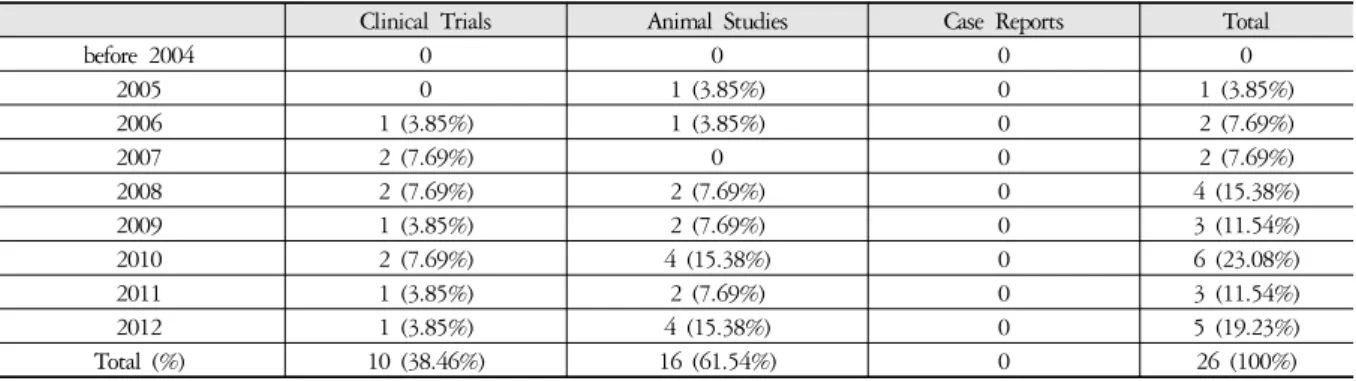
In Twenty six studies, the numbers of clinical and experimental studies are respectively 10 (38.46%) and 16 (61.54%).
The numbers of studies that used herbal complex were 20 (76.92%), and out of that, 6 studies had used a single herbal medicine (23.08%). The external application with oriental medicine for the atopic dermatitis used with Phellodendri Cortex (7), Sophorae Radix (6), Scutellariae Radix (6), Lonicerae Flos (5), Coptidis Rhizoma (5) and so on.
Among the clinical studies, the 5 studies were double-blind and randomized-controlled study (50%). The numbers of studies that used Hanifin and Rajka Diagnostic Criteria (1980) were 6 (60%), and that used the Diagnostic Criteria in Korean Atopic Dermatitis (2005) were 4 (40%).
Among the clinical studies, categories to evaluate of atopic dermatitis are respectively SCORAD Index (80%), Total IgE (80%), Eosinophil count (70%) and so on. All of the clinical studies (100%) showed a statistically significant decline in atopic dermatitis according to the SCORAD Index, Modified SCORAD Index, the Clinic index score.
Among the experimental studies, the numbers of studies that used NC/Nga mice were 9 (56.25%), and out of that 5 studies used BALB/c mice (31.25%). Most of the studies (68.75%) used DNCB as allergy inducing materials.
The scales for evaluation of atopic dermatitis were Clinical skin severity score, Histopathologic examination, Immunohematologic examination, safety test and so on. In 12 cases (75%) of experimental studies, the IgE level of experimental group showed a statistically significant decline after using external application. In 8 study cases (50%), Clinical skin severity score of experimental group showed a statistically significant decline after using external application.
Key words : Atopic dermatitis, External application
Received: January 25, 2013 ∙ Revised: February 14, 2013 ∙ Accepted: February 15, 2013 Corresponding Author: Park Eun Jung
Department of Pediatrics, Wonkwang University Jeonju Oriental Medicine Hospital, 99 Garyeonsan-ro, Deokjin-gu, Jeonju, Jeollabuk-do 561-851, Republic of Korea Republic of Korea
Tel: +82-63-270-1019 Fax: +82-63-270-1594 E-mail: [email protected]
ⓒ The Association of Pediatrics of Korean Medicine. All rights reserved. This is an open-access article distributed under the tenus of the Creative Commons Attribution Non-Commercial License (http://creativecommons.org/licenses/by-nc/3.0/), which permits unrestricted non-commercial use, distribution, and reproduction in any medium, provided the original work is properly cited.
아토피 피부염 외용제에 관련된 국내 임상 및 실험 논문 고찰
민들레․박은정․강경하
원광대학교 한의과대학 소아과학교실
J Pediatrics of Korean Medicine, February, 2013;27(1):36-49 ISSN 1226-8038(Print), 2287-9463(Online), http://dx.doi.org/10.7778/jpkm.2013.27.1.036
Korean electric databases for this review Domain
Korean Traditional Knowledge Portal http://www.koreantk.com
Oriental Medicine Advanced Searching Integrated system http://oasis.kiom.re.kr
National Assembly Library http://www.nanet.go.kr
Korean Medicine Database http://kmbase.medric.or.kr
Koreanstudies Information Service System http://kiss.kstudy.com
DBpia http://www.dbpia.co.kr
Korea Institute of Science and Technology Information http://society.kisti.re.kr
Total 7
Table 1. Lists of Search Engine
Clinical Trials Animal Studies Case Reports Total
before 2004 0 0 0 0
2005 0 1 (3.85%) 0 1 (3.85%)
2006 1 (3.85%) 1 (3.85%) 0 2 (7.69%)
2007 2 (7.69%) 0 0 2 (7.69%)
2008 2 (7.69%) 2 (7.69%) 0 4 (15.38%)
2009 1 (3.85%) 2 (7.69%) 0 3 (11.54%)
2010 2 (7.69%) 4 (15.38%) 0 6 (23.08%)
2011 1 (3.85%) 2 (7.69%) 0 3 (11.54%)
2012 1 (3.85%) 4 (15.38%) 0 5 (19.23%)
Total (%) 10 (38.46%) 16 (61.54%) 0 26 (100%)
Table 2. Classification of Articles Associated with Atopic Dermatitis External Application
Ⅰ. Introduction
아토피 피부염은 심한 소양감과 특징적인 습진성 피부병변을 나타내는 만성 재발성의 염증성 피부 질환 으로1), 연령에 따라 특징적인 병변의 분포와 양상을 보 인다2). 현재까지 정확한 원인과 발병기전이 밝혀져 있 지는 않으나, 다양한 가설로 유전적 요인, 환경적 요인, 약리적 요인, 심리적 요인, 면역학적 요인 및 표피 투과 장벽과 항균장벽기능 이상이 중요한 원인으로 제시되 고 있다3).
한의학에서 아토피 피부염은 浸淫, 浸淫瘡, 乳癬, 奶 癬, 胎斂瘡 등으로 불리며4-6), 크게 濕熱俱盛型, 脾虛濕 盛型, 血虛風燥型으로 변증 분류하여7) "外病內治"의 원칙하에 다양한 외치법도 병용되고 있다8).
아토피 피부염에 있어 피부 장벽의 역할이 중요한 데 다양한 원인에 의해 손상된 피부 장벽으로 피부 건 조가 유발되어 소양감이 생기고 이로 인하여 피부를 긁게 되며, 피부를 긁음으로써 피부에 상처가 유발되 고 이를 통하여 다시 소양감이 나타나게 되는
“itch-scratch-itch”의 악순환을 반복하게 된다. 따라서 아토피 피부염 치료의 기본은 피부 장벽 기능의 보강 이라고 볼 수 있으며9), 이를 위해서 적절한 피부 외용 제를 통한 적극적 外治가 필요하다.
이에 저자는 최근 국내 논문을 중심으로 아토피 피 부염 외용제에 대한 선행 연구들을 조사, 검토해 봄으 로써 아토피 피부염 치료에 있어서 외용제의 단독 적 용을 통한 치료 효과를 확인해 보고, 외용제 연구에 적 절하리라 생각되는 본초 및 처방을 정리한 결과 약간 의 지견을 얻었기에 보고하는 바이다.
Ⅱ. Materials and methods
연구 자료 수집은 국내 전자 데이터베이스 검색을 통해 수행하였다. 자료의 수집을 위해 ‘한국전통지식포 탈’, ‘한국의학정보포탈’, ‘국회도서관’, ‘의학논문데이 터베이스검색’, ‘한국학술정보’, ‘DBpia’, ‘과학기술학회 마을’을 중심으로 on-line 검색을 하였으며 (Table 1), 검 색어는 ‘아토피’, ‘아토피피부염’, ‘외용’, ‘외치’, ‘도포’,
‘화장품’, ‘화장수’를 조합하여 사용하였고 이 중 원문 열람이 가능한 논문만을 대상으로 하였다.
검색은 2012년 12월까지 출간된 학회지 논문으로 한정하였으며, 아토피 피부염에 대하여 외용제를 단일 치료 도구로 사용한 증례 보고, 임상 시험 연구, 동물 실험 연구 논문을 대상으로 포함하여 총 179편의 논문 중 세포실험 논문과 처방 내용을 알 수 없는 경우, 한약
Frequency Herbs Aroma Oil, Others 7 Phellodendri Cortex (黃柏)
6 Sophorae Radix (苦蔘), Scutellariae Radix (黃芩) 5 Lonicerae Flos (金銀花), Coptidis Rhizoma (黃連)
4 Angelicae Gigantis Radix (當歸), Rheum rhabarbarum L. (大黃), Houttuynia cordata Thunb (魚腥草),
Forsythiae Fructus (蓮翹) Lavender
3 Glycyrrhizae Radix (甘草), Dictamni Radicis Cortex (白鮮皮), Paeoniae Radix (白芍藥), Lithospermum
erythrorhizon siebold & zucc. (紫草), Gardeniae Fructus (梔子) Chamomile
2
Puerariae Radix (葛根), Portulaca oleracea L. (馬齒莧), Sanguisorba officinalis Linne (地楡), Kochia scoparia Schrader (地膚子), Torilis japonica (Houtt.) DC. (蛇床子), Schizonepeta tenuifolia Briquet (荊芥), Prunus yedoensis Rehder (樺皮), Rubus coreanus (覆盆子), Rehmannia glutinosa Libosch (生地 黃), Astragali Radix (黃芪), Angelica dahurica (白芷), Camellia Sinensis (綠茶), Phellinus linteus (桑黃), Sesameseed Oil (胡麻油), Bees Wax (蜜蠟), Swine Oil (豚脂)
Tea tree
1
Ginseng Radix (人蔘), Atractylodes macrocephala Koidzumi (白朮), Poria cocos (茯笭), Citrus Unshiu Markovich (陳皮), Chaenomeles sinensis (木瓜), Cimicifugae Rhizoma (升麻), Platycodi Radix (桔梗), Ponciri Fructus (枳實), Cnidium officinale makino (川芎), Corydalis Yanhusuo (玄胡索), Chamaecyparis obtusa (扁柏), Red ginseng (紅蔘), Hydnocarpi Semen (大風子), Sesami Semen (胡麻 子), Momordicae Semen (木鼈子), Xanthii Fructus (蒼耳子), Eucommia Ulmoides Oliver (杜仲), Gypsum Fibrosum (石膏), Fossilia ossis Mastodi (龍骨), Borax (硼砂), Sepiae Os (烏賊骨), Sulfur (硫黃), Gynostemma Pentaphyllum Makino (七葉膽), Arctii Fructus (牛蒡子)
Eucalyptus, Lemon, Snail Secretion
Filtrate Table 3. Frequency of Herbs in Prescription
재에서 특성 성분을 추출하여 사용한 경우는 연구 대 상에서 제외하였으며, 기타 치료 도구 (한약 복용, 침 치 료 등)를 병용한 논문을 제외하여 외용제 단독 사용 효 과를 알아보는 데에 중점을 두었다.
최종적으로 연구 주제에 부합하는 26편의 논문을 선정하여 분석하였다. 대상 논문에 대해 연도별, 유형 별 분류를 하였으며, 각 논문에 사용된 치료법과 평가 도구를 분석하였다.
Ⅲ. Results
1. 연도 및 유형별 분류
연구를 진행한 26편의 논문을 연도별로 살펴보면 2012년 5편 (19.23%), 2011년 3편 (11.54%), 2010년 6편 (23.08%), 2009년 3편 (11.54%), 2008년 4편 (15.38%), 2007년 2편 (7.69%), 2006년 2편 (7.69%), 2005년 1편 (3.85%)으로 조사되었다. 이 중 임상 시험 연구 논문은 10편 (38.46%), 동물 실험 논문은 16편 (61.54%)이었으 며, 외용제로 단독 치료한 증례 보고의 경우는 찾아볼 수 없었다(Table 2). 외용제 처방의 경우 복합처방 논문이 20편 (76.92%), 단미 처방 논문이 6편 (23.08%)이었다.
2. 외용제 처방에 관한 분석
외용제 처방에 사용된 본초를 살펴보면 黃柏 (7), 苦
蔘 (6), 黃芩 (6), 金銀花 (5), 黃連 (5), 當歸 (4), 大黃 (4), 魚腥草 (4), 蓮翹 (4), 甘草 (3), 白鮮皮 (3), 白芍藥 (3), 紫 草 (3), 梔子 (3) 등의 순으로 다용되었다 (Table 3). Aroma therapy에 사용되는 essential oil은 Lavender (4), Chamomile (3), Tea tree (2), Eucalyptus (1), Lemon (1)의 빈도로 사용 되었다.
3. 임상논문 분석
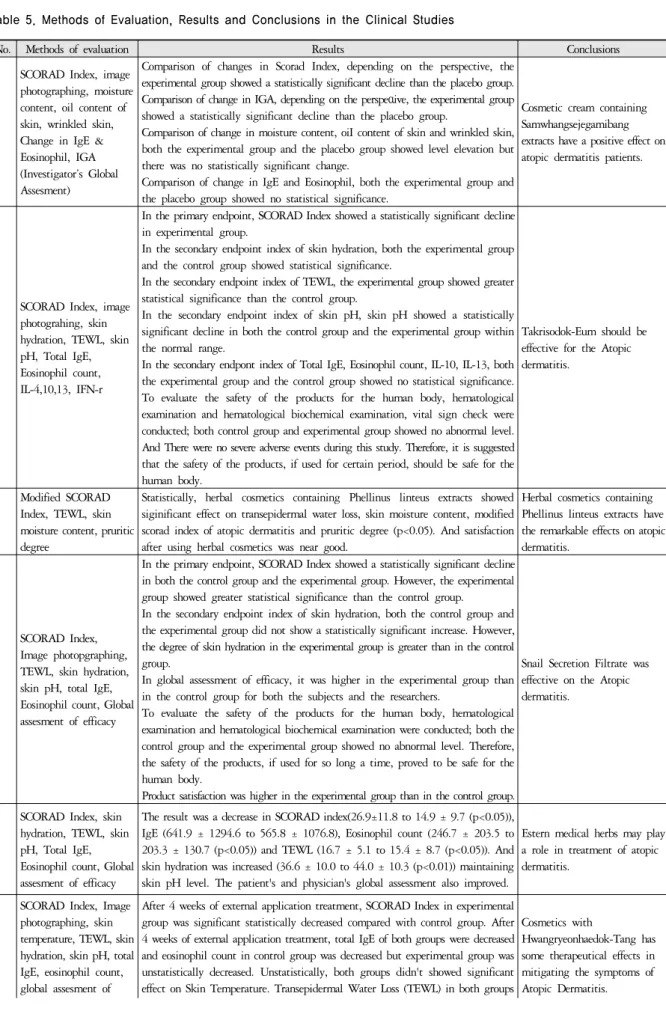
임상논문이라 함은 인체를 대상으로 일정한 처치를 시행하여 그에 대한 경과 및 효과를 관찰, 분석한 연구 를 편의상 지칭한 것으로10), 증례보고와 임상실험 연구 가 이에 해당한다고 볼 수 있다. 본 논문에서 분석한 10편의 주요 내용은 다음과 같다 (Table 4, 5).
(1) 연구방법에 관한 분석
아토피피부염 외용제 관련 임상실험 연구 총 10편 가운데 5편 (50%)만이 실험군-대조군을 설정하여 무작 위배정, 이중맹검으로 진행된 실험이었다.
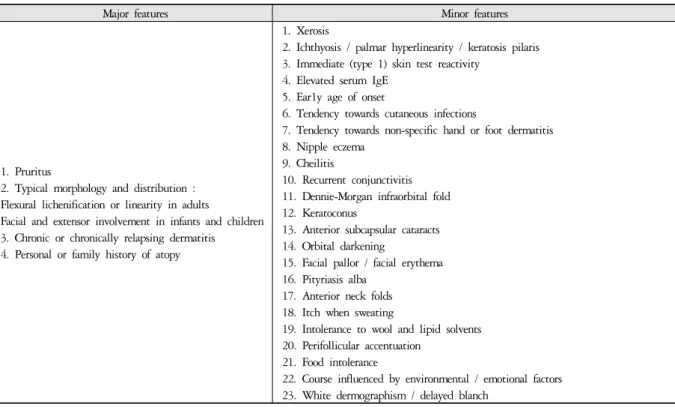
연구대상의 선정에 있어서 아토피 피부염을 진단하 는 기준으로 6편 (60%)은 Hanifin and Rajka의 진단 기준 (1980)11) (Table 6)을 사용했으며, 4편 (40%)은 대한아토 피피부염학회의 한국인 아토피 피부염 진단기준 (2005)12) (Table 7)을 사용했다. 또한 각 임상시험마다 환자 연령 군과 임상시험 진행 기간이 다양하여 일치되지 않는 경향을 보였으며, 연령별로 치료 내용에 명확한 차이 를 설정한 연구는 찾아볼 수 없었다.
No. 1st Author
(year) Article Publication journal Treatment
Subjects Duration Age
The types of study
1 Joo H.A.
(2012)
A Clinical study for the effect of cosmetic cream containing Samwhangsejegamibang Extracts
on Atopic dermatitis patients
The Journal of Korean Oriental
Medical Ophthalmology&
Otolaryngology&
Dermatology
cosmetic cream containing Samwhangsejegamiba
ng extracts
43 4weeks 5~25yr
A double-blind, randomized, placebo-controlled
intervention
2 O M.J.
(2011)
A Clinical study for the effect of ointment contained Takrisodok-Eum on recovering
the damaged skin barrier by Atopic dermatitis
The Journal of Korean Oriental
Medical Ophthalmology&
Otolaryngology&
Dermatology
ointment contained Takrisodok-Eum
37 8weeks 5~50yr
A double-blind, randomized-controll ed intervention
3 Jung H.J.
(2010)
Research about Herbal Cosmetics containing Phellinus linteus Extracts in Atopic Dermatitis
patients
The Journal of Korean Oriental
Medical Ophthalmology&
Otolaryngology&
Dermatology
herbal cosmetics containing Phellinus
linteus extracts
35 4weeks 2~65yr
Uncontrolled clinical trial
4 Oh M.J.
(2010)
The Effects of Snail Secretion Filtrate on the damaged skin barrier’s recovery of the Atopic
dermatitis
The Journal of Korean Oriental
Medical Ophthalmology&
Otolaryngology&
Dermatology
Snail Secretion Filtrate 15%
20 4weeks 15±9.1yr
A double-blind, randomized-controll
ed study
5 Kang S.J.
(2009)
The Enhancing effect of Atopic Dermatitis by cosmetics containing estern medical herbs
Journal of academia-industrial
technology
toner and cream using estern medical herbs
16 6weeks 5~50yr
Uncontrolled clinical trial
6 Yun D.C.
(2008)
Clinical research of Atopic Dermatitis treated by Hwangryeonhaedok-Tang in
Cosmetics
Korean J. Oriental Physiology &
Pathology
ointment that contain Hwangryeonhaedok-T
ang
31 4weeks
16yr~
A double-blind, randomized-controll
ed study
7 Kim S.H.
(2008)
A Clinical research of Atopic Dermatitis treated by Yeongyuseungmatang in
cosmetics
The Journal of Korean Oriental
Medical Ophthalmology&
Otolaryngology&
Dermatology
cosmetics with Yeongyuseungmatang
33 4weeks
16yr~
A double-blind, Randomized-control
led study
8 Hwang
S.Y.(2007)
A Clinical study of Atopic Dermatitis treated by external application with Gynostemma Pentaphyllum MAKINO in
cosmetics
The Journal of Korean Oriental
Medical Ophthalmology&
Otolaryngology&
Dermatology
cosmetics with Gynostemma Pentaphyllum
MAKINO
46 (laboratory
44) 4weeks 6~40yr
Prospective open study
9 Kim C.H.
(2007)
Clinical efficacy of External Preparation containing Herbal Extracts in Atopic Dermatitis
patients
The Journal of Korean Oriental
Medical Ophthalmology&
Otolaryngology&
Dermatology
the 4 items of Medibebe (cream, lotion, soap, and body
cleanser)
50 4weeks 1~60yr
Uncontrolled clinical trial
10 Yoon J.M.
(2006)
Effect of Taeyeol-go on Atopic Dermatitis
Daejeon University, Institute of korean
medicine .Thesis Collection
Taeyeol-go (TYG)
10 1week 3~37yr
Uncontrolled clinical trial Table 4. Methods of Treatment and the Types of Study in the Clinical Studies
No. Methods of evaluation Results Conclusions
1
SCORAD Index, image photographing, moisture content, oil content of skin, wrinkled skin, Change in IgE &
Eosinophil, IGA (Investigator’s Global Assesment)
Comparison of changes in Scorad Index, depending on the perspective, the experimental group showed a statistically significant decline than the placebo group.
Comparison of change in IGA, depending on the perspeαive, the experimental group showed a statistically significant decline than the placebo group.
Comparison of change in moisture content, oiI content of skin and wrinkled skin, both the experimental group and the placebo group showed level elevation but there was no statistically significant change.
Comparison of change in IgE and Eosinophil, both the experimental group and the placebo group showed no statistical significance.
Cosmetic cream containing Samwhangsejegamibang extracts have a positive effect on atopic dermatitis patients.
2
SCORAD Index, image photograhing, skin hydration, TEWL, skin pH, Total IgE, Eosinophil count, IL-4,10,13, IFN-r
In the primary endpoint, SCORAD Index showed a statistically significant decline in experimental group.
In the secondary endpoint index of skin hydration, both the experimental group and the control group showed statistical significance.
In the secondary endpoint index of TEWL, the experimental group showed greater statistical significance than the control group.
In the secondary endpoint index of skin pH, skin pH showed a statistically significant decline in both the control group and the experimental group within the normal range.
In the secondary endpont index of Total IgE, Eosinophil count, IL-10, IL-13, both the experimental group and the control group showed no statistical significance.
To evaluate the safety of the products for the human body, hematological examination and hematological biochemical examination, vital sign check were conducted; both control group and experimental group showed no abnormal level.
And There were no severe adverse events during this study. Therefore, it is suggested that the safety of the products, if used for certain period, should be safe for the human body.
Takrisodok-Eum should be effective for the Atopic dermatitis.
3
Modified SCORAD Index, TEWL, skin moisture content, pruritic degree
Statistically, herbal cosmetics containing Phellinus linteus extracts showed siginificant effect on transepidermal water loss, skin moisture content, modified scorad index of atopic dermatitis and pruritic degree (p<0.05). And satisfaction after using herbal cosmetics was near good.
Herbal cosmetics containing Phellinus linteus extracts have the remarkable effects on atopic dermatitis.
4
SCORAD Index, Image photopgraphing, TEWL, skin hydration, skin pH, total IgE, Eosinophil count, Global assesment of efficacy
In the primary endpoint, SCORAD Index showed a statistically significant decline in both the control group and the experimental group. However, the experimental group showed greater statistical significance than the control group.
In the secondary endpoint index of skin hydration, both the control group and the experimental group did not show a statistically significant increase. However, the degree of skin hydration in the experimental group is greater than in the control group.
In global assessment of efficacy, it was higher in the experimental group than in the control group for both the subjects and the researchers.
To evaluate the safety of the products for the human body, hematological examination and hematological biochemical examination were conducted; both the control group and the experimental group showed no abnormal level. Therefore, the safety of the products, if used for so long a time, proved to be safe for the human body.
Product satisfaction was higher in the experimental group than in the control group.
Snail Secretion Filtrate was effective on the Atopic dermatitis.
5
SCORAD Index, skin hydration, TEWL, skin pH, Total IgE, Eosinophil count, Global assesment of efficacy
The result was a decrease in SCORAD index(26.9±11.8 to 14.9 ± 9.7 (p<0.05)), IgE (641.9 ± 1294.6 to 565.8 ± 1076.8), Eosinophil count (246.7 ± 203.5 to 203.3 ± 130.7 (p<0.05)) and TEWL (16.7 ± 5.1 to 15.4 ± 8.7 (p<0.05)). And skin hydration was increased (36.6 ± 10.0 to 44.0 ± 10.3 (p<0.01)) maintaining skin pH level. The patient's and physician's global assessment also improved.
Estern medical herbs may play a role in treatment of atopic dermatitis.
6
SCORAD Index, Image photographing, skin temperature, TEWL, skin hydration, skin pH, total IgE, eosinophil count, global assesment of
After 4 weeks of external application treatment, SCORAD Index in experimental group was significant statistically decreased compared with control group. After 4 weeks of external application treatment, total IgE of both groups were decreased and eosinophil count in control group was decreased but experimental group was unstatistically decreased. Unstatistically, both groups didn't showed significant effect on Skin Temperature. Transepidermal Water Loss (TEWL) in both groups
Cosmetics with
Hwangryeonhaedok-Tang has some therapeutical effects in mitigating the symptoms of Atopic Dermatitis.
Table 5. Methods of Evaluation, Results and Conclusions in the Clinical Studies
No. Methods of evaluation Results Conclusions
efficacy
were increased but experimental group was significant decreased compared with control group. Skin Hydration in experimental group was significant statistically increased compared with control group. Statistically, both groups didn't showed significant effect on Skin pH. Only experimental group showed little increase. After 4 weeks of external application treatment, experimental group showed significant effect on global assesment of efficacy.
7
SCORAD Index, Image photographing, Skin temperature, TEWL, skin hydration, skin pH, Total IgE, Eosinophil count, Global assesment of efficacy
After 4 weeks of external application treatment, SCORAD Index in Yeongyuseungmatang was significant statistically decreased compared with control group.
After 4 weeks of external application treatment, eosinophil count in Yeongyuseungmatang was significant statistically decreased compared with control group but total IgE was very increased both Yeongyuseungmatang and control group.
Statistically, Yeongyuseungmatang and control group didn't showed significant effect on Skin Temperature was measeured by Thermometer SM815.
Transepidermal Water Loss (TEWL) in Yeongyuseungmatang was significant statistically decreased compared with control group measured by Tewameter TM300.
Skin Hydration in Yeongyuseungmatang was significant statistically increased compared with control group measured by Corneometer CM825.
Statistically, Yeongyuseungmatang and control group didn't showed significant effect on Skin pH was measured by Skin-pH-Meter PH905.
After 4 weeks of external application treatment, Yeongyuseungmatang showed significant effect on global assesment of efficacy.
Cosmetics with
Yeongyuseungmatang has some therapeutical effects in mitigating the symptoms of atopic dermatitis.
8
Clinical index score, Total IgE, eosinophil count, Total Availability
There are 46 patients we could check by clinic index score and 44 patients by laboratory.
In the 46 case clinic index score was significantly decreased between the before- and after-external application treatment periods (P<0.01).
The 46 cases was devided into two types (moist heat type and blood dryness type) by intensity. External application of Gynostemma Pentaphyllum MAKINO in cosmetics did not significant change by two types.
In the 44 laboratory cases, the number of eosinophil counts was decreased but the number of IgE was significantly increased.
Cosmetics with Gynostemma Pentaphyllum MAKINO have the remedical effect for Atopic Dermatitis.
9
SCORAD Index, Quality of Life (skindex-29), Total IgE
After 4 weeks' use of Medibebe, SCORAD index showed a decrease of 20.0 ± 10.2 (95% C.I:17.1-22.9) compared with when it was not applied, which is a statistically meaningful change (p-value<0.0001). Subjective pruritus and Sleeping loss reported after both 2 and 4 weeks' use of Medibebe decreased in a statistically meaningful way (p-value<0.0001) compared with before the application. but, 2 cases out of all 50 subjects for the clinical trial were excluded on the way.
4 items of Medibebe (cream, lotion, soap, and body cleanser) can be used by atopic patients safely and effectively with almost no side-effect.
10 SCORAD Index
10 patients (4 male, 6 female), 3 to 37 years of age (mean 14.6 ± 9.52 years old), 2 to 31 years of onset (mean 11.4 ± 8.54 years), finished study. After treatment extent (p<0.01), intensity (p<0.005), subjective symptom (p<0.002) and total SCORAD index (p<0.002) was significantly decreased than before treatment.
TYG is an effective therapeutic method for atopic dermatitis.
(2) 평가항목에 관한 분석
아토피 피부염의 상태를 평가하기 위해 사용된 scale 로서 SCORAD Index가 8편 (80%)으로 가장 많이 사용 되었으며, Modified Scorad Index, Clinical index score가 사용된 논문이 각각 1편 (10%)씩 조사되었다.
아토피 피부염 평가 scale 외에 혈액학적 검사로 8편 (80%)의 연구에서 Total IgE를 측정하였고, 7편 (70%) 의 연구에서 Eosinophil count를 시행하여 아토피 피부 염의 정도를 평가하는데 참고하였다. 이 외에 사진촬 영을 통해 병변 부위 상태를 관찰, 기록한 경우가 5편 (50%)이었고, 피부진단기기를 사용하여 피부의 수분
함유량, 표피수분손실량 (TEWL), 피부산성도 등을 측 정한 경우가 7편 (70%)이었다. 유효성 평가를 시행한 경우가 6편 (60%)이었고 기타 IL-4, IL-10, IL-13, IFN-γ 를 측정한 경우, skindex-29를 통하여 삶의 질을 평가한 보고도 있었다.
(3) 결과에 관한 분석
임상 시험 논문 10편 (100%) 모두에서 아토피 피부 염의 상태를 평가하기 위해 사용된 주요 scale (SCORAD Index, Modified SCORAD Index, Clinic index score)이 유 의성 있게 감소하였다. 피부수분함유량이 유의성 있게
Major features Minor features
1. Pruritus
2. Typical morphology and distribution : Flexural lichenification or linearity in adults
Facial and extensor involvement in infants and children 3. Chronic or chronically relapsing dermatitis 4. Personal or family history of atopy
1. Xerosis
2. Ichthyosis / palmar hyperlinearity / keratosis pilaris 3. Immediate (type 1) skin test reactivity
4. Elevated serum IgE 5. Ear1y age of onset
6. Tendency towards cutaneous infections
7. Tendency towards non-specific hand or foot dermatitis 8. Nipple eczema
9. Cheilitis
10. Recurrent conjunctivitis 11. Dennie-Morgan infraorbital fold 12. Keratoconus
13. Anterior subcapsular cataracts 14. Orbital darkening
15. Facial pallor / facial erythema 16. Pityriasis alba
17. Anterior neck folds 18. Itch when sweating
19. Intolerance to wool and lipid solvents 20. Perifollicular accentuation
21. Food intolerance
22. Course influenced by environmental / emotional factors 23. White dermographism / delayed blanch
Table 6. Hanifin and Rajka Diagnostic Criteria(1980)11) : at least three of 4 major features and three of 23 minor features
Major features Minor features
1. Pruritus
2. Typical morphology and distribution 1) Under the age of 2 years : face, trunk and
extensor involvement
2) Over the age of 2 years : face, neck and flexural involvement
3) Personal or family history (atopic dermatitis, asthma, allergic rhinitis)
1. Xerosis 2. Pityriasis alba
3. Periorbital eczema or orbital darkening 4. Periauricular eczema
5. Cheilitis
6. Tendency towards non-specific hand or foot dermatitis 7. Scalp scale
8. Perifollicular accentuation 9. Nipple eczema
10. Itch when sweating 11. White dermographism 12. Skin prick test reactivity 13. Elevated serum IgE
14. Tendency towards cutaneous infections
Table 7. Atopic Dermatitis Research Group (2005)12): diagnostic criteria in Korean (at least two of 4 major features and four of 14 minor features)
증가한 논문이 5편 (50%), 표피수분손실량 (TEWL)이 유의성 있게 감소한 논문이 4편 (40%), 총괄적 유효성 평가에서 실험군이 대조군에 비해 유의성 있게 높게 나타난 논문이 3편 (30%), Eosinophil이 유의성 있게 감 소한 논문이 2편 (20%)으로 나타났다.
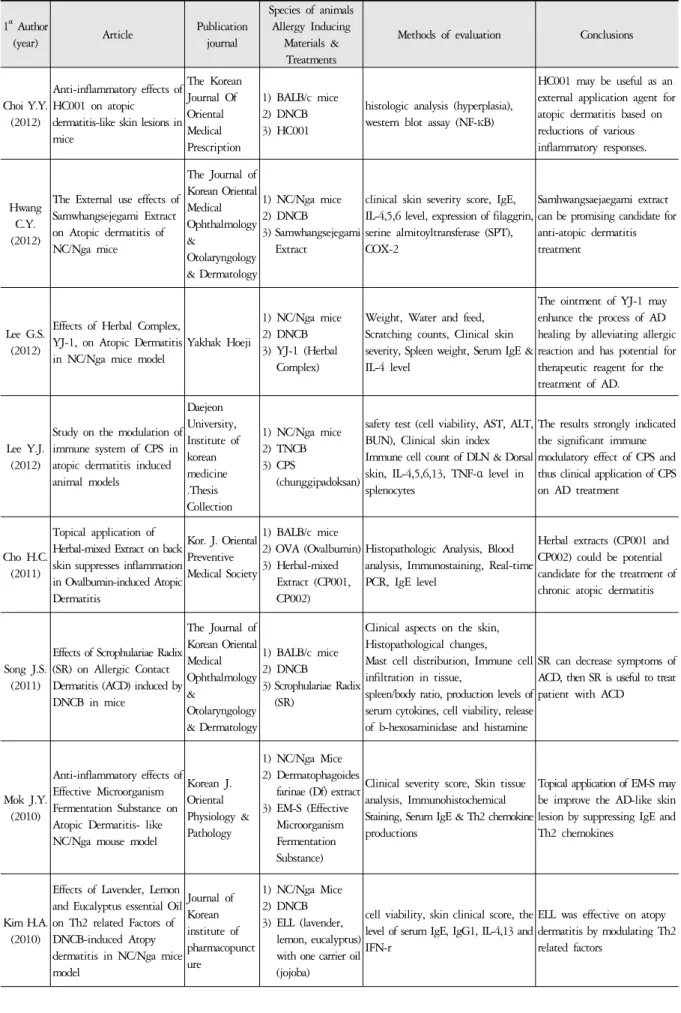
4. 동물실험논문 분석 (Table 8)
아토피 피부염 외용제 관련 동물실험 연구 총 16편 가운데 대상 동물로 NC/Nga mice를 사용한 논문이 9편
(56.25%), BALB/c mice로 실험한 논문이 5편 (31.25%), 기타 hairless mice, Sprague-Dawley rat를 사용한 논문이 각각 1편씩 있었다.
아토피 피부염 유발 물질로 1-chloro 2,4-dinitro- chlorobenzene (DNCB)를 사용한 경우가 11편 (68.75%)으 로 가장 많았으며, Biostir Mite antigen cream (BMAC)을 사용한 경우가 2편 (12.5%), 2,4,6-trinitrochlorobenzene (TNCB), Ovalbumin (OVA), Dermatophagoides farinae (Df) extract를 사용한 경우가 각각 1편씩 있었다. 외용
1st Author
(year) Article Publication
journal
Species of animals Allergy Inducing
Materials &
Treatments
Methods of evaluation Conclusions
Choi Y.Y.
(2012)
Anti-inflammatory effects of HC001 on atopic dermatitis-like skin lesions in mice
The Korean Journal Of Oriental Medical Prescription
1) BALB/c mice 2) DNCB 3) HC001
histologic analysis (hyperplasia), western blot assay (NF-κB)
HC001 may be useful as an external application agent for atopic dermatitis based on reductions of various inflammatory responses.
Hwang C.Y.
(2012)
The External use effects of Samwhangsejegami Extract on Atopic dermatitis of NC/Nga mice
The Journal of Korean Oriental Medical Ophthalmology
&
Otolaryngology
& Dermatology
1) NC/Nga mice 2) DNCB
3) Samwhangsejegami Extract
clinical skin severity score, IgE, IL-4,5,6 level, expression of filaggrin, serine almitoyltransferase (SPT), COX-2
Samhwangsaejaegami extract can be promising candidate for anti-atopic dermatitis treatment
Lee G.S.
(2012)
Effects of Herbal Complex, YJ-1, on Atopic Dermatitis in NC/Nga mice model
Yakhak Hoeji
1) NC/Nga mice 2) DNCB 3) YJ-1 (Herbal
Complex)
Weight, Water and feed, Scratching counts, Clinical skin severity, Spleen weight, Serum IgE &
IL-4 level
The ointment of YJ-1 may enhance the process of AD healing by alleviating allergic reaction and has potential for therapeutic reagent for the treatment of AD.
Lee Y.J.
(2012)
Study on the modulation of immune system of CPS in atopic dermatitis induced animal models
Daejeon University, Institute of korean medicine .Thesis Collection
1) NC/Nga mice 2) TNCB 3) CPS
(chunggipadoksan)
safety test (cell viability, AST, ALT, BUN), Clinical skin index Immune cell count of DLN & Dorsal skin, IL-4,5,6,13, TNF-α level in splenocytes
The results strongly indicated the significant immune modulatory effect of CPS and thus clinical application of CPS on AD treatment
Cho H.C.
(2011)
Topical application of Herbal-mixed Extract on back skin suppresses inflammation in Ovalbumin-induced Atopic Dermatitis
Kor. J. Oriental Preventive Medical Society
1) BALB/c mice 2) OVA (Ovalbumin) 3) Herbal-mixed
Extract (CP001, CP002)
Histopathologic Analysis, Blood analysis, Immunostaining, Real-time PCR, IgE level
Herbal extracts (CP001 and CP002) could be potential candidate for the treatment of chronic atopic dermatitis
Song J.S.
(2011)
Effects of Scrophulariae Radix (SR) on Allergic Contact Dermatitis (ACD) induced by DNCB in mice
The Journal of Korean Oriental Medical Ophthalmology
&
Otolaryngology
& Dermatology
1) BALB/c mice 2) DNCB
3) Scrophulariae Radix (SR)
Clinical aspects on the skin, Histopathological changes, Mast cell distribution, Immune cell infiltration in tissue,
spleen/body ratio, production levels of serum cytokines, cell viability, release of b-hexosaminidase and histamine
SR can decrease symptoms of ACD, then SR is useful to treat patient with ACD
Mok J.Y.
(2010)
Anti-inflammatory effects of Effective Microorganism Fermentation Substance on Atopic Dermatitis- like NC/Nga mouse model
Korean J.
Oriental Physiology &
Pathology
1) NC/Nga Mice 2) Dermatophagoides
farinae (Df) extract 3) EM-S (Effective
Microorganism Fermentation Substance)
Clinical severity score, Skin tissue analysis, Immunohistochemical Staining, Serum IgE & Th2 chemokine productions
Topical application of EM-S may be improve the AD-like skin lesion by suppressing IgE and Th2 chemokines
Kim H.A.
(2010)
Effects of Lavender, Lemon and Eucalyptus essential Oil on Th2 related Factors of DNCB-induced Atopy dermatitis in NC/Nga mice model
Journal of Korean institute of pharmacopunct ure
1) NC/Nga Mice 2) DNCB 3) ELL (lavender,
lemon, eucalyptus) with one carrier oil (jojoba)
cell viability, skin clinical score, the level of serum IgE, IgG1, IL-4,13 and IFN-r
ELL was effective on atopy dermatitis by modulating Th2 related factors
Table 8. Methods of Treatment and Evaluation in the Animal Experimentation
1st Author
(year) Article Publication
journal
Species of animals Allergy Inducing
Materials &
Treatments
Methods of evaluation Conclusions
Jung J.Y.
(2010)
Effect of Phellinus igniarius Quel Extract on the Anti-inflammatory, Anti allergy, Anti-oxidant, Anti-wrinkle reaction
The Journal of Korean Oriental Medical Ophthalmology&
Otolaryngology
& Dermatology
1) NC/Nga Mice 2) DNCB 3) BPE (Betula
platyphylla var.
japonica extract)
Cell viability, NO, TNF-α, IL-1β,2,4,5,6,8, IFN-γ, COX-2 production and gene expression, MAPK Western Blotting, Skin severity score, Weight, Water and feed, Blood test, Weight of organs, Histological change, Serum total IgE and Histological change of main organs
Phellinus igniarius Quel extract could be applicable for improvement of several skin functions
Kim G.E.
(2010)
Anti-acne and Anti-atopic Dermatitis Effect of Plant extracts including Eucommia ulmoides Oliv and Phellodendron amurense
Korean Chem.
Eng. Res.
1) hairless mice 2) DNCB 3) Plant Extracts
including Eucommia ulmoides Oliv. and Phellodendron amurense
Anti-oxidation effect (DPPH free radical scavenging activity) Anti-bacterial effect (disc diffusion method)
Anti-atopic dermatitis effect (skin condition observation, IgE concentration)
Plant extracts indicated strong anti-acne and anti-atopic dermatitis effect, and showed strong potential for cosmetics and skin related medicine
Ju Y.E.
(2009)
Effects of Atopy Cream-combined with Jawoongo Ointment on the Development of Atopic Dermatitis-like skin lesions in NC/Nga mouse
J. Korean Oriental Pediatrics
1) NC/Nga Mice 2) Biostir Mite antigen
cream (Mite Ext.) 3) A-J (Atopy
Cream-combined with Jawoongo Ointment)
Clinical skin score, Hematology and Serum total IgE, IgG1 level, Cytokine level, total cell number, Immunohistochemical staining, Histological features of ALN, DLN, PBMCs and dorsal skin tissue
A-J was the successful treatment of atopic dermatitis in a NC/Nga mouse model
Kim B.A.
(2009)
Effect of
Hwangryunhaedok-tang Extracts on DNCB-induced Allergic Contact Dermatitis
Kor. J.
Herbology
1) BALB/c mice 2) DNCB
3) HRHDT extract, HRHDT lotion
Histopathologic examination, Serum IgE level
HRHDT-skin could be used as a pharmaceutical material with antiinflammatory effects by reducing IgE in contact hypersensitivity dermatitis Balb/c mice by DNCB
Yeo E.J.
(2008)
Topical application of Atopy cream-Jawoogo ointment (A-J) of Ointment Inhibits Biostir mite antigen cream induced Atopy Dermatitis by local action in NC/Nga mice
Daejeon University, Institute of korean medicine .Thesis Collection
1) NC/Nga Mice 2) BMAC (Biostir
Mite antigen cream 3) Atopy cream-
Jawoogo ointment (A-J)
Clinical skin severity score, Serum IgE, IgG1 level
A-J can be an effective therapeutic method for atopic dermatitis.
Kim B.A.
(2008)
Inhibitory studies of Hwangryunhaedok-tang on development of Atopic Dermatitis in NC/Nga mice
Kor. J.
Herbology
1) NC/Nga mice 2) DNCB
3) Hwangryunhaedok- tang
TEWL Assay, Erythema Assay, Skin histopathologic examination, Serum IgE level.
HRHDT could be used as pharmaceutical material with anti-atopic dermatitis effect by reducing IgE in contact hypersensitivity atopic dermatitis NC/Nga mice model by DNCB.
Kim S.C.
(2006)
Effect of Lonicerae Flos-Skin on Contact Hypersensitivity induced by repeat elicitation of DNCB
Kor. J.
Herbology
1) BALB/c mice 2) DNCB 3) Lonicerae Flos-Skin
Contact hypersensitivity Serum IgG & IgE level
Lonicerae Flos-skin could be used as a pharmaceutical material with antiinlammatory effects by reducing IgG and IgE in contact hypersensitivity mouse model by DNCB
Kim C.J.
(2005)
The Effects of Sophorae Radix and Coptidis Rhizoma - Iontophoresis in Allergic Contact Dermatitis
The Journal of Korean Oriental Medical Ophthalmology
&
Otolaryngology
& Dermatology
1) Sprague-Dawley rat 2) DNCB
3) Sophorae Radix and Coptidis Rhizoma- iontophoresis
Contact hypersensitivity assay, Video microscope, Melanin-erythema levels, pH levels, Hydration levels, Blood test, Serum total IgE level, Skin tissue sample analysis
Sophorae Radix and Coptidis Rhizoma-iontophoresis had some anti-allergy, anti-inflammatory effects on allergic contact dermatitis, but had no effects on
melanin-erythema levels, pH levels and hydration levels of skin
제는 대부분 도포하는 방식이었고 1편에서 이온삼투요 법 (iontophoresis)으로 해당 약물을 피부에 침투시키는 방식을 사용하였다. 아토피 피부염 외용제의 효과를 평가하기 위해 사용된 도구로는 Clinical skin severity score, 조직병리학적 평가, 면역혈액학적 검사, 안전성 검사 등이 있었다.
IgE level이 유의성 있게 감소한 논문이 12편 (75%) 이었고, Clinical skin severity score가 유의성 있게 감소 한 논문이 8편 (50%), IL-4 level이 유의성 있게 감소한 논문이 5편 (31.25%)으로 나타났다. 이외에도 피부 과 각화증 완화, IL-4, IL-5, IL-6, IL-13 분비 및 발현 감소, TNF-α 분비 및 발현 감소, IgG level 감소, IFN-γ 생 성 증가, COX-2 유전자발현 억제 등의 효과를 보고한 논문들이 있었다.
Ⅳ. Discussion
한의학에서 아토피 피부염은 浸淫, 浸淫瘡, 乳癬, 奶 癬, 胎斂瘡 등으로 불리며4-6), 吳謙의 <醫宗金鑑>에서 는 奶癬을 胎斂瘡이라 하여 가려워 白屑이 일어나는 乾斂과 가려움이 甚하여 黃水가 浸淫하여 퍼져가는 濕 斂으로 나누어 설명하여 오늘날 아토피 피부염과 가장 유사하게 표현하고 있다13). 아토피 피부염을 크게 濕熱 俱盛型, 脾虛濕盛型, 血虛風燥型으로 변증 분류하는 데7), 한의학적으로 아토피 피부염의 병리기전은 체질 적으로 脾胃氣虛 때문에 濕熱의 邪氣를 感受하기 쉽 게 되어 胃의 痰飮이 일어나고 脾胃의 건전한 기능이 손상을 입은 體質虛弱한 소아가 外部의 영향을 받아 腠理에 濕熱症을 일으킨다고 보고 있다. 또한 先天的 으로 虛寒하며 脾의 건전한 運行機能을 상실한 사람에 게 風熱邪가 皮膚에 浸潤해서 발생되고 발작을 반복해 서 치유되지 않으면 결국 脾虛血燥로 되어 피부의 영 양실조를 일으킨다고 보았다14).
아토피 피부염은 심한 소양감과 특징적인 습진성 피부병변을 나타내는 만성 재발성의 염증성 피부 질환 으로1), 완치가 가능한 치료법이 없기 때문에 보습제 및 국소 steroid, 국소 tacrolimus, 항히스타민제, 항알러지 제, cyclosporine 투여 등을 증상 경감 또는 제어하는 목 적으로 이용하고 있다15,16). 그러나 steroid의 사용은 항 염증작용, 면역억제작용 외에 각질형성세포와 섬유세 포의 증식을 억제하여 피부 위축을 초래하고 초기에는 혈관수축을 일으키지만 결국 혈관 확장을 일으키며 그
외에 여드름을 유발하고 면역 억제 작용에 따른 세균 및 진균감염을 초래하는 등 여러 가지 부작용을 일으 킬 수 있다17). “피부 외용제에 의한 부작용 사례 연구”
에서, 1년 미만의 연구기간동안 피부 외용제에 의한 부 작용 사례가 무려 1257건으로 보고되었으며 이 중 부 작용의 빈도가 가장 많았던 외용제는 스테로이드 연고 로서 전체 외용제의 약 83%에 달하였다18).
최근 아토피 피부염의 병인은 피부 장벽 및 염증 반 응에 관여하는 다양한 유전적인 원인과 함께 후천적으 로 다양한 피부 장벽의 손상 및 항원의 노출에 의해 병변이 발현되는 Genotype-phenotype relation으로 이해 되고 있다19). 즉, 아토피 피부염 환자에서 장벽 기능을 회복시키는 치료는 아토피 피부염 치료의 핵심으로 생 각된다. 실제로 이는 자체의 치료 효과 뿐 아니라 다양 한 문제를 유발할 수 있는 국소 스테로이드제의 사용 을 감소시킬 수 있다20). 아토피 피부염의 치료 원칙은 악화요인을 피하고 피부를 청결하고 건조하지 않도록 잘 관리하는 것인데21) 이를 위해서 적절한 외용제 사용 이 권장되며, 국소 외용제를 잘 활용하면 아토피 피부 염 환자의 삶의 질을 향상시키는데 도움이 된다22).
이에 저자는 최근 국내 논문을 중심으로 아토피 피 부염 외용제에 대한 선행 연구들을 조사, 검토해 봄으 로써 아토피 피부염 치료에 있어서 외용제의 단독 적 용을 통한 치료 효과를 확인해 보고, 외용제 연구에 적 절하리라 생각되는 본초 및 처방을 정리해 보고자 본 연구를 진행하였다.
논문 분류에 있어 분류방법이 다양하여 임의로 문 헌논문, 임상논문, 실험논문의 세 종류로 분류하였고, 본 연구는 임상논문과 실험논문을 중심으로 진행하였 다. 여기에서 임상논문은 인간을 대상으로 실험하였거 나 치료경과를 발표한 논문, 실험논문은 사람 이외의 동물이나 기타 생물을 대상으로 실험하여 나타난 결과 를 발표한 논문을 말한다10).
연구를 진행한 26편의 논문을 연도별로 살펴보면 2012년 5편 (19.23%), 2011년 3편 (11.54%), 2010년 6편 (23.08%), 2009년 3편 (11.54%), 2008년 4편 (15.38%), 2007년 2편 (7.69%), 2006년 2편 (7.69%), 2005년 1편 (3.85%)으로 조사되었다. 이 중 임상 시험 연구 논문은 10편 (38.46%), 동물 실험 논문은 16편 (61.54%)이었으 며, 외용제로 단독 치료한 증례 보고의 경우는 찾아볼 수 없었다. 외용제 처방의 경우 복합처방 논문이 20편 (76.92%), 단미 처방 논문이 6편 (23.08%)이었다.
일반적으로 사용되어온 한의학적 약물요법을 종합
적으로 살펴보면 內治法으로 濕熱型은 淸熱利濕 養血 祛風하며 生地黃, 淡竹葉, 防風, 蒼朮, 白鮮皮, 燈心草, 赤芍藥, 連翹, 車前子, 蟬蛻 등의 약물이 주로 사용되 고, 脾虛濕盛型은 健脾利濕 消導淸熱하며 白朮, 茯笭, 白扁豆, 薏苡仁, 澤瀉, 地膚子, 牧丹皮 등의 약물이 주 로 사용되고, 血燥型은 養血潤燥 淸熱解毒하며 生地 黃, 牧丹皮, 當歸, 梔子, 黃柏, 麥門冬, 白茅根, 紫草 등 의 약물이 주로 사용된다23).
본 연구에서 외용제 처방에 사용된 본초를 살펴보 면 黃柏 (7), 苦蔘 (6), 黃芩 (6), 金銀花 (5), 黃連 (5), 當歸 (4), 大黃 (4), 魚腥草 (4), 蓮翹 (4), 甘草 (3), 白鮮 皮 (3), 白芍藥 (3), 紫草 (3), 梔子 (3) 등의 순으로 다용 되었다. Aroma therapy에 사용되는 essential oil은 Lavender (4), Chamomile (3), Tea tree (2), Eucalyptus (1), Lemon (1)의 빈도로 사용되었다.
아토피 피부염 외용제 관련 임상실험 연구 총 10편 가운데 5편 (50%)만이 실험군-대조군을 설정하여 무작 위배정, 이중맹검으로 진행된 실험이었다. 연구대상의 선정에 있어서 아토피 피부염을 진단하는 기준으로 6 편 (60%)은 Hanifin and Rajka의 진단 기준11) 을 사용했 으며, 4편 (40%)은 대한아토피피부염학회의 한국인 아 토피피부염 진단기준 (2005)12)을 사용했다. 환자 연령 군과 임상시험 진행 기간은 각 임상 시험마다 다양하 여 일치되지 않는 경향을 나타내었으며 연령별로 치료 내용에 명확한 차이를 설정한 연구는 찾아볼 수 없었 다. 이처럼 한의학 연구에 있어 질환별 관련 임상시험 에 대한 명확한 기준이 마련되어 있지 않고, 연구를 진 행하는 데 있어서 방법론적인 인식이 부족하다는 점이 아직까지의 한계로 지적될 수 있다. 특히 아토피 피부 염은 주로 영아와 유아에서 많이 발생하며 나이가 들 어감에 따라 유병율 및 질환의 강도가 감소하는 질환 으로24), 연령별로 각기 특징적인 병변의 양상이나 분포 를 보이므로2) 향후 대상 연령을 고려한 체계적인 연구 가 이루어질 필요가 있다.
논문의 객관성을 위해서는 자료 수집 방법의 객관 성이 중요하므로, 이를 위해 타당성 있고 신뢰도 있는 척도를 이용하는 것이 바람직하다. 이에 본 연구에서 는 각 논문에 사용된 평가 척도들을 살펴보았다. 아토 피 피부염의 상태를 평가하기 위해 사용된 scale로서 임 상실험 연구 총 10편 가운데 SCORAD Index가 8편 (80%)으로 가장 많이 사용되었으며, Modified Scorad Index가 1편 (10%), Clinical index score가 사용된 논문이 1편 (10%)이었다. 아토피 피부염 평가 scale 외에 혈액
학적 검사로 8편 (80%)의 연구에서 Total IgE를 측정하 였고, 7편 (70%)의 연구에서 Eosinophil count를 시행하 여 아토피 피부염의 정도를 평가하는데 참고하였다.
이 외에 사진촬영을 통해 병변 부위 상태를 관찰, 기록 한 경우가 5편 (50%)이었고, 피부진단기기를 사용하여 피부의 수분 함유량, 표피수분손실량 (TEWL), 피부산 성도 등을 측정한 경우가 7편 (70%)이었다. 유효성 평 가를 시행한 경우가 6편 (60%)이었고 기타 IL-4, IL-10, IL-13, IFN-γ를 측정한 경우, skindex-29를 통하여 삶 의 질을 평가한 보고도 있었다.
임상 시험 논문 10편 (100%) 모두에서 아토피 피부 염의 상태를 평가하기 위해 사용된 주요 scale (SCORAD Index, Modified SCORAD Index, Clinic index score)이 유 의성 있게 감소하였다. 외용제 사용으로 피부수분함유 량이 유의성 있게 증가한 논문이 5편 (50%), 표피수분 손실량 (TEWL)이 유의성 있게 감소한 논문이 4편 (40%), 총괄적 유효성 평가에서 실험군이 대조군에 비해 유의성 있게 높게 나타난 논문이 3편 (30%), Eosinophil 이 유의성 있게 감소한 논문이 2편 (20%)으로 나타났다.
이처럼 환자의 상태를 평가함에 있어 많은 수의 논 문에서 scale과 함께 혈액학적 검사, 피부진단기기를 통 한 측정 등을 병행하여 좀 더 객관적인 평가를 내리고 자 하는 시도가 이루어지고 있다. 논문의 객관성 확보 를 위한 노력이 점차 가시화되고 있다는 점에서 긍정 적으로 사료된다.
동물 실험은 연구자의 통제가 쉽고 표본추출과 대 조군의 설정이 간편하므로 현재 한의학계에서도 연구 가 많이 이루어지고 있는 추세이다. 아토피 피부염 외 용제 관련 동물실험 연구 총 16편 가운데 대상 동물로 NC/Nga mice를 사용한 논문이 9편 (56.25%), BALB/c mice로 실험한 논문이 5편 (31.25%), 기타 hairless mice, Sprague-Dawley rat를 사용한 논문이 각각 1편씩 있었다.
아토피피부염 유발 물질로 DNCB를 사용한 경우가 11편 (68.75%)으로 가장 많았으며, Biostir Mite antigen cream을 사용한 경우가 2편 (12.5%), 2,4,6-trinitrochlorobenzene (TNCB), Ovalbumin (OVA), Dermatophagoides farinae (Df) extract를 사용한 경우가 각각 1편씩 있었다. 외용 제는 대부분 도포하는 방식이었고 1편에서 이온삼투요 법 (iontophoresis)으로 해당 약물을 피부에 침투시키는 방식을 사용하였다. 아토피 피부염 외용제의 효과를 평가하기 위해 사용된 도구로는 Clinical skin severity score, 조직병리학적 평가, 면역혈액학적 검사, 안전성 검사 등이 있었다. 외용제 처리 후 IgE level이 유의성