INTRODUCTION
Atopic dermatitis (AD) is a common chronic allergic inflam- matory skin disease characterized by itching, dry skin, inflam- mation, and exudation, and is frequently associated with a per- sonal or familial history of allergic diseases.1 Hypersensitivity reaction to environmental agents has been suggested as a pa- thogenetic mechanism responsible for the development and maintenance of chronic skin inflammation in AD patients.2 However, the pathogenetic mechanism of AD seems to be more
complexly associated with genetic abnormalities, environmen- tal factors, skin barrier defects, and immune dysfunction. The precise pathogenetic mechanism underlying AD is not com- pletely understood.2
Current standard medical therapies for AD, including the use of topical corticosteroids and/or topical calcineurin inhibitors, focus mainly on transient symptomatic relief, and their clinical efficacies are often disappointing for both patient and physi- cian.3 Although a significant number of patients with severe AD find improvement upon systemic treatment with cyclosporine, mycophenolate, methotrexate or azathioprine, there is a possi- bility of toxicity from long-term treatment with these compo- unds.1 Recently, a randomized clinical trial showed significant clinical improvements in patients with moderate-to-severe AD after treatment with monoclonal antibody to interleukin (IL)-4 receptor alpha.4 This result suggested that immune dys- function and hypersensitivity reaction play key roles in the pathogenesis of AD and could be the critical therapeutic targets for AD.3 Further development of a new therapeutic modality is required to change the long-term clinical course of AD.3,5,6
Subcutaneous allergen immunotherapy (SCIT) is a treatment
Clinical Efficacy of Subcutaneous Allergen
Immunotherapy in Patients with Atopic Dermatitis
Dong-Ho Nahm, Myoung-Eun Kim, Byul Kwon, Su-Mi Cho, and Areum Ahn
Department of Allergy and Clinical Immunology, Ajou University School of Medicine, Suwon, Korea.
Purpose: The clinical usefulness of subcutaneous allergen immunotherapy (SCIT) in the treatment of atopic dermatitis (AD) is still controversial. We analyzed the clinical efficacy of SCIT in patients with AD and the clinical characteristics of patients showing a favorable clinical response to the treatment.
Materials and Methods: Two hundred and fifty one patients with AD sensitized to house dust mite (HDM) were treated by SCIT using HDM extract. The clinical severity of AD was measured using the standardized clinical severity scoring system for AD (SCO- RAD) at baseline and 12 months. A favorable clinical response to SCIT was defined as a decrease in SCORAD value at 12 months greater than 50% compared to baseline value. Severe AD was defined as a baseline SCORAD value above 50.
Results: A favorable clinical response to SCIT was observed in 73.6% of patients. The proportion of patients showing a favorable clin- ical response to SCIT was significantly higher in patients with severe AD (90.6%) than patients with mild to moderated AD (63.7%) (p<0.001). Patients with severe AD showing a favorable clinical response had a significantly shorter duration of AD (12.3±8.5 years;
mean±SD) than patients with severe AD showing no significant clinical response (20.6±10.9 years) (p<0.05) at baseline.
Conclusion: SCIT could be a clinically useful therapeutic option for patients with severe AD sensitized to HDM. Early initiation of SCIT might provide a favorable clinical outcome in patients with severe AD sensitized to HDM.
Key Words: Dermatitis, atopic; allergens; desensitization; clinical efficacy
pISSN: 0513-5796 · eISSN: 1976-2437
Received: March 18, 2016 Revised: May 5, 2016 Accepted: May 13, 2016
Corresponding author: Dr. Dong-Ho Nahm, Department of Allergy and Clinical Im- munology, Ajou University School of Medicine, 164 World cup-ro, Yeongtong-gu, Su- won 16499, Korea.
Tel: 82-31-219-5152, Fax: 82-31-219-5154, E-mail: [email protected]
•The authors have no financial conflicts of interest.
© Copyright: Yonsei University College of Medicine 2016
This is an Open Access article distributed under the terms of the Creative Com- mons Attribution Non-Commercial License (http://creativecommons.org/licenses/
by-nc/3.0) which permits unrestricted non-commercial use, distribution, and repro- duction in any medium, provided the original work is properly cited.
Yonsei Med J 2016 Nov;57(6):1420-1426 http://dx.doi.org/10.3349/ymj.2016.57.6.1420
method of administering gradually increasing doses of allergen to decrease hypersensitivity to the allergen and eventually re- duce allergic symptoms resulting from exposure to the aller- gen.7 The clinical efficacy of SCIT has been proven by multiple randomized, placebo controlled studies for the treatment of allergic rhinitis, allergic asthma, and bee venom hypersensitivi- ty.7,8 A recent meta-analysis of randomized clinical trials on SCIT with house dust mite (HDM) preparation in patients with AD provided a moderate-level evidence of the efficacy for AD.9 However, the clinical usefulness of SCIT for AD is still contro- versial. This controversy is partly due to the lack of the knowl- edge on the degree of clinical efficacy, predictive factor for a favorable clinical response, and selection criteria of patients for the treatment.
In this study, we analyzed the clinical efficacy of SCIT in 251 patients with AD sensitized to HDM and the clinical character- istics of patients showing a favorable clinical response to the treatment.
MATERIALS AND METHODS
Patients
Two hundred and fifty one patients with AD (103 females and 148 males) between 5 and 55 years of age (19.9±10.1; mean±SD) with AD who fulfilled all of the criteria below were included in this study (Table 1). The patients showed the typical clinical features of AD compatible with the diagnostic criteria for AD suggested by Hanifin and Rajka.10 All included patients showed a positive result for serum-specific IgE antibody to Derma-
tophagoides pteronyssinus (D. pteronyssinus) or Dermatopha- goides farinae (D. farinae) (≥3.5 kU/L) using the ImmunoCAP assay (Phadia US, Portage, MI, USA). The exclusion criteria for SCIT in patients with AD were 1) patients with concomitant significant systemic diseases, such as autoimmune disorders, malignancy, cardiovascular diseases, chronic infections, im- munodeficiencies, mental diseases, or other chronic inflam- matory disorders; 2) children of age less than 5 years; 3) preg- nancy; and 4) patients with poor compliance to long-term th- erapy. All of the patients provided written informed consent for SCIT, and this study was performed in accordance with local clinical practice guidelines. This study was approved by Institu- tional Review Board.
Study design
This study was conducted as an observational cohort study to assess the clinical efficacy of SCIT and clinical characteristics of patients with AD showing a favorable clinical response to SCIT. Systemic immunosuppressants, including cyclosporine, were not administered during the SCIT. All patients received premedication with fexofenadine or levocetirizine to minimize allergic side effects of SCIT. The use of topical corticosteroids and topical calcineurin inhibitors were adjusted according to the clinical condition of the patients by physicians.
Preparation of allergen extract for SCIT
Standardized allergen extract containing a mixture of D. ptero- nyssinus and D. farinae extract (50%:50%) adsorbed to alumi- num hydroxide (Novo-Helisen Depot®; Allergopharma Joachim Ganzer KG, Reinbeck, Germany) was used for SCIT. The HDM allergen extract for SCIT was composed of three vials (labeled as No. 1, 2, and 3) with ten-fold increases in allergen concen- trations. The schedule of SCIT was divided into an initial build- up phase and a maintenance phase. According to the schedule for initial build-up phase, we choose either a cluster schedule or an accelerated schedule to reach a maximal maintenance dose of HDM extract. In a cluster schedule for initial build-up phase, two increasing doses of HDM extract (in order of 0.1, 0.2, 0.4, and 0.8 mL of each vial) were injected subcutaneously to 181 of 251 patients (72.1%) at 30-minute intervals between two injections weekly for 6 weeks. In an accelerated schedule for initial build-up phase, subcutaneous injections of increasing doses of HDM extract were completed with a 1-day protocol (ultra-rush) or a 3-day protocol (rush) upon admission to a hospital for safety reasons, as previously described.11 Selection of the schedule for the initial build-up phase was determined by a physician considering the distance of each patient’s living place from the hospital, ability to make frequent hospital visits, and the patients’ occupations. In the maintenance phase of SCIT, 0.8 mL of the highest maintenance concentration of HDM extract (labeled as No. 3; 5000 TU/mL) was directly mixed with histamine-immunoglobulin complex (Histobulin®; Green Cross Co., Seoul, Korea), containing 12 mg of human immunoglobu- Table 1. Baseline Clinical Characteristics of 251 Patients with Atopic
Dermatitis Who Received Subcutaneous Allergen Immunotherapy with House Dust Mite Extract
Age, yrs 19.9±10.1
Gender, n (%)
Male 148 (59.0)
Female 103 (41.0)
Duration of disease, yrs 11.4±9.2
Age at onset of disease, yrs 8.3±9.5
Clinical severity score, SCORAD value 44.4±19.3
Mild (≤25), n (%) 34 (13.5)
Moderate (25–50), n (%) 123 (49.0)
Severe (>50), n (%) 94 (37.5)
Total IgE (kU/L) 2218.0±1936.3
Specific IgE to D. pteronyssinus (kU/L) 52.0±39.6 Specific IgE to D. farinae (kU/L) 61.8±39.1 Peripheral blood eosinophil count (/µL) 578.4±565.8 Schedule of initial build-up phase for immunotherapy, n (%)
Cluster/rush/ultra-rush 181 (72.1)/14 (5.6)/56 (22.3) SCORAD, standardized clinical severity scoring system for atopic dermatitis;
D. pteronyssinus, Dermatophagoides pteronyssinus; D. farinae, Dermatopha- goides farinae.
Data are expressed as means±SD or numbers with percentages.
lin and 0.15 µg of histamine dichloride, and injected subcuta- neously at monthly intervals as described in previous reports.12,13 Assessment of clinical efficacy and side effects
The primary efficacy outcome was change in clinical severity measured using standardized clinical severity scoring system for AD (SCORAD) values at 12 months in comparison with the values at baseline in patients with AD who received SCIT.14 In this study, severe AD was defined as a baseline total SCORAD value above 50 as previously described.15 A favorable clinical response to SCIT was defined as a decrease in total SCORAD value at 12 months greater than 50% compared to baseline value. To assess the safety of the SCIT, details of systemic reac- tions were recorded according to European Academy of Aller- gy and Clinical Immunology (EAACI) criteria for the classifi- cation and grading of systemic reactions associated with SCIT, as previously reported.16
Laboratory parameters
Serum concentrations of total IgE, specific IgE antibody to D.
pteronyssinus, and specific IgE antibody to D. farinae were mea- sured using ImmunoCAP assay (Phadia US, Portage, MI, USA).
This measurement system has limitations of detection levels for total IgE (2–5000 kU/L) and for the allergen-specific IgE (0.1–
100 kU/L). If the result of measurement was above the upper detection limit, serum concentration of total IgE was regarded as 5000 kU/L and serum concentration of allergen-specific IgE was regarded as 100 kU/L for statistical analysis. Peripheral blood eosinophil count was measured using an automated he- matology analyzer (Coulter Counter STKS; Beckman Coulter, Fullerton, CA, USA).
Statistical analysis
The data are expressed as mean±SD. The statistical significance of changes in SCORAD values before and after SCIT were ana- lyzed using Wilcoxon signed-rank test. Differences in param- eters between the two groups were analyzed using the Mann- Whitney U test. The χ2-test was used to compare the clinical ef- ficacy of SCIT between the two groups. A p value <0.05 was re- garded as statistically significant.
RESULTS
Compliance
The overall compliance rate for SCIT was 66.5% (167 of 251 pa- tients) at 12 months. There was no significant difference in the compliance rate for SCIT between patients with mild to mod- erate AD and patients with severe AD (p>0.05). In addition, there was no significant difference in the compliance rate for SCIT between cluster schedule group and accelerated sched- ule group for the initial build-up phase of SCIT (p>0.05).
Clinical efficacy
Overall, SCORAD values were measured in 144 of 167 patients (86.2%) who received SCIT for 12 months and the clinical effi- cacy of SCIT over 12 months was calculated in these patients.
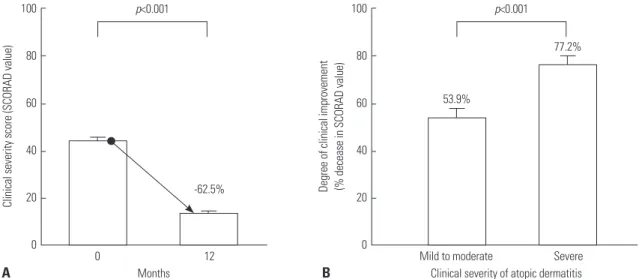
SCORAD values significantly decreased from 44.4±19.3 at baseline to 13.7±9.2 at 12 months (Wilcoxon signed-rank test, p<0.001) (Fig. 1A). The mean decrease in SCORAD value at 12 months, compared to baseline values, after SCIT was 62.5% in patients with AD. In patients with severe AD, the SCORAD val- ue significantly decreased from 64.9±12.4 at baseline to 14.6±
10.9 at 12 months (p<0.001). In patients with mild to moderate
Fig. 1. Change in clinical severity of atopic dermatitis from baseline to 12 months after subcutaneous allergen immunotherapy with house dust mites ex- tract in patients with atopic dermatitis (n=144) who received allergen immunotherapy with house dust mite extract for 12 months (A), and the degrees of clinical improvements in patients with mild to moderate atopic dermatitis and patients with severe atopic dermatitis who received allergen immunothera- py with house dust mite extract for 12 months, at 12 months compared to baseline (B). Data are expressed as means±standard error of the mean. Clinical severity score was expressing as standardized clinical severity scoring system for atopic dermatitis (SCORAD) value. Severe atopic dermatitis was de- fined as a baseline SCORAD value above 50.
100
80
60
40
20
0
100
80
60
40
20
12 0 Severe
Months Clinical severity of atopic dermatitis
p<0.001 p<0.001
-62.5%
53.9%
77.2%
0 Mild to moderate
Clinical severity score (SCORAD value) Degree of clinical improvement (% decease in SCORAD value)
A B
AD, the SCORAD value significantly decreased from 32.1±9.9 at baseline to 13.2±8.1 at 12 months (p<0.005). There was a sig- nificant difference in the mean percentages of decreases in SCORAD values at 12 months, compared to baseline, between patients with severe AD (77.2±17.2%) and patients with mild to moderate AD (53.9±31.7%) (Mann-Whitney U test, p<0.001) (Fig. 1B). However, there was no significant difference in the mean percentages of decreases in the SCORAD values at 12 months, compared to baseline, between the accelerated sched- ule group (64.1±23.1%) and cluster schedule group (59.9±41.6%) (p=0.741). A favorable clinical response to SCIT with a decrease in SCORAD value at 12 months greater than 50%, compared to baseline value, was observed in 106 (73.6%) of 144 patients (Table 2). The proportion of patients with a favorable clinical response was significantly higher in patients with severe AD (90.6%, 48/53) than patients with mild to moderated AD (63.7%, 58/91) at 12 months after SCIT (p<0.001). The proportion of patients showing a decrease in SCORAD value at 12 months gr- eater than 75%, compared to baseline value, was significantly higher in patients with severe AD (66.0%, 35/53) than patients with mild to moderated AD (29.7%, 27/91) (p<0.001) (Table 2).
Clinical characteristics of patients showing a favorable clinical response to SCIT
Baseline clinical and laboratory parameters were compared between patients showing a favorable clinical response to SCIT (responders) and patients showing no significant clinical re- sponse to SCIT (non-responders) among the 144 patients with AD who received the 12 months of SCIT. Baseline SCORAD values were significantly higher in the 106 responders (48.4±
18.3) than 38 non-responders (31.6±16.8) (p<0.001) (Table 3).
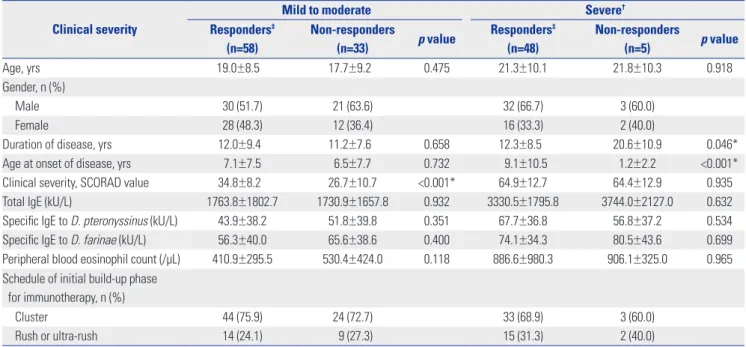
In 53 patients with severe AD who received 12 months of SCIT, 48 responders showed a significantly shorter duration of AD (12.3±8.5 years) than five non-responders (20.6±10.9 years) (p<0.05) (Table 4). In 53 patients with severe AD who received 12 months of SCIT, age of onset of AD was significantly higher in the 48 responders (9.1±10.5 years) than the five non-respond- ers (1.2±2.2 years) (p<0.001) (Table 4).
Changes in laboratory parameters
Laboratory parameters, including serum total IgE, specific IgE antibody to D. pteronyssinus, specific IgE antibody to D. fari- nae, and peripheral blood eosinophil count, were measured in 131 of 167 patients (78.4%) with AD at baseline and 12 months Table 2. Degree of Clinical Improvement in 144 Patients with Atopic Dermatitis Who Received Subcutaneous Allergen Immunotherapy with House Dust Mite Extract for 12 Months, at 12 Months Compared to Baseline
Total Mild to moderate (n=91) Severe (n=53) p value
SCORAD-50 (clinical improvement >50%)† 106 (73.6%) 58 (63.7%) 48 (90.6%) <0.001*
SCORAD-75 (clinical improvement >75%)‡ 62 (43.1%) 27 (29.7%) 35 (66.0%) <0.001*
SCORAD, standardized clinical severity scoring system for atopic dermatitis.
*p<0.05 is less than 0.05, †SCORAD-50: decrease of SCORAD values at 12 months compared to baseline >50%, ‡SCORAD-75: decrease of SCORAD values at 12 months compared to baseline >75%.
Table 3. Comparison of Baseline Clinical and Laboratory Parameters between Patients Showing a Favorable Clinical Response (Responders) and Patients Showing No Significant Clinical Response (Non-Responders) at 12 Months among Patients with Atopic Dermatitis Who Received Subcuta- neous Allergen Immunotherapy with House Dust Mite Extract for 12 Months
Responders (n=106)† Non-responders (n=38) p value
Age, yrs 20.1±9.3 18.2±9.3 0.291
Gender, n (%)
Male 62 (58.5) 24 (63.2)
Female 44 (41.5) 14 (36.8)
Duration of disease, yrs 12.1±8.9 12.4±8.6 0.850
Age at onset of disease, yrs 8.0±9.0 5.8±7.4 0.185
Clinical severity score, SCORAD value 48.4±18.3 31.6±16.8 <0.001*
Total IgE (kU/L) 2480.0±1955.1 1995.8±1828.0 0.186
Specific IgE to D. pteronyssinus (kU/L) 54.7±39.2 52.5±39.1 0.762
Specific IgE to D. farinae (kU/L) 64.4±38.4 65.8±39.1 0.851
Peripheral blood eosinophil count (/µL) 626.3±730.9 579.8±428.3 0.713
Schedule of initial build-up phase for immunotherapy, n (%)
Cluster 77 (72.6) 27 (71.1)
Rush or ultra-rush 29 (27.4) 11 (28.9)
SCORAD, standardized clinical severity scoring system for atopic dermatitis; D. pteronyssinus, Dermatophagoides pteronyssinus; D. farinae, Dermatophagoides farinae.
Data are expressed as means±SD or numbers with percentages.
*p<0.05 is less than 0.05, †Responders: patients with atopic dermatitis showing a favorable clinical response to subcutaneous allergen immunotherapy as a de- crease clinical severity score at 12 months greater than 50% compared to baseline value.
after SCIT. Serum total IgE concentrations significantly de- creased from 2379.4±1956.2 kU/L at baseline to 2165.7±1837.8 kU/L at 12 months (p=0.012) (Table 5). In patients with severe AD, serum total IgE concentrations significantly decreased from 3387.0±1788.8 kU/L at baseline to 3017.9±1773.9 kU/L at 12 months (p<0.005). There was no significant difference of se- rum total IgE concentrations between baseline (1777.4±1806.7 kU/L) and 12 months (1656.4±1689.4 kU/L) in patients with mild to moderate AD (p>0.05). Peripheral blood total eosino-
phil counts significantly decreased from 610.0±681.4 µL at baseline to 398.1±332.0 µL at 12 months (p<0.001) (Table 5). In patients with severe AD, peripheral blood total eosinophil co- unts significantly decreased from 895.4±961.7 µL at baseline to 500.0±398.3 µL at 12 months (p<0.001). In patients with mild to moderate AD, peripheral blood total eosinophil counts sig- nificantly decreased from 439.5±344.3 µL at baseline to 335.3±
267.7 µL at 12 months (p<0.001). However, there was no sig- nificant difference in serum concentrations of specific IgE an- Table 4. Comparison of Baseline Clinical and Laboratory Parameters between Patients Showing a Favorable Clinical Response (Responders) and Patients Showing No Significant Clinical Response (Non-Responders) at 12 Months among Patients with Mild to Moderate Atopic Dermatitis and Patients with Severe Atopic Dermatitis Who Received Subcutaneous Allergen Immunotherapy with House Dust Mite Extract for 12 Months
Clinical severity
Mild to moderate Severe†
Responders‡ (n=58)
Non-responders
(n=33) p value Responders‡ (n=48)
Non-responders
(n=5) p value
Age, yrs 19.0±8.5 17.7±9.2 0.475 21.3±10.1 21.8±10.3 0.918
Gender, n (%)
Male 30 (51.7) 21 (63.6) 32 (66.7) 3 (60.0)
Female 28 (48.3) 12 (36.4) 16 (33.3) 2 (40.0)
Duration of disease, yrs 12.0±9.4 11.2±7.6 0.658 12.3±8.5 20.6±10.9 0.046*
Age at onset of disease, yrs 7.1±7.5 6.5±7.7 0.732 9.1±10.5 1.2±2.2 <0.001*
Clinical severity, SCORAD value 34.8±8.2 26.7±10.7 <0.001* 64.9±12.7 64.4±12.9 0.935
Total IgE (kU/L) 1763.8±1802.7 1730.9±1657.8 0.932 3330.5±1795.8 3744.0±2127.0 0.632
Specific IgE to D. pteronyssinus (kU/L) 43.9±38.2 51.8±39.8 0.351 67.7±36.8 56.8±37.2 0.534
Specific IgE to D. farinae (kU/L) 56.3±40.0 65.6±38.6 0.400 74.1±34.3 80.5±43.6 0.699
Peripheral blood eosinophil count (/µL) 410.9±295.5 530.4±424.0 0.118 886.6±980.3 906.1±325.0 0.965 Schedule of initial build-up phase
for immunotherapy, n (%)
Cluster 44 (75.9) 24 (72.7) 33 (68.9) 3 (60.0)
Rush or ultra-rush 14 (24.1) 9 (27.3) 15 (31.3) 2 (40.0)
D. pteronyssinus, Dermatophagoides pteronyssinus; D. farinae, Dermatophagoides farinae.
Data are expressed as means±SD or numbers with percentages.
*p<0.05 is less than 0.05, †Severe atopic dermatitis was defined as a baseline standardized clinical severity scoring system for atopic dermatitis (SCORAD) value above 50, ‡Responders: patients with atopic dermatitis showing a favorable clinical response to subcutaneous allergen immunotherapy as a decrease clinical severity score at 12 months greater than 50% compared to baseline value.
Table 5. Change in Laboratory Parameters in Patients with Atopic Dermatitis Who Received Subcutaneous Allergen Immunotherapy with House Dust Mite Extract from Baseline to 12 Months
Baseline (n=131) 12 month (n=131) p value
Total IgE (kU/L) 2379.4±1956.2 2165.7±1837.8 0.012*
Specific IgE to D. pteronyssinus (kU/L) 53.5±39.2 55.0±38.8 0.769
Specific IgE to D. farinae (kU/L) 64.0±38.5 65.2±38.1 0.481
Peripheral blood eosinophil count (/µL) 610.0±681.4 398.1±332.0 <0.001*
Clinical severity
Mild to moderate Severe
Baseline (n=82) 12 month (n=82) p value Baseline (n=49) 12 month (n=49) p value
Total IgE (kU/L) 1777.4±1806.7 1656.4±1689.4 0.354 3387.0±1788.8 3017.9±1773.9 0.004*
Specific IgE to D. pteronyssinus (kU/L) 45.8±39.1 46.9±38.2 0.893 66.4±36.2 68.5±36.4 0.752
Specific IgE to D. farinae (kU/L) 57.5±39.6 58.4±39.2 0.561 74.9±34.3 76.4±33.5 0.713
Peripheral blood eosinophil count (/µL) 439.5±344.3 335.3±267.7 <0.001* 895.4±961.7 500.0±398.3 <0.001*
D. pteronyssinus, Dermatophagoides pteronyssinus; D. farinae, Dermatophagoides farinae.
Data are expressed as means±SD.
*p<0.05 is less than 0.05.
tibody to D. pteronyssinus (p=0.77) and specific IgE antibody to D. farinae (p=0.48) between baseline and 12 months after SCIT (Table 5).
Side effects
Twenty six of the 251 patients (10.4%) showed systemic reac- tions during the initial build-up phase of SCIT. Localized or generalized urticarial was observed in 21 patients (8.4%) and mild bronchospasm (mild dyspnea without wheezing) was seen in 5 patients (2.0%). In 70 patients who received accelerated schedules for initial build-up phase of SCIT, localized or gen- eralized urticaria was observed in 13 patients (18.6%), and mild bronchospasm (mild dyspnea without wheezing) was observed in 5 patients (7.1%). In 181 patients who received cluster sched- ules for initial build-up phase of SCIT, localized or generalized urticaria was observed in 8 patients (4.4%). Systemic reactions were significantly more frequently observed in patients who re- ceived accelerated schedules (18 of 70 patients, 25.7%) than the patients who received cluster schedules (8 of 181 patients, 4.4%), for the initial build-up phase (p<0.001). Grades of systemic reac- tions associated with SCIT ranged from grades 1 to 2 according to EAACI criteria. There was no case of patients who experi- enced anaphylaxis. Urticaria or bronchospasm rapidly resolved following intravenous administration of 4 mg of chlorphenira- mine and 5 mg of dexamethasone and/or inhalation of short- acting bronchodilator.
DISCUSSION
In this study, a favorable clinical response to SCIT with HDM extract was observed in 73.6% of patients with AD sensitized to HDM at 12 months. A proportion of patients showing a favor- able clinical response to SCIT was significantly higher in pa- tients with severe AD (90.6%) than patients with mild to mod- erated AD (63.7%). This result is consistent with results from a previous randomized placebo-controlled clinical study of SCIT with HDM extract which showed significantly greater clinical improvements in patients with severe AD who received SCIT than patients with severe AD who received placebo treatment.17 These results suggest that SCIT is a clinically useful therapeu- tic option for patients with severe AD sensitized to HDM.
In this study, patients with severe AD showing a favorable clinical response had a significantly shorter duration of AD (12.3±8.5 years) than patients with severe AD showing no sig- nificant clinical response (20.6±10.9 years). In patients with allergic rhinitis, patients showing a favorable clinical response to SCIT had a significantly shorter duration of symptom than patients showing no significant clinical response to SCIT in a previous study.18 In patients with AD, clinical outcomes for SCIT were better in patients younger than 12 years of age than patients older than 12 years in a previous study.19 These re- sults suggest that early initiation of SCIT after onset of symp-
toms might provide a favorable clinical outcome in patients with severe AD sensitized to HDM.
The reason for the decreased therapeutic efficacy of SCIT in patients with severe AD with a long duration of disease might be associated with the natural course of AD. A hypothesis sug- gested a concept of natural evolution of AD from nonallergic AD in infants to allergic AD in children and young adults, and eventually to autoallergic AD in adults.20 In the acute stage of AD, Th2 immune responses are suggested to play a major role.20 However, Th1 immune responses and autoallergic reactions to self-protein have been suggested to play a role in the devel- opment of chronic AD.21 In this study, the significantly shorter duration of disease in patients with severe AD showing a fa- vorable clinical response to SCIT, compared to patients with severe AD showing no significant clinical response to SCIT, is consistent with the above hypothesis. The natural course of AD seems to be a time-dependent evolutional process. There- fore, early initiation of SCIT in patients with severe AD at the stage of allergic AD might change the natural course of AD and improve long-term clinical outcome, as suggested by the data of this study.
The most important limitation of SCIT to be a standard treat- ment method for AD is a lack of objective clinical and labora- tory parameters to predict the clinical efficacy of SCIT before the initiation of the treatment. Previous studies on the analysis of predictive factors for the clinical efficacy of SCIT in patients with allergic rhinitis and allergic asthma have suggested that levels of total serum IgE or allergen-specific IgE could be used as a predictive marker for clinical efficacy of SCIT.22 In this study, we could not find any differences in baseline laboratory parameters between patients with AD showing a favorable clinical response to SCIT and the patients with AD showing no significant clinical response to SCIT, similar to a previous study.19 Further studies to identify predictive biomarker for clinical efficacy of SCIT in patients with AD are needed.23
Another important problem in the clinical application of SCIT for the treatment of patients with AD is a lack of knowl- edge on the expected degree of its clinical efficacy. This is a clinically important issue because clinicians should explain the chance of meaningful clinical improvement in patients with AD sensitized to HDM before the initiation of SCIT with HDM extract. In this study, we defined a favorable clinical re- sponse to SCIT as a decrease in SCORAD value at 12 months greater than 50% (SCORAD-50), compared to baseline, and a favorable clinical response were observed in 73.6% of patients with AD after SCIT for 12 months. Improvement of clinical se- verity at 12 months greater than 75% (SCORAD-75), com- pared to baseline, was observed in 66.0% of patients with se- vere AD who received SCIT with HDM extracts for 12 months.
Treatment with anti-IL 4 receptor alpha monoclonal antibody has an advantage of early onset of clinical efficacy in patients with AD, and allergen immunotherapy has a possible advan- tage of long-term clinical efficacy in patients with AD, as shown
in previous studies on allergic asthma and allergic rhinitis.4,7,8 Future clinical trials of combinations of allergen immunothera- py and monoclonal antibody therapy or polyclonal immuno- globulin therapy might improve the long-term therapeutic out- comes of patients with AD.3,4,12,13,24
This study has an important limitation. This was an observa- tional study on the clinical efficacy of SCIT in patients with AD.
Therefore, our study is limited by the possible involvement of a placebo effect from the natural clinical course in patients with AD. Randomized placebo-controlled clinical studies are need- ed for precise evaluation of the degree of the clinical efficacy of SCIT over a placebo in patients with AD. Nevertheless, the re- sults of our study provide useful information on the degree of long-term clinical efficacy of SCIT for AD and clinical charac- teristics of patients with severe AD showing a favorable clini- cal response to SCIT in a real clinical practice setting. Further studies are needed to evaluate the clinical usefulness of SCIT for AD.
In conclusion, SCIT could be a clinically useful therapeutic option for the patients with severe AD sensitized to HDM, and early initiation of SCIT might provide a favorable clinical out- come in patients with severe AD sensitized to HDM.
ACKNOWLEDGEMENTS
This work was supported by the National Research Foundation of Korea (NRF) grant funded by the Korea government (MSIP) (No. 2014R1A2A1A11049386) and the grant of the Korean Health Technology R&D Project, Ministry for Health, Welfare & Family Affairs, Republic of Korea (A102065).
REFERENCES
1. Akdis CA, Akdis M, Bieber T, Bindslev-Jensen C, Boguniewicz M, Eigenmann P, et al. Diagnosis and treatment of atopic dermatitis in children and adults: European Academy of Allergology and Clini- cal Immunology/American Academy of Allergy, Asthma and Im- munology/PRACTALL Consensus Report. J Allergy Clin Immunol 2006;118:152-69.
2. Bieber T. Atopic dermatitis 2.0: from the clinical phenotype to the molecular taxonomy and stratified medicine. Allergy 2012;67:
1475-82.
3. Nahm DH. Personalized immunomodulatory therapy for atopic dermatitis: an allergist’s view. Ann Dermatol 2015;27:355-63.
4. Beck LA, Thaçi D, Hamilton JD, Graham NM, Bieber T, Rocklin R, et al. Dupilumab treatment in adults with moderate-to-severe atopic dermatitis. N Engl J Med 2014;371:130-9.
5. Nahm DH, Cho SM, Kim ME, Kim YJ, Jeon SY. Autologous immu- noglobulin therapy in patients with severe recalcitrant atopic der- matitis: a preliminary report. Allergy Asthma Immunol Res 2014;
6:89-94.
6. Nahm DH, Kim ME, Cho SM. Effects of intramuscular injection of autologous immunoglobulin on clinical severity and serum IgE
concentration in patients with atopic dermatitis. Dermatology 2015;
231:145-51.
7. Bousquet J, Lockey R, Malling HJ. Allergen immunotherapy: thera- peutic vaccines for allergic diseases. A WHO position paper. J Aller- gy Clin Immunol 1998;102:558-62.
8. Pipet A, Botturi K, Pinot D, Vervloet D, Magnan A. Allergen-specific immunotherapy in allergic rhinitis and asthma. Mechanisms and proof of efficacy. Respir Med 2009;103:800-12.
9. Bae JM, Choi YY, Park CO, Chung KY, Lee KH. Efficacy of allergen- specific immunotherapy for atopic dermatitis: a systematic review and meta-analysis of randomized controlled trials. J Allergy Clin Immunol 2013;132:110-7.
10. Hanifin JM, Rajka G. Diagnostic features of atopic eczema. Acta Derm Venereol Suppl (Stockh) 1980;92 Suppl:S44-7.
11. Kim ME, Kim JE, Sung JM, Lee JW, Choi GS, Nahm DH. Safety of accelerated schedules of subcutaneous allergen immunotherapy with house dust mite extract in patients with atopic dermatitis. J Korean Med Sci 2011;26:1159-64.
12. Nahm DH, Lee ES, Park HJ, Kim HA, Choi GS, Jeon SY. Treatment of atopic dermatitis with a combination of allergen-specific immu- notherapy and a histamine-immunoglobulin complex. Int Arch Allergy Immunol 2008;146:235-40.
13. Nahm DH, Kim ME. Treatment of severe atopic dermatitis with a combination of subcutaneous allergen immunotherapy and cyclo- sporin. Yonsei Med J 2012;53:158-63.
14. European Task Force on Atopic Dermatitis: Severity scoring of atopic dermatitis: the SCORAD index. Dermatology 1993;186:23-31.
15. Oranje AP, Glazenburg EJ, Wolkerstorfer A, de Waard-van der Spek FB. Practical issues on interpretation of scoring atopic derma- titis: the SCORAD index, objective SCORAD and the three-item severity score. Br J Dermatol 2007;157:645-8.
16. Canonica GW, Baena-Cagnani CE, Bousquet J, Bousquet PJ, Lock- ey RF, Malling HJ, et al. Recommendations for standardization of clinical trials with Allergen Specific Immunotherapy for respiratory allergy. A statement of a World Allergy Organization (WAO) task- force. Allergy 2007;62:317-24.
17. Novak N, Bieber T, Hoffmann M, Fölster-Holst R, Homey B, Werfel T, et al. Efficacy and safety of subcutaneous allergen-specific im- munotherapy with depigmented polymerized mite extract in atop- ic dermatitis. J Allergy Clin Immunol 2012;130:925-31.
18. Kang MS, Choe YH, Heo YG, Kim HJ, Kim NS. The effect and pre- diction of efficacy of immunotherapy with mixed-allergen extracts in respiratory allergy patients. Korean J Med 1992;42:297-305.
19. Lee J, Lee H, Noh S, Bae BG, Shin JU, Park CO, et al. Retrospective analysis on the effects of house dust mite specific immunotherapy for more than 3 years in atopic dermatitis. Yonsei Med J 2016;57:
393-8.
20. Bieber T. Atopic dermatitis. N Engl J Med 2008;358:1483-94.
21. Tang TS, Bieber T, Williams HC. Does “autoreactivity” play a role in atopic dermatitis? J Allergy Clin Immunol 2012;129:1209-15.
22. Li Q, Li M, Yue W, Zhou J, Li R, Lin J, et al. Predictive factors for clin- ical response to allergy immunotherapy in children with asthma and rhinitis. Int Arch Allergy Immunol 2014;164:210-7.
23. Lee J, Park CO, Lee KH. Specific immunotherapy in atopic dermati- tis. Allergy Asthma Immunol Res 2015;7:221-9.
24. Nahm DH, Ahn A, Kim ME, Cho SM, Park MJ. Autologous immu- noglobulin therapy in patients with severe recalcitrant atopic der- matitis: long-term changes of clinical severity and laboratory pa- rameters. Allergy Asthma Immunol Res 2016;8:375-82.