Otolaryngology & Dermatology 2013;26(1):82-96 pISSN 1738-6640 eISSN 2234-4020
http://www.ood.or.kr http://dx.doi.org/10.6114/jkood.2013.26.1.082
Original Article / 원저
아토피 피부염의 레이저 치료에 관한 논문 경향 분석
조재명·홍은주·서형식 부산대학교 한의학전문대학원
Reviewing Research on Laser Therapy of Atopic Dermatitis
Jae-Myung Cho·Eun-Ju Hong·Hyung-Sik Seo School of Korean Medicine, Pusan National University
Abstract
Objective : The purpose of this study is to analyze research trends on the effects of laser therapy on atopic dermatitis.
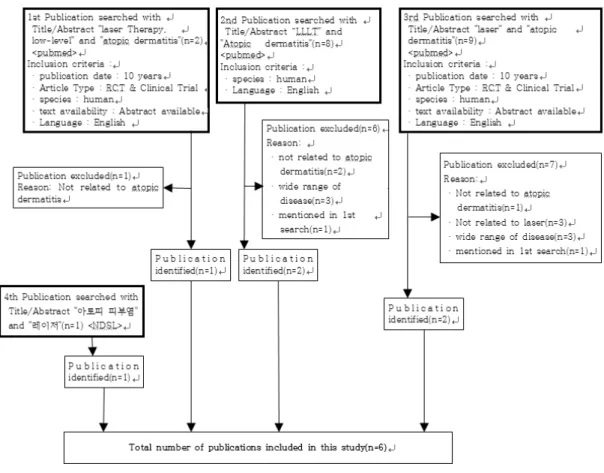
Methods : We searched papers using pubmed, First search used the keyword “Laser Therapy, Low-level and Atopic dermatitis". Inclusion criteria were last 10 years, RCT, Clinical trial, Human. Second search used the keyword
“LLLT and Atopic dermatitis". Inclusion criteria were Human. Third search used the keyword “Laser and Atopic dermatitis". Inclusion criteria was the same as first search. Finally we searched papers using the keyword “Laser and Atopic dermatitis" in NDSL and RISS. Papers not matched with inclusion criteria were excluded.
Results : A total 20 studies were found, 14 studies were excluded and 6 studies were selected and analyzed.
They turned out to be effective and no serious side-effect, but there was mild side-effect in 2 papers out of 4 papers using high-level laser.
Conclusions : Low-level laser and high-level laser therapy, both can be effectively used as an alternative to the treatment of atopic dermatitis. Thus further attention and studies are needed on this topic in order to reduce the side effects and demonstrate the effectiveness clearly.
Key words : Atopic dermatitis; Laser therapy; Review
ⓒ 2013 the Society of Korean Medical Ophthalmology & Otolaryngology & Dermatology
This is an Open Access journal distributed under the terms of the Creative Commons Attribution Non-Commercial License (http://creativecommons.org/license/by-nc/3.0/) which permits unrestricted non-commercial use, distribution, and reproduction in any medium, provided the original work is properly cited.
교신저자 : 서형식, 경남 양산시 물금읍 범어리 부산대학교 한의학전문대학원
(Tel : 055-360-5636, E-mail : [email protected])
∙
접수 2013/1/12∙
수정 2013/2/7∙
채택 2013/2/14Ⅰ. 서 론
아토피 피부염은 주로 유아기 혹은 소아기에 시작 되는 만성적이고 재발성의 염증성 피부질환으로 가려 움증과 피부건조증, 특징적인 습진을 동반한다. 유아 습진에서부터 소년기, 사춘기, 성인에까지 나타나는 전형적인 과민성 피부질환으로 홍반, 구진, 태선화 및 인설을 동반한 건성 피부병변이 특징적 소견이라 할 수 있다1). 2007년 국민건강영양조사(보건복지부)에 의하면 아토피피부염의 의사진단율은 만 11세 이하가 전체 20.6% 중 남자 18.8%, 여자 22.3%로 가장 높 았으며, 아토피피부염의 유병율은 1,000명당 53.8명 으로 조사되었으며, 아토피피부염은 일반적으로 연령 이 증가할수록 유병율이 감소하고 대부분 경한 경과 를 갖는 질환으로 알려져 있으나 최근 연구결과에 의 하면 10년 전과 비교하여 7세 이상 아동의 유병율이 증가하였을 뿐만 아니라 중증 환자의 구성비도 높아 진 것으로 보고되고 있다2).
아토피 피부염의 원인은 T림프구 및 백혈구의 면역 학적, 비면역학적 이상으로 알려지고 있으나 근본원 인에 대한 기전은 알려지지 않고 있다. 아토피 피부염 의 치료로는 국소 부신피질호르몬제, 항히스타민제 등이 있으나, 국소 부신피질호르몬제의 경우에는 피 부가 얇아지고, 위축되며 말초혈관확장, 접촉성 피부 염 유발, 일광에 대한 과민성 등 다양한 부작용을 일 으킬 수 있으므로 이러한 부작용이 없는 대체 치료 방법들이 거론, 시행되고 있다. 그 중 하나가 레이저 치료법이다.
광치료(Phototherapy)요법은 전 세계적으로 고대에 서부터 행해져 온 오래된 치료법의 하나로 1903년 덴 마크의 핀센에 의해 치료 원리가 처음으로 규명되었 다. 광치료에 사용하는 광원은 여러 가지인데 그 중
대표적인 것이 레이저이다. 레이저는 최근에 나온 가 장 발전된 광원으로서, ‘LASER’는 ‘Light Amplification by Stimulated Emission of Radiation’의 약자이다3). 레이저는 인위적으로 만들어진 고유 파장을 가진 빛 으로서 출력에 따라 고출력과 저출력 레이저로 구분 하는데, 고출력 레이저는 3,000∼10,000㎽ 정도로 외 과적인 수술과정에서 조직을 절개하는데 사용되고 그 과정에서 열을 방출한다. 저출력 레이저는 1∼500㎽
정도로 열을 발생하지 않는 상태에서 광에너지를 이 용한다4). 고출력레이저는 열을 발생시켜 수분을 증발 시킴으로서 세포나 조직을 태우는 불가역적인 반응효 과를 보이는 반면, 저출력레이저는 열을 발생시키지 않고, 세포손상 없이 피부표면을 통과하여 광 에너지를 신체 내부로 전달함으로써 손상부위의 치유 및 고통 완 화에 이용되는 가역적인 생체 촉진 효과가 있다5,6). 한의학적인 치료방법에는 한약재를 이용한 외용제 의 도포방법7)과 탕약 또는 환약 복용을 통한 면역조
절작용8-10) 등 다양한 방법이 있지만, 아토피 피부염의
선택치료로서 고출력 및 저출력 레이저 치료법이 이 용되고 있는 바, 본 저자는 이러한 아토피 피부염에 대한 레이저 치료법 관련 논문 현황을 살펴볼 필요가 있어, Pubmed, NDSL, RISS 등의 검색을 통해 알아 보고자 하였다.
Ⅱ. 연구방법
아토피 피부염의 레이저 치료에 관한 문헌을 조사 하기 위해서 PubMed와 NDSL을 이용하여 총 4차례 의 검색을 실시하였다.
1. 1차 검색 - 해외논문, 저출력레이저 중심으로 검색
1) 검색사이트 Pubmed
2) 검색어
저단계 레이저 치료에 해당하는 표준검색어 (Medical Subject Headings: MeSH)인 “Laser Therapy, Low-level” and “Atopic dermatitis”
3) 조건
Published in the last 10 years, RCT, Clinical Trial, Human
4) 검색결과
총 2편의 논문 검색, 그 중 제목과 초록을 검토한 결과 적합한 1편 선별.
2. 2차 검색 - 1차 검색에서 검색조건을 확장
1) 검색사이트 Pubmed
2) 검색어
“LLLT” and “Atopic dermatitis”
3) 조건 Human
4) 검색결과
총 8편의 논문 검색, 그 중 제목과 초록을 검토한 결과 적합한 논문 2편 선별.
3. 3차 검색 - 1차 검색에서 고출력레이저 영역 까지 확장
1) 검색사이트 Pubmed
2) 검색어
“Laser” and “Atopic dermatitis”
3) 조건
Published in the last 10 years, RCT, Clinical Trial, Human
4) 검색결과
총 9편의 논문 검색, 그 중 제목과 초록을 검토한 결과 적합한 논문 2편이 선별.
4. 4차 검색 - 국내논문 검색
1) 검색사이트 NDSL
2) 검색어
“아토피피부염” and “레이저”
3) 조건 없음.
4) 검색결과
총 1편의 논문 검색, 제목과 초록을 검토한 결과 적 합한 논문으로 채택.
총 4차례의 검색결과 6편의 관련 논문이 검색되었 고, 레이저 종류별로 보면 저출력레이저 2편, 고출력 레이저가 4편이었다(Table 1).
Ⅲ. 결 과
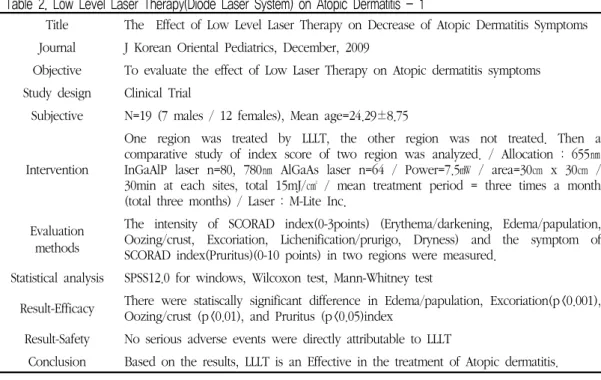
1. The Effect of Low Level Laser Therapy on Decrease of Atopic Dermatitis Symptoms (Table 2)
– 저출력 레이저 치료(LLLT)가 아토피 피부염의 증상 완화에 미치는 영향 (2009, 한국)11)
Table 1. Flowchart of the Article Selection Process.
본 논문은 아토피 피부염으로 한방치료를 받고 있 는 환자 19명을 대상으로 하였으며, 2009년 2월∼7월 까지 내원한 환자에게 한약과 침치료, 그리고 저출력 레이저를 병행하여 4∼14회 치료를 시행하였다. 저출 력 레이저 치료를 시행한 부위와 그렇지 않은 부위의 호전정도를 SCORAD index에서 정도(intensity)의 평 가 항목들과 주관적 증상평가항목인 pruritus를 이용 하여 평가하였으며, 증상이 가장 심한 곳이면서 좌우 비교가 용이한 부위를 레이저 치료의 대상 부위로 정 하였다. 구체적인 평가항목들은 Table 2에 구체적으 로 기술하였다. 저출력 레이저 치료를 받은 부위와 받 지 않은 부위의 치료 전 후 항목별 점수 차이를 비교 해본 결과 7항목 모두 레이저 치료를 받은 부위가 받
지 않은 부위보다 효과가 뚜렷하였다. 이는 저출력 치 료가 국소 알레르기 반응을 낮추고 면역반응을 조절 하는 것과 유사한 기전을 보이는 것으로 생각된다.
Erythema/Darkening, Lichenification/Prurigo, Dryness 항목 점수에서는 통계적으로 유의하지 않았 지만, 나머지 항목에서는 통계적으로 유의한 차이를 보였다. 이는 저출력 레이저가 아토피 피부질환을 어 떠한 기전으로 치료하는지에 대해 명확하게 밝혀져 있지 않기 때문에 항목별 유의한 차이의 유무에 대한 해답을 제시하지 못하고 있다. 따라서 저출력 레이저 조사 시 생체 각 기관에서 발생하는 변화 기전 및 가 장 적절한 치료 간격, 시간, 파장 등을 설정하는 추가 적인 연구가 필요하다고 생각된다.
Table 2. Low Level Laser Therapy(Diode Laser System) on Atopic Dermatitis - 1
Title The Effect of Low Level Laser Therapy on Decrease of Atopic Dermatitis Symptoms Journal J Korean Oriental Pediatrics, December, 2009
Objective To evaluate the effect of Low Laser Therapy on Atopic dermatitis symptoms Study design Clinical Trial
Subjective N=19 (7 males / 12 females), Mean age=24.29±8.75
Intervention
One region was treated by LLLT, the other region was not treated. Then a comparative study of index score of two region was analyzed. / Allocation : 655㎚
InGaAlP laser n=80, 780㎚ AlGaAs laser n=64 / Power=7.5㎽ / area=30㎝ x 30㎝ / 30min at each sites, total 15mJ/㎠ / mean treatment period = three times a month (total three months) / Laser : M-Lite Inc.
Evaluation methods
The intensity of SCORAD index(0-3points) (Erythema/darkening, Edema/papulation, Oozing/crust, Excoriation, Lichenification/prurigo, Dryness) and the symptom of SCORAD index(Pruritus)(0-10 points) in two regions were measured.
Statistical analysis SPSS12.0 for windows, Wilcoxon test, Mann-Whitney test
Result-Efficacy There were statiscally significant difference in Edema/papulation, Excoriation(p<0.001), Oozing/crust (p<0.01), and Pruritus (p<0.05)index
Result-Safety No serious adverse events were directly attributable to LLLT
Conclusion Based on the results, LLLT is an Effective in the treatment of Atopic dermatitis.
Table 3. Low Level Laser Therapy(Diode Laser System) on Atopic Dermatitis - 2
Title Clinical Application of Low Reactive Level Laser Therapy for Atopic Dermatitis Journal Keio J Med August 2, 1993
Objective To evaluate the effect of Low Laser Therapy(diode laser system) on Atopic dermatitis symptoms
Study design Clinical Trial
Subjective N= 112(62 females / 50 males) age=3∼45 (Mean age=18)
Intervention
A diode laser system(Luketron) was used for the treatment of AD patients. / Allocation : 830㎚ GaAlAs laser / Power=60㎽ cw beam / area=100㎠ / 120sec at skin lesion on the trunk, face or extremities, total 72mJ/㎠ / mean treatment period = once a month (from November. 1991 to April, 1993) / Laser : Matsushita Electrical Company
Evaluation methods
The evaluation of skin symptoms before and after LLLT was conducted according to the evaluation list. The evaluation list of skin symptom scores is dry skin, follicular keratosis, pityriasic scale, excoriation marks, erythema, papules, lichenification. Severe symptoms were graded as 3 points, moderate symptoms as 2 points, mild symptoms as 1 point, and no symptoms as 0 points. And Itchy sensation score was evaluated as grade 3, 2, 1, 0
Statistical analysis unknown Result-Efficacy
In 69 cases out of 112(62%), the skin symptom scores decreased more than 5 points after LLLT. In 79cases out of 112(71%), the itchy sensation scores decreased more than 1 point after LLLT
Result-Safety No serious adverse events were directly attributable to LLLT Conclusion
The treatment was effective for the decrease in itchy sensation in 71% of the cases.
Skin eruptions improved in 62% of cases. Based on evidence, we consider that LLLT
may become a new therapy of choice for the treatment of AD.
2. Clinical Application of Low Reactive Level Laser Therapy for Atopic Dermatitis(Table 3) – 아토피 피부염에 대한 저출력 레이저 치료의 임
상적 응용 (1993, 일본)12)
본 논문은 아토피 피부염 증상을 보이는 환자 112 명을 대상으로 하였으며, 1991년 11월∼1993년 3월 까지 저출력 레이저 치료를 시행하였다. 평가항목들 은 Table 3에 구체적으로 기술하였으며, 저출력 레이
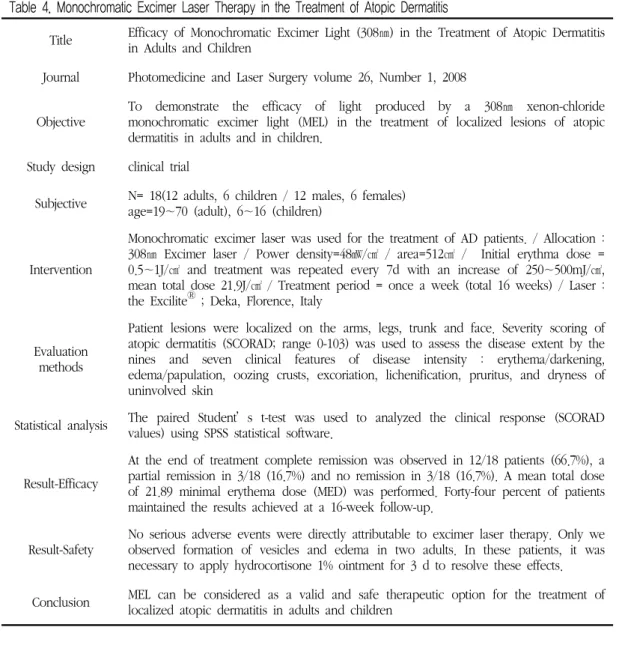
Table 4. Monochromatic Excimer Laser Therapy in the Treatment of Atopic Dermatitis
Title Efficacy of Monochromatic Excimer Light (308㎚) in the Treatment of Atopic Dermatitis in Adults and Children
Journal Photomedicine and Laser Surgery volume 26, Number 1, 2008
Objective
To demonstrate the efficacy of light produced by a 308㎚ xenon-chloride monochromatic excimer light (MEL) in the treatment of localized lesions of atopic dermatitis in adults and in children.
Study design clinical trial
Subjective N= 18(12 adults, 6 children / 12 males, 6 females) age=19∼70 (adult), 6∼16 (children)
Intervention
Monochromatic excimer laser was used for the treatment of AD patients. / Allocation : 308㎚ Excimer laser / Power density=48㎽/㎠ / area=512㎠ / Initial erythma dose = 0.5∼1J/㎠ and treatment was repeated every 7d with an increase of 250∼500mJ/㎠, mean total dose 21.9J/㎠ / Treatment period = once a week (total 16 weeks) / Laser : the Excilite
Ⓡ; Deka, Florence, Italy
Evaluation methods
Patient lesions were localized on the arms, legs, trunk and face. Severity scoring of atopic dermatitis (SCORAD; range 0-103) was used to assess the disease extent by the nines and seven clinical features of disease intensity : erythema/darkening, edema/papulation, oozing crusts, excoriation, lichenification, pruritus, and dryness of uninvolved skin
Statistical analysis The paired Student’s t-test was used to analyzed the clinical response (SCORAD values) using SPSS statistical software.
Result-Efficacy
At the end of treatment complete remission was observed in 12/18 patients (66.7%), a partial remission in 3/18 (16.7%) and no remission in 3/18 (16.7%). A mean total dose of 21.89 minimal erythema dose (MED) was performed. Forty-four percent of patients maintained the results achieved at a 16-week follow-up.
Result-Safety
No serious adverse events were directly attributable to excimer laser therapy. Only we observed formation of vesicles and edema in two adults. In these patients, it was necessary to apply hydrocortisone 1% ointment for 3 d to resolve these effects.
Conclusion MEL can be considered as a valid and safe therapeutic option for the treatment of localized atopic dermatitis in adults and children
저 시술 전후로 평가하였다. 먼저 Skin Symptom Score 평가에 있어서, 총 112명 중 69명이 저출력 레 이저 시술 후 5점 이상 감소하는 효과를 보였고, 112 명 중 79명이 Itchy Sensation Score 평가에서 1점 이상의 감소효과를 보였다. 저출력 레이저 시술 과정 중이나, 시술 후 어떠한 부작용도 없었다. 저출력 레 이저가 아토피 피부염에 대한 새로운 치료법이 될 수 있다고 생각된다.
3. Efficacy of Monochromatic Excimer Light (308㎚) in the Treatment of Atopic Dermatitis in Adults and Children(Table 4)
– 성인과 유아의 아토피 피부염 치료에 있어서 308nm 단일파장 엑시머 레이저의 효과 (2008, 이탈리아)13)
본 논문은 고출력 레이저의 일종인 308㎚ 단일파장 엑시머 레이저를 이용한 성인과 유아의 아토피 피부 염 치료 효과를 알아보기 위해 계획되었다. 출력밀도 는 낮았지만, 점차 조사량을 높임으로써 치료효과를 보고자 하였다. 12명의 성인과 6명의 유아를 대상으 로 임상시험을 진행하였으며, 일주일에 한번 총 16주
Table 5. Xenon Chloride Excimer Laser Therapy in the Treatment of Atopic Dermatitis
Title Treatment of atopic dermatitis with the xenon chloride excimer laser
Journal JEADV 2006;20;657-660 ⓒ 2006 European Academy of dermatology and Venerelogy Objective To evaluate the therapeutic efficacy of the 308 ㎚ excimer laser in atopic dermatitis Study design clinical trial
Subjective N= 15(6 males / 9 females), age=13∼24 (mean age=17.3)
Intervention
Xenon chloride excimer laser was used for the treatment of AD patients. / Allocation : 308㎚ Xenon chloride excimer laser / Power density=unknown / area=unknown / Initial erythema dose = 150∼450mJ/㎠ with 50mJ/㎠ increments up to maximum dose of 2.1 J/㎠ (mean cumulative dose=1.66J/㎠) / treatment period = twice a week (total 4 weeks) / Laser : the XTRAC laser(Photomedex Inc.)
Evaluation methods
The local eczema area severity index(EASI) was used to determine the atopic dermatitis. The severity of the atopic dermatitis (less than 20% body area involvement) was assessed via (ⅰ) a clinical score characterizing the intensity of erythema, infiltration, lichenification and excoriation ; (ⅱ) the quality of life, determined by means of a questionnaire; and (ⅲ) a visual linear analogue scale, with which the patients scored the severity of their pruritus
Statistical analysis Friedman’s nonparametric repeated measures ANOVA, followed by the Student-Newman-Keuls multiple comparison procedure was used.
Result-Efficacy
After 1 month of laser therapy, the clinical scores were significantly lower than the initial values. Similar decreases were observed for the quality of life and pruritus scores. (Clinical scores : 58% reduction / Quality of life : 74% reduction / Visual linear analogue scale : 81% reduction)
Result-Safety No serious or unpleasant side-effects were observed.
Conclusion The xenon chloride excimer laser is an effective and well-tolerated treatment for localized atopic dermatitis.
에 걸쳐 팔, 다리, 몸통, 얼굴의 국소 부위를 대상으로 시행하였다. SCORAD를 측정지표로 총 7개 항목을 평가하였다. 구체적인 평가항목은 Table 4에 기술하 였다. 측정 결과 총 18명 중 12명(66.7%)의 환자는 완벽하게 호전, 3명(16.7%)은 부분적 호전, 3명 (16.7%)은 전혀 호전되지 않았다. 또한 평균 SCORAD가 4주 이후에 상당히 개선되었고 치료 말 미와 6주 follow-up 기간에도 꾸준히 개선되었다. 12 주차 follow-up 기간에 10명(55.5%)에게서 최대 호전 효과를 보였다. 하지만, 두 명의 성인 환자에게서 작 은 수포와 부종이 발견되었고, 3일마다 부신피질호르 몬의 일종인 하이드로코르티존 1% 연고를 발라주어
부작용을 해소하였다. 308㎚ 엑시머 레이저 치료법은 성인뿐만 아니라, 유아에게서 치료효과를 보였지만, 아토피 피부염 치료에 관하여 미국 FDA 승인이 이루 어지지 않은 상태이고, 부작용이 일부 발생한 바, 다 른 치료법과 함께 사용하면 더욱 좋은 치료효과를 보 여줄 수 있을 것이다. 이에 대한 추가 연구를 통해 안 정성과 효율성의 확보가 필요하다고 생각된다.
4. Treatment of atopic dermatitis with the xenon chloride excimer laser(Table 5) – xenon chloride 엑시머 레이저를 이용한 아토피
피부염의 치료 (2006, 헝가리)14)
본 논문은 3번에서 언급한 논문과 유사하게 308㎚
엑시머 레이저를 이용한 아토피 피부염 치료를 확인 하기 계획되었다. 출력밀도가 명시되어 있지 않았지 만, 최대 조사량을 2.1J/㎠까지 늘림으로써 치료효과 를 보고자 하였다. 13세에서 24세까지 총 15명의 환 자를 대상으로 하였으며 치료는 일주일에 2회, Clinical Score, Quality of life, Visual Linear Analogue Scale을 평가하는 EASI를 이용하였다. 처 음 조사량은 100mJ/㎠ 으로 시작하여, 점차 조사량을 늘려서 평균 누적 조사량이 1.66J/㎠ 이 되도록 하였 다. 세부적인 사항은 Table 5에 기술하였다. 치료부 위는 상하지 굽혀지는 부위로 하였고, 1달 동안의 치 료 후에 Clinical Score, Quality of life, Visual Linear Analogue Scale을 평가해본 결과 치료 전보다 각각 58%, 74%, 81% 감소효과를 보였다. 심각하거 나 불쾌한 부작용은 관찰되지 않았다. 308㎚ 엑시머 레이저의 경우에는 기존에 아토피 피부염 치료에 효 과적이었던 311㎚ narrow-band UVB (NB-UVB)에 비해서 관련된 국소부위에만 한정적으로 치료할 수 있어서 전신에 자외선 노출로 인한 여러 부작용 등을 해소할 수 있는 장점이 있다고 언급하였다. 하지만, 임상 시험 기간이 짧고, 시험 환자의 수가 작으므로, 더욱더 많은 무작위 임상 시험 환자의 수를 확보하여 레이저 치료의 효과를 확인하는 것이 필요하다고 생
각된다.
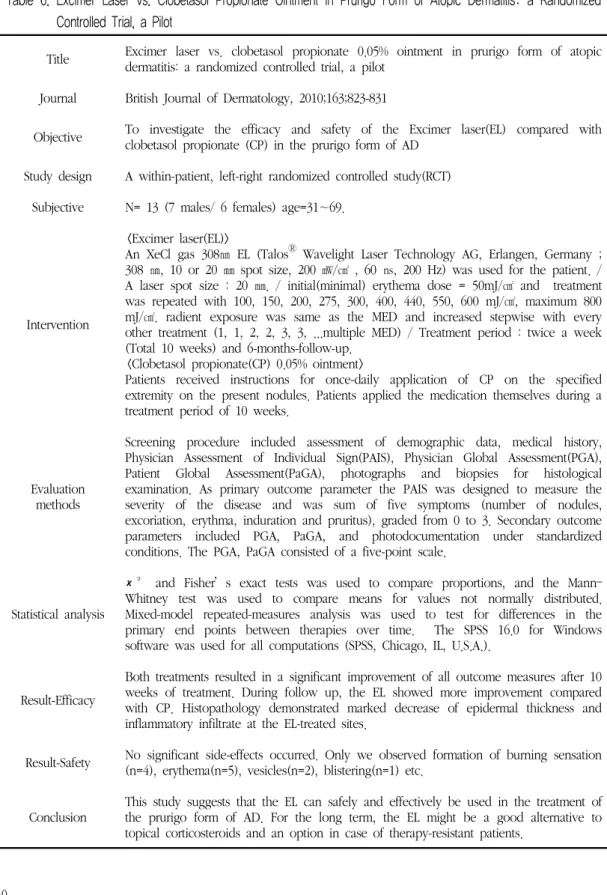
5. Eximer laser vs. clobetasol propionate 0.05%
ointment in prurigo form of atopic dermatitis : a randomized controlled trial, a pilot(Table 6) – 양진성 아토피 피부염에 대한 엑시머 레이저와
프로피온산 클로베타졸 연고의 비교, 무작위 대 조연구, 예비연구 (2010, 네덜란드)15)
본 논문은 무작위적으로 선정한 아토피 피부염 환 자를 대상으로 하여 고출력 레이저의 일종인 308㎚
단일파장 엑시머 레이저(EL)와 아주 강한 1단계로 분 류되는 프로피온산 클로베타졸(CP) 스테로이드 연고 의 치료 효과를 비교하기 위한 무작위 대조연구, 예비 연구이다. 기존 아토피 피부염에 대한 엑시머 레이저 치료에 대해 임상실험을 시행함에 있어 무작위 대조 연구를 최초로 시행했다는 점에서 의의가 있는 논문 이라 할 수 있다. 치료 효과를 비교하기 위한 주요 측 정지표로는 PAIS가 사용되었는데 이는 아토피 피부 염의 심한 정도를 나타내는 지표로서 치료 기간 10주 후에 결과를 보면 EL의 경우에는 처음 12.80±1.5에 서 7.5±2.9로 감소하였고, CP의 경우에는 처음 12.90±1.2에서 8.00±3.2로 감소한 것을 확인 할 수 있다. 또한 Follow-up 기간에는 EL의 경우 8.38±2.5 이고, CP의 경우에는 9.30±2.0으로 감소하여 차이를 확인할 수 있었다. 가려움증을 나타내는 측정지표로 쓰인 VAS의 경우 EL의 경우 63% 향상 되었고, CP 의 경우 49% 향상된 것을 확인할 수 있었다. 두 치료 법 모두 아토피 피부염에 효과가 있다는 결과를 얻을 수 있었지만, 6개월간의 follow-up 기간 동안 PAIS, VAS, PGA, PaGA 지표 결과를 살펴보면 엑시머 레 이저 치료가 프로피온산 클로베타졸 연고와 비교했 을 때 더욱 좋은 치료 효과를 보이는 것을 확인할 수 있었다. 조직병리학적인 측면에서도 엑시머 레이저 치료 효과가 더 크다는 것을 확인할 수 있었다. 이 논 문은 무작위 대조연구, 예비 연구로써, 대상자수가 적
Table 6. Excimer Laser vs. Clobetasol Propionate Ointment in Prurigo Form of Atopic Dermatitis: a Randomized Controlled Trial, a Pilot
Title Excimer laser vs. clobetasol propionate 0.05% ointment in prurigo form of atopic dermatitis: a randomized controlled trial, a pilot
Journal British Journal of Dermatology, 2010;163;823-831
Objective To investigate the efficacy and safety of the Excimer laser(EL) compared with clobetasol propionate (CP) in the prurigo form of AD
Study design A within-patient, left-right randomized controlled study(RCT) Subjective N= 13 (7 males/ 6 females) age=31∼69.
Intervention
<Excimer laser(EL)>
An XeCl gas 308㎚ EL (Talos
ⓇWavelight Laser Technology AG, Erlangen, Germany ; 308 ㎚, 10 or 20 ㎜ spot size, 200 ㎽/㎠ , 60 ㎱, 200 Hz) was used for the patient. / A laser spot size : 20 ㎜. / initial(minimal) erythema dose = 50mJ/㎠ and treatment was repeated with 100, 150, 200, 275, 300, 400, 440, 550, 600 mJ/㎠, maximum 800 mJ/㎠. radient exposure was same as the MED and increased stepwise with every other treatment (1, 1, 2, 2, 3, 3, ...multiple MED) / Treatment period : twice a week (Total 10 weeks) and 6-months-follow-up.
<Clobetasol propionate(CP) 0.05% ointment>
Patients received instructions for once-daily application of CP on the specified extremity on the present nodules. Patients applied the medication themselves during a treatment period of 10 weeks.
Evaluation methods
Screening procedure included assessment of demographic data, medical history, Physician Assessment of Individual Sign(PAIS), Physician Global Assessment(PGA), Patient Global Assessment(PaGA), photographs and biopsies for histological examination. As primary outcome parameter the PAIS was designed to measure the severity of the disease and was sum of five symptoms (number of nodules, excoriation, erythma, induration and pruritus), graded from 0 to 3. Secondary outcome parameters included PGA, PaGA, and photodocumentation under standardized conditions. The PGA, PaGA consisted of a five-point scale.
Statistical analysis
χ² and Fisher’s exact tests was used to compare proportions, and the Mann–
Whitney test was used to compare means for values not normally distributed.
Mixed-model repeated-measures analysis was used to test for differences in the primary end points between therapies over time. The SPSS 16.0 for Windows software was used for all computations (SPSS, Chicago, IL, U.S.A.).
Result-Efficacy
Both treatments resulted in a significant improvement of all outcome measures after 10 weeks of treatment. During follow up, the EL showed more improvement compared with CP. Histopathology demonstrated marked decrease of epidermal thickness and inflammatory infiltrate at the EL-treated sites.
Result-Safety No significant side-effects occurred. Only we observed formation of burning sensation (n=4), erythema(n=5), vesicles(n=2), blistering(n=1) etc.
Conclusion This study suggests that the EL can safely and effectively be used in the treatment of
the prurigo form of AD. For the long term, the EL might be a good alternative to
topical corticosteroids and an option in case of therapy-resistant patients.
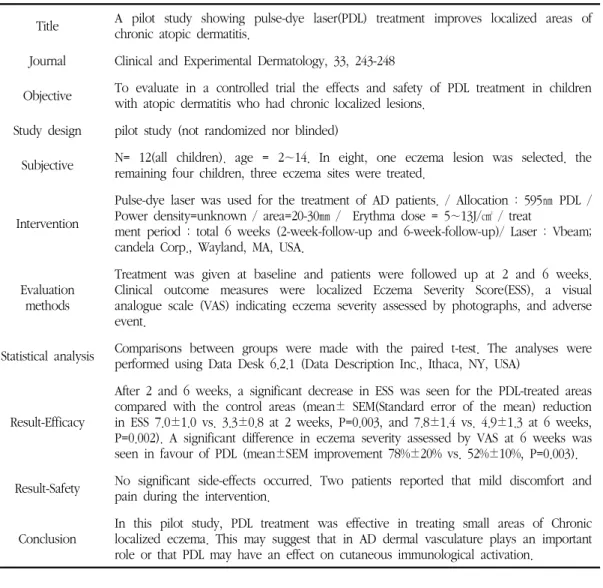
Table 7. Pulse-dye Laser Therapy in the Treatment of Atopic Dermatitis
Title A pilot study showing pulse-dye laser(PDL) treatment improves localized areas of chronic atopic dermatitis.
Journal Clinical and Experimental Dermatology, 33, 243-248
Objective To evaluate in a controlled trial the effects and safety of PDL treatment in children with atopic dermatitis who had chronic localized lesions.
Study design pilot study (not randomized nor blinded)
Subjective N= 12(all children). age = 2∼14. In eight, one eczema lesion was selected. the remaining four children, three eczema sites were treated.
Intervention
Pulse-dye laser was used for the treatment of AD patients. / Allocation : 595㎚ PDL / Power density=unknown / area=20-30㎜ / Erythma dose = 5∼13J/㎠ / treat
ment period : total 6 weeks (2-week-follow-up and 6-week-follow-up)/ Laser : Vbeam;
candela Corp., Wayland, MA, USA.
Evaluation methods
Treatment was given at baseline and patients were followed up at 2 and 6 weeks.
Clinical outcome measures were localized Eczema Severity Score(ESS), a visual analogue scale (VAS) indicating eczema severity assessed by photographs, and adverse event.
Statistical analysis Comparisons between groups were made with the paired t-test. The analyses were performed using Data Desk 6.2.1 (Data Description Inc., Ithaca, NY, USA)
Result-Efficacy
After 2 and 6 weeks, a significant decrease in ESS was seen for the PDL-treated areas compared with the control areas (mean± SEM(Standard error of the mean) reduction in ESS 7.0±1.0 vs. 3.3±0.8 at 2 weeks, P=0.003, and 7.8±1.4 vs. 4.9±1.3 at 6 weeks, P=0.002). A significant difference in eczema severity assessed by VAS at 6 weeks was seen in favour of PDL (mean±SEM improvement 78%±20% vs. 52%±10%, P=0.003).
Result-Safety No significant side-effects occurred. Two patients reported that mild discomfort and pain during the intervention.
Conclusion
In this pilot study, PDL treatment was effective in treating small areas of Chronic localized eczema. This may suggest that in AD dermal vasculature plays an important role or that PDL may have an effect on cutaneous immunological activation.
다는 한계가 있지만 무작위 대조 연구방법을 택해서 아토피 피부염 환자를 치료하는데 엑시머 레이저가 치료 효과가 있음을 입증하였다.
6. A pilot study showing pulse-dye laser(PDL) treatment improves localized areas of chronic atopic dermatitis.(Table 7)
– 만성 아토피 피부염의 국소부위를 개선하는 효 과를 보여주는 펄스형 색소 레이저의 예비 연구 (준비 조사) (2007, 영국)16)
본 논문은 아토피 피부염 치료에 대한 효과를 PDL 을 이용하여 시행하였다. PDL은 고출력 레이저의 일 종으로 선택적 광열분해라는 기본 개념에 바탕을 둔 색소 레이저이다. 0.5-1.2㎜ 깊이에 있는 피부혈관을 직접 타겟으로 하여 선택적으로 파괴하는데 사용되었 다. 색소레이저를 이용한 광역학치료는 일반적으로 탐색과 파괴의 두 단계로 실행되는데, 특정한 종양에 특이적인 항체를 24시간 전에 정맥 내에 주입한 후 색소가 집중된 영역이 나타나는데 이것은 종양의 존 재를 의미하고 형광을 나타내게 된다. 이 부위에 레이
저 광선을 조사하면 독성물질이 방출되어 종양세포를 죽이게 된다3). 최근에는 염증성 피부 질환, 건선 등의 치료 보고가 이루어졌고, 이 논문에서 처음으로 아토 피 피부염 치료에 대한 예비 연구를 수행하였다. 12 명이 유아를 대상으로 이루어졌고, 총 9개 부위(발목, 종아리, 무릎, 팔, 다리, 눈꺼풀, 뺨, 목, 손)를 환자마 다 부위가 다르게 하여 치료 시험을 진행하였다. 치료 횟수나 간격에 대한 언급은 없었으며, 2주, 6주 후에 평균 국소 ESS(Eczema Severity Score)를 측정 지표 로 하여 Table 7에서 언급된 총 6개의 임상지표의 점 수 합으로 치료 효과를 측정하였다. 또한 VAS(Visual Analogue Scale)도 추가로 시행하였다. PDL 치료 2 주 후에는 18개 치료부위 중 8개의 치료부위가 개선 되었고, 2개 부위가 완치 되었다. 그리고 6주 후에는 17개의 치료부위 중 13개 치료부위가 개선되었고, 9개 치료부위가 완치되었다. 6주 후 VAS 측정 결과 대조군 에 비하여 약 25% 개선 효과를 보였다. 본 예비 연구는 아토피 피부염 치료에 있어서 PDL을 이용한 최초연구 로써, 유아에게 어느 정도 효과가 입증되었지만, PDL의 선택적 광열분해에 의한 피부에 미치는 영향, 직접적으 로 피부 면역 활성화에 미치는 영향에 대한 불명확성을 추가 연구할 필요가 있다고 생각된다.
Ⅳ. 고 찰
아토피는 “이상한” 또는 “부적절한” 이란 의미로서 음식물에 의해서 혹은 흡입성 물질에 대한 알레르기 반응이 발생하는 경우를 일컫는다. 아토피 피부염은 유아와 소아에서 가장 흔한 염증성 피부질환으로 심 한 소양감, 홍반, 부종, 삼출, 인설, 태선화 등을 특징 으로 하는데 반복적인 소파로 인한 찰상과 태선화 등 2차적인 병변이 나타난다. 과거 1970년대까지는 아토 피 피부염의 발생 빈도가 6세 이하 어린이의 경우 약 3% 정도로 보고되었으나 최근에는 전 세계적으로 어 린이는 20% 이상, 성인은 1-3% 정도인 것으로 추정
되고 있다17).
아토피 피부염은 2001년 인구 천명당 5.7명이던 것 이 2005년에는 60.6명으로 10배 이상 증가했다는 보 고가 있을 정도로 심각한 질환이 되고 있으며, 이의 심각성을 인식한 정부는 2008년 27억원의 예산을 투 입해 천식 및 아토피 피부염 질환으로부터 국민 건강 을 보호한다는 대대적 방침을 공포했다. 아토피는 유 전적인 요소가 많은 것으로 알려져 있다. 아울러 면역 계 결핍과 관련되어 있다. 그 외에 피부가 건조하거 나, 정상인에 비해 쉽게 피부 가려움증을 느끼는 특 성, 세균·바이러스·곰팡이 등에 의한 감염, 환경적 요인이나 정서적 요인이 복합적으로 작용하여 발병하 는 것으로 보이지만, 명확한 원인은 밝혀지지 않은 상 태이다18).
아토피 피부염의 치료지침은 기본적 치료, 보조치 료, 선택 치료 및 유지 요법으로 나눠볼 수 있다. 기 본적인 치료는 경증 아토피 피부염에 주로 적용하며, 악화 인자 분석 및 제거, 보습 유지, 국소 스테로이드 제 등을 사용하는 것을 말한다. 보조치료는 기본적인 치료로 효과가 미진할 때 항히스타민제나 항생제, 항 바이러스제제 등을 이용하는 것이다. 심한 중증 아토 피 피부염에는 전신 스테로이드제제나 cycloporin 등 의 면역 억제제 등을 사용하는데, 이러한 약물제제의 장기간 적용은 피부위축과 혈관확장, 호르몬 불균형, 성장 저해 등의 다양한 부작용을 일으킬 수 있다. 이 러한 부작용의 문제 때문에 필수가 아닌 선택치료로 서 광선치료를 활용하는 것이 필요하리라 생각되어진 다.
광선치료의 일종인 레이저 치료는 이용이 간편, 접 근이 용이, 안정적, 비침습적, 부작용이 거의 없다는 특성을 가지고 있어 선택 치료로서 주목받고 있다.
레이저 치료는 출력에 따라 저출력 레이저 치료 (LLLT)와 고출력 레이저 치료(HLLT)로 구분된다. 저 출력 레이저 치료는 현재 각종 근골격계 질환 및 류 마티스 관절염, 창상치유, 포진후 신경통, 피부질환에 다양하게 응용되고 있다11,19-21). 저출력 레이저는 낮은
출력을 내는 레이저로, 노출 시 조직의 온도가 0.1-0.5℃ 정도 상승한다. 종류로는 He-Ne 레이저와 Table 2와 3에서 언급된 diode 레이저가 있으며, 상 처나 궤양의 치유촉진, 피부 이식편의 생착촉진, 통증 치료 등에 이용되고 있다22). 하지만, 치료효과만 입증 되었을 뿐, 구체적인 기전에 대해서는 아직 명확하게 규명되어 있지 않다. 현재 가설은 레이저 조사 부위 세포 안쪽에 존재하는 cytochrome 등과 같은 특정물 질이나 세포막에 존재하는 물질에 의해 빛에너지가 흡수되어 신호전달 및 증폭과정으로 ATP를 증가시킴 으로써, DNA, RNA 합성에 이른다. 이로써, 세포 분 열과 성장을 촉진하고 상처 재생을 촉진한다11). 고출 력 레이저 치료는 기존에 조직의 증산단백응고 등 절 개효과가 주작용이었다. 예를 들어 엑시머 레이저의 경우에는 주로 시력교정에 사용되고 있다. 라식 수술 시 각막 표면에 흡수된 엑시머 레이저의 짧은 파장은 각막의 표면을 깎아 냄으로써, 시술에 이용된다. 또한 색소레이저의 경우에는 피부 혈관 병변, 즉 화염상 모 반, 혈관확장증, 단순혈관종, 거미모반, 기타 양성 혈 관종 등의 치료에 주로 응용되어 왔다22). 하지만 최근 외과적 수술, 조직 절개에서 확장되어 치료레이저인 저 출력 레이저처럼 생체활성조절에도 응용되고 있다23-24). 아토피 피부염 치료를 위한 레이저 치료는 현재 대 부분이 임상시험과 예비 연구 단계이며 이중맹검법 및 무작위 치료군-대조군 설정 연구까지는 이루어지 지 못한 상태이다. 하지만, 고출력, 저출력 레이저 모 두 아토피 피부염 치료에 효과가 있다는 점에서 향후 치료 효과 검증에는 긍정적이라고 할 수 있다.
각종 검색 사이트를 통해 살펴본 총 6편의 논문을, 출력의 종류로 분류해 보면 저출력 레이저를 이용한 치료가 2편, 고출력 레이저를 이용한 치료가 4건이었 으며, 6건의 논문에 사용된 레이저에 대한 재원도 서 로 다르게 나타났다(Table 8). 또한 6편의 논문 중 1 편은 색소 레이저를 이용한 예비 연구였으며, 4편의 논문은 반도체 레이저 및 엑시머 레이저를 이용한 임 상시험, 나머지 1편은 엑시머 레이저를 이용한 임상시
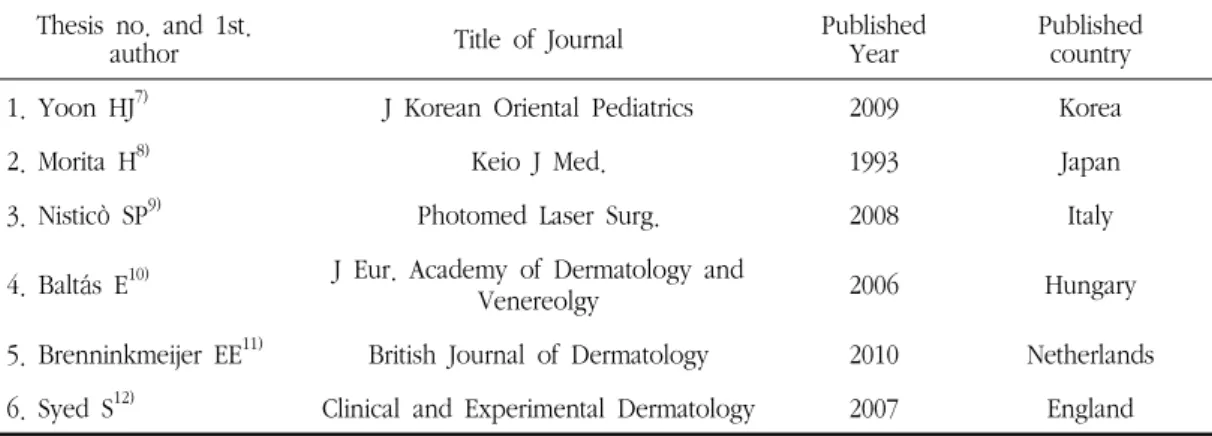
험 중 무작위대조군연구, 예비 연구였다. 치료 후 부 작용이 일어난 사례는 3편으로 주로 고출력 레이저 치료였으며 주요 부작용으로는 수포와 부종, 불편감 및 통증으로 나타났다. 나머지 3편에서는 특별한 부 작용 사례는 없었다. 6편의 논문 모두 게재된 저널과 발표된 나라가 달랐고, 표본 환자 샘플수가 대부분 작 았다. 또한 1편의 논문을 제외하고 2006년 이후에 게 재된 논문이었다(Table 9, 10). 치료효과 및 통계적 유의성에 있어서는 6편 모든 논문에서 치료효과가 있 었으나, 2편의 논문 중 1편(Table 2)은 일부 평가 항 목이 대조군과 통계적으로 유의한 차이가 나지 않았 고, 1편(Table 3)은 통계방법이 제시되지 않아, 통계 적 유의성 파악이 어려웠다.
6편의 논문 중, 1편의 국내논문(Table 2)에서만 한 약과 침치료 외에 레이저 치료를 병행하였고 나머지 4편(Table 3, 4, 5, 7)의 논문에서는 진행 중인 다른 아토피 치료를 멈춘 상태에서 순수하게 레이저 치료 만을 진행하였다. 1편(Table 6)의 논문은 스테로이드 제 연고와 레이저 치료와의 비교 데이터를 통한 연구 였다.
레이저에 대한 생체 자극 효과는 헝가리에서 먼저 발견되었고, 레이저 치료도 유럽, 러시아, 중국 등에 서 널리 사용되고 있으면 임상적인 연구도 활발히 진 행되고 있다. 하지만 미국에서는 레이저 치료에 대해 보수적인 정책을 고수하고 있다. 본론에서 밝혔듯이 엑시머 레이저의 경우 근시교정 수술법의 경우에는 1991년에 도입되었지만 1995년에 이르러 미국 FDA 의 승인이 이루어졌으며3), 아토피 피부염에 대한 엑 시머 레이저 치료에 대해서는 현재 미국 FDA의 승인 은 이루어졌지만 임상데이터가 많지 않은 상태이다15). 미국의 영향을 많이 받은 우리나라의 의료체계는 레 이저 치료 발전이 미흡했으며, 초기 임상적용단계라 고 볼 수 있다. Table 4∼7의 논문은 비록 고출력 레 이저의 일종이지만, 아토피 피부염 치료에 적용됨으 로서 치료레이저의 역할을 보여주고 있다. 다만 초기 연구 단계인 관계로 부작용도 존재하며, 임상 근거가
Table 8. Main Wavelength and Its Application for Laser Media.
medium state main wavelength(㎚) pulse/cw main application
GaAlAs semi-conductor 770-880 (780, 830) cw biostimulation
InGaAlP semi-conductor 635-690 (655) cw biostimulation
Excimer gas 193, 248, 308 pulse ophthalmology
Dye liquid (including organic pigment) 400-900 (595) pulse Photodynamic Therapy(PDT)
Table 9. Published Journal, Year and Country of Study
Thesis no. and 1st.
author Title of Journal Published
Year Published
country
1. Yoon HJ
7)J Korean Oriental Pediatrics 2009 Korea
2. Morita H
8)Keio J Med. 1993 Japan
3. Nisticò SP
9)Photomed Laser Surg. 2008 Italy
4. Baltás E
10)J Eur. Academy of Dermatology and
Venereolgy 2006 Hungary
5. Brenninkmeijer EE
11)British Journal of Dermatology 2010 Netherlands
6. Syed S
12)Clinical and Experimental Dermatology 2007 England
Table 10. Study Design, Sample Size, Result
Thesis no. and 1st.
author Study Design Laser Sample
Size Result
1. Yoon HJ
7)Clinical trial low-level 19 Effective, No side-effect
2. Morita H
8)Clinical trial low-level 112 Effective, No side-effect 3. Nisticò SP
9)Clinical trial high-level 18 Effective, mild side-effect 4. Baltás E
10)Clinical trial high-level 15 Effective, No side-effect 5. Brenninkmeijer EE
11)RCT, Pilot Study high-level 13 Effective, mild side-effect
6. Syed S
12)Pilot Study high-level 12 Effective, mild side-effect
부족한 상황이므로 추가적인 임상연구가 필요하다.
따라서, 레이저 치료에 대해서 국제적 신뢰를 얻기 위 해서는 각종 적응증에 대한 이중맹검법 및 무작위 치 료군-대조군 설정이 필요하며 임상시험 환자의 수가 늘려서 신뢰성을 확보해야 할 것으로 생각된다.
Ⅴ. 결 론
검색된 6편의 논문을 종합적으로 살펴본 결과 아토 피 피부염에 대한 레이저 치료는 영, 유아뿐만 아니라 성인에게서 발생하는 국소적 소양증에 효과가 있다는
것과 스테로이드제를 장기 복용, 외용하여 부작용이 발생한 만성 아토피 환자에게 적용 시 부작용을 줄이 면서 효과를 볼 수 있다는 것을 알 수 있었다. 따라서 한의학에서도 아토피 피부염의 치료를 위해 광선치료 의 일종인 레이저를 활용하여 보다 광범위한 임상연 구를 진행하는 것이 향후 필요할 것으로 생각된다.
Ⅵ. 참 고 문 헌
1. Lee HS, Kim JS, Pyun BY. Pediatric allergy and Respiratory Disease, Change of Prevalence and the Allergens of Atopic Dermatitis in Children: In between the year of 1992 and 2002. Pediatric allergy and Respiratory Disease. 2002;12(4);263-71.
2. Choi HY. The Effect of Living Environment and Dietary Habits on Atopic Dermatitis in Children. Sookmyung Women's University.
2011:49.
3. Tunér J, Hoe L(Author), Jang IS, Shin GB(Translator). Laser Therapy. Seoul:JungDam.
2006:8-9, 43-4, 128-9.
4. Yu W, Naim JO, Lanzafame RJ. Effects of photostimulation on wound healing in diabetic mice. Laser Surg Med. 1997;
20:56-63.
5. Babapour R, Glassberg E, Lask GP.
Low-energy laser systems. Clin Dermatol.
1995;13:87-90.
6. Basford JR. Low intensity laser therapy: still not an established clinical tool. Laser Surg Med. 1995;16:331-42.
7. Yeo EJ, Han JK, Kim YH. Topical Application of Atopy cream-jawoongo ointment(A-J) of Ointment Inhibits Biostir
mite antigen cream induced Atopy Dermatitis by Local Action in Nc/Nga Mice. Journal of the Institute of Oriental Medicine, Daejeon University.
8. Kim SB, Kim SM, Kim DH. Effects of Baedokhwanbalhyobang(BDHBH) on Immune Modulation in Dermatitis Model of NC/Nga Mice. Journal of the Institute of Oriental Medicine, Daejeon University. 2011;19(2):
101-18.
9. Kim YH, Han JK. Effect of Kami-Kang HwalSan on atopic dermatitis-Like skin Lesions induced in NC/Nga mice by mite antigen stimulation. Journal of the Institute of Oriental Medicine, Daejeon University.
2007;16(1):81-91.
10. Bang CK, Choi JJ, Eom DM, Kim DH. The Effects of BGG on Various Immunological Factors Related to Pathogenesis of Allergic Dermatitis in NC/Nga Mice Induced by Der-f.
Journal of the Institute of Oriental Medicine, Daejeon University. 2007;16(2):147-69.
11. Yoon HJ, Yoon JS, Kim DG, Lee JY. The Effects of Low Level Laser Therapy on Decrease of Atopic Dermatitis Symptoms. J Korean Oriental Pediatrics. 2009;23(3):193-206.
12. Morita H, Kohno J, Hori M, Kitano Y.
Clinical Application of Low Reactive Level Laser Therapy for Atopic Dermatitis. Keio J Med. 1993;42(4):174-6.
13. Nisticò SP, Saraceno R, Capriotti E, Felice CD, Chimenti S. Efficacy of Monochromatic Excimer Light (308㎚) in the Treatment of Atopic Dermatitis in Adults and Children.
Photomed Laser Surg. 2008;26(1):14-8.
14. Baltás E, Csoma Z, Bodai L, Ignácz F,
Dobozy A, Kemény L. Treatment of atopic dermatitis with the xenon chloride excimer laser. J Eur Acad Dermatol Venereol. 2006
;20(6):657-60.
15. Brenninkmeijer EE, Spuls PI, Lindeboom R, van der Wal AC, Bos JD, Wolkerstorfer A.
Eximer laser vs. clobetasol propionate 0.05%
ointment in prurigo form of atopic dermatitis of atopic dermatitis: a randomized controlled trial, a pilot. British Journal of Dermatology.
2010;163(4):823-31.
16. Syed S, Weibel L, Kennedy H, Harper JI. A pilot study showing pulse-dye laser treatment improves localized areas of chronic atopic dermatitis. Clinical and Experimental Dermatology. 2007;33(3):243-8.
17. Kang TJ, Lee SR. The causes and treatment of atopic dermatitis management. BioWave.
2010;12(3):1. Available from: URL:
http://bric.postech.ac.kr/myboard/read.php?Bo ard=review0&id=2640
18. Bae CU, Park MY. Do you know herb medicine enzyme? Atopy psoriasis treatment.
Seoul: Medical Books. 2008:106-11.
19. Chung PS, Lee SJ. Biomodulation Effect of the Low-Level Laser Therapy(LLLT). J Clinical Otolaryngol. 2004;15(2):167-73.
20. Schindl A, Neumann R. Low-intensity laser therapy in an effetive treatment for recurrent herpes simplex infection: Results from a randomized double-blind placebo-controlled study. J Invest Dermatol. 1999;54;2-7.
21. Goldman JA, Chiapella J, Casey H, Bass N, Graham J, Mcclatchey W. Laser therapy of rheumatoid arthritis. Lasers Surg Med.
1980;1:93-101.
22. Sung GJ, Choi JH. Laser treatment of skin diseases. The Ulsan Univ. Med. J. 1995;
4(2):8-17.
23. Iga N, Otsuka A, Tanioka M, Miyachi Y, Kabashima K. Improvement of Anti-TNF-α Antibody-Induced Palmoplantar Pustular Psoriasis Using a 308-㎚ Excimer Light. Case Rep Dermatol. 2012;4(3):261-4.
24. Taibjee SM, Cheung ST, Laube S, Lanigan SW. Controlled study of excimer and pulsed dye lasers in the treatment of psoriasis. Br J Dermatol. 2005;153(5):960-6.