752
Copyright © 2020 The Korean Society of Fisheries and Aquatic Science pISSN:0374-8111, eISSN:2287-8815
서 론
Vibrio속(genus)은 주로 해안, 강하구 및 수산생물에서 많 이 분리되며, 현재까지 140여종의 균주가보고되었다(Parte, 2018; Urakawa et al., 2000). 보고된대부분의 균주들은 인 체에 질병을 유발하지 않는 비병원성균이지만(Kongrueng et al., 2015) 이중12개의 Vibrio종, 즉 Vibrio parahaemolyti- cus, Vibrio vulnificus, Vibrio cholera, Vibrio mimicus, Vibrio
hollisae, Vibrio alginolyticus, Vibrio cincinnatiensis, Vibrio damsela, Vibrio fluvialis, Vibrio furnissii, Vibrio harveyi, 와 Vibrio metschnikovii가인체감염을유발하는것으로보고되 었다(Farmer et al., 2015; CDC, 2019). 전세계적으로비브리 오 콜레라균(V. cholera), 장염비브리오균(V. parahaemolyti- cus), 비브리오패혈증균(V. vulnificus)은주요한수인성·식품 매개질환의 원인균이다(Thompson et al., 2006). 특히, 우리 나라에서 가장 빈번하게 발생하는 장염비브리오균(V. para-
2019년 서해 연안 패류 및 양식 새우( Litopenaeus vannamei)에서 분리 한 Vibrio parahaemolyticus 균주들과 새우 급성간췌장괴사병(AHPND) 과의 연관성
장광일·박진일·오은경*·김수미1*
국립수산과학원 서해수산연구소, 1국립수산과학원 수산방역과
The Relationship Between Acute Hepatopancreatic Necrosis Disease
(AHPND) in Shrimp Litopenaeus vannamei and Vibrio parahaemolyticus Strains Isolated from Shellfish and Shrimp of the West Coast of Korea in 2019
Gwang Il Jang, Jin Il Park, Eun-Gyoung Oh* and Sumi Kim1*
West Sea Fisheries Research Institute, National Institute of Fisheries Science, Incheon 22383, Korea
1Aquatic Disease Control Division, National Institute of Fisheries Science, Busan 46083, Korea
Acute hepatopancreatic necrosis disease (AHPND), previously known as early mortality syndrome (EMS), is an emerging disease in shrimp caused by Vibrio parahaemolyticus. Some V. parahaemolyticus strains are associated with foodborne diseases in humans. To date, studies on the relationship between AHPND and pathogenic V. parahaemo- lyticus are very limited. In this study, we monitored the thermostable direct hemolysin-related hemolysin (trh) gene and AHPND–related genes, such as Photorhabdus insect-related (pir) genes, in 892 strains of V. parahaemolyticus isolated and identified in 24 areas of the West Coast of Korea from May to October 2019. The trh gene was detected in 9.6% of the isolates from short neck clam samples. However, the pirA and pirB genes related to AHPND were not found in any of the isolates despite using both duplex and nested PCR assays, suggesting that AHPND-related genes were nonexistent in the V. parahaemolyticus strains isolated. This study contributes to the current understanding of the relationship between AHPND and V. parahaemolyticus in Korea, as well as provides data on spatial and seasonal distributions of V. parahaemolyticus.
Keywords: Acute hepatopancreatic necrosis disease (AHPND), Vibrio parahaemolyticus, Shrimp, West Coast, Ther- mostable direct hemolysin-related hemolysin (trh) gene
*Corresponding author: Tel: +82. 32. 745. 0750 Fax: +82. 32. 745. 0619 E-mail address: [email protected]; [email protected]
This is an Open Access article distributed under the terms of the Creative Commons Attribution Non-Commercial Licens (http://creativecommons.org/licenses/by-nc/3.0/) which permits unrestricted non-commercial use, distribution, and reproduction in any medium, provided the original work is properly cited.
Received 9 July 2020; Revised 19 August 2020; Accepted 10 September 2020 저자 직위: 장광일(연구사), 박진일(연구사), 오은경(연구관), 김수미(주무관) https://doi.org/10.5657/KFAS.2020.0752
Korean J Fish Aquat Sci 53(5), 752-760, October 2020
haemolyticus)은인간에게장염및식중독(Kang et al., 2016;
Yang et al., 2017; Park et al., 2018)을유발하는내열성용혈 독소(thermostable direct hemolysin, TDH) 또는내열성용혈 독소유사독소(TDH-related hemolysin, TRH)를생성한다. 또 한, V. parahaemolyticus는어류, 패류, 갑각류등의양식생물에 질병을유발할뿐만아니라해수유래의기회감염균으로서역 할도한다(Sudheeshand and Xu, 2001; Marudhupandi et al., 2017). 최근 양식 새우류에 급성간췌장괴사병(acute hepato- pancreatic necrosis disease, AHPND)을유발하는원인균이 V.
parahaemolyticus라는것이밝혀지면서(Lightner et al., 2012;
Zhang et al., 2012) 전세계적으로 AHPND에대한관심이높 아지고있다. 세균학적분류측면에서는 V. parahaemolyticus 가 AHPND의원인병원체이지만, 모든균주가 AHPND를유발 하는것은아니다. 그중곤충관련(Photorhabdus insect-related, Pir)독소를생성하는 plasmid를가진일부균주만이 AHPND를 유발하는것으로밝혀졌다(Joshi et al., 2014; Han et al., 2015;
Kim and Kim, 2015). 그러므로해수및수산생물에서분리되 는 V. parahaemolyticus균주들이병원성또는비병원성인지에 대한판단이과학적인근거를통해이루어져야할필요가있다.
양식새우에대량폐사를유발하는 AHPND는 2009년중국에 서 처음 발병을 시작으로 베트남(2010년), 말레이시아(2011 년), 태국(2012년), 멕시코(2013년)까지전파되었고, 최근2017 년에는미국텍사스까지전파되어새우양식산업에막대한경 제적피해를입혔다(Zorriehzahra and Banaederakhshan, 2015;
Dhar et al., 2019). 2013년에 Tran et al. (2013)은AHPND의원 인균인그람음성의해양세균 V. parahaemolyticus를분리하였 고, V. parahaemolyticus가분비하는독소로인해새우의간췌 장부분손상및수축된증상을관찰하였다. 2014년에는태국 및중국의새우양식장에서분리된 AHPND 원인균인 V. para- haemolyticus 균주들의유전체서열분석을통해콜레라독소 와 type IV pilus/type IV 분비시스템뿐만아니라 plasmid에곤 충관련독소(pir toxin) 생성유전자와상동성부분이있다는것 을밝혔다(Kondo et al., 2014; Yang et al., 2014). 이후, Han et al. (2015)는베트남의새우양식장에서 AHPND에감염된 새우의위장에서 V. parahaemolyticus를분리하여 plasmid 에 곤충관련독소를생성하는유전자(pirA/pirB)가있음을확인하 였다. 우리나라에서는 2016년도에서해안의흰다리새우양식
장에서처음으로 AHPND가발생하여역학조사를실시하였으
나원인균의유래에대해서는보고되지않았다(Hwang et al., 2018). 새우양식장및해수환경에서분리된모든 V. parahae- molyticus 균주가 AHPND를유발하지않는다는보고는여러 차례있었지만(Tran et al., 2013; Kondo et al., 2014; Han et al., 2015; Lee et al., 2015), AHPND를유발하는 V. parahaemo- lyticus의유래에대한역학적연구는현재까지미흡하다.
본연구에서는식품위생학적관점에서의인체감염성세균과 어병학적관점에서의양식생물감염성세균의구분과역학적
접근을위하여 2019년 5월부터 10월까지서해안연안패류및 새우양식장에서일반적으로분리되는저도호염성해양세균 V. parahaemolyticus 및 내열성용혈독소(thermostable direct hemolysin, TDH)와 내열성 용혈독소유사독소(TDH-related hemolysin, TRH)를생산하는유전자(tdh, trh)를가진장염비 브리오(V. parahaemolyticus) 균주들과 새우급성간췌장괴사
병(AHPND)과의병인학적연관성을조사하였다.
재료 및 방법
시료채취
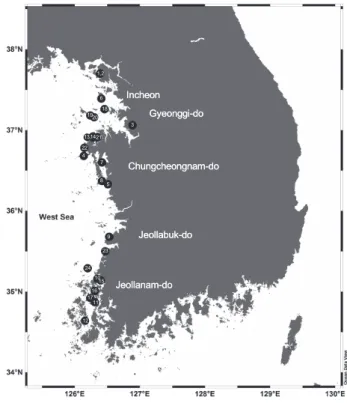
2019년 5월부터 10월까지V. parahaemolyticus 균주를 분 리하기위해서해안의주요패류양식장이위치한 18개지역, 인천광역시의 무의도(Muuido), 영흥도(Yeongheungdo), 소 이작도(Soijakdo), 승봉도(Seungbongdo), 충청남도의 천수 만(Cheonsu Bay), 원산도(Wonsando), 이원면(Iwon-myeon), 가로림만(Garorim Bay), 소원면(Sowon-myeon), 전라북도 의 변산(Byeonsan), 고창(Gochang-gun), 전라남도의 도리 포(Dolipo), 압해도(Aphaedo), 장산도(Jangsando), 함평만 (Hampyeong Bay), 탄도만(Tando Bay), 매화도(Maehwado), 칠산도(Chilsando)와새우양식장 4개지역, 인천광역시강화 군(Ganghwa-gun), 경기도 평택시(Pyeongtaek-si), 충청남도
Fig. 1. Sampling sites of shellfish and shrimp Litopenaeus vanna- mei on the West Coast of Korea during the period May to October in 2019. The description of sampling sites is the same as in Table 2.
G Gyyeeoonnggggii--ddoo IInncchheeoonn
C
Chhuunnggcchheeoonnggnnaamm--ddoo
JJeeoollllaabbuukk--ddoo
JJeeoollllaannaamm--ddoo
13, 1,2
6 18
3 1920
22 4
7 85
9 23
24 1015 16 1711 12
1421
M 1 2 3 4 5 6 7 8 NC PC
태안군(Taean-gun) 및 보령시(Boryeong-si)를선정하여 패류 즉, 굴(Oyster Crassostrea gigas), 동죽(Surf clam Mactra ven- eriformis), 바지락(Short neck clam Venerupis philippinarum), 백합(Ocean quahog Arctica islandica), 소라(Conch Lobatus gigas), 전복(Abalone Haliotis discus hannai) 및흰다리새우 (Shrimp Litopenaeus vannamei) 시료와사육수(pond water) 를채취하였다(Fig. 1; Table 1). 패류시료는채취한후멸균된 황동솔로표면에묻어있는이물질을현장해수로세척한후멸 균된용기에담았고, 새우시료는새우양식장에서구입후 10°C 이하로유지하면서실험실로운반하여실험에사용하였다. V. parahaemolyticus 균주 분리 및 동정
V. parahaemolyticus 분리및 동정은미국식품의약국(food and drug administration, FDA)의 bacteriological analytical manual (BAM)의방법에따라실시하였다(Elliot et al., 1995).
패류및 새우 전체시료(간췌장포함)에 phosphate buffered saline (PBS: 140 mM NaCl, 5 mM anhydrous Na2HPO4, 1.5 mM KH2PO4, pH 7.4)을첨가하여균질화후, alkaline peptone water (APW; peptone 10 g/L, NaCl 20 g/L, pH 8.5±0.2)에접 종하여 35±0.5°C에서 18-24시간증균배양하였다(Feng et al., 2017; Yang et al., 2019). 배양후, CHROMagar (Paris, France) 에획선도말하여 35°C에서 24시간배양하였다. CHROMagar 배지상에서 V. parahaemolyticus 균주로추정되는연보라색집 락(colony)을분리하여동정시험을실시하였다. V. parahaemo- lyticus 추정되는 균주에대하여내염성시험, 42°C 발육시험, ONPG (O-nitrophenyl-β-D-galactopyranoside) 시험등 생화 학시험을하였으며, 최종적으로 VITEK system (BioMérieux Vitek, Marcy-l'Étoile, France)을이용하여분리된 V. parahae- molyticus 균주들에대해확정하였다(Park et al., 2019; Song et al., 2020).
DNA 추출 및 병원성 관련 유전자 탐색
분리된장염비브리오균을대상으로식중독을유발시키는병 원성인자로알려진 tdh 및 trh유전자의존재유무확인은 PCR (polymerase chain reaction)기법을이용하였다. tdh 및 trh 유
전자 검출을위해 VPD- 1/VPD-2 및 VPR-1/VPR-2 primer sets (Takara, Bio Inc., Otsu, Japan)를사용하였다. 시험균주 는 Tryptic Soy Broth (Difco, Detroit, MU, USA) 10 mL에접 종하여 37°C에서 18-24시간배양후, DNA Isolation kit (MO- BIO, Carlsbad, CA, USA)를 이용하여 DNA를 추출하였다. tdh 및 trh 유전자증폭은 PCR Master mix (Takara Bio Inc., Otsu, Japan) 12.5 μL, 각 primer (10 pmol/μL) 0.2 μL씩, 추 출한 DNA 2 μL로반응액을조성한후, 멸균증류수를첨가하 여총 25 μL가되도록하였다. 그리고 thermal cycle (Takara Bio Inc., Otsu, Japan)를이용하여 98°C에서 10초, 55°C에서 30초, 72°C에서 60초의반응을 35회반복하여 PCR을실시하 였다. 증폭된 PCR 산물은 gel documentation system G BOX (Syngene, Cambridge, UK)를이용하여 amplicon 크기(tdh 유 전자, 251 bp; trh 유전자, 250 bp)를확인하였다.
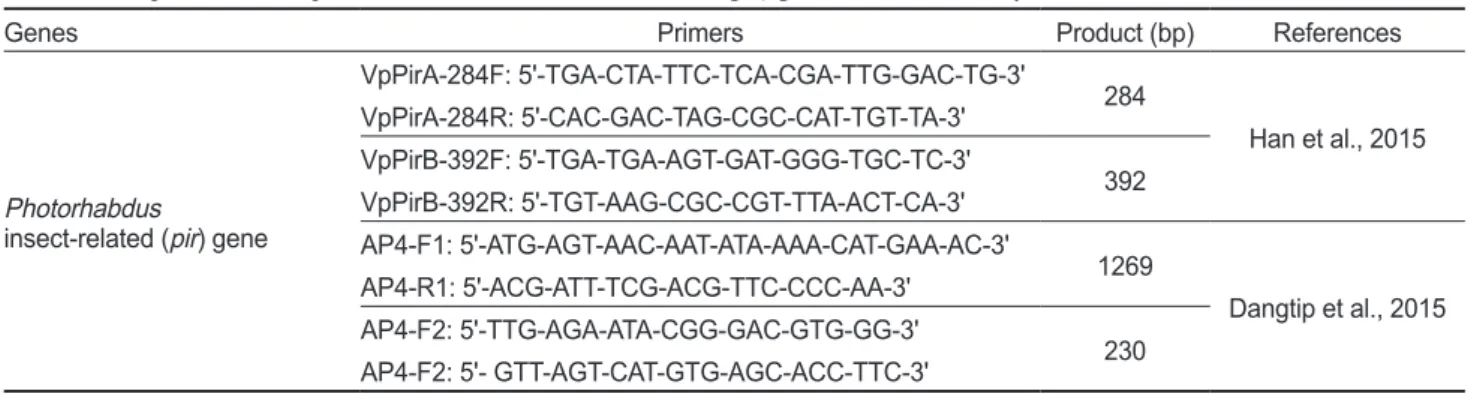
급성간췌장괴사병(AHPND) 관련유전자탐색은세계동물보 건기구(world organization for animal health, OIE)에서권장하 는방법들중아래의두가지(duplex PCR과 AP4 nested PCR) 방법을사용하였다(Dangtip et al., 2015; Han et al., 2015). V.
parahaemolyticus의 plasmid에위치한 Pir toxin 생성유전자를 탐색하기위해 AccuPower HotStart PCR premix kit (Bioneer, Korea)와 VpPirA-284F/R와 VpPirB-392F/R primer sets을이 용하여 duplex PCR을실시하였다(Table 1; Han et al., 2015).
동시에 Dangtip et al. (2015) 방법에 따라 AP4-F1/AP4-R1 primers를이용하여첫번째 PCR을수행후, 그 PCR 산물을이 용하여 AP4-F2/AP4-R2 primers로 AP4 nested PCR을수행하 였다(Table 1). PCR 증폭산물은 QIAxcel Advanced 자동전기 영동장치(Qiagen, Hilden, Germany)를이용하여확인하였다.
결과 및 고찰
패류 및 새우 양식장의 V. parahaemolyticus 분포 2019년 5월부터 10월까지서해안패류및새우양식장에서양 식중인패류및새우로부터V. parahaemolyticus를분리하였으 며, 시료채취지역, 시료및조사시기별분리한 V. parahaemo- lyticus의분포는 Table 2에나타내었다.
Table 1. PCR primers and sequences of Photorhabdus insect-related (pir) genes used in this study
Genes Primers Product (bp) References
Photorhabdus
insect-related (pir) gene
VpPirA-284F: 5'-TGA-CTA-TTC-TCA-CGA-TTG-GAC-TG-3'
284
Han et al., 2015 VpPirA-284R: 5'-CAC-GAC-TAG-CGC-CAT-TGT-TA-3'
VpPirB-392F: 5'-TGA-TGA-AGT-GAT-GGG-TGC-TC-3' VpPirB-392R: 5'-TGT-AAG-CGC-CGT-TTA-ACT-CA-3' 392 AP4-F1: 5'-ATG-AGT-AAC-AAT-ATA-AAA-CAT-GAA-AC-3'
1269
Dangtip et al., 2015 AP4-R1: 5'-ACG-ATT-TCG-ACG-TTC-CCC-AA-3'
AP4-F2: 5'-TTG-AGA-ATA-CGG-GAC-GTG-GG-3' AP4-F2: 5'- GTT-AGT-CAT-GTG-AGC-ACC-TTC-3' 230
서해안패류양식장 18개소및새우양식장 4개소에서채취한 총 76개시료로부터 892개균주를분리동정하였다. 시료별로 는굴에서 382개균주, 동죽에서 20개균주, 바지락에서 204개 균주, 백합 4개균주, 새우에서 125개균주, 새우사육수에서 147개균주, 소라및전복에서각 5개균주씩을분리하였다. 시 기별로는 5월에 2개시료에서 3개균주, 6월에 10개시료에서 45개균주, 7월에 12개시료에서 110개균주, 8월에 13개시료 에서 185개균주, 9월에 12개시료에서 236개균주, 10월에 27 개시료에서 313개균주를분리하였다(Table 2).
5월부터 10월까지인천광역시웅진군의소이작도와승봉도, 충청남도태안군이원면의 굴 양식장에서V. parahaemolyti- cus를분리한결과여름철인 8월에서 10월사이에높은 MPN (most probable number)을보였다(Fig. 2). Park et al. (2019) 은 2013년부터 2016년까지경상남도연안지역에서채취한패 류에서 V. parahaemolyticus의분리한결과 9월에 54.2%로가 장높은검출률을관찰하였다. 그리고 Lee et al. (2019)의보고 에따르면전라북도곰소만해역에서 3종의패류(바지락, 가무 락, 동죽)에서V. parahaemolyticus를분리한결과, 바지락은 8 월[8.9×10² colony form unit (CFU)/g], 가무락과동죽은 10월 (각각1.4×10³와 1.9×10³ CFU/g)에가장높은분리율을보였 으며, 수온이 14.6°C로떨어지는 11월에는 3종의패류모두에 서분리율이급격하게감소하는것을관찰하였다. 이외에도여
름철에우리나라연안지역에서채취한패류에서 V. parahae-
molyticus의검출률이높다는연구결과들이있으며(Lee et al., 2008; Yu et al., 2014; Kim et al., 2016), 이는본연구에서제시 한 5월부터 10월까지굴에서분리한 V. parahaemolyticus 균주 의시기별검출률과유사한경향을보였다.
2019년 6월부터 10월까지새우양식장의새우및사육수로부 터 2회이상연속적으로채취한시료에대해V. parahaemolyti- cus 검출률을살펴본결과새우에서는평균23.1%였고사육수
에서는평균 26.7%의검출률을보여사육수시료에서높은검
출률을보였다(Table2). 이는새우양식장의 일정한수온(26-
28°C)과염분농도(10-15 psu)를유지하는사육환경이 V. para- haemolyticus 균주의성장조건즉, 성장온도범위(20-30°C) 와염분범위(4-80 psu)와유사하여 V. parahaemolyticus 검출 률이시기별로차이를보이지않는것으로판단된다(Farmer et al., 2015; NIFS, 2018).
병원성 관련 유전자 검출
내열성 용혈독소(tdh) 및 내열성 용혈독소 유사독소 (trh) 유전자 검출
V. parahaemolyticus로동정된 892개균주에대하여내열성
1.E+00 1.E+01 1.E+02 1.E+03 1.E+04 1.E+05
May June July August September October November
V. parahaemolyticus (MPN/100 g) ▨ Site 13
▩ Site 14
■ Site 19
■ Site 20
M 1 2 3 4 5 6 7 8 NC PC M 1 2 3 4 5 6 7 8 NC PC
(a) (b)
Fig. 2. Monthly variation of V. parahaemolyticus isolated from Oyster Crassostrea gigas farm on the West Coast of Korea. The description of sampling sites is the same as in Table 2.
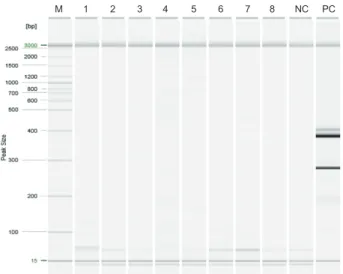
Fig. 3. Representative results of PCR of the AHPND related genes (pirA/pirB) using the duplex PCR for V. parahaemolyticus isolat- ed from shellfish and shrimp Litopenaeus vannamei on the West Coast of Korea. M, size marker; 1, Shrimp (1906 DS-W1); 2, Pond water (1909 DS-W13); 3, Oyster (JN 16-11); 4, Short neck clam (IC 2-1); 5, Conch (CN 4-13); 6, Abalone (CN 3-19); 7, Surf clam (JB 1-7); 8, Ocean quahog (JN 19-20); NC, negative control; PC, positive control.
C
Chhuunnggcchheeoonnggnnaamm--ddoo
JJeeoollllaabbuukk--ddoo
JJeeoollllaannaamm--ddoo
13, 22 4
7 85
9 23
24 1015 16 1711 12
1421
M 1 2 3 4 5 6 7 8 NC PC
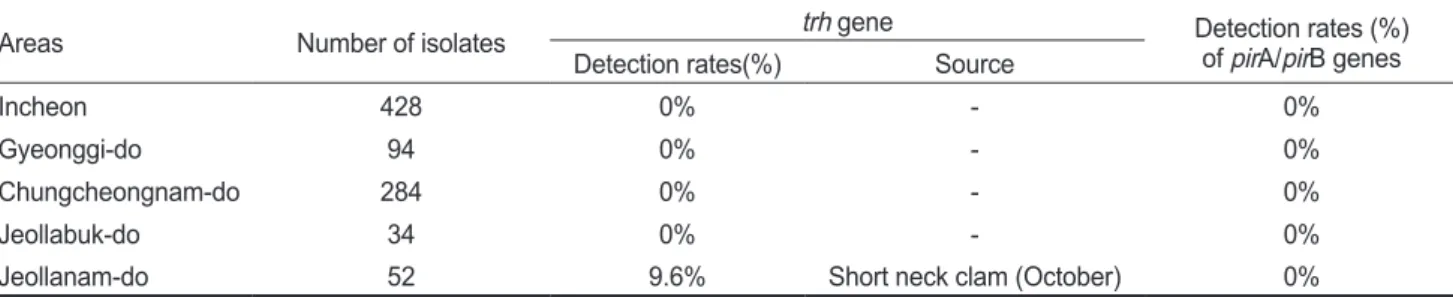
용혈독소(tdh) 및내열성용혈독소유사독소(trh) 유전자검출 률을조사한결과 tdh 유전자는검출되지않았지만, trh 유전자 는 10월의바지락시료에서분리된 5개균주(9.6%)에서만검 출되었다(Table 3).
2013년부터 2015년까지남해안패류양식장에서이루어진
연구를살펴보면84개의V. parahaemolyticus 균주에대해 tdh 및 trh 유전자검출률을조사한결과, tdh 유전자는 3.4-5.9%의 검출률을보였고, trh 유전자는 3.4-12.8%가검출되어 tdh 유전 자보다높은검출률을보였지만, 해수에서분리한 V. parahae- molyticus 37개균주에서는 tdh 및 trh 유전자는검출되지않았
다(Park et al., 2016). 그리고 Kang et al. (2017)은굴시료로 부터 toxR 유전자를가진V. parahaemolyticus 31개균주를분 리하여 tdh 및 trh 유전자검출률을조사한결과단지 4개균주 (9.1%)만이 trh 유전자를가지고있으며, tdh 유전자는검출되 지않았다. 이는해수및수산물에서분리되는모든 V. parahae-
molyticus균주가인간에게장염및식중독을일으키지않는다
는것을의미한다. 일반적으로자연환경에서분리된V. parahae-
molyticus균주는병원성유전인자보유율이낮다고알려져있
다(Thompson et al., 1976; Honda and Iida,., 1993; Yamamoto et al., 2008; Malcolm et al., 2015).
Table 2. Number of isolates from shellfish and shrimp Litopenaeus vannamei on the West Coast of Korea during the period May to October in 2019
Sites Sampling sites Samples May June July August September October
1 Ganghwa-gun, Incheon #1
Shrimp Litopenaeus vannamei (Pond water*)
- - (2*) 4 (4*) 9 (1*) 5 (21*) 8
2 Ganghwa-gun, Incheon #2 - 8 (6*) 10 (6*) 9 (4*) 19 (17*) 8 (5*)
3 Pyeongtaek-si, Gyeonggi-do - - 10 (10*) 3 (20*) 12 (19*) 6 (14*)
4 Taean-gun, Chungcheongnam-do - - 10 (3*) - (7*) - -
5 Boryeong-si, Chungcheongnam-do - 4 (8*) - - - -
6 Jung-gu, Incheon (Muuido)
Short neck clam Venerupis philippinarum
- - - - - 20
7 Seocheon-gun, Chungcheongnam-do (Cheonsu Bay) - - - - - 18
8 Boryeong-si, Chungcheongnam-do (Wonsando) - - - - - 18
9 Buan-gun, Jeollabuk-do (Byeonsan) - - - - - 14
10 Muan-gun, Jeollanam-do (Dolipo) - - - - - 10
11 Sinan-gun, Jeollanam-do (Aphaedo) - - - - - 13
12 Sinan-gun, Jeollanam-do (Jangsando) - - - - - 1
13 Taean-gun, Chungcheongnam-do (Iwon-myeon#1) Oyster Crassostrea gigas 1 3 16 33 34 32 14 Taean-gun, Chungcheongnam-do (Iwon-myeon #4) 2 4 11 27 32 11 15 Hampyeong-gun, Jeollanam-do (Hampyeong Bay) - - - - - 6
16 Muan-gun, Jeollanam-do (Tando Bay) - - - - - 9
17 Sinan-gun, Jeollanam-do (Maehwado) - - - - - 9
18 Ongjin-gun, Incheon (Yeongheungdo) Short neck clam Venerupis philippinarum (Oyster Crassostrea gigas†) - - - - - 5 (4†) 19 Ongjin-gun, Incheon (Soijakdo) - 8 (1†) - (21†) 14 (17†) 20 (36†) 31 (19†) 20 Ongjin-gun, Incheon (Seungbongdo) - 1 - (5†) 12 (29†) 12 (9†) 7 (11†) 21 Taean-gun, Chungcheongnam-do (Garorim Bay) Conch Lobatus gigas - - - - - 5
22 Taean-gun, Chungcheongnam-do (Sowon-myeon) Abalone Haliotis discus hannai - - - - - 5
23 Gochang-gun, Jeollabuk-do Surf clam Mactra veneriformis - - - - - 20
24 Yeonggwang-gun, Jeollanam-do (Chilsando) Ocean quahog Arctica islandica - - - - - 4
* and †in parentheses were isolated from pond water and Oyster, respectively. -, no data.
Vibrio parahaemolyticus 균주와 새우 급성간췌장괴사병(AHPND)과의 연관성 757
AHPND 관련 유전자 검출
V. parahaemolyticus로동정된 892개균주에대하여 duplex PCR 및 nested PCR을이용하여AHPND관련유전자인 pirA
와 pirB 유전자검출률을조사한결과모든균주에서검출되지
않았다(Fig. 3 and Fig. 4, Table 3).
2009년 AHPND가처음발병한이후, AHPND에대한연구 는현재까지꾸준히이루어지고있다. 2012년에중국의흰다리 새우양식장에서 AHPND를유발하는 V. parahaemolyticus를 분리하였고, 2013년에침지와경구감염을통해 V. parahaemo- lyticus가 AHPND의원인균임을밝혔다(Zhang et al., 2012;
Tran et al., 2013). Han et al. (2015)는병원성및비병원성 Vib- rio속과 Photobacterium속의 77개균주를대상으로 AHPND 를유발하는 pirA/pirB 유전자검출시험을한결과 AHPND증 상이있는새우양식장에서분리된V. parahaemolyticus균주에 서 pirA/pirB 유전자가검출되었다. 하지만, AHPND증상을보
이지않는새우양식장에서분리된 V. parahaemolyticus에서 는 pirA/pirB 유전자가검출되지않는것을확인하였다. 이는
본연구에서조사한 AHPND가발생하지않은패류및새우양
식장에서분리한 V. parahaemolyticus 균주들이 pirA/pirB 유 전자를보유하지않는결과와일치하였다. 그리고 Han et al.
(2015) 연구팀은베트남의새우양식장에서AHPND에감염된
새우로부터 V. parahaemolyticus 2개균주를분리하여병원성 시험한결과 1개균주만이 AHPND 증상을보이는것을확인하 였다. AHPND를유발하는 V. parahaemolyticus의전체염기서 열을분석한결과약 69 kb크기의 plasmid에곤충관련독소(Pir toxins) 유전자를암호화하고있는것을확인하였다. 위연구진 들은 V. parahaemolyticus 균주들간 AHPND 발생유무가차이 나는원인을새우의위/간췌장또는새우양식장의 biofilm에서 세균들이밀집되어집락을형성할때균주간의전위(transposi- tion), 접합(conjugation) 및 plasmid 흡수를통해 pirA/pirB 유
Table 3. Detection rates (%) of thermostable direct hemolysin-related hemolysin (trh) gene and AHPND related genes (pirA/pirB) in V. para- haemolyticus isolated from shellfish and shrimp Litopenaeus vannamei on the West Coast of Korea during the period May to October in 2019
Areas Number of isolates trh gene Detection rates (%)
of pirA/pirB genes Detection rates(%) Source
Incheon 428 0% - 0%
Gyeonggi-do 94 0% - 0%
Chungcheongnam-do 284 0% - 0%
Jeollabuk-do 34 0% - 0%
Jeollanam-do 52 9.6% Short neck clam (October) 0%
Fig. 4. Representative results of PCR of the AHPND related genes (pirA/pirB) using the (a) first PCR and (b) nested PCR for V. parahae- molyticus isolated from shellfish and shrimp on the West Coast of Korea. M, size marker; 1, Shrimp (1906 DS-W1); 2, Pond water (1909 DS-W13); 3, Oyster (JN 16-11); 4, Short neck clam (IC 2-1); 5, Conch (CN 4-13); 6, Abalone (CN 3-19); 7, Surf clam (JB 1-7); 8, Ocean quahog (JN 19-20); NC, negative control; PC, positive control.
1.E+00 1.E+01 1.E+02 1.E+03
May June July August September October November
V. parahaemolyticus (MPN/ ■
M 1 2 3 4 5 6 7 8 NC PC M 1 2 3 4 5 6 7 8 NC PC
(a) (b)
전자가비병원성 V. parahaemolyticus로전달될수있다고추 정하였다.
최근 AHPND가 발생한 국가들사이에 AHPND를 일으키
는V. parahaemolyticus 균주의분자역학적연관성을 조사하 기위해여러국가로부터 V. parahaemolyticus를분리하여전 체염기서열분석하였지만뚜렷한연관성을발견하지못했다 (Kondo et al., 2014; Yang et al., 2014; Lee et al., 2015; Fu et al., 2017). Fu et al. (2017)은중국의 3개지역에서분리한 V.
parahaemolyticus 9개균주와 Genbank에공개된여러나라의 V. parahaemolyticus 93개균주의전체염기서열을이용하여 V. parahaemolyticus의유전적다양성을조사하였다. Fu et al.
(2017)에의해분리된 V. parahaemolyticus 9개균주중 2개균 주만이 pirA/pirB 유전자를가지며 AHPND를유발하였으며, Genbank에공개된 V. parahaemolyticus 균주들중에서는 16개 균주만이 pirA/pirB 유전자를가지고있었다. 그리고 V. para- haemolyticus FDA_R31균주를기준으로단일유전변이(sin- gle nucleotide polymorphisms, SNPs)를살펴본결과 35,001 에서 35,889 SNPs가있는것을보고하였다. 이는 V. parahae-
molyticus 균주들사이에유전적다양성이존재하는것을의미
한다. 그리고 V. parahaemolyticus 102개균주의전체염기서열 을이용하여계통분류학적특성을분석한결과국가및지역별 로구분되는것을확인하였다. 이는 V. parahaemolyticus가유
전적으로단일계통이아닐수있으며AHPND가여러지역에
서독립적으로발생한것으로추정하였다. 따라서국가별또는 지역별로 AHPND를유발하는 V. parahaemolyticus의유래에 대한역학적인연구가반드시필요하다.
본연구에서 2019년 5월부터 10월까지서해안지역의패류 및새우양식장에서분리한 892개의V. parahaemolyticus 균주
들을대상으로 AHPND와의병인학적연관성을조사한결과,
분리된 V. parahaemolytic균주에서 AHPND를유발하는PirA/
PirB 유전자는전혀검출되지않았다. 이는서해연안해수및 서식생물에존재하는수인성 V. parahaemolyticus 뿐만아니라 양식장에상존하는 V. parahaemolyticus는 AHPND를유발하 는 V. parahaemolyticus와는역학적상관관계가멀다는것을 시사한다. 인체에병원성을보이는비브리오균과양식새우에
AHPND를유발하는비브리오균과의연관성에대한연구는국
내뿐만아니라해외에서도조사되지않았다. 그리고추가적으 로수산생물병원체와인체병원체에대한유래와분포, 서식특 성을구분하는조사분석이필요하다. 아시아를비롯한여러국 가의새우양식장에서AHPND에의한피해가지속적으로증가 하고있어감염역학적관점에서원인세균의분리유래를지속 적으로모니터링할필요성이있다고 여겨진다.
사 사
이논문은국립수산과학원의수산생물방역기술개발및프로
그램운영(R2020060)과수출패류생산해역및수산물위생조
사(R2020052)의지원으로수행된연구이며연구비지원에감
사드립니다.
References
CDC (Centers for Disease Control and Prevention). 2019. Vib- rio species causing vibriosis. Retrieved from https://www.
cdc.gov/vibrio/faq.html on May 1, 2020.
Dangtip S, Sirikharin R, Sanguanrut P, Thitamadee S, Srituny- alucksana K, Taengchaiyaphum S, Mavichak R, Proesprai- wong P and Flegel TW. 2015. AP4 method for two-tube nested PCR detection of AHPND isolates of Vibrio para- haemolyticus. Aquaculture Rep 2, 158-162. https://doi.
org/10.1016/j.aqrep.2015.10.002.
Dhar AK, Piamsomboon P, Caro LFA, Kanrar S, Adami R Jr and Juan YS. 2019. First report of acute hepatopancreatic necrosis disease (AHPND) occurring in the USA. Dis Aquat Org 132, 241-247. https://doi.org/10.3354/dao03330.
Elliot EL, Kaysner CA, Jackson L and Tamplin ML. 1995. Vib- rio cholera, V. parahaemolyticus, V. vulnificus and other Vib- rio spp. In: Bacteriological analytical manual. Association of Offical Analytical Chemists ed. FDA, Arlington, U.S.A., 9.01-9.27.
Farmer JJ III, Brenner FW, Cameron DN, Birkhead KM and Janda JM. 2015. Genus Vibrio Pacini 1854, 411AL In:
Bergey’s manual of systematics of archaea and bacte- ria. John Wiley Sons, Hoboken, NJ, U.S.A. https://doi.
org/10.1002/9781118960608.gbm01078.
Feng B, Liu H, Wang M, Sun X, Pan Y and Zhao Y. 2017. Di- versity analysis of acute hepatopancreatic necrosis disease- positive Vibrio parahaemolyticus strains. Aquacul Fish 2, 278-285. https://doi.org/10.1016/j.aaf.2017.10.001.
Fu S, Tian H, Wei D, Zhang X and Liu Y. 2017. Delineating the origins of Vibrio parahaemolyticus isolated from outbreaks of acute hepatopancreatic necrosis disease in asia by the use of whole genome sequencing. Front Microbiol 28, 2354.
https://doi.org/10.3389/fmicb.2017.02354.
Han JE, Tang KFJ, Tran LH and Lightner DV. 2015. Photorhab- dus insect-related (Pir) toxinlike genes in a plasmid of Vibrio parahaemolyticus, the causative agent of acute hepatopan- creatic necrosis disease (AHPND) of shrimp. Dis Aquat Or- gan 113, 33-40. https://doi.org/10.3354/dao02830.
Honda T and Iida T. 1993. The pathogenicity of Vibrio parahae- molyticus and the role of the thermostable direct haemolysin and related haemolysins. Rev Med Microbiol 4, 106-113.
Hwang SD, Hwang JY, Kang BC, Jeon HR, Chun WJ, Lee DW, Sohn SB, Kim SM, Kim SR, Lee KY, Jung MH, Seo JS, Kwon M and Jee BY. 2018. Whole genome sequence of acute hepatopancreatic necrosis (AHPND) isolated from Korea. In: Proceedings of the Korean Federation of Fisher- ies Science and Technology Societies (KOFFST) Interna- tional Conference 2018, Busan, Korea, 492.
Joshi J, Srisala J, Truong VH, Chen IT, Nuangsaeng B, Suthien- kul O, Lo CF, Flegel TW, Sritunyalucksana K and Thi- tamadee S. 2014. Variation in Vibrio parahaemolyticus isolates from a single Thai shrimp farm experiencing an out- break of acute hepatopancreatic necrosis disease (AHPND).
Aquaculture 428-429, 297-302. https://doi.org/10.1016/j.
aquaculture.2014.03.030.
Kang CH, Shin Y, Jang S, Yu H, Kim S, An S, Park K and So JS.
2017. Characterization of Vibrio parahaemolyticus isolated from oysters in Korea: Resistance to various antibiotics and prevalence of virulence genes. Mar Pollut Bull 118, 261- 266. https://doi.org/10.1016/j.marpolbul.2017.02.070.
Kang CH, Shin YJ, Kim WR, Kim YG, Song KC, Oh EG, Kim SK, Yu HS and So JS. 2016. Prevalence and antimicrobial susceptibility of Vibrio parahaemolyticus isolated from oys- ters in Korea. Environ Sci Pollut Res 23, 918-926. https://
doi.org/10.1007/s11356-015-5650-9.
Kim NE and Kim DH. 2015. Acute hepatopancreatic necrosis of shrimp and import health measures. J fish Pathol 28, 1-7.
https://doi.org/10.7847/jfp.2015.28.1.001.
Kim SK, An SR, Park BM, Oh EG, Song KC, Kim JW and Yu HS. 2016. Virulence factors and antimicrobial suscep- tibility of Vibrio parahaemolyticus isolated from oyster Crassostrea gigas. Korean J Fish Aquat Sci 49, 116-123.
https://doi.org/10.5657/KFAS.2016.0116.
Kondo H, Tinwongger S, Proespraiwong P, Mavichak R, Unajak S, Nozaki R and Hirono I. 2014. Draft genome sequences of six strains of Vibrio parahaemolyticus isolated from early mortality syndrome/acute hepatopancreatic necrosis disease shrimp in Thailand. Genome Announc 2, e00221-14. https://
doi.org/10.1128/genomeA.00221-14.
Kongrueng J, Yingkajorn M, Bunpa S, Sermwitaya-wong N, Singkhamanan K and Vudhakul V. 2015. Characterization of Vibrio parahaemolyticus causing acute hepatopancreatic necrosis disease in southern Thailand. J Fish Dis 38, 957- 966. https://doi.org/10.1111/jfd.12308.
Lee CT, Chen IT, Yang YT, Ko TP, Huang YT, Huang JY, Huang MF, Lin SJ, Chen CY, Lin SS, Lightner DV, Wang HC, Wang AH, Wang HC, Hor LI and Lo CF. 2015. The oppor- tunistic marine pathogen Vibrio parahaemolyticus becomes virulent by acquiring a plasmid that expresses a deadly tox- in. Proc Natl Acad Sci U S A 112, 10798-10803. https://doi.
org/10.1073/pnas.1503129112.
Lee DS, Shin HY, Park KS and Shin IS. 2019. Distribution of Vibrio parahaemolyticus and Vibrio vulnificus in seawater and shellfish at Gomso Bay. Korean J Fish Aquat Sci 52, 114-120. https://doi.org/10.5657/KFAS.2019.0114.
Lee JK, Jung DW, Eom SY, Oh SW, Kim Y, Kwak HS and Kim YH. 2008. Occurrence of Vibrio parahaemolyticus in oys- ters from Korean retail outlets. Food Control 19, 990-994.
https://doi.org/10.1016/j.foodcont.2007.10.006.
Lightner, DV, Redman, RM, Pantoja, CR, Noble, BL and Tran
L. 2012. Early mortality syndrome affects shrimp in Asia.
Retrieved from https://www.aquaculturealliance.org/pdf/
GAA-Lightner-Jan12.pdf on May 1, 2020.
Malcolm TTH, Cheah YK, Radzi CWJWM, Kasim FA, Kantilal HK, John TYH, Martinez-Urtazaf J, Nakaguchig Y, Nishi- buchig M and Sona R. 2015. Detection and quantification of pathogenic Vibrio parahaemolyticus in shellfish by using multiplex PCR and loop-mediated isothermal amplification assay. Food Control 47, 664-671. https://doi.org/10.1016/j.
foodcont.2014.08.010.
Marudhupandi T, Kumar TTA, Prakash S, Balamurugan J, Dhayanithia NB. 2017. Vibrio parahaemolyticus a caus- ative bacterium for tail rot disease in ornamental fish, Am- phiprion sebae. Aquaculture Reports 8, 39-44. https://doi.
org/10.1016/j.aqrep.2017.09.004.
NIFS (National Institute of Fisheries Science). 2018. Standard manual of whiteleg shrimp farming. NIFS, Busan, Korea.
Park K, Mok JS, Kwon JY, Ryu AR and Shim KB. 2019. Sea- sonal and Spatial Variation of Pathogenic Vibrio Species Iso- lated from Seawater and Shellfish off the Gyeongnam Coast of Korea in 2013-2016. Korean J Fish Aquat Sci 52, 27-34.
https://doi.org/10.5657/KFAS.2019.0027.
Park K, Mok JS, Ryu AR, Kwon JY, Ham IT and Shim KB.
2018. Occurrence and virulence of Vibrio parahaemolyticus isolated from seawater and bivalve shellfish of the Gyeong- nam coast, Korea, in 2004-2016. Mar Poll Bull 137, 382- 387. https://doi.org/10.1016/j.marpolbul.2018.10.033.
Park YS, Park K, Kwon JY, Yu HS, Lee HJ, Kim JH, Lee TS and Kim PH. 2016. Antimicrobial reststance and distribu- tion of virulence factors of Vibrio parahaemolyticus isolated from shellfish farms on the southern coast of Korea. Ko- rean J Fish Aquat Sci 49, 460-466. https://doi.org/10.5657/
KFAS.2016.0460.
Parte AC. 2018. LPSN-list of prokaryotic names with stand- ing in nomenclature (bacterio.net), 20 years on. Int J Syst Evol Microbiol 68, 1825-1829. https://doi.org/10.1099/
ijsem.0.002786.
Song X, Zang J, Yu W, Shi X and Wu Y. 2020. Occurrence and Identification of Pathogenic Vibrio Contaminants in Com- mon Seafood Available in a Chinese Traditional Market in Qingdao, Shandong Province. Front Microbiol 11,1488.
https://doi.org/10.3389/fmicb.2020.01488.
Sudheesh PS and Xu HS. 2001. Pathogenicity of Vibrio para- haemolyticus in tiger prawn Penaeus monodon Fabricius:
possible role of extracellular proteases. Aquaculture 196, 37-46. https://doi.org/10.1016/S0044-8486(00)00575-5.
Thompson CA, Vanderzant C and Ray SM. 1976. Serological and hemolytic characteristics of Vibrio parahaemolyticus from marine sources. J Food Sci 41, 204-205.
Thompson FL, Austin B and Swings J. 2006. The biology of vibrios. ASM Press copyright, Washington DC, U.S.A., 190-203.
Tran L, Nunan L, Redman RM, Mohney LL, Pantoja CR, Fitzsimmons K and Lightner DV. 2013. Determination of the infectious nature of the agent of acute hepatopancreatic necrosis syndrome affecting penaeid shrimp. Dis Aquat Or- gan 105, 45-55. https://doi.org/10.3354/dao02621.
Urakawa H, Yoshida T, Nishimura M and Ohwada K. 2000.
Characterization of depth-related population variation in microbial communities of a coastal marine sediment using 16S rDNA-based approaches and quinone profiling. Envi- ron Microbiol 2, 542-554. https://doi.org/10.1046/j.1462- 2920.2000.00137.x.
Yamamoto A, Iwahori J, Vuddhakul V, Charernjiratrag W, Vose D, Osaka K, Shigematsu M, Toyoufuku H, Yamamoto S, Nishibuchi M and Kasuga F. 2008. Quantitative modelling for risk assessment of Vibrio parahaemolyticus in bloody clams in southern Thailand. Int J Food Microbiol 124, 70- 78. https://doi.org/10.1016/j.ijfoodmicro.2008.02.021.
Yang JH, Mok JS, Jung YJ, Lee KJ, Kwon JY, Park K, Moon SY, Kwon SJ, Ryu AR and Lee TS. 2017. Distribution and antimicrobial susceptibility of Vibrio species associated with zooplankton in coastal area of Korea. Mar Poll Bull 125, 39- 44. https://doi.org/10.1016/j.marpolbul.2017.07.054.
Yang Q, Dong X, Xie G, Fu S, Zou P, Sun J, Wang Y and Huang J. 2019. Comparative genomic analysis unravels the trans- mission pattern and intra-species divergence of acute he- patopancreatic necrosis disease (AHPND)-causing Vibrio parahaemolyticus strains. Mol Genet Genomics 294, 1007- 1022. https://doi.org/10.1007/s00438-019-01559-7.
Yang YT, Chen IT, Lee CT, Chen CY, Lin SS, Hor LI, Tseng TC, Huang YT, Sritunyalucksana K, Thitamadee S, Wang HC and Lo CF. 2014. Draft genome sequences of four strains of Vibrio parahaemolyticus, three of which cause early mor- tality syndrome/acute hepatopancreatic necrosis disease in shrimp in China and Thailand. Genome Announc 2, e00816- 14. http://dx.doi.org/10.1128/genomeA.00816-14.
Yu HS, Oh EG, Shin SB, Park YS, Lee HJ, Kim JH and Song KC. 2014. Distribution and antimicrobial resistance of Vib- rio parahaemolyticus isolated from Korean shellfish. Ko- rean J Fish Aquat Sci 47, 508-515. https://doi.org/10.5657/
KFAS.2014.0508.
Zhang BC, Liu F, Bian HH, Liu J, Pan LQ and Huang J. 2012.
Isolation, identification, and pathogenicity analysis of a Vib- rio parahaemolyticus strain from Litopenaeus vannamei.
Prog Fish Sci 33, 56-62. https://doi.org/10.1371/journal.
pone.0186135.
Zorriehzahra MJ and Banaederakhshan R. 2015. Early mortality syndrome (EMS) as new emerging threat in shrimp industry.
Adv Anim Vet Sci 3, 64-72. https://doi.org/10.14737/jour- nal.aavs/2015/3.2s.64.7.