pISSN 2287-9714 eISSN 2287-9722 www.coloproctol.org
Validation of Korean Version of Low Anterior Resection Syndrome Score Questionnaire
Chang Woo Kim
1, Woon Kyung Jeong
2, Gyung Mo Son
3, Ik Yong Kim
4, Ji Won Park
5, Seung-Yong Jeong
5, Kyu Joo Park
5, Suk-Hwan Lee
11
Department of Surgery, Kyung Hee University Hospital at Gangdong, Kyung Hee University School of Medicine, Seoul;
2Department of Surgery, Keimyung University Dongsan Medical Center, Keimyung University School of Medicine, Daegu;
3Department of Surgery, Pusan National University Yangsan Hospital, Pusan University College of Medicine, Yangsan;
4Department of Surgery, Wonju Severance Christian Hospital, Yonsei University Wonju College of Medicine, Wonju;
5Department of Surgery, Seoul National University Hospital, Seoul National University College of Medicine, Seoul, Korea
Ann Coloproctol 2020;36(2):83-87 https://doi.org/10.3393/ac.2019.08.01
Purpose: Patients who undergo radical surgery for rectal cancer often experience low anterior resection syndrome (LARS). Symptoms of this syndrome include frequent bowel movements, gas incontinence, fecal incontinence, fragmen- tation, and urgency. The aim of this study was to investigate the convergent validity, discriminative validity, and reliability of the Korean version of the LARS score questionnaire.
Methods: The English LARS score questionnaire was translated into Korean using the forward-and-back translation method. A total of 146 patients who underwent radical surgery for rectal cancer answered the Korean version of the LARS score questionnaire including an anchor question assessing the impact of bowel function. Participants answered the ques- tionnaire once more after 2 weeks.
Results: The Korean LARS score questionnaire showed high convergent validity in terms of high correlation between the LARS score and quality of life (perfect fit 55.5% vs. moderate fit 37.6% vs. no fit 6.8%, respectively; P < 0.001). The LARS score also showed good discriminative validity between groups of patients differing by sex (29 for males vs. 25 for females;
P = 0.014), tumor level (29 for ≤8 cm vs. 24 for >8 cm; P = 0.021), and radiotherapy (32 for yes vs. 24 for no; P = 0.001).
The LARS score also demonstrated high reliability at test-retest with no difference between scores at the first and second tests (intraclass correlation coefficient: Q1 = 0.932; Q2 = 0.909, Q3 = 0.944, Q4 = 0.931, and Q5 = 0.942; P < 0.001, re- spectively).
Conclusion: The Korean version of the LARS score questionnaire has proven to be a valid and reliable tool for measuring LARS in Korean patients with rectal cancer.
Keywords: Low anterior resection syndrome; Rectal cancer; Quality of life; Validation; Questionnaire
INTRODUCTION
Treatment of colorectal cancer has gradually improved worldwide over the past few decades. Korea was the most successful country at increasing the survival of patients with colorectal cancer be- tween 2011 and 2015 [1]. Due to advancements in chemotherapy, radiotherapy, and surgical techniques, more sphincter-saving sur- geries using a colorectal or coloanal anastomosis without a per- manent stoma have been performed for patients with rectal can- cer. However, patients who underwent radical surgery for rectal cancer often suffer from low anterior resection syndrome (LARS) and symptoms such as frequent bowel movements, gas inconti- nence, fecal incontinence, fragmentation, and urgency [2-5].
Received: 22 May 2019
•Accepted: 1 August 2019 Correspondence to: Suk-Hwan Lee, M.D.
Department of Surgery, Kyung Hee University Hospital at Gangdong, Kyung Hee University School of Medicine, 892 Dongnam-ro, Gangdong-gu, Seoul 05278, Korea
Tel: +82-2-440-6134, Fax: +82-2-440-6073, E-mail: [email protected] ORCID: https://orcid.org/0000-0001-6470-8620
•
This work was presented as an oral presentation at the 52nd Annual meeting of the Korean Society of Coloproctology, April 5, 2019, Jeju, Korea.
© 2020 The Korean Society of Coloproctology
This is an open-access article distributed under the terms of the Creative Commons Attribution Non- Commercial License (https://creativecommons.org/licenses/by-nc/4.0) which permits unrestricted non- commercial use, distribution, and reproduction in any medium, provided the original work is properly cited.
Improved quality of life (QoL) and oncologic outcomes are im- portant metrics for survivors of rectal cancer. Many patients who undergo surgery for rectal cancer experience LARS, and a num- ber of studies reported that bowel habit changes affect patient QoL [6-8]. Until Emmertsen et al. [2] developed the LARS score in 2012, there were no evaluation tools or questionnaires for fecal incontinence and QoL that showed feasibility or validity for direct evaluation of LARS. The LARS score accurately reflects severity of bowel dysfunction after rectal surgery by scoring symptoms of LARS. The LARS score questionnaire was developed in Danish and was validated in many languages including English, Swedish, Spanish, Dutch, Japanese, and Chinese [9-12]. However, there has been no validated Korean version of the LARS score question- naire until now. The aim of this study was to investigate the con- vergent validity, discriminative validity, and reliability of the Ko- rean version of the LARS score questionnaire.
METHODS
Questionnaire
The LARS score is composed of five items: (1) incontinence for flatus, (2) incontinence for liquid stools, (3) frequency of bowel movements, (4) clustering of stools, and (5) urgency [2]. Each item has 3 or 4 response choices that are assigned with different score values. The range of score values was 0 to 42 with limits of 0 to 20 (no LARS), 21 to 29 (minor LARS), and 30 to 42 (major LARS). We received permission from Emmertsen et al. to trans- late the English version of the LARS score questionnaire into Ko- rean. The translation was performed according to the forward- and-back translation method and followed the recommendations of the World Health Organization and the European Organisation for Research and Treatment of Cancer (EORTC) [13,14]. Two in- dependent translators whose native language is Korean translated the English version of the LARS score into Korean. After the two translators reached an agreement, a common version was back- translated to English by a third independent translator whose na- tive language is English. Additional explanations for confusing words were inserted in parentheses in the final Korean version because “less than once” could be misunderstood in the Korean language. “Less than once” is usually regarded as “no or zero” in Korean. Appendix 1 shows the final Korean version of the LARS score questionnaire. One anchor question to assess QoL was added to the last part of the questionnaire (“Overall, how much does your bowel function affect your QoL?”), as previous studies suggested [9-11]. Available responses were “No”/“A little”/“Some”/
“A lot.”
Patients
Between January and December 2018, patients who underwent radical surgery for rectal cancer at five institutions in Korea an- swered the Korean version of the LARS score questionnaire, in- cluding an anchor question. Participants were retested once more
after 2 weeks. All participants had undergone a curative total me- sorectal excision for rectal adenocarcinoma less than 15 cm from the anal verge. Only patients who had no stoma at the time of an- swering the questionnaire were eligible, including those who pre- viously received stoma takedown (repair). Patients who had un- dergone abdominoperineal resection or palliative surgery were excluded. Patients who underwent surgery or examinations that could affect bowel function in the time between test and retest were also excluded to prevent test-retest reliability bias.
This study was conducted in compliance with the principles of the Declaration of Helsinki. The study protocol was reviewed and approved by the Institutional Review Boards of participating in- stitutions (IRB No. of the principal investigator: KHNMC 2017- 10-009-001). Written informed consents were obtained.
Convergent validity
Associations among the three groups based on the LARS score (no, minor, and major) and the three groups from the QoL impact an- chor question responses (no, a little = minor, some/a lot = some/
major) were analyzed for convergent validity. A 3-by-3 table was created to assess correlation between the LARS groups and the QoL groups. The percentages of perfect fit, moderate fit, and no fit were calculated. We hypothesized that the severity of the LARS score and influence on QoL would match. Therefore, when “no LARS” matched with “no affect to QoL,” a perfect fit was achieved.
A mismatch in one or two categorical levels was regarded as mod- erate fit or no fit, respectively. Moreover, differences in LARS score and QoL as continuous variables were also investigated.
Discriminative validity
Discriminative validity was assessed by comparing groups using the LARS score as a continuous variable: sex, age (more or less than 70 years), presence of stoma, time using the anus (i.e., time since radical surgery without stoma or reversal surgery of tempo- rary stoma, less than or greater than 18 months), tumor location (higher or lower than 8 cm from the anal verge), and radiotherapy.
Test-retest reliability
Agreement between the first and second responses was investi- gated as perfect, moderate, and no agreement. The same response for both the first and second test was regarded as perfect agree- ment. A difference of one category or two categories was regarded as moderate or no agreement, respectively. The extent of agree- ment was demonstrated on a Bland-Altman plot. In addition, the intraclass correlation coefficient (ICC) of each question was as- sessed.
Statistical analyses
The sample size was calculated according to the rule that at least
10 to 15 patients per question should be recruited for appropriate
analysis in the questionnaire survey [15]. The difference in con-
vergent validity was analyzed via linear association and the Spear-
man correlation coefficient. Additionally, the median value and interquartile range (IQR) were represented as a box plot, and the difference was assessed by Kruskal-Wallis and Mann-Whitney U- tests for convergent and discriminative validity. For test-retest re- liability, the extent of agreement was demonstrated on a Bland- Altman plot and the ICC of each question was assessed. All statis- tical analyses were performed with the IBM SPSS ver. 24.0 (IBM Corp., Armonk, NY, USA) and R software packages (R version 3.5.1, www.r-project.org).
RESULTS
Patients
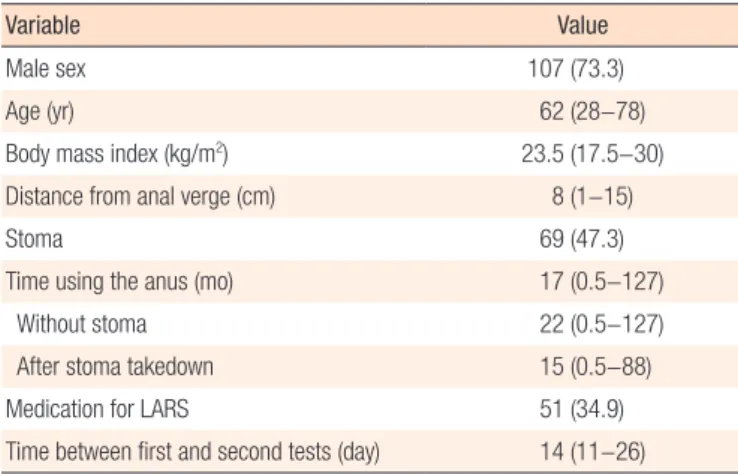
During the study period, 173 patients were asked to answer the Korean version of the LARS score questionnaire. Among them, 146 patients (84.4%) completed the questionnaire twice. Patient and treatment characteristics are listed in Table 1. The median age was 62 years, and the median tumor location was 8 cm from the anal verge. According to the LARS score, 46 patients had no LARS (31.5%), 36 had minor LARS (24.7%), and 64 had major LARS (43.8%).
Convergent validity
For QoL categorization, perfect, moderate, and no fit were 55.5%, 37.6%, and 6.8%, respectively (P < 0.001) (Table 2). The median LARS scores for no impact on QoL, minor impact on QoL, and some/major impact on QoL significantly differed at 5, 21, and 33, respectively (Fig. 1).
Discriminative validity
Male sex, tumor location less than 8 cm from the anal verge, and radiotherapy showed a significantly lower LARS score (Fig. 2).
The LARS score was not different between patients grouped ac- cording to age, presence of stoma, and time using the anus.
Fig. 1. c score versus impact in quality of life (QoL).
No QoL Minor QoL Some/major QoL 40
30 20 10 0
LARS score
Fig. 2. Box plots comparing low anterior resection syndrome (LARS) score by sex, tumor location, and radiotherapy.
Male Female ≤8 cm >8 cm No radiotherapy Radiotherapy
40 30 20 10 0
40 30 20 10 0
40 30 20 10 0
LARS score LARS score LARS score
P = 0.014 P = 0.021 P = 0.001
Table 1. Patient and treatment characteristics
Variable Value
Male sex 107 (73.3)
Age (yr) 62 (28−78)
Body mass index (kg/m
2) 23.5 (17.5−30) Distance from anal verge (cm) 8 (1−15)
Stoma 69 (47.3)
Time using the anus (mo) 17 (0.5−127)
Without stoma 22 (0.5−127)
After stoma takedown 15 (0.5−88)
Medication for LARS 51 (34.9)
Time between first and second tests (day) 14 (11−26) Values are represented as number (%) or median (range).
LARS, low anterior resection syndrome.
Table 2. Convergent validity
Variable No QoL Minor QoL Some/major QoL No LARS (0−20) 12 (8.2) 25 (17.1) 9 (6.1) Minor LARS (21−29) 0 (0) 16 (11.0) 20 (13.7) Major LARS (30−42) 1 (0.7) 10 (6.8) 53 (36.3) LARS score as a continuous variable 5 (0−16)
a21 (13−29)
b33 (27−39)
cValues are represented as number (%) or median (interquartile range).
LARS, low anterior resection syndrome; QoL, quality of life.
Perfect fit 55.5%, moderate fit 37.6%, no fit 6.8%. P-values: a vs. b, 0.006; a vs.
c, <0.001; and b vs. c, <0.001.
Test-retest reliability
For overall LARS category, perfect fit was 88.3% (Table 3). Each of the five items showed a high proportion of perfect fit (85.6%−
91.1%). The ICCs ranged from 0.909 to 0.944, demonstrating high agreement. Fig. 3 illustrates the extent of agreement between LARS scores on the first and second tests via the Bland-Altman plot.
DISCUSSION
This study validated the Korean version of the LARS score ques- tionnaire in Korean patients with rectal cancer. The LARS score questionnaire translated from English to Korean demonstrated convincing psychometric properties regarding convergent valid- ity, discriminative validity, and reliability, in accordance with pre- vious validation studies.
Perfect, moderate, and no fit were 55.5%, 37.6%, and 6.8%, re- spectively, between the LARS and QoL groups for convergent va- lidity (Table 3). The LARS score was clearly associated with QoL in Korean patients, and these results are similar to studies from Europe and Japan. Juul et al. [9] reported that there were 4.3% “no fits” in Sweden, 6% “no fits” in Spain, 7.7% “no fits” in Germany, and 2.3% “no fits” in Denmark. However, Akizuki et al. [11] re- ported only 0.7% “no fits”; “perfect” and “moderate fit” were simi- lar to our results (52.9% and 46.3%, respectively). Previous studies demonstrated that bowel dysfunction after rectal surgery is highly associated with poor QoL [7,8,16]. These studies analyzed the correlation of LARS score with EORTC Quality of Life Question- naire-Core 30 and/or the Wexner incontinence score. Based on these results, surgeons can actively, rather than passively, help pa- tients improve their QoL.
We sought to assess discriminative validity by identifying the correlation between the LARS score and known variables that might affect bowel dysfunction, including gender, age, presence of stoma, time using the anus, tumor location, and radiotherapy.
Male gender, lower tumor location, and radiotherapy were related with lower LARS score in this study. In the European population, age, radiotherapy, and type of surgery (total vs. partial mesorectal excision) showed differences in the LARS score [9,10]. However, we could not analyze the type of surgery as in the European vali-
dation study because the concept of partial mesorectal excision was unfamiliar. This was similar to a Japanese validation study which classified the type of surgery as (low) anterior resection, ul- tra-low anterior resection, and intersphincteric resection because the concept of partial mesorectal excision is relatively new in Ja- pan [11]. Limitations of their study included a study population from a single center and use of few neoadjuvant therapies. Hou et al. [12] demonstrated that female gender, radiotherapy, longer length of postoperative period, and lower tumor level were related to a lower LARS score in Chinese patients. Conversely, patients younger than 66.5 years old reported higher LARS scores than older patients with borderline significance (P=0.051). Although female gender is related to poor bowel dysfunction, our results may be due to confounding factors. There were several differ- ences between male and female patients in our dataset, including age (62 years vs. 60 years), radiotherapy (37.4% vs. 28.2%), and time using the anus (15 months vs. 24 months); male patients tended to have poorer factors, which may be responsible for the higher LARS scores.
In terms of test-retest reliability, we found relatively higher agreement (perfect fit more than 85% for all items) compared with European and Japanese studies. These results could be due to our strict time interval requirements between the first and sec- ond tests. Because bowel preparation for colonoscopy or any sur- gery under general anesthesia can influence the reliability of the test, patients who were scheduled to receive procedures or surgery were excluded. Accuracy and simplicity of translation were also important to achieving reliability; the self-reported questionnaire was easily understood by the non-medical population.
This is the first multicenter study to validate the Korean version of the LARS score questionnaire under permission of the original authors. Physicians, nurses, and students can now freely use this Table 3. Test-retest reliability (%)
Variable Perfect fit Moderate fit No fit ICC (95% CI)
LARS category 88.3 10.9 0.7 -
Item 1 87.6 9.6 2.8 0.932 (0.906−0.951) Item 2 85.6 11.0 3.4 0.909 (0.874−0.935) Item 3 86.3 13.1 0.7 0.944 (0.923−0.960) Item 4 91.1 6.9 2.1 0.931 (0.904−0.950) Item 5 85.6 13.7 0.7 0.942 (0.920−0.958) LARS, low anterior resection syndrome; ICC, intraclass correlation coefficient; CI, confidence interval.
Fig. 3. Bland-Altman plot 95% limits of agreement (−8.5 to 8.8) illus- trating differences between low anterior resection syndrome scores at first and second tests.
0 10 20 30 40
Average 15
10 5 0 -5 -10 -15
Difference