http://dx.doi.org/10.9724/kfcs.2015.31.6.718
블루베리즙 첨가량을 달리한 블루베리편의 품질 및 항산화특성
이동수 ․ 박진희1 ․ 유승석†
세종대학교 조리외식경영학과, 1우송대학교 외식조리학부 글로벌한식조리전공
Quality and Antioxidant Activity Characteristics of Blueberry-pyun with Different Amounts of Blueberry Juice
Dong Su Lee ․ Jin Hee Park1 ․ Seung Seok Yoo†
Department of Culinary and Foodservice Management, Sejong University, Seoul, 05006, Korea
1Department of Global Korean Culinary Arts, Woosong University, Daejeon, 34606, Korea
Abstract
In this study, we investigated the quality and antioxidant activity of blueberry-pyun (traditional Korean jelly using blueberry) according to different ratios of blueberry juice (100%, 80%, 60%, 40%, and 20%). Moisture and pH significantly decreased as the content of blueberry juice increased (p<0.05). As the amount of blueberry juice decreased, the lightness (L) decreased. At the same time, the redness (a) and yellowness (b) were significantly higher (p<0.05). DPPH radical scavenging activity and anthocyanin contents increased significantly when the amount of blueberry juice increased (p<0.05). In the texture profile analysis, hardness decreased as the content of blueberry juice increased. There were no significant differences in springiness. 20% blueberry juice showed the highest gumminess and chewiness. During sensory evaluation, 60% blueberry juice showed the highest in the appearance, color, sweetness and overall-acceptability. From these results, we conclude that blueberry-pyun made of 60% blueberry juice is the most desirable.
Key words: blueberry-pyun, blueberry juice, quality characteristics, antioxidant activity, DPPH radical scavenging activity
†
Corresponding author: Seung Seok Yoo, Department of Culinary and Foodservice Management, Sejong University, 209, Neungdong-ro, Gwangjin-gu, Seoul, 05006, Korea
Tel: +82-2-3408-3824 Fax: +82-2-3408-4313 E-mail: [email protected]
Ⅰ.
서 론블루베리는 진달래과 산앵도나무속(Vaccinium)에 속하 는 관목성 식물로 북아메리카가 원산지이다. 약 400여종 이 있으며 북미에서는 하이부시블루베리(V. corymbosum), 로부시블루베리(V. angustifolium) 및 래빛아이블루베리(V.
ashei) 등 세 종류가 상업적으로 중요한 과실로 재배되고 있다(Westwood MN 1993). 블루베리 성숙 과실에는 안토 시아닌과 카로티노이드 색소 등 여러 가지 뛰어난 생체 조절 기능 물질이 다량 함유되어 있어 항산화(Su MS &
Chien PJ 2007), 항당뇨(Martineau LC 등 2006) 및 항암 작용(Parry J 등 2006)이 우수하다. 또한 망막의 시각과 연결하는 로돕신(rhodopsin) 재합성 작용을 활성화 시켜 눈의 피로를 풀어주고 시야를 맑아지게 한다(Jeollabuk-do Agricultural Research & Extention Services 2009). 2002년 미국 타임지가 선정한 세계 10대 건강식품의 하나로 선
정된 바 있는 블루베리는 각종 성인병예방에 효과적이라 는 사실들이 밝혀지면서(Jeong CH 등 2008) 블루베리의 수요가 급증하고 있으며, 블루베리 생과 이용 이외에 다 양한 가공식품의 개발도 시도되고 있다. 블루베리를 첨가 한 떡(Oh JA 2008), 묵(Kim HY 등 2012), 머핀(Hwang SH & Ko SH 2010), 쿠키(Ji JR & Yoo SS 2010), 잼(Cho WJ 등 2010), 막걸리(Jeon MH & Lee WJ 2011), 젤리 (Joo NM 등 2012), 요구르트 드레싱(Lee WG & Lee JA 2012), 양갱(Han JM & Chung HJ 2013), 식빵(Lee ES 등 2014) 등의 연구가 보고되고 있다.
과편은 과일즙 또는 과일을 삶아 거른 물에 녹말과 설 탕, 꿀을 넣고 조려 엉기게 한 다음 그릇에 쏟아 식혀서 편으로 썬 것으로 서양의 젤리와 비슷한 우리나라 전통 한과이다(Kang IH 1997). 예로부터 제례, 혼례, 연회 등에 반드시 오르던 음식으로 주로 신맛이 나는 앵두나 살구, 산사, 복분자, 모과 등을 이용하였다(Chung HK & Woo NRY 2005). 최근까지 연구된 과편 중 과즙의 재료 배합 비에 따른 품질특성 연구로는 앵도편(Ryu JY & Lee HG 1986), 모과편(Lee JY & Lee HG 1994), 오디편(Kim AJ 등 2003), 석류편(Ko SH 등 2008), 유자과편(Nam HW 등 2004) 등이 있으며, 전분 및 감미료의 종류와 농도를 달
© 2015 Korean Society of Food and Cookery Science
Ingredients
Treatments (%) BP0
(100%) BP1 (80%)
BP2 (60%)
BP3 (40%)
BP4 (20%)
Blueberry juice 300 240 180 120 60
Water 0 60 120 180 240
Mungbean starch 30 30 30 30 30
Sugar 60 60 60 60 60
Oligosaccharide 40 40 40 40 40
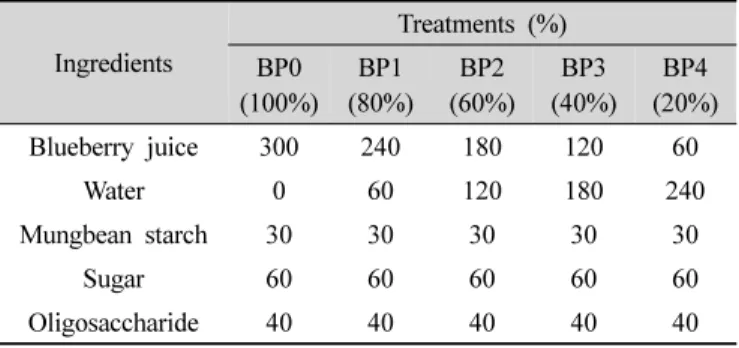
BP0: Blueberry juice 300 mL + Water 0 mL (100%) BP1: Blueberry juice 240 mL + Water 60 mL (80%) BP2: Blueberry juice 180 mL + Water 120 mL (60%) BP3: Blueberry juice 120 mL + Water 180 mL (40%) BP4: Blueberry juice 60 mL + Water 240 mL (20%)
Table 1. Formulas for blueberry-pyunClassification Qualification
Test speed 1.0 mm/s
Distance 30.0%
Time 20 sec
Load cell 5 kg
Sample height 25.0 mm
Calibrate probe 25.0 mm
Table 2. Analytical operation condition for texturemeter 리한 품질특성 연구로는 감귤편(Kim KS & Chae YK
1998), 도편(Park GS 등 1998), 살구편(Park GS 등 1999), 오미자편(Song ES 등 1993, Jeong HS & Joo NM 2003), 레몬과편(Kim EM & Lee HG 2003), 무화과편(Kim BS 등 2003) 등이 있으며, 과편의 영양강화 및 기능성식품을 첨가한 연구로는 칼슘을 첨가한 어린이용 포도편의 제조 및 품질 특성에 관한 연구(Chung HK 등 1997), 레몬홍삼 과편의 홍삼배합비에 따른 품질특성에 관한 연구(Kim EM 2006) 등이 보고되고 있다.
최근 각종 가공 식품의 발달과 외래식품의 다량 유입 으로 인하여 우리 전통 식품이 아주 낮은 섭취 이용률을 보이고 있어 전통적인 한과의 지속적인 발전 및 소비확 대를 위한 산업화와 상품화를 위하여 기능성이 가미된 다양한 한과개발이 필요하다. 따라서 본 연구에서는 블루 베리즙을 첨가한 과편을 제조하여 품질 및 항산화특성을 분석하고, 기능성과 기호성이 높은 과편의 상품화를 위한 연구를 수행하고자 하였다.
Ⅱ.
재료 및 방법 1. 실험재료 및 제조방법실험재료는 블루베리(예산농원, 천안, 대한민국)와 녹 두전분(고산전통식품, 고창, 대한민국), 설탕(정백당, 제일 제당, 서울, 대한민국), 올리고당(제일제당, 서울, 대한민 국)을 사용하였으며 블루베리편 재료배합비는 Table 1과 같다. 제조방법은 선행연구(Kim KS & Chae YK 1998)를 참고로 수차례 녹두전분과 설탕, 올리고당의 함량을 달리 하여 실시한 예비실험을 통해 녹두전분 30 g, 설탕 60 g, 올리고당 40 g으로 결정하였다. 블루베리를 착즙기 (SJ-200b, Hourom, Gimhae, Korea)에 짠 후 블루베리즙을 100%, 80%, 60%, 40%, 그리고 20%가 되도록 각각 물을 넣고 희석하였다. 먼저 20 cm의 냄비에 블루베리 희석액
300 mL 중 200 mL와 설탕, 올리고당을 첨가한 후 80±
5°C에서 4분 동안 끓인 다음 남은 블루베리 희석액 100 mL에 녹두전분을 풀은 현탄액을 넣고 나무 주걱으로 60 회/min 속도로 교반하여 끓어오르면 70±5°C에서 8분 동 안 끓였다. 7×15×3 cm 용기에 블루베리편을 넣어 실온에 서 2시간 동안 굳힌 후 4°C에서 24시간 냉장보관하며 시 료로 사용하였다.
2. 실험 방법
1) 수분측정 및 pH 측정
블루베리편의 수분측정은 105°C에서 상압 가열 건조법 으로 5회 반복 측정하여 그 평균값을 나타내었으며(Lee CH 등 1999), pH 측정은 pH meter(Mettler toledo, S20K, Greifeness, Switchland)로 5회 반복 측정하여 평균값을 구 하였다.
2) 색도 측정
색도는 색차계(CM-3500d, Minolita, Tokyo, Japan)를 사 용하여 측정하였다. 시료의 명도(lightness, L), 적색도 (redness, a), 황색도(yellowness, b)를 5회 반복 측정하여 평균값으로 나타내었다(The Korean Society of Food Science and Nutrition 2000). 표준백판의 값은 L값이 92.86, a값이 0.3132, b값이 0.3192이었다.
3) 항산화성 측정
항산화성은 DPPH(1,1-diphenyl-2-picrylhydrazyl) radical 의 소거활성을 측정하여 나타내었다. 525 nm에서 흡광도 를 각각 5회 반복 측정하여 평균값을 구하였다.
4) 안토시아닌(anthocyanin) 함량 분석
블루베리편의 안토시아닌 함량 분석은 추출용매(MeOH:
0.1M HCl=85:15)를 이용하여 시료로부터 안토시아닌을 추출하여 실온에서 30분가량 방치한 다음 535 nm에서 흡 광도를 측정하였다.
5) Texture 측정
텍스쳐 측정은 texture analyser(TAXT2i, Stable Micro
Sample
3⁾ Moisture (%) pH BP0 (100%) 51.80±0.71
e1,2)3.82±0.01
e1,2)BP1 (80%) 56.44±1.05
d3.88±0.01
dBP2 (60%) 58.68±0.73
c3.93±0.01
cBP3 (40%) 60.28±1.49
b3.99±0.01
bBP4 (20%) 61.94±1.67
a4.16±0.03
a1)
Values are mean±SD.
2) a-e
Mean in a column by different superscripts are signifi- cantly different at the p<0.05.
3)
Samples are same as in Table 1.
Table 3. Moisture and pH of blueberry-pyun
Sample
3⁾ L a b
BP0 (100%) 20.66±0.35
e1,2)9.02±0.14
a-0.71±0.09
aBP1 (80%) 21.76±0.23
d8.72±0.17
b-1.11±0.24
bBP2 (60%) 23.76±0.54
c7.92±0.14
c-2.13±0.04
cBP3 (40%) 26.68±0.19
b6.05±0.07
d-3.39±0.05
dBP4 (20%) 31.73±0.16
a3.98±0.08
e-4.56±0.06
e1)
Values are mean±SD.
2) a-e
Mean in a column by different superscripts are signifi- cantly different at the p<0.05.
3)
Samples are same as in Table 1.
Table 4. Hunter's color values of blueberry-pyun systems, Haslemere, England)를 이용하여 Table 2와 같은
조건에서 측정하였다. 경도(hardness), 탄력성(springing), 응집성(cohesiveness), 점착성(gumminess), 씹힘성(chewiness) 및 부착성(adhesiveness) 등의 TPA 특성치를 측정하였다 (Lee CH 등 1999).
6) 기호도 조사
블루베리편의 기호도 조사는 성인 50명을 대상으로 실시하였다. 시료는 2×2×2 cm의 크기로 지름 20 cm의 백 색 접시에 담아 세자리 난수표를 이용하여 시료번호를 표 시하였다. 한 개의 시료 평가 후 반드시 물로 입안을 헹 군 뒤 다음 시료를 평가하도록 하였다. 평가항목은 외형 (appearance), 색깔(color), 단맛(sweetness), 신맛(sourness), 투명도(clearness), 경도(hardness) 및 전체적인 기호도 (overall preference) 등에 대해 9점 채점법으로 최고 9점 에서 최저 1점까지 기호도가 좋을수록 높은 점수를 주도 록 하였다(Kim KO 등 2010).
7) 통계처리
모든 실험 결과의 통계처리는 SAS(Statistical Analysis System, version 8.1, SAS Institute, Cary, NC, USA) program을 이용하여 분산분석과 Duncan's multiple range test을 실시하여 각 시료간의 유의차를 p<0.05 수준으로 비교 분석하였다(Song MS 등 1989).
Ⅲ.
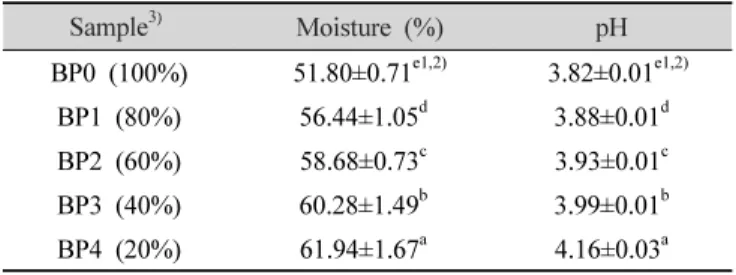
결과 및 고찰 1. 수분함량 및 pH 측정블루베리즙의 첨가량을 달리하여 제조한 블루베리편의 수분함량 및 pH 측정결과는 Table 3과 같다. 블루베리즙 을 20% 첨가한 BP4는 61.94로 가장 높게 나타났으며 블 루베리즙을 100% 첨가한 BP0는 51.80으로 가장 낮게 나 타났다. 모든 시료간에 유의적인 차이가 나타났으며(p<0.05) 블루베리즙의 첨가량이 많을수록 수분함량이 낮게 나타
났음을 알수 있었다. 이는 Ko SH 등(2008)의 석류편에서 도 석류즙과 석류농축액의 첨가량이 증가할수록 수분함 량이 낮았다는 연구결과와 같은 결과였다.
블루베리편의 pH는 블루베리즙을 20% 첨가한 BP4가 4.16으로 가장 높게 나타났으며, 블루베리즙의 첨가량이 감소할수록 pH는 높게 나타났다. 이는 Ko SH 등(2008) 은 석류즙 첨가량이 감소할수록 과편의 pH가 증가하는 경향을 보였다고 하여 본 연구와 같은 결과였으나 석류 즙 60%와 40% 첨가한 시료간에는 유의적인 차이가 없었 다고 하였으나 블루베리편의 모든 시료에서는 시료간 유 의적인 차이가 있었다(p<0.05).
2. 색도 측정
블루베리편의 색도 측정 결과는 Table 4와 같다. 명도 (L값)는 블루베리즙을 20% 첨가한 BP4가 31.73으로 가장 높아 밝게 나타났으며, 블루베리즙을 100% 첨가한 블루 베리편 BP0는 20.66으로 어둡게 나타났다. BP4, BP3, BP2, BP1, BP0 순으로 높게 나타났으며 모든 시료간에 유의적인 차이가 있었다(p<0.05). 이는 블루베리즙의 색 으로 인하여 첨가량이 증가할수록 밝기는 점점 어두워지 고 블루베리즙의 첨가량이 감소할수록 밝기는 더 밝게 나타났다. Han SK 등(2006)의 복분자편과 Ko SH 등 (2008)의 석류편의 연구에서도 과즙의 첨가량이 감소할수 록 L값이 증가했다는 결과와 일치하였다.
적색도(a값)는 블루베리즙을 100% 첨가한 BP0가 9.02 로 가장 높게 나타났고, 20% 첨가한 BP4가 3.98로 급격 히 낮아진 결과를 보였으며 모든 시료간 유의적인 차이 가 있었다(p<0.05). Kim EM(2006)의 레몬홍삼과편에서는 홍삼의 함량이 증가할수록 적색도가 증가한다고 하였으 며 Ko SH 등(2008)의 석류편에서 석류즙의 첨가량이 증 가할수록 적색도가 증가하였다는 결과와 같았다.
황색도(b값)의 경우 -4.56 ~ -0.71로 모든 시료간 유의적 인 차이가 있었으며(p<0.05) Han JM & Chung HJ(2013) 의 블루베리를 첨가한 양갱의 경우 -2.62 ~ -1.76으로 블
Sample
3)EDA (%) BP0 (100%) 81.72±0.90
a1,2)BP1 (80%) 73.53±0.07
bBP2 (60%) 64.70±0.24
cBP3 (40%) 62.89±0.13
cBP4 (20%) 46.98±0.09
d1)
Values are mean±SD.
2) a-d
Mean in a column by different superscripts are signifi- cantly different at the p<0.05.
3)
Samples are same as in Table 1.
Table 5. DPPH radical scavenging activity of blueberry-pyun (0.1% ascorbic acid - 90.45%)
Sample
3)Anthocyanin
BP0 (100%) 75.30±0.60
a1,2)BP1 (80%) 63.10±0.05
bBP2 (60%) 59.20±0.10
cBP3 (40%) 57.02±0.07
cBP4 (20%) 43.98±0.09
d1)
Values are mean±SD.
2) a-d
Mean in a column by different superscripts are signifi- cantly different at the p<0.05.
3)
Samples are same as in Table 1.
Table 6. Anthocyanins of blueberry juice and blueberry-pyun (unit : mg/1 00 g)
Sample
3)Hardness (Kgf)
Springiness (mm)
Cohesiveness (Kgf)
Gumminess (gf)
Chewiness (Kgf)
Adhesiveness (Kgf) BP0 (100%) 511.51±6.52
d1,2)6.44±0.32
NS4)0.20±0.04
b153.66±11.19
c977.79±88.57
b34.97±9.17
abBP1 (80%) 612.94±3.78
c6.75±0.73 0.29±0.07
a180.53±7.58
b1193.20±95.68
ab38.04±3.63
aBP2 (60%) 619.06±0.06
c7.01±0.14 0.30±0.04
a180.12±2.66
b1196.22±89.51
ab24.70±4.36
bBP3 (40%) 678.08±31.02
b6.50±0.27 0.19±0.02
b159.80±25.85
c1108.81±200.28
ab26.75±6.85
abBP4 (20%) 799.01±6.78
a6.96±0.27 0.26±0.02
ab199.47±8.61
a1306.88±134.23
a31.83±6.55
ab1)
Values are mean±SD.
2) a-d
Mean in a column by different superscripts are significantly different at the p<0.05.
3)
Samples are same as in Table 1.
4)
NS means no significant differences p<0.05.
Table 7. Textural properties of blueberry-pyun
루베리의 안토시아닌 색소의 영향으로 모두 음(-)의 값 을 나타내어 청색의 범위에 있는 것으로 나타났다는 결 과와 같은 경향이었다. 블루베리즙을 100% 첨가한 BP0 가 -0.71로 높게 나타났으며, 블루베리즙을 20% 첨가한 BP4에서 -4.56으로 가장 낮게 나타났다.
3. 항산화성 측정
블루베리편의 DPPH 측정 결과는 Table 5와 같다. 블루 베리즙을 100% 첨가한 BP0가 81.72%로 가장 높게 나타 났으며 다른 시료들과 유의적인 차이를 나타냈다(p<0.05).
블루베리즙을 20% 첨가한 BP4는 46.98%로 가장 낮게 나 타났으며 BP0, BP1, BP2, BP3, BP4 순으로 높았다. 석류 첨가량에 따른 석류편의 품질특성(Ko SH 등 2008)에 대 한 연구에서 석류즙에 대한 항산화성은 76.94%이었고, 석 류편의 DPPH는 21.37~36.22%였으나 블루베리즙의 DPPH 는 82.61%였고 블루베리편의 DPPH는 46.98~81.72%로 석류편보다 항산화성이 다소 높게 나타났다.
4. 안토시아닌(anthocyanin) 함량 측정
블루베리즙 첨가량에 따라 제조한 블루베리편의 안토
시아닌 함량 분석 결과는 Table 6과 같다. 블루베리즙 첨 가량에 따른 블루베리편의 안토시아닌 함량은 블루베리 즙을 100% 첨가한 BP0가 75.30으로 가장 높게 나타났으 며, 블루베리즙을 20% 첨가한 BP4는 43.98 mg/100 g으 로 가장 낮게 나타났다. BP0, BP1, BP2, BP3, BP4 순으 로 높게 나타나 블루베리즙의 첨가량이 많을수록 안토시 아닌 함량이 높았으며 각 시료간 유의적인 차이가 있었 다(p<0.05).
5. Texture 측정
블루베리편의 조직감의 측정 결과는 Table 7과 같다.
경도는 블루베리즙을 20% 첨가한 BP4가 799.01 Kgf로 가장 높게 나타났고, 블루베리즙을 100% 첨가한 BP0가 511.51 Kgf로 가장 낮게 나타나 블루베리즙의 첨가량이 많을수록 경도가 낮게 나타났다. 블루베리즙을 60% 첨가 한 BP2와 블루베리즙을 80% 첨가한 BP1은 서로 유의적 인 차이가 없었다. 탄력성은 블루베리즙을 60% 첨가한 BP2가 7.01 mm로 가장 높게 나타났고, 블루베리즙을 100% 첨가한 BP0가 6.44 mm로 낮게 나타났으나, 모든 시료간 유의적인 차이는 나타나지 않았다. 응집성은 블루
Sample
3)Appearance Color Sweetness Clearness Springiness Hardness Overall acceptance BP0 (100%) 5.71±2.43
b1,2)5.14±2.54
b5.14±2.28
b4.43±2.28
b4.80±2.18
NS4)4.00±2.45
NS)5.29±2.20
bBP1 (80%) 4.71±2.46
bc4.14±2.18
bc4.71±1.90
b3.00±1.36
b4.30±2.08 3.94±2.54 3.14±1.83
cBP2 (60%) 7.57±2.28
a7.43±1.79
a7.14±1.99
a6.71±1.33
a4.43±1.60 3.86±1.83 7.86±1.70
aBP3 (40%) 4.29±2.55
bc3.57±1.83
bc4.14±2.57
b4.00±2.18
b4.86±2.66 4.43±2.87 3.43±2.10
cBP4 (20%) 3.43±2.10
b3.00±1.76
c2.29±2.02
c4.29±2.79
b4.57±2.87 4.00±2.57 2.43±1.83
c1)
Values are mean±SD.
2) a-c
Mean in a column by different superscripts are significantly different at the p<0.05.
3)
Samples are same as in Table 1.
4)
NS means no significant differences p<0.05
Table 8. Sensory evaluation of blueberry-pyun베리즙을 60% 첨가한 BP2가 0.30 Kgf로 가장 높게 나타 났고, 블루베리즙을 40% 첨가한 BP3가 0.19 Kgf로 가장 낮게 나타났다. 블루베리즙을 100% 첨가한 BP0는 블루 베리즙을 80%, 60%, 40% 첨가한 BP1, BP2, BP3와는 유 의적인 차이가 없었다. 점착성은 블루베리즙을 20% 첨가 한 BP4가 199.47 gf로 가장 높게 나타났으며 다른 시료와 유의적인 차이가 있었다(p<0.05). 블루베리즙을 100% 첨 가한 BP0가 153.66 gf로 가장 낮게 나타났다. 씹힘성은 블루베리즙 20% 첨가한 BP4가 1306.88 Kgf로 가장 높게 나타났으며 블루베리즙 100% 첨가한 BP0가 977.79 Kgf 로 가장 낮게 나타났다. 부착성은 블루베리즙 80% 첨가 한 BP1이 38.04 Kgf로 가장 높게 나타났고, 블루베리즙 60% 첨가한 BP2가 24.70 Kgf로 가장 낮게 나타났으며 서로 유의적인 차이가 있었다(p<0.05).
6. 기호도 조사
블루베리편의 기호도 조사에 대한 결과는 Table 8과 같 다. 외형은 블루베리즙 60% 첨가한 BP2가 7.57로 가장 높게 나타났으며 다른 시료와는 유의적인 차이가 있었다 (p<0.05). 색깔은 블루베리즙 60% 첨가한 BP2가 7.43으 로 가장 높은 값을 나타냈으며, 단맛도 블루베리즙 60%
첨가한 BP2가 7.14로 가장 높게 나타나 블루베리즙의 함 량이 높을수록 단맛에 대한 기호도가 함께 상승하지는 않는 것으로 나타났다. 블루베리즙 20% 첨가한 BP4는 외형, 색깔, 단맛에서 가장 낮은 값을 나타냈다. 투명도는 블루베리즙 60% 첨가한 BP2가 6.71로 가장 높게 나타났 으며 다른 시료와는 유의적인 차이를 보였다(p<0.05). 탄 력성은 블루베리즙 40% 첨가한 BP3가 4.86으로 가장 높 은 값을 보였고, 경도도 블루베리즙 40% 첨가한 BP3가 4.43으로 가장 높게 나타났으나 탄력성과 경도에 대한 기 호도에서는 각 시료간 유의적인 차이는 없었다. 이는 전 분양이 동일하였기 때문인 것으로 기계적 측정결과에서 는 블루베리즙 첨가량에 따라 경도의 차이가 있었으나 기호도에서는 시료간 뚜렷한 차이를 보이지 않은 것으로
나타났다. 관능적으로 식품을 평가할 때 식품에 대한 인 상을 최초로 결정하는 색은(Hwang CS 등 1992) 품질감 정에 우선적인 기준이 되어 미관, 식욕과 밀접한 상관관 계가 있다고 한다(Kim JY & Na JK 2005). 외형, 색깔, 투명도의 기호도가 높았던 블루베리즙 60% 첨가한 BP2 가 전체적인 기호도에서도 7.86으로 가장 높게 나타났으 며, 다른 모든 시료와 유의적인 차이를 보였다(p<0.05).
석류첨가량에 따른 석류편의 기호도 조사에서도 색에 대 한 기호도가 높은 시료가 전체적인 기호도에서도 높게 나타났다(Ko SH 등 2008).
Ⅳ.
결론 및 요약블루베리즙의 첨가량을 달리하여 제조한 블루베리편의 수분함량, pH, 색도, 항산화성, 안토시아닌 함량, 텍스쳐 및 기호도 조사를 실시하였다. 블루베리편의 수분함량 및 pH는 블루베리즙 첨가량이 많을수록 낮게 나타났다. 색 도 측정 결과 명도(L값)는 블루베리즙 첨가량이 20%인 BP4의 값이 31.73%으로 가장 높게 나타나 블루베리즙 첨가량이 감소할수록 명도는 낮게 나타났다. 적색도(a값) 와 황색도(b값)는 블루베리즙 첨가량이 많을수록 유의적 으로 높게 나타났다(p<0.05). 항산화성 측정결과 블루베 리즙 100% 첨가한 BP0가 81.72%로 가장 높게 나타났으 며 다른 시료들과 유의적인 차이를 나타냈다(p<0.05). 안 토시아닌 함량은 블루베리즙 첨가량이 많을수록 안토시 아닌 함량이 높았고, 각 시료간 유의적인 차이가 있었다 (p<0.05). 텍스쳐 측정 결과 경도는 블루베리즙 20% 첨가 한 BP4가 가장 높게 나타났고, 블루베리즙 100% 첨가한 BP0가 가장 낮게 나타나 블루베리즙의 첨가량이 많을수 록 경도는 낮게 나타났다. 탄력성은 모든 시료간에 유의 적인 차이가 없었다. 응집성은 블루베리즙 60% 첨가한 BP2가 가장 높게 나타났고, 블루베리즙 40% 첨가한 BP3 가 가장 낮게 나타났다. 점착성과 씹힘성은 블루베리즙 20% 첨가한 BP4가 가장 높게 나타났으며 부착성은 블루
베리즙 80% 첨가한 BP1이 가장 높게 나타났다. 기호도 조사에서 외형, 색깔, 단맛은 블루베리즙 60% 첨가한 BP2가 가장 높게 나타났으며 블루베리즙 20% 첨가한 BP4는 가장 낮게 나타났다. 투명도는 블루베리즙 60%
첨가한 BP2가 가장 높게 나타났으며 다른 시료와는 유의 적인 차이를 보였다(p<0.05). 탄력성과 경도는 모든 시료 간 유의적인 차이가 없었다. 전체적인 기호도는 블루베리 즙 60% 첨가한 BP2가 7.86으로 가장 높게 나타났으며, 다른 모든 시료와 유의적인 차이를 보였다(p<0.05). 이상 의 결과로 보아 블루베리즙을 첨가한 과편 제조시 블루 베리즙 60%를 첨가하여 제조한 BP2가 가장 바람직한 것 으로 평가되어 기호성 및 기능성이 우수한 블루베리편으 로의 개발이 가능한 것으로 판단되었다.