Kor. J. Hort. Sci. Technol. 28(4):600-608, 2010
Effect of 1-Methylcyclopropene (1-MCP) Treatment on the Quality Characteristics and Pigmentation of
Tomato Fruit (Lycopersicon Esculentum Mill.)
YounSuk Lee1*, Dae-Sung Chung2, Bruce R. Harte3, and Joongmin Shin4
1Packaging Department, Yonsei University, Wonju 220-710, Korea
2National Institute of Horticultural & Herbal Science, Suwon 440-706, Korea
3School of Packaging, Michigan State University, East Lansing, MI 48824, USA
4Packaging Department, University of Wisconsin-Stout, Menomonie, WI 54751, USA
Abstract. The quality attributes of tomato fruit (Lycopersicon Esculentum Mill.) to treatments with 1-methylcyclopropene (1-MCP) were studied. Harvested tomato fruit was treated one time at the initiation of storage or once-a-day during storage with 1 μL/L 1-MCP at different storage temperatures, 12, 17, and 23℃. The results showed that both lower temperature and duration of 1-MCP treatment played an important role in ripening of tomato fruit. The once-a-day 1-MCP treatment was presented to be very effective in delaying quality changes of tomato fruit. The amount of chlorophyll and lycopene were measured to assess the impact of 1-MCP and temperature treatments on ripening, using a specific extinction coefficient absorbance technique. Storing tomato fruit at 12℃ resulted in a longer ripening period (color change) than tomato fruit stored at 17℃ and 23℃. 1-MCP treatment was very effective in retarding chlorophyll degradation and lycopene formation in the pericarp tissue of the tomato fruit at the different storage temperatures. The 1-MCP treatments affected the total chlorophyll content in different fruit tissues of the pericarp and placenta. Exposure of tomato fruit to 1-MCP gas at 12℃, using the once-a-day treatment, was highly effective in delaying pigment and color change.
Additional key words: chlorophyll, color change, lycopene, postharvest
*Corresponding author: [email protected]
※ Received 16 January 2010; Accepted 10 May 2010.
Introduction
Rapid ripening of the tomato fruit after harvest limits trans- portability and storability and thus is a marketing concern.
Fruit color is one of the most important indexes in deter- mining the market quality of tomato fruit and is used to represent maturation during storage (Lopez Camelo and Gomez, 2004).
The primary pigments impacting flesh and skin color are the chlorophylls and lycopene (Fraser et al., 1994). Chlorophyll degradation and carotenoid synthesis are affected by ethylene content (Lelievre et al., 1997). Edwards (1967) found that the chlorophyll content in green colored tomato fruit decreased while the content of carotenoids such as lycopene, lutein, β-carotene, ς-carotene, neurosporene, phytoene, and phytofluene increased during the ripening process.
In common varieties of tomato fruit, lycopene is found predominantly in the chromoplast, which is in the outer part of the pericarp tissue. Lycopene can make up 95-100% of
the total carotenoid content of certain varieties of tomato fruit (Nguyen and Schwartz, 1999).
Short term delay in color change during ripening has been achieved using controlled atmospheres with high CO2 and low O2 at 22℃ (Ratanachinakorn et al., 1997), treatment with fluorescent-light exposure to diszocyclopentadiene (DACP) at 22℃ (Sisler and Lallu, 1994), treatment with temperatures above 30℃ (Mitcham and Mcdonald, 1992), and ethanol exposure of the whole tomato fruit at various maturity stages (Saltveit and Sharaf, 1992). Storing the mature green tomato fruit under low oxygen atmosphere (3.05 kPa O2), can also delay color development compared to the control fruit under atmospheric conditions at 20℃ (Kim et al., 1999).
1-methylcyclopropene (1-MCP) has been evaluated as a non-toxic gaseous compound which can extend the freshness of horticultural produce. 1-MCP studies have been carried out with strawberries (Ku and Wills, 1999), apples (Watkins, et al., 2000), bananas (Jiang et al., 1999), kiwifruits (Kim et al., 2001), papaya (Manenoi et al., 2007), and tomatoes (Guillen et al., 2007). 1-methylcyclopropene (1-MCP) retards the ripening of fresh produce and can delay color develop- ment in ripening fruit. Mostofi et al. (2003) found that 1
μL・L-1 1-MCP arrested mature green tomato fruit ripening at three storage temperatures. They did not test at lower temperatures. Mir et al. (2001) determined that repeated 1 1 μL・L-1 1-MCP treatments of apples arrested ripening of fruit treated at the preclimacteric stage, but its effect on fruit quality was somewhat temperature-sensitive, with the poorest response to 1-MCP being found at 10℃. Guillen et al. (2007) evaluated the efficacy of 1-MCP to inhibit quality changes in tomato (Lycopersicon esculentum Mill.) fruit as a function of 1-MCP concentration at 0.5 μL・L-1 or 1 μL・L-1, and short duration of 1-MCP treatments for 3, 6, 12, and 24 h. Moretti et al. (2002) reported that pre-storage treatment with 1000 μL/L 1-MCP for a short time delayed total carotenoids synthesis and color development of tomato fruit. Porat et al. (1999) found that “Shamouti” oranges treated with 0.1 μL・L-1 of 1-MCP was very effective in inhibiting the ethylene- induced fruit degreening process. Golding et al. (1998) found that application of 1-MCP to mature green bananas significantly delayed onset of peel degreening at 20℃, which is associated with ripening.
However, several studies have been reported that 1-MCP applied once during a short duration of 24 h has been found to temporarily inhibit tomato ripening at room temperature (Guillen et al., 2007; Moretti et al., 2002; Mostofi et al., 2003). A single treatment of 1-MCP arrested ripening was not enough to maintain optimal quality of tomato fruit at different environmental conditions, especially for long term storage or transport of the tomato fruit. Moreover, the impacts of once-a-day 1-MCP treatment over a long period time on ripening were still not reported. No studies have examined the changes in pigment of tomato tissues at a low temperature and 1-MCP exposure of long duration. In order to achieve ideal 1-MCP treatments, the experiments using controlled treatment with continuous 1-MCP exposure of the tomato fruit were needed to verify that the freshness of postharvest produce was extended by maintaining an established level of 1-MCP for long term storage.
In addition, Lee et al. (2006) investigated the development of a 1-MCP delivery system with appropriate permeation properties for a continuous slow release of 1-MCP at an acceptable rate into the headspace of packages to obtain the desirable shelf life of fresh tomato fruit. This may also be used to provide more convenient means than 1-MCP delivery system by dissolving the complex in a suitable solvent in order to release the 1-MCP as current commercial 1-MCP preparation.
The objective of this study was to investigate the influence of 1-MCP treatments on the quality evaluation of tomato fruit and focus on changes in the major pigments during storage. The experiments were conducted at three different
storage temperatures: 12, 17, and 23℃. The tomato fruit was treated in one of two ways, 1 μL・L-1 1-MCP “once-a-day”, for a continuous 1-MCP exposure application, or a one-time application at the same 1-MCP concentration. Total chlorophyll and lycopene contents were quantified in 1-MCP treated and control fruit, using a specific extinction coefficient absorbance technique.
It is assumed that the results of these studies would enable better treatment and delivery system for controlled exposure of 1-MCP, and optimum storage life of fresh produces. The pigment studies should also improve our understanding of the effectiveness of 1-MCP of change in tomato color affected by ethylene.
Materials and Methods Material and storage
Fresh ‘Plum dandy’ tomato fruit (Lycopersicon Esculentum Mill.) grown during the summer of 2004 at the Horticulture Teaching and Research Center (HTRC) in Holt, MI were picked by hand and immediately transported to the laboratory for these studies. The tomato fruit was classified by skin color into the mature green stage and early ripening stage of maturity based on standard maturity grading (Ryall et al., 1979).
Defect-free fruits with uniform color, shape, and size were sorted, rinsed with distilled water to remove any debris, and dried in air. The average weight of each tomato was 82±12 g. About ten tomato fruits were selected and placed in a 10-L glass desiccator. A rubber port on the lid provided the inlet and outlet ports and the chamber was ventilated with a constant air flow of 12 mL・min-1. The inlet air was bubbled through water to increase its humidity. Chamber humidity was not measured. The chambers containing tomato fruit were placed in controlled temperature rooms to maintain 12, 17, and 23±1℃.
Preparation of 1-MCP and tomato treatments
1-MCP was obtained from Floralife Inc., (Walterboro, SC, USA) as EthylBlocⓇ powder containing 0.14% active ingredient.
Aliquots of 1-MCP as EthylBlocⓇ powder were weighed and placed into a 500 mL Erlenmeyer flask and tightly closed with a rubber stopper. 1-MCP was vaporized completely from the EthylBlocⓇ after 2 hr following the addition of 40 mL of distilled water. The headspace volume contained 480 μL 1-MCP per L. A 10 mL aliquot of the headspace volume was then injected through a rubber port on the lid of the glass desiccator to expose the tomato fruit to 1 μL 1-MCP per L of air. The concentration of 1-MCP in the sealed desiccator was measured using a Carle gas chromatograph
(GC) Series 100 AGC (Loveland, CO, USA), equipped with a flame ionization detector and a 30 cm × 2.2 mm inner diameter stainless steel column packed with Porapak-N (Aldrich Co., Milwaukee, WI, USA). 1-Butene (99.9% pure) was purchased from AGA Specialty Gas Inc., (Maumee, OH, USA) to use in quantitative analysis of 1-MCP.
Tomato fruit was exposed to 1-MCP gas using one of three techniques; a. once at the initiation of storage, b.
once-a-day during storage, or c. no exposure (controls). 1-MCP treatments were prepared as follows: (1) for the one-time application, 10 mL of the 1-MCP gas stock, were manually injected into the glass desiccator containing the tomato fruit to provide a concentration of approximately 1 μL・L-1. After exposing the tomato fruit to 1-MCP for 20 h, humidified air was flowed through the desiccator to flush out any remaining 1-MCP; (2) for the once-a-day application, 10 mL of the same gas stock was manually injected daily into the treatment chambers without interruption of the flow of humidified air.
Control fruit, not exposed to 1-MCP, were stored under a continuous stream of humidified air at the same storage temperatures. The 1-MCP treatments for harvested tomato fruit were conducted at the mature green stage and the break stage to determine the loss of chlorophyll and formation of lycopene, respectively.
Tomato color and other quality parameters
Tomato fruit was sampled for measuring the skin color, firmness, and total weight loss. Tomato skin color was measured at a point one-third of the distance from the stem scar to the apex of the fruit on a defect-free surface using a chromameter (Model CR-300 Minolta, Japan). Hue angle was used to describe the skin color change. A decrease in the value of the hue angle represents a change in skin color from green to pink to red. Firmness was measured manually using a hand-held durometer (ShoreⓇ Durometer Hardness Type 00, ShoreⓇ Instrument and Mfg. Co., Inc., Jamaica, NY, USA) at marked position. Durometer values were converted to Newton・mm-1 unit. A plunger-tip probe fitted in the duro- meter was pressed against the surface tissue of the fruit and the value after 3 second was measured. The durometer values were recorded between 0 and 100, a decrease in value represented a decline in firmness, converted to Newton・mm-1 unit. Total weight loss of a tomato was measured using a digital balance with 10 mg digit unit and expressed as percentage loss of original weight. The tomato ethylene production was measured on a single fruit using a static gas collection system at room temperature. A tomato fruit was placed in a 475 mL wide mouth glass jar, purged using ethylene-free air, and sealed with a closure containing a rubber septum at the top. After one hour, 1 mL of gas from
the headspace was extracted from the sealed glass jar using a 5 mL plastic syringe. The gas sample was injected into the gas chromatograph for quantification.
Chlorophyll and lycopene analysis
Harvested tomato fruit was prepared by excising the peri- carp, placenta, and gel tissues. Each tissue sample was cut into pieces approximately 1 cm in width. About 10 g of the sample parts were transferred to a Coors Mortar (90 mm diameter) and ground for 10 min using a hand pestle. After grinding, six-gram portions were transferred to glass test tubes (25 mm outside diameter×150 mm long). 5 mL of N-N-dimethylformamide (DMF) for chlorophyll analysis and 10 mL of methyl alcohol of lycopene analysis added to each sample tube. Each mixture was stirred using a Vortex (Model K550G, Scientific Industries Inc. Springfield, MA, USA) mixer and then allowed to stand for approximately 10min.
For chlorophyll analysis, an aliquot (1 mL) of the extraction mixtures was then placed into a glass cuvette after filtering the extraction mixture through filter paper (Whatman 1, 110 mm diameter source) using a Buchner funnel, and the total chlorophyll content of the extracted sample measured using an UV-Visible spectrophotometer (Model U-300, Hitachi Ltd. Japan).
The chlorophyll content in N-N-dimethylformamide (DMF) solvent was analyzed and calculated as described by Moran (1982). Total chlorophyll content in DMF was calculated from absorbance measurements at 647 and 664 nm using the following equation:
Total chlorophyll content (μg/g)
t
total
W
V A
A + ×
= (7.04 664 20.27 647)
(1) where, 7.04A664 + 20.27A647 = the extracted chlorophyll content (g・mL), Vtotal is the total volume with DMF solution (mL), Wt is the tomato sample weight (g).
For lycopene analysis, 10 mL aliquots of an acetone-hexane solution (1:1) were added to the mixture after treating with 10 mL of methyl alcohol from a grinding sample, and stirred again using the vortex for 1 min. It was then filtered and a Buchner funnel into a 100 mL volumetric flask. The pulp remaining in the filter paper was washed with 5 mL hexane.
The washed pulp was discarded after mechanically squeezing to remove remaining solvent. The extracts were combined and placed in a 125 mL separatory funnel. 100 mL of distilled water was added to the extracts and the mixture gently shaken for 1 min to remove acetone and methanol-water soluble substances. The hexane extract (upper phase in the separatory funnel) was collected in a glass tube. The hexane extract was
subjected to a saponification procedure to remove unwanted lipids and chlorophylls. The hexane extract was vortexed for 1 min with one-eighth volume methyl alcohol saturated with potassium hydroxide. After 30 min, the hypophase was removed using a 5 mL glass pipette. 10 mL of methyl alcohol was added to wash the hexane epiphase. The extract was then washed with 50 mL of distilled water to remove the methyl alcohol using a separatory funnel. The hexane extract (upper phase in the separatory funnel) was filtered through anhydrous sodium sulfate using filter paper and a buchner funnel. The lycopene hexane extract was chromatographed onto glass columns (2 cm outside diameter × 13 cm long) packed with an adsorbent combination of Hyflo Super Cel and MgO magnesia (1:1 by weight) using modifications of separation procedures outlined by Buckle and Rahman (1979).
A yellow-colored carotenoid band slowly separated from the main pink band at the top of the column. The column was then washed using 40 mL of a 3% acetone solution in hexane to elute the carotenoids ahead of the pink lycopene band that was slowly diffusing downward. The eluted material containing the yellow band was discarded. The lycopene was washed from the column with a 50 mL solution of 10%
acetone and 5% methanol in hexane. The lycopene solution was then transferred to a separatory funnel, and washed with 50 mL of distilled water to remove the acetone and methyl alcohol. The hexane extract was then filtered through anhydrous sodium sulfate to remove water, and made up to a volume of 50 mL with hexane.
The total lycopene content in the hexane solution was quantified using a Hitachi Model U-300 spectrophotometer (Hitachi Ltd., Tokyo, Japan). The purified lycopene was identified by comparison to the standard spectral of lycopene (Britton, 1983) and the absorbance of the lycopene measured at a wavelength of 472.5 nm. The total lycopene content in the tomato fruit was calculated by substitution into the following equation:
μg lycopene/gram of tomato
t cm
total
W E
V A
×
×
×
= ×
100 10
% 1 1
λ 6 (2)
where, A λ is the measured absorbance, Vtotal is the total sample volume (mL), Wt is the tomato sample weight (g), and E1%1 cm is the specific extinction coefficient (SEC) of lycopene at a given wavelength in a 1% solution (i.e. 1 g lycopene per 100 mL solution) in a 1 cm spectrophotometic cuvette. E1%1 cm of lycopene in a hexane solvent is 3450 at λ=472.5 nm (26)
Statistical analysis
Statistical analyses were performed using SAS for Windows,
version 6.08 (SAS Institute, Cary, NC). Appropriate com- parisons of 1-MCP treatments and storage time on the quality of tomato fruit were made using a Tukey test for multiple comparisons by a one-way analysis of variance (p<0.05).
Results and Discussion
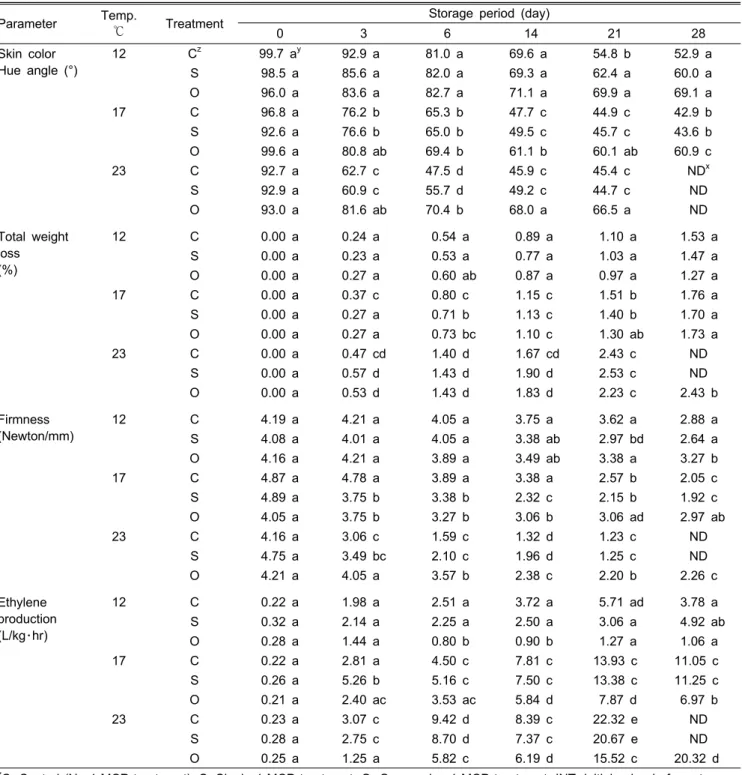
Color and other quality changes in the tomato fruit One-time and once-a-day 1-MCP treatments and lower storage temperatures delayed color development, softening, ethylene production, and total weight loss of the tomato fruit over the storage period at 12℃, 17℃, and 23℃ respectively (Table 1).
Color change of tomato is a good indicator of fresh quality and could be used to predict its storage life at each tem- perature condition. For harvested fresh tomato, the greatest color change occurred at day 21 at 12℃, day 14 at 17℃, and day 3 at 23℃ (Table 1). These results indicate that both the one-time and the once-a-day 1-MCP treatments substantially retarded the ripening process as compared to the control fruit.
A one-time treatment with 1-MCP at 23℃ delayed the color change until day 6 at a hue angle of 70 degree, while the control obtained the same hue angle within 3 days. By comparison under the respective storage temperature conditions, the rate of color change was slower in tomato fruit treated with 1 μL per L 1-MCP for the once-a-day 1-MCP treatment than for the single 1-MCP exposed fruit at the respective temperatures (12, 17, and 23℃). After 28 days, data collection was limited to fungal growth and development of a mottled appearance on the skin of the tomato fruit.
Firmness and total weight loss of fruit showed significant difference between 1-MCP treatment and the control at three storage temperatures. On the initial day, firmness value was 4.2 N・mm-1 in tomato fruit, all with an error of ± 0.5. At 23℃ the control fruit showed less firmness value of 1.6 N・mm-1 on day 6 than those of 2.1N・mm-1 in the single 1-MCP treated fruit, and 3.6 N・mm-1 in the once-a-day 1-MCP treated fruit.
Once-a-day 1-MCP treated tomato fruit at 17 and 23℃ was more firm than the controls, but had similar results to the controls at 12℃. Moreover, the once-a-day 1-MCP treatment was more effective in maintaining firmness than the single treatment. Tomato fruit stored at 12℃ was also significantly firmer than those at 23℃ for the storage period. This can be attributed to the lower storage temperature and treatment with 1-MCP.
The total weight of green tomato fruit decreased slowly over the storage. On day 6, the average weight loss of tomato fruit was about 0.55% at 12℃, 0.77% at 17℃, and 1.42%
at 23℃. There were no clear differences between the once- a-day 1-MCP treated and the control fruit. Comparing these
Table 1. The effect of the control and those treated single or daily with 1-MCP on quality parameters of post-harvested tomato fruits at 12, 17, and 23℃.
Parameter Temp.
℃ Treatment Storage period (day)
0 3 6 14 21 28
Skin color Hue angle (°)
12 Cz 99.7 ay 92.9 a 81.0 a 69.6 a 54.8 b 52.9 a
S 98.5 a 85.6 a 82.0 a 69.3 a 62.4 a 60.0 a
O 96.0 a 83.6 a 82.7 a 71.1 a 69.9 a 69.1 a
17 C 96.8 a 76.2 b 65.3 b 47.7 c 44.9 c 42.9 b
S 92.6 a 76.6 b 65.0 b 49.5 c 45.7 c 43.6 b
O 99.6 a 80.8 ab 69.4 b 61.1 b 60.1 ab 60.9 c
23 C 92.7 a 62.7 c 47.5 d 45.9 c 45.4 c NDx
S 92.9 a 60.9 c 55.7 d 49.2 c 44.7 c ND
O 93.0 a 81.6 ab 70.4 b 68.0 a 66.5 a ND
Total weight loss
(%)
12 C 0.00 a 0.24 a 0.54 a 0.89 a 1.10 a 1.53 a
S 0.00 a 0.23 a 0.53 a 0.77 a 1.03 a 1.47 a
O 0.00 a 0.27 a 0.60 ab 0.87 a 0.97 a 1.27 a
17 C 0.00 a 0.37 c 0.80 c 1.15 c 1.51 b 1.76 a
S 0.00 a 0.27 a 0.71 b 1.13 c 1.40 b 1.70 a
O 0.00 a 0.27 a 0.73 bc 1.10 c 1.30 ab 1.73 a
23 C 0.00 a 0.47 cd 1.40 d 1.67 cd 2.43 c ND
S 0.00 a 0.57 d 1.43 d 1.90 d 2.53 c ND
O 0.00 a 0.53 d 1.43 d 1.83 d 2.23 c 2.43 b
Firmness (Newton/mm)
12 C 4.19 a 4.21 a 4.05 a 3.75 a 3.62 a 2.88 a
S 4.08 a 4.01 a 4.05 a 3.38 ab 2.97 bd 2.64 a
O 4.16 a 4.21 a 3.89 a 3.49 ab 3.38 a 3.27 b
17 C 4.87 a 4.78 a 3.89 a 3.38 a 2.57 b 2.05 c
S 4.89 a 3.75 b 3.38 b 2.32 c 2.15 b 1.92 c
O 4.05 a 3.75 b 3.27 b 3.06 b 3.06 ad 2.97 ab
23 C 4.16 a 3.06 c 1.59 c 1.32 d 1.23 c ND
S 4.75 a 3.49 bc 2.10 c 1.96 d 1.25 c ND
O 4.21 a 4.05 a 3.57 b 2.38 c 2.20 b 2.26 c
Ethylene production (L/kg・hr)
12 C 0.22 a 1.98 a 2.51 a 3.72 a 5.71 ad 3.78 a
S 0.32 a 2.14 a 2.25 a 2.50 a 3.06 a 4.92 ab
O 0.28 a 1.44 a 0.80 b 0.90 b 1.27 a 1.06 a
17 C 0.22 a 2.81 a 4.50 c 7.81 c 13.93 c 11.05 c
S 0.26 a 5.26 b 5.16 c 7.50 c 13.38 c 11.25 c
O 0.21 a 2.40 ac 3.53 ac 5.84 d 7.87 d 6.97 b
23 C 0.23 a 3.07 c 9.42 d 8.39 c 22.32 e ND
S 0.28 a 2.75 c 8.70 d 7.37 c 20.67 e ND
O 0.25 a 1.25 a 5.82 c 6.19 d 15.52 c 20.32 d
zC, Control (No 1-MCP treatment); S, Single 1-MCP treatment; O, Once-a-day 1-MCP treatment, INT, initial value before storage.
yMean separation within the columns according to Fisher’s Protected LSD Test (P<0.05).
xND, not detected due to a mottled appearance on the skin caused leakage at surface cracks.
results, with the data obtained by Guillen et al. (2007) for 1-MCP treated tomato fruit, showed similar weight loss as a function of storage time.
An increase of ethylene production in the control and 1-MCP treated fruit was detected at 23, 17, and 12℃ during storage. Ethylene production of the control and 1-MCP treated fruit began to increase rapidly after 6 days at 23℃. This
is in agreement with Atta-Aly (1992) who observed that the highest level of ethylene production was at ripening stage in the intact tomato fruit at 20℃. Once-a-day 1-MCP treated fruit also showed increasing ethylene production over the length of the storage period, but had a relatively lower pro- duction than the control and single 1-MCP treated fruit at 23℃. However, throughout the results of our experiment,
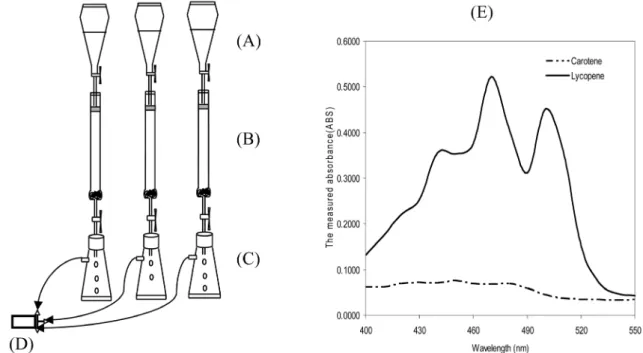
Fig. 1. A schematic diagram of the lycopene separation system: (A) sample and solvent supply system (125 mL); (B) glass columns (2 cm OD × 13 cm L) packed with adsorbent mixture of Hyflo Super Cel and MgO magnesia (1:1 by weight); (C) collection flasks (125 mL); (D) vacuum source; (E) a spectrophotometeric profile of the purified lycopene extracts
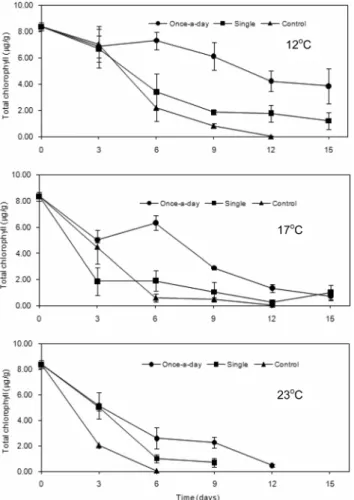
Fig. 2. Total chlorophyll content in the pericarp tissue of har- vested tomatoes in storage at 12, 17, and 23℃. Vertical error bars indicate the standard deviation of each mean value (n=10).
ethylene production in control fruit showed no significant difference in comparison with the single 1-MCP treated fruit.
Thus, the ethylene production of the whole fruit was not significantly affected by single 1-MCP treatment.
Several researchers have recently shown that 1-MCP is effective in delaying post-harvest ripening (Guillen et al., 2007; Mostofi et al., 2003) of tomato fruit. Most studies, however, used a one-time 1-MCP treatment at 20℃. This result was supported by the researches of Guillen et al. (2007) and Moretti et al. (2002), who showed that 1-MCP application and/or increasing concentration of 1-MCP decreased the rate of tomato color change. In this study once-a-day exposure effectively inhibited tomato color during storage.
Chlorophyll content
The total chlorophyll content in the tomato fruit was monitored for 15 days (Figs. 2 and 3). Chlorophyll content in tomato fruit at 23℃ decreased rapidly by day 3 and was not detected at 6 days. The total chlorophyll content in tomato fruit stored at 12℃ decreased through 12 days storage, which shows that the ripening process was delayed by the low temperature. Total chlorophyll content of the tomato fruit was 9.26 and 8.36 μg・g-1 in the pericarp and placenta tissues at day 0. The total chlorophyll content in the pericarp and placenta tissues of tomatoes (23℃) decreased to 3.28 and 2.01 μg・g-1 at 3 days. The total chlorophyll content in the pericarp tissue of the once-a-day 1-MCP exposed tomato fruit at 23℃ was 5.42 μg・g-1 at 9 days compared while
Fig. 3. Total chlorophyll content in the placenta tissue of har- vested tomatoes in storage at 12, 17, and 23℃. Vertical error bars indicate the standard deviation of each mean value (n=10).
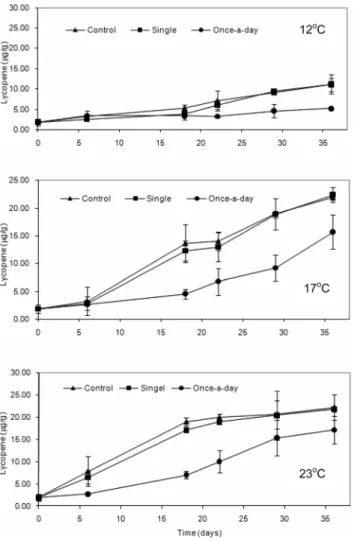
Fig. 4. Formation of lycopene in the pericarp tissue of harvested tomatoes in storage at 12, 17, and 23℃. Vertical error bars indicate the standard deviation of each mean value (n=10).
no chlorophyll was detected at 6 days in the controls. It was also found that total chlorophyll content in the pericarp tissue of once-a-day 1-MCP treated tomato fruit at 12℃ was 5.64 μg・g-1 at 12 days, while the total chlorophyll content in the pericarp tissue of the control tomato fruit was 1.62 μg・g-1 at 9 days at 12℃, 1-MCP may affect the degradation of chlorophyll by affecting both the physiological and bio- chemical reactions in tomato tissues that are associated with synthesis of ethylene binding sites (Lelievre et al., 1997).
In the present study, the total chlorophyll content in the pericarp tissues was higher than the other tomato tissues during the storage period. The placenta tissues have higher chlorophyll degradation rates than the pericarp tissue. Thus, it would seem that 1-MCP had a greater influence on the pericarp tissue.
Lycopene content
Two main carotenoids were separated from the hexane extract and identified by spectrophotometric analysis (Fig.
1-E). The spectral curve of the purified tomato lycopene showed maximum absorption at 470 nm, which is a major
peak strongly indicating predominance of the lycopene (red color), with two minor peaks at 440 and 500 nm. The spectral result for lycopene in the tested samples is similar to that published by Britton (1983).
Lycopene content in 1-MCP treated and non-treated tomato fruit changed during storage at 12, 17, and 23℃ (Figs. 4 and 5). The initial lycopene content in ripening tomato fruit was 0.45 and 0.79 μg・g-1 (pericarp and internal tissues). The lycopene content in the pericarp tissue increased rapidly in the fully ripened control fruit during 22 days at 23℃. After 28 days the lycopene content in the pericarp and internal tissues of 1-MCP once-a-day treated tomato fruit was 5.93 μg・g-1 and 12.39 μg・g-1, compared to the control values of 23.28 μg・g-1 and 22.30 μg・g-1. At 28 days, control fruit contained about 4 times more lycopene than once-a-day 1-MCP treated fruit.
The pericarp and internal tissues in control tomato showed a slow increase in lycopene content at 12℃, with values of 9.21 μg・g-1 and 11.57 μg・g-1 at 36 days. The lycopene
Fig. 5. Formation of lycopene in the placenta tissues of har- vested tomatoes in storage at 12, 17, and 23℃. Vertical error bars indicate the standard deviation of each mean value (n=10).
content of pericarp and internal tissues in once-a-day 1-MCP treated tomato fruit (12℃) was 5.74 μg・g-1 and 7.04 μg・g-1at 36 days, respectively.
Once-a-day 1-MCP exposure of tomato fruit also delayed lycopene formation during storage. The results showed that the tomato fruit with once-a-day 1-MCP treatment had a relatively lower level of lycopene than the control and one-time 1-MCP treated fruit at 17℃ and 23℃. In the present study, the lycopene content of fully ripened tomato fruit was similar to the lycopene content of red stage tomatoes found in the tomatoes by Moretti et al. (2002). Watada et al. (1976) reported that the lycopene content increased up to 46.7 μg・g-1 at the fully ripened stage.
The results showed that the formation of lycopene in the pericarp and placenta tissues of single 1-MCP treated tomato fruit was significantly less affected than the lycopene in the once-a-day 1-MCP treated tomato fruit. The lycopene content in the pericarp tissue of 1-MCP treated tomato fruit was lower than that in the placenta tissue. This may also indicate
that the pericarp tissue appears to have been more responsive to 1-MCP treatment. Such results suggest that 1-MCP can play an important role in the pigment formation during ripening of tomato fruit, by preventing lycopene synthesis.
Conclusions
Storage temperature is a major factor in determining the behaviour on changes in pigmentation during storage. 1-MCP treatment can increase the storage time of tomato fruit, by preventing ethylene from causing changes in the color of stored tomato fruit. Once-a-day 1-MCP treatment of tomato fruit, by itself or in conjunction with low temperature storage showed remarkable potential to extend harvested tomato fruit in storage. Once-a-day 1-MCP treatment had a greater effect on the chlorophyll degradation and lycopene formation in the pericarp of the tomato fruit than the other portions. This could be due to the 1-MCP compound may effectively block the active receptor, which causing pigment development in the pericarp tissue of the tomato fruit regarding ethylene–related response. Our results also suggest that the potential effect of 1-MCP treatment in other tomato cultivars or different delivery systems can be evaluated to provide a better under- standing of the relation between the contents of two major pigment components during storage.
Literature Cited
Buckle, K.A. and F.M.M. Rahman. 1979. Separation of chlorophyll and carotenoid pigments of capsicum cultivars. J. Chromatogr.
A. 71:385-391.
Britton, G. 1983. Carotenoids, p. 32-38. In: G. Britton (ed.). The biochemistry of natural pigments. Cambridge Univ. Press, New York.
Edwards, R.A. and F.H. Reuter. 1967. Pigment changes during the maturation of tomato fruit. Food Technol. Austral. 19:
352-357.
Fraser, P.D., M.R. Truesdale, C.R. Bird, and W. Schuch. 1994.
Carotenoid biosynthesis during tomato fruit development. J.
Plant Physiol. 105:405-413.
Golding, J.B., D. Shearer, S.G. Wyllie, and W.B. McGlasson.
1998. Application of 1-MCP and propylene to identify ethylene- dependent ripening processes in mature banana fruit. Postharvest Biol. Technol. 14:87-98.
Guillen, F., S. Castillo, P.J. Zapata, D. Martines-Romero, M.
Serrano, and D. Valero. 2007. Efficacy of 1-MCP treatment in tomato fruit 1. Duration and concentration of 1-MCP treatment to gain an effective delay of postharvest ripening.
Postharvest Biol. Technol. 43:23-27.
Jiang, Y., D.C. Joyce, and A.J. Macnish. 1999. Extension of the shelf life of banana fruit by 1-methylcyclopropene in com- bination with polyethylene bags. Postharvest Biol. Technol.
16:187-193.
1-Methylcyclopropane 처리가 토마토 선도유지 효과 및 색소 변화에 미치는 영향
이윤석1*ㆍ정대성2ㆍBruce R. Harte3ㆍ신중민4
1연세대학교 패키징학과, 2국립원예특작과학원, 3미시간주립대학교 패키징학과, 4위스콘신대학교 패키징학과 (*교신저자)
초 록. 토마토 에틸렌 발생 억제제인 1-Methylcyclopropane(1-MCP) 처리 방법 및 저장 온도에 따른 토마토의 선도 유지 그리고 토마토 과색의 주요 성분인 엽록소 및 라이코펜 함량 변화에 미치는 영향을 조사하였다. 수확한 토마토는 무처리 그리고 1.0μL/L 1-MCP를 사용하여 20시간 한번 처리 또는 매일 한 번씩 지속 처리를 통하여 각각 12, 17, 23℃에 저장하여 토마토의
색소 성분의 변화와 품질변화를 관찰하였다. 토마토 외피 색변화, 에틸렌 발생, 그리고 경도는 저장 온도가 높을수록 1-MCP
처리에 대한 품질변화 지연효과가 두드러짐을 확인할 수 있었으며 중량감모율은 저장 기간 동안 1-MCP처리 유무와 관계없이 서서히 증가하였으며, 저장온도가 높음에 따라 증가하는 차이를 보였다. 엽록소 및 라이코펜 함량 변화는 a specific extinction coefficient absorbance를 사용하여 관찰하였으며 각 저장 온도별 1-MCP 처리구가 엽록소 손실 및 라이코펜 형성에 지연에 매우 효과적이었다. 더욱이 매일 지속적인 1-MCP 처리구는 초기 한번 1-MCP 전처리구 보다 두드러진 숙도 변화가 낮아짐을 보여 주었으며 과피별로 pericarp 부분이 placenta 부분 보다 1-MCP 처리에 더 효과적인 것으로 나타내었다. 이는 표피를 접하고 있는 외부 환경 1-MCP 물질이 pericarp 부분에 sorption을 통해 직접적인 영향을 주었으리라 판단된다. 실험 결과 저온 온도에서 적정한 농도의 1-MCP를 매일 처리한 토마토의 품질 유지 및 색소 성분 변화에 중요한 역할을 하는 것으로 나타났다.
추가 주요어 : 엽록소, 색변화, 라이코펜, 수확후 품질변화 Kim, H.O., E.W. Hewett, and N. Lallu. 2001. Softening and ethylene
production of kiwifruit reduced with 1-methyleyclopropene.
Acta Hort. 553:167-170.
Kim, J., T. Solomos, and K.C. Gross. 1999. Changes in cell wall galactosyl and soluble galactose content in tomato fruit stored in low oxygen atmospheres. Postharvest Biol. Technol. 17:33-38.
Ku, V.V.V. and R.B.H. Wills. 1999. 1-Methylcylopropene can differentially affect the postharvest life of strawberries exposed to ethylene. J. Amer. Soc. Hort. Sci. 34:119-120.
Lee, Y.S., R.M. Beaudry, B.R. Harte, and J.N. Kim. 2006.
Development of a 1-methylcyclopropene (1-MCP) sachet release system. J. Food Sci. 71:C1-C6.
Lelievre, J.M., A. Latche, B. Jones, M. Bouzayen, and J.C. Pech.
1997. Ethylene and fruit ripening. Physiol. Plantarum 101:727-739.
Lopez Camelo, A.F. and P.A. Gomez. 2004. Comparison of color indexes for tomato ripening. Hort. Brasileira 22:534-537.
Manenoi, A., E.R.V. Bayogan, S. Thumdee, and R.E. Paull.
2007. Utility of 1-methylcyclopropene as a papaya postharvest treatment. Postharvest Biol. Technol. 44:55-62.
Mir, N., E. Curell, N. Khan, M. Whitaker, and R.M. Beaudry.
2001. Harvest maturity, storage temperature, and 1-MCP application frequency alter firmness retention and chlorophyll fluorescence of ‘Redchief Delicious’ apples. J. Amer. Soc.
Hort. Sci. 126:618-624.
Mitcham, E.J. and R.E. Mcdonald. 1992. Effect of high tem- perature on cell wall modifications associated with tomato fruit ripening. Postharvest Biol. Technol. 1:257-264 Moran, R. 1982. Formulae for determination of chlorophyllous
pigments extracted with N,N-Dimethylformamide. J. Plant Physiol. 69:1376-1381.
Moretti, C.L., A.L.A. Araujo, W.A. Marouelli, and W.L.C. Silva.
2002. 1-Methylcyclopropene delays tomato fruit ripening. Hort.
Brasileira 20:659-663.
Mostofi, Y., M.A. Toivonen Peter, H. Lessani, M. Babalar, and C. Lu. 2003. Effects of 1-methylcyclopropene on ripening of greenhouse tomatoes at three storage temperatures. Postharvest Biol. Technol. 27:285-292.
Nguyen, M.L. and S.J. Schwartz. 1999. Lycopene: Chemical and Biological Properties. Food Technol. 53:38-45.
Porat, R., B. Weiss, L. Cohen, A. Daus, R. Coren, and S. Droby.
1999. Effects of ethylene and 1-methylcyclopropene on the postharvest qualities of “Shamouti” oranges. Postharvest Biol.
Technol. 15:155-163.
Ratanachinakorn, B. and A. Klieber. 1997. Simons DH. Effect of short-term controlled atmospheres and maturity on ripening and eating quality of tomatoes. Postharvest Biol. Technol.
11:149-154.
Ryall, A.L. and W.J. Lipton. 1979. Tomatoes, p. 193-209. In:
A.L. Ryall and W.J. Lipton (eds.). Handling, transportation and storage of fruits and vegetables. AVI Publishing Co., Westport, Connect.
Saltveit, M.E. and A.R. Sharaf. 1992. Ethanol inhibits ripening of tomato fruit harvested at various degrees of ripeness without affecting subsequent quality. J. Amer. Soc. Hort. Sci.
117:793-798.
Sisler, E.C. and N. Lallu. 1994. Effect of diameterzocyclopentadiene (DACP) on tomato fruits harvested at different ripening stages.
Postharvest Biol. Technol. 4: 245-254.
Watada, A.E., K.H. Norris, J.T. Worthington, and D.R. Massie.
1976. Estimation of chlorophyll and carotenoid contents of whole tomato by light absorbance technique. J. Food Sci.
41:329-332.