The Merits of Endovascular Coil Surgery for Patients with Unruptured Intracranial Aneurysms
Seong-Ho Park, M.D.
Chang-Young Lee, M.D.
Man-Bin Yim, M.D.
Department of Neurosurgery Dongsan Medical Center Keimyung University School of Medicine Daegu, Korea
Received:March 5, 2008 Accepted:June 13, 2008 Address for reprints: Chang-young Lee, M.D.
Department of Neurosurgery Dongsan Medical Center Keimyung University School of Medicine,194 Dongsan-dong Jung-gu, Daegu 700-712, Korea Tel:+82-53-250-7732
Fax:+82-53-250-7356 E-mail : [email protected]
INTRODUCTION
Advancements in diagnostic techniques have allowed for improved detection of unruptured intracranial aneurysms (UIAs). The management of UIAs remains controversial because of incomplete and conflicting data concerning the natural history of these lesions and the risks associated with their repair21). The standard method of treatment for intracranial aneurysms is surgical clipping14). Until recently, endovascular treatment was restricted to patients in which the aneurysm was unsuitable for clipping because of its size or location, or surgical clipping was contraindicated17). Since the introduction of controlled detachable coils for endovascular packing of aneurysms, embolization is increasingly being used. In some institutions, embolization is now proposed as the initial method of treatment.
The aim of this article was to retrospectively review and report on the morbidity, mortality, and angiographic results of patients with UIAs, and to identify the advantages of elective coiling for treating UIAs.
MATERIALS AND METHODS
From May 2001 to November 2006, 96 UIAs in 92 patients were treated using endo- vascular coil surgery in the Department of Neurosurgery. The patients’ age range was 27-83 years, with a mean of 57 years. Seventy-one percent of the patients were over 50 years of age, and 45% of the patients were over 60 years of age. Of the 92 patients, 64 were women, and 28 were men.
Objective : The purpose of this study was to report the morbidity, mortality, angiographic results, and merits of elective coiling of unruptured intracranial aneurysms.
Methods : Ninety-six unruptured aneurysms in 92 patients were electively treated with detachable coils.
Eighty-one of these aneurysms were located in the anterior circulation, and 15 were located in the posterior circulation. Thirty-six aneurysms were treated in the presence of previously ruptured aneurysms that had already undergone operation. Nine unruptured aneurysms presented with symptoms of mass effect. The remaining 51 aneurysms were incidentally discovered in patients with other cerebral diseases and in individuals undergoing routine health maintenance. Angiographic and clinical outcomes and procedure- related complications were analyzed.
Results : Eight procedure-related untoward events (8.3%) occurred during surgery or within procedure-related hospitalization, including thromboembolism, sac perforation, and coil migration. Permanent procedural morbidity was 2.2% ; there was no mortality. Complete occlusion was achieved in 73 (76%) aneurysms, neck remnant occlusion in 18 (18.7%) aneurysms, and incomplete occlusion in five (5.2%) aneurysms. Recanalization occurred in 8 (15.4%) of 52 coiled aneurysms that were available for follow-up conventional angiography or magnetic resonance angiography over a mean period of 13.3 months. No ruptures occurred during the follow-up period (12-79 months).
Conclusion : Endovascular coil surgery for patients with unruptured intracranial aneurysms is characterized by low procedural mortality and morbidity and has advantages in patients with poor general health, cerebral infarction, posterior circulation aneurysms, aneurysms of the proximal internal cerebral artery, and unruptured aneurysms associated with ruptured aneurysm. For the management of unruptured aneurysms, endovascular coil surgery is considered an attractive alterative option.
KEY WORDS : Endovascular coil surgery·Complication·Unruptured intracranial aneurysm.
All coil embolization procedures were performed using a transfemoral approach and standard technique under local anesthesia in the Interventional Neuroradiology Suite. Balloon-assisted or stent-assisted coil embolization techniques were used for aneurysms with wide necks or unfavorable geometric features, for those that had failed past treatment, or for those that were likely to present difficulties in embolization with conventional single- microcatheter technique. Balloon-assisted coil embolization was adopted for 18 UIAs (19%), and stent-assisted coil embolization was adopted for seven UIAs (7%). All patients underwent endovascular coil surgery electively. In patients with a history of aneurysm rupture, elective coil surgery was performed at least six weeks after surgical clipping for the ruptured aneurysm. Heparinization was started as soon as the sheath was introduced into the common femoral artery. Systemic anticoagulation was maintained with an activated clotting time of 250-300 seconds throughout the procedure. Patients who required the stent-assisted technique received oral aspirin (300 mg/d) and clopidogrel (75 mg/d) for at least one week before the procedure. This combined medication regimen was given for 3 month after the procedure, and patients continued taking aspirin indefinitely.
The aim of coiling was to pack the aneurysm as densely as possible, until no more coils could be placed. After completion of aneurysm coil embolization, angiographic results were divided into three classes : total occlusion, neck remnant occlusion, and incomplete occlusion. An aneurysm was determined to be totally occluded if the neck and dome were densely packed and no angiographic contrast material could be observed. Neck remnant occlusion was declared if some contrast material could be observed near the neck region. Incomplete occlusion was declared if an obvious remnant was observed in the area of the aneurysm body.
Angiographic follow-up examination (conventional angiography or magnetic resonance angiography (MRA) with 3D reconstruction) was recommended to check for recanalization six months or more after treatment. MRA examinations were performed with a 3T system (General Electric, Milwaukee, WI), using a head coil. The MRA scans were obtained using 3D time-of-flight MRA technique. The imaging parameters used were as follows : repetition time, 22 msec ; echo time, 3.2 msec; flip angle, 20 degrees; section thickness, 0.6 mm; field of view, 220
×220 mm; and matrix, 224×512. Minor aneurysmal recanalization was defined as minimal coil compaction at the aneurysmal neck, and major recanalization was defined as contrast filling within the aneurysm dome or
significant coil loosening or compaction. The coil effect on symptoms related to mass effect was categorized as cured, improved, unchanged, or worsened.
Clinical examinations were performed before and after the procedure, as well as on the day of discharge and during follow-up visits in the outpatient clinic. Clinical outcomes were determined through review of medical records and clinical notes or direct telephone contact with patients. Procedure-related neurologic morbidity was defined as neurologic deficit lasting more than seven days that was attributable to coil embolization.
After the procedure, each patient was held in the inten- sive care unit for as long as necessary, depending on his/her clinical condition and evolution. All negative procedure- related events occurring during or after treatment were noted.
RESULTS
Aneurysm characteristics
Thirty-six unruptured aneurysms were treated in the presence of previously ruptured aneurysms that had been clipped. Two aneurysms had recurred after clipping. Nine aneurysms presented with symptoms of mass effect : 6 ophthalmoplegia, 1 visual disturbance, and 2 headache.
Thirty aneurysms were incidentally discovered on imaging studies performed for reasons unrelated to the aneurysm : 16 cerebral infarctions, 5 arteriovenous malformations (AVM), 5 intracranial hemorrhages (ICH), 2 moyamoya disease, and 2 brain tumors. The remaining aneurysms were incidentally discovered in patients undergoing routine health maintenance.
Sixty-six aneurysms (68%) were over 7 mm in length. The mean aneurysm diameter was 8.4 mm (range, 3.5-23 mm).
Aneurysm location
Aneurysms were discovered in the following locations:
cavernous segment (n=6), carotid cave (n=6), ophthalmic artery (n=6), superior hypophyseal artery (n=18), posterior communicating artery (n=28), anterior choroidal artery (n=2), bifurcation of the internal cerebral artery (n=2), anterior communicating artery (n=7), middle cerebral artery (n=6), posterior inferior cerebellar artery (n=3), basilar artery (n=8), superior cerebellar artery (n=3), and posterior cerebral artery (n=1).
Immediate angiographic results
All aneurysms were successfully embolized. Initial occlusion results for aneurysms were : complete occlusion in 73 (76%), neck remnant occlusion in 18 (18.8%), and incomplete occlusion in 5 (5.2%).
Procedural complications
Procedural complications occurred in 8 (8.3%) of 96 procedures, including 4 thromboemboli (4.1%), 3 intra- procedural ruptures (3.1%), and 1 coil migration (1%).
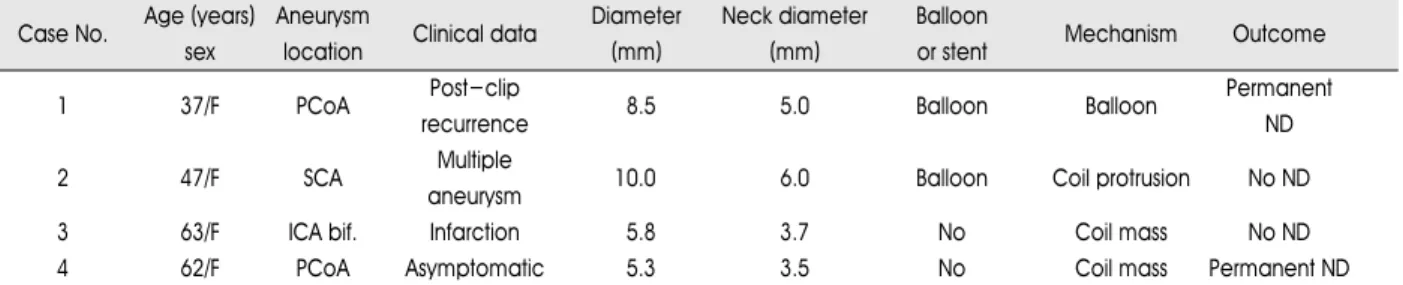
All thromboembolic complications were evident during the procedure as a result of coil mass (n=2), balloon (n=1), and coil protrusion (n=1).
These events were effectively managed with intra- arterial and systemic administration of fibrinolytic (Clexane injection; Sanofi-Aventis Korea, Seoul) or anti- platelet agents (Aspirin protect; Bayer Korea, Seoul), (Plavix Tab; Handok, Seoul). However, two patients incurred infarctions in portions of the left anterior cerebral artery and middle cerebral artery territory, respectively, as seen on MRI, which led to permanent neurologic deficits (memory deficits in one patient and hand weakness in the other) (Table 1).
Intraprocedural aneurysmal perforation occurred in three patients because of coil tip protrusion. All ruptures were treated with further coil embolization, along with systemic protamine injection for heparin reversal. No patients required other interventions, such as ventricular catheter insertion, and there were no clinical consequences associated with rupture (Table 2). Coil migration occurred during treatment in one patient. However, the migrated coil was successfully retrieved with no clinical consequences.
There were no procedure-related complications in unrup- tured aneurysms in patients with ischemic stroke.
Overall procedure-related morbidity and mortality rates were 2.2% and 0%, respectively. For the treatment of anterior circulation, the morbidity rate was 2.4% but no morbidity for the treatment of posterior circulation. Out of
4 cases of endovascular coil embolization undertaken in previously operated aneurysms, there was one minor stroke leading to memory deficit.
Effect of coil embolization on symptoms of aneurysmal mass effect
Clinical follow-up information was available for all nine patients who presented with symptoms of mass effect secondary to their aneurysms. The symptoms of mass effect improved in 4 patients and completely subsided in 5 patients.
Angiographic follow-up results and re-treatment Angiographic follow-up data was available in 52 (54%) of 96 patients through conventional angiography (n=21) or MRA (n=31), with follow-up ranging from 6 to 68 months (mean, 13.3 months). Recanalization was noted in eight aneurysms (15.3%). Five of these were minor recanalizations. Three were major recanalizations : one (14 mm) at the bifurcation of the middle cerebral artery and two (13 mm, 23 mm) at the basilar tip. Additional coil surgery was performed in these three cases. These aneurysms were successfully re-treated using two-catheter technique (n=1), balloon-assisted technique (n=1), and stent- assisted technique (n=1). There were no complications from these additional treatments. No ruptures were observed in the follow-up period (12-79 months).
DISCUSSION
The publication of data from the International Study of Unruptured Intracranial Aneurysms (ISUIA) in 200319)was
Table 1. Clinical data for patients who had thromboembolic complications Case No. Age (years) Aneurysm
Clinical data Diameter Neck diameter Balloon
Mechanism Outcome
sex location (mm) (mm) or stent
1 37/F PCoA Post-clip
8.5 5.0 Balloon Balloon Permanent
recurrence ND
2 47/F SCA Multiple
10.0 6.0 Balloon Coil protrusion No ND
aneurysm
3 63/F ICA bif. Infarction 5.8 3.7 No Coil mass No ND
4 62/F PCoA Asymptomatic 5.3 3.5 No Coil mass Permanent ND
PCoA : posterior communicating artery, ND : neurological deficit, SCA : superior cerebellar artery, ICA bif .: internal cerebral artery bifurcation Table 2. Clinical data for patients who experienced perforation
Case No. Age(years) Aneurysm
Clinical data Diameter Balloon Perforation
Outcome
sex location (mm) or stent mechanism
1 31/F SHA Moyamoya disease 7.2 No First coil No ND
2 45/F BA bif. AVM 6.0 No Second coil No ND
3 44/F PCoA Ophthalmoplegia 7.6 No Second coil No ND
SHA : superior hypophyseal artery, ND : neurological deficit, BA bif. : basilar artery bifurcation, AVM : arteriovenous malformation, PCoA : posterior communicating artery
remarkable because this large-scale study demonstrated an unexpectedly low annual rupture rate. Another study2) reporting on the natural history of aneurysms, and based on the ISUIA data, reported a figure of 4.2% for the prevalence of unruptured cerebral aneurysms in the general population. One study reported an annual subarachnoid hemorrhage (SAH) incidence of 19.6 per 100,000 in persons with aneurysms3). This study also reported 5.6 mm as the median diameter of unruptured aneurysms and 9.4 mm as the median diameter of ruptured aneurysms. In patients with unruptured aneurysms, the decision whether to treat is often clear.
According to Marieke et al.21), characteristics that increase the risk of aneurysm rupture include posterior circulation localization, size >5 mm, and symptoms other than those related to SAH. Based on the available literature, we believe that patients with unruptured aneurysms and the following characteristic should be treated : SAH from another aneurysm, symptomatic aneurysm, aneurysm larger than 10 mm in diameter, and aneurysms between 6 and 9 mm in diameter if the patient is young or middle-aged8). In our study, nine (9.3%) patients were symptomatic secondary to their aneurysms. Thirty-six aneurysms (37.5%) were treated in the presence of other previously ruptured aneurysms, and 43 (45%) aneurysms were in the posterior circulation or posterior communicating artery.
Endovascular coil surgery in patients with poor general health including cerebral infarction
In our study, 16.6% of patients presented with cerebral infarction. The ISUIA reported that 11% of patients with unruptured aneurysms presented with ischemic cere- brovascular disease12). Nagashima et al10). noted that surgical treatment of aneurysms in the presence of cerebral infarction is a high-risk procedure (surgical mortality : 4%, permanent morbidity : 18%). In our study, no patient suffered permanent morbidity. Therefore, for the treatment of these aneurysms, endovascular coiling seems to be a safer and more effective treatment method. Generally, old age and poor general health-including heart disease, renal disease, and cerebral vascular disease-are poor prognostic factors for major surgery.
Endovascular coil surgery in aneurysms of the posterior circulation and proximal ICA
Clipping of unruptured aneurysms is associated with a mortality of 2.6% and a morbidity of 10.9%21). For surgical clipping of proximal ICA and posterior circulation aneurysms, aggressive surgical manipulation is needed, in- cluding exposure of the cervical ICA and a skull base
approach. These extensive surgical operations increase post-operative complications. Above all, a very large aneurysm located in the posterior circulation is the most important predictor of a poor outcome. Wermer et al21). reported that patients with small posterior aneurysms have a mortality of 3% and a morbidity of 12.9%. Alan et al9). reported that 92.5% of patients treated with coiling for unruptured aneurysms in the posterior circulation achieve functional independence (Glasgow Outcome Scale 1 or 2), whereas only 1.9% ultimately live dependent lifestyles. The overall mortality, according to Alan et al., is 5.8%. However, in our study, the adverse event rate for aneurysms located in the posterior circulation was 13.3% (2/15), and permanent morbidity and mortality rates were 0%. In the treatment of proximal ICA aneurysms, we experienced only one transient case of morbidity and no case of permanent morbidity or mortality.
Endovascular coil surgery in previously operated aneurysms
The presence of an aneurysm remnant after incomplete or unsuccessful surgical clipping is associated with persistent risk of re-growth and rupture, and additional treatment is generally recommended. Attempts at surgical re-exploration are technically difficult and carry significant risk1,13). We treated four of these patients : two recurrent, one residual, and one failed aneurysm treat- ment after surgical clipping. Although one of these patients had a minor stroke (resulting in memory deficit), endovascular surgery was generally easy and successful.
Limitations of endovascular coil surgery
In our study, the rate of angiographic recurrence after endovascular treatment was 15.3%, and the rate of major recanalization was 5.7%. Raymond et al15). reported angiographic recurrence in 33.6% of patients with unruptured aneurysms who were treated endovascularly with detachable coils. Carlos et al4). confirmed the long- term efficacy of aneurysm clip ligation, reporting a 98.5%
permanent obliteration rate. There is a significant limitation to endovascular treatment: some embolized aneurysms will evolve over time. In some patients, the occlusion improves; however, the occlusion can also be worsened, necessitating close follow-up11). The balloon- assisted coil embolization technique was developed in an effort to improve obliteration rates6,18). However, this technique is associated with an increased risk of thrombo- embolic events and hemorrhage complications6). Despite the matter of durability, coiling for UIAs results in a lower
morbidity and mortality rate than clipping for UIAs5,7,16,19). In the near future, the durability of endovascular coil surgery is expected to improve because of rapid advances occurring in intravascular technology and devices. Several modified coil materials are already under development6).
Limitations of endovascular coil surgery in our Center
In our center, the coil embolization procedure was performed with patients under local anesthesia on account of insufficiency in its manpower and equipment. Under local anesthesia, it is hard to earn an exactly intended image because of several factors such as respiration, pain, and duration of surgery. In these situations, unexpected events may occur. General anesthesia is more appropriate in endovascular coil surgery.
In the ISUIA19), overall mortality and morbidity of clipping for UIAs was 2.3%, 15.3% each other in the low-risk group. We experienced low morbidity, despite the presence of a number of risk factors-including age > 50 years, aneurysm diameter >12 mm, aneurysms located in the posterior circulation, associated ischemic cerebro- vascular disease, and aneurysmal symptoms other than those associated with rupture-assessed as potential predictors of poor outcomes for clipping surgery21). Endovascular coil surgery is superior to open surgery for the management of unruptured aneurysms.
CONCLUSION
Endovascular coiling for patients with UIAs shows low procedural mortality and morbidity. It is advantageous in patients with poor general health, cerebral infarction, posterior circulation aneurysms, proximal ICA aneurysms, and unruptured aneurysms in the presence of previously treated ruptured aneurysms. For the management of UIAs, endovascular coil surgery is considered an attractive alter- ative option.
References
1. Bavinzski G, Talazoglu V, Killer M, Gruber A, Richling B, al- Shameri R : Coiling of recurrent and residual cerebral aneurysms after unsuccessful clipping. Minim Invasive Neurosurg 42 : 22-26, 1999
2. Chang HS : Simulation of the natural history of cerebral aneurysms based on data from the International Study of Unruptured Intracranial Aneurysms. J Neurosurg 104 : 188-194, 2006 3. Cowan JA Jr, Ziewacz J, Dimick JB, Upchurch GR Jr, Thompson
BG : Use of endovascular coil embolization and surgical clip occlusion for cerebral artery aneurysms. J Neurosurg 107 : 530- 535, 2007
4. David CA, Vishteh AG, Spetzler RF, Lemole M, Lawton MT, Partovi S : Late angiographic follow-up review of surgically treated aneurysms. J Neurosurg 91 : 396-401, 1999
5. King JT Jr, Berlin JA, Flamm ES : Morbidity and mortality from elective surgery for asymptomatic, unruptured, intracranial aneurysms: a meta-analysis. J Neurosurg 81 : 837-842, 1994 6. Koebbe CJ, Veznedaroglu E, Jabbour P, Rosenwasser RH :
Endovascular management of intracranial aneurysms : current experience and future advances. Neurosurgery 59 (5 Suppl 3) : S93-102; discussion S3-13, 2006
7. Lanterna LA, Tredici G, Dimitrov BD, Biroli F : Treatment of unruptured cerebral aneurysms by embolization with guglielmi detachable coils: case-fatality, morbidity, and effectiveness in preventing bleeding-a systematic review of the literature.
Neurosurgery 55 : 767-775; discussion 775-778, 2004
8. Le roux PD, Winn HR : Surgical decision making for the treatment of cerebral aneurysms in Winn HR(ed) : Youmans Neurological Surgery, ed 5. Piladelphia : Saunders, 2004, Vol 2, pp1793-1812
9. Lozier AP, Connolly ES Jr, Lavine SD, Solomon RA : Guglielmi detachable coil embolization of posterior circulation aneurysms : a systematic review of the literature. Stroke 33 : 2509-2518, 2002 10. Nagashima M, Nemoto M, Hadeishi H, Suzuki A, Yasui N :
Unruptured aneurysms associated with ischaemic cerebrovascular diseases. Surgical indication. Acta Neurochir (Wien) 124 : 71-88, 1993
11. Pouratian N, Oskouian RJ Jr, Jensen ME, Kassell NF, Dumont AS : Endovascular management of unruptured intracranial aneurysms. J Neurol Neurosurg Psychiatry 77 : 572-578, 2006
12. Raaymakers TW, Rinkel GJ, Limburg M, Algra A : Mortality and morbidity of surgery for unruptured intracranial aneurysms : a meta-analysis. Stroke 29 : 1531-1538, 1998
13. Rabinstein AA, Nichols DA : Endovascular coil embolization of cerebral aneurysm remnants after incomplete surgical obliteration.
Stroke 33 : 1809-1815, 2002
14. Raftopoulos C, Goffette P, Vaz G, Ramzi N, Scholtes JL, Wittebole X, et al : Surgical clipping may lead to better results than coil embolization : results from a series of 101 consecutive unrup- tured intracranial aneurysms. Neurosurgery 52 : 1280-1287;
discussion 1287-1290, 2003
15. Raymond J, Guilbert F, Weill A, Georganos SA, Juravsky L, Lambert A, et al : Long-term angiographic recurrences after selective endovascular treatment of aneurysms with detachable coils.
Stroke 34 : 1398-1403, 2003
16. Rhee DJ, Hong SC, Kim JH, Kim JS : Clinical Outcome of Surgery for Unruptured Intracranial Aneurysms. J Korean Neurosurg Soc 40 : 227-233, 2006
17. Schroder F, Regelsberger J, Westphal M, Freckmann N, Grzyska U, Herrmann HD : [Asymptomatic cerebral aneurysms-surgical and endovascular therapy options.] Wien Med Wochenschr 147 : 159-162, 1997
18. Sluzewski M, van Rooij WJ, Beute GN, Nijssen PC : Balloon- assisted coil embolization of intracranial aneurysms : incidence, complications, and angiography results. J Neurosurg 105 : 396- 399, 2006
19. The International Study of Unruptured Intracranial Aneurysms Investigators : Unruptured intracranial aneurysms-risk of rupture and risks of surgical intervention. International Study of Unrup- tured Intracranial Aneurysms Investigators. N Engl J Med 339 : 1725-1733, 1998
20. The International Study of Unruptured Intracranial Aneurysms Investigators : Unruptured intracranial aneurysms : natural history, clinical outcome, and risks of surgical and endovascular treatment.
Lancet 362 : 103-110, 2003
21. Wermer MJ, van der Schaaf IC, Algra A, Rinkel GJ : Risk of rupture of unruptured intracranial aneurysms in relation to patient and aneurysm characteristics: an updated meta-analysis. Stroke 38 : 1404-1410, 2007