약학회지 제 33 권 제 4 호 241〜 245 (1989) Yakhak Hoeji Vol. 33, No. 4
HPLC 를 이용한 고추엑스 제제 중 Capsaicin 과 Dihydrocapsaicin 의 분리정량
엄동옥 • 윤규섭 * 전주우석대학 약학과
•보령제약 (Received July 6,1989)
Differential determination of Capsaicin and Dihydrocapsaicin from Capsicum extract preparation by HPLC.
Dong Ok Eom and Kyu Sup Yoon*
Department of pharmacy, Jeonju Woo Suk University, Samryeup,Jeonbuk, Korea and
*Boryung Pharm. Co., Ltd.
Abstract一A new application of high performance liquid chromatography for the determination of capsaicin and dihydrocapsaicin in cataplasma preparation was investigated.
Optimum conditions for a good separation and detection were determined; 0.93 volt, acetonitrile:
H3PO4 sol (pH 2.8),sample size; 7 u I. Recovery rates of capsaicin and dihydrocapsaicin from mixed ar
tificial preparations were 99.9% and 98.4% respectively.
Also reproducibility tests showed that the coefficient of variation was 1.59% for capsaicin and 1.14%
for dihydrocapsaicin.
There was no interference with cataplasma preparation containing thymol, dl-camphor and the com
monly encountered excipients or additives such as gelatine, glycerine.
This method was rapid, accurate and it gave higher sensitivity than other method.
Keywords □ Capsacin, dihydrocapsaicin, cataplasma preparation.
고추엑스는 국소자극의 목적 으로 카타플라스마제,
연고제,외용액제에 배합되며,모근 자극이나 지양 효과를 기대하는 hair tonic 등에도 쓰인다. 이들 제제에 배합되어 있는 고추엑스의 정량은 cap- saicinoid 를 정량하고 있으나, capsaicinoid 는 capsaicin (CS), dihydrocapsaicin (DHC) 과 미량 의 homocapsaicin, homodihydrocapsaicin, nor- dihydrocapsanicin 등임 이 보고되어 있다.
고추엑스는 이들 각 성분을 GLC,1외 HPLC,3-5' GC-MS6'7) 둥으로 분리정량하고 있으나, 제제는 고 추액스가 저농도로 배합되어 있어 이들 성분의 정량 에 어려움이 있으므로 capsainoid 를 정량하여야 하 는 단점이 있다.
저지들은 이동상으로 acetonitrile 과 H 3P 0 4 완 충액의 혼액 (PH 2.8)을 쓰고, 검출기로 ECD를 이 용했을 때 미량농도의 고추엑스에서 CS 와 DHC 을 양호하게 분리할 수 있었으며, 제제도 capsaicin
oid 를 정량하는 것보다 시간을 단축하고,재현성있 게 정량할 수 있었으므로 보고한다.
실험방법
시약 및 시료--capsaicin(No.M-2028,Sigma), dihydrocapsaicin (N o.M-1022, 다igma),natural capsaicin(No.21750, Fluka), capsaicin extract (Hisamitsu)의 각 25 mg 씩을 정확히 달아 MeOH
241
Schem 1—Method of preparing sample solution.
Table I 一Conditions of high performance liquid chroma
tography.
Column : /i Bondapak Phenyl
(10/im, 3.9 m m x30 cm) Column temp. : about 30°C
Mobile phase : acetonitrile: H3P04 solution
(pH 2.8) - 36 : 64
Detector : +0.93 volt
Electrochemical detector Injection volume : l u l Flow rate : 2.0 m2/min.
Span rage : 20 nA
Chart speed : 0.5 cm/min.
: Me2CO(8 : 2) 혼액에 녹여 각각을 5.0xi0-3mg
• m/_1 외 용액으로 만들었고, acetonitrile(E.
Merk)은 LC grade 룰,물은 중류 个를 Water-I (GelmanCo.)로 정제한 것을, 기타의 시약들은 시 판 시약 특급을 사용하였다.
기 기 ᅳ HPLC 는 Waters 사 의 Glassy carbon working electrode 에 Ag/AgCl reference elec
trode 가 부착된 460 Amperometric elcetro- chemical detector 와 730,740 data module 의 Recorder -1-, Ultrasonic cleaner -fe- Bransonic 사의 model 220 을 사용하였다.
정량조작ᅳ고추엑스 10 mg 에 해당하는 카타풀라 스마제를 삼각 flask 에 넣고 Scheme 1로 조작하
여 시료용액을 만든 다음 Table I 에서와 같은 조 건에서 시료용액과 CS,DHC(natural) 표준용액 (표준조작) 각 7///씩을 주입하여 얻어지는 chrom
atogram 의 높이에 대한 비로부터 각각의 양을 환 산한다.
결과 및 고찰
검출기의 선정一J. Jurenitsch4) 둥은 자외,가시 홉광광도계를 검출기로 이용하여 고추엑 스에서 CS 와 DHC 을 정량했고,S.Ohnishi8) 등은 형광광도 계를 검출기로 이용하여 화장품에서 CS 를 정량하 였다. 이들 검출기를 이 실험에 이용하여 고추엑스 에서 분리양상을 검토하였으나,농도가 희박하여 분 리가 만족스럽지 못하였다. 그러나 G.H. Chian#
이 electrochemical (EC) monitoring 을 이 용하여 미량의 CS를 정량한 보고가 있어 이 실험에 이용한 결과 Fig.l 에서와 같이 0.93V 부근에서 일정한 peak response 의 한계전류가 되 었으므로 0.93 V 를 가전압으로 하여 미량의 CS 와 DHC 의 양호한 chromatogram 을 얻을 수 있었다.
이동상의 선택一n-Hexane 등 수종의 용매를 단
Voltage
Fig. 1ᅳCurrent-Voltage (C-V) curve of capsaicin and dihydrocapsaicin.
• Capsaicin, 스 Dihyrocapsaicin
J. Pharm. Soc. Korea
HPLC 를 이용한 고추엑스 제제 중 Capsaicin과 Dihydrocapsaicin 의 분리정량 243
0 1 3 5 7 9
Injected Volume (u/)
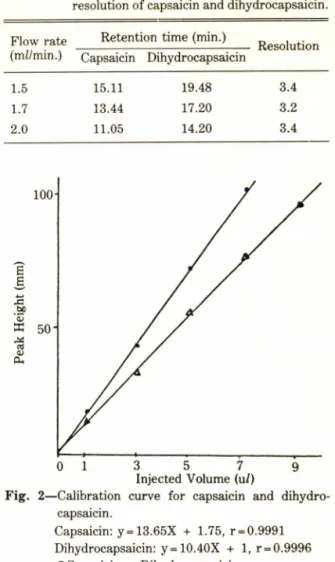
Fig. 2——Calibration curve for capsaicin and dihydro
capsaicin.
Capsaicin: y= 13.65X + 1.75, r = 0.9991 Dihydrocapsaicin: y= 10.40X + 1,r = 0.9996
•Capsaicin, a Dihydrocapsaicin
유속을 1.5m//min 에서 2.0m//min 까지 변화시켰 을 때 Table IV에서와 같이 유속이 감소됨에 따라 CS,DHC 간의 분리는 별로 차이가 없었으며,유지 시간은 길어졌으므로 이 실험에서 2.0mf/min을 택하였다.
검량선ᅳ5 X l O - 3 m g . m/-1 의 CS 와 DHC 표준
용액으로 이상과 같은 최적조건에서 정량 조작의 표준조작에 따라 HPLC를 행하였다. 각 표준용 액 1-9 ᆻ/의 주입시 CS 는 Y=13.65X+1.75(r=
0.9991) 이고,DHC 는 Y=10.40X+1.00 (r= 0.9996) 로 Fig.2에서와 같이 거의 원점을 지나는 양호한 직선성을 나타내었다.
공존물질에 의한 영향ᅳ시판 카타플라스마제에서 CS와 DHC의 분리정량시 기타의 약효 성분과 첨
Flow rate (mi/min.)
Retention time (min.)
Resolution Capsaicin Dihydrocapsaicin
1.5 15.11 19.48 3.4
1.7 13.44 17.20 3.2
2.0 11.05 14.20 3.4
Mobile phase
Retention time (min.) Thymol Capsaicin Dihydrocapsaicin 45 : 55 (4.0) 6.31 6.87 8.04 40 : 60 (3.0) 6.15 7.14 8.71 36 : 64 (2.8) 11.70 15.11 19.46
Mobile phase; Acetonitrile : H3P04 (pH 2.8)
Table III —Effect of column temperature on the reten
tion time and resolution of capsaicin and dihydrocapsaicin.
Column temp (°C)
Retention time (min.)
Resolution Capsaicin Dihydrocapsaicin
25 15.80 20.35 3.82
30 14.66 18.92 3,86
35 14.38 18.47 3.88
40 13.58 17.40 4.09
독 또는 혼합액으로 하여 분리 정도를 관찰하였으 나,검출량과 기타의 약효성분으로 첨가된 thymol (TM)과의 분리가 만족스럽지 못하였다. 그러나 이 중 가장 양호한 용매가 acetonitrile 과 H3P04용액 의 혼액이었으며,이 용매간의 혼합비는 Table II 에서와 같이 H3P04용액의 중가 및 pH 의 감소로 유지시간은 길어지나, 양호하게 분리되는 chrom
atogram 을 얻을 수 있었다.
특히 acetonitrile 과 H3P04용액 (pH 2.8)의 비 율이 36: 64에서 기타의 약효 성분인 TM 과 CS, DHC 간의 분리가 양호하였으므로 이 실험에서 이 동상으로 택하였다.
칼람 온도의 영향一column 온도가 TM,CS, DHC 의 분리에 대한 영향을 검토하기 위하여 1.5 m //m in의 유속에서 온도를 25°-40°C로 변경하면서 HPLC 를 행하였다. 그 결과 Table U1 에서와 같이 분리도는 조금 중가되었으나,유지시간이 약간 단축 되었다. column 의 온도가 분리나 유지시간에 큰 영향은 없었으나, column 의 수명과 일정온도를 유 지하기 위하여 30°C로 하였다.
유속의 영향一column 실의 온도를 30°C로 하고 Table II 一Effect of mobile phase on the retention time
of thymol, capsaicin and dihydrocapsaicin.
Table IV —Effect of flow rate on the retention time and resolution of capsaicin and dihydrocapsaicin.
1 00
5 0 s e
^
bo -sK 5
I S 0.
Vol. 33, No. 4’ 1989
0 5 10 15 20 0 Retention Time (min.)
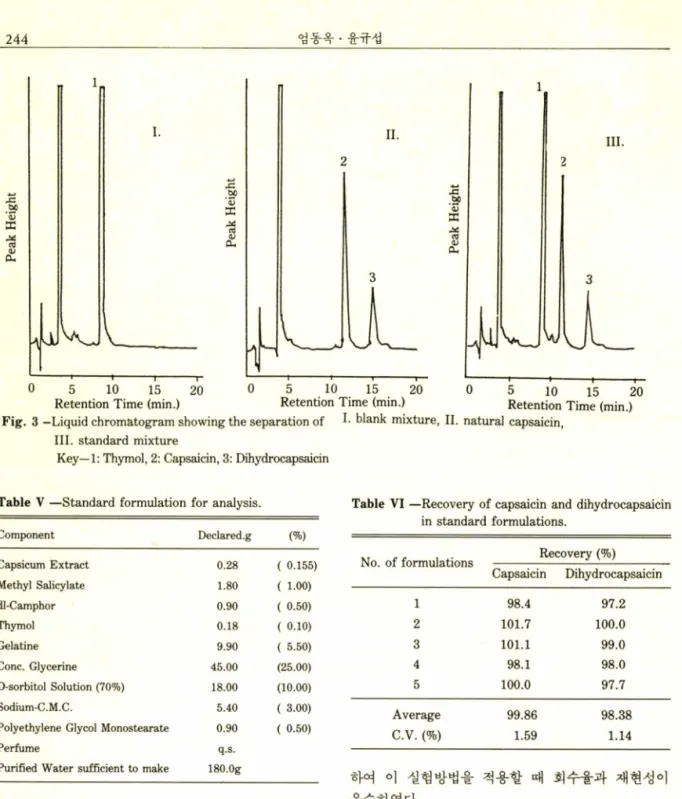
Fig. 3 -Liquid chromatogram showing the separation of III. standard mixture
Key—1: Thymol, 2: Capsaicin, 3: Dihydrocapsaicin
5 10 15 20
Retention Time (min.)
I. blank mixture, II. natural capsaicin,
5 10 15 20
Retention Time (min.)
Table V 一Standard formulation for analysis.
C o m p o n e n t D e c la re d .g (% )
C a p s ic u m E x tr a c t 0.28 ( 0.155)
M e th y l S a lic y la te 1.80 ( 1.00)
dl- C a m phor 0.90 ( 0.50)
T h y m o l 0.18 ( 0.10)
G e la tin e 9.90 ( 5.50)
C on e. G ly c e rin e 4 5.0 0 (25.00)
D -sorbitol S o lu tio n (70% ) 18.00 (10.00)
S o d iu m - C .M .C . 5.40 ( 3.00)
P o ly e th y le n e G lyc ol M o n o s te a ra te 0.90 ( 0.50)
P e r fu m e q.s.
P u r ifie d W a t e r s u ffic ie n t to m ak e 180.0g
Table VI 一Recovery of capsaicin and dihydrocapsaicin in standard formulations.
가제가 주는 영향을 검토하기 위하여 Table V와 같은 첨가제의 양과 종류로 표준처방을 조제하여 chromatogram 을 얻은 결과 Fig.3 에서와 같이 전
혀 영향을 받지 않았다.
회수율 및 재현성ᅳTable V 의 표준처방에 따라 조제된 시료용액으로 CS 와 DHC 의 회수율 및 재 현성을 검토한 결과 Table VI에서와 같이 상대표준 편차가 CS1.59%,DHC1.14%로 시판 제품에 대
No. of formulations Recovery (%) Capsaicin Dihydrocapsaicin
1 98.4 97.2
2 101.7 100.0
3 101.1 99.0
4 98.1 98.0
5 100.0 97.7
Average 99.86 98.38
C.V. (%) 1.59 1.14
하여 이 실험방법을 적용할 때 회수율과 재현성이 우수하였다.
결 론
이 정량방법은 카타플라스마제 둥에 함유되어 있 는 고추엑스 중 CS 와 DHC 를 복잡한 전처리 조작 없이 MeOH : Me2CO 혼액으로 Ultrasonic cle- aner 를 이용 추출하여 HPLC 로 정량할 수 있는 방법이다.
II
3
I L
^
bo -cH
3lsd
II
qI
boP H s
-sf v s
Msd
HPLC를 이용한 고추엑스 제제 중 Capsaicin과 Dihydrocapsaicin의 분리정량 245
흔히 제제 중에 함유되는 첨가제 둥의 영향을 받 지 않고 감도도 예민하여 2.3X10_6M 의 농도에서 정량이 가능하였으며, 그 범위는 2.3><10-6-2.lX 10_5M 이였다. CS 와 DHC 의 변동 계수가 각각 1.59%와 1.14%로 재현성이 매우 양호하였으며, capsaicinoid 만을 정량하는 기존의 방법에 비해 조 작이 간편할 뿐만 아니라, 신속 정확하게 분리정량 할 수 있는 장점이 있었으므로 제제의 품질관리는 물론 고추엑스의 기준 설정에도 활용될 수 있을 것
으로 사료된다.
문 헌
1) K. Sagara, S. Kakizawa, K. Kasuya, T. Misaki and H.
Yashizawa: Simultaneous Determination of Capsaicin, Dihydrocapsaicin and Nordihydrocapsacin in Capsicum Fruit by Gas Chromatography. Chem. Pharm. Bull., 28,
2796 (1980)
2) A. Miiller-Stock,R.K. Toshi and J. Buchi: II. Study of the components of capsaicin. Quantitative gas chromatographic determination of individual homologs and analogs of capsaicin in mixtures from a natural source and of vanillyl pelargonic amide as adulteration.
J. Chromatogr., 63, 281 (1971)
3) 0. Sticher, F. Sordati and R.K. Joshi: High performance liquid chromatographic separation and quantitative
determination of capsaicin, dihydrocapsaicin, nor- dihydrocapsaicin and homodihydrocapsaicin in natural capsaicinoid mixtures and fructus capsici. J.
Chromatogr., 166,221 (1978)
4) J. Jurenitsch and I. Kampelmuhler: Rapid determi
nation of nonylic acid vanillylamide and other cap- saicinoids in capsicum fruits and extracts by means of Ag+ complexation high performance liqid chromatogr.
J. Chromatogr., 193,101 (1980)
5) G.H. Chiang: HPLC Analysis of Capsaicins and Simultaneous Determination of Capsaicins and Piperine by HPLC-ECD and UV. Journal of Food Science, 51, 499 (1986)
6) K.R. Lee T. Suzuki, M. Kobayashi, K. Hasegawa and K. Iwai: Quantitative microanalysis of capsaicin, dihydrocapsaicin and nordihydrocapsaicin using mass fragmentography. J. Chromatogr., 23, 119 (1976).
7) K. Iwai, J. Suzuki, H. Fujiwake and S. Oka:
Simultaneous microdetermination of capsaicin and its four analogues by using high performance liquid chromatography and gas chromatography-mass spec
trometry. J. Chromatogr., 172, 303 (1979)
8) S. Ohnishi, T. Yoneya and S. Hara: Liquid-Solid chromatography resolution system for capsaicine analogues in cosmetic preparation. YAKUGAKU ZASSHI, 103,236 (1983)
Vol. 33, No. 4, 1989