Korean J Intern Med 2019;34:1125-1135 https://doi.org/10.3904/kjim.2018.097
1Department of Internal Medicine, Chonbuk National University Medical School, Jeonju; 2Research Institute of Clinical Medicine of Chonbuk National University- Biomedical Research Institute of Chonbuk National University Hospital, Jeonju; 3Department of Internal Medicine, Keimyung University Dongsan Medical Center, Daegu; 4Department of Internal Medicine, Dong-A University College of Medicine, Busan; 5Department of Internal Medicine, Veterans Health Service Medical Center, Seoul;
6Department of Internal Medicine, Soonchunhyang University Seoul Hospital, Seoul; 7Department of Internal Medicine, Ewha Womans University School of Medicine, Seoul;
8Department of Internal Medicine, CHA University School of Medicine, Seongnam; 9Department of Internal Medicine, Soonchunhyang University Gumi Hospital, Gumi;
10Department of Internal Medicine, Seoul National University Bundang Hospital, Seongnam, Korea Received : March 9, 2018 Revised : April 10, 2018 Accepted : April 11, 2018 Correspondence to Soo-Mee Bang, M.D.
Department of Internal Medicine, Seoul National University Bundang Hospital, 82 Gumi-ro 173beon-gil, Bundang-gu, Seongnam 13620, Korea
Tel: +82-31-787-7039 Fax: +82-31-787-4098 E-mail: [email protected]
Background/Aims: Limited data are available regarding the efficacy of rivarox- aban for the treatment of cancer-associated venous thromboembolism (VTE). The aim of this study was to evaluate the effectiveness and safety of rivaroxaban for the treatment of VTE in active cancer patients.
Methods: In this prospective, multicenter, open-label trial (NCT01989845), we enrolled patients with active cancer and objectively diagnosed lower-extremity deep vein thrombosis, pulmonary embolism (PE), or both from November 2013 to June 2016. Active cancer was defined as a histologically confirmed malignancy, which was diagnosed or treated within the previous 6 months, or as a recurrent/
metastatic cancer. Patients received oral rivaroxaban 15 mg twice daily for first 3 weeks, followed by 20 mg once daily for 6 months. The primary outcome was the symptomatic recurrent VTE and the secondary outcomes included any recurrent VTE, major or clinically relevant non-major (CRNM) bleeding events, and overall mortality. All study outcomes were validated by blinded central adjudication.
Results: Of 124 patients enrolled, 110 (88.7%) had solid cancer, 93 (75.0%) had metastatic disease, and 110 (88.7%) were receiving chemotherapy or radiothera- py. During the 6-month study period, seven patients experienced symptomatic recurrent VTE (cumulative incidence, 5.9%), and two patients experienced inci- dental recurrent PE (cumulative incidence of any recurrent VTE, 7.6%). Major bleeding events occurred in six patients (cumulative incidence, 5.3%) and CRNM bleeding events in 11 patients (cumulative incidence, 10.2%). Twenty-eight pa- tients (overall mortality, 24.0%) died.
Conclusions: Rivaroxaban is effective and safe for the treatment of VTE in pa- tients with active cancer.
Keywords: Neoplasms; Recurrence; Rivaroxaban; Venous thromboembolism;
Therapeutics
Long-term rivaroxaban for the treatment of acute venous thromboembolism in patients with active cancer in a prospective multicenter trial
Ho-Young Yhim1,2, Won-Il Choi3, Sung-Hyun Kim4, Seung-Hyun Nam5, Kyoung Ha Kim6, Yeung-Chul Mun7, Doyeun Oh8, Hun-Gyu Hwang9, Keun-Wook Lee10, Eun-Kee Song1,2, Yong Shik Kwon3, and Soo-Mee Bang10
INTRODUCTION
Venous thromboembolism (VTE), which typically in- cludes lower-extremity deep vein thrombosis (DVT) and pulmonary embolism (PE), is a common complication that can be associated with considerable morbidity and mortality in cancer patients [1]. Based on the results of large randomized trials in patients with cancer [2,3], the current international practice guidelines recommend the long-term use of low-molecular-weight heparin (LMWH) for the treatment of VTE in cancer patients [4-7].
The recent introduction of direct oral anticoagu- lants (DOACs) that directly inhibit clotting factor Xa or thrombin is rapidly replacing the use of LMWH and vi- tamin K antagonists in the treatment of VTE [4]. DOACs are attractive drugs in patients with VTE because they can be administered orally with fixed doses, they have few drug and food interactions, and they do not require routine laboratory monitoring [8]. Despite the practical advantages of DOACs, these agents have not been rec- ommended for treatment of cancer-associated VTE in the international guidelines due to insufficient evidence [4-7]. Although the pivotal phase III trials testing DOACs included cancer patients, the results of these trials [9-13]
and subsequent subgroup analysis [14-17] have been un- derpowered by the small number of cancer patients and the heterogeneity in definition of cancer for the trials [18]. Indeed, the cancer patients included in the pivotal trials usually had completed the cancer treatment be- fore enrollment or had a previous history of cancer and eventually they were not a true representative of active cancer patients [19]. Thus, there is considerable debate regarding the use of DOACs in the treatment of VTE in patients with active cancer. Therefore, we conducted this study (KVTE-1301) to evaluate the effectiveness and safety of long-term rivaroxaban treatment in patients with active cancer and VTE.
METHODS
Study population and eligibility criteria
The present prospective, multicenter, open-label study was designed to investigate the effectiveness and safe- ty of oral rivaroxaban treatment in consecutive patients with active cancer and objectively diagnosed lower-ex-
tremity DVT, PE, or both, who had a life expectancy of ≥ 3 months. The study was conducted in nine institutions of the Thrombosis Working Party of the Korean Society of Hematology and Venous Thrombosis Division of the Korean Society of Thrombosis and Hemostasis. Active can- cer was defined as a histologically confirmed solid cancer or hematologic malignancy (except for basal cell or squa- mous cell carcinoma of the skin), which were diagnosed or treated within the previous 6 months, or as a recurrent/
metastatic cancer. PE was diagnosed based on the presence of non-enhancing filling defects in at least one subseg- mental pulmonary artery on computed tomography (CT) pulmonary angiography, or high probability mismatched perfusion defect on ventilation/perfusion lung scan. DVT was diagnosed based on the non-compressibility on ultra- sonography, or intraluminal filling defects in lower-ex- tremity deep vein on CT venography. Incidental PE, which was defined when PE was detected by imaging studies that were performed for reasons other than suspected PE, was considered if the equivalent diagnostic criteria for symp- tomatic PE were met.
Patients were excluded if they had isolated asymp- tomatic distal DVT, splanchnic vein thrombosis, or catheter-associated thrombosis; an Eastern Cooperative Oncology Group (ECOG) performance status 3 or 4; a creatinine clearance of < 30 mL/min/1.73 m2; history of total gastrectomy; confirmation of VTE or therapeutic anticoagulation for > 120 hours prior to the first dose of rivaroxaban after enrollment; cardiogenic shock; treat- ment of qualifying VTE with thrombolysis, caval filter, or thrombectomy; uncontrolled brain metastasis; cancer treatment with bevacizumab or other drugs with potent anti-angiogenic property; active bleeding or history of bleeding within 4 weeks before enrollment; a high risk of serious bleeding; a platelet count < 75,000/μL; preg- nancy or breast feeding.
Study treatment
Rivaroxaban should be administered within 120 hours after confirmation of the VTE or therapeutic anticoag- ulation initiation. Patients were treated with oral rivar- oxaban 15 mg twice daily for the first 3 weeks, followed by 20 mg once daily for 6 months. Rivaroxaban was tem- porarily withheld if patients had a platelet count of <
50,000/μL, bleeding events, or invasive procedures. Dose reduction was not permitted, unless patients experi-
enced major bleeding events.
Study outcomes and follow-up
The primary outcome of this study was to assess the symptomatic recurrent VTE during the 6-month peri- od, which included fatal or symptomatic non-fatal PE or DVT. Fatal PE was defined when patients were con- firmed by objective diagnostic testing or autopsy, or when a specific cause of death could not be documented and PE could not be ruled out. Recurrent non-fatal PE was defined as a new intraluminal filling defect on CT pulmonary angiography, or as the presence of new or clearly enlarged area of mismatched perfusion defect on ventilation/perfusion lung scan. Recurrent DVT was determined if new thrombus was clearly identified by non-compressibility on ultrasonography or new intra- luminal filling defect on venography.
The secondary outcomes included any (symptomat- ic or incidental) recurrent VTE, bleeding events (ma- jor bleeding or clinically relevant non-major [CRNM]
bleeding), overall mortality, and validation of the Otta- wa score [20]. The severity of bleeding events was clas- sified based on the criteria of the International Society on Thrombosis and Haemostasis [21]. All recurrent VTE episodes, bleeding events, and deaths were reviewed in the independent central adjudication committee. They confirmed the presence of recurrent VTE, graded bleed- ing event severities, and determined the cause of death.
Patients had regular follow-up visit on days 7, 21 and then every 28 days until day 180, consent withdrawal, lost to follow-up or death. During every visit, symp- toms and signs of recurrent VTE and bleeding events were thoroughly investigated by treating physicians. If patients developed symptoms and signs of recurrent VTE, appropriate imaging methods were implemented to objectively diagnose VTE. Telephone contacts were made in case patients did not visit the hospital on the scheduled day.
Statistical analysis
Recurrent VTE rates for active cancer patients treat- ed with LMWH were reported previously to be 9% [2].
Sample size was calculated using one-sample propor- tion test to be sufficient to reject if expected proportion of recurrence was higher than 9% with a two-sided 95%
confidence interval (CI) of 0.107. Planned accrual was for
110 patients. Assuming a 15% dropout rate, the total ac- crual needed to be 127 patients. The recurrent VTE and bleeding events were calculated using a cumulative in- cidence method that incorporated death from any cause as competing risk [22]. Mortality was estimated using the Kaplan-Meier method. All analyses were conducted using SAS Enterprise Guide version 6.4 (SAS Institute Inc., Cary, NC, USA).
Study oversight
The study was conducted in accordance with the Good Clinical Practice of the International Conference on Harmonization Guidelines and the Declaration of Hel- sinki. The investigators were responsible for the study design and Bayer Korea provided an independent re- search fund to conduct the study. The study protocol was approved by the Institutional Review Board (B- 1308/216-005) of each participating institution and reg- istered at www.clinicaltrials.gov (NCT01989845). All pa- tients provided written informed consent.
RESULTS
Patient cohort and anticoagulation treatment
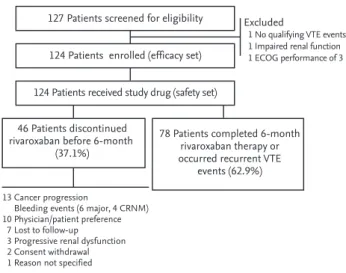
A total of 127 patients were screened for this study from November 2013 to June 2016. Three patients were ex- cluded because they did not meet the eligibility crite- ria: one patient did not have qualifying thrombotic epi- sodes, one patient had a creatinine clearance of < 30 mL/
min/1.73 m2, and one patient had ECOG performance status 3. Thus, 124 patients were enrolled and the data for these were analyzed (Fig. 1).
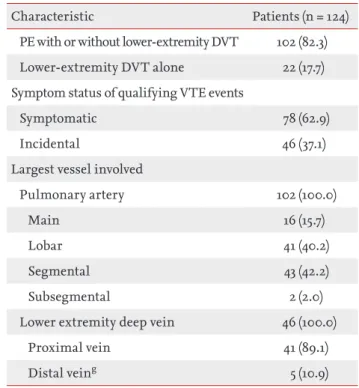
Baseline clinical and thrombotic event characteristics of the 124 patients are described in Table 1. Of these, 88.7% of patients had solid cancers, 75.0% had metastat- ic disease, and 88.7% were receiving chemotherapy or radiotherapy. The most common primary tumor sites were lung, colorectum, pancreaticobiliary tract, and stomach. The qualifying VTE event was PE ± DVT in 82.3% of the patients and presented as symptomatic in 62.9% of the patients.
Rivaroxaban was administered for a median duration of 171 days (range, 1 to 208) and temporarily interrupted in 32 patients (25.8%) for a median of 8 days (range, 1 to 37).
Recurrent VTE episodes
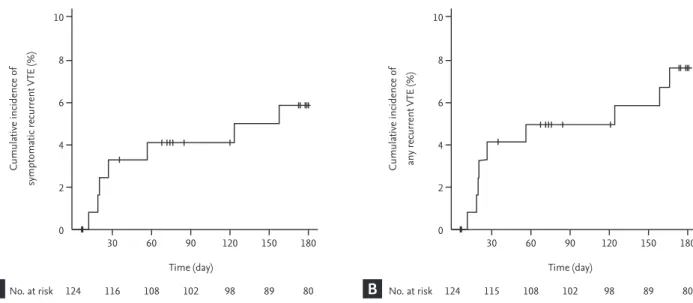
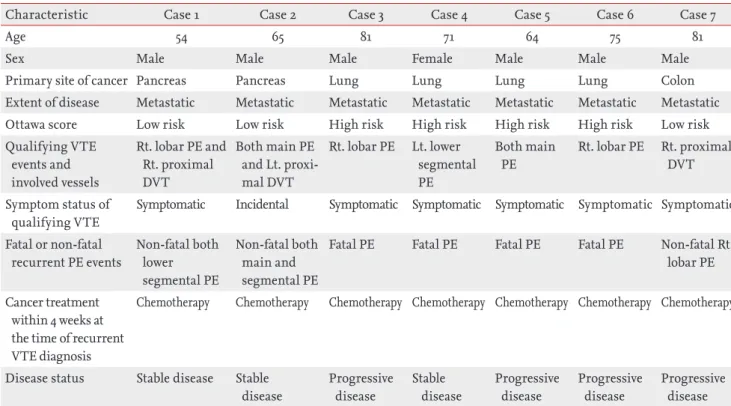
Seven patients experienced symptomatic recurrent VTE episodes: fatal PE in four patients and symptom- atic non-fatal PE in three patients. The cumulative in- cidence of symptomatic recurrent VTE was 5.9% (95%
CI, 2.6 to 11.1) at 6 months (Fig. 2A). Two patients expe- rienced incidental recurrent PE. Thus, the cumulative incidence of any recurrent VTE was 7.6% (95% CI, 3.7 to 13.2) (Fig. 2B). Comparisons of cumulative risk of recur- rent VTE according to the symptom status at the time of qualifying VTE diagnosis showed no significant differ- ences between symptomatic and incidental VTE events (symptomatic recurrence, 8.1% vs. 2.2%, respectively, p
= 0.184; any recurrence, 9.4% vs. 4.5%, respectively, p = 0.300). The Ottawa score did not predict the recurrence of symptomatic or any VTE events (Fig. 3). Clinical and thrombotic characteristics of patients with symptomatic recurrent VTE were summarized in Table 2.
Bleeding events and mortality
Six and 11 patients experienced major and CRNM bleed- ing events, respectively. The most common site of major bleeding was gastrointestinal in four patients (66.7%), whereas one patient experience major bleeding in the lung and one showed intracranial bleeding. Unresect- ed primary tumor in the gastrointestinal tract was the source of major bleeding in two patients (33.3%). The cumulative incidence of major and CRNM bleeding
events was 5.3% (95% CI, 2.1 to 10.5) and 10.2% (95% CI, 5.3 to 16.9), respectively (Fig. 4). All six patients expe- rienced major bleeding events didn’t resume rivarox- aban treatment.
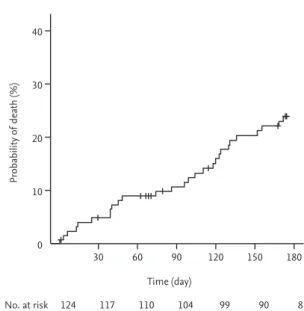
Overall, 28 patients died; the cause of death was can- cer progression in 17 patients (60.7%), fatal PE in four patients (14.3%), infection in four patients (14.3%), and fatal bleeding events in three patients (10.7%). The over- all mortality was 24.0% (95% CI, 15.8 to 31.4) at 6 months (Fig. 5). The mortality rate of patients with symptomat- ic VTE events was not significantly different compared to that of patients with incidental VTE events (23.4% vs.
24.7%, respectively; p = 0.998).
DISCUSSION
Our study provides several valuable insights into the incorporation of DOACs as a therapeutic option for cancer-associated VTE. Our results show that rivarox- aban is effective in patients with active cancer and low- er-extremity DVT, PE, or both. In 124 patients, the ma- jority of whom had metastatic disease and were under anti-cancer treatments, we observed a cumulative risk of symptomatic recurrence of 5.9% and a rate of any re- currence of 7.6%. The risk of recurrence observed in this study was promising, as compared with approximately 7% to 9% observed in active cancer patients treated with LMWH in the CLOT and CATCH trials (Table 3) [2,3]. In contrast, the results of meta-analysis [23] and subgroup analysis [14-17] regarding cancer patients enrolled in the pivotal DOAC trials showed that the recurrent VTE rates were approximately 3% to 5%. Although the recurrence rates of cancer patients in the DOAC trials were lower than those observed in the LMWH trials, it is difficult to be generalized in favor of the use of DOACs for treat- ment of cancer-associated VTE due to the different defi- nition of cancer patients between the DOAC and LMWH trials. Both CLOT and CATCH trials included patients with recently diagnosed or treated cancer, or with re- current/metastatic cancer in palliative setting [2,3]. In contrast, a substantial number of cancer patients in the DOAC trials just had a history of cancer at study entry.
Trials for apixaban [12] and edoxaban [13], in particular, excluded patients requiring long-term anticoagulation therapy, which indicated patients with recurrent/meta-
127 Patients screened for eligibility 124 Patients enrolled (efficacy set) 124 Patients received study drug (safety set)
Excluded
1 No qualifying VTE events 1 Impaired renal function 1 ECOG performance of 3
46 Patients discontinued rivaroxaban before 6-month
(37.1%)
13 Cancer progression
Bleeding events (6 major, 4 CRNM) 10 Physician/patient preference 7 Lost to follow-up 3 Progressive renal dysfunction 2 Consent withdrawal 1 Reason not specified
78 Patients completed 6-month rivaroxaban therapy or occurred recurrent VTE
events (62.9%)
Figure 1. Flow-chart of the study. VTE, venous thromboem- bolism; ECOG, Eastern Cooperative Oncology Group; CRNM, clinically relevant non-major.
static cancer were not eligible. Therefore, considering that no studies have specifically addressed the treatment of VTE using DOACs in patients with active cancer, it is noteworthy that our study tested rivaroxaban using the same definition of active cancer as in the CLOT and CATCH trials.
Because the Korean population was generally consid- Table 1. Baseline clinical and thrombotic event characteristics
Characteristic Patients (n = 124)
Age, yr 67 (28–85)
Sex
Male 69 (55.6)
Female 55 (44.4)
Primary site of cancer
Lung 30 (24.2)
Colorectum 24 (19.4)
Pancreaticobiliary tract 16 (12.9)
Stomach 16 (12.9)
Hematologic malignancy 14 (11.3)
Gynecologic system 9 (7.3)
Breast 7 (5.6)
Genitourinary tract 4 (3.2)
Othera 4 (3.2)
Extent of diseaseb
Localized or locoregional disease 17 (13.7)
Metastatic disease 93 (75.0)
Cancer treatment
Yes 110 (88.7)
Systemic anti-cancer treatmentsc 109 (87.9)
Radiotherapyd 6 (4.8)
Recent major surgery within 6 months 23 (18.5) ECOG performance status
0 or 1 97 (78.2)
2 27 (21.8)
The Ottawa scoree
Low risk (≤ 0) 53 (42.7)
High risk (> 0) 71 (57.3)
Previous history of VTE 6 (4.8)
Body weight, kg 61.2 ± 10.9
Body mass index 23.9 ± 3.9
Creatinine clearancef, mL/min/1.73 m2
≥ 30.0 and < 50.0 87 (14.5)
≥ 50.0 and < 80.0 67 (54.0)
≥ 80.0 39 (31.5)
Qualifying VTE events
Characteristic Patients (n = 124)
PE with or without lower-extremity DVT 102 (82.3) Lower-extremity DVT alone 22 (17.7) Symptom status of qualifying VTE events
Symptomatic 78 (62.9)
Incidental 46 (37.1)
Largest vessel involved
Pulmonary artery 102 (100.0)
Main 16 (15.7)
Lobar 41 (40.2)
Segmental 43 (42.2)
Subsegmental 2 (2.0)
Lower extremity deep vein 46 (100.0)
Proximal vein 41 (89.1)
Distal veing 5 (10.9)
Values are presented as mean (range), number (%), or mean ± SD.
ECOG, Eastern Cooperative Oncology Group; VTE, venous thromboembolism; DVT, deep vein thrombosis.
aOther cancers include nasopharyngeal cancer (n = 2), head and neck squamous cell carcinoma (n = 1), and metastasis of unknown primary site (n = 1).
bPatients with hematologic malignancy were not included.
cSystemic anti-cancer treatments included cytotoxic, hor- monal, and targeted therapy.
dFive patients were receiving concurrent chemoradiotherapy.
eThe Ottawa score that assigned a score of –2 for stage I can- cer, –1 for breast cancer, and +1 for lung cancer, female sex, and previous history of VTE categorized low risk group for recurrent VTE when the sum of score was ≤ 0 and high risk group if the sum of score was > 0.
fCreatinine clearance was calculated by the Cockcroft and Gault formulas.
gOne patient who had been receiving adjuvant chemothera- py for resected lung cancer had symptomatic isolated distal DVT, and another four patients with distal DVT had concur- rent PE.
Table 1. Continued
ered to have lower risk of VTE [24] even in surgical on- cologic patients [25], as compared with Caucasian pop- ulations, our data should be interpreted with caution.
However, there have been recent data suggesting that the tumor activity of advanced stage cancer can overcome the ethnic protective effect in the Korean population regarding thrombosis and recurrent thrombosis [26,27].
In our study, the mean age was 67 years (for CLOT, 62 years; for CATCH, 60 years), 75% of the patients had metastatic disease (for CLOT, 67%; for CATCH, 55%),
and approximately 89% of the patients were under ac- tive anti-cancer treatments (for CLOT, 78%; for CATCH, 53%) (Table 3). Despite the ethnic influence on recur- rent thrombosis, these findings may reflect the sig- nificant risk of recurrence in our study population.
Our study shared a considerable proportion of eligibil- ity criteria with the CLOT and CATCH trials. However, unlike these trials, in which only symptomatic VTE was eligible, our study included incidental VTE as qualifying thrombotic events. It is notable that patients with inci- Figure 2. Cumulative incidence of (A) symptomatic and (B) any recurrent venous thromboembolism (VTE).
10 8
6 4
2
0 30 60 90
Time (day) No. at risk
Cumulative incidence of symptomatic recurrent VTE (%)
120 150 180
124 116 108 102 98 89 80
10 8
6 4
2
0 30 60 90
Time (day) No. at risk
Cumulative incidence of any recurrent VTE (%)
120 150 180
124 115 108 102 98 89 80
A B
10 8
6 4
2
0 30 60 90
Time (day) No. at risk
Cumulative incidence of symptomatic recurrent VTE (%)
120 150 180
124 116 108 102 98 89 80
10 8
6 4
2
0 30 60 90
Time (day) No. at risk
Cumulative incidence of any recurrent VTE (%)
120 150 180
124 115 108 102 98 89 80
10 8 6 4 2
0
30 60 90
Time (day) 6-Month cumulative incidence of symptomatic recurrent VTE (95% CI) Low risk (n = 53) 5.9% (1.5–14.8) High risk (n = 71) 5.8% (1.9–13.2)
p = 0.987
No. at risk Cumulative incidence of symptomatic recurrent VTE (%)
120 150 180
Low risk 53 51 48 43 40 36 31
High risk 71 65 60 59 58 53 49
10 8 6 4 2
0
30 60 90
Time (day) 6-Month cumulative incidence of any recurrent VTE (95% CI) Low risk (n = 53) 5.9% (1.5–14.8) High risk (n = 71) 8.8% (3.6–17.0)
p = 0.539
No. at risk Cumulative incidence of any recurrent VTE (%)
120 150 180
Low risk 53 51 48 43 40 36 31
High risk 71 64 60 59 58 53 49
Figure 3. Cumulative incidence of (A) symptomatic and (B) any recurrent venous thromboembolism (VTE) according to the risk stratification by Ottawa score. CI, confidence interval.
A B
dental VTE events had similar rates of recurrent VTE and mortality in our study, as compared to those with symptomatic events, which was consistent with previous observations in cancer patients [28,29]. Thus, our study
prospectively confirmed the impact of the incidental VTE on recurrent VTE and mortality in cancer-associ- ated VTE.
The rate of major bleeding observed in this study was Table 2. Clinical and thrombotic characteristics of patients with symptomatic recurrent VTE (n = 7)
Characteristic Case 1 Case 2 Case 3 Case 4 Case 5 Case 6 Case 7
Age 54 65 81 71 64 75 81
Sex Male Male Male Female Male Male Male
Primary site of cancer Pancreas Pancreas Lung Lung Lung Lung Colon
Extent of disease Metastatic Metastatic Metastatic Metastatic Metastatic Metastatic Metastatic Ottawa score Low risk Low risk High risk High risk High risk High risk Low risk Qualifying VTE
events and involved vessels
Rt. lobar PE and Rt. proximal DVT
Both main PE and Lt. proxi- mal DVT
Rt. lobar PE Lt. lower segmental PE
Both main PE
Rt. lobar PE Rt. proximal DVT Symptom status of
qualifying VTE
Symptomatic Incidental Symptomatic Symptomatic Symptomatic Symptomatic Symptomatic Fatal or non-fatal
recurrent PE events
Non-fatal both lower segmental PE
Non-fatal both main and segmental PE
Fatal PE Fatal PE Fatal PE Fatal PE Non-fatal Rt.
lobar PE Cancer treatment
within 4 weeks at the time of recurrent VTE diagnosis
Chemotherapy Chemotherapy Chemotherapy Chemotherapy Chemotherapy Chemotherapy Chemotherapy
Disease status Stable disease Stable disease
Progressive disease
Stable disease
Progressive disease
Progressive disease
Progressive disease VTE, venous thromboembolism; Rt., right; PE, pulmonary embolism; DVT, deep vein thrombosis; Lt., left.
Figure 4. Cumulative incidence of (A) major and (B) clinically relevant non-major (CRNM) bleeding events.
20
15
10
5
0 30 60 90
Time (day) No. at risk
Cumulative incidence of major bleeding (%)
120 150 180
124 111 103 92 85 77 55
20
15
10
5
0 30 60 90
Time (day) No. at risk
Cumulative incidence of CRNM bleeding (%)
120 150 180
124 108 98 87 80 72 50
A B
5.3% for up to 6 months, slightly higher than anticipat- ed. Although the CLOT trial reported major bleeding rate of 6% [2], the rate of major bleeding in the recent studies regarding DOACs was approximately 2% to 3%
in cancer patients [14-17], which was similar to those found in LMWH group of the CATCH trial (2.7%) [3].
This slightly higher than expected major bleeding rate could be partially explained by lower body weight or body mass index of our population, as compared with those in the CATCH trial [3] and the cancer subgroup of DOAC trials [14,15,17]. In addition, the fact that the ma- jority of the study population was receiving anti-cancer treatments may raise the possibility that rivaroxaban activity is altered through interactions with chemother- apeutic agents and subsequently increases the risk of major bleeding. Although our study excluded patients treated with bevacizumab or other drugs with anti-an- giogenic properties (i.e., sunitinib, sorafenib, imatinib, nilotinib, dasatinib, ramucirumab, etc.), we allowed the use of some chemotherapeutic or hormonal agents that potentially inhibit or induce P-glycoprotein transport or the CYP3A4 pathway (i.e., doxorubicin, vinblastine, dexamethasone, tamoxifen, etc.) [8]. We could not ana- lyze the impact of drug-drug interactions on bleeding events because only a small number of patients received these drugs. However, tamoxifen is known to increase the plasma level of rivaroxaban, but none of the patients treated with tamoxifen and rivaroxaban in this study experienced bleeding events (data not shown). Further- more, the sum of both major and CRNM bleeding events (15.5% for 6 months) was similar to those reported in the cancer subgroup of DOAC trials [14-17] and the CATCH trial [3]. These findings suggested that rivaroxaban did not universally increase the bleeding risk in cancer pa- tients receiving active anti-cancer treatments. Thus, despite possible interactions between rivaroxaban and some anti-cancer drugs, we postulated that the impact of drug interactions on bleeding events may be minimal if agents with anti-angiogenic properties were not con- comitantly used.
Interestingly, the gastrointestinal tract was the main site of major bleeding in our study population and one- third of major bleeding events were located at the site of unresected primary tumor, which was consistent with the results of meta-analysis in unselected populations [30] and cancer patients [31] with VTE and treated with Table 3. Comparison of baseline characteristics, recurrent
VTE, and bleeding events in the KVTE 1301 study with CLOT and CATCH trials
Characteristic CLOT (n = 676)
CATCH (n = 900)
KVTE 1301 (n = 124)
Asian population, % 0 44 100
Mean age, yr 62 60 67
History of VTE, % 11.1 6.3 4.8
ECOG performance status 2, %
35.5 23.2 21.8
Metastatic disease, % 67.3 54.7 75.0 Anti-cancer treat-
ment, %
77.7 52.9 88.7
Cumulative 6-month mortality, %
39.3 32.0 23.8
Outcomes during 6 months
Dalteparin (n = 338)
Tinzaparin (n = 449)
Rivarox- aban (n = 124) Symptomatic recur-
rent VTE rate, %
9 7.2 5.9
Major bleeding, % 6 2.7 5.3
CRNM bleeding, % 14* 10.9 10.2
VTE, venous thromboembolism; KVTE, Korean venous thromboembolism; CLOT, randomized Comparison of LMWH versus Oral anticoagulant therapy for the preven- tion of recurrent VTE in patients with Cancer; CATCH, Comparison of Acute Treatments in Cancer Haemostasis;
ECOG, Eastern Cooperative Oncology Group; CRNM, clini- cally relevant non-major.
aIndicates the proportion of patients with any bleedings re- ported in the CLOT trial.
40
30
20
10
0 30 60 90
Time (day) No. at risk
Probability of death (%)
120 150 180
124 117 110 104 99 90 81
Figure 5. Overall mortality in the study population.
DOACs. The mechanisms of gastrointestinal bleeding observed from rivaroxaban therapy may be explained by the local effect of unabsorbed anticoagulant in the lumen of the gastrointestinal tract and consequent po- tentiation in vulnerable lesions in combination with systemic drug effect [32]. Therefore, the use of DOACs may lead to increased risk of gastrointestinal bleeding in patients with vulnerable mucosal lesion on unre- sected primary tumors of the gastrointestinal tract and need to be avoided in this group of patients. However, because the use of any anticoagulants in these patients may be associated with increased risk of bleeding, it is difficult to determine the risk of gastrointestinal bleed- ing during the treatment with other anticoagulants (i.e., LMWH). Considering the theoretical absence of local anticoagulant effects of LMWH, it is necessary to eval- uate the unresected primary gastrointestinal tumor as one of the factors for optimal selection of long-term an- ticoagulant treatment in patients with cancer-associated VTE.
Our study has several limitations. First, our study permitted the enrollment within 120 hours after con- firmation of the qualifying VTE event or the start of an- ticoagulation therapy, which was longer than the CLOT (48 hours) and CATCH (72 hours) trials. Because the risk of recurrent VTE was highest during the first month of VTE episode [33], it is possible that some patients with recurrence at first week of qualifying VTE episode were not considered as candidates for this study, indicating potentials of selection bias. Our study enrolled patients with incidental thrombosis as well as with symptomat- ic VTE and the date of objective diagnosis in patients with incidental thrombosis was the date of radiologic studies for qualifying VTE episode. There is a time gap between radiologic studies and detection of thrombosis in asymptomatic patients in real clinical practice. Be- cause of this, we allowed an additional 24- to 48-hour time period between objective diagnosis and study en- rollment. However, despite this limitation, our study included the highest proportion of metastatic cancer patients with active anti-cancer treatments among stud- ies ever conducted in this setting. Second, our findings may not be applicable to other ethnicities because of the single ethnicity (i.e., Korean) of our study participants.
Third, although the optimal duration of rivaroxaban treatment in patients with cancer-associated VTE is be-
yond the scope of this study, actual rates of recurrent VTE may have been underestimated owing to 6 months of treatment duration. There is a data showing that the risk of recurrent VTE is still clinically significant be- yond 6 months of treatment [34]. In addition, edoxaban recently showed continued benefit of treatment beyond 6 months [35]. Therefore, rivaroxaban treatment should not be discontinued just because patients completed the 6-month period treatment. Fourth, our study contained a relatively small sample size with a wide range of CI because the goal of our study was to detect a promis- ing, but not definitive benefit. Nevertheless, our results are sufficient to warrant assessment of rivaroxaban in a phase III trial because cancer-associated VTE patients consist a highly specific population with enormous un- met needs for treatment.
In conclusion, our results show that single target- ed inhibition of coagulation system using rivaroxaban is effective and safe in patients with active cancer and symptomatic or incidental lower-extremity DVT, PE, or both. Further evaluation of our findings in phase III tri- als is under way.
Conflict of interest
This study was supported by an independent research fund from Bayer Korea.
Acknowledgments
We would like to thank all participating patients and all study staff and nurses for their work in enrolling and managing patients. We would also like to acknowledge the contribution made by members of the independent central adjudication committee: Junshik Hong (Depart- ment of Internal Medicine, Seoul National University Hospital, Seoul, Korea) and Ji-Hyun Kwon (Department of Internal Medicine, Chungbuk National University
KEY MESSAGE
1. Cumulative incidence of symptomatic recurrent venous thromboembolism (VTE) and major bleeding events were 5.9% and 5.3%, respectively.
2. Oral administration of rivaroxaban offers a sim- ple and convenient option to treat cancer-asso- ciated VTE
Hospital, Cheongju, Korea), and sample size determina- tion by Heeyoung Lee (Center for Preventive Medicine and Public Health, Seoul National University Bundang Hospital, Seoul, Korea).
REFERENCES
1. Young A, Chapman O, Connor C, Poole C, Rose P, Ka- kkar AK. Thrombosis and cancer. Nat Rev Clin Oncol 2012;9:437-449.
2. Lee AY, Levine MN, Baker RI, et al. Low-molecular-weight heparin versus a coumarin for the prevention of recur- rent venous thromboembolism in patients with cancer. N Engl J Med 2003;349:146-153.
3. Lee AYY, Kamphuisen PW, Meyer G, et al. Tinzaparin vs warfarin for treatment of acute venous thromboembo- lism in patients with active cancer: a randomized clinical trial. JAMA 2015;314:677-686.
4. Kearon C, Akl EA, Ornelas J, et al. Antithrombotic therapy for VTE disease: CHEST guideline and expert panel re- port. Chest 2016;149:315-352.
5. Lyman GH, Khorana AA, Kuderer NM, et al. Venous thromboembolism prophylaxis and treatment in patients with cancer: American Society of Clinical Oncology clin- ical practice guideline update. J Clin Oncol 2013;31:2189- 2204.
6. Mandala M, Falanga A, Roila F; ESMO Guidelines Work- ing Group. Management of venous thromboembolism (VTE) in cancer patients: ESMO Clinical Practice Guide- lines. Ann Oncol 2011;22 Suppl 6:vi85-vi92.
7. Farge D, Bounameaux H, Brenner B, et al. International clinical practice guidelines including guidance for direct oral anticoagulants in the treatment and prophylaxis of venous thromboembolism in patients with cancer. Lan- cet Oncol 2016;17:e452-e466.
8. Lee AY, Peterson EA. Treatment of cancer-associated thrombosis. Blood 2013;122:2310-2317.
9. Schulman S, Kearon C, Kakkar AK, et al. Dabigatran ver- sus warfarin in the treatment of acute venous thrombo- embolism. N Engl J Med 2009;361:2342-2352.
10. EINSTEIN-PE Investigators, Buller HR, Prins MH, et al.
Oral rivaroxaban for the treatment of symptomatic pul- monary embolism. N Engl J Med 2012;366:1287-1297.
11. EINSTEIN Investigators, Bauersachs R, Berkowitz SD, et al. Oral rivaroxaban for symptomatic venous thrombo-
embolism. N Engl J Med 2010;363:2499-2510.
12. Agnelli G, Buller HR, Cohen A, et al. Oral apixaban for the treatment of acute venous thromboembolism. N Engl J Med 2013;369:799-808.
13. Hokusai-VTE Investigators, Buller HR, Decousus H, et al. Edoxaban versus warfarin for the treatment of symptomatic venous thromboembolism. N Engl J Med 2013;369:1406-1415.
14. Agnelli G, Buller HR, Cohen A, et al. Oral apixaban for the treatment of venous thromboembolism in cancer patients: results from the AMPLIFY trial. J Thromb Hae- most 2015;13:2187-2191.
15. Prins MH, Lensing AW, Brighton TA, et al. Oral rivarox- aban versus enoxaparin with vitamin K antagonist for the treatment of symptomatic venous thromboembo- lism in patients with cancer (EINSTEIN-DVT and EIN- STEIN-PE): a pooled subgroup analysis of two random- ized controlled trials. Lancet Haematol 2014;1:e37-e46.
16. Raskob GE, van Es N, Segers A, et al. Edoxaban for venous thromboembolism in patients with cancer: results from a non-inferiority subgroup analysis of the Hokusai-VTE randomised, double-blind, double-dummy trial. Lancet Haematol 2016;3:e379-e387.
17. Schulman S, Goldhaber SZ, Kearon C, et al. Treatment with dabigatran or warfarin in patients with venous thromboembolism and cancer. Thromb Haemost 2015;114:150-157.
18. Yhim HY, Bang SM. Direct oral anticoagulants in the treatment of cancer-associated venous thromboembo- lism. Blood Res 2014;49:77-79.
19. Piran S, Schulman S. Management of venous thrombo- embolism: an update. Thromb J 2016;14(Suppl 1):23.
20. Louzada ML, Carrier M, Lazo-Langner A, et al. Develop- ment of a clinical prediction rule for risk stratification of recurrent venous thromboembolism in patients with cancer-associated venous thromboembolism. Circulation 2012;126:448-454.
21. Schulman S, Kearon C; Subcommittee on Control of An- ticoagulation of the Scientific and Standardization Com- mittee of the International Society on Thrombosis and Haemostasis. Definition of major bleeding in clinical investigations of antihemostatic medicinal products in non-surgical patients. J Thromb Haemost 2005;3:692-694.
22. Ay C, Posch F, Kaider A, Zielinski C, Pabinger I. Estimat- ing risk of venous thromboembolism in patients with cancer in the presence of competing mortality. J Thromb
Haemost 2015;13:390-397.
23. van der Hulle T, den Exter PL, Kooiman J, van der Hoev- en JJ, Huisman MV, Klok FA. Meta-analysis of the efficacy and safety of new oral anticoagulants in patients with cancer-associated acute venous thromboembolism. J Thromb Haemost 2014;12:1116-1120.
24. Jang MJ, Bang SM, Oh D. Incidence of venous thrombo- embolism in Korea: from the Health Insurance Review and Assessment Service database. J Thromb Haemost 2011;9:85-91.
25. Yhim HY, Jang MJ, Bang SM, et al. Incidence of venous thromboembolism following major surgery in Korea:
from the Health Insurance Review and Assessment Ser- vice database. J Thromb Haemost 2014;12:1035-1043.
26. Lee KW, Bang SM, Kim S, et al. The incidence, risk factors and prognostic implications of venous thromboembo- lism in patients with gastric cancer. J Thromb Haemost 2010;8:540-547.
27. Yhim HY, Jang MJ, Kwak JY, et al. The incidence, risk factors, and prognosis of recurrent venous thromboem- bolism (VTE) in patients with advanced solid cancers receiving anticoagulation therapy after the diagnosis of index VTE. Thromb Res 2013;131:e133-e140.
28. den Exter PL, Hooijer J, Dekkers OM, Huisman MV. Risk of recurrent venous thromboembolism and mortality in patients with cancer incidentally diagnosed with pulmo- nary embolism: a comparison with symptomatic patients.
J Clin Oncol 2011;29:2405-2409.
29. van der Hulle T, den Exter PL, Planquette B, et al. Risk of recurrent venous thromboembolism and major hem- orrhage in cancer-associated incidental pulmonary em- bolism among treated and untreated patients: a pooled analysis of 926 patients. J Thromb Haemost 2016;14:105- 113.
30. Chai-Adisaksopha C, Crowther M, Isayama T, Lim W. The impact of bleeding complications in patients receiving target-specific oral anticoagulants: a systematic review and meta-analysis. Blood 2014;124:2450-2458.
31. Schulman S, Shrum J, Majeed A. Management of bleed- ing complications in patients with cancer on DOACs.
Thromb Res 2016;140 Suppl 1:S142-S147.
32. Desai J, Kolb JM, Weitz JI, Aisenberg J. Gastrointestinal bleeding with the new oral anticoagulants: defining the issues and the management strategies. Thromb Haemost 2013;110:205-212.
33. Kearon C, Hirsh J. Management of anticoagulation before and after elective surgery. N Engl J Med 1997;336:1506- 1511.
34. Francis CW, Kessler CM, Goldhaber SZ, et al. Treatment of venous thromboembolism in cancer patients with dalteparin for up to 12 months: the DALTECAN Study. J Thromb Haemost 2015;13:1028-1035.
35. Raskob GE, van Es N, Verhamme P, et al. Edoxaban for the treatment of cancer-associated venous thromboem- bolism. N Engl J Med 2018;378:615-624.