서 론
오이 검은별무늬병균(Cladosporium cucumerinum, cucum- ber scab)은 불완전 균류에 속하고 20°C–25°C에서 생장이 가장 우수한 병원균으로, 오이 반촉성 및 조숙재배와 같이 시설 내 온화한 조건에서 발병이 용이하다. 2016년에도 전
북 완주군 국립농업과학원 내 유기농 오이 연작 시설재배지 에서 이 병에 대한 피해가 나타나는 등 보고가 증가하고 있 는 추세이며, 이에 따라 병원균의 특성연구 및 저항성 품종 선발을 위한 연구가 이루어지고 있다(Lee 등, 1997; Park 등, 2015). 주로 어린 과실이나 연한 잎, 생장점에 발생하며 병든 잎이나 줄기에서 균사나 분생포자 형태로 월동하여 1차 전 염원이 되고, 2차 전염원은 병반상에 형성된 분생포자가 바 람에 비산되어 이루어지기 때문에 발병을 조기에 발견하여
©The Korean Society of Plant Pathology
cc
This is an open access article distributed under the terms of the Creative Commons Attribution Non-Commercial License (http://creativecommons.org/licenses/
by-nc/4.0/), which permits unrestricted non-commercial use, distribution, and reproduction in any medium, provided the original work is properly cited.
Research Article Open Access
Research in Plant Disease pISSN 1598-2262, eISSN 2233-9191 www.online-rpd.org
159
오이 검은별무늬병 방제에 효과적인 유기농업자재 선발
Screening for Effective Organic Farming Materials for the Control of Cucumber Scab Caused by Cladosporium cucumerinum
*Corresponding author Tel: +82-63-238-2554 Fax: +82-63-238-3824 E-mail: [email protected]
박소향ㆍ홍성준ㆍ심창기ㆍ김민정ㆍ박종호ㆍ한은정ㆍ김용기*
농촌진흥청 국립농업과학원 농업환경부 유기농업과
So-Hyang Park, Sung-Jun Hong, Chang-Ki Shim, Min-Jeong Kim, Jong-Ho Park, Eun-Jung Han, and Yong-Ki Kim*
Organic Agriculture Division, Department of Agricultural Environment, National Institute of Agricultural Sciences, Rural Development Administration, Wanju 55365, Korea
Received February 6, 2017 Revised March 31, 2017 Accepted April 2, 2017
This study was conducted to evaluate the control efficacy of the organic farming materials on cucumber scab caused by Cladosporium cucumerinum PT1 (KACC 48094). The antifungal activities in vitro as well as the suppressive effect of 43 organic farming materials on the spore germination and germ tube growth by inoculating spore suspension on cucumber seedlings in vivo were investigated.
Thirteen organic farming materials inhibited the mycelial growth of C. cucumerinum and nine of these were microbial agents. In the screening using cucumber seedlings, six organic farming materials were very effective with control efficacy value of 90%. Among them, Bacillus amyloliquefaciens M27 provided suppressive effect on both mycelial growth and spore germination against cucumber scab.
Finally, nine organic farming materials were selected to test the protective and curative effects, and all chosen organic farming materials significantly suppressed disease incidence when applied in the preventive action, in comparison with the curative action. Especially, Bordeaux mixture I and III gave excellent protective control efficacy with control values of 96.7% and 73.3%, respectively, whereas its curative control effect was significant low. Among these, only Thymus quinquecostatus+Sophora extract showed curative activity, although the control value was as low as 50%. This study suggests that cucumber scab can be controlled by some organic farming materials in the farmhouses under comparatively cold and wet condition and protective treatment is more important and efficient.
Keywords: Cladosporium cucumerinum, Cucumber, Organic farming materials, Scab
약제를 살포해야 한다고 하였다(Kim, 1999). 방제약제로는 dithiocarbamate 분무처리가 성공적이라고 보고되었고(Ellis 와 Holliday, 1972), 우리나라에는 디페노코나졸 등 24품목의 작물보호제가 등록되어 있는 등 화학적 방제가 주로 이루어 지고 있다(KCPA, 2016).
Jeong 등(2016)에 따르면 친환경농산물 재배면적은 2013 년 이후 감소해왔으나 2016년 이후 정부의 제4차 친환경농 업 육성 5개년 계획의 추진으로 증가세로 전환될 것이라고 전망했고, 따라서 유기농업에 대한 관심과 중요성도 증가할 것이라 예상된다. 하지만 유기농업은 관행농업에 비하여 병 해충 방제와 제초작업에 많은 노동력이 투입되고 값비싼 유 기농자재를 구입하여 사용하기 때문에 생산비가 높게 나타 나 어려움을 겪고 있음이 보고되었다(Sung과 Jung, 2015).
여러 유기농업자재가 개발되어 2016년에는 1,459개의 품목 이 고시되어 있고, 이 중 병해관리용 제제는 166품목으로 광물질, 미생물 그리고 식물추출물 등을 유효성분으로 하 는 제품이 포함되어 있으며, 기 개발된 유기농업자재를 이용 하여 고추 역병과 탄저병(Park 등, 2012), 잿빛곰팡이병(Hong 등, 2015; Kwak 등, 2012b), 그리고 유자에 발생하는 주요 병해 (Park 등, 2014)에 대한 방제 연구가 보고된 바 있다. 하지만 오 이 검은별무늬병에 대하여서는 Bacillus subtilis KMU-13이 높 은 항진균 활성을 나타냈다는 보고(Park 등, 2006) 외에 유기 농업자재의 방제효과가 규명되어 있는 정보가 미미하기 때 문에 유기농업을 하는 농민들이 유기농업자재를 적시적지에 효과적으로 사용하지 못하고 있는 것이 현실이다. 따라서 본 연구는 오이 검은별무늬병에 대해 효과적인 유기농업자재 선택 및 이를 활용한 효과적인 사용법을 확립하기 위하여 수 행하였다.
재료 및 방법
병원균 및 유기농업자재. 오이 검은별무늬병균인 C.
cucumerinum PT1 (KACC 48094)은 2015년 경기도 평택의 오
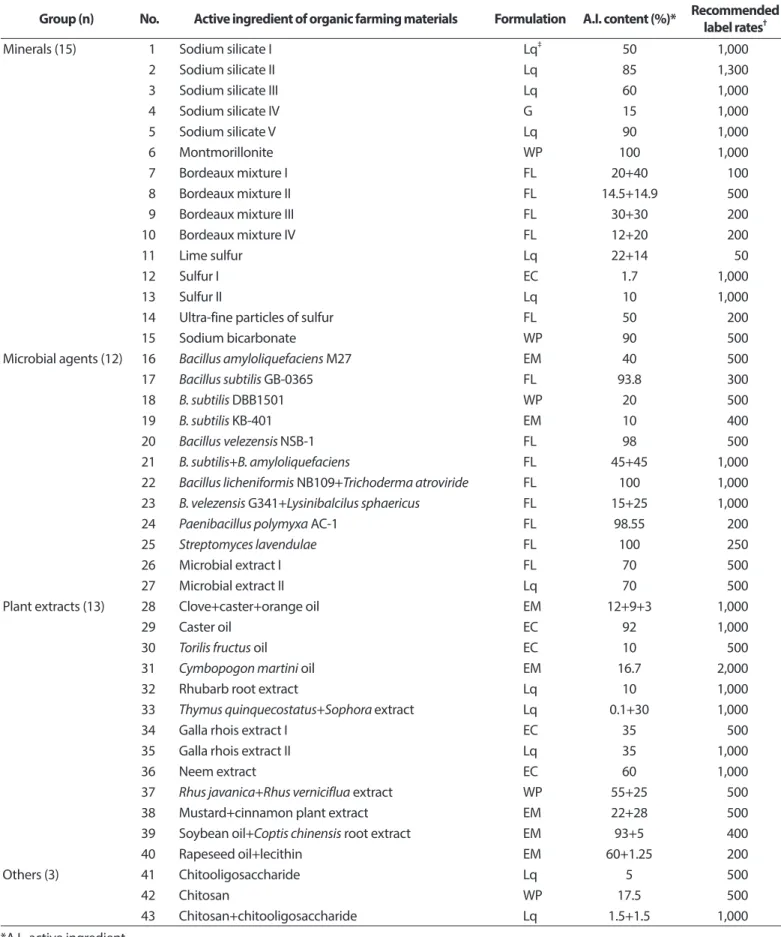
이 하우스 재배지의 오이 이병과실에서 순수 분리한 것을 potato dextrose agar (PDA) 배지에 접종하여 20°C에서 배 양하면서 본 실험에 사용하였다. 오이 검은별무늬병에 효 과적인 유기농업자재를 선발하기 위해 공시한 유기농업 자재는 농촌진흥청 유기농업자재 정보시스템에 등록된 제품 중에서 규산나트륨 등 광물질유래 15품목, Bacillusamyloliquefaciens M27 등 미생물 제제 12품목, 정향오일 등 식
물추출물 제제 13품목, 키토산 등 기타 3품목의 총 43제품을 라벨에 있는 권장사용량에 따라 희석하여 실험에 사용하였다(Table 1).
항균활성 검정. 43품목의 유기농업자재 중에서 균사생 장을 억제하는 자재를 선발하기 위해 paper disc 검정방법으 로 실험하였다. 시험균주인 C. cucumerinum PT1의 균사 끝부 분을 5 mm cork borer로 잘라 병원균 agar disc 조각을 PDA (Difco, Detroit, MI, USA) 배지 중앙에 이식하였다. 8 mm paper disc를 중앙으로부터 약 2.5 cm 떨어진 곳에 치상하였고, 유 기농업자재는 멸균수를 이용하여 품목별 추천농도로 희석 한 것을 4반복으로 하여 30 μl씩 점적 처리한 뒤 20°C 항온기 에서 암조건으로 배양하였다. 12일 후 생장저지원(inhibition zone)의 직경을 측정함으로써 항균활성 여부 및 정도를 조 사하였다.
오이 유묘를 이용한 오이 검은별무늬병에 효과적인 유 기농업자재 선발. 43품목의 유기농업자재 중에서 오이 검 은별무늬병의 포자발아억제 및 균사생장을 억제하는 자재 를 선발하기 위해 2–3엽기 전개된 ‘은미엠’ 오이 품종의 유묘 를 사용하였다. 오이 검은별무늬병원균의 포자현탁액을 제 조하기 위하여 오이 C. cucumerinum PT1의 균사 끝부분을 5 mm cork borer로 잘라 PDA 배지 중앙에 접종 후 20°C 암상태 에서 14일간 배양하였다. 배양된 병원균에 멸균수를 부어 루 프로 포자를 떼어낸 후 4겹 거즈로 걸러서 포자만 수확하여 1×10⁵ 포자/ml로 조절하였다. 오이 유묘에 3반복으로 분무접 종하고 1시간 동안 건조한 뒤 조제한 유기농업자재를 분무처 리 하였다. 처리된 식물체는 온실 내에서 16.5°C–18.5°C, 상대 습도 70%–90%, 오전 9시부터 오후 6시까지 9시간 동안은 광 조건으로, 오후 6시부터 다음날 오전 9시까지 15시간 동안은 암조건으로 하였으며, 10일 후 병 발생 정도를 조사하여 방제 가를 산출하였다. 병 발생 정도는 발병 수준을 0–5로 나누어 0은 무발병, 1은 생장점 갈변, 2는 생장점 고사, 3은 생장점 고 사와 본엽에 갈색 병반, 4는 생장점 및 본엽 일부 고사, 5는 식 물체 완전 고사로 하였다.
오이 유묘를 이용한 오이 검은별무늬병에 대한 예방 및 처리효과 검정. 유묘검정을 통하여 오이 검은별무늬병 에 85% 이상의 방제효과를 나타낸 광물질 유래 3품목, 미생 물 제제 4품목, 식물추출물 제제 2품목 등 9개의 유기농업자 재를 선발하여 예방 및 치료 효과를 검정하였다. 효과가 우 수한 유기농업자재를 선발했기 때문에 예방 및 처리효과 실 험에서는 병원균 포자의 발아율과 발아포자의 부착기 형성 을 빠르게 하여 초기발병이 유리하게 하기 위해 온도조건은
Table 1. The list of commercial organic farming materials used in this study
Group (n) No. Active ingredient of organic farming materials Formulation A.I. content (%)* Recommended label rates
†Minerals (15) 1 Sodium silicate I Lq
‡50 1,000
2 Sodium silicate II Lq 85 1,300
3 Sodium silicate III Lq 60 1,000
4 Sodium silicate IV G 15 1,000
5 Sodium silicate V Lq 90 1,000
6 Montmorillonite WP 100 1,000
7 Bordeaux mixture I FL 20+40 100
8 Bordeaux mixture II FL 14.5+14.9 500
9 Bordeaux mixture III FL 30+30 200
10 Bordeaux mixture IV FL 12+20 200
11 Lime sulfur Lq 22+14 50
12 Sulfur I EC 1.7 1,000
13 Sulfur II Lq 10 1,000
14 Ultra-fine particles of sulfur FL 50 200
15 Sodium bicarbonate WP 90 500
Microbial agents (12) 16 Bacillus amyloliquefaciens M27 EM 40 500
17 Bacillus subtilis GB-0365 FL 93.8 300
18 B. subtilis DBB1501 WP 20 500
19 B. subtilis KB-401 EM 10 400
20 Bacillus velezensis NSB-1 FL 98 500
21 B. subtilis+B. amyloliquefaciens FL 45+45 1,000
22 Bacillus licheniformis NB109+Trichoderma atroviride FL 100 1,000
23 B. velezensis G341+Lysinibalcilus sphaericus FL 15+25 1,000
24 Paenibacillus polymyxa AC-1 FL 98.55 200
25 Streptomyces lavendulae FL 100 250
26 Microbial extract I FL 70 500
27 Microbial extract II Lq 70 500
Plant extracts (13) 28 Clove+caster+orange oil EM 12+9+3 1,000
29 Caster oil EC 92 1,000
30 Torilis fructus oil EC 10 500
31 Cymbopogon martini oil EM 16.7 2,000
32 Rhubarb root extract Lq 10 1,000
33 Thymus quinquecostatus+Sophora extract Lq 0.1+30 1,000
34 Galla rhois extract I EC 35 500
35 Galla rhois extract II Lq 35 1,000
36 Neem extract EC 60 1,000
37 Rhus javanica+Rhus verniciflua extract WP 55+25 500
38 Mustard+cinnamon plant extract EM 22+28 500
39 Soybean oil+Coptis chinensis root extract EM 93+5 400
40 Rapeseed oil+lecithin EM 60+1.25 200
Others (3) 41 Chitooligosaccharide Lq 5 500
42 Chitosan WP 17.5 500
43 Chitosan+chitooligosaccharide Lq 1.5+1.5 1,000
*A.I., active ingredient.
†
Figures indicated the dilution concentration recommended by manufacture company for using each organic material in the fields.
‡
Lq, liquid; G, granule; WP, wettable powder; FL, flowable; EC, emulsifiable concentrate; EM, emulsifiable suspension for microbial pesticide.
23.7°C–25°C, 상대습도는 80%–90%로 하였고, 예방효과는 병 원균을 분무 접종하기 1일 전에, 치료효과는 병원균을 분무 접종하고 1일 후에 유기농업자재를 처리하였다. 공시 오이품 종, 오이 검은별무늬병원균 포자현탁액의 농도와 광조건 및 발병정도 측정은 위의 유기농업자재 선발 검정과 동일하였 으며, 2주 후 병 발생정도를 조사하여 방제가를 산출하였다.
통계분석. 데이터 수집 후 처리구 평균 간 유의성 검정을 위하여 SAS 프로그램(ver. 9.1; SAS Institute, Cary, NC, USA)을 이용하여 Duncan’s multiple range test를 실시하였다.
결과 및 고찰
오이 검은별무늬병에 대한 항균활성 검정. 유기농업 자재 43개 중 오이 검은별무늬병원균의 균사생장 억제 효과 를 나타낸 것은 총 13개였고, 처리 간에 유의한 차이가 있었 으며(F=3.48, P=0.0017), 억제하는 형태도 유기농업자재별로 다양했다. 이 중 미생물 제제가 9품목으로 대부분을 차지했 을 뿐만 아니라 균사생장 억제효과도 뛰어났다(Table 2, Fig.
1). 특히 B. subtilis DBB1501 수화제가 오이 검은별무늬병에 대 하여 억제효과가 가장 높았고, Bacillus velezensis NSB-1 액상 수화제도 우수하였다. 이는 Bacillus 균주가 여러 식물병원균 에 항균활성이 있다는 보고와 일치된다(Cochrane과 Vederas,
Table 2. Inhibition effect of organic farming materials on mycelial growth of Cladosporium cucumerinum causing cucumber scab Group Active ingredient of organic farming materials Inhibition zone (mm)*
1 2 3 4 Mean
Minerals Sodium silicate I 4.5 11 - 11 8.83 abc
†Sodium silicate II 5 7 2 1 3.75 d
Microbial agents Bacillus amyloliquefaciens M27 9 8.5 13.5 12 10.75 ab
Bacillus subtilis GB-0365 5.5 9 5.5 11 7.75 abcd
B. subtilis DBB1501 11 13 10 12.5 11.63 a
B. subtilis KB-401 6 6 9.5 12 8.38 abc
Bacillus velezensis NSB-1 9 11 11 14 11.25 ab
B. subtilis+B. amyloliquefaciens 11 10 11 9 10.25 ab
B. velezensis G341+Lysinibalcilus sphaericus 13 7.5 7 6 8.38 abc
Paenibacillus polymyxa AC-1 9 9 5 6 7.25 abcd
Streptomyces lavendulae 7 14 9 10 10.00 ab
Plant extracts Clove+caster+orange oil - 1.5 9 10 6.83 bcd
Rapeseed oil+lecithin 5 5 3.5 4.5 4.50 cd
*Growth inhibition was investigated after 12 days of incubation at 20°C.
†
The different letters indicate significantly different (P<0.01) according to Duncan’s multiple range test.
A B C D
Fig. 1. Antifungal activities of organic farming materials against Cladosporium cucumerinum causing cucumber scab on potato dextrose
agar. (A) Bacillus amyloliquefaciens M27. (B) Bacillus subtilis DBB 1501. (C) Rapeseed oil+lecithin. (D) Control.
2016; Nielsen과 Sørensen, 1997; Zhang 등, 2008). Hong 등 (2015)은 시험에 사용된 대부분의 유기농업자재들에서 잿빛 곰팡이병 병원균의 균사 생육억제 효과가 나타났다고 하였 지만, Kwak 등(2012a, 2012b)은 유기농업자재 중 B. subtilis를 주성분으로 하는 미생물자제가 잿빛곰팡이병과 탄저병 균 사생장억제효과가 높았으며 식물추출물이나 광물질이 주 성분인 자재의 경우는 낮은 균사생장억제효과를 나타낸다 고 하였는데, 본 실험에서도 광물질유래 및 식물추출물유래 의 유기농업자재는 균사생장억제효과가 낮거나 없었다.
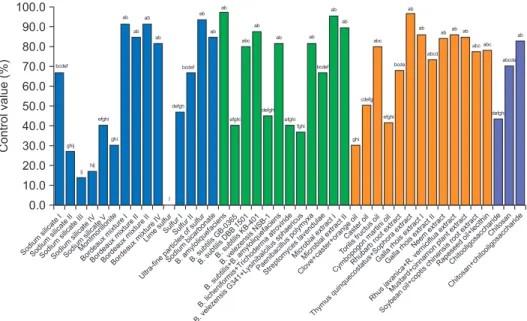
오이 검은별무늬병 포자현탁액 분무접종을 통한 유묘 검정. 유기농업자재를 처리하기 1시간 전에 오이 유묘에 오 이 검은별무늬병 포자 현탁액을 접종한 뒤 유기농업자재를 권장 사용량대로 희석하여 처리한 실험에서 전체 43개 유기 농업자재 중 90% 이상의 우수한 방제효과를 나타낸 유기농 업자재는 B. amyloliquefaciens M27, 미생물 대사산물 추출물 I, 백리향+고삼 추출물, 초미립자 유황 제제, 보르도액 I과 보르 도액 III, 총 6품목이었다(Fig. 2).
미생물 제제인 B. amyloliquefaciens M27이 97.3%로 포자 발아 및 발아관 신장 억제효과가 가장 우수하였으며, 미생 물의 대사산물 추출물 I이 95.3%로 나타났다. Bacillus 균주 는 대체로 식물 병원균을 억제하는 항생물질을 포함하여 많 은 생활성 화합물을 생산한다고 보고되었는데(Emmert와 Handelsman, 1999; Katz와 Demain, 1977), 특히 본 유묘실험을 통해 억제효과가 뛰어났던 B. amyloliquefaciens M27 균주는 항균활성 검정을 통해 넓은 스펙트럼의 병원균의 생장을 억 제했음을 제시했고(Kim 등, 2008), 또한 B. amyloliquefaciens로
부터 생합성 항균물질과 관련된 bacillomycin, fengycin, iturin, surfactin 등과 식물 생육 촉진물질과 관련된 bacillibactin의 유전자가 발견되었다고 보고하였다(Arguelles-Arias 등, 2009;
Borriss 등, 2011; Lee 등, 2012). 식물추출물 제제인 백리향+
고삼 추출물이 혼용된 자재는 96.7%의 방제효과를 나타냈 다. 백리향(Thymus quinquecostatus)은 thymol 성분을 함유하 고 있는 Thymus속 식물로(Choi 등, 2013), thyme 오일이나 그 주성분인 thymol이 몇몇 식물병원균에 대해 살균활성, 포 자발아억제 효과가 있으며 오이작물에서 잿빛곰팡이병균 (Botrytis cinerea)에 대한 예방효과가 있다고 보고되었고(Choi 등, 2006), matrine이 유효성분인 고삼(Sophora flavescens) 추 출물은 고농도에서 약간의 항균활성을 나타냈다(Hwang 등, 2014)고 하였다. 또한 식물추출물 오일은 기주식물 저항성 반응을 증가시킬 수 있다고 하였는데(Northover와 Timmer, 2002), 본 실험에서 오이유묘를 이용해 포자발아억제 정도를 검정할 때에는 방제효과가 우수하게 나타났으나 항균활성 검정에서는 균사생장 억제효과를 나타내지 않았다. 이는 식 물추출물질이 식물의 생리활성을 촉진시키며 저항성 향상 에 도움을 주었거나 포자 발아에만 특이적으로 억제하는 물 질이 작용했을 것이라고 생각한다.
무기화합물 제제인 초미립자 유황이 함유된 자재는 93.3%, 보르도액 I과 III이 91.3%의 방제가를 나타냈다. 유황 원소는 진균세포를 투과할 수 있고(Beffa, 1993) 세포질로 흡수되어 미토콘드리아 호흡에 영향을 주며, 산소 대신 수소이온이 황 으로 전달될 수 있어 유독한 황화수소 생성의 원인이 되는데 이 물질이 세포단백질에 독소로 작용하여 진균 세포를 죽이 는 데 관여한다고 하였다(McCallan과 Wilcoxon, 1931; Miller
Fig. 2. Suppressive effect of 43 organic farming materials against cucumber scab on the ‘Eunmi M’ seedlings. After inocula- tion of Cladosporium cucumerinum spore suspension containing 1×10
5spores/ml, all organic material treatments were ap- plied the same day about an hour later.
The different letters indicate significantly different (P<0.01) according to Duncan’s multiple range test.
Control value (%)
100.0 90.0 80.0 70.0 60.0 50.0 40.0 30.0 20.0 10.0
Organic materials 0.0
Sodium silicate
I
Sodium silicate
II
Sodium silicate
III
Sodium silicate
IV
Sodium silicate
V
Montmorillonite Bordeaux
mixture I
Bordeaux mixture
II
Bordeaux mixture
II
Bordeaux mixture
IV Lime
sulfurSulfur I Sulfur
II
Ultra-fine particles
ofsulfur
Sodium bicarbonate B.amyloliquefaciens
B.subtilis GB-0365
B.subtilis DBB
1501
B.subtilis KB-401
B.velezensis NSB-1
B.subtilis+B.
amyloliquefaciens
B.licheniformis+T richoderma
atroviride
B.velezensis G341+L
ysinibalcilus sphaericus
Paenibacillus polymyxa
Streptomyces lavendulae Microbial
extract I
Microbial extract
II
Clove+caster+orange oil Caster
oil
Torilis fructus
oil
Cymbopogon martini
oil
Rhubarb root
extract
Thymus
quinquecostatus+Sophora extract
Galla rhois
extract I
Galla rhois
extract II
Neem extract
Rhus javanica+R.
verniciflua extract
Mustard+cinnamon plant
extract
Soybean oil+coptis
chinensis root
extract
Rapeseed oil+lecithin Chitooligosaccharide
Chitosan
Chitosan+chitooligosaccharide ab
ab ab ab
ab ab
ab
ab ab
ab ab
ab ab
ababab
ab
bcdef
ghij
ij hij
efghi
ghi
j defgh
bcdef
efghi abc
ab
defgh efghi
fghi bcdef
ghi cdefg
abc
efghi bcde
abcd
abc abc
defghi abcde
등, 1953). 또한 Tweedy와 Turner (1966)는 시토크롬 b와 c 단 계에서 미토콘드리아 전자전달의 방해가 균류에 독성을 나 타냈을 것이라 암시했다. 더욱이 유황을 식물에 적용할 때 작 은 입자가 큰 입자보다 더 넓은 범위를 제공하고 부착력도 더 우수하기 때문에 잎과 병원균 조직에 작은 입자가 더욱 효과 적이다(Wilcoxon과 McCallan, 1931)라고 하였는데, 본 실험에 서도 석회유황합제보다 초미립자유황 제제의 방제효과가 뛰어난 이유도 입자의 크기가 영향을 미쳤을 것이라 생각된 다. 구리 제제는 불용성 화합물이지만 물과 접촉했을 때 구 리이온 유출로 인하여 살균제로서 작용을 하며, 병원균의 포 자가 발아하면서 구리이온이 병원균 내로 흡수되어 단백질 에 존재하는 다양한 화학작용기인 imidazoles, phosphates, sulfhydryls, hydroxyls과 결합하고 그들의 기능을 방해하기 때문에 세포단백질의 비특이적 변성을 일으킨다고 하였다 (Caldwell 등, 2013). 본 실험에 처리한 구리 제제인 보르도액 은 항균활성 검정에서 균사생장을 전혀 억제하지 못했으 나 포자발아 및 발아관 신장 억제효과가 나타났는데, 이는 Everett와 Timudo-Torrevilla (2007)의 주요 식물병원균에 대한 연구와 유사한 결과였다. 이렇게 미생물의 2차 대사물질, 식 물추출물질의 유효성분, 그리고 미네랄 성분들이 오이 검은 별무늬병균의 포자발아와 발아관 신장을 억제했을 것으로 생각된다.
하지만 유기농업자재의 주성분이 같더라도 함량, 제형 및 희석배수에 따라 방제효과에 있어서 차이가 있었다. 구리 제 제는 모두 80% 이상의 높은 방제효과를 나타냈으나 규산 나트륨 제제는 13.3%–66.7%로 저조하였으며, 유황 제제는 0%–93.3%의 다양한 범위의 방제가를 나타냈다. 미생물 제제 와 식물추출물 제제 또한 유래미생물 및 식물체의 종류, 혼 용조합 등에 따라 각각 36.7%–97.3%, 30%–96.7%로 다양하 게 나타났는데, Kim 등(2011)은 미생물제의 유효미생물은 저 장온도 및 기간과 제형에 따라서 미생물 활성에 영향을 미칠 수도 있다고 하였다. 본 실험에서도 액상수화제보다 수화제 와 유상현탁제에서 항균활성이 우수하게 나타났고 발병 억 제 효과가 높았다. 석회유황합제를 처리한 오이 유묘에서는 식물체가 완전히 고사하였는데, 제품의 유효성분이 오이 검 은별무늬병의 포자발아 및 균사생장을 억제하지 못한 것인 지 또는 고농도로 인한 약해 때문인지 규명할 수가 없어 농도 를 달리하여 추가실험이 필요하겠다. 따라서 오이 검은별무 늬병을 방제하고자 유기농업자재를 선택할 때 신중한 주의 가 필요할 것이다.
오이 검은별무늬병균은 어린잎을 침해하는 데 분생포자 가 발아하여 발아관 끝이 표피세포의 봉합부에 이르게 되
면 부착기를 형성하여 거기에서 균사가 세포간극으로 뚫 고 들어가는 세포 봉합부 침입을 한다고 하였다(Pierson과 Walker, 1954). 따라서 유기농업자재를 처리하여 방제하고 자 할 때에는 분생포자의 발아 및 균사생장을 억제하여 식 물체에 침입할 수 없도록 하는 것에 착안점을 두어야 하는 데, in vitro 항균활성 검정과 in vivo 유묘검정 결과, 포자 발아 및 균사생장, 이 두 가지 모두를 억제하는 유기농업자재는 B.
amyloliquefaciens M27로 나타났다. 이 균주는 오이 흰가루병
에 대해서도 방제효과가 있는 것으로 보고된 바 있어(Lee 등, 2013a, 2013b) 한 가지 제품의 유기농업자재를 처리함으로써 오이에 발생하는 여러 병을 방제할 수 있다면 효율적인 병해 관리가 될 수 있을 것이라 생각된다.오이 유묘를 이용한 오이 검은별무늬병에 대한 유기농 업자재의 예방 및 치료효과 검정. 43개 유기농업자재 중 유묘검정을 통해 85% 이상의 방제효과를 나타낸 9개 자재를 선발하여, 오이 검은별무늬병 포자현탁액 분무 접종 24시간
Fig. 3. Preventive and curative activity of 9 selected organic farm- ing materials against Cladosporium cucumerinum. For preventive treatments, cucumber seedlings of the ‘Eunmi M’ were sprayed with organic farming materials and then C. cucumerinum spore suspension containing 1×10
5spores/ml of inoculum was applied 24 h later. For curative treatment, organic farming materials were applied, after inoculation of C. cucumerinum, as spray on cucum- ber seedlings 24 h earlier. The different letters indicate significant- ly different (P<0.01) according to Duncan’s multiple range test.
Control value (%)
100.0 90.0 80.0 70.0 60.0 50.0 40.0 30.0 20.0 10.0
Organic materials 0.0
Preventive Curative
Bordeaux mixtur
e I
Bordeaux mixture
III
Ultra-fine particle
s of sulfu r
B. amyloliquefaciens M27
B. subtilis KB-401
Microbial extract
I
Microbial extract
II
Thymus
quinquecostatus+Sophora extract
Rhus javanica+R.
verniciflua extract
aab
ab
ab ab
bc ab
bc
bc
f
de ef
de f de
ef bc
de
전에 오이 유묘에 유기농업자재를 처리한 예방적 방제와 24 시간 후에 처리한 치료적 방제 효과를 비교하였다(Fig. 3, 4).
병원균 침입 전에 처리한 예방적 처리구가 병원균이 침입한 후에 처리한 치료적 처리구보다 대체적으로 발병 억제 효과 가 우수하게 나타났다. 특히 보르도액 I과 III의 예방적 효과는 각각 96.7%, 73.3%로 탁월하였으나 치료적 효과는 0%, 16.7%
로 현저하게 낮게 나타났다. 백리향+고삼 추출물이 함유된 자재에서만 유일하게 예방적 처리보다 치료적 처리의 효과가 높게 평가되었으며, 치료적 처리의 방제가도 50%로 다른 자 재들보다 높게 나타났다. 따라서 시설하우스 내 오이 연작 재 배지 또는 오이 검은별무늬병 피해 상습지역에서는 병 발생 이 예상되는 시기에 보르도액을 미리 살포하여 포자 발아를 억제하도록 하고, 이에 더하여 식물체가 생장함에 따라 잎과 줄기 등에 보르도액의 피복률을 유지함으로써 오이 검은별 무늬병원균이 식물체에 침입할 수 없도록 주기적으로 처리 를 해야 효과적인 병 방제가 될 것이다. Park 등(2016)은 오이 노균병 방제를 위해 유기농업자재를 처리한 결과 석회보르 도액 4–6식이 높은 방제효과를 보였다고 하였으므로, 석회 보르도액 처리는 오이 검은별무늬병 뿐만 아니라 오이 재배시 주요한 병해인 노균병 방제에도 효과적일 것이라 생각된다.
오이 검은별무늬병은 주로 어린 과실이나 연한 잎, 생장 점에 발생하기 때문에 자재를 살포할 때에는 생장점 부근 이 골고루 묻도록 정성 들여 살포해야 하는데, 보르도액만 을 처리할 경우 식물체에 대한 약해 등이 문제가 될 수 있다 (Fernandes와 Henriques, 1991; Martins 등, 2012). 따라서 유묘 검정을 통해 오이 검은별무늬병에 효과가 있었던 백리향+고 삼추출물과 B. amyloliquefaciens M27 등의 다른 친환경 자재 도 활용하여 석회 보르도액과 교호살포하는 방제체계 구축 및 포장에서의 효과검정에 대한 추가적인 연구가 필요할 것
으로 판단된다.
요 약
본 연구는 Cladosporium cucumerinum PT1 (KACC 48094)에 의해 발생하는 오이 검은별무늬병에 대하여 유기농업자재의 방제효과를 평가하기 위해 수행되었다. 43품목의 유기농업 자재를 대상으로 실내에서 항균활성 검정과 온실에서 오이 유묘에 포자현탁액 접종을 통한 유묘검정을 실시하였다. 13 개 품목의 유기농업자재가 균사생장을 억제하였고, 이 중 9 개 품목이 미생물 제제였다. 오이 유묘를 이용한 검정에서 6 품목의 유기농업자재가 90% 이상의 우수한 방제효과를 나 타냈다. 그 중에서 Bacillus amyloliquefaciens M27이 유효성분 인 미생물 제제의 억제효과가 가장 뛰어났다. 그 다음으로 9 개의 유기농업자재를 선발하여 예방적 및 치료적 효과를 알 아보기 위해 적용하였는데, 예방적으로 처리했을 때 9개 자 재 모두 병 발생을 상당히 억제하였다. 특히, 보르도액 I과 III 은 방제가가 각각 96.7%, 73.3%로 훌륭한 예방효과를 나타냈 다. 이 중 백리향+고삼 추출물이 함유된 자재에서만 방제가 가 50%로 다소 낮았지만 치료적 처리의 효과가 나타났다. 이 연구를 통해 시설 내 온화하고 습한 조건에서 잘 발생하는 오이 검은별무늬병은 유기농업자재로 방제될 수 있고 예방 적 처리가 더욱 중요하고 효과적임이 확인되었다.
Conflicts of Interest
No potential conflict of interest relevant to this article was reported.
Fig. 4. Symptoms of cucumber scab on cucumber seedlings when Bordeaux mixture I (A) and Bacillus amyloliquefaciens M27 (B) were treated one day before (left) and after (right) inoculation of cucumber scab pathogen.
A B
Acknowledgement
This study was carried out with the support of Research Program for Agricultural Science & Technology Development (Project No. PJ01087903), National Institute of Agricultural Sciences, Rural Development Administration, Republic of Korea.