Research Article Open Access http://dx.doi.org/10.5423/RPD.2014.20.2.119
Research in Plant Disease
The Korean Society of Plant Pathology pISSN 1598-2262, eISSN 2233-9191
오이 뿌리혹선충병에 대한 효율적인 저항성 검정법 확립
Development of Efficient Screening Methods for Resistant Cucumber Plants to Meloidogyne incognita
황성민 · 장경수 · 최용호 · 김진철 · 최경자*
한국화학연구원 바이오화학연구센터
Sung Min Hwang, Kyoung Soo Jang, Yong Ho Choi, Jin-Cheol Kim and Gyung Ja Choi*
Research Center for Biobased Chemistry, Korea Research Institute of Chemical Technology, Daejeon 305-600, Korea
Root-knot nematodes represent a significant problem in cucumber, causing reduction in yield and quality.
To develop screening methods for resistance of cucumber to root-knot nematode Meloidogyne incognita, development of root-knot nematode of four cucumber cultivars (‘Dragonsamchuk’, ‘Asiastrike’, ‘Nebakja’ and
‘Hanelbakdadaki’) according to several conditions such as inoculum concentration, plant growth stage and transplanting period was investigated by the number of galls and egg masses produced in each seedling 45 days after inoculation. There was no difference in galls and egg masses according to the tested condi- tion except for inoculum concentration. Reproduction of the nematode on all the tested cultivars according to inoculum concentration increased in a dose-dependent manner. On the basis of the result, the optimum conditions for root-knot development on the cultivars is to transplant period of 1 week, inoculum concentra- tion of 5,000 eggs/plant and plant growth stage of 3-week-old in a greenhouse (25 ± 5°C). In addition, under optimum conditions, resistance of 45 commercial cucumber cultivars was evaluated. One rootstock cultivar, Union was moderately resistant to the root-knot nematode. However, no significant difference was in the resistance of the others cultivar. According to the result, we suggest an efficient screening method for new resistant cucumber to the root-knot nematode, M. incognita.
Keywords : Cucumis sativus, Cultivar, Host resistance, Meloidogyne incognita
서 론
토양에 서식하는 선충은 주로 유기물이 풍부한 토양에 널 리 분포하고 있다. 그 중 식물의 뿌리에 구침을 찔러 넣어 영양 분을 섭취하거나 뿌리 조직 안으로 들어가 식물체에서 서식 하는 식물기생성 선충이 농작물에 문제시 되고 있다(Taylor과 Sasser, 1978; Thorne, 1961). 식물기생 선충은 전 세계적으로 약 2,000여종이 보고되어 있고 작물에 미치는 경제적 손실이 계속 증가하고 있는 추세이다(Abad 등, 2008; Boina 등, 2008; Jung 과 Wyss, 1999). 식물 기생성 선충은 식물에 기생하여 피해를 주
기 때문에 외관상 봤을 때 양분의 부족이나 생리적인 장애로 진 단되는 경우가 많다. 식물기생성 선충류 중 Meloidogyne 속에 속하는 뿌리혹선충류는 오이와 토마토, 멜론, 딸기를 포함하는 많은 원예 작물에 기생하여 생산량의 감소와 품질 저하로 인한 경제적 손실을 가져오는 대표적인 식물 기생성 선충의 한 종류 이다. 또한 뿌리혹선충류는 토양병원균들의 식물체 침입을 증 대시키기 때문에 2차적인 병으로 인한 상처가 유인이 되어 2차 적인 감염으로 인한 다른 병해가 유도 된다(van der Putten 등, 2006). 국내에서 뿌리혹선충에 의해 가장 피해가 큰 작물로는 고구마, 감자, 오이, 참외, 수박, 멜론, 토마토, 고추, 당근, 상추 등 이 있다. 그 중 박과 작물에 속하는 오이(Cucumis sativus)의 시 설재배 규모가 대형화되고 생산량이 증가하는 추세로 연작이 장기화되고, 연중재배로 인해 시설재배지 토양 내 뿌리혹선충
*Corresponding author Tel : +82-42-860-7434 Fax: +82-42-861-4913 E-mail: [email protected]
Received February 4, 2014 Revised May 9, 2014 Accepted May 14, 2014
밀도가 높아져 병해 발생이 심각하다(Cho 등, 2000a, b; Kim 등, 1998; Kim과 Han, 1998).
뿌리혹선충병의 방제는 화학적 방제(살선충 약제방제), 물리 적 방제(태양열소독, 온탕 침지법), 경종적 방제(토양개량, 객 토, 답전윤환, 저항성 품종의 육종, 저항성 윤작, 유인식물 재배), 생물적 방제(살선충 천적) 등의 다양한 방안 중에서(Chen 등, 1996; Han과 Kim, 1997; Heald과 Robinson, 1987; Kim과 Han, 1998; Park 등, 1995b) 포장상태, 방제 효율 및 경제성 등을 고려 하여 적합한 방제 방법들을 선택하게 된다(Chon 등, 1996; Park 등, 1995a). 선충의 화학적 방제는 최근 약효가 우수한 살선충 제가 많이 개발되었지만, 토양 및 물의 이동, 유묘, 농기구 등에 의해 재오염이 빈번할 뿐만 아니라 살선충제의 높은 독성과 긴 잔류 기간으로 인해 토양 미생물에 대해 광범위한 영향을 미 쳐 토양 생태계 불균형과 같은 환경 문제를 발생시키므로 근본 적인 방제는 아닌 것으로 인식되고 있다(Birch 등, 1993; Kim과 Choi, 2001). 최근에는 환경친화적인 측면에서 저항성 품종을 재배하던가, 천적을 이용한 생물적 방제, 경종적 방제, 살선충 물질을 함유한 식물추출물을 이용하여 방제하는 방법 등 친환 경적이고 특이한 작용 기작을 가진 새로운 살선충 물질의 탐색 을 강구하고 있으며(Boina 등, 2008; Gurr, 1992; Prakash과 Rao, 1997), 장기적인 환경친화적 방제방법으로 저항성 대목이나 품 종을 통한 윤작이 유용하게 이용 될 수 있을 것이다(Kinloch과 Hinson, 1972; Rhoades, 1976). 최근까지 과채류 작물에서의 뿌 리혹선충의 저항성 품종 육종이 진행되고 있지만 높은 저항성 을 지닌 계통은 그리 많지 않은 것으로 보고되어 있으며 작물 의 저항성을 이용한 뿌리혹선충 방제에 관한 방법으로 스크리 닝을 통해 선발된 선충 저항성 토마토 품종을 이용한 윤작 등 친환경적 방제에 대한 연구가 이루어지고 있다(Cho 등, 1986;
Choi 등, 2006; Han과 Kim, 1997; Kim, 2001; Park 등 1995a;
Rhoades, 1976). 하지만 뿌리혹선충은 선충의 종과 레이스에 따라 저항성품종에 대한 저항성 반응이 상이하고 기주 범위가 매우 넓어 경제성이 높은 저항성 윤작 작물을 찾기가 어렵다는 단점이 있다.
본 연구는 오이 품종의 저항성 연구 및 새로운 저항성 육종 소 재를 개발하는데 있어서 Meloidogyne incognita로 동정된 뿌리 혹선충(Hwang 등, 2014)으로서 접종원 농도, 오이의 생육 시기 및 이식 시기 등의 발병 조건에 따른 4개의 오이 품종들의 뿌리 혹선충병 발생을 조사하였고, 이를 통해 효율적인 뿌리혹선충 병 저항성 검정 방법을 확립하고자 하였다. 또한 뿌리혹선충병 발생의 적정 조건에서 시판중인 45개 오이 품종의 뿌리혹선충 병 저항성 정도를 조사하여 저항성 품종을 육성하는 기반을 구 축하고 기초 자료를 제공하기 위해 연구를 수행하였다.
재료 및 방법
토마토 뿌리혹 선충의 채집, 분리 및 동정. 토마토 뿌리혹
선충은 부여 토마토 재배 포장에서 뿌리혹이 발생한 ‘유니콘’
토마토 품종의 뿌리를 샘플링하였다. 뿌리 혹을 흐르는 물로 잘 씻어서 뿌리속의 뿌리혹선충의 알과 유충을 개량된 sodium hyphochlorite(NaOCl) 방법을 사용하였다. 분리방법은 깨끗이 씻은 뿌리를 1 cm 간격으로 잘라서 200 ml의 1% NaOCl 용액 이 들어있는 믹서기에 넣고 고속으로 1분간 회전시켰다(Kim과 Lee, 2008). 그리고 믹서기 내의 뿌리 찌꺼기, 알, 유충은 75 μm 와 28 μm 체를 통시키고 28 μm 체에 걸린 알이 부화할 때까지 25oC 상온에서 보관하였다. 분리한 알과 유충으로부터 추출한 DNA와 M. incognita 특이적 프라이머를 혼합하여 PCR 증폭하 였고 산물의 크기를 1% agarose gel에서 확인하였다(Hwang 등, 2014).
식물체 준비. 다양한 조건(접종원 농도, 오이 이식 시기 및 생육 시기)에서의 뿌리혹선충에 대한 저항성 검정 실험에는 4품종인 ‘드레곤삼척’(코레곤종묘), ‘아시아스트라이크’(아시아 종묘), ‘네박자’(신젠타종묘), ‘하늘백다다기’(신젠타종묘)을 이 용하였고, 적합한 조건에서 시판 중인 대목 6개 품종(‘눈부셔’,
‘뉴타입’, ‘서포트’, ‘슈퍼흑종’, ‘유니온’, ‘쯔야까EX’)과 오이 39개 품종(‘계대백과’, ‘구월반백’, ‘글로리삼척’, ‘낙동청장’, ‘네박자’,
‘노다지백다다기’, ‘녹야청청’, ‘대선’, ‘드레곤삼척’, ‘러스보이’,
‘무진장’, ‘미니사엽’, ‘미니큐’, ‘미인백다다기’, ‘백미백다다기’,
‘백침맛짱’, ‘신세대’, ‘신정풍’, ‘싱싱백다다기’, ‘아시아노각’, ‘아 시아스트라이크’, ‘아시아은천’, ‘아시아청장’, ‘오대백다다기’,
‘월하삼척’, ‘웰빙맛짱’, ‘은미에스’, ‘은천백다다기’, ‘일동청장’,
‘정선삼척’, ‘젤루존백침’, ‘중복삼척’, ‘청록맛짱’, ‘청화흑진주’,
‘통일백다다기’, ‘하늘백다다기’, ‘한성백다다기’, ‘호동청장’, ‘흑 룡삼척’)에 대하여 뿌리혹선충병 저항성 검정을 실시하였다.
식물체 생육. 접종원의 농도에 따른 영향과 시판중인 45개 오이품종의 저항성 검정 실험에서의 생육 조건으로 오이 종자 를 5 × 8 육묘용 연결포트(70 ml/pot, 범농사)에 원예용 상토 (쑥쑥이, 농우바이오)를 채워 넣고 파종하여 유리온실(25±
5oC)에서 21일 동안 재배한 이후 육묘용 오이를 원예용 상토와 멸균 모래가 혼합(1:1, v/v)된 플라스틱 포트(직경 9.0 cm, 높이 8.0 cm)에 이식하여 7일이 지난 이후에 접종원을 접종하 였고 유리온실(25±5oC)에서 45일간 재배하였다. 유리온실(25
±5oC)에서 생육시기 조건에 따른 실험을 위해 오이의 이식 및 접종시기를 동일하게 하고 파종 이후 2주, 3주, 4주 동안 재배한 식물체를 이식하여 7일 이후에 접종하였고 45일간 재배하였 다. 이식시기 조건 실험을 위해서는 접종시기를 동일하게 하고 21일 동안 재배한 후 9일전, 3일전, 접종 직전 이식한 식물체에 접종하여 45일간 재배하였다.
뿌리혹선충 증식. 오이 품종의 저항성을 검정하기 위해 사 용된 뿌리혹선충 (M. incognita) (Hwang 등, 2014)은 유리온실
에서 서광 품종의 토마토 유묘를 이용해서 증식하였다. 원예용 상토와 멸균된 모래의 비율(v/v)이 1 : 1인 혼합 상토가 들어 있 는 플라스틱 포트(직경 10.0 cm, 높이 9.0 cm)에 파종한지 21일 된 토마토(‘서광’, 몬산토코리아) 유묘를 이식하여 7일이 지난 이후에 접종하였고 45-60일 동안 뿌리혹이 형성 되도록 관리 하였다. 증식 실험에 이용된 접종원은 뿌리혹선충 알을 포기당 10,000개를 이용하였다.
접종원 준비. 뿌리혹선충에 대한 뿌리 혹 지수(gall index) 가 높은 증식용 토마토의 뿌리를 수거하여 뿌리혹선충 알을 분 리하기 위해 개량된 NaOCl 방법(Barker 등, 1985)을 사용하였 다. 알 분리 방법으로 깨끗이 씻은 뿌리를 1 cm 이하 간격으로 잘라서 250 ml 의 0.5% NaOCl 용액이 들어있는 분쇄기에 넣고 90초간 고속 회전시켰다. 그리고 혼합 용액을 0.065 mm 체에 걸러 뿌리 찌꺼기와 같은 잔여물을 걸러내고 그것을 통과한 알 들은 0.025 mm 체에 수집하여 잔존하는 NaOCl 성분이 없어지 도록 수돗물로 충분히 씻어 주었다. 이렇게 수집된 뿌리혹선충 알의 농도는 실체현미경을 통해 측정하였고 접종원 농도에 따 른 조건 실험을 제외한 모든 실험에서 접종 농도가 포기당 알 5,000개가 되도록 멸균수로 희석하여 접종원으로 사용하였다.
접종 및 저항성 검정. 오이 품종별 유묘가 이식 되어 있는 원예용상토와 멸균모래가 혼합된(1 : 1, v/v)포트(직경 9.0 cm, 높이 8.0 cm)에 포기당 뿌리혹선충 알 5,000개의 농도로 3 cm 깊이에 접종하였고 접종원 농도에 따른 실험조건에서는 현미 경을 이용해 분리한 뿌리혹선충 알의 접종 농도(500개, 1,000개, 5,000개, 10,000개, 30,000개)에 따라 조정하여 실험하였다. 접 종한 유묘는 유리온실(25±5oC)에서 관행으로 수분관리를 하 면서 재배하였다. 접종 45일 후에 오이 품종들의 뿌리를 수거 해 흙을 제거하고 물로 씻은 후에 뿌리에 발생한 난낭수(egg mass)와 뿌리 혹 지수(gall index)를 조사하였다. 난낭수 조사는
접종원 접종 이후 뿌리혹선충의 감염에 의해 난낭이 형성된 오 이 뿌리를 erioglaucine disodium 용액(15 mg/l)에 30분간 침지 하여 염색한 후 조사하였다(Umesh 등, 1994).
저항성 판정은 뿌리혹선충의 감염으로 뿌리에 형성된 난 낭수가 가장 많은 품종과 비교하여 난낭수가 10% 이하이면 저항성(R), 11-25% 사이면 중도저항성(M), 26% 이상이면 감 수성(S)으로 판정하였고 뿌리에 혹이 생긴 정도에 따라 혹 지 수(0 = 0%, 1 = 10%, 2 = 20%, 3 = 30%, 4 = 40%, 5 = 50%, 6 = 60%, 7 = 70%, 8 = 80%, 9 = 90%, 10 = 100%)를 조사하 였다(Bridge과 Page, 1980; Fassuliotis, 1985; Taylor과 Sasser, 1978). 모든 실험은 3반복으로 2회 실시하였으며, 통계 분석은 SAS(SAS Institute, Inc., 1989, Cary, NC) 프로그램을 이용하여 ANOVA 분석을 하였으며, 처리 평균간 비교를 위하여 Duncan’s multiple range test (P = 0.05)를 실시하였다.
결과 및 고찰
뿌리혹선충병 저항성 검정의 접종원 농도에 따른 영향.
온실에서 파종 후 21일 동안 재배되고 이식 후 7일간 배양한 4개 품종(‘드레곤삼척’, ‘아시아스트라이크’, ‘네박자’, ‘하늘백다 다기’) 유묘에 여러 가지 접종원 농도에 따른 뿌리혹선충 저항 성의 영향을 알아보기 위하여 접종원인 뿌리혹선충 알의 다섯 가지(포기 당 500개, 1,000개, 5,000개, 10,000개, 30,000개) 농 도의 현탁액으로 접종하였다. 접종일로부터 45일 이후, 4종 오 이 품종들의 뿌리 혹 및 난낭 형성은 모든 품종에서 접종원의 농도가 증가함에 따라 뿌리혹선충 감염으로 증가하였다. 특히, 접종원 농도 500개와 1,000개의 접종구에서 접종된 4개 품종들 은 접종원 농도 증가에 따른 뿌리혹선충 감염 정도(뿌리 혹 및 난낭 형성)가 미미하였던 반면에 접종원 농도 5,000개, 10,000개 및 30,000개 접종구의 경우는 농도 증가에 의존적으로 뿌리 혹 및 난낭의 형성이 증가됨을 알 수 있었고 5,000개 이상의 농도
Table 1. Root-knot nematode severity of four cucumber cultivars according to inoculum concentration of Meloidogyne incognitaz Cucumber
cultivar
Inoculum concentration (the number of eggs)
500 1,000 5,000 10,000 30,000
Dragonsamchuk 17 ± 2.1ydx (0.7 ± 0.2wdx) 51 ± 5.3c (1.8 ± 0.2c) 123 ± 5.7b (6.0 ± 0.0b) 137 ± 6.5ab (8.7 ± 0.2a) 145 ± 7.1a (8.7 ± 0.2a) Asiastrike 13 ± 1.2b (0.5 ± 0.0c) 26 ± 3.3b (1.2 ± 0.2c) 110 ± 2.5a (6.0 ± 0.8b) 123 ± 11.1a (8.7 ± 0.5a) 122 ± 3.1a (9.3 ± 0.2a) Nebakja 19 ± 2.1c (0.5 ± 0.0c) 53 ± 3.9b (1.3 ± 0.2c) 124 ± 5.0a (6.5 ± 0.4b) 130 ± 8.7a (8.2 ± 0.6a) 137 ± 7.4a (8.5 ± 0.4a) Hanelbakdadaki 15 ± 4.3c (0.7 ± 0.2c) 50 ± 7.9b (0.8 ± 0.2c) 116 ± 7.0a (6.2 ± 0.6b) 126 ± 6.5a (7.5 ± 0.4ab) 132 ± 9.0a (8.2 ± 0.2a)
Mean 16 (0.6) 45 (1.3) 118 (6.2) 129 (8.3) 134 (8.7)
zOne week after transplanting, the potted 28-day-old seedlings were inoculated with M. incognita. The inoculated plants were incubated in a greenhouse (25 ± 5oC). Forty five days after inoculation, disease severity of the seedlings was rated on the number of egg masses and gall index of a scale 0 to 10.
yThe number of egg masses/plant. Each value represents the mean ± standard deviation of two runs with three replicates each.
xValues in the labeled with the same letter in each line are not significantly different in Duncan’s multiple range test at P = 0.05.
wEach value represents the mean gall index ± standard deviation of two runs with three replicates each.
에서 뿌리 혹 및 난낭의 수가 거의 일정하게 나타남을 확인 할 수 있었다. 따라서 오이품종들의 뿌리혹선충병 검정에 있어 접 종원 농도에서의 뿌리혹선충 감염으로 인한 혹 지수와 난낭수 의 차이가 가장 큰 5,000개 정도로 접종하는 것이 효과적임을 알 수 있었다(Table 1).
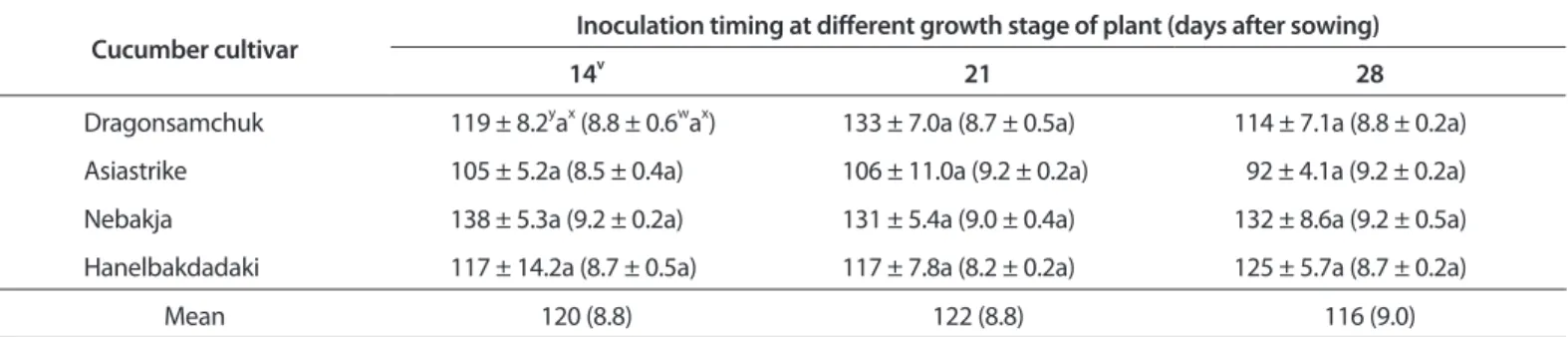
뿌리혹선충 저항성에 오이 식물의 이식시기와 재배시기가 미치는 영향. 온실에서 4개 품종(‘드레곤삼척’, ‘아시아스트라 이크’, ‘네박자’, ‘하늘백다다기’)을 파종한 후 오이 뿌리의 발근 및 활착에 따른 뿌리혹선충병 발생 정도를 알아보기 위해 품종 들의 이식 시기별로 접종 9일전, 3일전, 접종 직전과 생육 시기 에 따라 14일, 21일, 28일 동안 재배한 오이 유묘의 이식 및 접종 을 통해서 45일 후에 뿌리혹선충병 저항성 정도를 조사하였다.
그 결과 이식 시기와 재배 시기에 관계없이 뿌리혹선충의 감염
으로 4개 품종간 유사하게 발생된 뿌리 혹과 난낭을 볼 수 있었 다(Table 2, 3). 결론적으로, 접종원의 농도와 두 가지 생육조건 에서의 결과를 볼 때 뿌리혹선충의 기주에 대한 감염과 뿌리혹 선충병 발생 정도에 따른 저항성을 검정하기 위해서는 온실 (25±5oC)에서 파종한 오이 품종을 21일 동안 재배하고 이식한 다음 7일간 재배 후 5,000개의 뿌리혹선충 알 접종으로 45일 동안 온실 재배 이후에 조사하는 것이 효과적인 것으로 생각 되었다.
시판중인 오이 품종들의 저항성 검정. 시판 중인 오이 45개 품종의 뿌리혹선충병에 대한 저항성 정도를 앞서의 적합 한 실험 조건를 바탕으로 오이 뿌리에 형성된 난낭수와 혹 지 수를 조사하여 품종간 차이를 조사하였다. 그 결과 100개 이상 의 난낭수를 나타내는 대다수의 오이 품종과는 달리 대목 품종
Table 2. Root-knot nematode severity of four cucumber cultivars according to inoculation timing at different growth stage of plantz Cucumber cultivar Inoculation timing at different growth stage of plant (days after sowing)
14v 21 28
Dragonsamchuk 119 ± 8.2yax (8.8 ± 0.6wax) 133 ± 7.0a (8.7 ± 0.5a) 114 ± 7.1a (8.8 ± 0.2a)
Asiastrike 105 ± 5.2a (8.5 ± 0.4a) 106 ± 11.0a (9.2 ± 0.2a) 92 ± 4.1a (9.2 ± 0.2a)
Nebakja 138 ± 5.3a (9.2 ± 0.2a) 131 ± 5.4a (9.0 ± 0.4a) 132 ± 8.6a (9.2 ± 0.5a)
Hanelbakdadaki 117 ± 14.2a (8.7 ± 0.5a) 117 ± 7.8a (8.2 ± 0.2a) 125 ± 5.7a (8.7 ± 0.2a)
Mean 120 (8.8) 122 (8.8) 116 (9.0)
zOne week after transplanting, the potted seedlings were inoculated with Meloidogyne incognita. The inoculated plants were incubated in a greenhouse (25 ± 5oC). Forty five days after inoculation, disease severity of the seedlings was rated on the number of egg masses and gall index of a scale 0 to 10.
yThe number of egg masses/plant. Each value represents the mean ± standard deviation of two runs with three replicates each.
xValues in the labeled with the same letter in each line are not significantly different in Duncan’s multiple range test at P = 0.05.
wEach value represents the mean gall index ± standard deviation of two runs with three replicates each.
v14 days (two-leaf stage), 21 days (four-leaf stage), 28 days (six-leaf stage).
Table 3. Root-knot nematode severity of four cucumber cultivars according to days after transplanting of seedlings for inoculation of Meloido- gyne incognitaz
Cucumber cultivar Inoculation days after transplanting
0 3 9
Dragonsamchuk 120 ± 9.5yax (7.7 ± 0.5wax) 115 ± 10.2ab (7.0 ± 0.8a) 109 ± 9.9b (8.8 ± 0.2a)
Asiastrike 79 ± 6.0a (8.0 ± 0.4a) 88 ± 4.2a (8.7 ± 0.5a) 79 ± 7.9a (8.3 ± 0.5a)
Nebakja 105 ± 25.7a (7.5 ± 0.7a) 116 ± 11.8a (7.3 ± 0.5a) 119 ± 12.5a (7.2 ± 0.2a)
Hanelbakdadaki 108 ± 4.5a (8.0 ± 0.8a) 110 ± 13.1a (7.3 ± 0.2a) 103 ± 8.7a (7.5 ± 0.4a)
Mean 103 (7.8) 107 (7.6) 103 (8.0)
zOne, three, and nine days after transplanting, the potted 28-day-old seedlings were inoculated with M. incognita, respectively. The inoculated plants were incubated in a greenhouse (25 ± 5oC). Forty five days after inoculation, disease severity of the seedlings was rated on the number of egg masses and gall index of a scale 0 to 10.
yThe number of egg masses/plant. Each value represents the mean ± standard deviation of two runs with three replicates each.
xValues in the labeled with the same letter in each line are not significantly different in Duncan’s multiple range test at P = 0.05.
wEach value represents the mean gall index ± standard deviation of two runs with three replicates each.
인 ‘눈부셔’, ‘슈퍼흑종’, ‘유니온’의 난낭수는 각각 50개, 55개, 24개로 다소 낮은 발병도를 보여 주었고 난낭수가 가장 많은 품종(‘러스보이’)과의 비교를 통한 저항성 판정으로 ‘유니온’ 대 목 품종이 중간 저항성임을 확인하였다. 그 외의 품종들은 저항 성 판정법으로 품종간에 저항성과 감수성 정도의 차이가 없는 감수성 반응을 나타내었고 여러 종자회사에서 판매되고 있는 오이 품종 간에 뿌리혹선충 발생이 거의 차이가 없었다(Table 4).
박과 작물의 뿌리혹선충병에 대한 검정법 확립을 위한 연구 가 점차 진행되고 있지만, 뿌리혹선충과 같은 토양전염성 병해 충의 피해를 줄이기 위해 가장 환경 친화적인 방법으로 인식되 고 있는 저항성 품종과 저항성 대목의 개발을 포함한 유기재배 와 관련된 연구가 여전히 미흡한 실정이다. 다만, 오이의 뿌리 혹선충병 발생에 관해서 Kim 등(2012)이 M. incognita에 대한 21품종의 뿌리혹선충병 저항성 정도를 조사한 결과 접종 45일 후 백침계오이인 ‘백봉다다기’가 중도저항성을 나타낸다는 것 을 알 수 있었다. 따라서 뿌리혹선충의 종에 의한 저항성 차이 를 알기 위함과 오이 품종에 따른 저항성 및 감수성 정도의 지 속적인 변화에 대응하기 위해서는 체계적이고 효율적인 저항 성 검정 방법이 필수적으로 요구된다.
요 약
연작 재배로 인하여 뿌리혹선충(Meloidogyne incognita)과 같 은 식물 기생 선충에 의한 피해는 오이 재배 면적이 늘어나면서 크게 늘어나고 있다. 이러한 생산량의 감소 피해를 해결하기 위 한 친환경적인 방제 방법으로 경종적 방제의 저항성 품종을 이 용한 재배가 점차 증가되고 있다. 본 연구에서는 새로운 저항 성 육종 소재를 찾기 위한 효율적인 저항성 검정 방법을 확립하 기 위하여, 뿌리혹선충 M. incognita를 이용한 오이의 선충병 발 생 정도를 접종원 농도, 오이 생육 시기 및 이식 시기 등의 다양 한 발병 조건에 따라 오이 4개 품종(‘드레곤삼척’, 아시아스트라 이크’, ‘네박자’, ‘하늘백다다기’)을 대상으로 조사하였다. 접종 원의 접종 농도가 증가 할수록 오이의 뿌리혹선충병 발생은 농 도 의존적으로 증가되었지만, 오이의 생육 시기 및 이식 시기에 따른 오이의 뿌리혹선충병 발생은 유의한 차이가 없었다. 따라 서, 오이 품종의 뿌리혹선충병 저항성 검정 조건으로 온실(25 ± 5oC)에서 파종 후 21일간 재배하고, 이식한지 7일 후에 5,000개 의 뿌리혹선충 알 접종으로 45일 이후에 병 조사를 하는 것이 적합함을 알 수 있었다. 적정한 발병 조건에 따라 시판 중인 오 이 45개 품종의 뿌리혹선충에 대한 저항성 정도를 조사한 결과, 대목 6개 품종에서 난낭수 100개 이하의 뿌리혹선충병 발생 정 도를 보였고, 특히 ‘유니온’ 대목 품종은 중간 저항성으로 조사 되었다. 그 외 실험한 모든 품종들은 유사한 정도의 높은 감수 성을 나타냈다. 이들 결과들을 바탕으로 M. incognita에 대한 오 이 품종의 저항성 정도를 검정하기 위한 효율적인 방법을 제안 하고자 한다.
Table 4. Resistance degrees of 45 commercial cucumber cultivars to Meloidogyne incognitaz
Cucumber cultivar No. of egg mass Resistance reactiony Asiacheongjang 132 ± 7.8w (9.2 ± 0.2v) S
Asiaeuncheon 109 ± 16 (8.2 ± 0.2) S
Asianogak 106 ± 16 (8.2 ± 0.2) S
Asiastrike 105 ± 9.3 (8.0 ± 0.4) S
Baekchimmatjjang 112 ± 5.3 (7.8 ± 0.2) S
Baekmibaekdadagi 123 ± 3.9 (8.0 ± 0.4) S
Cheonghwaheukjinju 137 ± 8.7 (8.8 ± 0.2) S Cheongnokmatjjang 112 ± 3.9 (8.0 ± 0.4) S
Daesun 102 ± 7.4 (8.3 ± 0.2) S
Dragonsamcheok 105 ±12 (7.8 ± 0.6) S
EunmiS 85 ± 10 (7.5 ± 0.7) S
Glorysamcheok 113 ± 9.0 (8.2 ± 0.2) S
Gyedaebaekgwa 112 ± 9.6 (9.5 ± 0.0) S
Haneulbaekdadagi 112 ± 6.5 (8.0 ± 0.4) S
Hansungbaekdadagi 113 ± 5.8 (8.3 ± 0.2) S
Heukryongsamcheok 105 ± 26 (7.7 ± 1.3) S
Hodongcheongjang 113 ± 11 (8.8 ± 0.2) S
Ildongcheongjang 104 ± 25 (8.3 ± 0.5) S
Jellujonbaekchim 100 ± 11 (8.5 ± 0.4) S
Jungboksamcheok 100 ± 9.3 (7.5 ± 0.2) S
Jungsunsamcheok 117 ± 5.4 (8.7 ± 0.2) S
Miinbaekdadagi 114 ± 5.1 (8.0 ± 0.4) S
Minicue 102 ± 8.2 (9.0 ± 0.0) S
Minisayeop 134 ± 4.9 (8.7 ± 0.2) S
Mujinjang 120 ± 4.1 (8.7 ± 0.2) S
Nakdongcheongjang 120 ± 12 (8.3 ± 0.5) S
Nebakja 120 ± 8.0 (8.5 ± 1.1) S
Nodajibaekdadagi 119 ± 8.0 (8.7 ± 0.2) S
Nokyacheongcheong 118 ± 6.6 (8.5 ± 0.0) S
Ohdaebaekdadagi 102 ± 3.7 (8.2 ± 0.2) S
Russboy 140 ± 6.8 (9.3 ± 0.2) S
Septembersemigreen 114 ± 5.8 (8.0 ± 0.4) S Singsingbaekdadagi 129 ± 4.8 (8.8 ± 0.2) S
Sinjeongpum 93 ± 8.5 (7.7 ± 0.6) S
Sinsedae 128 ± 7.4 (8.7 ± 0.2) S
Tongilbaekdadagi 125 ± 7.5 (8.3 ± 0.2) S
Unchunbaekdadagi 119 ± 5.9 (8.2 ± 0.2) S
Wellbeingmatjjang 124 ± 16 (8.2 ± 1.2) S
Wolhasamcheok 137 ± 6.6 (9.2 ± 0.2) S
Nunbusher (Root-Stock) 50 ± 15 (4.3 ± 0.8) S Newtype (Root-Stock) 73 ± 7.0 (4.7 ± 0.2) S Support (Root-Stock) 65 ± 4.8 (5.0 ± 0.4) S Superheukjong (Root-Stock) 55 ± 9.2 (3.7 ± 0.5) S TsuyakaEX (Root-Stock) 96 ± 6.4 (6.3 ± 0.2) S Union (Root-Stock) 24 ± 3.4 (2.2 ± 0.6) MR
zOne week after transplanting, the potted 28-day-old seedlings were inoculated with M. incognita. The inoculated plants were incubated in a greenhouse (25 ± 5oC). Forty five days after inoculation, disease severity of the seedlings was rated on the number of egg masses and gall index of a scale 0 to 10.
yResistance reaction of cucumber cultivar was determined by the number of egg masses per plant. R, resistant, 0-14; MR, moderately resistant, 15-35; S, susceptible, more than 36.
wThe number of egg masses/plant. Each value represents the mean ± standard deviation of two runs with three replicates each.
vEach value represents the mean gall index ± standard deviation of two runs with three replicates each.
Acknowledgement
This research was supported by Golden Seed Project Vegetable Seed Center (213002-04-1-SBZ10) and Golden Seed Project Horti- cultural Seed Center (213003-04-2-WTV11), Ministry of Agriculture, Food and Rural Affairs (MAFRA), Ministry of Oceans and Fisheries (MOF), Rural Development Administration (RDA) and Korea Forest Service (KFS).
References
Abad, P., Gouzy, J., Aury, J. M., Castagnone-Sereno, P., Danchin, E. G. J.
and Deleury, E. 2008. Genome sequence of the metazoan plant- parasitic nematode Meloidogyne incognita. Nat. Biotechnol. 26:
909-915.
Barker, K. R., Schmitt, D. P. and Imbriani, J. L. 1985. Nematode popu- lation dynamics with emphasis on determining damage poten- tial to crops. In: An Advanced Treatise on Meloidogyne. Vol. II, ed.
by K. R. Barker, C. C. Carter and J. N. Sasser, pp. 135-148. North Carolina State University, Raleigh, North Carolina, USA.
Birch, A. N. E., Robertson, W. M. and Fellows, L. E. 1993. Plant prod- ucts to control plant parasitic nematodes. Pestic. Sci. 39: 141- 145.
Boina, D. R., Lewis, E. E. and Bloomquist, J. R. 2008. Nematicidal ac- tivity of anion transport blockers against Meloidogyne incognita, Caenorhabditis elegans and Heterorhabditis bacteriophora. Pest Manag. Sci. 64: 646-653.
Bridge, J. and Page, S. L. J. 1980. Estimation of root-knot nematode infestation levels on roots using a rating chart. Trop. Pest Man- age. 26: 296–298.
Chen, Z. X., Dickson, D. W., McSorley, R., Mitchell, D. J. and Hewlett, T. E. 1996. Suppression of Meloidogyne arenaria race 1 by soil application of endospores of Pasteuria penetrans. J. Nematol. 28:
159-168.
Cho, H. J., Han, S. C. and Choi, D. G. 1986. Screening of peanut, pep- per, cucumber, and tomato varieties for resistance to root-knot nematode, Meloidogyne hapla. Res. Rept. RDA. 28: 94-97. (In Korean)
Cho, M. R., Lee, B. C., Kim, D. S., Jeon, H. Y., Yiem, M. S. and Lee, J. O.
2000a. Distribution of plant-parasitic nematodes in fruit veg- etable production areas in Korea and identification of root-knot nematodes by enzyme phenotypes. Korean J. Appl. Entomol. 39:
123-129. (In Korean)
Cho, M. R., Na, S. Y. and Yiem, M. S. 2000b. Biological control of Meloidogyne arenaria by Pasteuria penetrans. J. Asia Pac. Entomol. 3:
71-76.
Choi, D. R., Lee, J. K., Park, B. Y. and Chung, M. N. 2006. Occurrence of root-knot nematodes in sweet potato fields and resistance screening of sweet potato cultivars. Korean J. Appl. Entomol. 45:
211–216. (In Korean)
Chon, H. S., Park, H. J., Yeo, S. G., Park, S. D. and Choi, Y. E. 1996. Technical development for control on soil nematodes (Meloidogyne spp.) of oriental melon in plastic film house. RDA J. Agri. Sci. 38 (C.P.): 401-407. (In Korean)
Fassuliotis, G. 1985. The role of nematologist in the development of resistance cultivars. In: An Advanced Treaties on Meloidogyne.
Vol. I. Biology and Control, ed. by J. N. Sasser and C. C. Cater, pp.
234-240. North Carolina State University, Raleigh, North Caro- lina, USA.
Gurr, G. M. 1992. Control of potato cyst nematode (Globodera pallida) by host plant resistance and nematicide. Ann. Appl. Biol. 121:
167-173.
Han, S. C. and Kim, Y. G. 1997. Screening of resistant red pepper va- rieties to Meloidogyne hapla and their resistance mechanisms.
Korean J. Appl. Entomol. 36: 185-191. (In Korean)
Heald, C. M. and Robinson, A. F. 1987. Effects of soil solarization of Rotylenchus reniformis in the Lower Rio Grande Valley of Texas. J.
Nematol. 19: 93-103.
Hwang, S. M., Park, M. S., Kim, J.-C., Jang, K. S., Choi, Y. H. and Choi, G.
J. 2014. Occurrence of Meloidogyne incognita infecting tomato Mi cultivars and development of an efficient screening method for resistant tomato to the Mi-virulent nematode. Korean J. Hort.
Sci. Technol. 32: 217–226. (In Korean)
Jung, C. and Wyss, U. 1999. New approaches to control plant parasitic nematodes. Appl. Microbiol. Biotechnol. 51: 439-446.
Kinloch, R. A. and Hinson, K. 1972. The Florida program for evaluat- ing soybean (Glycine max L. Merr.) genotypes for susceptibility to root-knot nematode disease. Proc. Soil Crop Sci. Soc. Florida 32: 173-176.
Kim, D. G. 2001. Occurrence of root-knot nematodes on fruit veg- etables under greenhouse conditions in Korea. Res. Plant Dis. 7:
69-79. (In Korean)
Kim, D. G. and Choi, S. K. 2001. Effects of incorporation method of nematicides on reproduction of Meloidogyne arenaria. Korean J.
Appl. Entomol. 40: 89-95. (In Korean)
Kim, D. G. and Lee, J. H. 2008. Economic threshold of Meloidogyne incognita for greenhouse grown cucumber in Korea. Res. Plant Dis. 14: 117-121. (In Korean)
Kim, H. H., Choo, H. Y., Park, C. G., Lee, S. M. and Kim, J. B. 1998. Bio- logical control of the northern root-knot nematode, Meloido- gyne hapla with plant extract. Korean J. Appl. Entomol. 37: 199- 206. (In Korean)
Kim, J. I. and Han, S. C. 1998. Effect of solarization for control of root- knot nematode (Meloidogyne spp.). Korean J. Appl. Entomol. 27:
1-5. (In Korean)
Kim, S. H., Shin, J. E., Kyung, J. L., Sheng, J. X. and Kim, B. S. 2012.
Evaluation of disease resistance of cucurbit cultivars to pow- dery mildew and root-knot nematode. Res. Plant Dis. 18: 29-34.
(In Korean)
Park, S. D., Kwon, T. Y., Choi, B. S., Lee, W. S. and Choi, Y. E. 1995a.
Studies on integrated control against root-knot nematode of fruit vegetable (oriental melon and cucumber) in vinyl house.
Korean J. Appl. Entomol. 34: 75-81. (In Korean)
Park, S. D., Kwon, T. Y., Jun, H. S. and Choi, B. S. 1995b. The occur- rence and severity of damage by root-knot nematode (Meloido- gyne incognita) in controlled fruit vegetable field. RDA. J. Agri.
Sci. 37: 318-323. (In Korean)
Prakash, A. and Rao, J. 1997. Botanical Pesticides in Agriculture. CRC Press Inc. Boca Raton. 461 pp.
Rhoades, H. L. 1976. Effects of Indigofera hirsute on Belonolaimus longicaudatus, Meloidogyne incognita, and M. javanica and sub- sequent crop yield. Plant Dis. Rep. 60: 384-386.
Taylor, A. L. and Sasser, J. N. 1978. Biology, Identification and Con- trol of Root Knot Nematodes (Meloidogyne spp.). Department of Plant Pathology, North Carolina State University and United
States Agency for International Development, Graphics, Raleigh, North Carolina. 111 pp.
Thorne, G. 1961. Principles of Nematology. McGraw-Hill Book Co.
Inc. New York, Toronto, London. 553 pp.
Umesh, K. C., Ferris, H. and Bayer, D. E. 1994 Competition between the plant-parasitic nematodes Pratylenchus neglectus and Meloidogyne chitwoodi. J. Nematol. 26: 286-295.
van der Putten, W. H., Cook, R., Costa, S., Davies, K. G., Fargette, M., Freitas, H., Hol, W. H. G., Kerry, B. R., Maher, N., Mateille, T., Moens, M., de la Pena, E., Piskiewicz, A. M., Raeymaekers, A. D. W., Rodri- guez-Echeverria, S. and van der Wurff, A. W. G. 2006. Nematode interactions in nature: models for sustainable control of nema- tode pests of crop plants? Adv. Agron. 89: 227-260.