*정회원, 원광대학교 컴퓨터소프트웨어공학과
**정회원, 한성대학교 컴퓨터공학부
접수일자 2019년 1월 13일, 수정완료 2019년 2월 3일 게재확정일자 2019년 2월 8일
Received: 13 January, 2019 / Revised: 3 February, 2019 / Accepted: 8 February, 2019
**Corresponding Author: [email protected]
Department of Computer Engineering, Hansung University, Seoul, Korea
https://doi.org/10.7236/JIIBC.2019.19.1.171
JIIBC 2019-1-23
선박 신수요 예측을 위한 빅데이터 기반 인공지능 알고리즘을 활용한 플랫폼 개발
Development of a Platform Using Big Data-Based Artificial Intelligence to Predict New Demand of Shipbuilding
이상원
*, 정인환
**Sangwon Lee
*, Inhwan Jung
**요 약 한국의 조선 산업은 대내외 환경 변화로 인해 심각한 위기 상황에 처해 있다. 이 위기를 극복하기 위해서, 선박 신수요 예측을 통한 제품 및 기술의 선제적 개발이 필요하다. 본 연구의 목표는 선박 신수요 예측을 위해 선박 빅데이터에 기반한 인공지능 알고리즘의 개발이다. 본 연구에서는 선박 수요 예측에 특화된 빅데이터 분석 플랫폼을 개발하고 데이터 분석을 통한 선박 신수요 예측 결과를 신제품 기획/개발에 활용하고자 한다. 이를 통해 장비 및 기자재 제조업체를 위한 지속 가능한 신사업 모델 개발로 조선소 및 선박 기자재 업체에 대한 신성장동력을 창출할 수 있을 것이다. 또한 조선 업체들은 측정 가능한 성과를 기반으로 비즈니스 사례를 창출하고 시장 지향적 인 제품과 서비스를 계획하며 높은 시장 파괴력을 가진 혁신을 지속적으로 달성 할 수 있을 것으로 기대된다.
Abstract
Korea's shipbuilding industry is in a critical condition due to changes in the domestic and international environment. To overcome this crisis, preemptive development of products and technologies through prediction of new demand for ships is necessary. The goal of this research is to develop an artificial intelligence algorithm based on ship big data in order to predict new demand for ships. We intend to develop a big data analytics platform specialized in predicting ship demand and to utilize the forecast results of new ship demand through data analysis for planning/development of new products. By doing so, the development of sustainable new business models for equipment and equipment manufacturers will create new growth engines for shipyard and shipbuilders. Furthermore, it is expected that shipbuilders will be able to create business cases based on measurable performance, plan market-oriented products and services, and continuously achieve innovation that has high market destructive power.Key Words :
Big Data, Shipbuilding, Demand Prediction, Platform, Business ModelⅠ. Introduction
The purpose of this research is to actively generate new customer-oriented demand and to discover new
growth engines for shipbuilders. Current shipping
orders are executed by operating activities based on
price and performance advantages in line with the
customer's order plan. These passive operations alone
were sufficient in the supplier-dominated market
[5], but they have to face difficulties in the current market, where ship orders are stagnant and competition with neighboring countries is intensifying. If shipbuilders can preemptively propose new products and technologies by anticipating customer needs, they will not only be able to break down the price-competitive market, but also accelerate innovation and come up with strategies to differentiate themselves from their competitors.
In order to develop a platform for predicting new demand for big data-based ships, it is urgent to develop a model for estimating demand for ships. To this end, we analyzed vessel operation patterns based on Automatic Identification System (AIS) data. Further, in order to identify ship owners and suppliers, the company's order-oriented attitude was analyzed and the competition environment of the shipping industry was analyzed. Text mining analysis for technology trends was also added.
Ⅱ. Related Works
With the business environment deteriorating due to the global shipbuilding market, the domestic shipbuilding industry is waging a fierce battle for orders due to the chase by Chinese shipbuilders and the rising price competitiveness of Japanese companies due to the yen's effect. Despite the urgent need to develop new products and new businesses that will fuel new growth, the shipbuilding industry is a traditional contract industry that takes at least two to three years from design to production, and is very passive in developing new products and creating new demand.
Because it takes a long time to develop a product, there is a low chance of success when new technologies or products are released. Therefore, shipbuilders must develop the ability to accurately predict and deliver the products they need in a timely manner. Based on such capabilities, diverse ship-related companies as well as
shipbuilders will be able to find new growth engines by actively exploring new demand for new ships and developing sustainable new business models.
On the other hand, the global business environment, where virtually everything has been digitized, offers huge market intelligence under the name of "Big Data
[7,8]
." Major advanced countries such as the U.S. and the U.K. consider big data as an innovation in technology and a new way to solve problems. In addition, large global companies are quickly taking the lead by building business models based on big data or actively utilizing big data for development of corporate products
[2, 4]and services
[3, 6].
However, local shipbuilders still lack understanding of big data, and their ability to understand market and customer needs based on big data is not enough.
Conventional data, such as economic indicators, market conditions, and internal data affecting the shipbuilding industry, are growing at an alarming rate, but are not properly utilized. Moreover, more than 2GB of data are collected per day for ships around the world due to the development of satellite communication technology, but there is no idea of how this data can be used and what value it contains. Moreover, it is difficult to access the data because it is mixed with large amounts of unstructured data such as shipbuilding and marine related magazines, technical journals, and various technical documents. In reality, they lack the ability and technology to process and analyze collected data, and they have no experience of understanding the data and making inferences from it and using it for their businesses.
In response, this study began with information that
would provide new opportunities for shipbuilders and
shipbuilders to make new leaps. It is possible to
overcome the price competition-oriented market
situation by preemptively suggesting and developing
new products and technologies in advance by
anticipating the needs of customers, instead of passive
ship order sales that rely solely on the customer's
order plan. In addition, we will be able to promote
sustainable growth in the long term by accelerating innovation and developing differentiated strategies with competitors from Japan and China.
Ⅲ. Platform Design to Predict New Demand of Shipbuilding
1. Introduction to Research Model
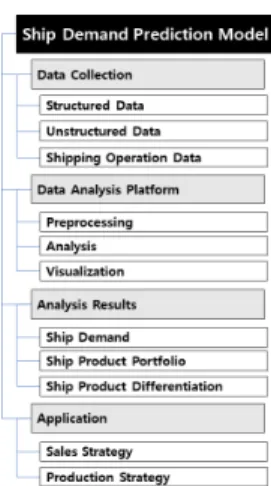
The ship's new demand forecast platform will develop a big data analytics platform specialized in predicting ship demand and utilize the forecast results of new products through data analysis (Fig 1).
그림 1. 연구 모델 Fig. 1. Research Model
(1) Data Collection: First, the object of data collection is a wide variety of structured, unstructured, and large data. Some 70 types of data (economic indicators, logistics, ship owners, etc.) needed to predict ship demand were collected, and more than 10 million worldwide shipping data were also included.
(2) Data Analysis Platform: A modularity for pre-processing, analysis, and visualization of data has been structured and the platform has been completed.
(3) Data Results: We have produced forecasts of ship demand from the perspective of the
shipping company and have also obtained forecasts for the product portfolio. In addition, additional product differentiation analysis was conducted with the customer at the new technology level.
(4) Application: The results of market prediction are utilized in the operation or product development strategy.
2. Development of a Demand Forecasting Platform for Shipbuilding
The ship demand forecast study first defined clearly the objectives of the analysis, collected structured and unstructured data needed to meet the analysis objectives, benchmarked the world's leading ship new demand forecast institutions for new demand forecasting methods and utilization data. Various analysis techniques such as statistical analysis, data mining, machine learning methods, and profiling were applied to derive optimal analysis results based on collected data. The analysis model developed was implemented in the analysis platform and the platform optimization and statistical UI were developed so that the desired analysis can be continuously.
The ship's new demand forecast model, which uses
statistical techniques to predict future new orders, and
by performing freight load analysis and ship
obsolescence and replacement demand forecasts based
on information about ship operation, has overcome the
limitations of traditional market estimation methods and
to predict new demand considering the current
situation and needs of customers. In addition, we
analyzed customer data and order book inside A
Company to identify customer order trends over the
past few years and analyzed the business and financial
status of each customer and forecast customers by
product. The forecast of demand and the forecast of
customer orders are expected to contribute to
maximising the effect of orders by presenting products
of the performance needed by the customer and ships
of the size that can maximize the customer's operating
profit by utilizing the A Company's product development and marketing.
The analysis of competitiveness within the shipbuilding industry was designed to analyze the price competitiveness of products between Korea, China, and Japan, and to identify the premium of technology superiority of Korean shipbuilders and A Company, thereby overcoming the inferiority in price in future technology development. In addition, by analyzing unstructured data, it discovered promising technologies in the shipbuilding and marine fields and predicted future product development. The results obtained from these analyses will be reflected in the product load map and technology load map of A Company and will be utilized in the technology strategy to develop the products and technologies customers want in a timely manner.
그림 2. 자동 식별 시스템 데이타
Fig. 2. Data of Automatic Identification System
The major big data used to forecast new demand for ships is about 350 types of data in the shipbuilding and shipping sector, about 1.5GB of Automatic Identification System (AIS) (Fig. 2) data per day (about 10 million cases per day), six months of data on customer and product technologies within A Company, and five years of weekly and monthly technology. New demand prediction platform for ships was developed first by collecting, processing and storing up to 20 million data per day. It is able to collect information on location of more than 140,000 vessels in operation and decode data in real time, and collect 280 kinds of global economy, shipbuilding, and shipping indicators and update them in real time. R analysis was used to extract and analyze data. After analyzing 500 million
data, the first analysis through R was performed and the second and third data were normalized using R again. The analysis results obtained through these processes are visualized through the dashboard.
Ⅳ. Analysis Results
In order to predict new demand for ships, a total of five detailed analyses were carried out in this study (Fig. 3).
그림 3. 플랫폼 개발 과정
Fig. 3. Procedure of Platform Development
1. Ship Demand Estimation Model
Fig. 4 shows the process for estimating new demand for ships. We analyzed the relationship of large number of indicators in various areas related to the shipbuilding industry, including economy, shipbuilding, and shipping, and performed a correlation analysis between major variables through primary filtration. The four main variables that influence the new demand for container vessels through correlation are 'China Maritime Container Import and Export', 'China PMI Index', 'OECD Industrial Production' and 'Lead Index'.
Meanwhile, the variables that affect the demand of bulk carriers most are 'middle-high line', 'sea freight', and 'steel price'.
그림 4. 새로운 선박 수요 예측
Fig. 4. Estimating New Demand for Ships
Time series graphs and scatterplot graphs were performed to further correlate key variables (Fig. 5). In addition, various statistical techniques were used, such as HP filtration, Time shift, regression, and Auto Progress Analysis, to identify the relationship between each parameter and the increase in the volume of ships.
그림 5. 상관 분석
Fig. 5. Correlation Analysis
AR (Autoregressive Model) (Fig. 6) was used to predict ship order quantity of container ships, and artificial neural network model was analyzed and forecast was performed to verify the analysis model.
그림 6. 자동 회귀 모델 Fig. 6. Autoregressive Model
The forecast of demand for bulk carriers has developed a model that describes the current volume of ships in the past (12 months, 24 months ago) as steel prices, shipping charges, second-hand prices, shipping volume and dismantling volume. Using the three models of the Distributed Lag Model (DL Model) (Fig.
7), the Autoregressive Distributed Lag Model (ADL Model) (Fig. 8), and the Autoregressive Model (AR Model) (Fig. 9), we set the learning interval from January 1999 to December 2014 and analyzed the accuracy of the dose prediction by dividing it into the forecast section. The analysis of the three models confirmed that the forecast value of the AR model is
the closest to the actual value, i.e. the most predictable model, and based on this analysis, the demand for the new bulk line was estimated between 2017 and 2019, reflecting the order book in 2015 and 2016.
그림 7. 분산 래그 모델 Fig. 7. Distributed Lag Model
그림 8. 자동 회귀 분산 래그 모델
Fig. 8. Autoregressive Distributed Lag Model
그림 9. 자동 회귀 모델 Fig. 9. Autoregressive Model
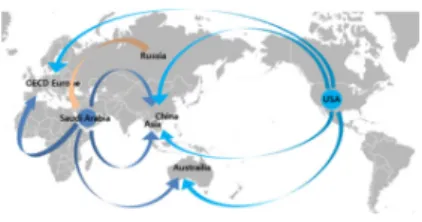
Unlike estimates of demand for container ships and bulk carriers, the demand for ships can be predicted according to the volume of product supply under the global oil refinery construction and development plan and the increase in demand in major importers (Fig.
10). First of all, according to the current status and
plans for additional construction of refineries
worldwide, it is expected that supply increases in the
United States and Saudi Arabia will accelerate. In
addition, major demand increases for products occur mostly in China and Asia and are expected to account for about 44 percent of global demand for products by 2019.
그림 10. 주요 선박 공급 전망
Fig. 10. Estimation of Major Ship Supply
2. Analysis of Ship Satellite Navigation Information
AIS data are automatic position calling devices mounted on ships, which are transmitted for the purpose of identifying and locating ships, and provide real-time navigation information such as location, path, and speed of ships. A company conducted an analysis using AIS data for the first time in the world to analyze the current state of ship use in each prehistoric vessel, and to derive optimal fuel efficiency based on the speed of travel by vessel. First, the freight load of the ships was analyzed to analyze the current state of the customers' ship use, i.e. the operation rate of the ships. This allowed us to estimate the oversupply of prehistoric ships. In addition, estimates of carbon emissions per vessel have allowed for analysis of ship-to-ship energy efficiency
[1], which provides important information in estimating that some customers will have low energy efficiency and that replacement demand will occur in the future.
3. Customer Profiling
The customer profile analysis obtains all of the world's forward list data and identifies the current state of the vessel ownership by nationality and type of ship. Through this analysis, the current market conditions, the size and characteristics of the ships owned are analyzed. Based on the financial status of
each pre-delivery unit, it is also possible to predict future customer order patterns by analyzing the relationship between current shipping order trends and the financial situation of the futures. In addition, the current orderbook list analysis identifies the size and characteristics of vessels ordered by customers over the past two years. For example, container ships have seen an average annual increase of more than 30 percent over the last three years, and small and medium-sized vessels have many orders, but less than 10 percent of the total container carrying volume. This trend of shipping orders has been utilized to find customers who are more likely to place orders with us by ship size in the future, along with the above analysis of profiling.
4. Unstructured Data Analysis
As the analysis target is derived from technology and product trends related to specific ship types, the related keywords were first found and grouped by subject. The initial keywords were organized through international agency reports, technical data of the company, and magazine. Within the document, a piece of document containing this keyword was extracted and belongs to a piece of document on the subject. This creates a document fragment structure for each subject, and the contents (photography) that correspond to the subject are woven into the subject in a large number of document bundles. After this structure, the relationship between the time-occurrence of the topic and the topic was plotted and analyzed. Extracting a document using a specific keyword was able to find a meaningful keyword within the piece of the document.
Ⅴ. Conclusions
The purpose of this study is to optimize
infrastructure and data resources and analytics within
the industry to understand customer requirements and
to identify and support new business opportunities,
※ This research was financially supported by Hansung University.
※ This work was supported by the Ministry of Education of the Republic of Korea and the National Research Foundation of Korea (NRF-2018S1A5A2A03038738)
※ The authors would like to thank project members and agency officers (Korea Information Society Agency, Daewoo Shipbuilding & Marine Engineering Co., Ltd.) for providing project materials and interviews.
while providing accurate and rapid market insight from existing and newly introduced internal information. In other words, by establishing capabilities to collect and analyze big data in shipbuilding, such as ship market, energy trend, global volume change, global ship operation data, and innovative technology development trend, customers can proactively propose products of requirements and push for technology development accordingly. In particular, it would be possible to develop a product that enables customers to create a premium based on data without wasting resources on technology development they do not want.
Furthermore, it is expected that businesses will be able to create business cases based on measurable performance, plan market-oriented products and services, and continuously achieve innovation that has high market destructive power.
References
[1] Lee, Yong-Soo, Jun Heo, and Yong-Hoon Choi.
"A Study on Smart Energy Management System using Information and Communication Technology." The Journal of The Institute of Internet, Broadcasting and Communication 14.5 (2014): 167-172.
DOI: https://doi.org/10.7236/JIIBC.2014.14.5.167 [2] Li, Jingran, et al. "Big data in product lifecycle
management." The International Journal of Advanced Manufacturing Technology 81.1-4 (2015): 667-684.
DOI: https://doi.org/10.1007/s00170-015-7151-x [3] Lee, Jay, Hung-An Kao, and Shanhu Yang.
"Service innovation and smart analytics for
industry 4.0 and big data environment." Procedia Cirp 16 (2014): 3-8.
DOI: https://doi.org/10.1016/j.procir.2014.02.001 [4] Chong, Alain Yee Loong, et al. "Predicting
consumer product demands via Big Data: the roles of online promotional marketing and online reviews." International Journal of Production Research 55.17 (2017): 5142-5156.
DOI: https://doi.org/10.1080/00207543.2015.1066519 [5] Wang, Gang, et al. "Big data analytics in logistics and supply chain management: Certain investigations for research and applications."
International Journal of Production Economics 176 (2016): 98-110.
DOI: https://doi.org/10.1016/j.ijpe.2016.03.014 [6] Chen, Hsinchun, Roger HL Chiang, and Veda C.
Storey. "Business intelligence and analytics: from Big Data to big impact." MIS quar-terly (2012):
1165-1188.
DOI: https://doi.org/10.2307/41703503
[7] Jeon, Sooyune, Donghun Lee, and Manjae Bae. "A Study on the Application Method of Munitions Quality Information based on Big Data." Journal of the Korea Academia-Industrial cooperation Society 17.6 (2016): 315-325.
DOI: https://doi.org/10.5762/KAIS.2016.17.6.315 [8] Eum, Hee-Kyoung, et al. "A Study on Big data
Utilization Policy by the Complex System Theory:
Focused on 2030 Seoul City Comprehensive Plan."
The Journal of Korea Institute of Information, Electronics, and Communication Technology 8.4 (2015): 281-298.
DOI: https://doi.org/10.17661/jkiiect.2015.8.4.281
저자 소개
이 상 원(정회원)
∙KAIST 경영공학과 공학박사
∙2011년 3월 ~ 현재 : 원광대학교 컴퓨 터소프트웨어공학과 부교수
∙주관심분야: 데이터공학 등
정 인 환(정회원)
∙KAIST 정보및통신공학과 공학박사
∙한성대학교 컴퓨터공학부 교수
∙주관심분야 : IoT, 분산시스템, 망관리, 빅데이터분석 등