• 검색 결과가 없습니다.

Profiling Patterns of Volatile Organic Compounds in Intact, Senescent, and Litter Red Pine (Pinus densiflora Sieb. et Zucc.) Needles in Winter

N/A
N/A
Protected

Academic year: 2021

Share "Profiling Patterns of Volatile Organic Compounds in Intact, Senescent, and Litter Red Pine (Pinus densiflora Sieb. et Zucc.) Needles in Winter"

Copied!
17
0
0

로드 중.... (전체 텍스트 보기)

전체 글

(1)

Profiling Patterns of Volatile Organic Compounds in Intact, Senescent, and Litter Red Pine (Pinus densiflora Sieb. et Zucc.) Needles in Winter 1

Won-Sil CHOI 2 ⋅Seung-Ok YANG 2 ⋅Ji-Hyun LEE 2 ⋅Eun-Ji CHOI 2 ⋅ Yun-Hee KIM 2 ⋅Jiyoon YANG 3 ⋅Mi-Jin PARK 3,†

ABSTRACT

1)

This study was aimed to investigate the changes of chemical composition of the volatile organic compounds (VOCs) emitted from red pine needles in the process of needle abscission or senescence. The VOCs in intact, senescent, and litter red pine needle samples were analyzed by headspace-solid phase microextraction gas chromatography-mass spectrometry (HS-SPME-GC/MS). And then, multivariate statistical interpretation of the processed data sets was conducted to investigate similarities and dissimilarities of the needle samples. Principal component analysis (PCA) and orthogonal partial least squares discriminant analysis (OPLS-DA) were used to investigate the dataset structure and discrimination between samples, respectively. From the data preview, the levels of major components of VOCs from needles were not significantly different between needle samples. By PCA investigation, the data reduction according to classification based on the chlorophyll a / chlorophyll b (Ca/Cb) ratio were found to be ideal for differentiating intact, senescent, and litter needles. The following OPLS-DA taking Ca/Cb ratio as y-variables showed that needle samples were well grouped on score plot and had the significant discriminant compounds, respectively. Several compounds had significantly correlated with Ca/Cb ratio in a bivariate correlation analysis. Notably, the litter needles had a higher content of oxidized compounds than the intact needles. In summary, we found that chemical compositions of VOCs between intact, senescent, and litter needles are different each other and several compounds reflect characteristic of needle.

Keywords: Pinus densiflora, HS-SPME-GC/MS, VOCs, Multi-variate, PCA, OPLS-DA, Chlorophyll a / Chlorophyll b ratio

1. INTRODUCTION

Living stands in pine forest are the main source of a wide range of biogenic volatile organic compounds (VOCs) in the forest atmosphere. It is well known that

plant VOCs have various direct and indirect defensive roles against various abiotic and biotic stresses, and show various biological activities and have been used as alternative treatments for diseases (Ahn et al., 2018;

Jeong et al., 2017). Most VOCs from trees contribute

1 Date Received April 7, 2020, Date Accepted June 29, 2020

2 National Instrumentation Center for Environmental Management, Seoul National University, Seoul 08826, Republic of Korea

3 Division of Wood Chemistry, Department of Forest Products, National Institute of Forest Science, Seoul 02455, Republic of Korea

† Corresponding author: Mi-Jin PARK (e-mail: [email protected], ORCID: 0000-0002-7748-3886)

Original Article

(2)

to the characteristic atmospheric environment of for- ests and provide useful bioresources of essential oil for the flavor and fragrance industries (Kim et al., 2017; Yang et al., 2019; Venkatesan et al., 2020).

In pine trees, the VOCs are produced mainly in nee- dle tissue via photosynthetic pathways, and therefore living intact needles are important for continuous emission and accumulation of VOCs. However, needle abscission or senescence of living stands is usually caused by environmental stressors, such as drought or flooding, atmospheric temperature fluctuation, soil sal- inity, heavy metals, etc. (Finkelstein, 2013). The pre- mature senescence and shedding of leaves can be in- duced by a deficit of water. The loss of pine needles during droughts involves true abscission; in other plants, the leaves merely wither and die. As temper- atures decline in fall, the leaves of trees stop produc- ing chlorophyll, and some species that contain large amounts of carbohydrates and possess the hereditary potential to do so begin to form anthocyanins in their leaves. As chlorophyll synthesis stops, the chlorophyll already present in the leaves begins to degrade and the newly formed anthocyanins are unmasked (Krammer and Kozlowski, 1979).

On the other hand, there are only a few studies whether the VOCs composition in needle are preserved or changed after needle abscission or senescence. The shed of aged or damaged needles in pine stands is im- portant for the release of VOCs from the forest floor (Isidorov et al., 2003, Wang et al., 2018). Even when senescent or dead, pine needles contain high levels of terpenes and other precursors of the oxidized volatile compounds, formed as a result of enzymatic reactions (Isidorov et al., 2010; Jo and Kim, 2010; Zhang et al., 2018). Coniferous litter is also a good source of secondary metabolites that are released during chem- ical or biological decomposition processes. Intact Scots pine needles contain more than 70 organic com- pounds of different classes (Isidorov et al., 2003), as

shown by solid-phase microextraction (SPME) and gas chromatography-mass spectrometry (GC-MS). They observed that the storage for four weeks on a conical floor stressed needles and caused their chemical com- positions to vary.

It is obvious that volatile metabolomic patterns vary between intact and damaged or senescent needles, and statistical analysis should show which compounds constitute important discriminant variables. Besides the authentication and identification of needles, both marked and slight differences between the unique characteristics of needles can be studied with multi- variate analysis. A practical and efficient assessment of biomass availability on pine forest floors could be made possible and easily accessible via the metab- olomic interpretation of chemical components.

The objectives of the present study were to de- termine which VOCs in red pine needles change over the course of senescence or after shedding in relation to chlorophyll variation in the needles, and hence to reveal similarities and dissimilarities among intact, senescent, and litter needles.

2. MATERIALS and METHODS 2.1. Materials

The needles of red pines (Pinus densiflora Sieb. et Zucc.) were collected from standing trees at three site at Seoul National University, Seoul Campus, Republic of Korea (37°27'28.0"N 126°56'56.5"E) in the period of from November 2019 until January 2020. Intact needles were collected with an amount of 5-10 g for each stand and combined as a sample set, and sen- escent and litter needles were collected from broken branches and the upper layer of fallen needle on the wide-spread floor zone under the tree stands, respectively.

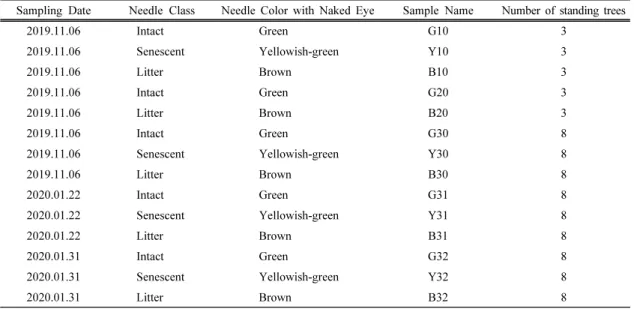
Information on the samples is presented in Table 1,

and sample code was named to reflect sampling site

position and date. Collected needles (50-100 g in a

(3)

sample set) were stored at -80°C after collection for further analysis. The experiments were repeated three times by pooling samples.

2.2. Sample preparation

Frozen needles were crushed and milled in liquid nitrogen using a Freezer/Mill cryogenic grinder (SPEX 6875D, SPEX Co., USA) to avoid any chemical de- composition or change in the chemical composition of the needles after collection. Some of the milled needle samples were further freeze-dried and used for pig- ment analysis.

2.3. Pigment analysis

The chlorophyll a (Ca), chlorophyll b (Cb), and car- otenoid (Cx-c) contents of the samples were de- termined according to the method described by Wellburn (1994). Briefly, 1 g sample mixed with 30 mL methanol in a 50 mL conical tube (polypropylene) was sonicated for 1 h and then shaken for 1 h.

Samples were filtered with a 0.2 µm syringe filter.

Absorbance was read at 666, 653, and 470 nm on a

spectrophotometer (SpectraMax Ⓡ ABS Plus, Molecular Devices LLC., USA) to determine Ca, Cb, and Cx-c content, respectively. The experiments were repeated three times. The amount of these pigments in the sam- ples was calculated according to the formulae of Lichtenthaler and Wellburn (1983) as shown in the following equations, and expressed in microgram per unit dry weight gram of sample.

Ca = 15.65 × A 666 – 7.34 × A 653

Cb = 27.05 × A 653 – 11.21 × A 666

Cx-c = (1,000 × A 470 – 2.86 × Ca – 129.2 × Cb) / 245

where, A 666 , A 653 , and A 470 are absorption values at 666 nm, 653 nm, and 470 nm spectral wavelength, respectively.

2.4. VOC analysis by headspace-solid phase microextraction gas

chromatography-mass spectrometry

Next, the composition of VOCs emitted from the freeze-milled samples was investigated using a head- space-solid phase microextraction gas chromatog-

Sampling Date Needle Class Needle Color with Naked Eye Sample Name Number of standing trees

2019.11.06 Intact Green G10 3

2019.11.06 Senescent Yellowish-green Y10 3

2019.11.06 Litter Brown B10 3

2019.11.06 Intact Green G20 3

2019.11.06 Litter Brown B20 3

2019.11.06 Intact Green G30 8

2019.11.06 Senescent Yellowish-green Y30 8

2019.11.06 Litter Brown B30 8

2020.01.22 Intact Green G31 8

2020.01.22 Senescent Yellowish-green Y31 8

2020.01.22 Litter Brown B31 8

2020.01.31 Intact Green G32 8

2020.01.31 Senescent Yellowish-green Y32 8

2020.01.31 Litter Brown B32 8

Table 1. Characteristics of red pine needle samples

(4)

raphy-mass spectrometry (HS-SPME-GC/MS) system (TSQ 8000, Thermo Fisher Scientific Inc., USA). Five hundred milligram samples were placed into 25 mL glass vessels and 4 µL of internal standard solution (100 ppm 1,4-dichlorobenzene-d4 in methanol) was added. The necks of the vessels were tightly sealed with an elastic Te flon film. After incubation on an au- tosampler at 30°C for 10 min, the VOCs from the headspace were adsorbed on an SPME fiber coated with divinylbenzene/polydimethylsiloxane (DVB/PDMS, 50/30 mm, 10 mm fiber length, SUPELCO Co., USA).

The total exposition time was 40 min and every 12 s the vessels with needle samples were slightly shaken to mix the gas phase for 10 s. After adsorption of the headspace, VOCs were desorbed by introducing the SPME fiber into the injector of the gas chromatograph with mass spectrometer. The injector temperature was set at 250°C. During injection, the fiber was main- tained for 2 min in the injector, which was used in

split mode (10:1). Components were separated on a DB-wax fused silica column (60 m length × 0.25 mm internal diameter × 0.5 µm film thickness). The carrier gas was helium at a flow rate of 2.0 mL/min. The oven temperature was altered as follows: the thermo- stat temperature was initially 40°C (holding time 2 min), then was increased to 150°C (holding time 10 min) at a rate of 4°C/min, then to 200°C (holding time 5 min) at a rate of 3°C/min, and finally to 240°C (holding time 5 min) at a rate of 10°C/min. The mass spectrometer transfer line temperature was 250°C and the ion source temperature was 250°C. Mass scanning was performed from 35 to 550 amu for with scan time of 0.2 s. Component qualification was conducted by comparison of the measured mass spectra with those from an NIST/EPA/NIH Mass Spectral Library (version 2.0 g, NIST, USA) and additional Kovats re- tention index information (the retention times of alka- nes were obtained by direct injection of standard sol-

Samples Needle Class Chlorophyll a ( ㎍/dwg 1 )

Chlorophyll b ( ㎍/ dwg)

Carotenoid

( ㎍/ dwg) Ca/Cb ratio 2 G10 Intact 1,568.1 ± 9.7 3 994.2 ± 2.4 4.0 ± 1.0 1.58 G20 Intact 1,351.7 ± 6.3 835.1 ± 6.9 44.5 ± 0.9 1.62 G30 Intact 1,396.3 ± 11.4 867.3 ± 7.9 2.9 ± 0.9 1.61 G31 Intact 914.8 ± 3.5 512.5 ± 2.3 150.2 ± 1.4 1.80 G32 Intact 1,233.1 ± 64.8 737.7 ± 38.5 192.9 ± 10.3 1.67 Y10 Senescent 161.5 ± 1.7 151.5 ± 2.3 45.2 ± 0.1 1.07 Y30 Senescent 78.2 ± 0.8 87.0 ± 1.3 49.8 ± 0.5 0.90 Y31 Senescent 561.4 ± 1.3 524.6 ± 2.8 10.7 ± 0.8 1.10 Y32 Senescent 1,118.7 ± 70.7 1,031.3 ± 63.1 20.4 ± 1.4 1.08 B10 Litter 55.2 ± 1.0 73.1 ± 1.6 10.7 ± 0.4 0.75 B20 Litter 55.8 ± 1.3 103.1 ± 1.6 11.9 ± 0.2 0.54 B30 Litter 71.2 ± 0.7 85.4 ± 0.5 25.2 ± 0.9 0.83 B31 Litter 51.8 ± 2.0 76.5 ± 2.7 19.0 ± 0.8 0.70 B32 Litter 90.9 ± 3.4 153.7 ± 2.3 22.1 ± 2.5 0.59

1 dwg: g of dry weight

2 Ca/Cb ratio: Chlorophyll a/Chlorophyll b ratio

3 Data indicate an average ± standard deviation. (n=3)

Table 2. Content of chlorophyll a (Ca), chlorophyll b (Cb), and carotenoid in red pine needles according to

spectrophotometric determination

(5)

ution under the same GC-MS conditions). To calculate retention time index, a standard solution containing C7-C30 normal alkanes in dichloromethane was used.

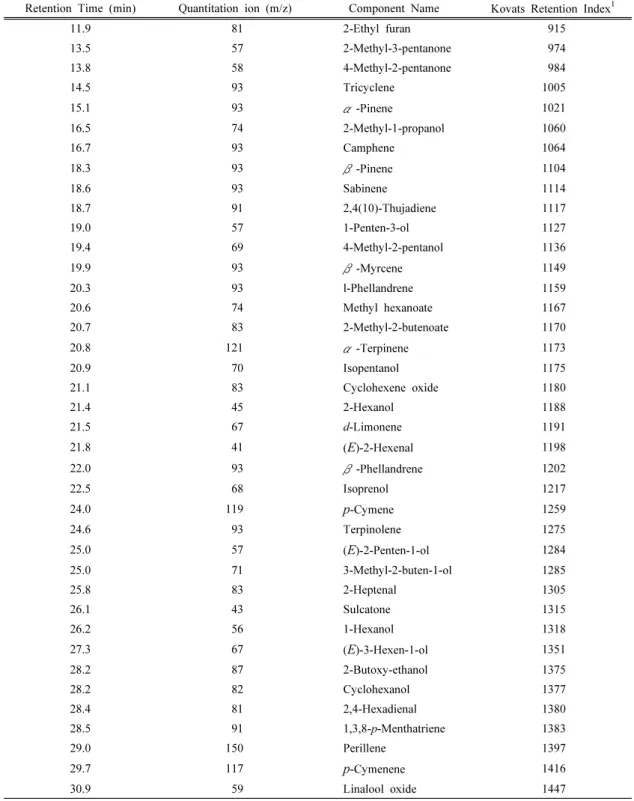
The area of corresponding peaks was calculated by in- tegration of peak intensity on the selected ion monitor- ing chromatogram from the total ion chromatogram (the parameter is shown in Table 3). The calculated area of each compound was normalized by dividing by the internal compound peak area and multiplying by 100 to give the semi-quantitative composition of VOCs. The two-array sample data sets were used for the following statistical analysis.

2.5. Statistical data analysis

Principal component analysis (PCA) was im- plemented on the two-way array to overview data structure and relation trend between data sets. Results were presented as score plots. For further discriminant analysis, the orthogonal partial least square discrim- ination analysis (OPLS-DA) was conducted. OPLS-DA model is a useful discriminant model for metabolic fingerprinting studies of chromatography data sets (Bernal et al., 2016). An OPLS-DA model was there- fore constructed for classification of the samples with chlorophyll variables to determine the important com- pounds among samples. The PCA and OPLS-DA mod- els were created using SIMCA 15 software (Umetrics Inc.), and bivariate correlation analyses were con- ducted using IBM SPSS Statistics (IBM Co., ver 25.0).

3. RESULTS and DISCUSSION 3.1. Pigment analysis

The amounts of Ca, Cb and Cx-c in needle samples are shown in Table 2. The average amount of both Ca and Cb was lowest in litter needles and highest in intact needles, while there was no obvious trend or pattern for Cx-c. During the growing season, chlor-

ophyll is constantly broken down and replaced.

According to Taylor and Whitelaw (2001), abscission is frequently associated with senescence as both proc- esses are initiated in evergreen plants by many of the same developmental as well as environmental and stress factors, such as changed photoperiod and temperature. Abscission involves the shedding of aged or diseased organs and often occurs as a consequence of senescence related to the death of an organism or some part of it. The low efficiency of photosynthesis below a certain threshold causes the senescence of needles and abscission following cessation of photo- synthesis and an endogenous decline in plant hor- mones (Thimann, 1985). As the photoperiod decreases in the fall, the synthesis of new chlorophyll is pre- vented by an abscission layer of cork-like material that forms due to the rapid division of cells near the leaf stem (Webster and Leopold, 1972). This abscission layer prevents transport of carbohydrates and minerals to and from leaf, causing chlorophyll to be broken down but not replaced. Therefore, a lower amount of Ca and Cb in needles is related to senescence or ab- scission, although this relationship is not straightfor- ward because environmental and stress factors can al- so influence Ca and Cb levels.

In the present study, the Ca/Cb ratio was 1.7 ± 0.1 in intact green needles, 1.0 ± 0.1 in senescent yellow- ish-green needles, and 0.7 ± 0.1 in brown litter nee- dles, as shown in Table 2. The Ca/Cb ratio was high in intact needles and low in litter needles because in many species Ca is destroyed more rapidly than Cb in the fall and under water stress (Krammer and Kozlowski, 1979). Therefore, the Ca/Cb ratio was re- garded as a good indicator of three levels of sen- escence (intact, senescent, litter), whereas Ca, Cb, and Cx-c values appear to be poor indicators of senescence as they varied greatly within the same needle sample.

Therefore, the Ca/Cb ratio was used to investigate var-

iation in VOCs among needle samples.

(6)

Retention Time (min) Quantitation ion (m/z) Component Name Kovats Retention Index 1

11.9 81 2-Ethyl furan 915

13.5 57 2-Methyl-3-pentanone 974

13.8 58 4-Methyl-2-pentanone 984

14.5 93 Tricyclene 1005

15.1 93 α -Pinene 1021

16.5 74 2-Methyl-1-propanol 1060

16.7 93 Camphene 1064

18.3 93 β -Pinene 1104

18.6 93 Sabinene 1114

18.7 91 2,4(10)-Thujadiene 1117

19.0 57 1-Penten-3-ol 1127

19.4 69 4-Methyl-2-pentanol 1136

19.9 93 β -Myrcene 1149

20.3 93 l-Phellandrene 1159

20.6 74 Methyl hexanoate 1167

20.7 83 2-Methyl-2-butenoate 1170

20.8 121 α -Terpinene 1173

20.9 70 Isopentanol 1175

21.1 83 Cyclohexene oxide 1180

21.4 45 2-Hexanol 1188

21.5 67 d-Limonene 1191

21.8 41 ( E )-2-Hexenal 1198

22.0 93 β -Phellandrene 1202

22.5 68 Isoprenol 1217

24.0 119 p -Cymene 1259

24.6 93 Terpinolene 1275

25.0 57 ( E )-2-Penten-1-ol 1284

25.0 71 3-Methyl-2-buten-1-ol 1285

25.8 83 2-Heptenal 1305

26.1 43 Sulcatone 1315

26.2 56 1-Hexanol 1318

27.3 67 ( E )-3-Hexen-1-ol 1351

28.2 87 2-Butoxy-ethanol 1375

28.2 82 Cyclohexanol 1377

28.4 81 2,4-Hexadienal 1380

28.5 91 1,3,8-p-Menthatriene 1383

29.0 150 Perillene 1397

29.7 117 p -Cymenene 1416

30.9 59 Linalool oxide 1447

Table 3. The VOCs identified in needle of red pine tree by HS-SPME-GC/MS analysis

(7)

Retention Time (min) Quantitation ion (m/z) Component Name Kovats Retention Index 1

31.4 105 α -Cubebene 1460

32.9 77 Benzaldehyde 1496

33.1 119 α -Copaene 1500

33.6 95 Camphor 1510

34.3 81 β -Bourbonene 1524

35.7 81 Pinocarvone 1551

36.0 149 Methyl thymyl ether 1556

36.3 95 L-Bornyl acetate 1561

36.7 71 Terpinen-4-ol 1568

37.1 161 Longifolene 1577

37.5 105 Methyl benzoate 1584

38.0 161 β -Cubebene 1592

38.3 91 Caryophyllene 1597

38.8 79 Myrtenal 1606

38.9 161 Aromadendrene 1609

39.6 92 Pinocarveol 1620

40.6 69 cis- β -Farnesene 1638

40.7 109 cis -Verbenol 1640

41.3 95 Cryptone 1650

41.7 59 α -Terpineol 1656

42.2 95 Borneol 1665

42.3 93 α -Humulene 1666

43.0 161 γ -Muurolene 1678

43.5 135 Verbenone 1685

43.8 68 Linalool oxide1 1691

44.3 161 Germacrene-D 1699

44.8 105 α -Muurolene 1708

45.0 105 β -Selinene 1712

46.4 161 δ -Cadinene 1741

46.7 161 γ -Cadinene 1748

47.0 79 Myrtenol 1752

48.3 105 α -Cadinene 1778

49.3 135 p -Cymen-8-ol 1798

57.1 79 Caryophyllene oxide 1973

59.5 96 Humulene oxide 2027

62.5 91 Spathulenol 2091

1 Kovats Retention Index : Retention indices were determined using n-alkane C7 to C30 as an external standard

Table 3. (Continued)

(8)

3.2. VOCs analysis by HS-SPME-GC/MS 3.2.1. Preview of VOCs emitted from pine

needles

HS-SPME-GC/MS analysis is a powerful tool for analyzing the metabolomic patterns of essential oils (Goncalves et al., 2012). Table 3, 4, and 5 show the qualitative and semi-quantitative (quantitation was per- formed using an internal normalization method) com- position of the VOCs emitted from the needles in the present study. Each component was identified based on its mass spectrum using a NIST library search program (NIST MS Search 2.0 g). Interestingly, the VOCs con-

tent of the senescent and litter needles was comparable to that of intact needles, but the chemical composition of the VOCs was slightly different.

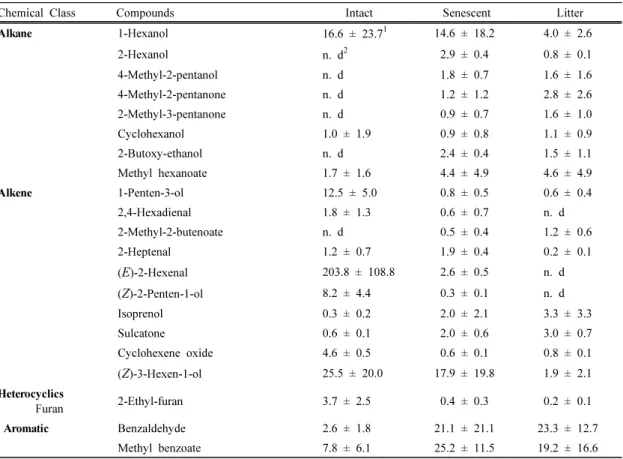
Both non-terpenic aliphatic compounds and terpenic compounds were found in all needles (Table 4 and 5).

The most abundant chemical group consists of terpene compounds: monoterpenes and sesquiterpenes. The major volatile compounds emitted by intact needles were an alkene (2-hexenal), monoterpenes ( α-pinene, β-myrcene, β-phellandrene, myrcene, 2-β-pinene, d-L-limonene, L-bornyl acetate, and camphene), and sesquiterpenes (caryophyllene and germacrene-D).

These results are similar to those of Lee et al. (2005)

Chemical Class Compounds Intact Senescent Litter Alkane 1-Hexanol 16.6 ± 23.7 1 14.6 ± 18.2 4.0 ± 2.6

  2-Hexanol n. d 2 2.9 ± 0.4 0.8 ± 0.1

  4-Methyl-2-pentanol n. d 1.8 ± 0.7 1.6 ± 1.6   4-Methyl-2-pentanone n. d 1.2 ± 1.2 2.8 ± 2.6   2-Methyl-3-pentanone n. d 0.9 ± 0.7 1.6 ± 1.0   Cyclohexanol 1.0 ± 1.9 0.9 ± 0.8 1.1 ± 0.9   2-Butoxy-ethanol n. d 2.4 ± 0.4 1.5 ± 1.1   Methyl hexanoate 1.7 ± 1.6 4.4 ± 4.9 4.6 ± 4.9 Alkene 1-Penten-3-ol 12.5 ± 5.0 0.8 ± 0.5 0.6 ± 0.4   2,4-Hexadienal 1.8 ± 1.3 0.6 ± 0.7 n. d   2-Methyl-2-butenoate n. d 0.5 ± 0.4 1.2 ± 0.6

  2-Heptenal 1.2 ± 0.7 1.9 ± 0.4 0.2 ± 0.1

  ( E )-2-Hexenal 203.8 ± 108.8 2.6 ± 0.5 n. d   ( Z )-2-Penten-1-ol 8.2 ± 4.4 0.3 ± 0.1 n. d

  Isoprenol 0.3 ± 0.2 2.0 ± 2.1 3.3 ± 3.3

  Sulcatone 0.6 ± 0.1 2.0 ± 0.6 3.0 ± 0.7

  Cyclohexene oxide 4.6 ± 0.5 0.6 ± 0.1 0.8 ± 0.1   ( Z )-3-Hexen-1-ol 25.5 ± 20.0 17.9 ± 19.8 1.9 ± 2.1 Heterocyclics

Furan 2-Ethyl-furan 3.7 ± 2.5 0.4 ± 0.3 0.2 ± 0.1 Aromatic Benzaldehyde 2.6 ± 1.8 21.1 ± 21.1 23.3 ± 12.7

Methyl benzoate 7.8 ± 6.1 25.2 ± 11.5 19.2 ± 16.6

1 Compound amount was estimated based on the percent ratio of peak area of identified

compound to internal standard peak area. Each amount was calculated based on extracted ion chromatograms from scanning data.

2 n. d: not detected

Table 4. Relative level of non-terpenic VOCs from red pine needles analyzed by HS-SPME-GC/MS

(9)

Chemical Class Compounds Intact Senescent Litter Monoterpenes

Furan Perillene 0.3 ± 0.1 1 0.4 ± 0.1 0.4 ± 0.2 Bornane   Borneol 21.4 ± 12.7 76.8 ± 87.6 127.1 ± 115.6

Camphor 0.7 ± 0.7 44.8 ± 59.1 53.4 ± 31.4   L -Bornyl acetate 191.8 ± 71.1 50.1 ± 31.4 13.8 ± 8.3 Isocamphane Camphene 179.3 ± 60.7 234.2 ± 37.4 214.4 ± 62.9

Myrcane   Linalool oxide (1) 1.2 ± 0.1 0.4 ± 0.4 1.5 ± 1.9   β- Myrcene 1,170.6 ± 906.1 1,505.1 ± 595.9 833.4 ± 176.1   Linalool oxide (2) n. d 2 6.3 ± 3.6 9.8 ± 5.9 Pinane 2- β -Pinene 386.1 ± 216.6 574.3 ± 219.0 445.9 ± 194.7

  cis -Verbenol 0.9 ± 1.1 1.1 ± 1.0 3.5 ± 3.2   Myrtenal n. d 1.2 ± 0.3 5.6 ± 4.5   Myrtenol 0.5 ± 0.3 4.8 ± 4.5 5.6 ± 2.1   Pinocarveol n. d 2.4 ± 1.0 5.7 ± 2.9   Pinocarvone 0.4 ± 0.2 1.0 ± 0.7 4.9 ± 3.7   Verbenone 0.3 ± 0.1 3.0 ± 3.0 4 ± 3.7   α -Pinene 2,277.2 ± 945.7 3,153.4 ± 560.3 2,759.2 ± 421.8 p -Menthane 1,3,8- p -Menthatriene 0.8 ± 0.4 2.5 ± 0.4 2.1 ± 0.7

  Cryptone 2.2 ± 1.4 2.1 ± 0.3 1.5 ± 1.1   d -Limonene 248.6 ± 92.7 344.2 ± 54.7 299.8 ± 57.9   l-Phellandrene 31.6 ± 17.1 26.7 ± 6.8 88.2 ± 129.0   Methyl thymyl ether 98.5 ± 83.3 90 ± 23.3 57.9 ± 21.8   p -Cymen-8-ol 2.2 ± 1.6 10.1 ± 7.1 13.5 ± 9.7   p -Cymene 9.5 ± 3.7 31.1 ± 5.0 86.6 ± 47.5   p -Cymenene 3.5 ± 2.6 19.7 ± 13.2 35.2 ± 24.0   Terpinen-4-ol 2.0 ± 2.0 1.8 ± 1.8 2.0 ± 1.4

Terpinolene 308.8 ± 187.9 531.2 ± 105.0 305.2 ± 85.6 α -Terpinene 7.5 ± 3.1 5.7 ± 1.3 3.7 ± 1.1 α -Terpineol 1.0 ± 1.0 5.1 ± 2.5 5.6 ± 4.5 β -Phellandrene 1,918.8 ± 974.3 1,837.4 ± 312.9 1,210.2 ± 240.1 Thujane 2,4(10)-Thujadiene 0.7 ± 0.6 1.4 ± 1.1 3.3 ± 3.5

Sabinene 45.5 ± 29.5 33.5 ± 24.4 10.1 ± 7.3 Sesquiterpenes

Aromadendrane Aromadendrene 4.3 ± 2.0 4.5 ± 2.1 5.0 ± 1.5

  Spathulenol 0.4 ± 0.2 2.6 ± 1.6 2.3 ± 1.0

Bicyclogermacrane Bicyclogermacrene 31.7 ± 15.1 6.8 ± 5.8 4.0 ± 1.3

Bourbonane β -Bourbonene 5.9 ± 5.2 10.0 ± 4.9 14.3 ± 3.2

Table 5. Relative ratio level of terpenic VOCs from red pine needles analyzed by HS-SPME-GC/MS

(10)

and Yu et al. (2004).

The VOCs composition emitted from senescent and litter needles was similar to that of intact needles, but the emissions of germacrene-D, 2-hexenal, and L-bornyl acetate were much lower in the senescent and litter needles. Several alkanes, such as a C6 compound of 2-hexanol, C5 compounds of 4-methyl-2-pentanol, 4-methyl-2-pentanone, and 2-methyl-3-pentanone, and a C4 compound of 2-butoxyethanol, were detected on- ly in the senescent and litter needles, in addition to terpenic compounds, such as linalool oxide, myrtenal, pinocarveol, p-cymene, p-cymenen, caryophyllene ox- ide, and humulene oxide. According to Isidorov et al.

(2003), oxidized or modified forms of terpenes were

increased or found only in the litter needles of the Scots pine, including toluene, p-cymene, verbenene, p-cymenen, p-cymene-8-ol, anisaldehyde, and linalool acetate as minor compounds. The authors suggested that most of these compounds are secondary products of microorganism metabolism involving dehydration and oxidation of precursor terpenic compounds in in- tact needles. Our results are similar to those of Isidorov et al. (2003), but the experimental evidence on this topic is insufficient and further study is needed.

3.2.2. Multivariate analysis

As shown in Table 4 and Table 5, major compounds with higher ratio values are more important than minor Chemical Class Compound Name Intact Senescent Litter

  Cadinane α -Cadinene 5.3 ± 2.5 3.6 ± 1.5 3.8 ± 1.1     γ -Cadinene 32.1 ± 13.9 34.7 ± 7.0 45 ± 8.3     δ -Cadinene 49 ± 20.4 49.4 ± 8.9 59.7 ± 13.1   Caryophyllane Caryophyllene 196.6 ± 67.5 246.9 ± 46.3 213.5 ± 24.1     Caryophyllene oxide 0.8 ± 0.3 7.0 ± 2.2 12.8 ± 5.8   Copaane α -Copaene 13.2 ± 5.8 16.2 ± 2.8 18.1 ± 2.2   Cubebane α -Cubebene 8.0 ± 3.0 8.4 ± 1.9 9.3 ± 1.0     β -Cubebene 6.7 ± 3.1 5.8 ± 2.0 6.8 ± 1.1   Eudesmane α -Selinene 5.4 ± 2.5 9.0 ± 3.1 9.9 ± 3.1     β -Selinene 6.2 ± 2.9 10.2 ± 3.7 12.1 ± 3.8   Farnesane cis - β -Farnesene 4.5 ± 3.0 8.8 ± 6.9 6.8 ± 3.0   Germacrane Germacrene-D 122.8 ± 61.4 54.4 ± 37.3 35.6 ± 30.5   Humulane Humulene oxide n. d 1.1 ± 0.4 1.9 ± 1.0     α- Humulene 89.8 ± 34.4 107.4 ± 19.3 101.7 ± 17.6   Longifolane Longifolene 14.7 ± 6.3 21.5 ± 8.6 21.9 ± 6.3   Muurolane α -Muurolene 16.0 ± 7.4 12.9 ± 2.6 16.5 ± 3.2     γ -Muurolene 24.0 ± 10.4 22.1 ± 5.8 28.8 ± 2.8 Hemiterpeneste Isopentanol 0.8 ± 0.1 7.0 ± 1.8 9.0 ± 10.2 2-Methyl-1-propanol 0.2 ± 0.1 0.4 ± 0.3 0.5 ± 0.2 3-Methyl-2-buten-1-ol 0.4 ± 0.6 7.0 ± 2.9 4.7 ± 7.8

1 Compound amount was estimated based on the percent ratio of peak area of identified compound to internal standard peak area. Each amount was calculated based on extracted ion chromatograms from scanning data.

2 n. d: not detected

Table 5. (Continued)

(11)

compounds with lower ratio values. However, the more compounds in a sample, the more complex and difficult it becomes to determine which compounds differ between levels of senescence. Therefore, we used a clustering and correlation statistical technique to determine which compounds among the VOCs of needles are most important for identifying senescence, and then to investigate changes in VOCs during sen- escence or after shedding.

In order to improve the quality of the data by re- ducing inconsistency and noise, pre-processing algo- rithms were applied to the raw data. To minimize data skewness, the log transformation (log x) was applied to the raw data in Table 4 and Table 5, and then Pareto scaling was applied to eliminate the unfavorable ef- fects among compounds present in substantially differ- ent amounts.

PCA model of VOCs from pine needles

PCA was applied to the pre-processed data to inves- tigate the correlation structure.

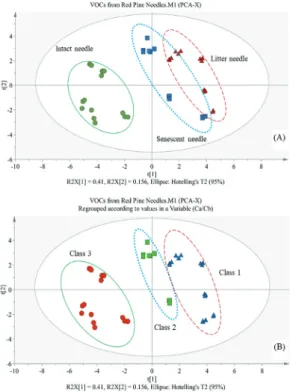
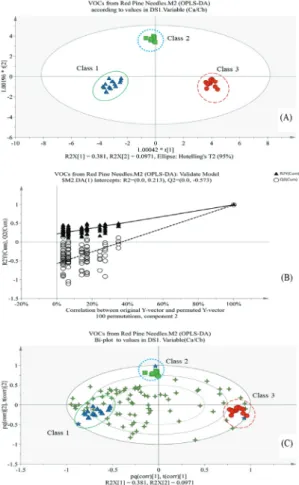
On the PCA-derived score plot (Fig. 1A), intact nee- dles were located far from senescent and litter needles, indicating that intact needles are different based on principal component (PC) 1. The first two PCs were able to explain 56.7% of the total variance of the vari- able set, and there was no outlier in this model.

However, there was overlap between senescent and lit- ter needles; therefore, it was not possible to differ- entiate these two variables on this PC1 and PC2 plane model. While chlorophyll content variation was high among samples due to the ecological environment (Shan et al., 1996), seasonal variation (Gond et al., 1999; Deligoz et al., 2018), soil type, etc., the Ca/Cb ratio has lower deviation in the same sampling part and was significantly different between samples.

Therefore, the Ca/Cb ratio was used to define classes in a PCA-derived score plot (Fig. 1B) with three classes (Ca/Cb ratio values: Class 1, 0.5 –0.95; Class

2, 0.95 –1.35; Class 3, 1.35–1.80). The senescent and litter needles were more easily differentiated based on Ca/Cb ratio; Y31, Y32, and Y33 were close to the litter needles (Class 1) due to their low Ca content (Table 2). Thus, it is thought that the Ca/Cb ratio value is an ideal discriminant variable for intact and litter needles on the PC1 plane of a PCA-derived score plot.

OPLS-DA model of VOCs from pine needles The OPLS-DA model was applied to the data set after reprocessing according to Ca/Cb ratio classes in order to investigate variability in chemical compounds to discriminate between senescence levels in needles.

The resulting score plot (Fig. 2A) shows that classi-

Fig. 1. PCA score plot of the volatile compounds of intact (green round), senescent (blue square), and litter (red triangle) needles according to sample (A). The Ca/Cb ratio was used to define classes in a PCA-derived score plot (B) with three classes (Class 1: Ca/Cb ratio values 0.5 –0.95; Class 2: Ca/Cb ratio values 0.95–1.35;

Class 3: Ca/Cb ratio values 1.35 –1.80).

(12)

fication is possible based on Ca/Cb ratio classes. The plot (Fig. 2B) strongly indicates that the original mod- el is valid; all predicted Q2-values are lower than the original points and the regression line of the Q2-points intersects the vertical axis below zero. Also, all R2-values to the left are lower than the original points to the right, which is another indication of the validity of the original model.

The variable importance for the projection (VIP) plot (Fig. 3) summarizes the importance of the varia-

bles both to explain variables (compounds) and to cor- relate to sample character in a statistical projected plane. The non-terpenic compounds (E)-2-hexenal, 1-penten-3-ol, 4-methyl-2-pentanone, 2-ethyl furan, (Z)-3-hexen-1-ol, and 2-penten-1-ol, and terpenic com- pounds of camphor, L-bornyl acetate, myrtenol and caryophyllene oxide were importantly found (VIP val- ue > 1.0 ) in the VIP plot, and deviated more among needles than the terpenic compounds. Most strong (VIP value > 1.5) VIPs were camphor and 1-pent- en-3-ol, without 2-hexenal due to its large deviation, and were thought to have the critical role in the overall discrimination in the OPLS-DA-derived score plot, es- pecially to explain the differences between intact and litter samples. And figure 2C shows the distribution of VOCs related to sample classification; their dis- tribution deviated among needle samples. The con- tribution list (Table 6) from the bi-plot (Fig. 2C) shows the difference between each point (scaled and centered as the workset) and the average of the model, which indicates the characteristics of each class and which compounds are discriminants. For the intact needles (Class 1), 1-penten-3-ol and 2-ethyl furan, and L-bornyl acetate were the strong (score > 1.5) contrib- utors to the dissimilarity of this class to the others, while camphor, pinocarvone, and myrtenol were for

Fig. 2. OPLS-DA analysis based on Ca/Cb ratio classes (Class 1: Ca/Cb ratio values 0.5-0.95; Class 2: Ca/Cb ratio values 0.95 –1.35; Class 3: Ca/Cb ratio values 1.35–1.80).

(A): OPLS-DA derived score plot, (B): OPLS-DA permutation plot, (C): OPLS-DA bi-plot.

Fig. 3. The major volatile metabolites identified in red pine needles according to variables importance plot (VIP

> 1.0) for OPLS-DA derived score plot.

(13)

Class 3 (litter needles), and 2-heptanal, β-myrcene, 3-methyl-2-buten-1-ol, and spathulenol were for of Class 2 (senescent needles) in the OPLS-DA-derived score plot plane. 1-Penten-3-ol and camphor were most strong contributors for intact (Class 1) and litter (Class 3) needle, respectively, which result had a same trend with the result by VIP values evaluation.

The content of the leaf aldehyde (E)-2-hexenal, an aroma-active compound of fresh red pine needles (Yu et al., 2004), was higher in intact needles and almost absent in litter needles (Table 4). The content of the leaf alcohol (Z)-3-hexen-1-ol followed a similar pat- tern to (E)-2-hexenal. The C6 volatile compounds (Z)-3-hexen-1-ol and (E)-2-hexenal are biosynthesized via the lipoxygenase pathway, which includes a secon- dary hydroxyperoxide lyase reaction from unsaturated fatty acids, such as linolenic acid and linoleic acid, and the formation of the C5 volatile compounds 1-penten-3-ol and 2-penten-1-ol from inhibited secon-

dary hydroxyperoxide lyase (Shen et al., 2014). The levels of (E)-2-hexenal, 1-penten-3-ol, (Z)-3-hexen-1-ol, and 2-penten-1-ol were significantly higher in intact needles than in senescent and litter needles, and these compounds with high VIP values were characteristic non-terpenic compounds of intact needles. As for ter- penic compounds, also shown in Table 4 and Table 5, the content of camphor, an oxidized form of mono- terpene with a borane skeleton, was higher in sen- escent and litter needles than in intact needles, while the opposite was true of L-bornyl acetate, which fea- tures the same borane skeleton. Furthermore, the lev- els of p-cymenene and p-cymene, which are chemi- cally stable compounds due to the presence of a ben- zene ring, were higher in litter than intact needles, while the content of labile bicyclogermacrene and ger- macrene-D were higher in intact needles. Oxidized or modified terpenes were contributors (Table 6) and had high VIP values (Fig. 3) in litter needles in the

Class according to

Ca/Cb ratio Compound Name Chemical Class Score Contrib (Group - Average), Weight=p1p2

Class 1 1-Penten-3-ol alkene 2.50226

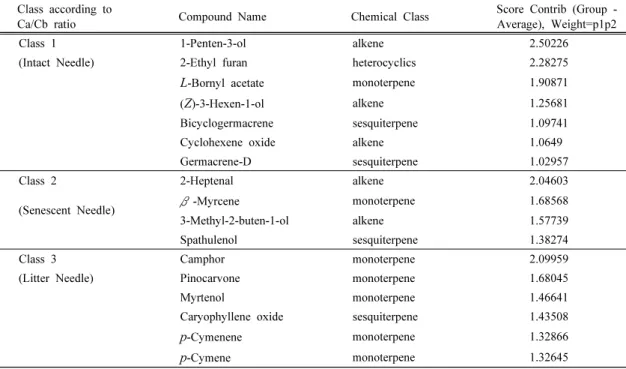
(Intact Needle) 2-Ethyl furan heterocyclics 2.28275 L -Bornyl acetate monoterpene 1.90871 ( Z )-3-Hexen-1-ol alkene 1.25681 Bicyclogermacrene sesquiterpene 1.09741 Cyclohexene oxide alkene 1.0649 Germacrene-D sesquiterpene 1.02957

Class 2 2-Heptenal alkene 2.04603

(Senescent Needle) β -Myrcene monoterpene 1.68568 3-Methyl-2-buten-1-ol alkene 1.57739 Spathulenol sesquiterpene 1.38274

Class 3 Camphor monoterpene 2.09959

(Litter Needle) Pinocarvone monoterpene 1.68045

Myrtenol monoterpene 1.46641

Caryophyllene oxide sesquiterpene 1.43508 p -Cymenene monoterpene 1.32866

  p -Cymene monoterpene 1.32645

Table 6. The major VOCs identified in red pine needles according to contribution plot (weight > 1.0) list of

OPLS-DA derived score plot

(14)

OPLS-DA model, and were characteristic compounds of senescent and litter needles.

Therefore, it was suggested that the oxidation re- action involving the lipoxygenase pathway occurred in the intact needles, to a lesser extent or not at all in the senescent and litter needles, and that the terpenic compounds were also degraded or modified during senescence or after shedding. Unfortunately, in this paper, there were no experimental data on the evi- dence about oxidation, degradation, and modification reactions of VOCs in the process of senescence and shedding.

Bivariate regression of important variables with Ca/Cb ratio

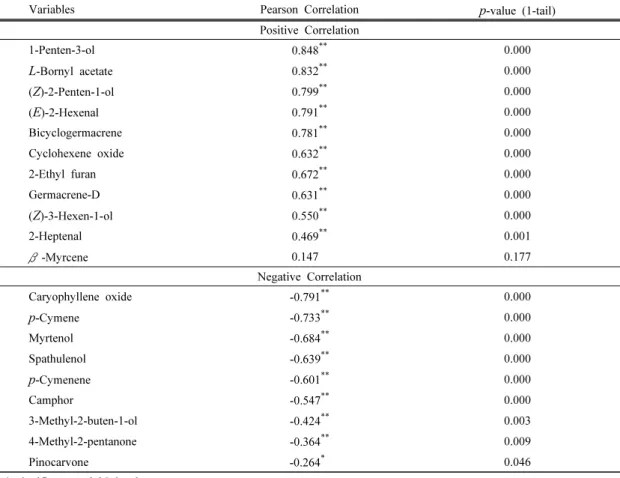
Variables of contribution list (Table 6) and VIP plot (Fig. 3), were further processed by a bivariate re- gression with Ca/Cb ratio with no data transformation, to find out which compound has more higher correla- tion with Ca/Cb ratio, meaning the dependence on de- gree of senescence or after shedding.

As shown in Table 7, with the exception of β -myrcene, all variable revealed significant (p > 0.01) correlation coefficients with a sign of positive or negative. The level of variables of positive correlation

Variables Pearson Correlation p -value (1-tail) Positive Correlation

1-Penten-3-ol 0.848 ** 0.000

L -Bornyl acetate 0.832 ** 0.000

( Z )-2-Penten-1-ol 0.799 ** 0.000

( E )-2-Hexenal 0.791 ** 0.000

Bicyclogermacrene 0.781 ** 0.000

Cyclohexene oxide 0.632 ** 0.000

2-Ethyl furan 0.672 ** 0.000

Germacrene-D 0.631 ** 0.000

( Z )-3-Hexen-1-ol 0.550 ** 0.000

2-Heptenal 0.469 ** 0.001

β -Myrcene 0.147 0.177

Negative Correlation

Caryophyllene oxide -0.791 ** 0.000

p -Cymene -0.733 ** 0.000

Myrtenol -0.684 ** 0.000

Spathulenol -0.639 ** 0.000

p -Cymenene -0.601 ** 0.000

Camphor -0.547 ** 0.000

3-Methyl-2-buten-1-ol -0.424 ** 0.003

4-Methyl-2-pentanone -0.364 ** 0.009

Pinocarvone -0.264 * 0.046

* significant at 0.05 level

** significant at 0.01 level

Table 7. Bivariate correlation coefficients between Ca/Cb ratio and variables extracted from contributors

(Table 6) and VIPs (Fig. 3)

(15)

coefficients increase dependently on Ca/Cb ratio in- crease, which reflects the closeness to being intact, while for negative correlation Ca/Cb ratio dependently decreases which reflects the closeness to being litter.

1-Penten-3-ol had the highest positive correlation coefficient, while caryophyllene oxide had the neg- ative one. Interestingly, this result informs of im- portance of 1-penten-3-ol as an excellent discriminant of intact needle, in that this is a strong contributor for intact needle and also important VIP on OPLS-DA evaluation. However, camphor, having strong con- tribution to litter needle and the highest VIP value, revealed relatively low negative correlation coefficient but significant. This result was thought to be derived by very low content of intact needle and high content of senescent and litter needles (Table 5) because re- sultantly data points deviated largely from linear re- gression line.

From the additional bivariate regression analysis, several compounds of VOCs in red pine needle in- crease or decrease proportionally to degree of sen- escence of needle, represented by the Ca/Cb ratio. And it was thought that these compounds react very sensi- tively and sequentially to surrounding environment changes during senescence or after shedding and would be useful as indicators or makers for degree of sensescence or aging after shedding.

4. CONCLUSION

The present study successfully determined which VOCs in red pine needles are changed over the course of senescence or after shedding by statistical analyses and finally revealed similarities and dissimilarities among intact, senescent, and litter needles. The Ca/Cb ratio was a good indicator of whether needle was in- tact or not; the intact needle had higher average Ca/Cb ratio than the senescent and the litter needles. Whether needles were intact, senescent, or litter was well ex-

plained by multivariate statistical interpretation of VOCs using the PCA and the OPLS-DA models with Ca/Cb ratio values as a classification variable.

Further investigation on effects of variables (chemical components) to needle classification re- vealed several significant compounds. 1-Penten-3-ol and camphor were most strong contributors for intact (Class 1) and litter (Class 3) needle, respectively, which result had a same trend with the result by VIP values evaluation. The oxidation reaction involving the lipoxygenase pathway occurred in the intact nee- dles, to a lesser extent or not at all in the senescent and litter needles, and that the terpenic compounds were also degraded or modified during senescence or after shedding. The content of compounds having high correlation coefficient would increase or decrease pro- portionally to degree of senescence of needle, repre- sented by the Ca/Cb ratio, indicating that these com- pounds react very sensitively and sequentially to sur- rounding environment changes during senescence or shedding.

In addition, this study suggests that senescent and litter needles along with intact needles are also good bioresources of biogenic volatiles in the forest ecosys- tem and fragrance and flavor industry because major compounds of VOCs were also found between nee- dles, but their chemical composition or content of sev- eral chemical compounds are markedly different. It was thought that further works on biological or phys- iological or environmental pathway should be con- ducted to elucidate or explain the deviation of VOCs in needle samples.

REFERENCES

Ahn, C., Park, M.J., Kim, J.W., Yang, J., Lee, S.S.,

Jeung, E.B. 2018. Cytotoxic evaluation of plant

essential oils in human skin and lung cells. Journal

of the Korean Wood Science and Technology 46(2):

(16)

166-177.

Bernal, F.A., Orduz-Díaz, L.L., Coy-Barrer, E.C. 2016.

Application of PARAFAC and OPLS-DA analyses on HPLC fingerprints for the characterization of Hibiscus sabdariffa Calyxes. Quím. Nova 39(2):

160-166.

Deligoz, A., Bayar, E., Genc, M., Karatepe, Y., Kirdar, E., Cankara, F.G. 2018. Seasonal and needle age-related variations in the biochemical characteristics of Pinus nigra subsp. pallasiana (Lamb.) Holmboe.

Journal of Forest Science 64(9): 379-386.

Finkelstein, R. 2013. Abscisic acid synthesis and response. The Arabidopsis Book / American Society of Plant Biologists. 11: e0166.

doi:10.1199/tab.0166. PMC 3833200. PMID 24273463.

Goncalves, J., Figueira, J., Rodrigues, F., Camara, J.S.

2012. Headspace solid-phase microextraction combined with mass spectrometry as a powerful analytical tool for pro filing the terpenoid metabolomic pattern of hop-essential oil derived from Saaz variety. Journal of Separation Science 35(17):

2282-2296.

Gond, V., Pury, D., Veroustraete, F., Ceulemans, R.

1999. Seasonal variations in leaf area index, leaf chlorophyll, and water content; scaling-up to estimate fAPAR and carbon balance in a multilayer, multispecies temperate forest. Tree Physiology 19(10): 673-679.

Isidorov, V.A., Smolewska, M., Purzynska-Pugacewicz, A., Tyszkiewicz, Z. 2010. Chemical composition of volatile and extractive compounds of pine and spruce leaf litter in the initial stages of decompo- sition. Biogeosciences 7: 2785-2794.

Isidorov, V.A., Vinogorova, V.T., Rafaowski, K. 2003.

HS-SPME analysis of volatile organic compounds of coniferous needle litter. Atmospheric Environment 37(3): 4645 –4650.

Jeong, M.J., Yang, J., Choi, W.S., Kim, J.W., Kim, S.J., Park, M.J. 2017. Chemical compositions and

antioxidant activities of essential oil extracted from Neolitsea aciculata (Blume) Koidz leaves. Journal of the Korean Wood Science and Technology 45(1):

96-106.

Jo., G.G., Kim, J.H. 2010. Changes in terpenes of three kinds of pine needles during litter decomposition.

Journal of Ecology and Field Biology 33(2):

175-186.

Kim, S.H., Lee, S.Y., Cho, S.M., Hong, C.Y., Park, S.Y., Park, M.J., Choi, I.G. (2017). Antioxidant activities of Cryptomeria japonica leaves extracts by extraction methods. Journal of the Korean Wood Science and Technology 45(5): 495-510.

Krammer, P. J., Kozlowski, T.T. 1979. Physiology of Wood Plants. Academic Press Inc, pp. 550-554.

Lee, J.G., Lee, C.G., Back, S., Jang, H.J., Kwag, J.J., Lee, G.H. 2005. Volatile compounds of pine needles from Pinus densiflora S. using solid phase microextraction- gas chromatography-mass spectrometry. Korean Journal of Food and Nutrition 18(4): 373-379.

Lichtenthaler, H.K., Wellburn, A.R. 1983. Determinations of total carotenoids and chlorophylls a and b of leaf extracts in different solvents. Biochemical Society Transaction 11(5): 591-592.

Shan, Y., Izuta, T., Aoki, M., Totsuka, T. 1996. Effects of O 3 and soil acidification, alone and in combina- tion, on growth, gas exchange rate and chlor- ophyll content of red pine seedlings. Water, Air, and Soil Pollution 97: 355-366.

Shen. J., Tieman, D., Jones, J.B., Taylor, M.G., Schmelz, E., Huffaker, A., Bies, D., Chen, K., Klee, H. J.

2014. A 13-lipoxygenase, TomloxC, is essential for synthesis of C5 flavour volatiles in tomato. Journal of Experimental Botany 65(2): 419-428.

Talyor, J.E., Whitelaw, C.A. 2001. Signals in abscission.

New Phytologist 151(2): 323-339.

Thimann, K.V. 1985. The interaction of hormonal and

environmental factors in leaf senescence. Biologia

Plantarum 27(2): 83-91.

(17)

Venkatesan, T., Choi, Y.W., Kim, Y.K. 2020. Comparative evaluation of the impact of extraction solvent and time on the yield and antioxidant potential of Pinus densiflora needle and bark extracts. Wood Science and Technology 54: 587-598.

Wang, M., Schurgers, G., Hellen, H., Lagergren, F., Hoist, T. 2018. Biogenic volatile organic compound emissions from a boreal forest floor. Boreal Environment Research 23: 249-265.

Webster, B.D., Leopold, A.C. 1972. Stem abscission in Phaseolus vulgaris explants. Botanical Gazette 133(3): 292-298.

Wellburn, A.R. 1994. The spectral determination of chlorophyll a and b, as well as total carotenoids, using various solvents with spectrophotometers of

different resolution. Journal of Plant Physiology 144(3): 307-313.

Yang, J., Choi, W.S., Kim, J.W., Lee, S.S., Park, M.J.

2019. Anti-inflammatory effect of essential oils extracted from wood of four coniferous tree species.

Journal of the Korean Wood Science and Technology 47(6): 674-691.

Yu, E.J., Kim, T.H., Kim, K.H., Lee, H.J. 2004. Aroma ‐ active compounds of Pinus densi flora (red pine) needles. Flavour and Fragrance Journal 19(6):

532-537.

Zhang, X., Wang, B., Liuc, Z. 2018. Coniferous litter

extracts inhibit the litter decomposition of Catalpa

fargesii Bur. and Eucommia ulmoides Oliver. Acta

Oecologica 93: 7-13.

수치

Table 1. Characteristics of red pine needle samples
Table 2. Content of chlorophyll a (Ca), chlorophyll b (Cb), and carotenoid in red pine needles according to spectrophotometric determination
Table 3. The VOCs identified in needle of red pine  tree by HS-SPME-GC/MS analysis
Table 4. Relative level of non-terpenic VOCs from red pine needles analyzed by HS-SPME-GC/MS
+5

참조

관련 문서

The purpose of this study is to investigate changes in listening, reading achievement, and learning attitudes of Korean elementary students who enrolled in

In this study, we have fabricated the 660 nm red LED illumination controller and LED array module and evaluated the proliferation and differentiation

This study was conducted to investigate the effects of 12 weeks after school physical activity program on body composition and PAPS in obese elementary

In SDE extraction, a total of 117, 115 and 120 volatile compounds were detected in Aster yomena, Aster tataricus and Chrysanthemum zawadskii, individually, whereas their total

The purpose of this study was to investigate how the BOSU Ball exercise, which can develop core muscles in middle-aged women, affects body composition and

Purpose: This study was aimed to compare the functional outcomes of the continuous and discontinuous fractures, retrospectively, in multiple thoracolumbar

To investigate the PL quenching sensitivity behaviors of the organic vapor, an organic vapor sensor based on rugate PSi filters was fabricated and tested

1 John Owen, Justification by Faith Alone, in The Works of John Owen, ed. John Bolt, trans. Scott Clark, "Do This and Live: Christ's Active Obedience as the