건강신념모델에 근거한 노인 대상 식품안전・영양교육 프로그램 효과 평가
최정화1․이은실2․이윤진2․이혜상3․장혜자4․이경은5․이나영6․안 윤5․곽동경2
1숭의여자대학교 식품영양과, 2연세대학교 식품영양학과
3안동대학교 식품영양학과, 4단국대학교 식품영양학과
5서울여자대학교 식품영양학과, 6대전대학교 식품영양학과
Food Safety and Nutrition Education Program for Elderly and Assessment of Program Effectiveness Based on Health Belief Model
Jung-Hwa Choi1, Eun-Sil Lee2, Yoon-Jin Lee2, Hye-Sang Lee3, Hye-Ja Chang4, Kyung-Eun Lee5, Na-Young Yi6, Yoon Ahn5, and Tong-Kyung Kwak2
1Department of Food & Nutrition, Soongeui Women's College
2Department of Food & Nutrition, Yonsei University
3Department of Food & Nutrition, Andong University
4Department of Food Science & Nutrition, Dankook University
5Department of Food & Nutrition, Seoul Women's University
6Department of Food Science & Nutrition, Daejeon University
ABSTRACT Most elderly have difficulties in managing food safety and nutrition by themselves. Various nutrition educations for the elderly have been developed, but food safety and nutrition education program and educational tools for the elderly are very limited. The aim of the study was to evaluate a food safety and nutrition education program based on the Health Belief Model (HBM) for the elderly. Education program was implemented for 220 seniors (137 educated group and 83 control group) aged over 65 years at senior welfare community centers. The intervention study was carried out on a weekly basis during each of 5 weeks, and each session lasted about 35 or 40 minutes. The effectiveness of the program was assessed with a questionnaire before and after education. Education program consisted of a 5 week program, and topics were ‘Dietary changes for the elderly's healthy life’, ‘Prevention of food poisoning in everyday life’, ‘Safe food handling for my health’, ‘Healthy dietary life to prevent chronic disease’, and ‘Safety!
nutrition! healthy dietary life’. Education program materials such as slides, handouts, videos, leaflet, and booklets were developed. As a result, there were score improvements in knowledge, dietary behaviors, and health belief after intervention in the intervention group, which were higher than those of the control group. In particular, there was a meaningful interrelation between dietary behavior and health belief (r=0.520, P<0.001). This finding suggests that changing beliefs is very important to make desirable dietary behavioral changes. For this reason, we can conclude HBM theory is an effective model to educate nutrition and food safety for the elderly. Furthermore, food safety and nutrition education programs are implemented and delivered continuously at various settings such as a health center or community welfare center, and those will contribute significantly to enhance perception and change their desirable dietary behaviors for the elderly.
Key words: elderly, food safety, nutrition education, Health Belief Model, effectiveness assessment
Received 15 February 2016; Accepted 17 August 2016 Corresponding author: Tong-Kyung Kwak, Department of Food &
Nutrition, Yonsei University, Seoul 03722, Korea E-mail: [email protected], Phone: +82-2-2123-3120
서 론
우리나라 65세 이상 인구가 차지하는 비율은 2019년 14.3%인 고령사회(aged society), 2026년에는 20.8%인 초고령사회(super-aged society)에 도달할 것으로 전망되 고 있다(1). 사회와 가정구조의 변화로 노인가정과 독거노인
이 증가하고 있으며, 신체적 노화와 만성질환, 경제적 어려 움 등으로 인해 장보기와 식사준비에 어려움을 겪고 있다(2).
노년기는 노화로 인하여 소화 및 흡수 기능의 저하, 만성퇴 행성 질환의 발병 등에 의한 영양소의 체내 이용률 감소 등 신체적인 변화로 영양 불량 위험이 증가하는 시기이다(3,4).
식품안전 측면에서도 노인은 다른 연령층과 비교할 때 비위 생적으로 식품을 관리하는 비율이 더 높은 것으로 보고되었 다(5-7).
노년기의 건강문제는 생활습관의 변화를 통하여 예방될 수 있고, 건강증진 행위를 통하여 질병을 예방하고 건강하게
Table 1. Education topics and materials for the elderly
Class Education topics Materials
1 2 3 4 5
Dietary change for the elderly's healthy life Prevention of food poisoning in everyday life Safe food handling for my health
Healthy dietary life to prevent chronic disease Safety! nutrition! healthy dietary life
PPT slides, handout, booklet
PPT slides, video, milk, magnifier, handout, booklet
PPT slides, view box, fluorescence lotion, soap, handout, booklet PPT slides, video, handout, booklet
PPT slides 생활할 수 있으며 삶의 질을 높일 수 있다(8). 노인들은 예방
적인 차원에서 건강한 생활을 위한 영양관리와 안전한 식품 취급 행위를 유지할 수 있도록 교육이 필요한 시점이다. 노 인들이 올바른 지식을 가지고 건강생활을 추구하는 태도와 행동을 통해 스스로 건강을 책임질 수 있도록 유도할 필요가 있다(9).
영양교육은 개인이 건강한 식생활을 실천하는 데 필요한 지식(knowledge)을 바르게 이해하고, 식생활을 실천하는 능력을 높이고자 하는 태도(attitude)를 변화시키고, 스스로 식생활에 관한 행동(behavior)으로 옮겨 실천하게 하는 일 련의 KAP(knowledge, attitude, practice) 과정이다(10).
영양교육은 영양지식에 중점을 둔 인식적 측면이 강조된 프 로그램보다는 태도와 식행동을 확립할 수 있는 실천적인 측 면의 변화가 중요하며(11), 식행동의 변화를 일으킬 수 있는 동기와 지식 및 실행능력을 높임으로써 자발적이고 지속적 인 효과를 가져온다(12,13).
본 연구에서는 건강신념모델을 적용하여 교육프로그램을 개발하였는데, 건강신념모델(Health Belief Model, HBM) 은 1950년대 후반 질병의 조기발견과 예방접종과 같은 예방 적 건강행동을 설명하기 위한 모델로 개발되었으며(14), 개 인의 건강신념과 건강행위 사이의 관련성을 설명하기 위해 건강관련 분야에서 많이 활용되고 있다(15). 건강신념모델 을 적용하여 노인의 건강신념 변수와 안전한 식품 취급 행동 사이의 관계를 식중독의 인지된 위협, 행위단서, 그리고 안 전한 식품 취급 행동의 변수로 측정한 결과 노인의 식품 취 급 행동을 조사하는 유용한 틀이라고 제시하였다(14,16).
영양교육 이론 중 건강신념모델은 의식을 증가시키고 동기 를 향상시키는 데 기여할 수 있는 이론으로 여겨진다.
노년기의 건강한 식생활은 영양적 균형과 함께 안전한 식 품 섭취를 통해 달성될 수 있으나, 국내에서 기존에 개발된 교육 콘텐츠는 영양적 측면의 자료와 프로그램이 주를 이루 고 있다(13,17-19). 따라서 노인의 요구나 필요성을 반영하 며, 영양적 측면과 함께 식품의 안전한 관리를 포함하는 보 다 포괄적인 식생활교육 프로그램이 요구된다.
본 연구는 건강신념모델을 적용하여 노인의 인식 변화가 바람직한 식행동으로 이어지도록 하기 위한 식품안전・영양 교육 프로그램을 시범 시행하고 그 효과를 평가하였다.
대상 및 방법 교육 대상
본 조사 대상자는 도시(서울, 청주)와 농어촌(의성, 진천) 의 노인 복지관에서 65세 이상 노인 교육군 200명과 대조군 100명을 편의추출법으로 모집하고, 자발적인 참여 의사를 밝힌 대상자에 한하였다.
교육 프로그램과 시행
교육 기간은 2011년 7월 28일부터 9월 9일까지 총 5주간 매주 1회, 35~40분씩 교육을 시행하였다. 각 복지관에서 교육 하루 전날 연구보조원들이 모든 교육 참여자에게 개별 적으로 연락을 취하여 교육에 참여할 수 있게 하였다. 식품 안전・영양교육 프로그램은 포커스그룹 인터뷰와 델파이조 사를 통해 5주차로 구성되었으며 Table 1에 제시하였다 (20). 교육은 건강신념모델을 적용하여 노인들이 식습관을 변화하지 않을 경우 질병 가능성을 알려 심각성을 인지하도 록 하였으며 노인들이 식행동 수정 시 얻게 되는 이득을 알 려주고 행동을 실행할 수 있도록 자아효능감을 제공해주고 자 하였다. 교육매체는 슬라이드, 생활실천 체크리스트가 포 함된 유인물, 식중독 뉴스와 어르신을 위한 건강요리 동영 상, 식생활 안전・영양 가이드 소책자를 이용하였다. 교육은 실생활에서 행동수정이 가능한 행동지침을 제시하였으며 참여형태의 교육과 퀴즈를 포함하여 교육 참여자들이 주도 적 학습을 할 수 있도록 하였다.
교육 프로그램 효과 평가
교육군과 대조군은 교육이 시작하는 1차 시와 종료되는 5차 시에 교육 평가를 하였으며, 교육군은 총 5회 교육 중 3회 이상 교육을 받은 노인의 평가를 분석에 이용하였다.
설문지는 대상자가 직접 기입하는 자기기입식으로 하였고, 대상자의 특성상 도움이 필요한 경우 연구자와 훈련받은 보 조원들이 설문지를 읽어주고 대상자가 답하는 것을 기입하 였다. 본 연구에서는 교육을 시행하고 교육 전과 후를 비동 등성 대조군 전후 실험설계(nonequivalent control group pretest-posttest design)를 이용하여 식품안전・영양교육 프로그램의 효과를 평가하였다.
교육군은 도시, 농촌 총 200명이 참여를 시작하였으며, 3회 출석은 도시 9명, 농촌 3명, 4회 출석은 도시 12명, 농촌 12명, 5회 출석은 도시 51명, 농촌 50명이었다. 최종 연구대 상은 교육군이 5회 교육 중 3회 이상 교육에 참여하고 교육 전후 평가를 마친 137명, 대조군은 사전 설문조사를 참여한 100명 중 사후 설문조사를 하지 않거나 불성실한 응답자를 제외한 83명으로 총 220명이었다.
Table 2. General characteristic of the participants
Variables Intervention (N=137) Control (N=83) χ2-value Living status Urban
Rural
73 (53.3)1) 64 (46.7)
43 (51.8)
40 (48.2) 0.045
Age
≤64 years 65∼74 years 75∼84 years 85 years ≤ Average age
5 (3.6) 67 (48.9) 60 (43.8) 5 (3.6) 74.3 years
0 (0.0) 17 (20.5) 57 (68.7) 9 (10.8) 78.4 years
24.184***
Gender Male
Female
18 (13.1) 119 (86.9)
13 (15.7)
70 (84.3) 0.647
Education level
≤ Primary school Primary school Middle school High school College or high Others
18 (13.1) 53 (38.7) 37 (27) 22 (16.1) 7 (5.1) 0 (0.0)
50 (60.2) 24 (28.9) 7 (8.4) 1 (1.2) 0 (0.0) 1 (1.2)
64.224***
Living with
Alone A spouse Two generations Three generations Others
73 (53.3) 36 (26.3) 18 (13.1) 7 (5.1) 3 (2.2)
38 (45.8) 20 (24.1) 14 (16.9) 11 (13.3) 0 (0.0)
7.056
Perceived economic
status
High
Intermediate high Intermediate Intermediate low Low
0 (0.0) 14 (10.2) 55 (40.1) 20 (14.6) 48 (35.0)
0 (0.0) 3 (3.6) 30 (36.1) 15 (18.1) 35 (42.2)
4.221
Drink and smoking
Alcohol Tobacco Both Neither
14 (10.2) 1 (0.7) 2 (1.5) 120 (87.6)
8 (9.6) 8 (9.6) 2 (2.4) 65 (78.3)
10.830
Perceived health status
Very good Good Neutral Poor Very poor
13 (9.5) 37 (27.0) 49 (35.8) 29 (21.2) 9 (6.6)
6 (7.2) 31 (37.3) 15 (18.1) 25 (30.1) 6 (7.2)
9.378
Educational experience in
past 3 years
Nutrition and food safety Nutrition
Food safety Neither
21 (15.3) 8 (5.8) 7 (5.1) 101 (73.7)
16 (19.3) 5 (6.0) 1 (1.2) 61 (73.5)
2.650
1)N (%). ***P<0.001.
설문지는 연세대학교 인체시험심의위원회의 검토와 승인 을 사전에 받았다(YUIRB-2011-4-170). 예비조사는 10명 의 노인을 대상으로 시행한 후 설문지를 수정 보완하여 최종 완료하였다. 설문지는 일반사항과 식품안전・영양지식 8문 항(5,21-26), 식행동 14문항(5,6,23,25-27), 건강신념 10 문항(28-30)으로 구성되었다. 지식은 ‘맞다’(1점), ‘틀리 다’(0점), ‘모르겠다’(0점)로, 식행동과 건강신념 문항은 ‘전 혀 그렇지 않다’(1점), ‘그렇지 않다’(2점), ‘그렇다’(3점),
‘매우 그렇다’(4점)의 4점 척도로 구성하였다.
교육 효과 분석
교육 효과 분석은 대상자의 지식, 식행동, 건강신념, 일반
사항을 SPSS Package(Version 18.0, IBM Co., Armonk, NY, USA)를 이용하여 기술통계, paired t-test와 χ2 분석을 시행하였다. 지식, 식행동, 건강신념의 변화량 간의 상관관 계 분석을 시행하였다.
결과 및 고찰
대상자의 일반사항
연구 대상자의 일반사항은 Table 2에 제시하였다. 교육 군과 대조군 모두 대도시 거주자가 많았으며 교육군의 평균 연령은 74.3세, 대조군의 평균연령은 78.4세로 나타났다.
교육군의 나이 분포는 65~74세가 48.9%로 가장 많았고 대
Table 3. Changes of correct answering rate on the food safety and nutrition knowledge
Item Group Pre Post t-value
Food safety
Raw foods are more easier to spoil than cooked food. Intervention Control
83 (60.6)1) 43 (51.8)
120 (87.6) 60 (72.3)
-6.089***
-3.473**
When vegetables are cut with a knife which was cut meat before, vegetables can be cross-contaminated with bacteria from meat.
Intervention Control
129 (94.2) 69 (83.1)
132 (96.4) 75 (90.4)
-0.687 -1.441 When keeping side dishes in a refrigerator, they must be put down
part of the refrigerator than raw vegetables or meat.
Intervention Control
44 (32.4) 24 (28.9)
82 (59.9) 31 (37.3)
2.255* -0.365 The food which is left after defrosting, it must be frozen again. Intervention
Control
59 (43.1) 21 (25.3)
122 (89.1) 21 (25.3)
6.941***
-0.630 It is desirable to wear disposable gloves when you seasoning cooked
vegetables.
Intervention Control
120 (87.6) 68 (81.9)
135 (98.5) 79 (95.2)
-3.897***
-3.025**
Nutrition
When making up deficient nutrients, pill or liquid type nutritional supplements are more effective for good nutrition than food.
Intervention Control
66 (48.2) 26 (31.3)
102 (74.5) 31 (37.3)
2.575**
-1.492 Chronic disease such as high blood pressure, diabetes and
cardiovascular diseases are related to diets.
Intervention Control
128 (93.4) 68 (81.9)
128 (93.4) 66 (79.5)
-0.168**
0.125 When seasoning foods with salt, at high temperature of foods results
in consuming less salt.
Intervention Control
44 (32.1) 8 (9.6)
101 (73.7) 27 (32.5)
2.720 1.026
1)N (%). *P<0.05, **P<0.01, ***P<0.001 by paired t-test.
조군의 나이 분포는 78~84세가 68.7%에 가장 많았다. 성별 은 교육군과 대조군의 여자노인이 평균 약 85.6%로 남자노 인의 6배 정도였다. 교육 수준은 대조군이 60.2%가 무학이 었고, 교육군은 초등학교 졸업이 38.7%로 가장 많았으며 대 조군보다 교육 수준이 높게 나타났다. 거주는 단독 49.55%, 노인부부 25.2%, 2세대 15.0%, 3세대 9.2%로 나타났다.
인지된 경제 상태로는 ‘중’이라고 응답한 비율이 38.1%로 가장 많았으며, 교육군 87.6%, 대조군 78.3%의 응답자가 술과 담배를 하지 않았다. 건강상태는 대조군(37.3%)이 교 육군(35.8%)보다 더 건강하다고 느끼고 인지하였고, 70%
이상의 응답자가 최근 3년 이내 영양・위생 교육을 받은 경험 이 없는 것으로 나타났다. 연령과 교육 수준 항목에서 유의 적인 차이를 보였다(P<0.001). 응답자에서 노인 대상 영양・
식생활교육 경험 여부를 조사한 결과 19.8%만이 교육 경험 이 있는 것으로 보여 본 연구 결과에서 조금 높게 나타났다 (31).
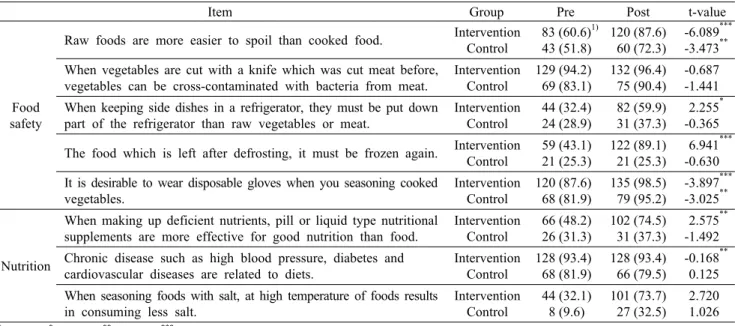
식품안전・영양지식
식품안전 5문항, 영양 3문항으로 총 8문항으로 구성되었 으며, 교육 전후의 교육군과 대조군의 지식 정답률은 Table 3에 제시하였다. 교육 후 ‘고혈압, 심혈관계 질환, 당뇨병 등 과 같은 만성질환은 식사와 관련이 깊다’(사전 93.4%, 사후 93.4%)를 제외한 모든 문항의 정답률이 향상되었다. 식품안 전 영역에서 교육 전 정답률이 50.0% 미만인 ‘냉장고에 반 찬을 보관할 때는 생채소나 고기를 보관한 곳보다 아래쪽에 보관해야 한다’(32.4%), ‘해동하고 남은 식품은 다시 얼려야 한다’(43.1%)는 각각 59.9%(향상률 27.5%), 89.1%(향상 률 46.0%)로 향상되었다. 2차 시 ‘식중독의 예방, 생활 속 안전실천’에서 교차오염 방지와 식품별 보관기간 등에 대한 교육과 3차 시 ‘위생적인 음식관리, 안전한 내 건강’에서 안
전한 식품조리에 대한 교육의 효과로 생각한다. 식중독과 안전한 식품조리 교육 시 동영상과 손 씻기 실습을 통한 교 육을 시행하였으며, 노인들의 지식 향상을 위해서는 미디어 활용과 다양한 리플렛과 브로셔를 활용한 교육이 효과적이 라 하였다(32). 영양 영역에서 교육 전 정답률이 50.0% 미 만이었던 ‘부족한 영양을 보충하는 데 식품보다는 알약 또는 액체 형태의 영양보충제가 더 효과적이다’의 정답률이 48.2
%에서 74.5%(향상률 26.3%)로 향상되었다. 1차 시 ‘변화 된 식생활, 건강한 내 생활’에서 올바른 식이보충제 섭취에 대한 교육을 통해 지식 향상이 된 것으로 생각한다. ‘조리 시간은 뜨거울 때 맞춰야 소금을 더 적게 먹게 된다’ 문항은 32.1%에서 73.7%(향상률 41.6%)로 향상되었다. 4차 시 ‘만 성질환을 극복하는 건강한 식생활’의 내용에서 소금 섭취를 줄일 수 있는 방법으로 교육이 수행되었다. 노인을 대상으로 수행한 영양교육 효과 분석 연구에서도 교육 전 28.9%에서 교육 후 64.0%로 지식이 향상된 결과를 보였다(17).
노인들의 영양지식은 식태도와 관련이 있으며 지식수준 이 높은 노인들이 영양태도와 변화에 대해 긍정적이며(21), 지식수준이 높을수록 균형된 식사를 계획하고 식생활에 적 용하여 더욱 좋은 식습관을 가지고 있었다(33). 노인들의 식 품안전과 영양에 대한 지식이 식행동으로 나타나기 위해서 는 단순한 지식 전달이 아니라 스스로 실천할 방법을 구체적 으로 제시하여 행동 변화에 초점을 맞춘 교육이 필요하다고 하였다(34).
식행동
식행동은 노인들이 ‘직접 식품을 구매한다’, ‘직접 조리한 다’의 식품 취급실태를 확인하는 2개의 선별문항을 포함하 였다. ‘식품을 직접 구매한다’의 문항은 교육군 88.3%, 대조 군 71.1%가 직접 구매한다고 응답하였으며, ‘직접 조리한
Table 4. Comparison of food safety handling practices score and dietary life nutrition practices score
Item Group Pre Post t-value Change
Food safety handling
When I go shopping, I take my glasses or magnifier to check the expiration date on the label of processed foods such as milk.
Intervention Control
2.87±1.021) 2.79±1.13
3.21±0.67 2.77±1.04
3.369**
-0.104
0.34±1.12 -0.18±1.27 When I cook meats or fishes, I check their degree of
doneness and cook them thoroughly.
Intervention Control
3.34±0.68 3.54±0.77
3.36±0.55 3.54±0.60
0.220 0.000
0.02±0.82 0.00±0.95 Frozen products are deforested in the refrigerator. Intervention
Control
2.58±0.94 2.78±1.05
2.92±0.80 2.36±0.83
3.120**
-2.474*
0.34±1.19 -0.42±1.32 When using a single cutting board or knife, wash and
sanitize the cutting board and knife with hot soapy water after every use.
Intervention Control
2.89±0.81 3.10±0.78
3.26±0.64 3.00±0.72
4.478***
-0.772
0.38±0.93 -0.10±1.02 Dispose cooked vegetables and side dishes of fishes and
meat which are kept in the refrigerator more than five days.
Intervention Control
2.57±0.90 2.89±1.04
3.10±0.65 2.61±0.90
6.022***
-1.628
0.53±1.02 -0.28±1.31 When I eat side dishes which is kept in the refrigerator,
I portioned out from the container as much as I can eat.
Intervention Control
3.10±0.68 3.18±0.81
3.30±0.57 3.10±0.67
2.873**
-0.776
0.20±0.80 -0.08±0.99 When I come back home, I wash my hands with hot
soapy water and make enough bubbles more than twenty seconds.
Intervention Control
3.12±0.76 3.01±0.85
3.31±0.54 2.92±0.68
2.504* -0.775
0.19±0.89 -0.10±1.13
Dietary life nutrition
I eat protein foods like meats, fishes, eggs and soybeans everyday.
Intervention Control
2.51±0.82 2.18±0.83
2.85±0.70 2.17±0.80
4.140***
-0.109
0.34±0.95 -0.01±1.01 I eat dairy food or soybean milk everyday. Intervention
Control
2.55±0.94 1.95±1.04
2.87±0.68 2.12±0.97
4.094***
1.305
0.31±0.90 0.17±1.18 I eat more solid ingredients rather than liquid of soup
or stew.
Intervention Control
2.47±0.88 2.28±1.03
3.16±0.64 2.34±0.95
7.660***
0.445
0.69±1.05 0.06±1.23 I drink water more then eight glasses even though I'm
not thirsty.
Intervention Control
2.60±0.90 2.49±0.93
3.22±0.63 2.23±0.92
7.051***
-2.047*
0.62±1.03 -0.27±1.18 I try to move as much as possible and reduce sitting
hours.
Intervention Control
3.04±0.78 2.84±1.08
3.26±0.49 2.86±0.81
3.092**
0.107
0.22±0.83 0.01±1.03
1)Mean±SD. Scale from 1 (strongly disagree) to 4 (strongly agree).
*P<0.05, **P<0.01, ***P<0.001 by paired t-test.
다’의 문항은 교육군 89.1%, 대조군 71.1%가 직접 조리한 다고 응답하였다.
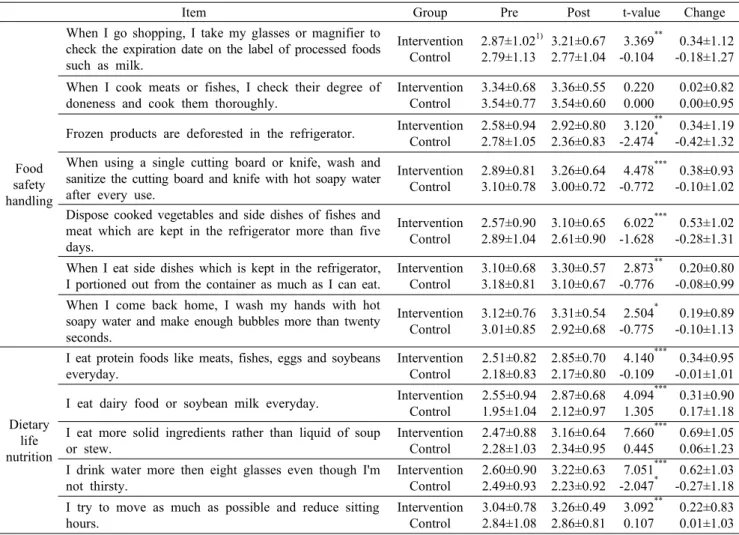
식행동은 식품안전 7문항, 영양 5문항으로 구성되었으며 Table 4에 제시하였다(4점 척도). 교육군에서 ‘냉장고에서 5일 이상 보관했던 나물류, 어육류 반찬들은 버린다’는 교육 후 0.53점(교육 전 2.57점, 교육 후 3.10점)이 향상되어 가 장 높은 변화를 보였다. ‘장 볼 때 돋보기나 안경을 챙겨가서 유통기한을 확인한다’, ‘냉동한 식품은 냉장고에서 해동한 다’, ‘도마가 하나인 경우 식재료의 종류가 바뀔 때마다 칼, 도마를 세제를 사용하여 뜨거운 물로 씻는다’, ‘냉장고에서 5일 이상 보관했던 나물류, 어육류 반찬들은 버린다’, ‘냉장 고에서 보관했던 반찬을 먹을 때는 용기째로 꺼내 먹지 않고 먹을 만큼만 덜어 먹는다’, ‘외출하고 돌아왔을 때 손을 비누 거품을 충분히 내어 따뜻한 물로 20초 이상 깨끗이 씻는다’
의 6개 문항은 교육군에서 유의적인 향상을 보였다(P<
0.05). 모든 문항은 3차 시 ‘위생적인 음식관리, 안전한 내 건강’의 식생활 안전가이드 교육 내용에 포함되었다. 노인 대상 식품안전 동영상 시청과 뷰박스를 활용한 손 씻기 실습 으로 노인들의 자아효능감을 높이도록 교육이 수행된 결과
로 생각한다. 노인의 35.0%가 얼린 냉동고기를 싱크대 위에 서 해동하고 있었으며, 일반소비자 대상 연구에서는 50.4%
가 싱크대 위에서 해동하는 것으로 나타났다(32,35). 소비 자 대상 조사 연구에서는 62.0%의 응답자가 생쇠고기나 닭 고기를 자른 후 도마와 칼을 세제와 뜨거운 물을 이용하여 씻는다고 하였다(22). 노인을 대상으로 조사한 연구(35)에 서 노인들은 손을 씻어야 할 시기에 잘 씻는 것으로 나타났 으며, 비누를 이용하여 손을 따뜻한 물로 씻는 노인은 낮은 비율을 보였다. 실질적인 행동 변화가 이루어지도록 행동수 정 위주의 교육은 바람직한 식행동으로 변화하는 데 도움을 주며, 노인들이 쉽게 따라할 수 있는 실질적인 교육이 중요 하다고 하였다(12). 영양 영역에서는 교육 후 모든 문항에서 유의적인 향상을 보였으며(P<0.01), ‘국과 찌개는 건더기 위주로 먹고 국물을 적게 먹는다’의 문항에서 교육 후 0.69 점(교육 전 2.47점, 교육 후 3.16점)이 향상되어 가장 높은 변화를 보였다. 성인 대상 조사에서는 ‘국이나 국수류의 국 물을 남김없이 먹는다’에서 영양 영역의 문항 모두 1차 시
‘변화된 식생활, 건강한 내 생활’에서 ‘어르신을 위한 식생활 지침’에서 교육이 수행되었다. 노인을 대상으로 영양중재 프
Table 5. Comparison of health belief perception for the participants before and after intervention study
Health belief Group Pre Post t-value Change
Food safety
Perceived susceptibility
I think I can get foodborne disease if I handle foods with unsanitary ways.
Intervention Control
3.22±0.631) 3.33±0.70
3.30±0.55 3.18±0.65
1.155 -1.717
0.08±0.81 -0.14±0.77 Perceived
severity
I think I can be dead if I get foodborne disease.
Intervention Control
2.71±0.82 3.01±0.79
3.28±0.53 2.95±0.78
3.066***
1.136
0.57±0.88 -0.06±0.94 Perceived
benefits
I think foodborne disease can be prevented if I handle foods with sanitary ways.
Intervention Control
3.34±0.55 3.39±0.64
3.34±0.48 3.22±0.42
7.563 -0.583
0.01±0.64 -0.17±0.66 Perceived
barriers2)
I think that frequent hand washing is troublesome work.
Intervention Control
1.77±0.76 2.07±1.11
1.70±0.71 2.16±0.89
0.126 -0.800*
-0.07±0.97 0.08±1.24
Self efficacy
I know the importance of hand-washing and I think I can prevent the outbreak of food poisoning by washing my hands properly.
Intervention Control
3.26±0.53 3.34±0.52
3.39±0.50 3.24±0.48
0.696* -1.395
0.12±0.68 -0.10±0.66
Nutrition
Perceived susceptibility
I think I can get a chronic disease if I do have unbalanced diet.
Intervention Control
3.06±0.70 2.99±0.82
3.27±0.58 3.10±0.58
0.134**
-2.331
0.22±0.81 0.11±0.87 Perceived
severity
I think I have difficulties for daily activities if I have a chronic disease.
Intervention Control
3.25±0.58 3.31±0.66
3.26±0.52 3.24±0.53
-2.941 -2.849
0.01±0.68 -0.07±0.82 Perceived
benefits
I think healthy dietary life is helpful for preventing chronic disease.
Intervention Control
3.25±0.62 3.25±0.70
3.29±0.50 3.13±0.49
-0.876 0.619
0.04±0.74 -0.12±0.79 Perceived
barriers2)
I think that it is too expensive to take a variety of foods.
Intervention Control
3.10±0.78 3.46±0.69
2.91±0.66 3.20±0.60
3.741**
-0.410
-0.20±0.78 -0.25±0.81 Self efficacy I think I can cook in the way of reducing
salt.
Intervention Control
2.93±0.81 2.69±0.88
3.21±0.48 2.64±0.71
2.136**
-1.340
0.28±0.89 -0.05±1.07
1).Mean±SD. Scale from 1 (strongly disagree) to 4 (strongly agree).
2)Reverse answer item.
*P<0.05, **P<0.01, ***P<0.001 by paired t-test.
로그램을 시행한 후 ‘하루에 한 번은 고기, 생선, 달걀, 콩 제품 중에 하나 이상을 먹는다’의 문항에서 유의적인 식행동 향상을 보였으며, 대상자에게서 다양한 식품을 섭취하려는 식행동의 변화가 나타났다(36). ‘국이나 찌개, 국수 종류의 국물을 남김없이 먹는다’의 문항에서도 영양교육 참여 후 식행동이 유의적으로 향상되었다(37). 노인을 대상으로 영 양교육 프로그램 효과분석 결과에도 영양교육 전과 후를 비 교한 결과 식생활 향상과 식습관 개선된 것과 일치하였다 (17,38,39).
노인들이 일반 소비자와 비교할 때 비위생적으로 식품을 관리하는 비율이 더 높으며(5,6), 식품 준비와 취급습관이 오랜 세월 몸에 굳어져 있어 행동 수정에 어려움이 있다고 보고되었다(40). 노년기 건강문제의 80.0%는 생활습관의 변화를 통해 예방될 수 있으며(8), 영양학 전문가 및 지역사 회 보건 교육자들이 노인들을 대상으로 한 안전한 식품 취급 과 섭취습관에 대한 조언과 교육을 통해 예방할 수 있다고 하였다(41).
건강신념
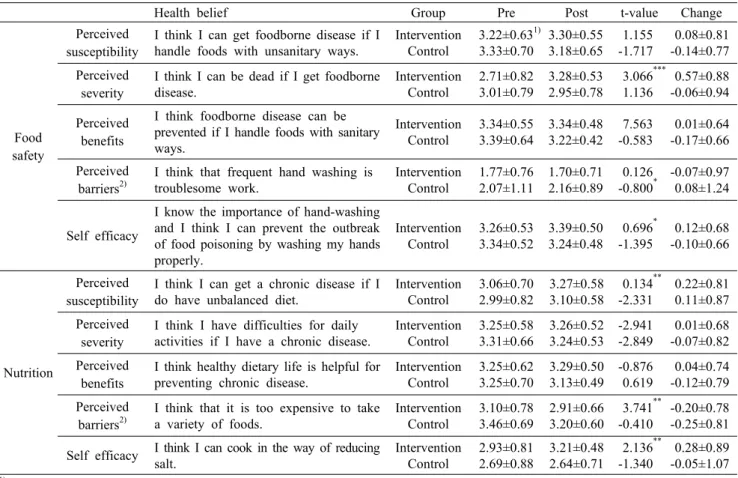
건강신념은 식품안전 영역의 식중독, 영양 영역의 만성질 환을 주제로 인지된 민감성, 인지된 심각성, 인지된 이익,
인지된 장애, 그리고 자아효능감으로 구성되었으며 결과는 Table 5에 제시하였다. 식품안전 영역에서는 인지된 심각성 이 2.71점에서 3.28점으로 가장 높은 유의적인 향상을 보였 으며(P<0.001), 자아효능감이 3.26점에서 3.39점으로 유 의적인 향상을 보였다(P<0.05). 식품을 섭취한 뒤 설사나 복통 증상이 있는 경우 배탈로 생각하고 넘기는 경우가 많으 나 식중독일 수도 있다는 교육과 식중독의 위험성을 강조한 교육을 통해 인지된 민감성과 인지된 심각성이 향상되었을 것으로 생각한다. 또한, 자아효능감은 뷰박스, 안전 동영상 등의 교육이 긍정적 향상을 가져온 것으로 생각한다. 소금 섭취를 줄이는 조리법과 메뉴에 대한 교육 동영상이 자아효 능감을 높이는 데 긍정적인 영향을 미친 것으로 생각한다.
노인을 대상으로 잠재적으로 건강에 위험을 주는 요인을 이 해하고 긍정적 행동 변화를 이끌어 내기 위해서는 건강신념 모델이 효과적이며 자아효능감이 노인들의 행동 변화에 긍 정적인 역할을 한다고 하였다(42,43). 건강신념모델을 이용 하여 여자 노인을 대상으로 영양교육을 수행한 결과 지식, 신념, 행동에 효과적인 결과를 보였다(44). 영양교육은 만성 질환 예방관리뿐만 아니라 의료비 절감, 사회적 비용 절감 등의 경제적 효과 또한 가져올 수 있어 인식을 변화하는 교 육은 중요하다(45).
Table 6. Relationship of knowledge, dietary behavior, and heath- belief perception scores
Knowledge
change Dietary behavior change HBM
change Knowledge
change 1
Dietary
behavior change 0.054 1
HBM change 0.100 0.520*** 1 HBM: Health Belief Model. ***P<0.001.
식품안전과 영양 영역의 자아효능감은 교육 후 향상된 결 과를 보였으며, 자아효능감이 높은 사람은 낮은 사람보다 더 많은 노력을 지속해서 수행하며, 체중 조절, 채소와 과일 섭취, 운동 등 건강 행동에 미치는 주요한 요인으로 제시되 고 있다(28-30,46). 건강신념모델을 이용하여 노인의 식품 취급 행동을 조사한 연구 결과 식품 기인성 질환의 인지된 위협과 안전한 식품 취급 행동 간의 유의적인 관계가 있는 것으로 나타났다(28). 또한, 심혈관계 질환을 줄이기 위하여 건강신념모델을 이용하여 시행된 영양교육은 건강한 영양 습관과 심장질병과 관련된 영양지식의 인지된 이익이 교육 군에서 개선된 결과를 보였다(30).
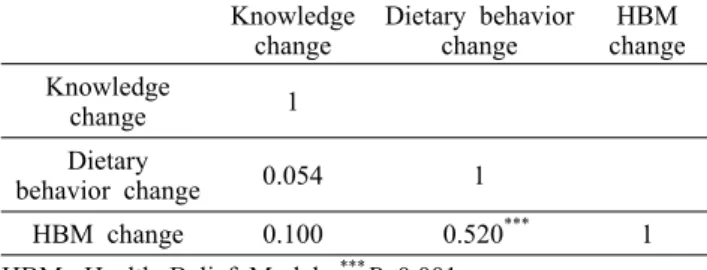
지식, 식행동, 건강신념 변화량의 상관관계 분석 결과를 Table 6에 제시하였다. 건강신념의 변화량과 식행동의 변화 량 간에 유의적인 상관관계를 보였다(P<0.001). 높은 지식 이 실제 행동으로 실천되지 않기 때문에 건강신념의 변화는 식행동을 변화시키는 데 주요한 요인이다(30,47). 본 연구 에서 이용된 건강신념모델은 기존 연구(48)와 같이 교육 대 상자의 인식 변화에 기여하였으며 인식의 변화를 통해 식행 동의 변화를 가져오게 하였다. 영양지식, 식태도, 식습관 및 식행동 조사 연구 결과 영양지식과 식태도 및 식습관 간의 상관관계는 없었으나 지속적이고 체계적인 교육이 이루어 질 경우 긍정적인 변화와 지식, 태도, 행동 간의 유기적인 관계를 확고히 할 수 있다고 하였다(49).
이상의 결과에서 노인을 대상으로 한 식품안전・영양교육 프로그램 시행 후 지식, 태도, 건강신념에서 유의적인 효과 가 나타났다. 이는 교육 시 노인들이 실생활에서 행동수정이 가능한 행동지침을 제시하고, 노인에게 적합한 매체를 활용 한 참여형태의 교육이 효과가 있는 것으로 생각한다. 따라서 노인을 대상으로 한 식품안전・영양교육 프로그램이 노인복 지관, 보건소 및 정부 차원에서 지속적・정기적으로 시행되 어야 할 것으로 생각한다.
요 약
노인은 면역취약집단으로 다른 인구 집단보다 만성질환과 식품매개 질병에 걸릴 위험이 크며 식행동은 오랜 세월 굳어 져 왔기 때문에 변화하기가 쉽지 않다. 노인을 대상으로 건 강신념모델을 적용하여 식품안전・영양교육 프로그램을 시
범 적용하고 그 효과를 평가하였다. 식품안전・영양 시범 교 육은 서울 마포, 충북 청주, 경북 의성, 충북 진천의 노인복지 관을 이용하는 65세 이상 노인을 대상으로 2011년 7월 28 일부터 9월 9일까지 총 5주간 매주 1회, 35~40분씩 교육을 시행하였다. 교육 전후 조사가 완료된 최종 연구대상은 교육 군이 5회 교육 중 3회 이상 교육에 참여하고 교육 전후 평가 를 마친 대상자로 137명, 대조군은 사후 설문조사를 하지 않거나 불성실한 응답자를 제외한 83명으로 총 220명이었 다. 교육은 건강신념모델을 적용하여 노인들이 식습관을 변 화하지 않을 경우 질병 가능성을 알려 심각성을 인지하도록 하였으며 노인들이 식행동 수정 시 얻게 되는 이들을 알려주 고 행동을 실행할 수 있도록 자아효능감을 제공해주고자 하 였다. 교육 후 식품안전・영양지식은 모든 항목에서 향상을 보였으며, 식품안전 영역 5문항 중 4문항, 영양 영역 3문항 중 2문항에서는 유의적인 향상을 보였다. 식행동은 교육군 에서 ‘고기, 생선류는 조리 시 속까지 완전히 익힌다’를 제외 한 모든 항목에서 유의적인 향상을 보였다. 건강신념은 식품 안전의 영역에서는 인지된 심각성과 자아효능감, 영양 영역 에서는 인지된 민감성, 인지된 장애, 자아효능감에서 유의적 인 향상을 보였다. 지식, 식행동, 건강신념 변화량의 상관관 계를 분석한 결과 건강신념의 변화량과 식행동의 변화 가능 성 간의 유의적인 상관관계를 보였다(P<0.001). 본 연구의 참여 대상자들이 일반 재가 노인보다 복지관에서 봉사하거 나 활동하는 노인이었기 때문에 표본의 대표성이 떨어져 결 과를 일반화하기에 어려움이 있다. 또한, 교육기간이 5주로 비교적 짧았기 때문에 오랜 기간에 걸쳐 형성된 식행동이 쉽게 변화하거나 개선되기 어려우므로 장기간에 걸친 반복 교육이 필요할 것으로 생각한다. 본 연구에서 개발된 교육 프로그램을 향후 보건소나 복지관 등을 통해 지속해서 시행 된다면 노인의 식품안전・영양에 대한 인식을 높이고 바람직 한 식행동 변화에 긍정적인 기여를 할 수 있을 것으로 생각 된다.
감사의 글
본 연구는 2011년 식품의약품안전처(11062 MFDS 205)의 지원을 받아 이루어졌으며, 이에 감사드립니다.
REFERENCES
1. Statistics Korea. 2011. Population projections for Korea: 2010- 2060 (based on the 2010 census). http://kostat.go.kr/portal/ko- rea/kor_nw/2/2/6/index.board?bmode=read&aSeq=252623 (accessed Nov 2015).
2. Jung HY, Yang IS, Lee HY, Chae IS. 2003. Analyzing the current congregate meal service program for homebound elderly. Korean J Community Nutr 8: 919-926.
3. de Luis D, Lopez Guzman A; Nutrition Group of Society of Cstilla-Leon (Endocrinology, Diabetes and Nutrition).
2006. Nutritional status of adult patients admitted to internal medicine departments in public hospitals in Castilla y Leon,
Spain-A multi-center study. Eur J Intern Med 17: 556-560.
4. Yang EJ, Bang HM. 2008. Nutritional status and health risks of low income elderly women in Gwangju area. Korean J Nutr 41: 65-76.
5. Altekruse SF, Street DA, Fein SB, Levy AS. 1996. Consum- er knowledge of foodborne microbial hazards and food- handling practices. J Food Prot 59: 287-294.
6. Gettings MA, Kiernan NE. 2001. Practices and perceptions of food safety among seniors who prepare meals at home.
J Nutr Educ 33: 148-154.
7. Fein SB, Lando AM, Levy AS, Teisl MF, Noblet C. 2011.
Trends in U.S. consumers' safe handling and consumption of food and their risk perceptions, 1988 through 2010. J Food Prot 74: 1513-1523.
8. Pastorino CA, Dickey T. 1990. Health promotion for the eld- erly: issues and program planning. Orthop Nurs 9: 36-42.
9. Lee YW, Hwang WS, Choe SJ, Lee DH, Kim DH, Lee EH, Hong EG, Noh HL, Chung YS, Lee KW, Kim HM. 2003.
The effect of intensive education on glycemic control in type 2 diabetic patients. J Korean Soc Endocrinol 18: 63-72.
10. Mo S. 1990. The present status and a future scheme in nu- trition education. Korean J Nutr 23: 208-212.
11. Sheahan SL, Fields B. 2008. Sodium dietary restriction, knowledge, beliefs, and decision-making behavior of older females. J Am Acad Nurse Pract 20: 217-224.
12. Yim KS, Min YH, Lee TY. 1997. Evaluations of the Elderly Nutrition Improvement Program in the community health center: Effects of nutrition counseling and education pro- gram on elderly dietary behavior. J Korean Diet Assoc 3:
197-210.
13. Son SM, Kim MJ. 2001. The effect of nutrition education program for various chronic disease in elderly visiting pub- lic health center. Korean J Community Nutr 6: 668-677.
14. Janz NK, Becker MH. 1984. The Health Belief Model: A decade later. Health Edu Q 11: 1-47.
15. Kim MH. 1997. Health Belief Model approach to health beliefs, attitude, and health behaviors concerning HIV/AIDS.
J Korean Soc Health Edu 14: 125-147.
16. Hanson JA, Benedict JA. 2002. Use of the Health Belief Model to examine older adults' food-handling behaviors. J Nutr Educ Behav 34: S25-S30.
17. Kang NE, Lee JY. 2005. The analysis of effect on nutrition education program for the elderly in Sung-nam area. Korean J Food Nutr 18: 357-366.
18. Park PS, Chun BY, Jeong GB, Hun CH, Joo SJ, Park MY.
2007. The effect of follow-up nutrition intervention pro- grams applied aged group of high risk undernutrition in ru- ral area (Ⅰ). Korean J Food Cult 22: 127-139.
19. Kim MS, Kim JY. 2012. Development of nutrition educa- tion material for nutrient intake and prevention of disease and the effects of nutrition education for the elderly -fo- cused on items related to health and nutrients intake-.
Korean J Community Living Sci 23: 467-478.
20. Choi JH, Lee ES, Lee YJ, Lee HS, Chang HJ, Lee KE, Yi NY, Ahn Y, Kwak TK. 2012. Development of food safety and nutrition education contents for the elderly -by focus group interview and Delphi technique-. Korean J Com- munity Nutr 17: 167-181.
21. Yang IS, Lee JM, Chae IS. 1998. Nutrition knowledge and attitude analysis of elderly people for the development of nutrition education program. J Korean Diet Assoc 4: 76-87.
22. Medeiros LC, Hillers VN, Chen G, Bergmann V, Kendall P, Schroeder M. 2004. Design and development of food safety knowledge and attitude scales for consumer food safe-
ty education. J Am Diet Assoc 104: 1671-1677.
23. Almanza BA, Namkung Y, Ismail JA, Nelson DC. 2007.
Clients' safe food-handling knowledge and risk behavior in a home-delivered meal program. J Am Diet Assoc 107: 816- 821.
24. McCarthy M, Brennan M, Kelly AL, Ritson C, de Boer M, Thompson N. 2007. Who is at risk and what do they know?
Segmenting a population on their food safety knowledge.
Food Qual Prefer 18: 205-217.
25. Lee KE, Yi NY, Park JY. 2009. Food safety knowledge and home food safety practices of home-delivered meal service recipients. J Korean Soc Food Sci Nutr 38: 618-625.
26. Sanlier N. 2009. The knowledge and practice of food safety by young and adult consumers. Food Control 20: 538-542.
27. Ferrini R, Edelstein S, Barrett-Connor E. 1994. The associa- tion between health beliefs and health behavior change in older adults. Prev Med 23: 1-5.
28. Hanson JA, Benedict JA. 2002. Use of the Health Belief Model to examine older adults' food-handling behaviors. J Nutr Educ Behav 34: S25-S30.
29. Hudson PK, Hartwell HJ. 2002. Food safety awareness of older people at home: a pilot study. J R Soc Promot Health 122: 165-169.
30. Abood DA, Black DR, Feral D. 2003. Nutrition education worksite intervention for university staff: application of the health belief model. J Nutr Educ Behav 35: 260-267.
31. Lee MJ, Kim JH, Park OJ, Lee YM. 2016. A study on the needs for nutrition management program for elderly who use welfare facilities. Korean J Community Nutr 21: 65-74.
32. Jevšnik M, Ovca A, Bauer M, Fink R, Oder M, Sevšek F.
2013. Food safety knowledge and practices among elderly in Slovenia. Food Control 31: 284-290.
33. Eppright ES, Fox HM, Fryer BA, Lamkin GH, Vivian VM.
1970. The North Central Regional Study of diets of preschool children. 2. Nutrition knowledge and attitudes of mothers.
J Home Econ 62: 327-332.
34. Jang JY, Kim MJ, Han JS. 2009. A study on food frequency, dietary habits and nutrition knowledge of the elderly who intake high sodium. J Korean Soc Food Sci Nutr 38: 1362- 1372.
35. Choi JH, Lee YJ, Lee ES, Lee HS, Chang HJ, Lee KE, Yi NY, Kwak TK. 2016. Investigation of food safety knowl- edge, attitudes, and behavior for analyzing food safety risk factors in the elderly. J Korean Soc Food Sci Nutr 45: 746- 756.
36. Kim BH, Yang J, Kye SH, Lee Y. 2014. The effect of a community-based nutrition intervention program on dietary behavior and nutritional status of low-income elderly wom- en in Gwangju city. Korean J Food Nutr 27: 495-506.
37. Jung EJ, Kwon JS, Ahn SH, Son SM. 2013. Blood pressure, sodium intake and dietary behavior changes by session at- tendance on salt reduction education program for pre-hyper- tensive adults in a public health center. Korean J Communi- ty Nutr 18: 626-643.
38. Kang NE, Lee JY. 2005. The analysis of effect on nutrition education program for the elderly in Sung-nam area. Korean J Food Nutr 18: 357-366.
39. Boonyasopun U, Aree P, Avant KC. 2008. Effect of an em- powerment-based nutrition promotion program on food con- sumption and serum lipid levels in hyperlipidemic Thai elderly. Nurs Health Sci 10: 93-100.
40. Kendall PA, Hillers V, Medeiros LC. 2006. Food safety guid- ance for older adults. Clin Infect Dis 42: 1298-1304.
41. Kendall P, Medeiros LC, Hillers V, Chen G, DiMascola
S. 2003. Food handling behaviors of special importance for pregnant women, infants and young children, the elderly, and immune-compromised people. J Am Diet Assoc 103:
1646-1649.
42. Orji R, Vassileva J, Mandryk R. 2012. Towards an effective health interventions design: An extension of the Health Be- lief Model. Online J Public Health Inform 4: ojphi.v4i3.4321.
43. Baghianimoghadam MH, Shogafard G, Sanati HR, Baghia- nimoghadam B, Mazloomy SS, Askarshahi M. 2013. Appli- cation of the health belief model in promotion of self-care in heart failure patients. Acta Med Iran 51: 52-58.
44. Iranagh JA, Rahman HA, Motalebi SA. 2016. Health Belief Model-based intervention to improve nutritional behavior among elderly women. Nutr Res Pract 10: 352-358.
45. Rajgopal R, Cox RH, Lambur M, Lewis EC. 2002. Cost- benefit analysis indicates the positive economic benefits of the Expanded Food and Nutrition Education Program related
to chronic disease prevention. J Nutr Educ Behav 34: 26-37.
46. Contento I, Balch GI, Bronner YL, Lytle LA, Maloney SK, Olson CM, Swadener SS. 1995. The effectiveness of nu- trition education and implications for nutrition education policy, programs, and research: a review of research. J Nutr Educ 27: 275.
47. Worsley A. 2002. Nutrition knowledge and food consump- tion: can nutrition knowledge change food behaviour?. Asia Pac J Clin Nutr 11: S579-S585.
48. Sin EK, Lee YK. 2006. Development and application of a health belief model based nutrition education program for day care center children. Korean J Community Nutr 11: 488- 501.
49. Lee KS, Kim KN. 1997. Effects of nutrition education on nutrition knowledge, dietary attitudes, and food behavior of college students. Korean J Community Nutr 2: 86-93.