Received: March 21, 2018 Revised: July 27, 2018 Accepted: July 30, 2018
protection in some dental hygiene students
Seung-Hun Lee
Department of Dental Hygiene, Cheongam College
Corresponding Author: Seung-Hun Lee, Department of Dental Hygiene, Cheongam College, 1641, Noksae-ro, Suncheon, Jeollanam-Do, 57997, Korea, Tel: +82-61-740-7382, Fax: +82-61-740-7418, E-mail:
Abstract
Objectives: This study explored the perception and practice of privacy protection of some dental hygiene students. Methods: On the basis of survey data from 126 respondents, the correlation between the perception and the practice was analyzed. Also the multiple regression analysis was performed on the variables that affect the practice. Cronbach's α of the questionnaire was more than 0.6. The items were scored on 5 points scale or true-false type. Results: The perception of privacy protection was 3.23 points, the law is 0.88 points, and the practice is 3.47 points. The educated students were more perceive than those who did not(p<0.05). The higher the perception, the higher the practice(r=0.230, p<0.01). The practice was influenced by the perception(p<0.05). Conclusions: Dental hygiene students should be educated to perceive and protect the personal and medical information of a patient. Also, an educational institutions need a efforts to protect personal information.
Key Words: Dental hygiene student, Information protection act, Perception, Personal information, Practice, Privacy protection
Introduction
DependingonthePersonalInformationProtectionAct
,
apersonalinformationisaninformation about aliving person and aninformation thatcan identify anindividual,
such asname,
resident registrationnumber,
andimage.
Inaddition,
itincludesaninformationthatcanbeeasilyidentifiedand combinedwithotherinformationeveniftheinformationisnotknowntoaspecificindividual[
1].
Currently
,
oursocietyisaninformationsocietywherenotonlyofflinebutalsoonlineaninformation canbeeasilyobtained.
Thedevelopmentoftechnologyhasconvenientaccesstoinformation,
butitcan leadtotheleakageofpersonalinformationthatcouldinvadeaprivacyorthreatenasafety.
According toe-
Nara index ofthe Korea CommunicationsCommission,
the number ofpersonal informationinfringementsroseto98
,
210in2016,
morethanfourtimesthatof23,
333in2006,
and48,
557casesofan identitytheft,
includingaresidentregistrationnumber,
accountedforthehighestpercentage[
2].
Medicalinformationisbeingcomputerizedandnetworked
[
3],
andthedigitalsystemischanginginthe dentistry.
Ifthepatient'
spersonalinformationandmedicalinformationwelldonotmanage,
thosewillbe leaked[
4].
Inparticular,
ifthemedicalinformationwereleaked,
itwillhaveacatastrophicadverseeffecton theprivacyofindividualpatients[
5].
Therefore
,
inKorea,
PersonalInformationProtectionActwasenactedinMarch2011andhasbeenin operationsinceSeptember[
2].
Inthepast,
accordingtoActonProtectionofPersonalInformationofPublic Institutions,
it wasprotected onlyfor public periodorcorporations.
However,
asthe PrivacyAct was enforced,
itwasalsoappliedtomedicalinstitutions[
6].
Thedentalhygienistperformstheduties,
suchas resourcemanagement,
patientcare,
medicalrecordmanagement,
insuranceclaim,
managementofmaterials andmedicines,
andcontinuouspatientmanagement.
Inspiteofadentaladministratorwhoplayanimportant roleofprotectingapersonalinformationofpatients,
theywerelowertheknowledgeandpracticethanthe otherprofessionals inmedicalinstitution[
7].
Ifthe personalinformationwerenotenough protected,
the patientswillnotonlybeanxiousbutalsodistrustthedentist.[
8].
Itwasreportedthattheleakageofpatient
'
spersonalinformationwascausedbyaninsiderswhohadeasier accessedtoinformationthananoutsiders[
9].
Therefore,
itisimportanttorecognizetheprotectionofpersonal informationin medical institutions aswell as the systems and the laws for the protection of medical information,
andtoestablishtheirpracticalwill[
10].
Recently
,
theeffortstoprotectmedicalinformationhavebeenstarted,
butthoseisalackindentistry[
5,
7].
Themostofthestudiesrelatedtotheprotectionofmedicalinformationweretargetedatnurses
[
11],
doctors,
nursingassistants,
medicaltechnicians,
andgeneraladministrativestaff[
9,
10].
Thepreviousstudies[
9-
11]
werelimitedtothestudysubjectsandtothemedicalinstitution[
10].
Therehavebeenstudiedonthedental protectionofpersonalinformation[
7],
buttheresearchesondentalhygienestudentshavebeenlacked.
Adentalhygienistdealswithpatient
'
spersonalinformationsuchassocialsecuritynumber,
address,
and telephonenumber.
Theyalsohandlesensitivemedical information,
forexamplemedicalhistory,
family history,
takingmedications,
andphysicalcondition.
Therefore,
itisnecessarytoinvestigatetheperception andpracticeofpersonalinformationprotectionofstudentswhoarepreliminarydentalhygienists.
Thepurposeofthisstudyistorecognizetheimportanceofpersonalandmedicalinformationandtoprovide thebasicdataforpracticebyinvestigatingthem
.
Methods
1. Study subjects
Theconvenientlysampled136studysubjectswerethedentalhygienestudentsofCheongamcollegein Suncheoncity
.
Theywereexplainedthepurposeandmethodofthestudy,
filledouttheself-
administered questionnairewhentheyagreed.
Thesurveyperiodwas5daysfromMarch16to21,
andthequestionnairewascollecteddirectlybytheresearcher
.
Thetotal126questionnaireswereusedinthefinaldataanalysis,
exceptforthenumberofmissing8copiesandincomplete2responses.
Theminimumnumberofstudysampleswascalculatedas102usingGPower3
.
0[
12,
14]
programby analysisofvariance(
ANOVA),
0.
05significancelevel,
95%
poweroftest,
and0.
40effectsize.
Assumingthe eliminationby10%,
136subjectsweresuitablefortheanalysis.
Thesizeeffectwasreferencedtheresultsof Jung[
15]
thatcomparedtheperceptionforprotectionofpatient’
spersonalinformation.
ThisstudywasapprovedbyCheongamcollegeInstitutionalReviewBoard
(
CA17-
180316-
HR-
004-
01).
2. Study method
Thequestionnaireconsistedof33itemswhichwere5itemsofsubjectscharacteristics
,
8itemsofthe perceptionofprivacyprotection,
8itemsofPersonalInformationProtectionAct,
and12itemsofthepractice ofprivacyprotection.
Theitemsweremodifiedandadaptedaccordingtothestudypurposebyreferringtothe questionnaireofBae[
5].
Itwasscoredona5pointLikertscalethatwastheperceptionandpracticeofprivacy protection.
ThequestionrelatedtoPersonalInformationProtectionActwasthetrue-
falseitem.
Cronbach’
sα was0.
603fortheinternalconsistencyofperceptionofprivacyprotection.
Therewere0.
614inInformation ProtectionActand0.
666inthepracticeofprivacyprotection.
3. Data analysis
Thecharacteristicsofthesubjectswerefrequencyandpercentage
.
Itwascalculatedthemeanandstandard deviationthatwastheperceptionandpracticeofprivacyprotection,
andPersonalInformationProtection Act.
The analysis method was two independent samples t-
test,
one wayANOVA,
pearsoncorrelation coefficient.
Inaddition,
themultipleregression analysiswasperformedtothe variablethataffected the practice.
Thedatawere analyzedusing StatisticalPackageforSocialScience(
SPSSver.
18.
0,
Chicago,
Illinois,
USA).
Results
1. The characteristics of the study subjects
Thestudysubjectswere126femaledentalhygienestudentsinCheongamcollegeandwereshownin
<
Table1>.
55.
6%
havenoteducatedontheprivacyprotection,
and50.
0%
desiredanonlinelecture.
2. The perception of privacy protection
Itwas3
.
23pointsthatwastheperceptionofprivacyprotection.
Theythoughtthatthepersonalinformation ofothersshouldbeprotected(
4.
46points),
andtheperceptionofpersonalinformationwaschanged(
3.
65 points).
However,
theydidnotknowaboutPersonalInformationProtectionAct(
2.
42points)
andwasnot protectedmyself(
2.
48points)<
Table2>.
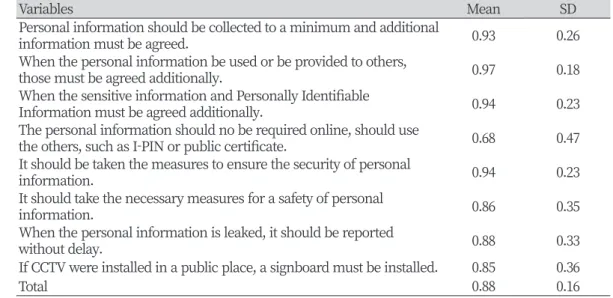
3. The perception of Personal Information Protection Act
Itwas0
.
88pointsthatwastheperceptionofPersonalInformationProtectionAct.
Theythoughtthatthe additionalagreementshouldbeneedwhenthepersonalinformationbeusedorbeprovidedtoothers(
0.
97 points).
WhenthesensitiveinformationandPersonallyIdentifiableInformationmustbeagreedadditionally(
0.
94points),
andit shouldbetakenthemeasurestoensurethesecurityofpersonalinformation(
0.
94points).
However,
itwaslow pointsthatthepersonalinformationshouldnoberequiredonline,
shouldusetheothers,
suchasInternet PersonalIdentificationNumber(
I-
PIN)
orpubliccertificate(
0.
68points),
ifClosedCircuitTelevision(
CCTV)
wereinstalledinapublicplace,
asignboardmustbeinstalled
(
0.
85points)<
Table3>.
Table 1. The characteristics of the study subjects
Characteristics Division N %
Gender Female 126 100.0
Grade 1 43 34.1
2 41 32.5
3 42 33.3
Region Suncheon 61 48.4
etc. 65 51.6
Education experience Yes 56 44.4
No 70 55.6
Desirable education method Lecture 63 50.0
Online 63 50.0
Total 126 100.0
Table 2. The perception of privacy protection
Variables Mean SD
Perception of personal information protection act 3.65 1.11
Change of perception 2.48 0.81
Protection to myself 3.24 0.87
Protection at medical institution 4.46 0.76
Protection to others 3.16 0.97
Impact of education on practice 3.23 0.46
Total 3.23 0.46
Table 3. The perception of Personal Information Protection Act
Variables Mean SD
Personal information should be collected to a minimum and additional
information must be agreed. 0.93 0.26
When the personal information be used or be provided to others,
those must be agreed additionally. 0.97 0.18
When the sensitive information and Personally Identifiable
Information must be agreed additionally. 0.94 0.23
The personal information should no be required online, should use
the others, such as I-PIN or public certificate. 0.68 0.47 It should be taken the measures to ensure the security of personal
information. 0.94 0.23
It should take the necessary measures for a safety of personal
information. 0.86 0.35
When the personal information is leaked, it should be reported
without delay. 0.88 0.33
If CCTV were installed in a public place, a signboard must be installed. 0.85 0.36
Total 0.88 0.16
4. The practice of privacy protection
Itwas3
.
47pointsthatwasthepracticeofprivacyprotection.
Theydidnotreadthepersonalinformationof others(
4.
55points),
and usedtheiridentification(
ID)
and passwordonline(
4.
52 points).
Buttheydidnot periodicallychangetheirIDandpassword(
1.
87points),
anddidnotusethepersonalcomputer(
PC)’
sscreen saver(
2.
09points)<
Table4>.
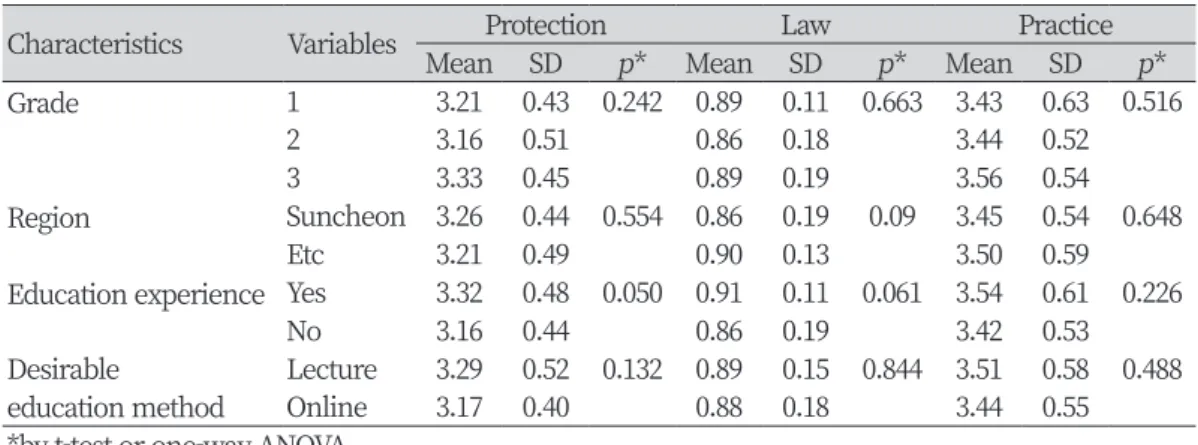
5. The differences of the variables according to the subject characteristics
Itwasshownin
<
Table5>
thatwasthedifferencesintheperception,
theAct,
andthepracticeofprivacy protectionaccordingtothecharacteristicsofstudysubjects.
Theeducationexperienceshowedstatistically significantdifferenceintheperceptionofprivacyprotection.
Theeducatedsubjectsweremoreperceivethan thosewhodidnot.
However,
therewerenostatisticallysignificantdifferencesintheother.
6. The correlative among the variables
Itwasshownin
<
Table6>
thatwasthecorrelationintheperception,
theeducationexperience,
theAct,
andTable 4. The practice of privacy protection
Variables Mean SD
Use my ID and password online 4.52 0.97
Check out the logout 4.14 1.26
Use the PC screen saver 2.09 1.24
Change my ID and password periodically 1.87 1.04
Not sharing ID and password 4.13 1.15
Not reading the personal information of others 4.55 0.98
Crush up the printout related to personal information 3.42 1.39
Update of the PC anti-virus program periodically 3.21 1.39
Keep in locking cabinet the printout 2.8 1.30
Not talking about personal information in public places 3.41 1.20
Not providing the personal information of others 4.06 0.98
Total 3.47 0.57
Table 5. The differences of the variables according to the subject characteristics
Characteristics Variables Protection Law Practice
Mean SD p* Mean SD p* Mean SD p*
Grade 1 3.21 0.43 0.242 0.89 0.11 0.663 3.43 0.63 0.516
2 3.16 0.51 0.86 0.18 3.44 0.52
3 3.33 0.45 0.89 0.19 3.56 0.54
Region Suncheon 3.26 0.44 0.554 0.86 0.19 0.09 3.45 0.54 0.648
Etc 3.21 0.49 0.90 0.13 3.50 0.59
Education experience Yes 3.32 0.48 0.050 0.91 0.11 0.061 3.54 0.61 0.226
No 3.16 0.44 0.86 0.19 3.42 0.53
Desirable Lecture 3.29 0.52 0.132 0.89 0.15 0.844 3.51 0.58 0.488
education method Online 3.17 0.40 0.88 0.18 3.44 0.55
*by t-test or one-way ANOVA
thepracticeofprivacyprotectionofthestudysubjects
.
Theperceptionhasapositivecorrelationwiththe educationexperience(
r=
0.
175,
p<
0.
05),
theAct(
r=
0.
263,
p<
0.
01),
andthepractice(
r=
0.
230,
p<
0.
01).
7. The affecting variables on the practice of privacy protection
Itwasstatisticallysignificantthatwasthemultipleregressionanalysisofthevariablesaffectingthepractice ofprivacyprotection
(
p<
0.
05).
Theperceptionhadaneffectonthepractice(
p<
0.
01)<
Table7>,
buttheactdid notaffectit.
Discussion
In2015
,
theSocialNetworkServices(
SNS)
ofSeongnammayorwasthebigissuebecauseherevealedthe residence,
theworkplace,
the schoolnameofthe peoplewhowere testedpositiveon theMiddleEast Respiratory Syndrome
(
MERS)[
16].
He disclosed thosein accordance with the Act on Prevention and ManagementofInfectiousDiseases,
butseriouslyinfringedthepersonalinformationofpatient.
Apatient'
s medicalinformationisverysensitive,
andifthosewereinfringed,
thosewillnotbereversed.
MinistryofHealthandWelfareissuedtheguidelinesfortheprivacyprotectionofmedicalinstitutions
[
17],
andamedicalinstitutionsareestablishingthesystemforpatientsandlegallyobligatingtheeducationof privacyprotectionatleastonceayear.
Dentalhygienistsshouldalsotrytoperceivetheknowledgeandthe Actandtopracticetheprivacyprotectionasaoralcareprofessional.
Theyalsoneedtobeeducatedabout medicalprivacyprotectionineducationalinstitutions.
Thisstudyinvestigatedtheperception,
theActandthe practiceofprivacyprotectionofthestudentsasapre-
dentalhygienist.
InthestudyofBae
[
5],
theperceptionofprivacyprotectionwaschangedduetotheabuseofpersonal informationandtheincreaseintherightconsciousness.
Andtheperceptionpathwasthepersonalinformation education,
thebroadcastingmedia,
andtheinternet.
SincePersonalInformationProtectionActwasenactedTable 6. The correlation between the perception and the practice of privacy protection
Variables Practice Perception Act Education
experience
Practice 1
Perception 0.230** 1
Act 0.033 0.263** 1
Education experience 0.109 0.175* 0.158* 1
*p<0.05, **p<0.01 by pearson's correlation analysis
Table 7. The affecting variables on the practice of privacy protection
Variables B SE ß t p*
2.630 0.396 6.643 0
Perception 0.289 0.111 0.237 2.612 0.010
Act -0.104 0.318 -0.030 -0.326 0.745
R2= 0.54, Adjusted R2=0.38, F=3.481, p<0.05
*by multiple regression analysis at α=0.05
in2011
,
theperceptionwaschangingthroughvariousmedia.
Alsotheyweremoreperceiveitbecauseofthe education.
ThestudysubjectsrespondedthatPersonalInformationProtectionAct
(
2.
42points)
wasunfamiliar,
butthe mostofthemaincontentsoftheActwerealreadyknown(
0.
88points).
Theythoughtthattheproviderwould need additional the consent when providing the personal information to others,
and for the sensitive informationandPersonallyIdentifiableInformation.
Theyalsosaidthatthemeasuresshouldbetakento protectprivacy.
But,
itwaslowpointsthanothersthatwasprotectingapersonalinformationonline,
for exampleI-
PIN,
publiccertificate,
andsettinguptheCCTVsignage.
InthestudyofLeeandSo[
7],
Itwas higherpointsthatwastheCCTVinstallationguide(
92.
7%)
andthepatient’
sconsentwhenusingthosefor studypurpose(
84%),
whileitwaslowerpointsthatwasthepersonalinformationcollection(
15.
4%)
andthe periodicletterstonon-
visitingpatients(
30.
8%).
InstudyofChoiandKang[
12],
itwashighpointsthatthe personalinformationwasnotprovidedtootherdepartments(
3.
3points)
andtoother(
3.
3points),
butitwas lowpointsthatwasLogout(
2.
76points),
andthescreensaver(
2.
98points).
Theresultsofthisstudywere slightlydifferentfromthoseofthepreviousstudybecauseofthedifferencesinthesubjectsorthestudy methods.
Thepracticeofprivacyprotectionwasthenormallevelattheaverageof3
.
47points.
Itwasthehighlevel thatwasreadingothersinformation(
4.
55points),
andusingownIDandpassword(
4.
52points).
However,
It wasthelowlevelthatwaschanging theIDandpassword(
1.
87 points),
andusingthescreensaver(
2.
09 points).
Thereasonsofdifficultyinpracticingwerethecomplexity(
32.
3%),
andbusyingandannoying(
21.
2%).
InstudyofChoiandKang
[
12],
itwashighpointsthatwasthepatient’
sprivacyprotection(
2.
94points)
andthe consent(
2.
94points),
butitwaslowpointsthatwastheparticipationineducation(
1.
48points)
andthedialogue onpatientinformation(
2.
98points).
InthestudyofKimetal.[
18],
thepracticeofprivacyprotectionwas3.
84 points.
Itwasthehigheritemswhichwerethemedicalrecordsmanage(
4.
46points),
andtheuseofIDand password(
4.
34points).
ButItwastheloweritemswhichweretheminimumcommunicationaboutapatient’
s information(
3.
35points),
andtheconversationsaboutapatientsinpublicplaces(
3.
39points).
Inthestudyof Jeong et al.[
19],
the conversation about a patient’
s information(
95.
3%)
and reading about patient information(
94.
8%)
werethehighlevel,
buttheeducationparticipationonprivacyprotection(
44.
1%),
and thecounselingroomforapatient’
sprivacy(
47.
7%)
werethelowlevel.
Inthisstudy,
thepracticeofprivacy protectionwasthenormallevel,
itwassimilartothepreviousstudies[
18,
19],
Howevertherewereabit differentfromitofthepreviousstudy[
12]
duetodifferencesinstudysubjects.
Theeducatedsubjectsweremoreperceivethanthosewhodidnot
.
However,
therewerenostatistically significantdifferencesinthegrade,
theregion,
andthedesirableeducationmethod.
InthestudyofLeeand So[
7],
theperceptionofprivacyprotectionvariedaccordingtothegender,
theacademicbackground,
andthe workingexperience.
TheperceptionoftheActwastheageandtheworkingexperience,
thepracticewasa statisticallysignificantdifferencebytheage,
thegender,
theacademicbackground,
theworkingexperience,
theworkorganizationandthejob.
InthestudyofChoiandKang[
12],
theperceptionvariedaccordingtothe positionand thenumberofemployees,
andthe practicevariedaccordingtothe positionand thework experience.
InthestudyofKimetal.[
18],
thereweredifferedintheperceptionaccordingtotheeducationalbackgroundandtheage
,
andthereweredifferencesintheirpracticesaccordingtotheeducationexperience,
theeducationprograms,
andtheeducationtime.
Inthisstudy
,
thehighertheperceptionofprivacyprotection,
thehigherthepracticeofthose.
Inprevious studies[
7,
12,
19],
thehighertheperception,
thehigherthepractice.
Inaddition,
similartopreviousstudies[
12],
theperceptionwasfoundtoinfluencethepractice.
Thisstudyisasignificantstudyinvestigatingtheperceptionandpracticeofprivacyprotectionofdental hygienestudents
.
However,
thisstudyhasthelimitationsthatthesamplingwastheconveniencesamplingand itwasdifficulttogeneralizebecauseofthefemalestudent,
thelimitationinsomeareas,
andsomesubjects.
In afollow-
upstudy,
itshouldalsobeinvestigatedinabroaderrangeofsubjectsandregions,
bysystematic probabilitysampling.
Since2015
,
ithadbebegunaself-
checkonpersonalinformationprotectionatmedicalinstitution[
20].
However
,
asfrom2016,
only11.
0%
ofthedentalhospitalsand14.
0%
ofthedentalclinicshadbeenforced,
thepracticewasstilllacking[
21].
Itwastryingtothecompulsoryeducation,
butithavenothadthelegal enforcement.
Alsoitisnotpunishableevenifitisnotenforced.
Asapreliminarydentalhygienist
,
adentalhygienestudentsshouldbetrainedtoperceiveandtoprotecta patient'
sinformation.
Ifaneducationalinstitutionsstrengthentheefforttoprotectpersonalinformation,
a perceptionandpracticeofstudentswillbeimproved.
Conclusions
Thisstudywasinvestigatedtheperceptionandpracticeofprivacyprotectionofdentalhygienestudents
,
andwasprovidedabasicdata.
Theresultsofthequestionnairesurveyof126studentswereasfollows.
1
.
Theperceptionofprivacyprotectionwas3.
23points,
theActwas0.
88points,
andthepracticewas3.
47 points.
2
.
Theeducatedstudentsweremoreperceivethepersonalinformationthanthosewhodidnot(
p<
0.
05).
3
.
Thehighertheperceptionofprivacyprotection,
thehigherthepractice(
r=
0.
230,
p<
0.
01).
4
.
Thepracticeofprivacyprotectionwasinfluencedontheperception.
Dentalhygienestudentsshouldbeeducatedtoperceiveandprotectthepersonalandmedicalinformation ofapatient
.
Acknowledgements
ThisresearchwassupportedbytheResearchGrantofCheongamCollegein2018