RESEARCH ARTICLE
Received: October 10, 2019, Revised: November 2, 2019, Accepted: November 25, 2019 eISSN 2233-7679
†Correspondence to: Sun-Mi Kim, https://orcid.org/0000-0003-0718-9419
Department of Dental Hygiene, Wonkwang Health Science University, 514 Iksan-daero, Iksan 54538, Korea Tel: +82-63-860-1260, Fax: +82-63-840-1269, E-mail: [email protected]
Copyright © The Korean Society of Dental Hygiene Science.
Factors Affecting Clinical Competence in Dental Hygiene Students
Hyun-Ok Lee and Sun-Mi Kim
†Department of Dental Hygiene, Wonkwang Health Science University, Iksan 54538, Korea
Background: This study aimed to examine the factors that influence clinical performance of dental hygiene students to provide
useful data for developing strategies to improve clinical competence.
Methods: The effects of variables on clinical competence by quantile level were analyzed using quantile regression analysis in 247
dental hygiene students. Quantile regression and multiple regression analyses were conducted using the Stata 11.0 program to analyze predictors of clinical competence.
Results: The clinical competence score of dental hygiene students was 42.69±5.90, the satisfaction of clinical practice was
49.90±7.44, the clinical practice stress was 50.62±7.37, and the professional self-concept was 31.68±4.41. Empathy was the highest at 50.87±4.93. Multiple regression analysis showed that school year, stress from clinical training, satisfaction with clinical training, professional self-concept, and empathy had significant impact on clinical competence. Quantile regression analysis showed that the effects varied depending on the clinical competence level. School year and professional self-concept had a significant positive effect, regardless of the clinical competence level, while empathy had a significant positive effect at the top 10% (Q90) of the clinical competence level. Satisfaction with clinical practice affected clinical competence at Q25, Q50, and Q90.
Stress from clinical practice had significant effects at Q25, Q50, and Q90 (p<0.05).
Conclusion:
According to the study results, different factors affected clinical competence according to the quantile of clinical competence. This study provides valuable implications for designing clinical competence enhancement programs and strategies.
In addition, objective indicators for considering factors that may affect the clinical competence, such as academic competence and satisfaction of practice hospitals, are expected to require detailed analysis and measures.
Key Words: Clinical competence, Dental hygiene, Empathy
Introduction
The growth and advancement of dental technology is promoting subdivision and specialization of care and demanding greater professionalism and competence in the work performed by dental hygienists
1). Therefore, in dental hygiene curricula, there is a need for integration between theory and practice and efficient competency- based education to improve applicability in clinical settings
1). Clinical practice is a requirement for dental hygienists to build fundamental skills, improve clinical competence, gain problem solving abilities through
communication with patients, and develop a value system as a professional
1-3). The clinical competence required from dental hygiene students includes using knowledge, skills, and judgment in a practical environment to effectively manage and resolve problems in an uncertain and rapidly changing environment. In addition, it is important to possess both communications skills (to communicate with hospital members and patients) and the ability to apply these skills
2-4).
Clinical practice allows students to become familiar
with the differences between academic theory and the
actual clinical environment, with clinical application, and
with the stress of clinical practice caused by role confusion and reduced coping ability in diverse situations. Excessive stress can affect the individual’s mental health and even harm clinical competence and cause loss of interest in one’s field of study
4). For these reasons, it is crucial to investigate the factors associated with students’ stress in clinical practice and explore measures to assess problems in current clinical practice and provide appropriate stress management
5,6).
Empathy is an important internal factor in the dynamic relationship between an individual and others. It improves social relationships and can be considered a core competency required for communication with others
7). Goubert et al.
8)reported that in nurses, a high degree of empathy affected the quality of relationships with patients and had a positive impact on the course of disease and outcomes. Jung and Lee
9)reported that empathy affects clinical practice for nursing students. Empathy is an essential competency for dental hygiene students, who have to form numerous relationships in the clinical environment, including with patients. However, limited studies have investigated the relationship between empathy and clinical competence for dental hygiene students.
According to previous studies, stress during clinical practice
4-6), empathy
7-9), and professional self-concept
10)affect clinical competence. However, there limited studies have investigating the effects of students’ personal internal factors on clinical competence. Furthermore, the ordinary least squares method, used in most previous studies, examines the effects of independent variables that influence the mean clinical competence; hence, it does not allow for discussion of the individual effects of independent variables at different levels of clinical competence.
Thus, in the present study, we performed quantile regression (QR) analysis to ascertain dental hygiene students’ personal internal factors, such as stress from clinical practice, empathy, and professional self-concept according to the level of clinical competence and to identify contributing factors, thereby providing data to support the development of customized strategic programs using factors that affect clinical competence.
Materials and Methods
1. Study participants
The participants in this study were 3rd- and 4th-year students with clinical practice experience in the dental hygiene departments of 5 universities in Jeonbuk. Using the G*Power 3.0 program, with a moderate effect size of 0.15, significance level of 0.05, and power of 0.95, the minimum sample size was calculated to be 173 persons.
After thoroughly explaining the research objectives to the students, we extracted a convenience sample of students who consented to the questionnaire, distributed 280 questionnaires, and received 265 completed question- naires. After excluding 18 participants with missing values, 247 participants were included in the final analysis. After receiving approval from the ethics committee, the investigation was performed between April 1 and May 20, 2019.
2. Research methods
This was a descriptive survey to ascertain the factors affecting clinical competency among dental hygiene students with clinical practice experience. The questionnaire consisted of 78 questions in total. General characteristics consisted of 6 questions on sex, type of healthcare facility for clinical practice, subjective health status, satisfaction in major, satisfaction in clinical practice, and sense of pride and achievement after practice. For stress from clinical practice, we used 15 questions adapted from a study conducted by Hwang
11)on dental hygiene students, with each question scored on a 1∼5 point scale from
“strongly disagree” to “strongly agree”; higher scores
indicated higher levels of stress. The Cronbach’s was
0.846. For empathy, we used the research instrument
adapted by Kim
12)from the Interpersonal Reactivity Index
of Davis
13)for nursing students. We further adapted this
instrument for dental hygiene students. There were 15
questions, scored from 1 (“strongly disagree”) to 5
(“strongly agree”), with higher scores indicating higher
empathy. For the 5 negatively phrased questions (2, 4, 7,
13, and 14), the scores were inverted before analysis. The
Cronbach’s was 0.733. For professional self-concept,
we took the instrument from a study of dental engineers
Table 1. Distribution and Rate of Study Subjects by Demographic Characteristics
Characteristic n (%)
Sex
Male 8 (3.2)
Female 239 (96.7)
Grade
2nd 213 (86.2)
34 (13.7) 3rd
Practice institutions type
aUniversal hospital 147 (43.6)
Hospital 26 (7.7)
Clinic 156 (46.2)
Etc. 8 (2.3)
Perceived health status
Very Good 43 (17.4)
Good 107 (43.3)
Common 84 (34.0)
Bad 11 (4.4)
Very bad 2 (0.8)
Satisfaction on major
Very satisfied 23 (9.3)
Satisfied 105 (42.5)
Common 100 (40.4)
Dissatisfied 15 (6.0)
Very dissatisfied 4 (1.6)
Self-esteem and accomplishment after practice
Very much 27 (10.9)
Have some 97 (39.2)
Common 98 (39.6)
Do not have 22 (8.9)
Not at all 3 (1.2)
a
Multiple responses were allowed about practice institutions type.
conducted by Lee
14), adapted from the Professional Self-Concept of Nurses Instrument developed by Arthur
15). We further adapted the instrument to suit the present study. Questions were scored from 1 (“strongly disagree”) to 5 (“strongly agree”), with higher scores corresponding to higher professional self-concept. The Cronbach’s was 0.755. For satisfaction in clinical practice, we adapted the research instrument developed by Kim
12)for nursing students, with higher scores indicating higher satisfaction. The Cronbach’s was 0.871. For clinical competence, we used the instruments used by Jang
16)to study dental hygiene students and Kim
12)to study nursing students. We further adapted these to suit the aims of the present study. There were 15 questions, scored from 1 point (“perform very poorly”) to 5 points (“perform very well”); higher scores indicated better clinical competence. The Cronbach’s was 0.925.
3. Data analysis
Descriptive statistics were used for participants’ general characteristics and major variables, independent t-tests and ANOVA were used to analyze differences in major clinical practice-related variables according to general characteristics, and Scheffe’s test was used for post-hoc testing. Multiple linear regression (MLR) and QR analyses were used to investigate and compare the factors affecting clinical competence among dental hygiene students. MLR analysis, which uses mean values to estimate contributing factors based on the distribution of dependent variables after controlling for the effects of explanatory variables, cannot be used to examine clinical competence by quantile
13). Thus, we aimed to identify the factors affecting each quantile of clinical competence using QR analysis, in which the observed values are divided into quantiles and all observed values are used with different weights. When multicollinearity was analyzed, the variance inflation factor was 1.40, implying that there was no collinearity between the independent variables. STATA 11.0 SE (StataCorp., College Station, TX, USA) was used for statistical analysis.
Results
1. Demographic characteristics
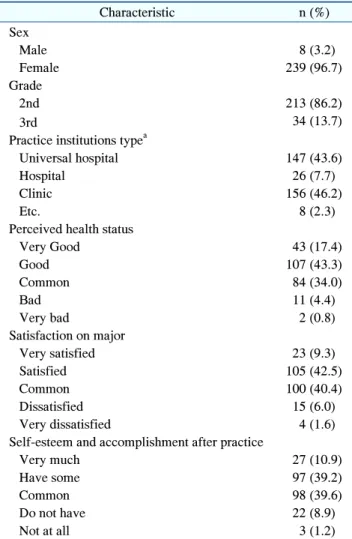
In terms of sex, majority of the participants were female (239 persons, 96.7%), and 213 persons (86.2%) reported having experienced clinical practice in their 2nd year. In total, 147 persons (43.6%) and 156 persons (46.2%) had practiced at a university hospital or private clinic, respectively. There were 107 persons (43.3%) who reported
“good” subjective health and 105 persons (42.5%) who
responded “satisfied” to the question about satisfaction in
their major. The most common response to the question
about whether the student had felt a sense of pride or
achievement after clinical practice was “common” (98
Table 2. Factors Related to Clinical Practice, Self-Concept, Empathy
Variable Maximum Minimum Mean±standard deviation
Clinical competence ability 60 22 42.69±5.90
Professional self-concept 50 10 31.68±4.41
Empathy 64 36 50.87±4.93
Satisfaction with clinical practice 75 15 49.90±7.44
Clinical practice stress 75 26 50.62±7.37
persons, 39.6%) (Table 1).
2. Clinical practice-related factors and extent of empathy and professional self-concept The mean clinical competence score for the dental hygiene students was 42.69±5.90 (range, 22∼60).
Satisfaction in clinical practice showed an even distrib- ution in the range of 15∼75, with a mean of 49.90±7.44.
The mean stress from clinical practice was 50.62±7.37 (range, 26∼75). The mean professional self-concept score was 31.68±4.41 (range, 10∼50). The mean empathy was relatively high at 50.87±4.93 (range, 36∼64) (Table 2).
3. Clinical practice-related factors and differences in empathy and professional self-concept
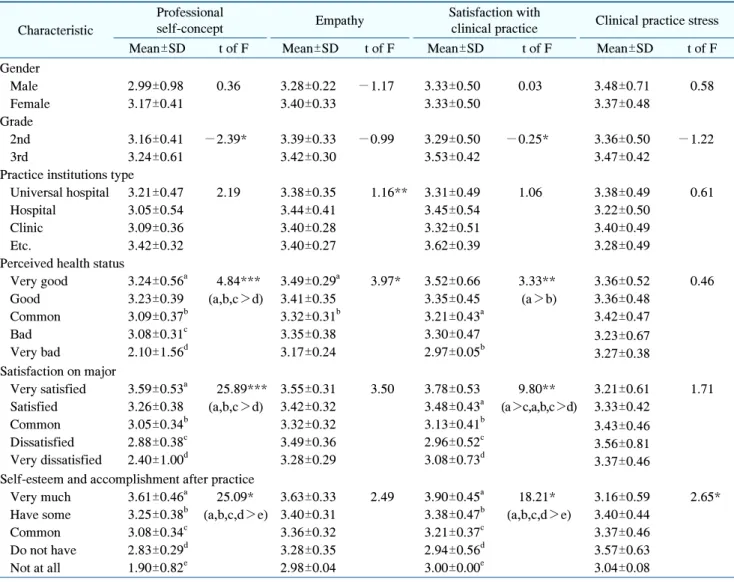
Professional self-concept showed significant differences according to school year (t= −2.39, p<0.05), subjective health status (F=4.84, p<0.001), satisfaction in major (F=25.89, p<0.001), and sense of pride or achievement after clinical practice (F=25.09, p<0.05). Empathy showed significant differences according to type of healthcare facility for clinical practice (F=1.16, p<0.01) and subjective health status (F=3.97, p<0.05). Clinical practice satisfaction showed significant differences according to school year (t=−0.25, p<0.05), subjective health status (F=3.33, p<0.01), satisfaction in major (F=9.80, p<0.01), and sense of pride or achievement after clinical practice (F=18.21, p<0.05); clinical practice stress showed significant differences according to sense of pride or achievement after clinical practice (F=2.65, p<0.05) (Table 3).
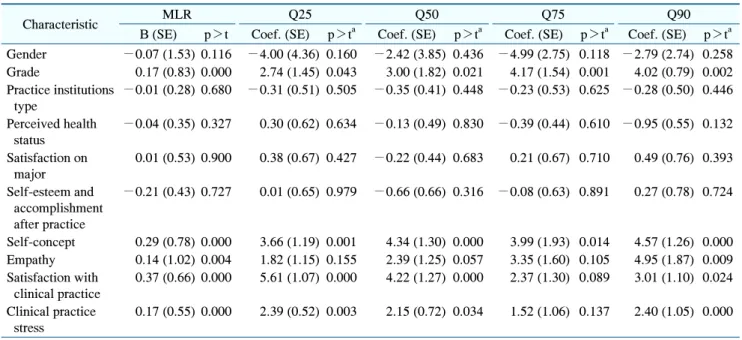
4. Factors affecting clinical competence The QR analysis of factors affecting clinical competence
had an explanatory power of 38%. School year and professional self-concept showed effects at Q25, Q50, Q75, and Q90; empathy showed an effect at Q90; and satisfaction in clinical practice showed effects at Q25, Q50, and Q90. Clinical practice stress showed effects at Q25, Q50, and Q90, but not Q75. School year and professional self-concept showed significant positive effects irrespective of clinical competence quantile. In the upper 10% (90Q) of clinical competence, empathy also showed a significant positive effect. In the MLR analysis, school year (=0.17, p<0.001), professional self-concept (=0.29, p<0.001), empathy (=0.14, p<0.01), satisfaction in clinical practice (=0.37, p<0.001), and clinical practice stress (=0.17, p<0.001) showed significant effects (F=28.04, p<0.001) (Table 4).
Discussion
The present study aimed to perform QR analysis of factors affecting clinical competence in 3rd- and 4th-year dental hygiene students and provide data supporting customized strategies to improve clinical competence.
When we examined differences in clinical competence-
related factors according to general characteristics, clinical
competence was 2.80±0.37 for 2nd-year students and
3.13±0.43 for 3rd-year students. These scores are lower
than those reported by Jang
16)(3.13±0.47 for 2nd-year
students and 3.34±0.90 for 3rd-year students). This
discrepancy is thought to be due to the questionnaire and
convenience sampling. Nevertheless, with increasing
school year, as students took more courses and were
exposed to various practical environments, it is thought
that critical thinking improved and students had more
opportunities to apply their dental hygiene skills, leading
to the observed results.
Table 3. Differences in Professional Self-Concept, Empathy, Clinical Practice Stress, and Clinical Practice Satisfaction according to General Characteristics
Characteristic
Professional
self-concept Empathy Satisfaction with
clinical practice Clinical practice stress
Mean±SD t of F Mean±SD t of F Mean±SD t of F Mean±SD t of F
Gender
Male 2.99±0.98 0.36 3.28±0.22 −1.17 3.33±0.50 0.03 3.48±0.71 0.58
Female 3.17±0.41 3.40±0.33 3.33±0.50 3.37±0.48
Grade
2nd 3.16±0.41 −2.39* 3.39±0.33 −0.99 3.29±0.50 −0.25* 3.36±0.50 −1.22
3rd 3.24±0.61 3.42±0.30 3.53±0.42 3.47±0.42
Practice institutions type
Universal hospital 3.21±0.47 2.19 3.38±0.35 1.16** 3.31±0.49 1.06 3.38±0.49 0.61
Hospital 3.05±0.54 3.44±0.41 3.45±0.54 3.22±0.50
Clinic 3.09±0.36 3.40±0.28 3.32±0.51 3.40±0.49
Etc. 3.42±0.32 3.40±0.27 3.62±0.39 3.28±0.49
Perceived health status
Very good 3.24±0.56
a4.84*** 3.49±0.29
a3.97* 3.52±0.66 3.33** 3.36±0.52 0.46
Good 3.23±0.39 (a,b,c>d) 3.41±0.35 3.35±0.45 (a>b) 3.36±0.48
Common 3.09±0.37
b3.32±0.31
b3.21±0.43
a3.42±0.47
Bad 3.08±0.31
c3.35±0.38 3.30±0.47 3.23±0.67
Very bad 2.10±1.56
d3.17±0.24 2.97±0.05
b3.27±0.38
Satisfaction on major
Very satisfied 3.59±0.53
a25.89*** 3.55±0.31 3.50 3.78±0.53 9.80** 3.21±0.61 1.71 Satisfied 3.26±0.38 (a,b,c>d) 3.42±0.32 3.48±0.43
a(a>c,a,b,c>d) 3.33±0.42
Common 3.05±0.34
b3.32±0.32 3.13±0.41
b3.43±0.46
Dissatisfied 2.88±0.38
c3.49±0.36 2.96±0.52
c3.56±0.81
Very dissatisfied 2.40±1.00
d3.28±0.29 3.08±0.73
d3.37±0.46
Self-esteem and accomplishment after practice
Very much 3.61±0.46
a25.09* 3.63±0.33 2.49 3.90±0.45
a18.21* 3.16±0.59 2.65*
Have some 3.25±0.38
b(a,b,c,d>e) 3.40±0.31 3.38±0.47
b(a,b,c,d>e) 3.40±0.44
Common 3.08±0.34
c3.36±0.32 3.21±0.37
c3.37±0.46
Do not have 2.83±0.29
d3.28±0.35 2.94±0.56
d3.57±0.63
Not at all 1.90±0.82
e2.98±0.04 3.00±0.00
e3.04±0.08
SD: standard deviation.
*p<0.05, **p<0.01, ***p<0.001.
a-e
The same superscript letter indicates no significant difference (p>0.05 by Scheffe post-hoc test).
A greater sense of pride or achievement in becoming a dental hygienist after clinical practice was associated with better clinical competence, higher clinical practice satisfaction, and higher professional self-concept (p<
0.05). This is related to occupational values in a broader sense. Since the formation of occupational values in students can affect not only occupational satisfaction but also the quality of medical services provided to patients
5), it will be necessary to make efforts to improve curricula and programs that promote positive occupational values.
When we used QR analysis to evaluate the effects
according to the clinical competence quartile of dental
hygiene students. Clinical practice stress, clinical practice
satisfaction, empathy, and professional self-concept varied
according to the clinical competence level, and the
explanatory power was 38%. School year had a positive
effect on clinical competence, and this is thought to be
because students accumulated more practical experience
with the increasing school year, resulting in more
opportunities to practice coping skills and independent
thinking. Professional self-concept had a positive effect on
clinical competence, which is agreement with the results
Table 4. Factors Influencing Clinical Competence Ability
Characteristic MLR Q25 Q50 Q75 Q90
B (SE) p>t Coef. (SE) p>t
aCoef. (SE) p>t
aCoef. (SE) p>t
aCoef. (SE) p>t
aGender −0.07 (1.53) 0.116 −4.00 (4.36) 0.160 −2.42 (3.85) 0.436 −4.99 (2.75) 0.118 −2.79 (2.74) 0.258 Grade 0.17 (0.83) 0.000 2.74 (1.45) 0.043 3.00 (1.82) 0.021 4.17 (1.54) 0.001 4.02 (0.79) 0.002 Practice institutions
type
−0.01 (0.28) 0.680 −0.31 (0.51) 0.505 −0.35 (0.41) 0.448 −0.23 (0.53) 0.625 −0.28 (0.50) 0.446
Perceived health status
−0.04 (0.35) 0.327 0.30 (0.62) 0.634 −0.13 (0.49) 0.830 −0.39 (0.44) 0.610 −0.95 (0.55) 0.132
Satisfaction on major
0.01 (0.53) 0.900 0.38 (0.67) 0.427 −0.22 (0.44) 0.683 0.21 (0.67) 0.710 0.49 (0.76) 0.393
Self-esteem and accomplishment after practice
−0.21 (0.43) 0.727 0.01 (0.65) 0.979 −0.66 (0.66) 0.316 −0.08 (0.63) 0.891 0.27 (0.78) 0.724
Self-concept 0.29 (0.78) 0.000 3.66 (1.19) 0.001 4.34 (1.30) 0.000 3.99 (1.93) 0.014 4.57 (1.26) 0.000 Empathy 0.14 (1.02) 0.004 1.82 (1.15) 0.155 2.39 (1.25) 0.057 3.35 (1.60) 0.105 4.95 (1.87) 0.009 Satisfaction with
clinical practice
0.37 (0.66) 0.000 5.61 (1.07) 0.000 4.22 (1.27) 0.000 2.37 (1.30) 0.089 3.01 (1.10) 0.024
Clinical practice stress
0.17 (0.55) 0.000 2.39 (0.52) 0.003 2.15 (0.72) 0.034 1.52 (1.06) 0.137 2.40 (1.05) 0.000
MLR: multiple linear regression, Coef.: coefficient, SE: standard error.
a