I. Introduction
Modern daily life offers many conveniences due to the in- credible speed of information and communication technol- ogy (ICT) and the Internet of Things (IoT), especially the ease of communication and access of information through the Internet and social network service (SNS). However, per- sonal information can be leaked to the Internet and SNSs.
To protect personal information, the Treaty of Personal Information Protection of the European Council (Treaty of the European Parliament for the Protection of Individuals Related to the Automatic Processing of Personal Informa-
Trends in Research on the Security of Medical Information in Korea: Focused on Information Privacy Security in Hospitals
Yong-Woon Kim, BA, MBA1, Namin Cho, BS2, Hye-Jung Jang, PhD3
1Department of Management and Support, Yonsei University Dental Hospital, Seoul, Korea; 2Department of Medical Information and Communication Infor- mation Security, Yonsei University Health System, Seoul, Korea; 3Department of Clinical Trials for Medical Devices, Yonsei University Health System, Sever- ance Hospital, Seoul, Korea
Objectives: Information technology involves a risk of privacy violation in providing easy access to confidential information, such as personal information and medical information through the Internet. In this study, we investigated medical infor- mation security to gain a better understanding of trends in research related to medical information security. Methods: We researched papers published on ‘의료정보’ and ‘medical information’ in various Korean journals during a 10-year period from 2005 to 2015. We also analyzed these journal papers for each fiscal year; these papers were categorized into the areas of literature research and empirical research, and were further subdivided according to themes and subjects. Results: It was confirmed that 48 papers were submitted to 35 academic journals. There were 33 (68.8%) literature review articles, and analysis of secondary data was not carried out at all. In terms of empirical research, 8 (16.7%) surveys and 7 (14.6%) pro- gram developments were studied. As a result of analyzing these papers according to the research theme by research method, 17 (35.4%) papers on laws, systems, and policies were the most numerous. It was found that among the literature research papers on medical personnel were the most common, and among the empirical research papers, research on experts in infor- mation protection and medical personnel were the most common. Conclusions: We suggest that further research should be done in terms of social perception, human resource development, and technology development to improve risk management in medical information systems.
Keywords: Electronic Health Records, Hospital Information Systems, Medical Informatics, Computer Security
Healthc Inform Res. 2018 January;24(1):61-68.
https://doi.org/10.4258/hir.2018.24.1.61 pISSN 2093-3681 • eISSN 2093-369X
Submitted: August 31, 2017 Revised: November 7, 2017 Accepted: December 22, 2017 Corresponding Author Hye-Jung Jang, PhD
Department of Clinical Trials for Medical Devices, Yonsei University Health System, Severance Hospital, 50 Yonsei-ro, Seodaemun-gu, Seoul 03722, Korea. Tel: +82-2-2228-5150, E-mail: [email protected]
This is an Open Access article distributed under the terms of the Creative Com- mons Attribution Non-Commercial License (http://creativecommons.org/licenses/by- nc/4.0/) which permits unrestricted non-commercial use, distribution, and reproduc- tion in any medium, provided the original work is properly cited.
ⓒ 2018 The Korean Society of Medical Informatics
tion) was established in 1980 [1]. In the same year, the Or- ganization for Economic Co-operation and Development (OECD) provided the Guideline on Privacy Protection and Cross-Country Distribution of Personal Information [2].
A guide for the handling of personal information files was codified by the United Nations and was published in 1990 [3]. Rules for the handling, processing, and transmission of personal information in the European Union (EU) were then published in 1995 as the International Standard for the Protection of Individuals [4]. Medical information, the most important and sensitive personal information, should be particularly protected [5].
Although medical information should be protected in the Internet space, personal records created by medical institutions and medical treatment prescription computer networks can be infiltrated, resulting in spamming by com- mercial advertisements and product promotions. Thus, personal information is frequently misused. This problem must be addressed by laws and improvement of security of institutional equipment and systems used to handle personal information [6]. Nowadays, anyone can search for any in- formation. Advances in technology provide us with ways to easily exchange personal information; however, this leads to the danger of infringement [7]. Medical information, as important and sensitive personal information, should be protected. Regarding information related to the provision of healthcare by national and local public health institutions, the information is generally gathered by doctors who direct- ly provide medical care and services to patients. This means that materials are collected throughout the entire process, including diagnosis and the subsequent course of treatment, including information analyzed based on these materials [8].
Currently, medical information in the clinical environment of a hospital is conveniently managed by utilizing Electronic Health Record (EHR) systems without the need for paper records. However, criminal activities are actively being car- ried out to acquire personal information to perform illegal financial or monetary transactions. It is impossible to suf- ficiently protect personal medical information if there is no standard for medical information protection. We should not only take countermeasures against damages cause by medi- cal information leakage; we must also take measures to pre- vent information leakage [9]. Medical information systems are intended store and share information among healthcare providers and to improve work efficiency of various hospital departments, prevent medical accidents, reduce the waiting time of patients, and prevent over-prescription or lack of prescription without requiring paper or film storage. It has
been demonstrated that such systems can reduce costs [10].
As a ubiquitous technology to enable the use of services any- where any time, u-health (ubiquitous health) allows patients to receive medical services at places other than hospitals by sharing treatment paradigms among medical service provid- ers and hospitals that respond to the illness; thus, healthcare services will be given in a more timely manner in the future.
However, we must always consider the security of shared systems that collect, store, and transfer medical information.
Medical information includes extremely personal health information as well as information about a patient’s lifestyle habits and physical features. The importance of storing such sensitive information has been emphasized to prevent per- sonal information security problems, such as information leakage, hacking, tampering, and so on [11]. There have been no studies on trends in the security of medical informa- tion in Korea. This study was conducted to investigate trends in medical information security for personal information protection in Korea during the period 2005 to 2015 and to determine whether personal information is being protected properly.
II. Methods
1. Research Contents
In this study, we found that research on medical informa- tion was mainly focused on risk management of medical information systems at hospital-centered medical institu- tions rather than general agencies. We analyzed the contents of papers published in this area by theme, year, and research method. Our main objective was to produce results that would be useful for future research. Therefore, our research had the following aims: (1) to analyze medical information security-related papers based on theme and year and (2) to compare medical information security-related papers and analyze the research methods used.
2. Scope of Research Papers
The purpose of this research was to analyze the trends in research on the theme of medical information. Therefore, papers on medical information published in various domes- tic Korean journals from 2005 to 2015 were searched. On July 16, 2016, using academic research information service (RISS), a search site for published papers, 274 papers were obtained using the keywords of ‘의료정보’ (medical infor- mation in Korean) and ‘medical information’. Their informa- tion was extracted. On July 21, 2016, three experts reviewed these papers, and 74 papers were selected after this review.
The list of studies was chosen by sorting out the last 48 of 60 articles (Figure 1).
3. Medical Information Papers and Analysis Criteria by Year In this study, we analyzed research papers related to medical information published from 2005 to 2015 to reveal the trends in current research approaches to guide the direction of fu- ture research. Based on 274 studies published, the research trends were classified. The results are shown in Table 1.
Considering recent research references after analyzing the research trends of papers on medical information, the pa- pers were divided into categories of literature research and
empirical research. We prepared an analysis framework to facilitate our analysis.
More specifically, the field of medical information research cannot advance by only focusing on the sensitivity of the medical information of patients. Therefore, the papers were further classified into more specific research areas of com- puter systems, electronic medical records, and personal in- formation protection.
III. Results
To observe the trends in research investigating medical in-
Research Information Sharing Service (RISS)
Search based on the keyword of and medical information Total (n = 274)
The results obtained after excluding research papers focused only on medical information
(n =72)
After the review of abstracts, the results obtained after excluding research papers that did not fit the reference frame.
(n =60)
The results of the study for the reference frame derived after the final review
(n =48)
Excluding research that focuses only on medical information by referring to the title
and subject area of the researcher (n =202)
Review the abstracts to distinguish the contents to be included in each research field and exclude
studies that do not fit the reference frame (n =12)
Examine the information protection relevance of the main words and title and exclude studies
not conforming to the reference frame (n = 12)
Figure 1. QUOROM flowchart for literature review about risk management of medical information system in Korea.
Table 1. Article classification process
Classification process Method Standard Number of papers
Search for articles Academic research information service (RISS)
Search keywords about medical information and medical information
274 1st classification For the entire paper, the
researchers are classified into individual classifications
Considering the title preferentially, do not refer to researchers’ specialty fields
72
2nd classification Three researchers joint confirmation
Based on the primary classification data, classify the contents included in each research field (abstract review)
60
3rd classification Three researchers joint confir- mation
Analysis after finally checking what is relevant to the relevant box (related to information protec- tion of major word and title)
48
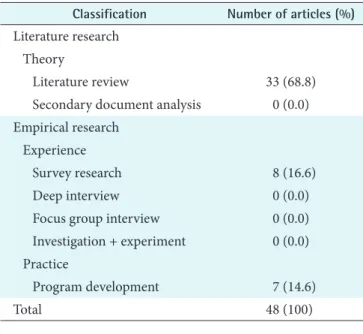
formation security, we categorized the papers by methodolo- gy into literature research and empirical research categories.
The results are as shown in Table 2.
Literature research was found to have the highest number of published papers. There were 33 (68.8%) literature review papers published during the study period. The methodologi- cal approach adopted in empirical studies was to recruit groups and developed research and programs concurrently.
Compared to the empirical study method, 8 (16.6%) survey research papers of 48 total papers were published, while 7 (14.6%) papers on methods of research in the practical field were published.
Detailed results are shown in Figure 2. Thirty-three (68.8%) theoretical papers were published among the total papers on
research methods. There were many literature review papers published that focused on analyzing methods. Literature reviews were carried out periodically. Analysis of secondary data was not performed at all. The field of empirical research was divided into survey research, in-depth interviews, focus group interviews, and investigations and experiments in parallel. Survey research was dominant every year. However, there were not in-depth interviews conducted during 2005–
2015 each time period. There were no reports of focus group interviews or investigation and experiments in parallel either since 2005. There were 7 (14.6%) practice research papers among total research methods.
Results of our analysis on research on the management of medical information systems according to research methods and topics are shown in Figure 3. There were 17 (35.4%) pa- pers published on laws, systems, and policies. There were no papers published on the topics of recognition of and satisfac- tion with medical information security. On the topics of ac- tual situations, review discussions, trends, and factors, there were 5 (10.4%), 9 (18.8%), and 3 (6.3%) papers published, respectively. There were no papers on the topics of the effect and influence of medical information security. For measure topic, there were 2 (4.2%) papers published. On the topics of applications (program), utilization, and model development, 9 (18.8%), 2 (4.2%), and 1 (2.1%) paper(s) were published, respectively.
According to the method of research, there were 33 (68.8%) papers on literature studies and 15 (31.3%) papers published on laws, systems, and policies. There was no paper published on recognition and satisfaction. Actual situation topic had Table 2. Number of published articles by research method
Classification Number of articles (%) Literature research
Theory
Literature review 33 (68.8)
Secondary document analysis 0 (0.0) Empirical research
Experience
Survey research 8 (16.6)
Deep interview 0 (0.0)
Focus group interview 0 (0.0) Investigation + experiment 0 (0.0) Practice
Program development 7 (14.6)
Total 48 (100)
Recognition, satisfactio
n
Actual situatio
n
Review , discussion,
trend Factor Effect
, influenceMeasures
Applicatio
n(program)Utilizatio n 16
14 12 10 8 6 4 2 0
Law , system,
polic y
Literature research Empirical research
Model
development
Figure 3. Number of papers by research theme and research method.
Figure 2. Number of articles published by period.
2005 2006 2007 2008 2009 2010 201 1
2012 2013 2014 2015 7
6 5 4 3 2 1 0
Literature research (theory) literature review Empirical research (experience) survey research Empirical research (practice) program development
1 (2.1%) paper. Review discussion and trend topic had 9 (18.8%) papers while factor topic had 2 (4.2%) papers. How- ever, there was no paper published on effect and influence.
Topics of measures, applications (program), and utilization each had 2 (4.2%) papers published. However, there was no paper published on model development. The total number of empirical research paper was 15 (31.3%). Two papers (4.2%) were published on the topics of laws, systems, and policies.
No papers were published on recognition and satisfaction.
Four papers (8.3%) were published on the topic of actual situations. One paper (2.1%) was published on the topic of factors. No papers were published on review discussion, and trend, effect, influence, or measure topics. Application (pro- gram) topic had 7 (14.6%) papers while model development topic had 1 (2.1%) paper. However, utilization topic had no paper.
The results of our analysis of research on the manage- ment of medical information systems according to research methods and subjects are shown in Table 3. A total of 16 (8.7%) papers were studies on patients, while 101 (55.2%) papers were studies on medical-related workers. There were 46 (25.1%) papers on information-related experts, 1 (0.6%) paper on small and medium business centers (public institu- tions), 4 (2.2%) papers on healthcare agencies (hospital), 12 (6.6%) papers on government agencies, 2 (1.1%) papers on integrated medical information systems, and 1 (0.6%) paper on multidisciplinary approaches.
The results are as shown in Table 3. In more details, regard- ing medical-related workers, there were 18 (9.8%) papers on doctors, 17 (9.2%) papers on nurses, 2 (1.0%) papers on physical therapists, 15 (8.2%) papers on radiological tech- nologists, 1 (0.6%) paper on students in the department of dental hygiene, 15 (8.2%) papers on pharmacists, 15 (8.2%) papers on clinical pathologists, 16 (8.7%) papers on medi- cal record system managers, 1 (0.6%) paper on hospital ad- ministrative managers, and 1 (0.6%) paper on occupational therapists. Regarding information-related experts, there were 16 (8.7%) papers on security officers, 1 (0.6%) paper on expert computer officers, 17 (9.3%) papers on information handlers, 4 (2.2%) papers on information protection experts, and 8 (4.3%) papers on medical information experts. There was 1 (0.6%) paper on healthcare managers for small and medium business centers (public institutions). Regarding healthcare agencies (hospitals), there were 2 (1.0%) papers on hospital staff members; 1 (0.6%) paper on telemedicine users; and 1 (0.6%) paper on individuals, organizations, businesses, and organizations that handle health informa- tion. Regarding government agencies, there were 6 (3.3%)
papers on law, 1 (0.6%) paper on policy (Ministry of Health and Welfare), 1 (0.6%) paper on various international norms on the protection and utilization of personal information (OECD, EU), 1 (0.6%) paper on personal health information, 3 (1.6%) papers on privacy information security and medical privacy information security. There were 2 (1.0%) papers on integrated medical information system and 1 (0.6%) paper on multidisciplinary approach.
Based on research methodology, 165 (90.2%) studies were conducted as literature research, including 17 (9.3%) papers on doctors; 16 (8.7%) papers on nurses, persons in charge of medical record, security officers, and information handlers;
15 (8.2%) papers on radiological technologists, pharmacist, and clinical pathologist; 8 (4.3%) papers on medical infor- mation experts; 6 (3.3%) papers on laws; 2 (1.1%) papers on privacy information security and medical privacy informa- tion security; and 1 (0.6%) paper each for hospital adminis- trative managers; occupational therapists; expert computer officers; individuals, organizations, businesses, and orga- nizations that handle health information; policy (Ministry of Health and Welfare); various international norms on the protection and utilization of personal information (OECD, EU); and personal health information. There were no papers on physical therapists, students in the department of dental hygiene, information protection experts, healthcare manag- ers, telemedicine users, hospital staff members, integrated medical information systems, or multidisciplinary approach- es.
A total of 18 (9.8%) empirical studies were reported, in- cluding 4 (2.2%) papers on information protection experts;
2 (1.0%) papers each on physical therapists, hospital staff members, and integrated medical information systems; 1 (0.6%) paper each on doctors, nurses, students in the depart- ment of dental hygiene, information handlers, healthcare managers, telemedicine users, privacy information security and medical privacy information security, and multidisci- plinary approaches. There were no papers on patients; ra- diological technologists; pharmacists; clinical pathologists;
person in charge of medical records; hospital administrative managers; occupational therapists; expert computer officers;
security officers; medical information experts; individuals, organizations, businesses, and organizations that handle health information policy (Ministry of Health and Welfare);
various international norms on the protection and utiliza- tion of personal information (OECD, EU); personal health information; or law.
IV. Discussion
There were 48 articles on medical information published in journals from 2005 to 2015 in Korea. Looking at them year by year, one paper was published in 2005, whereas 10 papers
had been published by 2009. However, 38 were published by various academic societies from 2010 to 2015. In terms of research methodology, 33 (68.8%) papers were based on literature review research, while 15 (31.2%) papers reported empirical research. Literature reviews were consistently car- Table 3. Lists the research subjects and research papers by research method
Literature research
Empirical
research Total
Patient 16 - 16 (8.7)
Medical-related person
Doctor 17 1 18 (9.8)
Nurse 16 1 17 (9.2)
Physical therapist - 2 2 (1.0)
Radiological technologist 15 - 15 (8.2)
Student in the department of dental hygiene - 1 1 (0.6)
Pharmacist 15 - 15 (8.2)
Clinical pathologist 15 - 15 (8.2)
A person of medical record 16 - 16 (8.7)
Hospital administrative manager 1 - 1 (0.6)
Occupational therapist 1 - 1 (0.6)
Information-relates expert
Expert computer officer 1 - 1 (0.6)
Security officer 16 - 16 (8.7)
Information handler 16 1 17 (9.3)
Information protection expert - 4 4 (2.2)
Medical information experts 8 - 8 (4.3)
Small & medium business center (public institutions)
Health care manager - 1 1 (0.6)
Healthcare agency (hospital)
Telemedicine user - 1 1 (0.6)
Hospital staff - 2 2 (1.0)
Individuals, organizations, businesses, organizations that handle health information
1 - 1 (0.6)
Government agency
Policy (Ministry of Health and Welfare) 1 - 1 (0.6)
Various international norms on the protection and utilization of personal information (OECD, EU)
1 - 1 (0.6)
Personal health information 1 - 1 (0.6)
Law 6 - 6 (3.3)
Privacy information security and medical privacy information security 2 1 3 (1.6)
Integrated medical information system - 2 2 (1.0)
Multidisciplinary approach - 1 1 (0.6)
Totala (%) 165 (90.2) 18 (9.8) 183 (100)
aA total of 183 papers. Because, there are more than one objects in 48 papers, and the number of papers increases.
ried out during the period from 2005 to 2015. However, sec- ondary data analysis was not published. Surveys were pub- lished consistently every year; however, in-depth interviews were not conducted during that period. In addition, there has been no report of investigation and experiment in par- allel since 2005. Research on medical information systems has been published during this time period, although these papers were fewer than literature review papers.
The results of the theme analysis of papers based on litera- ture review are discussed below. Laws, systems, and policies were the focus of 15 (31.3%) papers. Review discussion and trend topics were the focus of 9 (18.8%) papers. Factor, mea- sures, applications (programs), and utilization topics were the focus of 2 (4.2%) papers each. One (2.1%) paper was published on an actual situation topic. No papers were pub- lished on recognition of and satisfaction with medical infor- mation security, the effect and influence of medical infor- mation security, or model development topics. In empirical research, application (program) topic had 7 (14.6%) papers.
Actual situation topic had 4 (8.3%) papers. Law, system, and policy topics had 2 (4.2%) papers. Factor and model devel- opment topics had 1 (2.1%) paper each. Recognition and satisfaction, review discussion and trend, effect and influ- ence, measures, or utilization topic had no paper. The lack of prior research focusing on the reliability of medical informa- tion and its associated legal issues and the lack of revision of related clause made it difficult to derive a concrete identity policy proposal. Future study should establish a legal con- cept for the security of medical information. There is a need for more concrete preventive measures and countermeasures against breaches of medical information security through analysis of the reliability of medical information and in- fringement of platforms. Specific policies that can reduce the number of functional impairments can be proposed by searching for pure functions associated with the use of medi- cal information [6]. Medical information should be pro- tected in compliance with strict confidentiality obligations.
It has been proposed that management and supervision with a high level of ethical awareness and the implementation of medical information security system should be the standard practice [9].
For medical information in hospitals where human re- sources are utilized for various job types and operations, it is important to promote medical information protection in hospitals centering on electronic support. Efforts have been made to improve the level of information protection and information security in medical institutions by establishing measures to protect information, such as the establishment
of administrative measures and countermeasures to have physical security and technical safeguards with information protection policies. It should be emphasized that all staff should take the initiative to make efforts to create a culture that protects medical information [12]. In this study, we ana- lyzed research on medical information security by year, re- search method, research theme, and research subject. Based on the above analysis results, we found that a systematic ap- proach to research is needed.
Although the scope of personal information has been con- sidered in various fields, including economic, scientific, and technical fields, and this has provided an important founda- tion for future research, problems such as infringement on the private lives of individuals and society in general have arisen. We need to analyze processes that can handle one or more situations or problems while taking the specialization and specificity of medical information into account [13]. It is necessary to recognize the importance of social awareness of medical information security and its sensitivity. Changes in the perception that health information in the field of medical information technology and policy science should be shared should be prioritized. In recent years, hacking of medical in- formation has been frequently reported. We should actively promote the protection of personal information, curriculum, biographical data, and publications from the viewpoints of research, so we should treat medical information as an im- portant research subject. It is necessary to develop a training program for human resource development. It is also impor- tant to build the capacity to strengthen medical information security. In addition, employees of medical institutions are in an important position to protect such information. They should be aware of the importance of medical information;
therefore, specific education and training within medical institutions should be provided. It is necessary to develop education programs and continuous education so that em- ployees can increase their awareness of health information protection. In addition, it is important to strengthen internal regulations on the protection of patients' medical informa- tion as well as legal regulations [11]. Systematic technology is also needed for medical information security. When a database of medical information and the medical records in a medical information system centered on medical institu- tions is built, medical information is subjected to advanced persistent threat (APT). Therefore, it is important to con- sider the vulnerability of and threats to medical information to comply with the Personal Information Protection Law and the Medical Law, and presented security requirements [12]. Legal regulations and government policies also needed
to be specifically established regarding medical informa- tion security. The HIPAA (Health Insurance Portability and Accountability Act of 1996) governs the use and disclosure of identification information. It provides specific details applicable to medical insurers, medical staff, and medical information exchange offices that transmit medical personal information in electronic form. The HIPAA also applies to electronically managed and transmitted patient identities, including patient's electronic identification, the information on documents printed from electronic media, and computer systems [8]. It is necessary to standardize inspection items so that they can be applied immediately. Quality management for safe medical information systems is also needed in the field [13]. There should be realistic study of infringement or outflow of medical information or activities related to medi- cal information in the private sector. Through this research, we gained a clearer understanding of the current status of medical information security research in Korea. In addi- tion, this study can be used to help governments, hospitals, and individuals to find ways to protect medical information.
There have been many studies on methods, systems, and policies for medical information security. In the future, it will be necessary to try various research methods and con- duct practical research son education and inspection related to medical information security.
Conflict of Interest
No potential conflict of interest relevant to this article was reported.
References
1. Council of Europe. Explanatory report to the Conven- tion for the Protection of Individuals with regard to Automatic Processing of Personal Data (ETS No. 108) [Internet]. Strasbourg, France: Council of Europe; c2017 [cited at 2018 Jan 10]. Available from: https://rm.coe.
int/16800ca434.
2. OECD. Guidelines on the protection of privacy and
transborder flows of personal data [Internet]. Paris, France: OECD; c2018 [cited at 2018 Jan 10]. Available from: http://www.oecd.org/internet/ieconomy/oecd- guidelinesontheprotectionofprivacyandtransborder- flowsofpersonaldata.htm.
3. United Nations. Guidelines for the regulation of com- puterized personal data files [Internet]. New York (NY):
United Nations; 1990 [cited at 2018 Jan 10]. Available from: http://www.un.org/documents/ga/res/45/a45r095.
htm.
4. Jeun YJ. The medical information protection and major Issues. J Korea Soc Comput Inf 2012;17(12):251-8.
5. Kim YR. Exploring the social and legal issues of inter- net medical information: focusing on the credibility of internet medical information use and invasion of cyber privacy. J Commun Sci 2010;10(2):179-220.
6. Jeun YJ. The medical information and privacy protec- tion. Korean Law Rev 2006;23:521-40.
7. Lee SM. The medical treatment informatization and medical treatment information protection. Hanyang Law J 2006;25(1):39-56.
8. Lee HY. The storage of electronic medical record and trusted third party. Hanyang Law Rev 2013;44:123-49.
9. Kim DS, Kim MS. Issues of health information protec- tion and policy direction according to the progress of e- health age. Informatiz Policy 2006;13(4):128-48.
10. Lee HJ. Problems and solutions of personal information protection in the medical area. Korean J Leg Med 2012;
20(2):267-93.
11. Jung EY, Jung SJ. A study on perception and practice of protecting the patient medical information in some gen- eral hospital employees. Korean J Health Serv Manag 2014;8(4):35-45.
12. Hong CM, Shin W. Security requirements of order com- munication system in hospitals for compliance with Personal Information Protection Act. J Secur Eng 2013;
10(5):513-26.
13. Jeong HJ, Kim NH. How do they manage personal in- formation in hospital? A survey study for IT governance in hospitals. Crisisonomy 2013;9(8):47-66.